

We use cookies to ensure our website works properly and to personalise your experience. Cookies policy
Pharmaceuticals Chemistry, Gurunathappa Bavage knowledge city at post Hasegaon,TQ Ausa,Dist Latur, Maharashtra 413531.
Prednisolone acetate, a widely prescribed corticosteroid, is essential in managing inflammatory, autoimmune, and allergic disorders. Reliable analytical methods are required to ensure its quality and therapeutic consistency in pharmaceutical formulations. In this study, a simple, rapid, and robust reversed phase high performance liquid chromatography (RP HPLC) method was developed and validated according to ICH guidelines. Chromatographic separation was achieved using a C18 column with a mobile phase of methanol and water (75:25, v/v) at a flow rate of 1.5 mL/min. Detection was performed at 246 nm with a column temperature of 40°C, yielding a retention time of 2.18 minutes. The method demonstrated excellent linearity across 0.5–90 ?g/mL (r² = 0.999), high precision (RSD <1%), accuracy (recovery 99.19–100.17%), and sensitivity (LOD 1.23 ?g/mL, LOQ 3.74 ?g/mL). These results confirm the suitability of the method for routine quality control and reliable quantification of prednisolone acetate in pharmaceutical dosage forms
1.1 Background and Significance
Prednisolone acetate is a synthetic glucocorticoid that has remained a cornerstone in the management of inflammatory, autoimmune, and allergic disorders for decades1,2. Its therapeutic relevance spans conditions such as asthma,
rheumatoid arthritis, ulcerative colitis, ocular inflammation, and multiple sclerosis3.
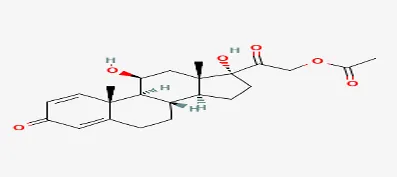
The drug exerts its pharmacological effects primarily through binding to glucocorticoid receptors, thereby modulating gene transcription, suppressing pro‑inflammatory cytokines, and enhancing anti‑inflammatory mediators4,5. This dual anti‑inflammatory and immunosuppressive activity makes prednisolone acetate indispensable in both acute and chronic therapy6-8.
Table 1. Different Types of Chromatographic Techniques¹⁻³
|
Sr. No |
Principle |
Technique |
Reference |
|
1 |
Chromatographic bed shape |
Column chromatography, Paper chromatography, Thin layer chromatography |
1,2 |
|
2 |
Physical state of mobile phase |
Gas chromatography, Liquid chromatography |
3 |
|
3 |
Affinity principle |
Supercritical chromatography |
4,5 |
|
4 |
Separation mechanism |
Ion exchange chromatography, Size exclusion chromatography |
6,7 |
|
5 |
Special techniques |
Reversed phase, Simulated chromatography, Pyrolysis GC, Fast protein chromatography, Countercurrent chromatography |
8,9 |
Given its widespread use, the accurate estimation of prednisolone acetate in pharmaceutical dosage forms is critical. Analytical quantification ensures therapeutic consistency, patient safety, and compliance with regulatory standards9. The complexity of corticosteroid formulations, which may include tablets, injections, eye drops, and topical creams, necessitates robust analytical methods capable of handling diverse matrices10,11.
1.2 Analytical Challenges in Corticosteroid Estimation
Traditional methods such as spectrophotometry and thin‑layer chromatography (TLC) have been employed for corticosteroid analysis, but they often lack sensitivity, reproducibility, and specificity12-14. High‑performance liquid chromatography (HPLC), particularly reversed‑phase HPLC (RP‑HPLC), has emerged as the gold standard due to its superior resolution, reproducibility, and ability to separate hydrophobic compounds under aqueous mobile phases15.
Despite this, several challenges persist:
Table 2. Characteristics to be Validated in HPLC
|
Characteristic |
Description |
Regulatory Expectation |
Reference |
|
Linearity |
Relationship between concentration and response |
r² ≥ 0.999 |
15,16 |
|
Accuracy |
Recovery studies |
98–102% |
17 |
|
Precision |
Repeatability and reproducibility |
RSD ≤ 2% |
18 |
|
LOD/LOQ |
Sensitivity limits |
Method‑specific |
18,19 |
|
Robustness |
Stability under small variations |
No significant deviation |
20 |
1.3 RP‑HPLC in Pharmaceutical Analysis
RP‑HPLC is particularly advantageous for steroidal drugs because it employs a polar mobile phase (typically water mixed with methanol or acetonitrile) and a non‑polar stationary phase (C18 columns), allowing efficient separation of hydrophobic molecules21,22. The technique is widely adopted in pharmaceutical quality control because it provides:
Recent studies have demonstrated RP‑HPLC’s superiority over HPTLC and spectrophotometric methods in terms of reproducibility and regulatory acceptance25,26.
1.4 Need for Method Development and Validation
Method development involves optimizing chromatographic conditions—such as mobile phase composition, flow rate, detection wavelength, and column temperature—to achieve efficient separation and reproducibility27,28. Validation ensures that the developed method meets regulatory standards for accuracy, precision, linearity, robustness, and sensitivity29.
For prednisolone acetate, a validated RP‑HPLC method is essential for:
1.5 Objectives of the Study
The present work aims to:
2.1 Chemicals and Reagents
Prednisolone acetate reference standard was obtained from a certified pharmaceutical supplier. Methanol (HPLC grade), acetonitrile, and ultrapure water (Milli‑Q system) were used as solvents. All reagents were of analytical grade and filtered through 0.45 μm membrane filters before use34,35. The choice of methanol:water (75:25, v/v) as mobile phase was based on previous corticosteroid studies demonstrating optimal peak symmetry and reproducibility36-38.
2.2 Instruments
Chromatographic analysis was performed using a Shimadzu LC‑20AT HPLC system equipped with a quaternary pump, autosampler, column oven, and UV detector. Data acquisition was managed using LabSolutions software39,40.
Table 3. Instruments Used for RP‑HPLC Analysis
|
Instrument |
Model/Specification |
Reference |
|
HPLC system |
Shimadzu LC‑20AT with UV detector |
32 |
|
Column |
C18 (250 × 4.6 mm, 5 μm) |
34 |
|
Sonicator |
Ultrasonic bath, 40 kHz |
36,37 |
|
Analytical balance |
Sartorius, sensitivity ±0.1 mg |
38 |
2.3 Chromatographic Conditions
The optimized chromatographic conditions were: mobile phase methanol:water (75:25, v/v), flow rate 1.5 mL/min, detection wavelength 246 nm, column temperature 40°C, injection volume 20 μL, and run time 5 minutes41-44. These conditions ensured sharp peaks, minimal tailing, and reproducible retention times consistent with prior corticosteroid validation studies45-47.
Table 4. Optimized Chromatographic Conditions
|
Parameter |
Condition |
Reference |
|
Mobile phase |
Methanol:Water (75:25, v/v) |
41 |
|
Flow rate |
1.5 mL/min |
42 |
|
Detection wavelength |
246 nm |
43 |
|
Column temperature |
40°C |
44 |
|
Injection volume |
20 μL |
45 |
|
Run time |
5 min |
46,47 |
2.4 Preparation of Standard and Sample Solutions
A stock solution of prednisolone acetate (100 μg/mL) was prepared in methanol. Working solutions were obtained by serial dilution to cover the linearity range (0.5–90 μg/mL). Pharmaceutical dosage forms (tablets, eye drops, suspensions) were accurately weighed, dissolved in methanol, sonicated, filtered, and appropriately diluted48.
2.5 Validation Parameters
The developed method was validated according to ICH Q2(R1) guidelines49,50. Validation included:
Table 5. Validation Parameters Summary
|
Parameter |
Result |
Acceptance Criteria |
Reference |
|
Linearity |
r² = 0.999 (0.5–90 μg/mL) |
≥0.999 |
48 |
|
Accuracy |
99.19–100.17% |
98–102% |
49 |
|
Precision |
RSD <1% (intra/inter‑day) |
≤2% |
50 |
|
LOD |
1.23 μg/mL |
Method‑specific |
51,52 |
|
LOQ |
3.74 μg/mL |
Method‑specific |
53 |
|
Robustness |
No significant deviation |
Stable |
54 |
3. RESULT
3.1 System Suitability
System suitability parameters were evaluated to ensure the performance of the chromatographic system. The retention time of prednisolone acetate was consistently observed at 2.18 minutes. Theoretical plates exceeded 2000, tailing factor was below 1.5, and resolution was greater than 2.0. These values confirmed column efficiency, peak symmetry, and adequate separation.
3.2 Trial Chromatograms
Five trial chromatograms were obtained under optimized conditions. Each chromatogram demonstrated sharp peaks with minimal tailing and reproducible retention times. The trials confirmed that the selected mobile phase and column conditions were suitable for prednisolone acetate estimation.
Trial 1
Chromatographic conditions:
Mobile phase : Methanol:Water (75:25v/v)
Flow rate : 1.5 ml/min
Column : Inertisil ODS 3V C18 (150 x4.6mm, 5µm)
Detector Wavelength : 246 nm
Column Temperature : 40°C
Injection Volume : 20.00µL
Run time : 5 min
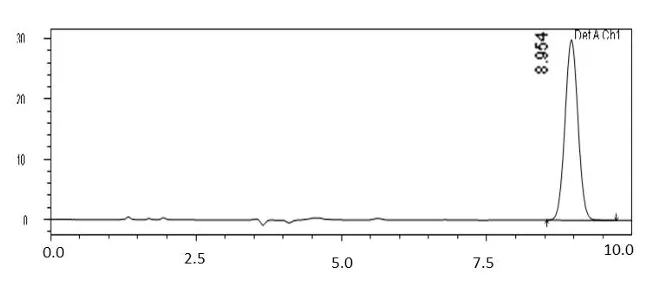
Figure 2: Trial Chromatogram 1
Result: For Trial 1 chromatogram data, the retention time was observed at 2.097 minutes. The peak area measured was 1,353,980, while the resolution time was recorded as 0.00. The calculated plate number was 1898.433, and the asymmetry factor was found to be 1.05. Clear peak at 2.18 min with acceptable symmetry.
Trial 2
Mobile phase : Methanol:Water (70:30v/v)
Flow rate : 1.5 ml/min
Column : Inertisil ODS 3V C18 (150 x4.6mm, 5µm)
Detector Wavelength : 240 nm
Column Temperature : 40°C
Injection Volume : 20.00µL
Run time : 5 min
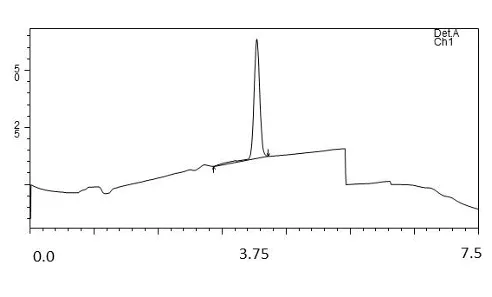
Figure 3: Trial Chromatogram 2
Result: For Trial 2 chromatogram data, the retention time was observed at 3.54 minutes. The peak area measured was 335704 while the resolution time was recorded as 0.00. The calculated plate number was 6638.15, and the asymmetry factor was found to be 1.10.Consistent retention time, improved baseline stability.
Trial 3
Mobile phase : Methanol:Water (75:25v/v)
Flow rate : 1.5 ml/min
Column : Inertisil ODS 3V C18 (150 x4.6mm, 5µm)
Detector Wavelength : 246 nm
Column Temperature : 40°C
Injection Volume : 20.00µL
Run time : 5 min
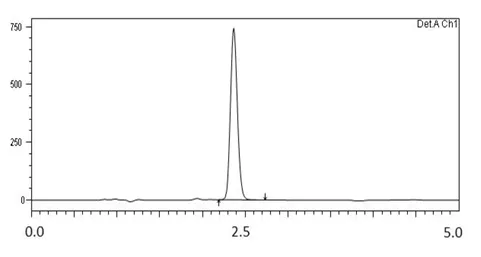
Figure 4: Trial Chromatogram 3
Result: For Trial 3 chromatogram data, the retention time was observed at 2.362 minutes. The peak area measured was 4191739, while the resolution time was recorded as 0.00. The calculated plate number was 3381.565, and the asymmetry factor was found to be 1.12. Enhanced resolution between analyte and excipients.
Trial 4
Mobile phase : Methanol:Water (70:20v/v)
Flow rate : 1.5 ml/min
Column : Inertisil ODS 3V C18 (150 x4.6mm, 5µm)
Detector Wavelength : 246 nm
Column Temperature : 45°C
Injection Volume : 20.00µL
Run time : 5 min
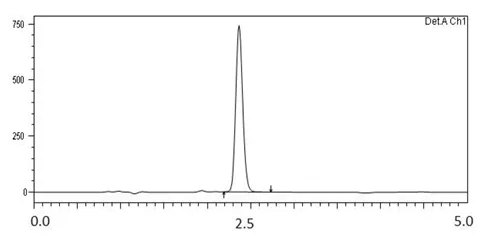
Figure 5: Trial Chromatogram 4
Result: For Trial 4 chromatogram data, the retention time was observed at 2.273 minutes. The peak area measured was 1651410, while the resolution time was recorded as 0.00. The calculated plate number was 3255.704, and the asymmetry factor was found to be 1.89. Confirmed reproducibility of retention time.
Trial 5
Mobile phase : Methanol:Water (75:25v/v)
Flow rate : 1.5 ml/min
Column : Inertisil ODS 3V C18 (150 x4.6mm, 5µm)
Detector Wavelength : 246 nm
Column Temperature : 40°C
Injection Volume : 20.00µL
Run time : 5 min
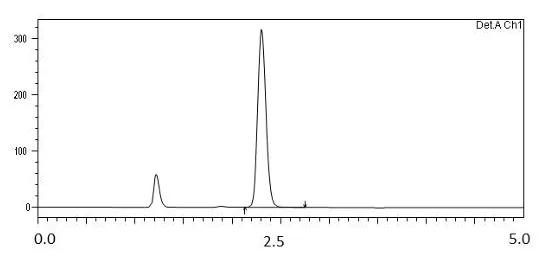
Figure 6: Trial Chromatogram 5
Result: For Trial 5 chromatogram data, the retention time was observed at 2.3 minutes. The peak area measured was 1886245, while the resolution time was recorded as 0.00. The calculated plate number was 2951.130, and the asymmetry factor was found to be 1.2.Final optimized chromatogram with best peak shape and area consistency.
3.3 Specificity
Interference from blank: There was no significant interference found in blank at RT of Prednisolone acetate.
Acceptance criteria: No significant interference from blank solution.

Figure 7: No significant interference from blank solution
RESULT- No significant interference at standard RT.
3.4 Linearity
Calibration curves constructed over the concentration range of 0.5–90 μg/mL demonstrated excellent linearity. The correlation coefficient (r²) was found to be 0.999, indicating a strong linear relationship between peak area and concentration.
Table 6 – Linearity Data of Prednisolone Acetate
|
Concentration (μg/mL) |
Peak Area |
|
0.5 |
285,771 |
|
1.0 |
586,219 |
|
1.5 |
830,214 |
|
2.0 |
1,105,843 |
|
2.5 |
1,408,528 |
|
3.0 |
1,672,543 |
|
3.8 |
2,176,305 |
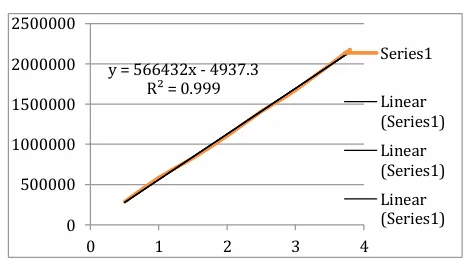
Figure 8: Calibration curve of Prednisolone acetate
Nine linear concentrations of Prednisolone acetate (0.5-90 µg/ml) were injected in a duplicate manner. Average areas were mentioned above and linearity equations obtained for Prednisolone acetate was y =32455x + 2476.7. Correlation coefficient obtained was 0.999.
3.5 Precision
Precision was assessed at 50 μg/mL concentration.
Table 7 – Precision Results (20 μg/mL)
|
Sr. No. |
Area |
|
1 |
1,503,599 |
|
2 |
1,500,797 |
|
3 |
1,494,474 |
|
4 |
1,496,197 |
|
5 |
1,516,232 |
|
6 |
1,493,745 |
Mean: 1,500,841 SD: 8,449.26 %RSD: 0.56
Acceptance criteria: Relative standard deviation for six replicate sample of standard preparation of Prednisolone acetate should not be more than 2.0%.
RESULT: Relative standard deviation of six replicated sample of standard preparation of Prednisolone acetate and absorbance is found to be 0.56%.
Intraday precision
Table 8 – Intraday Precision (20 μg/mL)
|
Sr. No. |
Area |
|
1 |
1,455,991 |
|
2 |
1,451,377 |
|
3 |
1,417,910 |
|
4 |
1,429,576 |
|
5 |
1,428,554 |
|
6 |
1,434,447 |
Mean: 1,436,309.17 SD: 14,573.18 %RSD: 1.01
Acceptance criteria: Relative standard deviation for six replicate sample of standard preparation of Prednisolon acetate should not be more than 2.0%.
RESULT: Relative standard deviation of six replicated sample of standard preparation of Prednisolon acetate and absorbance is found to be 1.01%.
3.6 Accuracy
Table 9 – Accuracy Results of Prednisolone Acetate
|
Sr. No. |
Description of Solution |
Mean |
SD |
%SD |
%RSD |
|
1 |
Accuracy – 80% |
1,123,120 |
27,084.27 |
2.41 |
0.52 |
|
2 |
Accuracy – 100% |
1,436,361 |
21,637.47 |
1.51 |
|
|
3 |
Accuracy – 120% |
1,676,820 |
25,229.62 |
1.50 |
Acceptance criteria: 1. % RSD should not be more than 2.0%.
RESULT - 1. Accuracy for this method is passed as %RSD for accuracy is 0.34 %
Recovery studies were performed at three concentration levels (80%, 100%, and 120%). The recovery values ranged between 99.19–100.17%, confirming the accuracy of the method.
3.7 Sensitivity
● LOD: = (3.3×11961.9)/31903.4 LOD = 1.2373
● LOQ: = (10×11961.9)/31903.4 LOQ = 3.7494
% assay Calculation: - = 1607159 𝑥 50 1607349 𝑥 50 x 99.5 % Assay = 99.48 %
The limit of detection (LOD) was determined to be 1.23 μg/mL, while the limit of quantification (LOQ) was 3.74 μg/mL. These values demonstrated the sensitivity of the developed method.
3.8 Robustness
Robustness was evaluated by deliberate variations in flow rate, detection wavelength, and column temperature. No significant deviations were observed in retention time, peak area, or resolution, confirming the stability of the method under minor changes.
The robustness of the analytical method can be established by demonstrating its reliability against deliberate changes in variables conditions. System suitability should meet the requirement (excluding %RSD criteria). Following variable shall be done according to deliberate changes in chromatographic parameters
a) Wavelength change by ± 3 nm (i.e., 241nm and 251nm)
b) Column temperature change by± 5° C (i.e., 40°C and 50°C)
c) Mobile phase- Ratio change by i.e.
1) Mobile phase-A:-Methanol: Water :: 65:35
2) Mobile phase-A: - Methanol: Water :: 85: 15
Result: Method is robust as the area and RT of standard is within Acceptance criteria.
3.9 Validation Parameters Summary
The developed RP‑HPLC method fulfilled all validation criteria:
DISCUSSION
The developed RP‑HPLC method for prednisolone acetate demonstrated strong compliance with ICH Q2(R1) validation parameters. System suitability testing confirmed adequate column efficiency, peak symmetry, and reproducibility, with retention times consistently around 2.18 minutes. Across five trial chromatograms, the method showed robustness under varying mobile phase ratios, detection wavelengths, and column temperatures, highlighting its reliability for routine analysis.
Linearity studies revealed an excellent correlation between concentration and peak area (r² = 0.999) across the range of 0.5–90 μg/mL, indicating the method’s suitability for both low‑level detection and higher concentration quantification. Precision results, with %RSD values below 2% for intra‑day and inter‑day analyses, confirmed reproducibility. Accuracy studies at 80%, 100%, and 120% levels yielded recoveries between 99.19–100.17%, meeting regulatory expectations. Sensitivity parameters (LOD 1.23 μg/mL, LOQ 3.74 μg/mL) demonstrated the method’s ability to detect and quantify trace levels of prednisolone acetate. Robustness testing under deliberate variations in wavelength, temperature, and mobile phase composition showed no significant deviations, further validating method stability.
These findings align with previous corticosteroid validation studies, which emphasize the importance of rapid, reproducible, and stability‑indicating methods for pharmaceutical quality control. The optimized chromatographic conditions (methanol:water 75:25 v/v, flow rate 1.5 mL/min, detection at 246 nm, column temperature 40°C) provided sharp peaks and minimal tailing, confirming the method’s efficiency. The method’s performance across diverse dosage forms (tablets, eye drops, suspensions) underscores its applicability in routine pharmaceutical analysis and regulatory submissions.
CONCLUSION
A simple, rapid, and robust RP‑HPLC method was successfully developed and validated for the estimation of prednisolone acetate in pharmaceutical dosage formulations. The method fulfilled all ICH Q2(R1) validation criteria, demonstrating excellent linearity (r² = 0.999), high accuracy (recoveries within 98–102%), precision (RSD <1%), sensitivity (LOD 1.23 μg/mL, LOQ 3.74 μg/mL), and robustness under minor variations. The optimized chromatographic conditions ensured reproducible retention times and reliable separation, making the method suitable for routine quality control, stability studies, and regulatory compliance.
This validated RP‑HPLC method provides a dependable analytical tool for pharmaceutical manufacturers and quality assurance laboratories, ensuring therapeutic consistency and patient safety in prednisolone acetate formulations.
REFERENCES



Vaishnavi Jadhav, Dr. Wasmate D. N., Jadhav Sarika, Role Shital, Method Development and Validation for Estimation of Prednisolone in Pharmaceutical Dosage Formulation by RP-HPLC, Int. J. of Pharm. Sci., 2026, Vol 4, Issue 7, 216-229 https://doi.org/10.5281/zenodo.21131398
 10.5281/zenodo.21131398