

We use cookies to ensure our website works properly and to personalise your experience. Cookies policy
Department of Pharmacology, Surabhi Dayakar Rao College of pharmacy, Rimmanaguda, Gajwel, Siddipet, Telangana, India, 502311.
A robust and reliable reverse-phase high-performance liquid chromatography (RP-HPLC) method was successfully developed and optimized for the simultaneous estimation of Levosulpiride and Rabeprazole in bulk and pharmaceutical dosage forms. Chromatographic separation was achieved using a Platisil C18 column with a mobile phase of 0.1% formic acid and acetonitrile, resulting in well-resolved peaks with satisfactory retention times, good peak symmetry, and acceptable system suitability parameters. The method demonstrated excellent linearity with correlation coefficients greater than 0.999 for both drugs. Precision studies confirmed repeatability with %RSD values within acceptable limits, while accuracy studies showed recovery values close to 100%, validating the reliability of the method. Sensitivity was established through low LOD and LOQ values, confirming its ability to detect and quantify trace levels effectively. Overall, the validated RP-HPLC method proved accurate, precise, linear, sensitive, and robust, meeting all ICH guideline requirements. Its simplicity, cost-effectiveness, and reproducibility make it highly suitable for routine quality control analysis in pharmaceutical industries and research laboratories for combined dosage forms of Levosulpiride and Rabeprazole.
Analytical techniques play an important role in Production and evaluation of new drugs in bulk and formulation and also estimation from biological fluids, Detection and quantification of impurities and metabolites, Accelerated stability studies, Invitro dissolution studies, Pharmacokinetic studies and drug metabolism studies, Determination of bioavailability of two or more formulation.
A. Rabeprazole: It is a Proton pump inhibitor. Proton-pump inhibitors (ppis) are a group of drugs whose main action is a pronounced and long lasting reduction of gastric acid production. They are the most potent inhibitors of acid secretion available today. The group followed and has largely superseded another group of pharmaceuticals with similar effects, but different mode-of-action, called H2- receptor antagonists. These drugs are among the most widely-selling drugs in the world and are generally considered effective. The vast majority of these drugs are benzimidazole derivatives; however, promising new research indicates that imidazopyridine derivatives may be a more effective means of treatment. High dose or long-term use of ppis carry a possible increased risk of bone fracture.[2]
B. Levosulpiride An antipsychotic (or Neuroleptic) is a tranquilizing psychiatric medication primarily used to manage psychosis (including delusions or hallucinations, as well as disordered thought), particularly in schizophrenia and bipolar disorder, and is increasingly being used in the management of non-psychotic disorders. Reverse phase HPLC (RP-HPLC or RPC) has a non-polar stationary phase and an aqueous, moderately polar mobile phase. One common stationary phase is a silica which has been treated with rme2sicl, where R is a straight chain alkyl group such as C18H37 or C8H17.
Rationale for Combination of Levosulpiride and Rabeprazole
The combination of levosulpiride and rabeprazole is widely prescribed for the management of gastrointestinal disorders, particularly GERD and dyspepsia. The rationale behind this combination lies in their complementary mechanisms of action:
This dual mechanism provides more effective symptom relief compared to monotherapy. Due to the increasing use of this combination, there is a growing need for reliable analytical methods to simultaneously estimate both drugs in pharmaceutical formulations. (12,13)
Significance of the Present Study
The present study aims to develop and validate a simple, precise, accurate, and robust liquid chromatographic method for the concurrent analysis of levosulpiride and rabeprazole in bulk and pharmaceutical dosage forms.
Method Development and Validation for the Concurrent Analysis of Levosulpiride and Rabeprazole by Liquid Chromatography.
1. To study the physicochemical properties of Levosulpiride and Rabeprazole relevant to method development.
2. To develop an optimized RP-HPLC method by selecting suitable:
3. To achieve proper separation of Levosulpiride and Rabeprazole with acceptable system suitability parameters such as:
4. To validate the developed method as per ICH guidelines for the following parameters:
5. To apply the validated method for the quantitative estimation of Levosulpiride and Rabeprazole in combined dosage form.
6. To ensure the method is suitable for routine quality control analysis in pharmaceutical laboratories.
2.EXPERIMENTAL METHODOLOGY
2.1 MATERIALS AND METHODS:
List of Proposed Materials:
|
Sr. No. |
Chemicals/ standards and reagents |
Grade |
Make |
Used for the estimation of drugs |
|
1 |
0.1% OPA |
HPLC |
Qualigens |
1.Levosulpiride and Rabeprazole |
|
2 |
0.1%Formic acid |
HPLC |
Qualigens |
1.Levosulpiride and Rabeprazole |
|
3 |
Water |
HPLC |
Qualigens |
For all drugs |
|
4 |
Acetonitrile |
HPLC |
Qualigens |
For all drugs |
|
5 |
Methanol |
HPLC |
Rankem |
For all drugs |
Equipments and instruments used in the study:
|
Sr.No. |
Equipment |
Model/ Type |
Manufacturer |
|
1 |
Electronic Balance |
SAB2032 |
SCALETEC |
|
2 |
Ultra- Sonicator |
SE60US |
LABMAN SCIENTIFIC INDIA |
|
3 |
Thermal Oven |
I-THERM A17782 |
DWARAKA SCIENTIFIC |
|
4 |
Ph Meter |
ORION STAR A111 |
THERMOSCIENTIFIC |
|
5 |
Filter Paper |
0.45 microns |
MILLIPORE |
|
6 |
HPLC System |
WATERS 2690 SEPARATION MODULE |
WATERS |
PREPARATION OF BUFFER AND MOBILE PHASE:
Preparation of 0.1% Formic Acid:
To prepare 0.1% Formic Acid buffer solution by adding 1ml of Formic Acid in 1000ml HPLC water adjust the solution to desired PH.
Preparation of mobile phase:
Mix a mixture of above 0.1% Formic Acid and ACN and degas in ultrasonic water bath for 5 minutes. Filter through 0.45µfilter under vacuum filtration.
2.2 HPLC METHOD DEVELOPMENT:
OPTIMIZED CHROMATOGRAPHIC CONDITIONS
Instrument used : High performance liquid chromatography equipped with Auto Sampler and PDA detector
Temperature : Ambient
Column : Platisil C18, (250×4.6mm, 5μm)
Buffer : 0.1% Formic Acid (ph-3.5)
Mobile phase : 40% Phosphate buffer: 60% CAN
Flow rate : 1.0 ml per min
Wavelength : 284 nm.
Injection volume : 20 ml
Run time : 12 min
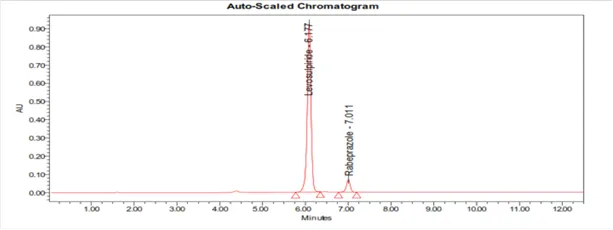
Chromatogram for system suitability
|
Sr. No |
Name |
RT (min) |
Area (µv sec) |
Height (µv) |
Resolution |
USP Tailing |
USP plate count |
|
1 |
LEVOSULPIRIDE |
6.177 |
60214786 |
924033 |
4.25 |
1.03 |
3517 |
|
2 |
RABEPRAZOLE |
7.011 |
2073901 |
24260 |
1.21 |
4158 |
System Suitability:
Tailing factor for the peaks due to Levosulpiride and Rabeprazole in Standard solution should not be more than 2.0
Theoretical plates for the Levosulpiride and Rabeprazole peaks in Standard solution should not be less than 2000
2.3 METHOD VALIDATION PARAMETERS:
2.3.1 ASSAY:
Standard Solution Preparation:
Accurately weigh and transfer 25mg of Levosulpiride and 6.67mg Rabeprazole working standard into a 25ml clean dry volumetric flask add Diluents and sonicate to dissolve it completely and make volume up to the mark with the same solvent. (Stock solution)
Further pipette 0.75ml of the above stock solution into a 10ml volumetric flask and dilute up to the mark with Diluents (75ppm Levosulpiride & 20ppm Rabeprazole).
Procedure:
Inject 10 ml of the standard, sample into the chromatographic system and measure the areas for the Levosulpiride and Rabeprazole peaks and calculate the % Assay by using the formulae.
2.3.2 LINEARITY:
Preparation of stock solution:
Accurately weigh and transfer 25mg of Levosulpiride and 6.67mg Rabeprazole working standard into a 25ml clean dry volumetric flask add Diluents and sonicate to dissolve it completely and make volume up to the mark with the same solvent. (Stock solution)
Preparation of Level–I (25ppm of Levosulpiride and 6.7ppm Rabeprazole):
0.25 ml of stock solution has taken in 10ml of volumetric flask dilute up to the mark with Diluents.
Preparation of Level–II (50ppm of Levosulpiride and 13.3ppm Rabeprazole):
0.5 ml of stock solution has taken in 10ml of volumetric flask dilute up to the mark with Diluents.
Preparation of Level–III (75ppm of Levosulpiride and 20ppm Rabeprazole):
0.75 ml of stock solution has taken in 10ml of volumetric flask dilute up to the mark with Diluents.
Preparation of Level–IV (100ppm of Levosulpiride and 26.7ppm Rabeprazole):
1.0 ml of stock solution has taken in 10ml of volumetric flask dilute up to the mark with Diluents.
Preparation of Level–V (125ppm of Levosulpiride and 33.3ppm Rabeprazole):
1.25 ml of stock solution has taken in 10ml of volumetric flask dilute up to the mark with Diluents.
Procedure:
Inject each level into the chromatographic system and measure the peak area.
Plot a graph of peak area versus concentration (on X-axis concentration and on Y-axis Peak area) and calculate the correlation coefficient.
2.3.3 PRECISION:
Preparation of standard Solution
Accurately weigh and transfer 25mg of Levosulpiride and 6.67mg Rabeprazole working standard into a 25ml clean dry volumetric flask add Diluents and sonicate to dissolve it completely and make volume up to the mark with the same solvent. (Stock solution)
Further pipette 0.75ml of the above stock solution into a 10ml volumetric flask and dilute up to the mark with Diluents (75ppm Levosulpiride &20ppm Rabeprazole).
Procedure:
The standard solution was injected for six times and measured the area for all six injections in HPLC. The %RSD for the area of six replicate injections was found to be within the specified limits.
2.3.4 INTERMEDIATE PRECISION/ RUGGEDNESS:
To evaluate the intermediate precision (also known as Ruggedness) of the method, Precision was performed on different day within the laboratory.
Preparation of standard solution:
Accurately weigh and transfer 25mg of Levosulpiride and 6.67mg Rabeprazole working standard into a 25ml clean dry volumetric flask add Diluents and sonicate to dissolve it completely and make volume up to the mark with the same solvent. (Stock solution)
Further pipette 0.75ml of the above stock solution into a 10ml volumetric flask and dilute up to the mark with Diluents (75ppm Levosulpiride &20ppm Rabeprazole).
Procedure:
The standard solution was injected for six times and measured the area for all six injections in HPLC. The %RSD for the area of six replicate injections was found to be within the specified limits.
2.3.5 ACCURACY:
For accuracy determination, three different concentrations were prepared separately i.e. 50%, 100% and 150% for the analyte and chromatograms are recorded for the same.
Preparation of Standard solution:
Accurately weigh and transfer 25mg of Levosulpiride and 6.67mg Rabeprazole working standard into a 25ml clean dry volumetric flask add Diluents and sonicate to dissolve it completely and make volume up to the mark with the same solvent. (Stock solution)
Further pipette 0.75ml of the above stock solution into a 10ml volumetric flask and dilute up to the mark with Diluents (75ppm Levosulpiride &20ppm Rabeprazole).
Preparation Sample solutions:
For preparation of 50% solution (With respect to target Assay concentration):
Accurately weigh and transfer 12.5mg of Levosulpiride and 3.33mg Rabeprazole working standard into a 25ml clean dry volumetric flask add Diluents and sonicate to dissolve it completely and make volume up to the mark with the same solvent. (Stock solution)
Further pipette 0.75ml of the above stock solution into a 10ml volumetric flask and dilute up to the mark with Diluents (75ppm Levosulpiride &20ppm Rabeprazole)..
For preparation of 100% solution (With respect to target Assay concentration):
Accurately weigh and transfer 25mg of Levosulpiride and 6.67mg Rabeprazole working standard into a 25ml clean dry volumetric flask add Diluents and sonicate to dissolve it completely and make volume up to the mark with the same solvent. (Stock solution)
Further pipette 0.75ml of the above stock solution into a 10ml volumetric flask and dilute up to the mark with Diluents (75ppm Levosulpiride &20ppm Rabeprazole).
For preparation of 150% solution (With respect to target Assay concentration):
Accurately weigh and transfer 37.5mg of Levosulpiride and 10mg Rabeprazole working standard into a 25ml clean dry volumetric flask add Diluents and sonicate to dissolve it completely and make volume up to the mark with the same solvent. (Stock solution)
Further pipette 0.75ml of the above stock solution into a 10ml volumetric flask and dilute up to the mark with Diluents (75ppm Levosulpiride &20ppm Rabeprazole).
Procedure:
Inject the standard solution, Accuracy -50%, Accuracy -100% and Accuracy -150% solutions.
Calculate the Amount found and Amount added for Levosulpiride and Rabeprazole and calculate the individual recovery and mean recovery values.
2.4 LIMIT OF DETECTION:
2.4.1 Preparation of Levosulpiride and Rabeprazole solution:
Preparation of 0.02µg/ml solution:
Accurately weigh and transfer 25mg of Levosulpiride working standard into a 25ml clean dry volumetric flask add Diluents and sonicate to dissolve it completely and make volume up to the mark with the same solvent. (Stock solution)
Further pipette 0.75ml of the above stock solution into a 10ml volumetric flask and dilute up to the mark with Diluents
Further pipette 0.1 ml of the above stock solution into a 10ml volumetric flask and dilute up to the mark with Diluent.
Further pipette 0.25 ml of the above stock solution into a 10ml volumetric flask and dilute up to the mark with Diluent.
Preparation of 0.20µg/ml solution:
Accurately weigh and transfer 6.67mg Rabeprazole working standard into a 25ml clean dry volumetric flask add Diluents and sonicate to dissolve it completely and make volume up to the mark with the same solvent. (Stock solution)
Further pipette 0.75ml of the above stock solution into a 10ml volumetric flask and dilute up to the mark with Diluents
Further pipette 0.1 ml of the above stock solution into a 10ml volumetric flask and dilute up to the mark with Diluent.
2.4.2 LIMIT OF QUANTIFICATION:
Preparation of Levosulpiride and Rabeprazole solution:
Preparation of 0.06µg/ml solution:
Accurately weigh and transfer 25mg of Levosulpiride working standard into a 25ml clean dry volumetric flask add Diluents and sonicate to dissolve it completely and make volume up to the mark with the same solvent. (Stock solution)
Further pipette 0.75ml of the above stock solution into a 10ml volumetric flask and dilute up to the mark with Diluents
Further pipette 0.1 ml of the above stock solution into a 10ml volumetric flask and dilute up to the mark with Diluent.
Further pipette 0.8 ml of the above stock solution into a 10ml volumetric flask and dilute up to the mark with Diluent.
Preparation of 0.66µg/ml solution:
Accurately weigh and transfer 6.67mg Rabeprazole working standard into a 25ml clean dry volumetric flask add Diluents and sonicate to dissolve it completely and make volume up to the mark with the same solvent. (Stock solution)
Further pipette 0.75ml of the above stock solution into a 10ml volumetric flask and dilute up to the mark with Diluents
Further pipette 0.33 ml of the above stock solution into a 10ml volumetric flask and dilute up to the mark with Diluent.
2.5 ROBUSTNESS:
As part of the Robustness, deliberate change in the Flow rate, Mobile Phase composition, Temperature Variation was made to evaluate the impact on the method.
A) The flow rate was varied at 0.9 ml/min to 1.1 ml/min.
Standard solution 75 µg/ml of Levosulpiride and 20 µg/ml Rabeprazole prepared and analysed using the varied flow rates along with method flow rate.
B) The Organic composition in the Mobile phase was varied from 54% to 66%
Standard solution 75µg/ml of Levosulpiride and 20 µg/ml Rabeprazole was prepared and analysed using the varied Mobile phase composition along with the actual mobile phase composition in the method.
3. RESULTS AND DISCUSSIONS
TRIAL 1
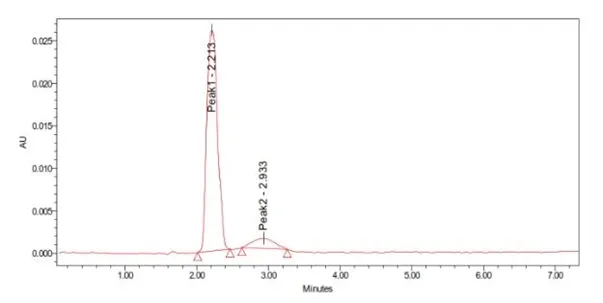
TRIAL2
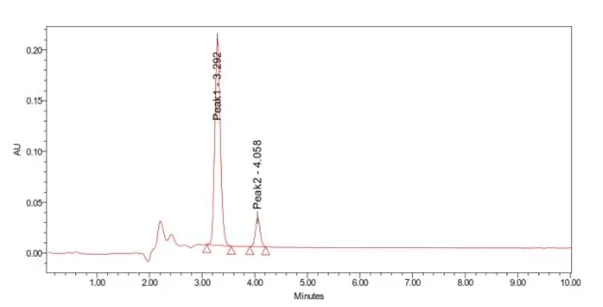
Results of system suitability parameters
|
Sr. No |
Name |
RT (min) |
Area (µv sec) |
Height (µv) |
Resolution |
USP Tailing |
USP plate count |
|
1 |
LEVOSULPIRIDE |
6.177 |
60214786 |
924033 |
4.25 |
1.03 |
3517 |
|
2 |
RABEPRAZOLE |
7.011 |
2073901 |
24260 |
1.21 |
4158 |
Acceptance criteria:
3.1 VALIDATION PARAMETERS:
3.1.1 ASSAY:
Standard and sample solution injected as described under experimental work. The corresponding chromatograms and results are shown below.
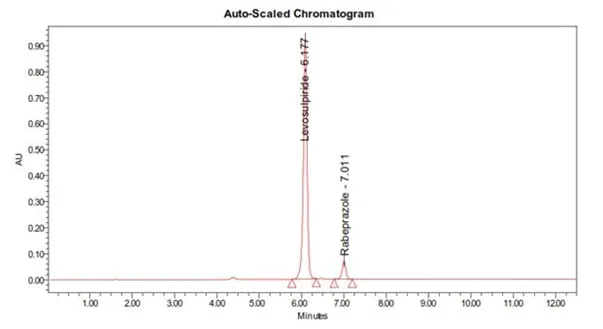
Figure 1 Chromatogram for Standard
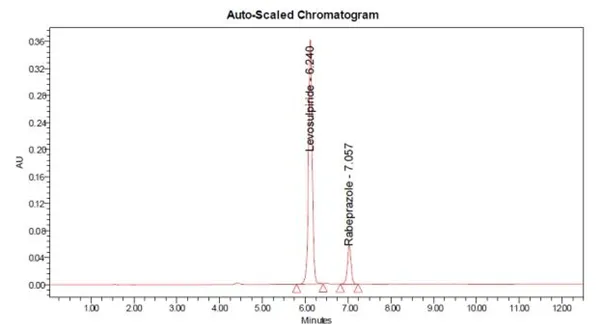
Figure 2: Chromatogram for Sample
Results of Assay for Levosulpirideand Rabeprazole
|
|
Label Claim (mg) |
% Assay |
|
Levosulpiride |
75 mg |
99.69% |
|
Rabeprazole |
20mg |
99.6% |
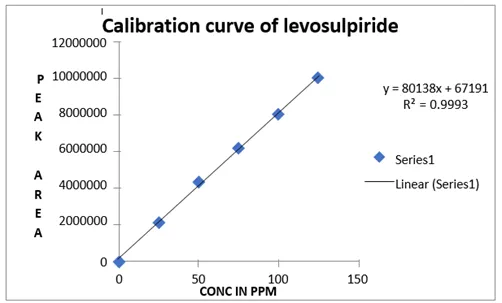
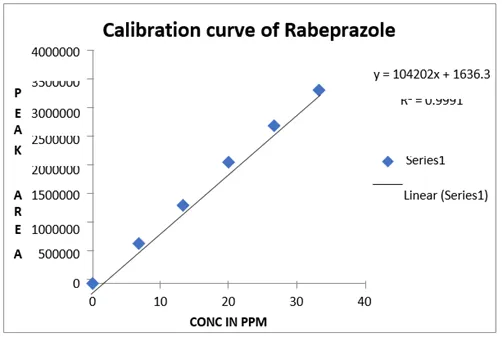
3.1.2 LINEARITY:
The linearity range was found to lie from 10µg/ml to 50µg/ml of Levosulpirideand Rabeprazole and chromatograms are shown below.
Acceptance criteria:
Correlation coefficient (R2) should not be less than 0.999
The correlation coefficient obtained was 0.999 which is in the acceptance limit.
3.1.3 PRECISION:
Precision of the method was carried out for both sample solutions as described under experimental work. The corresponding chromatograms and results are shown below.
Results of Precision for Levosulpirideand Rabeprazole
|
Injection |
Levosulpiride Area |
Rabeprazole Area |
|
Injection-1 |
6151942 |
2151853 |
|
Injection-2 |
6149862 |
2162153 |
|
Injection-3 |
6143214 |
2154269 |
|
Injection-4 |
6149523 |
2152530 |
|
Injection-5 |
6158143 |
2150469 |
|
Injection-6 |
6147436 |
2151280 |
|
Average |
6150020 |
2153759 |
|
Standard Deviation |
4958.7877 |
4308.878 |
|
%RSD |
0.1 |
0.2 |
Acceptance criteria:
%RSD for sample should be NMT 2
The %RSD for the standard solution is below 2, which is within the limits hence method is precise.
3.1.4 INTERMEDIATE PRECISION (ruggedness)
There was no significant change in assay content and system suitability parameters at different conditions of ruggedness like day to day and system to system variation.
Results of Intermediate precision for Levosulpiride and Rabeprazole
|
Injection |
Levosulpiride Area |
Rabeprazole Area |
|
Injection-1 |
6154213 |
2142016 |
|
Injection-2 |
6157513 |
2141523 |
|
Injection-3 |
6150123 |
2146851 |
|
Injection-4 |
6157826 |
2156531 |
|
Injection-5 |
6154832 |
2149530 |
|
Injection-6 |
6169321 |
2151369 |
|
Average |
6157304.7 |
2147970 |
|
Standard Deviation |
6510.8567 |
5754.018 |
|
%RSD |
0.11 |
0.3 |
Acceptance criteria:
%RSD of five different sample solutions should not more than 2
The %RSD obtained is within the limit, hence the method is rugged.
3.1.5 ACCURACY:
Sample solutions at different concentrations (50%, 100%, and 150%) were prepared and the% recovery was calculated.
Accuracy (recovery) data for Levosulpiride and Rabeprazole
|
% Concentration (at specification Level) |
Area* |
Amount Added (mg) |
Amount Found (mg) |
% Recovery |
Mean Recovery |
|
50% |
3088512 |
12.5 |
12.51 |
100.1 |
99.9 |
|
100% |
6160423 |
25 |
24.9 |
99.78 |
|
|
150% |
9248652 |
37.5 |
37.45 |
99.87 |
3.1.6 ROBUSTNESS:
The standard and samples of Levosulpiride and Rabeprazole were injected by changing the conditions of chromatography. There was no significant change in the parameters like resolution, tailing factor, asymmetric factor, and plate count.
Results for variation in flow for Levosulpiride and Rabeprazole
|
Sr. No
|
Flow Rate (ml/min) |
System Suitability Results of Clindamycin phosphate |
|
|
USP Plate Count |
USP Tailing |
||
|
1 |
0.9 |
3214 |
1.01 |
|
2 |
1.0 |
3241 |
1.21 |
|
3 |
1.1 |
3045 |
1.08 |
|
System Suitability Results of Rabeprazole |
|||
|
1 |
0.9 |
6514 |
1.24 |
|
2 |
1.0 |
6748 |
1.34 |
|
3 |
1.1 |
6214 |
1.27 |
* Results for actual flow (1.0 ml/min) have been considered from Assay standard
4. CONCLUSION:
The validated RP-HPLC method proved to be accurate, precise, linear, sensitive, and robust for the simultaneous determination of Levosulpiride and Rabeprazole. All validation parameters, including system suitability, precision, accuracy, linearity, LOD, LOQ, and robustness, complied with the recommended acceptance criteria, confirming the method’s suitability for routine quality control analysis. The method is simple, cost-effective, and reproducible, making it highly appropriate for application in pharmaceutical industries and research laboratories for the analysis of combined dosage forms of these drugs.
REFERENCES


Narsapuram Bharathi, Sania Tabassum, A. Sai Kiran, B. Pravalika, Aliya Siddiqua, Kurakula Manga, Method Development and Validation for the Concurrent Analysis of Levosulpiride and Rabeprazole by Liquid Chromatography, Int. J. of Pharm. Sci., 2026, Vol 4, Issue 5, 8155-8166. https://doi.org/10.5281/zenodo.20447859
 10.5281/zenodo.20447859