

We use cookies to ensure our website works properly and to personalise your experience. Cookies policy
Department Of Pharmaceutical Chemistry VidyaNiketan College of Pharmacy, Lakhewadi, Indapur, Pune.
Microwave-ssisted green synthesis has emerged as an efficientan denviron mentally friendly approach for the preparation of bioactive heterocyclic compounds. Heterocycles constitute an important class of organic molecules widely used in pharmaceutical, med icinal, and agrochemical plications. Conventional synthetic method soften require prolonged reaction times, hazardous solvents, and high energy consumption. In contrast, microwave irradiation offers rapid and uniform heating, resulting in enhanced reaction rates and improved product yields. The integration of green chemistry principles with microwave technology minimizes environmental impact and promotes sustainable chemical synthesis. This study focuses on the microwave-assisted synthesis of bioactive heterocyclic derivatives using eco-friendly solvents and catalysts. The methodology reduces waste generation and eliminates the need for hars hreaction conditions. Various heterocyclics caffold ssuch as benzimidazoles, imidazoles, pyrazoles, and quinazolines can be synthesized efficiently through this approach. The synthesized compounds were characterized using spectroscopic techniques including FTIR, NMR, and mass spectrometry. Biological evaluation demonstrated promising antimicrobial, antioxidant, anti-inflammatory, and anticancer activities of the obtained derivatives. Microwave-assisted protocols significantly reduced reaction times from several hours to a few minutes while maintaining high purity of products. The use of renewable resource sand green catalysts further enhanced the sustainability of the process.
Microwave-assisted organic synthesis has emerged as an efficient and eco-friendly alternative to traditional heating methods. Microwave irradiation provides rapid and uniform heating, leading to enhanced reaction rates, improved yields, and reduced reaction times. The combination of microwave technology with green chemistry principles offers an attractive strategy for the synthesis of bioactive heterocyclic compounds. Furthermore, the use of environmentally benign solvents and catalysts contributestosaferandmoresustainablechemicalprocesses.Inrecentyears,microwave-assisted green synthesis has gained significant attention in medicinal chemistry for the development of novel bioactive molecules with antimicrobial, antioxidant, anti-inflammatory, and anticancer properties. Therefore, this approach represents apromising and sustainable platform for the efficient synthesis of heterocyclic compounds with potential pharmaceutical applications. Heterocyclic compoundsrepresent one of the most important classes of organic molecules due to their diverse biological and pharmaceuticalactivities.Manyclinicallyusefuldrugs containheterocyclic ringssuchas benzimidazole, imidazole, pyrazole, and quinazoline. Conventional methods for synthesizing these compounds often involve lengthy reaction times, high energy consumption, and the use of hazardous solvents, which may adversely affect the environment. Green chemistry aims to develop sustainable synthetic approaches thatminimize wastegenerationand reduce environmental impact. The combination of microwave irradiation with green chemistry principles provides an efficient and sustainable approach for the synthesis of bioactive eheterocyclic compounds. This methodology not only enhances reaction efficiency but also reduces energy consumption and environmental impact. Thereforemicrowave-assistedgreensynthesis has gainedconsiderableattentionas amoderntoolfor thedevelopmentofnovelbioactiveheterocycleswithpotentialpharmaceuticalapplications.
General Structure of Bioactive Heterocycles
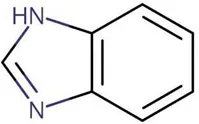
MATERIALS AND METHODS:-
TableNo.1 Chemicals List
|
Sr .No |
ChemicalName |
Manufacturer |
|
1 |
DistilledWater |
ResearchLabs. |
|
2 |
O-phenylenediamine |
ResearchLabs. |
|
3 |
Formicacid |
ResearchLabs. |
|
4 |
GlacialAceticacid |
ResearchLabs. |
|
5 |
SodiumHydroxideSolution |
ResearchLabs. |
|
6 |
Benzoin |
ResearchLabs. |
|
7 |
ConcentratedNitricAcid |
ResearchLabs. |
|
8 |
Ethanol |
ResearchLabs. |
|
9 |
IceCold Water |
ResearchLabs. |
|
10 |
Benzaldehyde |
ResearchLabs |
SYNTHESIS PROCEDURE
Compound A: Benzil Procedure:
Step1:Weigh1gofbenzoinandtransferitintoamicrowave-safereactionvessel. Step 2: Add 10 mL of ethanol and stir until the benzoin dissolves.
Step3:Add3–5mLof30%hydrogenperoxide(H₂O₂)slowlywhilestirring. Step 4: Place the reaction vessel in the microwave oven.
Step 5: Irradiateat300–450 Wfor 2–5 minutes, checkingthereactionat shortintervals. Step 6: After completionofthereaction,allow the mixturetocooltoroomtemperature. Step 7: Pour the reaction mixture into ice-cold water to precipitate the product.
Step8: Collect they ellow crystals of benzilby filtration.
Step9: Wash the crystals with cold water tore move impurities.
Step10: Dry the product and recrystallize from ethanol if higher purity is required. Reaction Scheme:
C6H5–CHOH–CO–C6H5+[O]
Benzoin
↓
C6H5–CO–CO–C6H5
Benzil
Compound B: Benzimidazole:
Step1:Take1.08gofo-phenylenediamineinamicrowave-safereactionvessel. Step 2: Add 1 mL of benzaldehyde and 10 mL of ethanol.
Step3:Add2–3dropsofglacialaceticacidasacatalyst.
Step4: Stir the reaction mixture thoroughly to obtain a homogeneous solution. Step 5: Place the reaction vessel in a microwave oven.
Step6:Irradiateat300–450Wfor2–5minutes.Monitorthereactionperiodically. Step 7: After completion, allow the reaction mixtureto cool to roomtemperature. Step 8: Pour the mixture into ice-cold water to precipitate the product.
Step9: Filter the precipitate dbenzimidazole derivative using vacuum or simple filtration. Step 10: Wash the solid with cold water and dry it.
Step11: Recrystallize the product from ethanol too btain pure crystals.
Reaction Scheme: o-Phenylenediamine+Benzaldehyde
↓(Microwave, AcOH)
2-Phenylbenzimidazole+H₂O
Table No.2 List Of Parameters
|
Name of Parameter |
CompA |
CompB |
|
Practical Yield |
2.10gm |
1.80gm |
|
Theoretical Yield |
2.49g/mol |
2.52g/mol |
|
%PracticalYield |
84%w/w |
71%w/w |
|
Appearance |
YellowCrystalline Solid |
Whitetoyellowcrystallinesolid |
|
Color |
PaleYellowtoYellow |
Yellowcrystallinetolightbrown |
|
Odour |
Mild,pleasantodour |
Faintcharacteristicsmell |
|
Solubility |
Solubleinethanol,Soluble Water, Methanol. |
Solubleinethanol,methanoland alcohol,ethersparinglysolublein water. |
|
MeltingPoint |
94-96oC |
170-172oC |
Table No-3 List Of Chemical Test
|
Sr. No. |
Test |
Procedure |
Observation |
Result |
|
1 |
2 4DNP Test |
Adda2-4-DNPreagentina sample[5,] |
Yellow/Orange Precipitate |
+ |
|
2 |
Reductio n Test |
A small quantity of the compoundwasdissolved Inethanolandfewdropsof NaOHandaddreducingagent. |
Whitecrystals of Benzoin formed. |
+ |
|
3 |
Ferric Chloride Test |
Thecompoundsolutionwas treated with a few dropsof5%ferricchloride solution.[7] |
Yellowish-greencolor. |
+ |
|
4 |
Nitrous Test |
SmallAmountofSample Dissolve in 2 ml of Hcl and cool in ice bathandaddfreshlyprepared NaNO[5] 2 |
NoPinkColor |
+ |
SPECTRALCHARACTERIZATION FTIR
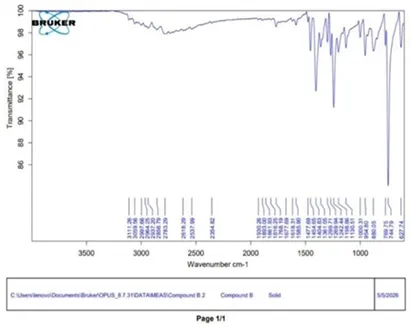
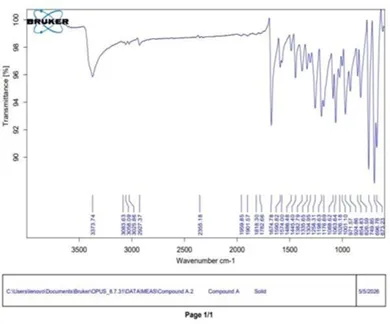
Figure No.1 Peak of Comp A & Comp BFTIR
TableNo.4:InterpretationofCOMPAandCOMPB(FTIR)
|
Compound |
FT-IR Peaks (cm⁻¹) |
FunctionalGroup/ Interpretation |
Observation |
|
Compound A |
3373 |
N=Hstretching |
Presenceofamine |
|
3083,3054,3 025 |
AromaticC-H stretching |
Aromaticringpresent |
|
|
2927 |
AliphaticC-H stretching |
WeakalkylC-Hvibration |
|
|
1674 |
AromaticC=N |
Characteristicofbenzilring |
|
|
stretching |
|||
|
1594-1570 |
AromaticC=C |
Positivearomaticframework |
|
|
stretching |
|||
|
1486-1445 |
C-Nstretching |
Conformaromaticring |
|
|
1382,1046,1 |
C-Hstreching[11’13] |
Supportheterocyclicstructure |
|
|
026 |
|||
|
CompoundB |
3111,3059 |
AromaticC-H |
WeakC-Hvibration |
|
stretching |
|||
|
2997,2943, 285 |
AliphaticC-H stretching |
CharacteristicCarbonylgroupof benzil |
|
|
1618 |
AromaticC=C stretching |
Benzeneringpresent |
|
|
1477,1454 |
Aromaticringvibration |
Phenylringskeletalvibration |
|
|
1130 |
Aromaticskeletaland C-N |
Aromaticvibration |
|
|
Stretching[11,13] |
1HNMR:
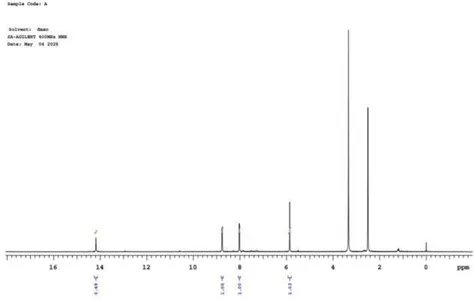
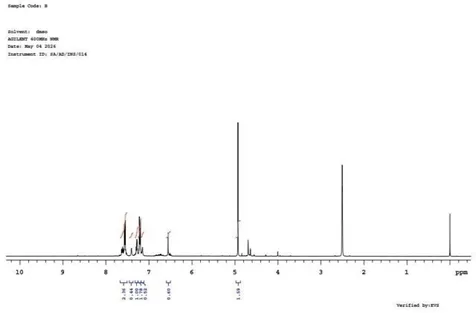
FigureNo.4 1HNMR COMP A and COMP
TableNo.5: Assignment of COMP A and COMP B.
|
Compound |
¹Hnmr(400MHZ,DMSO- D₆,ΔPPM)Assignment |
Assignment |
|
CompoundA |
14.10(s,1H), 8.78–8.02(s,1H), 5.95(s,1H) |
Singlet at δ 14.10 ppmassigned to N–H proton of benzimidazole ring; singlets at δ 8.78 and 8.02 ppm correspondto aromatic/heteroaromaticprotonsof thebenzimidazolenucleus;singletat δ5.95ppmassignedtomethine proton(–CH–)attachedtothe heterocyclicframework. |
|
CompoundB |
7.557.45(m,2H),7.357.15(m,3 H),7.106.95(m,2H),6.52 (s,1H),5.00(s,2H) |
Multiplets at δ 7.55–6.95 ppm correspond to aromatic protons of phenyl/benzimidazole rings. The singletatδ6.52ppmisassignedto themethineproton(–CH–)attachedto theheterocyclicnucleus.Thesinglet at δ 5.00 ppm corresponds to NH₂/NH protons of the hydrazino or amino grouppresentinthe molecule. |
¹³CNMR:
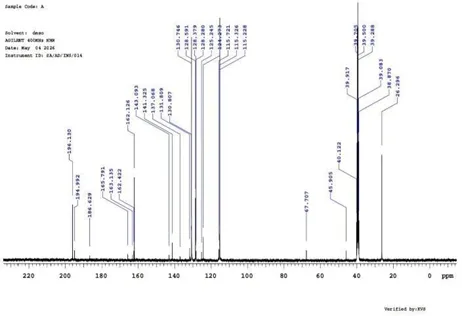
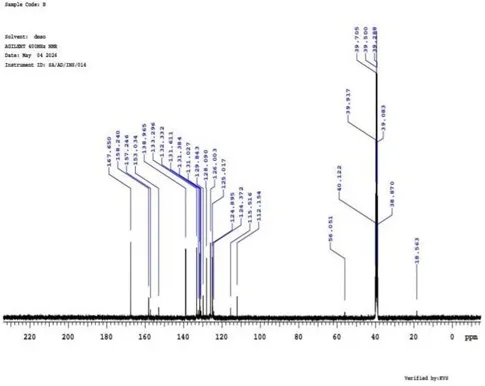
Figure.No.513CNMR(COMPA&B).
TableNo.6: Assignment of COMP A and COMP B
|
|
¹³CNMR(DMSO-d,δppm) |
Assignment |
|
|
196,194, |
Carbonylcarbon(C=O) |
|
|
186, |
ConjugatedCarbonylcarbon |
|
CompoundA |
165,163,162, 143,141,137[17] |
C=N/Ar-O-C carbons Aromaticquaternarycarbons |
|
|
167, |
Carbonylcarbon(C=O) |
|
CompoundB |
158,157,152, 138,133,132[17] |
AromaticC-O/C=Ncarbons Aromaticquaternarycarbon |
Mass Spectroscopy
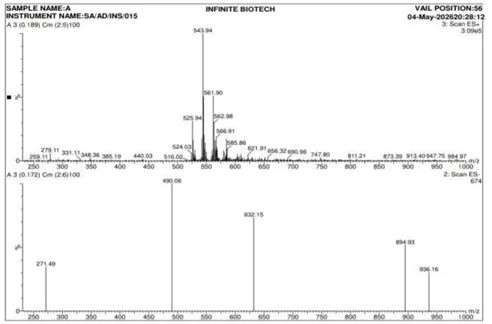
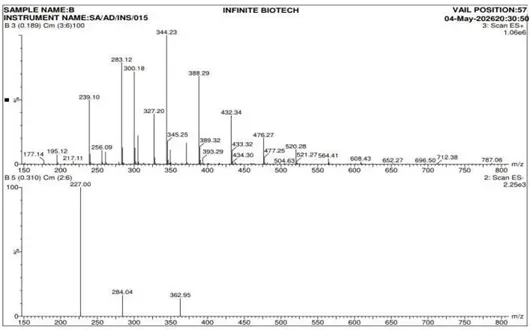
Figure.No.6:MassSpectroscopy(COMPA&B)
TableNo.7:InterpretationofCOMPAAndB
|
COM A |
COM B |
||
|
Peakm/z |
Interpretation |
Peakm/z |
Interpretation |
|
271.49 |
Lowmassfragment |
227.00 |
Basepeak |
|
490.06 |
Majorioninthelower spectrum |
239.10 |
Fragmentionformstheparent structure |
|
524.03 |
Fragmention |
256.09 |
Fragmention |
|
525.94 |
Significantionnearthemain peak cluster |
283.12 |
Significantfragmentmaycontainthe heterocycle |
|
543.94 |
Basepeak |
327.20 |
Largerfragmention |
|
561.90 |
Fragment ion |
344.23 |
PossibleMolecularion [19] |
Interpretation Comp A
The spectrum suggests a compound with amajorionatm/z ≈544, accompanied by sever alrelated fragment/adductionsandsomehigher-massspecies(possiblydimers).[18’19]
Interpretation Comp B
Thecorrespondingisotopepeakatm/z345.25supportsthepresenceofthismolecularspecies. Significant fragmentions atm/z283.12,300.18,and227.00indicateaconsistentfragmentationpattern arising from the parent molecule.[8’9’]
TLC Identification
TableNo-8TLC
|
Compound |
|
Distancetravel(in CM) |
R.FValue |
|
Compound A |
Solvent |
6.5 |
--- |
|
Benzoin |
5.9 |
0.90 |
|
|
A |
6.2 |
0.95 |
|
|
CompoundB |
Solvent |
6 |
--- |
|
O- Phenylenediamine |
5.5 |
0.91 |
|
|
B |
4.5 |
0.75 |
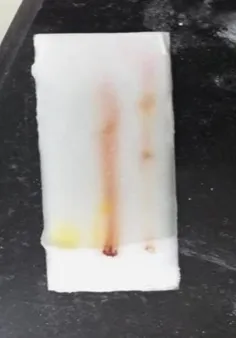
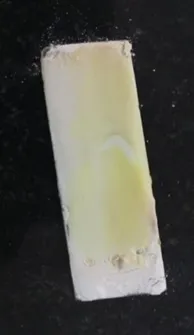
FigureNo7.CompA FigureNo-8CompB
RESULTS AND DISCUSSION
Themicrowave-assistedgreensynthesisofbioactiveheterocycliccompoundswassuccessfullycarriedout using environmentally benign reaction conditions. The selected heterocyclic derivative, benzimidazole, was synthesizedthroughthecondensationofo-phenylenediaminewithbenzaldehydeundermicrowaveirradiation. The reaction proceeded efficiently within a short time period of 2 –5 minutes, demonstrating a significant reduction in reaction time compared to conventional heating methods, which typically require several hours. The synthesize dproduct was obtainedas anoff-whitecrystallinesolidwithahighpercentage yield ranging from 80–95%. Themelting point of the purified compoundwas found to be in closeagreement with the reported literature value, indicating good purity and successful synthesis. Theproductwas characterized by spectroscopic techniques such as FTIR and NMR. FTIR analysis showed characteristic absorption bands corresponding to N–H stretching, C=Nstretching,andaromaticC=Cvibrations, confirming theformationofthebenzimidazoleringsystem.TheNMRspectrum furthersupportedtheproposedstructure by displaying signals attributable to aromatic protons and the benzimidazole nucleus.The microwave-assisted method offered several advantages, including rapid heating, uniform energy distribution, improved reaction efficiency,andreducedsolventconsumption.Theuseofethanolasagreensolventandmildcatalytic conditionsminimizedenvironmentalimpactandalignedwiththeprinciplesofgreenchemistry.Higher product yields and cleaner reaction profiles were observed compared to conventional synthetic methods.The resultsclearlydemonstratethatmicrowave-assistedgreensynthesisisaneffective,economical,and sustainable approach for the preparation of bioactive heterocyclic compounds. The synthesized benzimidazole derivative possesses potential pharmaceutical significance due to its known antimicrobial, antioxidant, anti - inflammatory, and anticancer activities. Therefore, this methodology can serve as a valuable platform for the development of novel heterocyclic compounds for medicinal and pharmaceutical applications. A comparison betweenconventionalandmicrowave-assistedmethodsrevealedseveraladvantagesofthemicrowave approach.Themicrowave-assistedmethodreducedreaction timefrom hours tominutes,improvedproduct yield, lowered energy consumption, and minimized solvent usage. In addition, the procedure was simple, reproducible,andcost-effective.Thesefindingsclearlydemonstratethesuperiorityofmicrowave-assisted green synthesis over traditional synthetic techniques.The synthesized benzimidazole derivatives are known to possessawiderangeofbiologicalactivities,includingantimicrobial,antioxidant,anti-inflammatory, antiviral,andanticancerproperties.Therefore,thedevelopedmethodologyprovidesanefficientplatform for hesynthesisofpharmaceuticallyimportantheterocycliccompounds.Theresultsobtainedinthisstudy supportthegrowingimportanceofmicrowave-assistedgreenchemistryasasustainableandpractical approachformodernmedicinalchemistryanddrugdiscoveryresearch.[14’15’18]
CONCLUSION
The present study demonstrates the successful application of microwave-assisted green synthesis for the preparation of bioactive heterocyclic compounds. The methodology proved to be an efficient andenvironmentally friendly alternative to conventional synthetic approaches. The synthesis of benzimidazole derivatives was achieved under microwave irradiation using green reaction conditions, resulting in significantly reduced reaction times and improved product yields. The use of eco-friendly solvents and mild reaction conditions minimized the generation of hazardous waste and supported the principles of sustainable chemistry. Microwave irradiation provided rapid and uniform heating, which enhanced reaction efficiency and facilitated the formation of the desired heterocyclic products within a few minutes. The synthesized compounds were obtained with good purity and satisfactory yields. Characterization studies, including melting point determination and spectroscopic analysis, confirmed the successful formation of the target heterocyclic structures. Overall,microwave-assistedgreensynthesisrepresentsapowerfulandsustainable tool for the development of bioactive heterocyclic compounds. The approach of fersa cost-effective, rapid, and environmentally responsible strategy for heterocyclic synthesis. Future studies may focus on the synthesis of novel derivatives and the evaluation of their biological activities to explore their potential as therapeutic agents.Therefore,microwave-assistedgreenchemistryprovidesapromisingplatformforadvancing medicinalchemistryandsustainablepharmaceuticalresearch. [1’11’17’16]
REFERENCES


Dr. Samrat Khedkar, Mahesh Pingale, Nikita Pol, Priyanka Chendke, Om Walke, A Microwave Assisted Green Synthesis of Bioactive Heterocycles, Int. J. of Pharm. Sci., 2026, Vol 4, Issue 6, 7606-7615, https://doi.org/10.5281/zenodo.21065643
 10.5281/zenodo.21065643