

We use cookies to ensure our website works properly and to personalise your experience. Cookies policy
1,2MBBS 5th year, Department of Pharmacology, Fergana Medical Institute of Public Health, Uzbekistan.
3Assistant Professor Department of Pharmacology, Fergana Medical Institute of Public Health, Uzbekistan.
The blood–brain barrier (BBB) remains the principal obstacle to pharmacological treatment of central nervous system (CNS) disorders, excluding more than 98% of small-molecule drugs and virtually all biologics from the brain parenchyma. Over the past decade, nanotechnology has emerged as the most versatile platform for circumventing this barrier, encompassing lipid-based, polymeric, inorganic, and biomimetic nanocarriers engineered for receptor-mediated transcytosis, adsorptive-mediated transcytosis, and stimuli-responsive release. This review synthesizes recent (2023–2026) primary and secondary literature on nanoparticle-mediated BBB crossing, covering BBB anatomy and physiology, the pathophysiological and pharmacokinetic challenges of brain drug delivery, major nanocarrier platforms and their mechanisms of transcytosis, surface engineering and ligand-conjugation strategies, stimuli-responsive and controlled-release systems, applications across neurodegenerative disease, glioma, stroke, and psychiatric disorders, the emerging role of artificial intelligence and machine learning in nanocarrier design, clinical translation and regulatory status, nanotoxicology and safety assessment, and persistent knowledge gaps. Receptor-targeted nanoparticles (e.g., transferrin-, LRP1-, and insulin-receptor-directed systems) and adjunct physical methods such as MRI-guided focused ultrasound with microbubbles have produced the most substantial preclinical and early clinical gains, including a recently reported survival benefit in glioblastoma when focused-ultrasound BBB opening is combined with standard chemotherapy. Nonetheless, clinical translation remains constrained by scale-up manufacturing, anti-PEG immunogenicity, incomplete regulatory guidance for nanomaterial-containing drug products, and unresolved questions about long-term neurotoxicity of nanomaterials that accumulate in neural tissue. We conclude that closing these gaps will require standardized characterization protocols, AI-guided rational design integrated with high-fidelity human-relevant BBB models, and
Nervous system disorders are frequently cited, across recent reviews summarized in this paper, as affecting a very large share of the global population and as a leading contributor
to disability-adjusted life years worldwide, a burden expected to grow as populations age and as diagnostic capture of neurodegenerative and psychiatric disease improves. Despite this scale, the number of approved disease-modifying (as opposed to purely symptomatic) CNS therapeutics remains small relative to oncology or cardiometabolic disease, a gap attributable in large part to the pharmacological inaccessibility of the target organ rather than to a lack of validated molecular targets.
Neurological and psychiatric disorders—including Alzheimer's disease (AD), Parkinson's disease (PD), glioblastoma, stroke, and schizophrenia—collectively represent one of the largest unmet burdens in modern medicine, yet pharmacotherapy for the CNS lags behind almost every other organ system. The rate-limiting step is transport: the blood–brain barrier (BBB) restricts more than 98% of small-molecule drugs and essentially all large-molecule biologics from reaching brain parenchyma at therapeutic concentrations.
Nanotechnology has become the dominant strategy for overcoming this barrier because nanoscale carriers can be engineered simultaneously for (i) protection of labile cargo (peptides, nucleic acids, unstable small molecules) in systemic circulation, (ii) prolonged circulation and reduced off-target clearance, (iii) active or passive targeting to brain endothelium and diseased tissue, and (iv) controlled or stimuli-triggered release once inside the CNS. Over the past three years the field has been reshaped by three converging developments: clinical validation of MRI-guided focused ultrasound (FUS) BBB opening, maturation of receptor-mediated transcytosis (RMT) ligand platforms beyond transferrin toward LRP1, insulin, and GLUT1 receptors, and the incorporation of artificial intelligence and machine learning into nanocarrier design and toxicity prediction.
This review synthesizes the current (2023–2026) primary literature and recent systematic reviews to provide an integrated account of BBB biology, delivery challenges, nanocarrier platforms and their transport mechanisms (including the growing intranasal and nucleic-acid/gene-editing subfields), surface engineering, stimuli-responsive systems, disease-specific applications spanning neurodegenerative disease, oncology, cerebrovascular disease, psychiatric disease, epilepsy, and neurogenetic disorders, AI-enabled design, clinical translation, safety, and open questions, closing with a forward-looking assessment of the field.
5. Anatomy and Physiology of the Blood–Brain Barrier
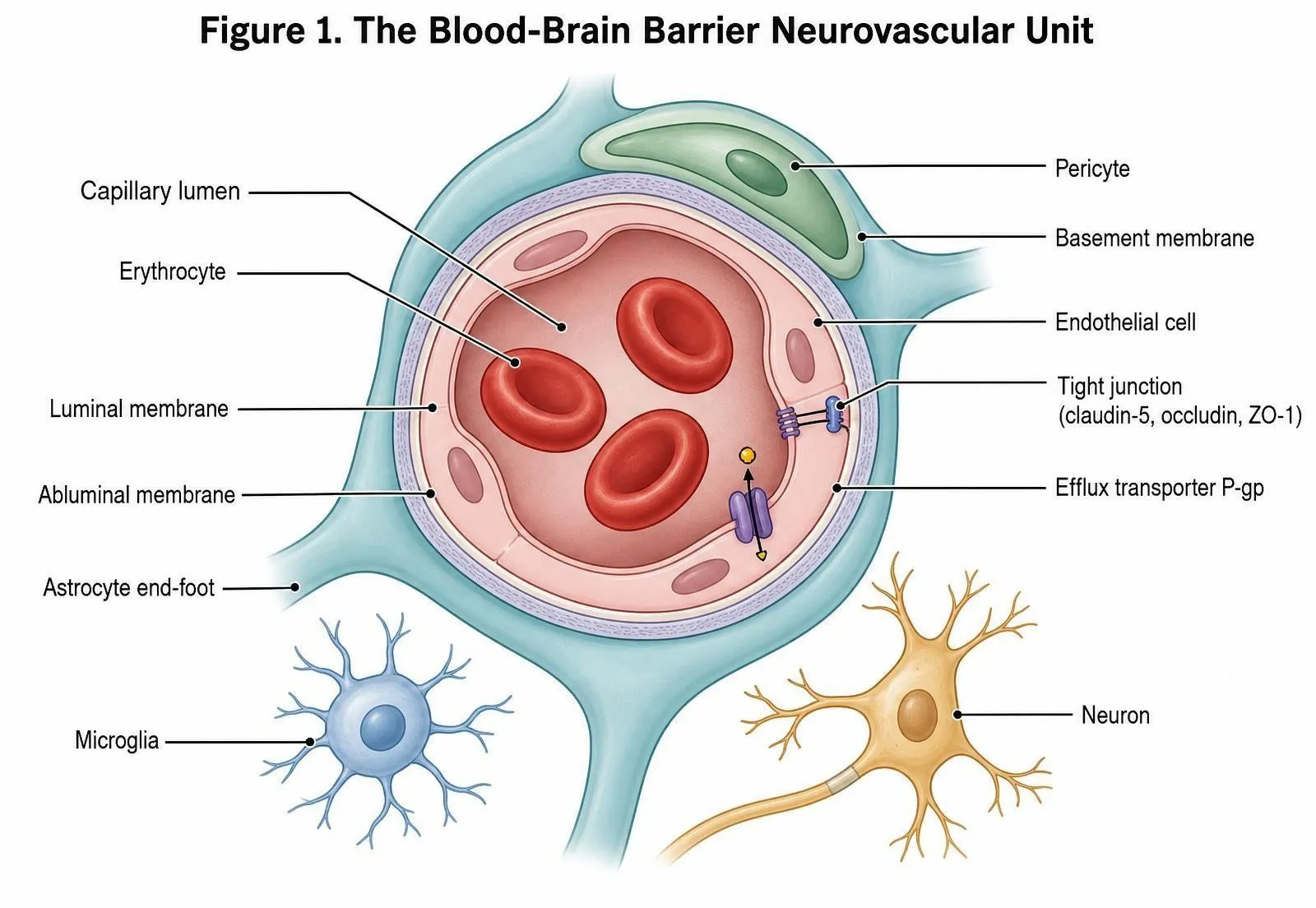
Figure 1: The Blood–Brain Barrier Neurovascular Unit. Labelled Components Include the Capillary Lumen and Erythrocytes, Endothelial Cells Sealed by Tight Junctions (Claudin-5, Occludin, ZO-1), Luminal and Abluminal Membranes, the P-glycoprotein Efflux Transporter, Basement Membrane, Pericytes, Astrocyte End-Feet, Microglia and Neurons.
The BBB is formed by specialized brain capillary endothelial cells (BCECs) joined by tight junctions (claudin-5, occludin, zonula occludens proteins) that abolish paracellular diffusion, and is functionally completed by pericytes embedded in the capillary basement membrane and astrocytic end-feet that ensheath more than 90% of the capillary surface. Together with a basement membrane and, in some formulations, perivascular microglia, these elements constitute the "neurovascular unit," which regulates ion and nutrient flux, restricts immune cell entry, and expresses a battery of efflux transporters (P-glycoprotein, BCRP, MRP family) that actively pump many xenobiotics—including nanoparticle-released small molecules—back into blood.
Physiological transport across intact BCECs occurs through several parallel routes: passive transcellular diffusion (restricted to small, lipophilic, low-hydrogen-bond-donor molecules obeying Lipinski-type rules), carrier-mediated transport for essential nutrients (glucose via GLUT1, amino acids via LAT1), receptor-mediated transcytosis (RMT) for larger endogenous ligands such as transferrin, insulin, and low-density lipoprotein, and adsorptive-mediated transcytosis (AMT) driven by electrostatic interaction between cationic macromolecules and the anionic luminal glycocalyx. Nanocarriers are engineered to hijack RMT and AMT
pathways rather than passive diffusion, because the latter is inaccessible to particles in the tens-to-hundreds-of-nanometer size range.
Understanding this baseline physiology is essential because most nanocarrier design parameters—size, shape, surface charge, and ligand density—are chosen specifically to engage or avoid these named transport systems, and because disease states (glioma, stroke, neuroinflammation) alter BBB integrity and transporter expression in ways that both create opportunities (e.g., enhanced permeability and retention in tumor-associated vasculature) and complicate rational design.
6. Challenges in Brain Drug Delivery
6.1 Physicochemical and pharmacokinetic barriers
Beyond the physical tight-junction barrier, systemically administered nanocarriers must survive opsonization and mononuclear phagocyte system (MPS) clearance in blood, avoid hepatic and splenic sequestration, and resist enzymatic and pH-driven degradation before ever reaching the brain capillary bed. Efflux transporters further reduce the effective free-drug concentration achieved after any successful transcytosis event.
6.2 Disease heterogeneity
BBB permeability differs markedly by disease and even by lesion within the same patient: glioblastoma exhibits a leaky, heterogeneous blood–tumor barrier permissive to modest passive accumulation at the tumor core but a largely intact BBB at the infiltrative margin, which is where recurrence originates; neurodegenerative diseases such as AD and PD are associated with subtle, progressive BBB dysfunction rather than frank breakdown; and ischemic stroke produces a narrow, time-limited window of increased permeability.
6.3 Preclinical model limitations
A substantial fraction of translational failure in BBB-crossing nanomedicine is attributable to the limited predictive validity of standard preclinical models. Static Transwell monocultures of immortalized brain endothelial cell lines, still widely used for early screening, systematically overestimate paracellular permeability and underrepresent efflux transporter activity relative to the in vivo BBB. Coculture models incorporating primary or induced pluripotent stem cell (iPSC)-derived brain endothelial cells with pericytes and astrocytes, and microfluidic "BBB-on-a-chip" platforms that reintroduce physiological shear stress, substantially improve barrier tightness (as measured by transendothelial electrical resistance, TEER) and better recapitulate RMT receptor expression, but remain far less widely adopted than static assays because of cost and throughput constraints. Rodent models, in turn, both overestimate and underestimate different aspects of human BBB permeability depending on the transport pathway and receptor orthology involved (transferrin receptor affinity, for example, differs substantially between rodent and human antibody-based ligands), which is one reason non-human primate and, increasingly,
human-derived in vitro systems are now recommended as bridging steps before first-in-human dosing for receptor-targeted biologics and nanocarriers.
6.4 Translational and manufacturing barriers
A 2025 systematic review of 77 advanced drug-delivery-system studies (2016–2025) found that successful clinical translation depended on matching carrier physicochemical properties to the specific barrier encountered, and identified reproducible microfluidic manufacturing, scalability, cost, and anti-PEG immunogenicity as recurring translational bottlenecks across nanocarrier classes, not only for CNS-targeted systems.
7. Nanotechnology Platforms for BBB Drug Delivery
7.1 Lipid-based nanocarriers
Liposomes and lipid nanoparticles (LNPs) are the most clinically advanced nanocarrier class, exploiting biocompatible phospholipid bilayers that can encapsulate hydrophilic cargo in an aqueous core or hydrophobic cargo within the bilayer. Cell-penetrating-peptide-and TAT-peptide-modified liposomes have shown severalfold increases in BBB penetration relative to unmodified liposomes in coculture BBB models, and hybrid cell-membrane-coated liposomes (e.g., platelet–chemokine-receptor hybrids) have achieved multitarget delivery that reduced amyloid plaque burden and neuroinflammation in transgenic AD mouse models.
7.2 Polymeric nanoparticles
Poly (lactic-co-glycolic acid) (PLGA), polybutylcyanoacrylate, chitosan, and PEG–PLGA copolymer nanoparticles offer tunable degradation kinetics and straightforward surface conjugation chemistry. T7-peptide-functionalized PLGA nanoparticles targeting the transferrin receptor have achieved approximately sixfold increases in brain delivery with measurable functional improvement in stroke and glioma models.
7.3 Inorganic and mesoporous silica nanoparticles
Gold, iron oxide, and mesoporous silica nanoparticles (MSNs) provide rigid, high-surface-area scaffolds amenable to "gated" stimuli-responsive release and to dual use as MRI/CT contrast agents, enabling theranostic applications. Iron oxide nanoparticles additionally allow magnetically guided accumulation and hyperthermia-triggered release.
7.4 Biomimetic carriers and extracellular vesicles
Exosomes and other small extracellular vesicles are increasingly explored as "natural" nanocarriers because their endogenous membrane composition confers innate BBB-crossing capacity and reduced immunogenicity; engineering exosomes to express RMT ligands such as an LDL-receptor-targeting apolipoprotein B fragment has been shown to
enhance CNS delivery in preclinical models. Cell-membrane-coated and other biomimetic nanoparticles similarly exploit endogenous trafficking pathways to reduce opsonization and MPS clearance.
7.5 Dendrimers
Dendrimers are hyperbranched, monodisperse macromolecules whose generation number, core chemistry, and surface functionality can be tuned with a precision unavailable to most other nanocarrier classes. Polyamidoamine (PAMAM) dendrimers, the first and most widely studied family, allow drug encapsulation within the dendrimeric core or conjugation/complexation at the surface. Cationic, amine-terminated dendrimers show concentration-dependent cytotoxicity linked to membrane disruption, whereas carboxylic-acid- or hydroxyl-terminated and mixed-surface (e.g., G4 70/30) dendrimers are markedly more biocompatible while retaining efficient CNS uptake; a 2026 ACS Chemical Neuroscience study demonstrated non-invasive brain delivery of mixed-surface PAMAM dendrimers via the intranasal route, with proposed extensions to co-delivery of small molecules and gene therapies in models of Alzheimer's disease, glioblastoma, Huntington's disease, and Parkinson's disease. Dendrimer-based platforms have also been explored specifically for glioma, where their small, tunable size and high surface-ligand density support both BBB/blood–tumor-barrier crossing and multivalent receptor engagement.
7.6 Carbon-based nanomaterials and quantum dots
Carbon nanotubes, graphene oxide, and carbon dots offer very high surface-area-to-volume ratios, intrinsic near-infrared optical properties useful for imaging and photothermal therapy, and versatile covalent/non-covalent surface functionalization. However, of all nanocarrier classes reviewed here, carbon-based nanomaterials and certain quantum dots are the most frequently implicated in preclinical neurotoxicology studies (see Section 14), owing to their poor biodegradability and propensity for long-term tissue persistence, which currently limits their translational trajectory relative to lipid, polymeric, and biodegradable inorganic platforms.
7.7 Nucleic acid and gene-editing nanocarriers
A rapidly growing platform category is purpose-built for delivering RNA- and DNA-based therapeutics—small interfering RNA (siRNA), antisense oligonucleotides, messenger RNA (mRNA), plasmid DNA, and CRISPR-Cas gene-editing components—across the BBB. Ionizable-lipid LNPs, structurally related to those validated in mRNA vaccines, remain the most clinically advanced nucleic-acid carrier; a 2026 BioDrugs review catalogued their use for antisense oligonucleotides, siRNA, mRNA, plasmid DNA, and CRISPR-Cas cargo in CNS indications, including CasRx-mediated knockdown of mutant huntingtin mRNA that ameliorated gliosis in Huntington's disease mouse and pig models. Combinatorial libraries of biodegradable ionizable lipids optimized specifically for CNS delivery via intrathecal administration have been reported as recently as late 2025, reflecting continued rapid iteration in this subfield.
Beyond LNPs, bioinspired nanovesicles, virus-like particles, protein-based carriers, and inorganic nanoparticles have all been applied to CNS-targeted genetic therapy, exploiting paracellular transport, RMT, and micropinocytosis to reach lesion-specific or subcellularly localized targets. A representative example is a reactive-oxygen-species-responsive lipid nanoparticle loaded with a CRISPR-Cas9 system targeting the MDK gene in glioblastoma, in which the ROS-rich tumor microenvironment itself triggers intracellular cargo release and gene knockout, significantly inhibiting tumor growth in preclinical models. A 2025 review of RNA delivery to brain cancer further emphasized that ligands such as GLUT1-, RVG-peptide-
, and ApoE-mimetic-peptide-targeting, combined with non-invasive adjuncts such as focused ultrasound, are likely to be critical for translating RNA and CRISPR therapeutics from non-CNS clinical successes (e.g., mRNA vaccines, hepatic siRNA drugs) into brain-directed indications. Prenatal and early-postnatal gene editing is an emerging frontier: densely PEGylated, acid-degradable LNPs have achieved substantial CRISPR-mediated genetic modification across the fetal mouse brain following in utero delivery, with minimal toxicity, suggesting a possible future preventive strategy for genetic neurodevelopmental disorders, though substantial ethical and safety evaluation would precede any human application.
7.8 Comparative considerations
No single platform dominates across all indications: lipid-based systems remain the most clinically mature and manufacturable, and are now the leading platform for nucleic-acid and gene-editing cargo; polymeric systems allow the most versatile surface chemistry; dendrimers offer unmatched precision in size, valency, and multifunctionality; inorganic platforms are best suited to combined imaging/therapy and externally triggered release; carbon-based platforms offer powerful imaging and photothermal capability but the least favorable biodegradability profile; and biomimetic/extracellular-vesicle systems offer the lowest immunogenicity but the greatest manufacturing and batch-consistency challenges.
8. Mechanisms of BBB Crossing
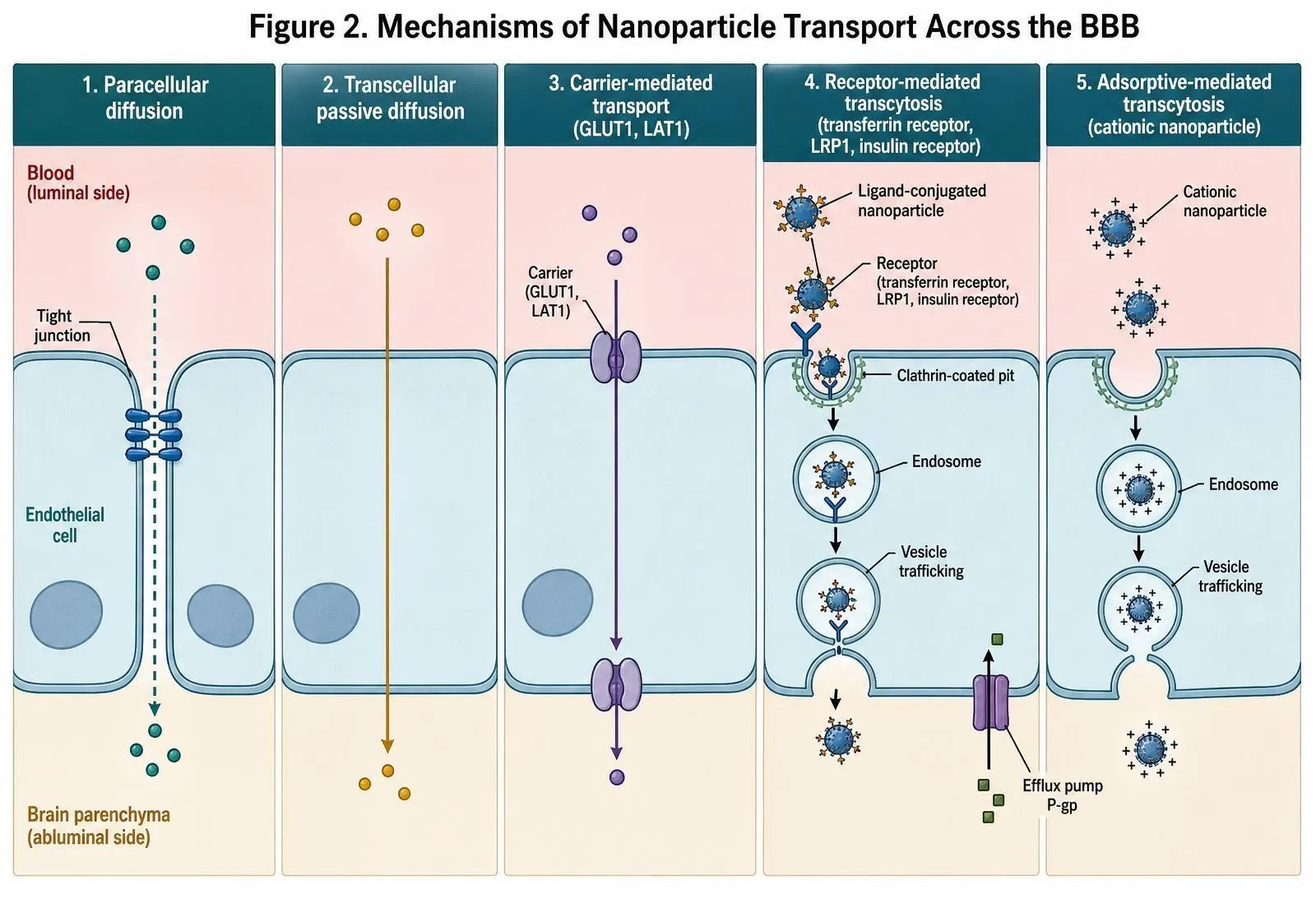
Figure 2: Mechanisms of Nanoparticle and Solute Transport Across the BBB: Paracellular Diffusion, Transcellular Passive Diffusion, Carrier-Mediated Transport (GLUT1, LAT1), Receptor-Mediated Transcytosis (Transferrin Receptor, LRP1, Insulin Receptor) via Clathrin-Coated Pits, Endosomes and Vesicular Trafficking, and Adsorptive-Mediated Transcytosis of Cationic Nanoparticles, with P-gp Efflux Shown.
Nanoparticles cross the intact or disease-modified BBB through several documented mechanisms. Receptor-mediated transcytosis (RMT) remains the most clinically validated active-targeting strategy, achieving preclinical brain delivery efficiencies on the order of 0.1–1% injected dose per gram (ID/g) for classical transferrin-receptor-targeted systems, and up to 17.2% ID/g for optimized receptor-targeted nanoparticles in preclinical glioma models. Key RMT receptors include the transferrin receptor (TfR1/CD71), low-density lipoprotein receptor-related protein 1 (LRP1, engaged by the Angiopep-2 peptide), insulin receptor, and GLUT1 (engaged under hypoglycemic conditions by glucose-decorated nanocarriers, which increases luminal Glut1 expression and transcytosis).
Adsorptive-mediated transcytosis (AMT) exploits electrostatic attraction between cationic nanoparticle surfaces and the anionic endothelial glycocalyx; it offers higher capacity but lower specificity than RMT and can increase off-target and peripheral toxicity. Carrier-mediated transport can be hijacked for very small nanostructures or nanoparticle-drug conjugates resembling endogenous nutrient substrates.
Transient barrier modulation represents a complementary, carrier-independent mechanism: MRI-guided focused ultrasound (FUS) combined with intravenously administered microbubbles produces mechanical oscillation and transient, reversible opening of tight junctions in a precisely targeted brain region, allowing co-administered or nanoparticle-encapsulated drugs of a wide size range to enter the parenchyma without requiring active ligand targeting. Clinically, FUS-mediated BBB opening has now progressed to multicenter phase 1/2 trials in glioblastoma using devices such as InSightec's ExAblate Neuro and Carthera's implantable SonoCloud, and a 2025 open-label phase 1/2 trial reported that combining FUS BBB opening with standard temozolomide chemotherapy was safe and associated with a likely survival benefit relative to a matched historical control cohort (34 treated patients versus 185 matched controls).
Nanoparticle physicochemical parameters modulate all of these mechanisms: hydrodynamic diameter (typically 20–200 nm for effective transcytosis while avoiding rapid renal clearance or MPS uptake), shape (discoidal geometries have shown enhanced transit attributed to greater membrane-interaction surface area and favorable trafficking orientation), surface charge (near-neutral to slightly cationic surfaces balance AMT engagement against opsonization risk), and mechanical stiffness.
8.1 Quantifying and imaging nanoparticle BBB crossing
Rigorous comparison across the mechanisms above depends on consistent quantification, and the literature has converged on a small set of standard metrics and imaging modalities. Injected-dose-per-gram (%ID/g) of brain tissue, typically measured by radiolabeling or fluorescence quantification of harvested tissue, remains the primary preclinical brain-uptake metric, though it does not by itself distinguish intravascular/endothelial-bound nanoparticle from material that has fully transcytosed into parenchyma—a distinction increasingly resolved using intravital two-photon microscopy or serial optical clearing and light-sheet imaging of whole-brain tissue in rodent studies. Dynamic contrast-enhanced MRI and PET-based approaches (using radiolabeled nanocarriers or, for FUS studies, gadolinium-based contrast agents as an opening surrogate) provide translatable, non-terminal readouts usable in both large-animal and early human studies. Transendothelial electrical resistance (TEER) and permeability coefficients for marker molecules (e.g., Lucifer yellow, sodium fluorescein) remain the standard in vitro correlates of barrier integrity in the coculture and microfluidic models discussed in Section 6.3, allowing nanoparticle transport data to be normalized against a defined barrier-tightness baseline rather than reported in isolation.
A mechanistically distinct strategy avoids the BBB altogether by exploiting the direct anatomical connection between the nasal cavity and the CNS via the olfactory and trigeminal nerve pathways. Intranasally administered nanocarriers can travel along olfactory and trigeminal neuronal and perineural (extracellular) pathways to reach the cerebrospinal fluid and brain parenchyma within minutes to hours, circumventing both the BBB and first-pass hepatic metabolism. A range of nanocarrier chemistries has been adapted to this route, including polymeric nanomicelles (optimal size range approximately
30–150 nm), nanoemulsions, niosomes, transfersomes, polymeric nanogels, and dendrimers; a 2025 MedComm review characterized nose-to-brain delivery as enabling CNS access for small molecules, biologics, and nucleic acids alike across neurodegenerative and psychiatric indications.
Nose-to-brain delivery is attractive because it is non-invasive, avoids systemic circulation (and therefore much of the opsonization, hepatic clearance, and off-target toxicity risk associated with intravenous nanocarriers), and permits self-administration, but it is constrained by the small nasal mucosal surface area and short residence time available for absorption, mucociliary clearance, and enzymatic degradation within the nasal cavity, and by a payload capacity generally more limited than intravenous delivery. It has been explored across the same major disease areas covered in Section 11, including antiepileptic small molecules (clonazepam, lorazepam, diazepam, lamotrigine, oxcarbazepine) delivered via PLGA and other polymeric nanoparticles, and multivalent bioadhesive nanoparticle clusters designed to protect against cerebral ischemic reperfusion injury following intranasal administration.
9. Surface Engineering Strategies
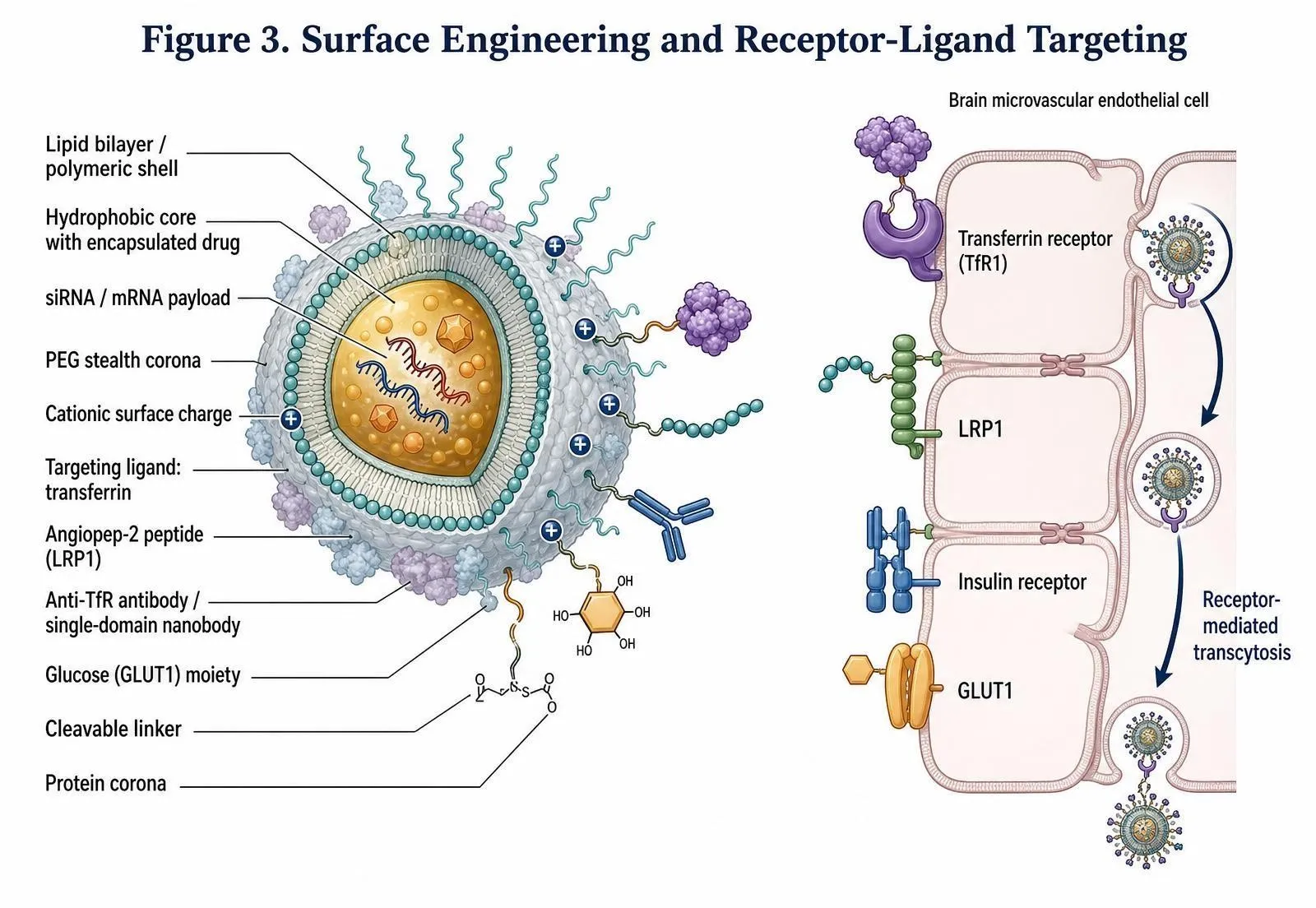
Figure 3: Surface Engineering and Receptor–Ligand Targeting of Brain-Directed Nanocarriers. Labelled Features: Lipid Bilayer/Polymeric Shell, Hydrophobic Drug Core, siRNA/mRNA Payload, PEG Stealth Corona, Cationic Surface Charge, Transferrin, Angiopep-2 (LRP1), Anti-
TfR antibody/nanobody, glucose (GLUT1) moiety, cleavable linker and protein corona, engaging TfR1, LRP1, insulin receptor and GLUT1 for receptor-mediated transcytosis.
Conjugating receptor-specific ligands to the nanoparticle surface is the principal strategy for converting a passively circulating carrier into an actively BBB-targeted one. Ligand classes include monoclonal antibodies and antibody fragments (e.g., anti-TfR antibodies), endogenous proteins (transferrin, lactoferrin, melanotransferrin), small peptides (Angiopep-2 for LRP1; T7 and other TfR-binding peptides; cell-penetrating peptides such as TAT), aptamers, and small-molecule ligands (folate, glucose, mannose).
Peptides have become particularly favored ligands because of their ease of synthesis, low intrinsic cytotoxicity, and amenability to multi-receptor and dual-targeting designs; combining two distinct targeting peptides on a single liposome (dual-functionalized systems) has outperformed single-ligand analogs in comparative BBB-crossing efficiency assays. PEGylation remains a near-universal adjunct strategy: the hydrophilic PEG shield reduces opsonization and reticuloendothelial clearance, extends circulation half-life, and can itself serve as a spacer/linker for ligand conjugation—though anti-PEG antibody responses upon repeat dosing are an increasingly recognized translational liability.
Folate-receptor targeting illustrates an important nuance in ligand selection: folate-mediated transcytosis is not a significant pathway across the healthy, intact BBB, yet folate receptors are selectively upregulated in brain tumor vasculature, allowing folate-conjugated nanoparticles to achieve tumor-selective BBB bypass with limited effect on surrounding healthy brain tissue—an example of disease-state-dependent ligand rationale rather than a universal targeting solution.
9.1 Antibody-based ligands and "brain shuttle" formats
Antibody-based targeting has evolved beyond simple anti-receptor monoclonal conjugation toward engineered "brain shuttle" formats designed to solve a specific problem of RMT biology: high-affinity, bivalent antibodies against the transferrin receptor tend to become trapped in the endothelial cell (excessive receptor engagement impairs release and recycling), whereas monovalent or low-to-moderate affinity binding formats transcytose more efficiently. This affinity-engineering principle, established for antibody-drug and antibody-oligonucleotide constructs, is now being applied to nanoparticle surface density optimization: nanocarriers over-decorated with high-affinity ligand achieve strong initial endothelial binding but poor net brain parenchymal delivery, while an intermediate ligand density and affinity window tends to maximize net transcytosis. This nonlinear, "affinity/avidity ceiling" relationship is an increasingly important, if still incompletely standardized, design parameter across antibody-, peptide-, and aptamer-conjugated nanocarriers alike.
Multivalent and dual-ligand designs (Section 9) partially sidestep this ceiling by distributing binding across two distinct receptors or epitopes, and bispecific antibody formats—one arm engaging the RMT receptor for transport, the other engaging the therapeutic target once inside the brain—represent a conceptually related, nanoparticle-adjacent strategy
increasingly used as either a stand-alone modality or a nanocarrier surface ligand in its own right.
10. Controlled and Stimuli-Responsive Drug Delivery
Beyond crossing the BBB, therapeutic success requires that payload release be spatially and temporally controlled once the carrier reaches its target. Stimuli-responsive nanocarriers achieve this using endogenous triggers—pH gradients (e.g., the mildly acidic tumor or endosomal microenvironment), redox potential (elevated glutathione in tumor cytosol), overexpressed enzymes (matrix metalloproteinases in glioma), and hypoxia—or exogenous triggers such as externally applied light, alternating magnetic fields, temperature, and ultrasound.
Mesoporous silica nanoparticles are a widely used scaffold for "gated" stimuli-responsive release: pH-sensitive MSN systems functionalized with transferrin gatekeepers, for example, remain closed at physiological pH but open under the acidic conditions typical of the tumor microenvironment, enabling on-demand, site-specific release. Magnetic nanoparticles allow externally triggered hyperthermia-based release under an alternating magnetic field, and photothermal/photodynamic nanoplatforms allow light-triggered release with additional therapeutic (ablative) effect.
A 2026 review of nanoparticle-based CNS therapeutics for psychiatric and neurological disorders emphasized that release-modulation mechanisms—diffusion, matrix erosion, ligand desorption, and stimulus-triggered release—should ideally be matched to disease chronobiology and to a defined therapeutic window balancing on-target efficacy against neuro- and cardiopulmonary toxicity, underscoring that stimuli-responsiveness is not merely a delivery refinement but a determinant of the safety margin for CNS-targeted nanomedicines.
11. Applications in Neurological Disorders
11.1 Alzheimer's disease
Nanoparticle strategies in AD have focused on both symptomatic drug delivery and disease-modifying interventions targeting amyloid-beta and tau pathology. Lipid-based, polymeric, and inorganic nanoparticles have been surface-modified to enhance BBB permeability and target amyloid-beta oligomers, plaques, and phosphorylated tau tangles; hybrid-cell-membrane liposomes carrying dual-mechanism drug combinations have reduced amyloid deposition, neuroinflammation, and cognitive impairment in transgenic AD mouse models. Clinically, FUS-mediated BBB opening trials in mild AD have reported safe, tolerable opening volumes with measurable, if modest, reductions in amyloid PET signal and improvements in caregiver-reported neuropsychiatric outcomes, though not in standard cognitive screening scores.
Beyond amyloid- and tau-targeted delivery, nanoparticle platforms have also been applied to restore BBB-associated clearance mechanisms themselves in AD, on the rationale that impaired LRP1-mediated efflux of amyloid-beta from brain to blood contributes to plaque accumulation; LRP1-engaging nanocarriers designed to enhance rather than merely traverse this receptor's native efflux function represent a mechanistically distinct "barrier-restoring" strategy alongside the more conventional "barrier-crossing, drug-delivering" paradigm that dominates the rest of this review. Cholinesterase-inhibitor and NMDA-receptor-antagonist (the two current symptomatic AD drug classes) nanoparticle reformulations have also been explored primarily to improve brain bioavailability and reduce peripheral cholinergic side effects rather than to enable fundamentally new mechanisms of action.
11.2 Parkinson's disease
PD-focused nanocarrier research targets α-synuclein clearance and restoration of dopaminergic signaling; cationic-peptide-modified nanoparticles have been proposed to exploit BBB-associated changes in anionic surface glycoprotein expression to deliver α-synuclein scavengers or anti-inflammatory agents via electrostatic (adsorptive-mediated) targeting. FUS-BBB-opening pilot trials combined with enzyme-replacement therapy (β-glucocerebrosidase) in PD are ongoing.
11.3 Glioblastoma and brain tumors
Glioma remains the most clinically advanced application of BBB-crossing nanotechnology, benefiting both from partial native blood–tumor barrier permeability and from validated adjunct FUS opening. Receptor-targeted nanoparticles (TfR-, LRP1-, and folate-receptor-directed) combined with chemotherapy have demonstrated substantially enhanced brain/tumor uptake in preclinical models, and the 2025 multicenter FUS-plus-temozolomide phase 1/2 trial reported the first clinical evidence of a survival benefit from BBB-opening-enhanced chemotherapy delivery in newly diagnosed glioblastoma, with treated patients surviving approximately 40% longer than a matched historical control cohort receiving chemotherapy alone, no treatment-related deaths, and only one FUS-related adverse event exceeding grade 2 across 34 treated patients and 972 individual sonication procedures.
Complementary device-based approaches are progressing in parallel: Carthera's implantable SonoCloud device is being evaluated in the multicenter SONOBIRD trial to enable repeated, outpatient FUS-mediated BBB opening for temozolomide delivery in recurrent glioblastoma, and a pediatric feasibility study (FIDES, not yet recruiting as of mid-2026) is designed to extend FUS-enhanced temozolomide delivery to pontine diffuse midline glioma, a pediatric brainstem tumor for which the intact BBB has historically been a dominant barrier to effective chemotherapy. A 2024 systematic review of FUS clinical trials in brain tumors, covering PubMed and ClinicalTrials.gov records through late 2023, characterized the field as transitioning from single-center feasibility studies toward multicenter efficacy trials, while flagging standardization of opening-volume measurement
and dose–response characterization as continuing methodological priorities—needs partly addressed by the acoustic-emission-based opening-prediction method reported in 2025.
11.4 Stroke
The narrow post-ischemic window of increased BBB permeability has been exploited for time-limited passive nanoparticle accumulation, while actively targeted (TfR-peptide-conjugated PLGA) nanoparticles have shown improved functional recovery in preclinical stroke models by combining enhanced brain delivery with neuroprotective or thrombolytic cargo.
11.5 Psychiatric disorders
Nanocarrier applications in psychiatric disease remain earlier-stage but growing, motivated by the need to improve CNS bioavailability of antipsychotics and mood stabilizers while reducing peripheral side effects; a 2026 Molecular Psychiatry review of nanoparticle-based CNS therapeutics frames dose–response characterization, release-mechanism selection, and matching of pharmacokinetics to disease chronobiology as central design considerations for this emerging application area.
11.6 Epilepsy, multiple sclerosis, and traumatic brain injury
Intranasal polymeric-nanoparticle formulations of established antiepileptic drugs (clonazepam, lorazepam, diazepam, lamotrigine, oxcarbazepine) have been developed to improve seizure-control onset and reduce systemic exposure relative to oral or intravenous dosing. In multiple sclerosis and other neuroinflammatory conditions, stimuli-responsive nanomedicines have been designed to respond to the inflamed-tissue microenvironment itself (elevated ROS, altered pH, upregulated adhesion molecules) to achieve lesion-selective anti-inflammatory or remyelinating drug release. In traumatic brain injury and cerebral ischemic reperfusion injury, multivalent bioadhesive nanoparticle clusters administered intranasally have shown neuroprotective effect in preclinical injury models, exploiting the acute, time-limited increase in nasal and BBB permeability that follows injury.
11.7 Neurogenetic and neurodevelopmental disorders
Gene-editing and RNA-modulating nanocarriers (Section 7.7) are beginning to be applied directly to monogenic and neurodevelopmental CNS disorders, including Huntington's disease (CasRx-mediated mutant-huntingtin mRNA knockdown), Angelman syndrome, and, at the preclinical proof-of-concept stage, in utero correction of neurodevelopmental gene defects via acid-degradable LNP-mediated mRNA delivery to the fetal brain. These applications remain considerably earlier in development than the small-molecule and antibody-based platforms discussed above and will require extensive additional safety and ethical evaluation before clinical translation.
12. AI and Machine Learning in Brain Nanomedicine
AI and machine learning are increasingly integrated across the nanomedicine development pipeline, from target identification through nanocarrier design, toxicity prediction, and personalized dosing. A 2025 Advanced Materials perspective proposed an integrated "AI-driven nanoarchitectonics" framework combining bioinformatic target profiling, machine-learning-guided surface-chemistry optimization, and in silico simulation of delivery dynamics to enable adaptive, feedback-informed nanocarrier design rather than purely empirical formulation.
Quantitative structure–activity relationship (QSAR) models, physiologically based pharmacokinetic (PBPK) modeling, agent-based modeling, and emerging deep learning and graph neural network approaches have been applied to predict nanoparticle–biological interactions, endosomal escape efficiency, and pharmacokinetic/pharmacodynamic behavior, shortening design–test iteration cycles relative to trial-and-error formulation. High-throughput approaches such as DNA-barcoded nanoparticle libraries and large-scale protein-corona proteomic screening have been highlighted as particularly promising for connecting nanoparticle design variables to in vivo performance data at a scale amenable to machine learning.
Nonetheless, a 2025 WIREs Nanomedicine and Nanobiotechnology review cautioned that data standardization, model generalizability across nanoparticle chemistries, and the absence of dedicated FDA guidance addressing the intersection of AI and nanomedicine remain significant barriers to translating AI-guided design into approved CNS-targeted products, and called for harmonized data-sharing standards and rigorous in vivo validation of model predictions.
12.1 Generative design and image-based analytics
A second, complementary AI application area concerns generative and structure-based design: generative algorithms proposed for nanocarrier formulation optimization aim to suggest lipid, polymer, or ligand combinations predicted to satisfy multiple simultaneous constraints (size, charge, ligand density, degradation rate, target-receptor affinity) rather than requiring exhaustive combinatorial screening. A 2026 Journal of Pharmaceutical Innovation review situated this generative approach within the broader landscape of AI-enabled molecular design and precision therapeutics, noting its particular value for narrowing very large formulation spaces (e.g., combinatorial ionizable-lipid libraries of the kind used for CNS-targeted LNP gene-editing carriers, Section 7.7) before experimental validation.
Image-based machine learning is being applied on the clinical-monitoring side as well: acoustic-emission signal analysis to predict and titrate FUS-mediated BBB opening in real time (Section 8), and automated quantification of amyloid/tau PET and dynamic contrast-enhanced MRI biomarkers, both represent applications of pattern-recognition AI to the translational and safety-monitoring pipeline rather than to nanocarrier design itself,
illustrating that AI's role in this field now spans discovery, formulation, and clinical deployment stages rather than being confined to preclinical optimization alone.
13. Clinical Translation
Clinical translation of BBB-crossing nanomedicines is most advanced for lipid-based systems (which benefit from decades of liposomal and lipid-nanoparticle manufacturing experience from oncology and mRNA-vaccine applications) and for FUS-based physical BBB opening, which has now reached multicenter phase 1/2 evaluation in glioblastoma with a reported survival signal, alongside ongoing feasibility trials in Alzheimer's disease, Parkinson's disease, and pediatric diffuse midline glioma.
A 2025 systematic review covering 77 advanced-drug-delivery-system studies (2016–2025) concluded that clinical translation success correlates most strongly with matching carrier physicochemical design to the specific biological barrier encountered, and identified microfluidic/continuous manufacturing as enabling improved reproducibility, while scalability, production cost, and anti-PEG immunogenicity remained the dominant unresolved translational barriers across nanocarrier classes, not specific to CNS indications alone.
Beyond manufacturing, CNS-targeted nanomedicines face the added translational burden of demonstrating target engagement and pharmacodynamic effect behind an intact or only transiently opened barrier, which has driven increased reliance on quantitative imaging biomarkers (amyloid and tau PET, dynamic contrast-enhanced MRI, acoustic-emission-based prediction of FUS opening) as surrogate translational endpoints.
Route of administration is itself an increasingly important translational variable. Intravenous receptor-targeted and FUS-adjunct nanomedicines carry the manufacturing, immunogenicity, and biodistribution burdens discussed above but allow the largest formulation design space; intranasal (nose-to-brain) nanocarriers offer a non-invasive, potentially self-administered alternative with a more constrained payload and a distinct set of nasal-mucosa-specific formulation and regulatory requirements; and intrathecal administration, now used for several approved non-nanoparticle CNS oligonucleotide therapies, is emerging as a validated route specifically for biodegradable LNP-based gene-editing cargo, trading invasiveness for direct cerebrospinal fluid access and reduced systemic exposure. Selecting among these routes is disease- and cargo-specific rather than universal, and several concurrent clinical and late preclinical programs are now directly comparing intravenous-FUS, intranasal, and intrathecal nanocarrier delivery for the same therapeutic targets.
Regulatory pathway selection interacts closely with all of the above: nanomaterial-containing CNS drug products in the United States are generally reviewed as combination products or under standard IND/NDA pathways with nanomaterial-specific characterization expectations layered on via the FDA's 2024 nanomaterials guidance (Section 14), while device-led approaches such as FUS systems are reviewed primarily through the medical-
device pathway (the ExAblate Neuro platform, for instance, holds device-level approval for tissue ablation indications, with BBB-opening indications evaluated as a distinct, lower-energy application of the same hardware). This bifurcation between drug-product and device-product regulatory tracks, even for therapies that are conceptually a single combined intervention (nanocarrier plus FUS), is itself a translational complexity specific to physically adjunctive BBB-crossing strategies and is not yet addressed by harmonized combination-product guidance specific to CNS indications.
14. Safety and Toxicity
Nanocarrier neurotoxicity is an actively investigated safety concern precisely because the design features that enable BBB crossing—small size, high surface reactivity, and, for cationic or AMT-targeted systems, strong membrane interaction—can also promote unwanted neural tissue accumulation and injury. Documented mechanisms of nanoparticle-induced neurotoxicity include oxidative stress, mitochondrial dysfunction, DNA damage, activation of apoptotic pathways, disruption of cholinergic and purinergic signaling, and induction of neuroinflammation, with metal-based (iron oxide, silver, titanium dioxide) and carbon-based (carbon nanotube, graphene oxide) nanomaterials most frequently implicated in preclinical neurotoxicology studies.
Regulatory response has begun to catch up with this concern: in 2024 the U.S. FDA updated its guidance on "Considerations for Drug Products that Contain Nanomaterials," specifically emphasizing physicochemical characterization, toxicity and immunogenicity assessment, and appropriate regulatory pathway selection (IND/NDA) for CNS-targeted nanomedicines, while the European Medicines Agency has reaffirmed a parallel risk-based approach. A 2024 ScienceDirect review of nanocarrier neurotoxicity and safety assessment strategies argued that clinical translation ultimately hinges on biocompatibility data generated under standardized, disease-relevant conditions, given that nanocarrier accumulation and persistence in neural tissue can differ substantially between healthy and diseased brain.
Practical safety strategies discussed in the literature include minimizing use of persistent, non-biodegradable inorganic cores where biodegradable lipid or polymeric alternatives are feasible, limiting repeat-dose PEG exposure to reduce anti-PEG immune sensitization, and incorporating dose–response and hysteresis mapping into preclinical pharmacology to detect tolerance or unwanted depot effects beforefirst-in-human study.
Nucleic-acid and gene-editing nanocarriers raise additional, platform-specific safety considerations beyond conventional small-molecule delivery: off-target gene editing, prolonged or uncontrolled transgene/Cas9 expression, and the immunogenicity of both the ionizable lipid components and the delivered nucleic acid cargo itself. Biodegradable ionizable-lipid design (e.g., ester- or acid-degradable linkages) is increasingly used specifically to mitigate LNP-associated toxicity by ensuring carrier clearance after cargo release, and ROS- or pH-responsive release strategies are used to confine CRISPR-Cas activity to the diseased microenvironment (e.g., the tumor) rather than healthy surrounding
brain tissue. Cationic, amine-terminated dendrimers illustrate a parallel structure–toxicity relationship: their membrane-disruptive cytotoxicity is concentration- and surface-chemistry-dependent, and can be substantially mitigated through mixed or anionic surface functionalization without eliminating CNS uptake efficiency.
Immunogenicity assessment for CNS-targeted nanomedicines must additionally account for the CNS's own distinctive immune environment: while the brain was historically considered "immune-privileged," the discovery of meningeal lymphatic vessels and the demonstrated capacity of nanocarrier-associated antigens to elicit peripheral immune responses (notably anti-PEG antibodies and, for viral-vector-adjacent platforms such as virus-like particles, anti-capsid responses) mean that repeat-dose CNS nanomedicine programs increasingly incorporate baseline and on-treatment anti-drug-antibody and anti-excipient antibody monitoring as a standard safety endpoint, an approach directly analogous to established biologics immunogenicity assessment and increasingly expected by regulators for nanomaterial-containing CNS products.
15. Current Challenges and Knowledge Gaps
16. Future Perspectives
The convergence of receptor-targeted nanocarrier chemistry with clinically validated physical BBB-opening methods (FUS) is likely to define the next generation of combination CNS delivery strategies, potentially allowing lower systemic doses, reduced off-target toxicity, and disease-stage-adapted opening protocols guided by real-time acoustic-emission feedback. AI-driven nanoarchitectonics frameworks, if validated against harmonized experimental datasets, could substantially compress design–test–optimize cycles and enable more individualized nanocarrier formulations matched to patient-specific BBB permeability and target expression profiles.
Biomimetic and extracellular-vesicle platforms are positioned to address immunogenicity limitations of synthetic carriers, provided manufacturing and characterization standardization can be achieved. Finally, regulatory science will need to evolve in parallel—both to define nanomaterial-specific safety and characterization standards for CNS products and to establish frameworks for evaluating AI-guided design and manufacturing processes—if the substantial preclinical progress summarized in this review is to translate into approved therapies at a pace commensurate with the unmet clinical need.
Looking further ahead, three trends appear likely to shape the next five years of the field. First, route diversification will likely continue, with intravenous-FUS, intranasal, and intrathecal delivery increasingly positioned as complementary rather than competing options selected according to cargo class, disease chronicity, and desired invasiveness, rather than a single "best" route emerging for all indications. Second, nucleic-acid and gene-editing nanocarriers are likely to expand from their current concentration in oncology and rare monogenic disease toward broader neurodegenerative applications, contingent on resolving the off-target editing, durability, and immunogenicity questions specific to this cargo class. Third, the field will likely see growing emphasis on combination regimens—receptor-targeted nanocarriers used together with transient physical BBB modulation, or dual-ligand nanocarriers paired with disease-microenvironment-responsive release—reflecting the empirical observation that no single targeting or release mechanism achieves both the specificity and delivery efficiency required for robust clinical effect on its own.
CONCLUSION
Nanotechnology has fundamentally reshaped the landscape of brain drug delivery, offering multiple validated mechanisms—receptor- and adsorptive-mediated transcytosis, stimuli-responsive release, and adjunct physical BBB modulation via focused ultrasound—for overcoming the central pharmacological barrier in CNS therapeutics. Clinical evidence,
most notably the 2025 demonstration of a survival benefit from FUS-enhanced chemotherapy delivery in glioblastoma, confirms that BBB-crossing strategies developed over the past decade are beginning to produce measurable patient benefit rather than preclinical promise alone. Realizing the full potential of this field will depend on resolving persistent manufacturing, immunogenicity, safety, and regulatory gaps, and on the disciplined integration of AI-guided design with rigorous, disease-relevant experimental validation.Recent advances in nanoparticle engineering, surface functionalization, and stimuli-responsive delivery systems have further improved the precision and efficacy of brain-targeted therapies. Functionalization with targeting ligands, antibodies, peptides, and biomimetic coatings enables nanoparticles to exploit endogenous transport mechanisms, thereby increasing therapeutic accumulation within the central nervous system while reducing off-target toxicity. Furthermore, the integration of nanotechnology with emerging fields such as gene therapy, RNA-based therapeutics, artificial intelligence, and precision medicine is creating new opportunities for the development of personalized treatments for complex neurological diseases, including Alzheimer’s disease, Parkinson’s disease, glioblastoma, stroke, and multiple sclerosis. In conclusion, nanotechnology represents a transformative approach for overcoming BBB-associated limitations in neurological drug delivery. Continued innovation in smart nanocarriers, biomimetic systems, and targeted delivery strategies is expected to improve therapeutic efficacy while minimizing adverse effects. With sustained interdisciplinary research and appropriate regulatory support, nanotechnology-based drug delivery systems have the potential to redefine the treatment of neurological disorders and advance the development of safer, more effective, and personalized neurotherapeutic interventions. These advances are likely to play a crucial role in improving patient outcomes and shaping the future of precision medicine for diseases of the central nervous system.
REFERENCES



Abhay Upadhyay, Mohammed Owaish, Shivprasad Dhage, Nanotechnology for Blood–Brain Barrier Crossing: Advanced Drug Delivery Strategies for Neurological Disorders, Int. J. of Pharm. Sci., 2026, Vol 4, Issue 10, 2570-2586. https://doi.org/10.5281/zenodo.23414958
 10.5281/zenodo.23414958