

We use cookies to ensure our website works properly and to personalise your experience. Cookies policy
Department of Pharmaceutics, St. Soldier Institute of Pharmacy, Lidhran campus Behind NIT, Jalandhar-Amritsar Bypass, Jalandhar, Punjab-144001, India.
Injectable hydrogels represent a rapidly advancing platform for localized and controlled drug delivery, offering minimally invasive administration and programmable therapeutic performance. Unlike conventional delivery systems that rely on systemic distribution and passive diffusion, next-generation hydrogels are engineered through tunable crosslinking chemistries and dynamic network architectures that enable precise control over mechanical properties, degradation, and drug release kinetics.Hydrogels have evolved from simple water-swollen polymer matrices into sophisticated, multifunctional platforms for controlled drug delivery and regenerative medicine. Early hydrogel systems primarily relied on passive diffusion for drug release and often exhibited limited mechanical strength and structural uniformity. Advances in polymer chemistry and materials science have enabled the development of stimuli-responsive and injectable hydrogels with precisely tunable mechanical, swelling, and degradation properties. Central to these innovations is the control of crosslinking mechanisms—physical, chemical, and hybrid—which govern network architecture, injectability, viscoelastic behavior, and therapeutic performance.This review adopts a mechanism-centered perspective to examine hydrogel design principles, emphasizing how crosslinking strategies influence structural stability, responsiveness, and mass transport. Physical crosslinking methods provide reversibility and self-healing properties, whereas chemical crosslinking ensures robust mechanical integrity and long-term stability. Hybrid and dynamic covalent systems integrate the advantages of both approaches, offering adaptable and biofunctional platforms suitable for minimally invasive administration. The review further explores the relationship between mesh size, swelling behavior, and drug release kinetics, linking molecular architecture with clinical functionality.Beyond drug delivery, hydrogels demonstrate broad utility in wound healing, tissue engineering, ocular and transdermal delivery, gene and protein transport, biosensing, environmental remediation, and cosmetic applications. By integrating nano/microstructural engineering with pharmacokinetic and pharmacodynamic considerations, next-generation hydrogel systems are positioned to improve therapeutic efficacy while minimizing adverse effects. Overall, this review provides a rational roadmap for the design and clinical translation of advanced injectable hydrogel platforms.
Hydrogel-based drug delivery systems have evolved from simple water-swollen polymer networks to advanced, multifunctional therapeutic platforms1. Early hydrogels, first introduced for biomedical use in the 1960s, primarily served as passive carriers where drug release was controlled by diffusion2. However, these conventional synthetic hydrogels often suffered from structural heterogeneity, weak mechanical strength, and limited control over degradation and release kinetics3.
Advances in polymer chemistry led to the development of stimuli-responsive hydrogels capable of reacting to temperature, pH, ionic strength, or enzymatic activity4. Improved crosslinking techniques, including radical polymerization and click chemistry, enabled better control over mechanical properties, swelling behavior, and degradation rates5,6.
To overcome the limitations of purely synthetic or natural systems, hybrid hydrogels emerged by combining natural polymers, synthetic polymers, and nano/microstructures. These systems offer enhanced mechanical stability, improved bioactivity, and more precise drug release profiles7. The integration of nanoparticles, growth factors, and biofunctional molecules further transformed hydrogels into dynamic platforms that support tissue regeneration while delivering therapeutics8,9.
Overall, hydrogel drug delivery platforms have transitioned from passive matrices to intelligent, tunable systems designed for controlled release, regenerative medicine, and clinical translation.
Recent advances in drug delivery systems using organic, inorganic, and hybrid nanoparticles have significantly improved targeted therapy, especially in chemotherapy. These modern systems are designed with optimized particle size, enhanced permeability and solubility, better stability, controlled release, and site-specific targeting, leading to improved therapeutic efficacy compared to conventional dosage forms10.
By integrating advanced material science with pharmacokinetic and pharmacodynamic insights, contemporary delivery platforms maintain drug levels within the therapeutic range for prolonged periods while minimizing toxicity. Their clinical and commercial success depends on efficient design, patient-centered development, and the ability to enhance efficacy with reduced adverse effects.
This review adopts a mechanism-centered framework to examine next-generation injectable hydrogels, emphasizing the fundamental crosslinking chemistries and structure–property relationships that dictate gel formation, mechanical behavior, degradation, and therapeutic performance. Rather than organizing content solely by material class, it focuses on how physical, chemical, and dynamic crosslinking strategies influence injectability, stability, and drug release kinetics, while tunable physicochemical parameters such as swelling, mesh size, and viscoelasticity govern mass transport and biological interactions. By integrating hybrid designs and nano/microstructural engineering within this mechanistic perspective, the review connects molecular-level design principles with functional outcomes and clinical translation, offering a rational roadmap for the development of advanced injectable hydrogel systems.
Hydrogels are soft materials formed by an interconnected three-dimensional network of polymer chains. Because these polymers contain water-attracting (hydrophilic) groups, hydrogels can absorb and retain significant amounts of water while maintaining their shape. The polymer chains are joined together at specific points called crosslinks, which give the structure stability and prevent it from dissolving. This unique combination of a hydrated environment and a crosslinked network is what allows hydrogels to behave like flexible, water-rich solids11–14. Hydrogels have a remarkable ability to absorb and hold large amounts of water or biological fluids without breaking apart. Although they swell significantly when placed in water, they do not dissolve, which is why they are often described as water-swollen polymer networks rather than simple soluble materials15.
Their swelling behavior is mainly driven by several key factors. First, the presence of hydrophilic functional groups attached to the polymer chains attracts water molecules. Second, a strong thermodynamic affinity between the polymer network and water encourages fluid uptake. Finally, their highly porous structure, soft texture, and naturally high water content allow fluids to move easily into the network. Together, these characteristics give hydrogels their unique combination of flexibility, hydration capacity, and structural stability16–18.
Hydrogels in their solid state consist of interconnected polymer chains that are linked together to form a continuous three-dimensional network. This crosslinked architecture gives the material structural integrity while still allowing it to retain large amounts of water19. Because the polymer chains are joined into a single network, hydrogels behave as if they possess an extremely high—almost unlimited—molecular weight. On a microscopic scale, their properties are largely determined by the mesh size of the network and the length (molecular weight) of the polymer segments between crosslinking points20. These structural parameters directly influence swelling behavior, mechanical strength, and molecular diffusion. In general, hydrogels are formed through either physical or chemical crosslinking processes. Physical crosslinking typically arises from reversible interactions such as hydrogen bonding or chain entanglements, whereas chemical crosslinking involves the formation of more stable covalent bonds between polymer chains21.
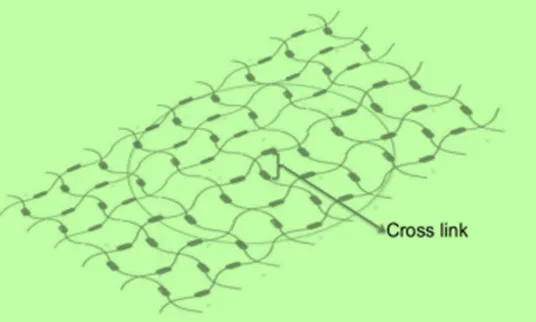
Figure 1: Structure of Hydrogel
Hydrogels can be classified in several ways depending on their origin, method of preparation, ionic nature, responsiveness to stimuli, type of crosslinking, physical structure, and biodegradability.
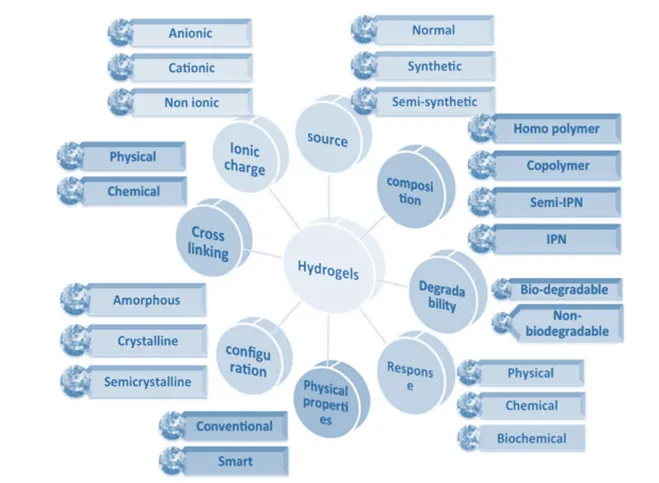
Figure 2: Classification of Hydrogels
According to their origin, hydrogels are grouped into natural, synthetic, hybrid, and semi-synthetic types. Natural hydrogels, derived from materials such as collagen, gelatin, alginate, and chitosan, are generally biodegradable and highly biocompatible, making them attractive for biomedical use. They often promote good cell interaction and adhesion. However, they may suffer from weak mechanical strength and limited stability22. For example, hydrogels formed from chitosan and hyaluronic acid using Schiff base reactions have shown improved cellular responses and potential in tissue engineering applications. Materials like sodium alginate, collagen, and agarose also demonstrate favorable bioactivity along with acceptable mechanical properties.
Hydrogels can also be categorized by their polymer composition. Homopolymer hydrogels are made from a single type of monomer, while copolymer hydrogels contain two or more different monomer units. Semi-interpenetrating networks (semi-IPNs) consist of a crosslinked polymer network interlaced with a linear polymer chain without chemical bonding between them. For instance, silk fibroin combined with polyacrylamide has been used to create semi-IPN systems for controlled drug release. Interpenetrating polymer networks (IPNs) involve two independently crosslinked polymer networks that are physically interlocked. This structure enhances mechanical strength and reduces phase separation, improving both bulk and surface properties.
From a structural standpoint, hydrogels may be amorphous, semi-crystalline, or crystalline. Amorphous hydrogels lack an ordered molecular arrangement, while crystalline hydrogels exhibit highly organized polymer chains. Semi-crystalline systems contain both ordered and disordered regions. The degree of crystallinity depends on factors such as polymer structure and cooling conditions during formation, and it significantly influences mechanical behavior and stability.
Finally, hydrogels are classified according to the nature of their crosslinks. Physical (reversible) hydrogels are formed through non-covalent interactions such as hydrogen bonding, ionic interactions, hydrophobic forces, or molecular entanglements. These gels can often respond to environmental changes and may revert to a sol state under certain conditions.
Chemical (permanent) hydrogels, in contrast, are formed through covalent bonding between polymer chains. These stable networks provide stronger mechanical properties and long-term degradation24.
Crosslinking plays a central role in stabilizing hydrogels. During this process, individual polymer chains become interconnected, forming a three-dimensional network that gives the material its structural framework. This interconnected structure not only makes the hydrogel more stable in aqueous environments but also helps it maintain its shape when it absorbs water. Without sufficient crosslinking, hydrogels can lose their form or collapse during swelling25,26.
Moreover, crosslinking significantly improves the mechanical performance of hydrogels. By reinforcing the internal network, it enhances their physical strength and resistance to deformation, making them more suitable for practical applications where durability and integrity are required27.
Chemical crosslinking can be achieved through several approaches. These include reactions between complementary functional groups—such as Schiff base formation, Michael addition, and condensation reactions—as well as techniques like ultraviolet (UV) irradiation, free-radical polymerization, and high-energy radiation. Each method offers different advantages depending on the desired properties and intended application of the hydrogel28.
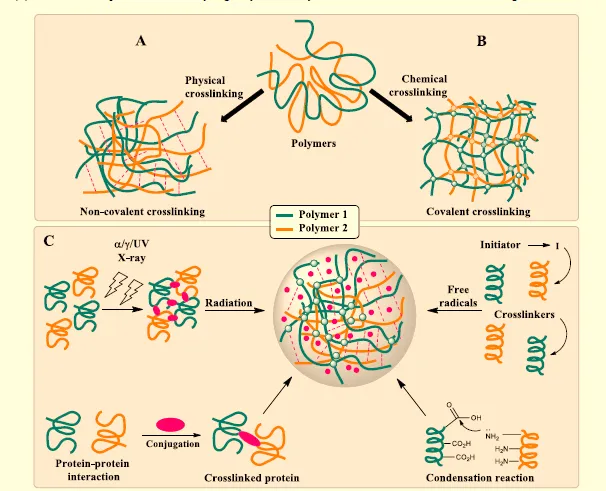
Figure 3: Crosslinking Mechanism of Hydrogels
Hydrogels derive their structural integrity and functional behavior from crosslinking—the process that connects polymer chains into a three-dimensional (3D) network capable of retaining large volumes of water without dissolving. The nature of these crosslinks determines not only the mechanical stability of the hydrogel but also its swelling behavior, degradation profile, biocompatibility, and responsiveness to environmental stimuli. Based on the synthesis principles described in the reference article, hydrogel crosslinking mechanisms can be broadly categorized into physical (reversible), chemical (permanent), and hybrid mechanisms
3.1 Physical Crosslinking
Physically crosslinked hydrogels are formed through non-covalent interactions such as hydrogen bonding, ionic interactions, hydrophobic associations, crystallization, and chain entanglements. These interactions are typically reversible, meaning the network can respond dynamically to environmental changes like pH, temperature, or ionic strength.
One common example involves ionic crosslinking, where oppositely charged polymers or multivalent ions create junction points within the network. Alginate gels crosslinked with calcium ions are a classic case: divalent cations bridge guluronic acid residues, forming stable but reversible structures. Similarly, hydrogen bonding plays a significant role in polymers such as poly(vinyl alcohol), where repeated freeze–thaw cycles induce crystallite formation that acts as physical crosslinking points.
Another important mechanism is hydrophobic association, particularly in amphiphilic polymers. In aqueous environments, hydrophobic segments cluster together to minimize contact with water, forming transient junction zones. These hydrogels often exhibit shear-thinning and self-healing properties, making them suitable for injectable biomedical applications.
Because physical crosslinks do not involve covalent bonds, these hydrogels are generally easier to prepare and avoid potentially toxic crosslinking agents. However, they may show limited mechanical strength and lower long-term stability compared to chemically crosslinked systems.
3.2 Chemical Crosslinking
Chemically crosslinked hydrogels contain permanent covalent bonds between polymer chains. These networks are typically more stable and mechanically robust. The reference article outlines several approaches to achieving chemical crosslinking:
Small bifunctional or multifunctional molecules (e.g., glutaraldehyde, N,N′-methylenebisacrylamide) react with functional groups on polymer chains to form stable covalent bridges. This method is widely used in synthetic polymer systems but requires careful purification to remove residual crosslinking agents that may cause cytotoxicity.
Hydrogels can be synthesized by polymerizing monomers (such as acrylates or methacrylates) in the presence of crosslinkers. Initiation may occur thermally, chemically, or photochemically. Photopolymerization, in particular, allows spatial and temporal control over gel formation, which is advantageous in tissue engineering and in situ forming systems.
High-energy radiation (e.g., gamma rays or electron beams) generates free radicals within polymer chains, leading to covalent bond formation without additional chemical crosslinkers. This approach can simultaneously sterilize the material, which is beneficial for biomedical applications.
Certain enzymes catalyze bond formation between polymer chains under mild physiological conditions. For instance, horseradish peroxidase-mediated reactions enable controlled gelation in biocompatible systems.
Chemical crosslinking generally enhances structural integrity, reduces solubility, and improves durability. However, these networks may lack the reversibility and dynamic responsiveness seen in physically crosslinked hydrogels.
3.3 Hybrid and Advanced Crosslinking Systems
Hybrid hydrogels combine both physical and chemical crosslinking to achieve synergistic properties. For example, a chemically crosslinked backbone may be reinforced with reversible ionic or hydrogen bonds, resulting in improved mechanical strength alongside self-healing or stimuli-responsive behavior.
In recent developments highlighted in the reference article, “smart” hydrogels utilize dynamic covalent chemistry (such as Schiff base reactions or disulfide linkages) to create networks that can reorganize under specific environmental triggers. These adaptable crosslinking strategies expand the potential applications of hydrogels in drug delivery, wound healing, and regenerative medicine.
Hydrogels are three-dimensional, hydrophilic polymeric networks capable of absorbing and retaining substantial amounts of water while maintaining structural integrity. Their biocompatibility, tunable mechanical properties, and responsiveness to environmental stimuli make them highly versatile across biomedical, pharmaceutical, environmental, and industrial domains
Table 1: Hydrogel Applications and Associated Polymers29
|
Application Area |
Polymers Utilized and Their Function |
|
Wound Management |
Polyurethane, poly(ethylene glycol) (PEG), polypropylene glycol (PPG), polyvinylpyrrolidone (PVP), agar, xanthan gum, methyl cellulose, carboxymethyl cellulose (CMC), alginate, hyaluronic acid, and related hydrophilic polymers are employed to maintain moist environments and support healing. |
|
Pharmaceutical Drug Delivery |
Poly(vinylpyrrolidone), starch derivatives, poly(vinyl alcohol), hydroxypropyl methylcellulose (HPMC), and methyl cellulose are widely applied to enable sustained and controlled release of therapeutics. |
|
Dental Applications |
Polyvinyl alcohol, acrylic and methacrylic acid derivatives, carrageenan, acrylamide-based polymers, 2-acrylamido-2-methylpropane sulfonic acid (AMPS), and carboxymethyl cellulose are used in oral care and dental formulations. |
|
Tissue Engineering |
Natural hydrocolloids such as gelatin, agarose, alginate, chitosan, collagen, and methyl cellulose serve as scaffolding materials for cell growth and regeneration. |
|
Injectable Polymeric Systems |
Biodegradable polyesters, polypeptides, chitosan, heparin, and gelatin are formulated as injectable hydrogels for localized therapeutic delivery. |
|
Technical / Consumer Products (Cosmetics & Pharmaceuticals) |
Starch, gum arabic, xanthan gum, pectin, carrageenan, guar gum, locust bean gum, alginate, and chitin/chitosan are incorporated for thickening, stabilization, and controlled release functions. |
|
Other Uses (Agriculture, Water Treatment, etc.) |
Starch-based polymers, poly(vinyl methyl ether), and poly(N-isopropylacrylamide) are used for moisture retention, soil conditioning, and responsive material systems. |
|
Soft Contact Lenses |
Silicone hydrogels and polyacrylamide provide oxygen permeability and mechanical stability. |
|
Industrial Applications |
Hydrogel beads act as adsorbents for pollutants (e.g., dyes, toxins) in wastewater treatment systems. |
|
Gastrointestinal Drug Delivery |
pH-responsive hydrogels and colon-targeted systems are engineered to release drugs selectively in specific regions of the GI tract. |
|
Rectal Delivery Systems |
Thermosensitive hydrogels are designed to undergo gelation at body temperature for rectal administration. |
|
Ocular Delivery |
In-situ gelling systems (e.g., alginate-based systems combined with gellan gum) enhance drug retention in the eye. |
|
Transdermal Drug Delivery |
Hydrogel patches containing agents such as corticosteroids provide controlled permeation across skin barriers. |
|
Subcutaneous Delivery |
Cross-linked polymers such as PHEMA are used for prolonged subdermal drug administration (e.g., cytarabine delivery). |
|
Advanced Biodegradable Hydrogels |
Implantable and environmentally degradable systems are under development for sustained therapeutic release without surgical removal. |
|
Novel Controlled Drug Release Systems |
Hydrophilic polymer networks (e.g., HPAN and crystalline ester-based systems) are optimized for predictable release profiles. |
|
Gene Delivery Systems |
Modified chitosan hydrogels and other biocompatible matrices are explored for nucleic acid transport and gene therapy applications. |
|
Cosmetic Applications |
Silicone elastomer-based hydrogels are used in aesthetic implants and dermal fillers. |
|
Topical Therapeutics |
Hydrogel matrices incorporating anti-inflammatory or dermatological agents improve skin adherence and patient compliance. |
|
Protein Delivery |
Injectable hydrogel systems form polymer networks in situ to allow gradual release of protein-based drugs. |
1. Drug Delivery Systems
Hydrogels are widely investigated as controlled and targeted drug delivery platforms due to their porous structure and capacity for stimulus responsiveness (pH, temperature, ionic strength).
Oral Drug Delivery:
pH-sensitive hydrogels protect drugs from gastric degradation and enable site-specific release in the intestine or colon (Peppas et al., 2000; Qiu & Park, 2001).
Transdermal Delivery:
Hydrogel-based patches enhance drug permeation across the skin and provide sustained release with improved patient compliance (Prausnitz & Langer, 2008).
Injectable and In Situ Gelling Systems:
Thermosensitive hydrogels (e.g., poloxamers, chitosan-based systems) undergo sol–gel transition at physiological temperature, enabling minimally invasive administration (Jeong et al., 2002).
Ocular and Nasal Delivery:
In situ forming hydrogels prolong drug residence time at mucosal surfaces, improving bioavailability30–34
2. Wound Healing and Tissue Regeneration
Hydrogels maintain a moist environment, promote autolytic debridement, and facilitate oxygen permeability. Modern hydrogel dressings incorporate antimicrobial agents, growth factors, or bioactive compounds to accelerate healing.
In tissue engineering, hydrogels mimic the extracellular matrix (ECM), providing scaffolds for cell attachment and proliferation. Natural polymers such as collagen, gelatin, and hyaluronic acid are commonly used35–37.
3. Tissue Engineering and Regenerative Medicine
Hydrogels serve as scaffolds for cartilage, bone, cardiac, and neural tissue engineering. Their mechanical properties can be tailored to match target tissues. Injectable hydrogels allow minimally invasive delivery of cells and bioactive molecules38,39
4. Contact Lenses and Ophthalmology
Silicone hydrogel materials revolutionized soft contact lenses due to high oxygen permeability and improved wearer comfort. Hydrogel systems are also used in artificial tears and corneal regeneration studies.40
5. Gene and Protein Delivery
Hydrogels protect sensitive biomolecules such as proteins, peptides, and nucleic acids from degradation and enable sustained release. Modified chitosan and PEG-based systems are extensively studied for gene therapy applications41
6. Biosensors and Diagnostics
Stimuli-responsive hydrogels are used in biosensing platforms, where volume changes or optical responses signal analyte detection. Glucose-sensitive hydrogels are particularly relevant in diabetes monitoring42.
7. Environmental and Agricultural Applications
Hydrogels are applied in wastewater treatment for adsorption of heavy metals and dyes. Superabsorbent hydrogels are also used in agriculture for soil moisture retention and controlled fertilizer release43.
8. Cosmetic and Aesthetic Applications
Hydrogels are incorporated into dermal fillers, facial masks, and cosmetic patches due to their hydrating and biocompatible nature. Silicone-based hydrogels are also used in implantable aesthetic devices.
CONCLUSION
Hydrogels have undergone a remarkable transformation from passive, water-absorbing polymer networks to intelligent, adaptable biomaterials capable of addressing complex therapeutic challenges. The evolution of crosslinking strategies—ranging from reversible physical interactions to permanent covalent bonding and dynamic hybrid systems—has enabled precise control over mechanical strength, swelling behavior, degradation profiles, and drug release kinetics. These advances have significantly expanded the functional capabilities of hydrogel systems, particularly in injectable and in situ forming applications.
A deeper understanding of structure–property relationships, including mesh size, viscoelasticity, and responsiveness to environmental stimuli, has allowed researchers to tailor hydrogels for specific biomedical needs. By integrating natural and synthetic polymers, nanoparticles, and bioactive molecules, modern hydrogel platforms combine biocompatibility with mechanical robustness and therapeutic precision. Such hybrid systems bridge the gap between laboratory innovation and clinical translation.
Importantly, hydrogel-based drug delivery systems now extend beyond conventional sustained release formulations to include targeted, stimulus-responsive, and regenerative strategies. Their applications span drug delivery, wound management, tissue engineering, gene and protein therapy, biosensing, agriculture, and environmental remediation. As material design increasingly aligns with pharmacological and patient-centered considerations, next-generation injectable hydrogels hold strong potential for improving therapeutic outcomes while minimizing toxicity and invasiveness.
Future progress will depend on scalable manufacturing, regulatory standardization, and long-term biocompatibility evaluation. With continued interdisciplinary collaboration, hydrogels are poised to play a central role in the advancement of precision medicine and translational biomedical engineering.
FUTURE PERSPECTIVE
The future of hydrogel-based drug delivery systems lies in the integration of smart material design with precision medicine. As understanding of structure–property relationships continues to advance, next-generation hydrogels will increasingly be engineered at the molecular level to achieve predictable mechanical behavior, degradation kinetics, and therapeutic performance. Greater control over mesh size, crosslinking density, and viscoelastic properties will allow fine-tuning of drug diffusion, cell infiltration, and tissue integration, enabling more reliable clinical outcomes.
One promising direction is the development of dynamically adaptable hydrogels based on reversible and bio-orthogonal chemistries. Systems incorporating dynamic covalent bonds, self-healing interactions, and multi-responsive mechanisms (pH, temperature, enzymatic, redox, or light-triggered) are expected to provide on-demand drug release and improved injectability. Such materials may enable personalized treatment strategies in oncology, regenerative medicine, and chronic disease management by responding directly to pathological microenvironments.
The convergence of hydrogel technology with nanotechnology, gene editing tools, and biologics represents another transformative frontier. Hybrid platforms embedding nanoparticles, exosomes, peptides, growth factors, or nucleic acids can serve as multifunctional therapeutic depots. These systems may simultaneously provide structural support, immunomodulation, and controlled molecular delivery. Injectable hydrogels capable of localized and sustained gene or protein release are particularly promising for tissue regeneration and precision immunotherapy.
Advances in biofabrication and 3D bioprinting are also expected to expand hydrogel applications. Printable and shear-thinning hydrogel formulations will facilitate patient-specific implants and scaffolds with spatially controlled drug distribution. The integration of biosensing capabilities within hydrogel matrices may lead to “theranostic” systems that combine real-time monitoring with therapeutic release, enhancing treatment accuracy and safety.
From a translational perspective, future efforts must focus on scalable manufacturing, reproducibility, sterilization strategies, and regulatory compliance. Long-term biocompatibility, biodegradation by-products, and immunological responses require comprehensive evaluation. Sustainable and green synthesis approaches may further improve environmental compatibility and cost-effectiveness.
Overall, the next decade is likely to witness the emergence of intelligent, personalized, and multifunctional hydrogel platforms that bridge material science, pharmacology, and clinical medicine. With continued interdisciplinary collaboration, injectable hydrogels are poised to become central tools in precision therapeutics, regenerative healthcare, and advanced biomedical engineering
REFERENCES

Dhiraj Sharma, Pardeep Kaur, Dr.Ajeet Pal Singh Dr. Amar Pal Singh. Next-Generation Hydrogels: Crosslinking Mechanisms and Applications, Int. J. of Pharm. Sci., 2026, Vol 4, Issue 8, 3215-3227, https://doi.org/10.5281/zenodo.22040243
 10.5281/zenodo.22040243