

We use cookies to ensure our website works properly and to personalise your experience. Cookies policy
Shri Venkateshwara College of Pharmacy, Puducherry.
Oral disintegrating films (ODF) also known as fast dissolving oral films, are a modern and user-friendly drug delivery system that dissolves quickly in the mouth without the need of water. They are especially helpful in children, elderly individuals and patients who have difficulty in swallowing tablets or capsules. By avoiding first pass metabolism and facilitating rapid drug release, these film’s hydrophilic polymers, which readily absorb saliva, improve the drug’s absorption. It also addresses evaluating aspects including drug’s release, disintegration time, taste, pH and strength. To preserve stability and efficacy, the significance of appropriate packing based on Quality by Design (QbD) principles is highlighted. All things considered, ODFs continue to demonstrate significant promise in pharmaceutical development and provide a practical, efficient, and a patient-friendly method of drug administration
Oral disintegrating films are sometimes known as fast-dissolving oral films. It has also been considered a relatively new technology. According to the FDA, they are single or multilayer sheets composed of suitable materials designed to quickly release one or more active chemicals in the mouth, forming a thin suspension or solution in saliva without the need for chewing or water consumption. They are the most advanced forms in terms of flexibility. ODF research has been more popular in the last few decades. Its advantages over other medicinal formulations, such as rapidly dissolving pills. The original researchers said that the purpose of creating ODFs was to alleviate bad breath, and they developed it by adding active components with the broadest variety of applications. When it comes to adaptability, they are the most sophisticated forms. Over the past few decades, ODF research has grown in popularity. its benefits over other pharmacological formulations, like pills that dissolve quickly. ODFs were initially developed to treat foul breath, according to the original researchers. Over time, the formulation evolved to incorporate active components with the widest range of potential uses. This review's goal is to go over the most recent advancements in oral disintegrating films, along with their applications and production methods in the food industry. One kind of polymeric oral drug delivery technology used to deliver nutritional and health elements or active medicinal ingredients is oral disintegrating films. When the hydrophilic polymeric matrix containing the uniformly dispersed or dissolved active agents is placed in the oral cavity, saliva quickly hydrates it, causing it to break down and release the active ingredients. It is the most used drug delivery route since it has many advantages over other drug administration procedures. Its high cost of therapy, convenience of use, and ability to reduce pain all contribute to high levels of patient compliance. Systems for delivering oral medications could yet be improved, though. Oral medication delivery methods still need to be improved, though, because some patient classes—such as the elderly, children, and dysphasic patients—still have issues swallowing or digesting solid dosage forms due to a variety of medical conditions. The difficulty of digesting oral solid dose forms led to the development of oral fast-dissolving drug delivery devices in the late 1970s. These systems use oral dispersible pills, which dissolve and break down quickly in the mouth. However, because of their tablet-like shape and potential for choking, many juvenile and elderly patients are hesitant to consume even ODTs. Oral disintegrating tablet formulations may also be more difficult and costly to produce, and issues with hardness and friability may occur during handling, storage, administration, and manufacturing. Oral-dispersible films are a new technology that was created to address these issues. Oro-dispersible film formulation is a new drug delivery method that uses hydrophilic polymers to prepare the medication for rapid release. Compared to conventional drug delivery methods, pharmaceutical technology has many advantages. It is often known that oral drug delivery is the most practical, economical, and favored way to administer drugs. These medication delivery methods can be applied topically, in the mouth, beneath the tongue, or simultaneously to the mouth and the skin. Because buccal drug delivery circumvents the liver's rapid metabolism and lessens drug degradation in the GI tract, it has become a significant method of drug administration. In improved drug delivery, oral medication has evolved from tablets and capsules to better-releasing formulations, such as wafers, orally disintegrating tablets, and, most recently, fast-dissolving oral films. The formulations release the medication without the need for chewing or drinking, dissolving in a matter of seconds. Because of the mucosa's abundant blood supply, medications are readily absorbed and become promptly available. These films are particularly useful for medications that degrade quickly because they avoid the first-pass metabolism and become instantly accessible. The medication is metabolized by the liver, increasing its overall body availability. Due to the technologies employed in oral films Although it is still in its infancy, it holds great promise for improving patient adherence to treatment regimens. Films disintegrate readily in the oral cavity. The films often dissolve in less than a minute when they come into touch with saliva. This facilitates rapid medication absorption and instant bioavailability. (10) (8) (14)
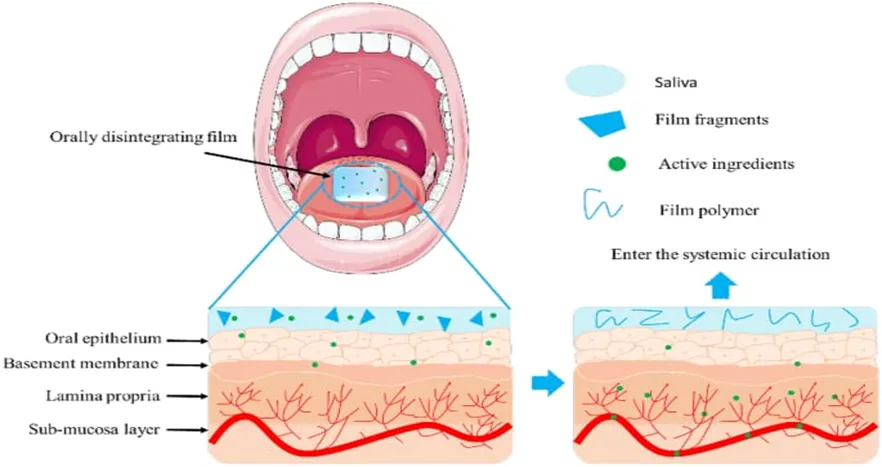
Figure: 1 Mechanism of drug absorption and systemic delivery via an orally disintegrating film (ODF)
FORMULATION INGREDIENTS
An oral disintegrating film is a thin, drug loaded strip designed with a surface area ranging from 5 to 20cm2. A single oral disintegrating film (ODF) can typically incorporate up to 30mg of medication. The maximum strength currently marketed is 100mg. ODF typically have a thickness of 100 μm or less and weight not exceeding 300mg per film. All excipients used in ODF must be permitted for use in oral dosage form and must be Generally Recognized as Safe (GRAS) according to regulatory guidelines. (7)
The formulation ingredients include:
Table: 1 Formulation of ODF
|
Sl.no |
Ingredients |
Concentration(w/w) |
|
1. |
Drug (API) |
1-30% |
|
2. |
Film Forming Plasticizer |
30-40% |
|
3. |
Plasticizer |
0-20% |
|
4. |
Saliva stimulating agent |
2-6% |
|
5. |
Surfactant |
qs |
|
6. |
Stabilizing & thickening agent |
5% |
|
7. |
Sweetener |
qs |
|
8. |
Colouring agent |
qs |
|
9. |
Flavours |
qs |
Active Pharmaceutical Ingredient
In ODF, the API is usually added in concentrations ranging from 5% to 30%w/w, while multivitamin films may contain up to 10%w/w of total dry weight. The use of micronized API helps to improve the smooth texture of the film, ensures uniform distribution of drug and allows it to dissolve quickly. Hydrophilic drugs are generally preferred because hydrophobic drugs do not dissolve in aqueous solution. When drug has bitter taste, taste masking becomes essential before incorporation into the film. One of the simplest taste masking techniques is obscuration technique, where the bitter API is mixed or co-processed with pleasant tasting excipients to improve palatability. These films can deliver a wide range of drugs including antiasthmatics, antiemetics, antihistamines, analgesics, drug for erectile dysfunction and drugs acting on central nervous system. (13) (6) (17)
Film forming polymer
The main structural elements of ODF are film forming polymer, which provide them the strength and flexibility required for consistent drug distribution and easy handling. They can be employes singly or in combination, and characteristics like tensile strength are directly impacted by their kind and quantity. Polymers typically comprise at least 45% w/w of the formulation, with 60-65% w/w of a water-soluble polymer thought to be optimal for creating flexible and thin films.
An ideal polymer should be safe, non-irritant, hydrophilic, tasteless, colorless, cost effective, stable and capable of forming strong films without causing irritation to oral mucosa.
These are essential to ODFs because they facilitate quick breakdown, improve mouthfeel, increase stability, and guarantee stability, all of which increase patient compliance. Both natural and synthetic polymers are used, with pullulan being most widely used, along with others like chitosan, Carboxymethyl Cellulose, Hydroxy Propyl Cellulose and Hydroxypropyl Methylcellulose. (4)
Plasticizer
The films are made less brittle and more flexible by the use of plasticizer. They function by reducing the polymer’s glass transition temperature (Tg), which increases the film’s elasticity and reduces their susceptibility to breaking. This lessens the possibility of tearing or delaminating of film while being processed and stored.
The drug, polymer and solvent system should be compatible with plasticizer. Choosing a wrong plasticizer might result in issues like film peeling, cracking or decreased strength. In the range of 0-20% w/w of dry polymer weight, plasticizer are added.
They work by creating more space within structure, by forming hydrogen bonds with polymer chains, and making the film more flexible. However, excessive amounts cause plasticizer-plasticizer interaction which can negatively affect the quality of the dried film.
Commonly used plasticizer includes glycerol, propylene glycol, polyethylene glycol (PEG), phthalate derivatives (dimethyl, diethyl and dibutyl phthalate), citrate derivatives (tributyl citrate, triethyl citrate, acetyl citrate), triacetin and castor oil. (12)
Saliva stimulating agents
Saliva stimulating agents are combined to oral films to stimulate the production of saliva, which helps the rapid disintegration and dissolution of film in the mouth. They can be used alone or in combination, usually in concentration ranging from 2-6%. In some formulations, sweetener act as saliva stimulating agents.
By increasing secretion of saliva, these agents speed up disintegration and improve the overall dissolution profile of the film. Examples of saliva stimulating agents are citric acid, malic acid, tartaric acid, lactic acid and ascorbic acid.
Surfactants
Surfactants improve the drug’s solubility, dispersibility and wettability, helping it dissolve faster and release the drug quickly within seconds. They reduce the surface tension of the casting solution, which supports uniform film formation.
Poloxamer 407 is the commonly used surfactants in oral film formulations. Other examples include sodium lauryl sulphate, tweens and benzethonium chloride.
Stabilizing and thickening agents
Stabilizing and thickening agents are added to improve the viscosity and consistency of the formulation before it is cast into films. These agents are generally used in concentration of 5%w/w of the total formulation weight. Examples of stabilizers and thickeners include natural gums as xanthan gum, carrageenan and locust bean gum as well as cellulose derivatives.
Sweetener
Sweeteners play key role in enhancing the taste and patient acceptability of ODF, especially in pediatric patients. They are usually used either alone or in combination in the range 3-6% w/w. Both natural and artificial sweeteners improve taste and effectively mask bitterness. However, use of natural sugars is limited in diabetic patients due to glycemic effect. Commonly used sweeteners are sucrose, dextrose, maltose, sucralose and aspartame.
Flavoring agents
The amount of flavoring agent needed to effectively mask the drug's taste depends on type of flavor used and its intensity. Selection of flavor is also influenced by the patient’s age, taste preference and overall acceptability. For example, younger individuals often prefer fruit flavors, pediatric may prefer chocolate, while geriatric patients may prefer milder flavors like orange, lemon, mint. Flavor are generally used at concentrations of up to about 10%w/w. The flavor used should be USFDA approved. In some formulations, cooling agents are added to enhance and prolong the flavor sensation.
Coloring agents
The coloring agents used in films should be FDA- approved (FD&C) and are typically limited to no more than 1%w/w. A commonly used example is titanium dioxide.
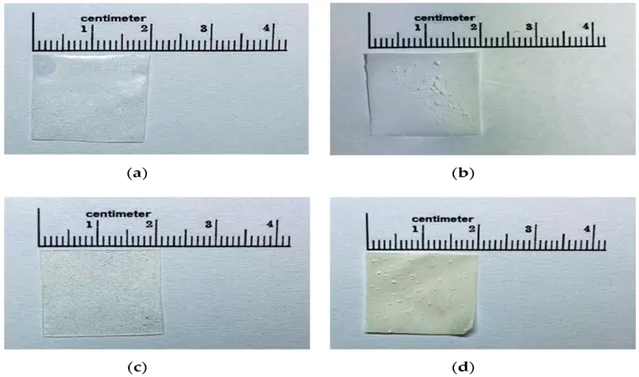
Figure: 2 Visual Appearance and Dimensions of 2 cm × 2 cm ODF Formulations
METHODS OF ODF PREPARATION
Standard Manufacturing Methods for ODFs
The production of oro-dispersible films primarily involves four distinct techniques, with solvent casting being the most prevalent in research and industry.
1.Solvent Casting Method
This is the most widely used method for preparing ODFs due to its simplicity and cost-effectiveness.
Preparation of Solution: Water-soluble polymers and plasticizers are dissolved in a suitable volatile solvent (such as ethanol or distilled water) to form a clear viscous solution.
Incorporation of API: The Active Pharmaceutical Ingredient (API) and other excipients (like sweeteners and flavors) are dissolved in an aqueous solvent and then combined with the polymer bulk.
De-aeration: The mixture is stirred for approximately 2 hours, and entrapped air is removed by vacuum or by allowing the solution to stand overnight.
Casting and Drying: The final solution is cast into a suitable petri dish or onto a casting surface and dried in an oven (typically at 500C for 24 hours). Finishing: Once dried, the film is peeled off and cut into the desired size and shape. (14)
2.Hot-Melt Extrusion (HME)
2HME is a solvent-free process used to prepare sustained-release and transdermal delivery systems, though it is also applied to ODFs.
Mixing: The drug is first mixed with carriers in solid form.
Extrusion: The mixture is melted by an extruder equipped with heaters.
Shaping: The molten mass is forced through dies to be shaped into films.
Cooling: The films are then cooled by rollers into their final state. (14)
3.Semisolid Casting Method
This method is specifically used when acid-insoluble polymers are required in the formulation.
Preparation: A solution of water-soluble film-forming polymer is prepared first.
Blending: This is added to a solution of acid-insoluble polymers (e.g., cellulose acetate phthalate) in a specific ratio, often 1:4.
Gel Formation: Plasticizers are added to obtain a gel mass.
Casting: The gel is cast into films or ribbons using heat-controlled drums, aiming for a thickness of 0.015–0.05 inches.
4.Rolling Method
The rolling method involves preparing a pre-mix and passing it through a series of rollers.
Pre-mix: A mixture of film-forming polymers, polar solvents, and other additives (excluding the drug) is prepared.
Drug Addition: The required amount of drug is added to the pre-mix and blended to achieve a uniform matrix.
Rolling: The mixture is fed into rollers. The film is formed and carried away by a support roller.
Drying: The wet film is dried using controlled bottom drying and subsequently cut to size.
EVALUATION PARAMETERS
Visual appearance
In order to assure uniformity and smoothness, the film’s surface texture is reviewed by gently touching and feeling it. The film’s physical appearance is evaluated through close visual inspection. (1)
Weight variation
Each film from each formulation was weighed separately using a digital balance in order to determine weight variance. To assess how much each film deviated from mean, the mean weight was computed and the standard deviation was found. (9)
Thickness test
Using a micrometer screw gauge, the thickness of each film was measured at five different locations. At each location, three readings were taken, and the mean value was determined. Maintaining dose accuracy and content homogeneity in every dosage unit requires consistent film thickness. (11)
Folding endurance
It is evaluated by repeatedly folding a specimen at a same location under specified condition until rupture occurs.
The folding endurance value is expressed as the number of double folds the specimen withstands at that location before failure. (2)
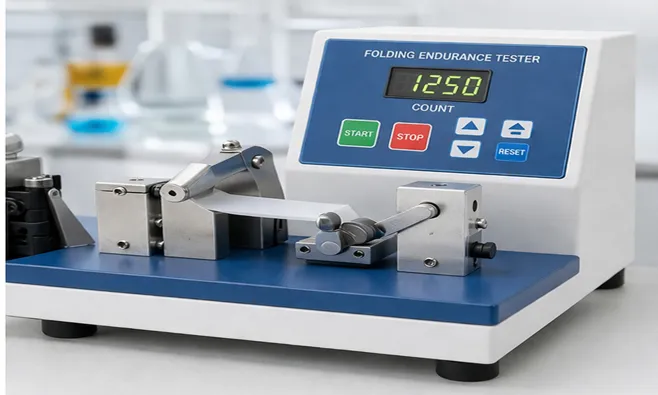
Figure: 3 Folding Endurance Tester
Tear resistance
Tear resistance is defined as the force required to initiate or propagate a tear in a film specimen under standardized test conditions. In order to determine the tear resistance value, which is stated in pounds force (lbf) or Newtons (N), a tensile stress is applied to a specimen at constant crosshead speed, usually 51mm/min, until tearing occurs. (5)
Disintegration time
To determine the disintegration time of a film, the official disintegration apparatus described in pharmacopeias is commonly employed. Depending on the ingredients in the formulation, the disintegration time usually falls between 5 to 30 seconds. There are two widely used techniques for determining the disintegration time of ODF despite the lack of official guidelines:
A drop of distilled water is applied to film’s surface after it has been clamped inside a slide frame. The frame is then positioned over a petri dish. The time required for the film to completely disintegrated is recorded.
The film is put in a petri dish with 2 ml of distilled water in it. The time taken for complete disintegration of the film is measured and documented. (18)
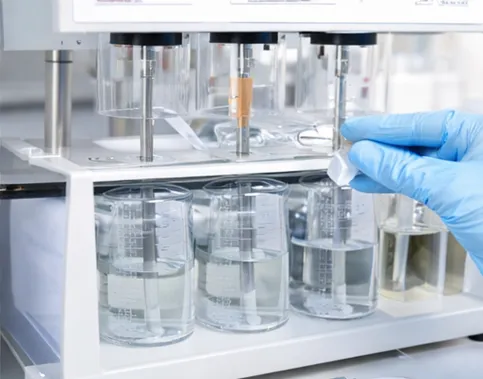
Figure: 4 In Vitro Dissolution Testing
Tensile strength
The highest strength a film can sustain before breaking is known as its tensile strength. In short, it demonstrates the film’s strength and durability under force. This breaking force is then divided by the film strip’s cross-sectional area to determine the tensile strength, which yields a consistent result for comparison. (16)
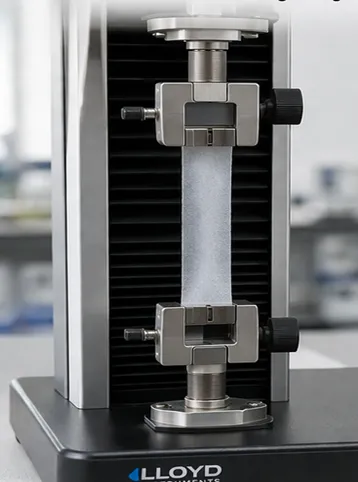
Figure: 5 Tensile tester
Surface pH test
The film’s surface pH is crucial quality feature since variations from neutrality could irritate oral mucosa. The surface pH should ideally be around 7. A combination Ph electrode can be used for measurement. The electrode is positioned in contact with the film’s surface after the film has been slightly moistened with water. A minimum of six films should be used for the readings, and the final result should be given as the mean ± standard deviation. Alternatively, the surface pH can be assessed by placing the film on a 1.5 % w/v agar gel and applying pH indicator paper; the resulting color change provides an estimate of the film’s surface pH.
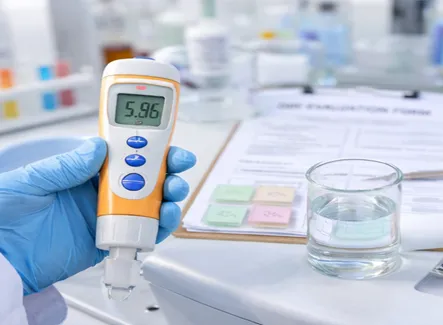
Figure: 6 pH meter
Swelling property
The swelling behavior of the films was assessed using simulated saliva solution in accordance with standard in vitro protocols. Each film was weighed initially and placed in a pre-weighed stainless steel wire mesh. The mesh containing the film was then immersed in simulated saliva, and the weight of the film was recorded at predetermined time intervals unit equilibrium was reached. The following formula is used to determine degree of swelling:
DS = wt – w0 / w0
Where wt is the film’s weight at time t and w0 is its starting weight.
This process yields a numerical representation of the film’s swelling properties and water absorption capacity.
Transparency
An UV visible spectrophotometer is used to access the film’s transparency in compliance with accepted analytical practices. The film is made and placed in rectangular specimens on the interior of the spectrophotometer cell. A wavelength of 600nm is used measure the film’s transmittance. The following formula is used to determine transparency:
Transparency = (log T600) / b
where b is the film thickness and T600 is the measured transmittance at 600nm.
This method provides a quantitative assessment of the optical clarity of the film; higher transparency values indicate better light transmission.
In vitro Dissolution studies
A typical basket or paddle system is used for film disintegrating systems, the basket system is typically used because it keeps the film from the floating in the medium, which could impede precise measurement. Sink conditions are maintained throughout the test either using either 0.1N (900ml) or pH 6.8 phosphate buffer (300ml) as the disintegrate medium. The rotation speed is usually set at 50rpm, and the medium is maintained at 37 ± 0.5 °C. Samples of dissolved medication are collected and analyzed using a UV visible spectrophotometer at predetermined intervals. Despite its extensive use, dissolution testing is still prone to fluctuation and requires cautious handling to provide accurate and reproducible findings.
Organoleptic characters
Patient acceptability and palatability are enhanced by oral films, large surface area in contact with the oral mucosa. It is crucial to guarantee correct mouthfeel, taste masking and minimal after taste since unpleasant characteristics including bitterness, limited solubility, particle size, ionization and mechanical strength are usually linked to the physicochemical features of the pharmacological module.
Target population considerations are important because ODF s are often developed for young and old patients. For example, although taste preferences vary by region and nation, young individuals tend to prefer fruity flavor and old people often prefer mint. Studies on animals also show that different species have different preferences for flavor and colors. For example, horses prefer banana over apples, emus react to yellow, iguanas to red. Therefore, the combined effects of the drug and excipients, which enable efficient taste masking and an overall pleasant sensory experience, determine the choice of color and flavor in ODFs.
PACKING
These specialized technical sections which focus on the Quality by Design (QbD) and advanced regulatory aspects of packaging.
Quality by Design (QbD) in Packaging
Integrating QbD principles ensures that the packaging is not an afterthought but a “critical quality attribute” (CQA).
Container Closure System (CCS): The choice of material must be justified based on the Water Vapor Transmission Rate (WVTR). A low WVTR is essential to prevent the film from absorbing moisture and turning into a gel.
Extractables and Leachable: Since ODFs often contain solvents or surfactants, it is vital to test that no chemicals from the plastic or adhesive layers leach into the film, which could cause toxicity or change the film’s taste.
Advanced Secondary Packaging
While the pouch is primary, the secondary packaging (the box or carton) serves a functional role:
Temperature Buffering: Insulated secondary packaging is used for thermally unstable APIs to protect against spikes during global shipping.
Compliance Features: Many ODF boxes now incorporate NFC chips or QR codes that patients can scan to watch a video on how to apply the film correctly to the tongue.
Sustainability in ODF Packaging
A major trend in pharmaceutical reviews is the shift toward eco-friendly materials:
Recyclable Laminates: Replacing traditional aluminum-plastic multi-layers with mono-material structures that provide the same oxygen barrier but are easier to recycle.
Biodegradable Pouches: Research into cellulose-based barrier films that can protect the ODF while reducing the carbon footprint of “single-dose” waste.
Regulatory Documentation
For a comprehensive article, mention that packaging data must be submitted in the Common Technical Document (CTD):
Section 3.2.P.7: This specific part of the drug application must detail the choice of container, its specifications, and proof that it protects the film’s “mechanical integrity” (its ability to remain flexible without cracking). (3)
Table: 2 Packaging Requirements and Material Specifications for ODFs
|
Feature |
Requirement |
Common material |
|
Moisture barrier |
High (WVTR<0.1) |
Aluminium foil laminate |
|
Light protection |
Opaque |
Metalized polyester |
|
Opening mechanism |
Child resistant |
Push and peelings pouches |
|
Bulk storage |
Airtight |
Heat sealed poly pouch |
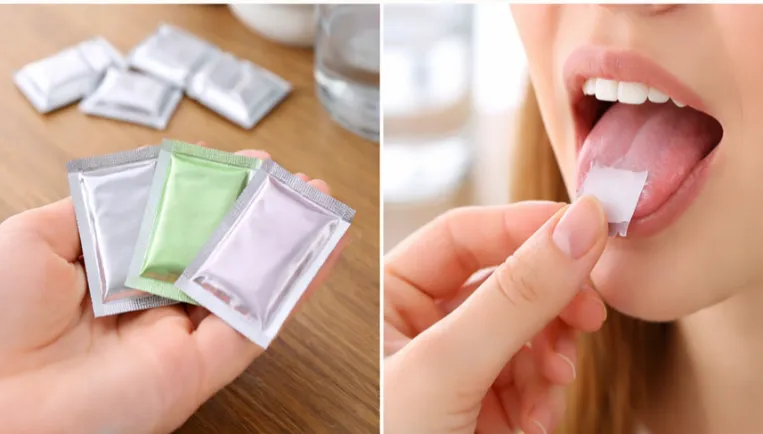
Figure: 7 Packaging and Administration of Orally Disintegrating Films (ODFs)
CONCLUSION
A convenient alternative for traditional dosage forms, oral disintegrating films (ODFs) are an advanced and efficient drug administration method. They are especially beneficial for children, elderly patients and patients who struggle to swallow as they dissolve fast the mouth without the need for water. For the effective performance of ODF, polymers, plasticizer and other formulation ingredients must be carefully chosen to provide flexibility, and effective drug release. Their development is supported by a variety of manufacturing techniques, and stability and quality are maintained through careful assessment and suitable packing. Although still advancing, ODFs have strong potential in the pharmaceutical field and are expected to enhance patient compliance and treatment effectiveness in the future.
REFERENCES


Nirmala E, Vishvaja G, Swarnamanjari M, Umadevi V, Vigneshwaran S, Suriya S, Oral Thin Films: Emerging Trends in Drug Delivery Technology, Int. J. of Pharm. Sci., 2026, Vol 4, Issue 5, 7586-7596, https://doi.org/10.5281/zenodo.20423679
 10.5281/zenodo.20423679