

We use cookies to ensure our website works properly and to personalise your experience. Cookies policy
Vilasrao Deshmukh Foundation School of Pharmacy, Latur.
On April 4, 2019, the Food and Drug Administration (FDA) approved a supplemental new drug application for palbociclib (IBRANCE®), to expand the approved indications in women with hormone receptor (HR)-positive, human epidermal growth factor receptor 2 (HER2)-negative advanced or metastatic breast cancer (MBC) in combination with an aromatase inhibitor or fulvestrant, to include men [1-2]. Palbociclib was first approved in 2015 for use in combination with letrozole for the treatment of estrogen receptor (ER)-positive, HER2-negative advanced breast cancer as initial endocrine-based therapy in postmenopausal women and subsequently in 2016 in combination with fulvestrant in women with HR-positive, HER2-negative advanced breast cancer with disease progression following endocrine therapy. Furthermore, it has been shown to significantly prolong progression-free survival
Breast cancer is the most common cancer among women worldwide, with approximately 1.7 million cases reported each year. Palbociclib is a highly specific, orally active CDK4/6 inhibitor currently approved for the treatment of hormone receptor positive, HER2-negative (HR+/HER2neg) advanced breast cancer (BC) in combination with the endocrine agents letrozole or fulvestrant[1-3]. Given the efficacy and the tolerability shown by CDK4/6 inhibitors, utilization of these drugs in clinical practice is common in patients with HR+/HER2neg advanced BC. However, acquired resistance to these agents is universal, and results from clinical trials indicate that approximately 10 to 15% of patients may exhibit de novo resistance. This drug does not kill cells directly, but arrests the cell cycle during the restriction point when the cell passes from G1 to S phase going through another cell division putting them into senescence. This may represent a mechanism potential of cell radio sensitisation as during S phase cells are more radioresistant.
Drug discovery and history
FDA approved (first approved February 3, 2015)
Ibrance is the brand name
Solid dosage form(Tablet and capsules)
Treatment for metastatic breast cancer

Fig: Palbociclib drug molecule structure
Palbociclib is a piperazine pyridopyrimidine[4] that acts in the cell cycle machinery. It is a second generation cyclin-dependent kinase inhibitor[5] selected from a group of pyridopyrimidine compounds due to its favorable physical and pharmaceutical properties.
Palbociclib was developed by Pfizer Inc after the discovery that identified the cyclin-dependent kinases as key regulators of cell growth[7]. It was originally FDA approved on March 2015 for the treatment of HR-positive, HER2-negative advanced or metastatic breast cancer and its indications were updated in April 2019 to include male patients based on findings from postmarketing reports and electronic health records demonstrating safety and clinical efficacy.
PHYSICOCHEMICAL PROPERTIES
Table No.1
|
Boiling Point |
711.50C |
|
Melting Point |
263-2660C |
|
LogP |
0.99 |
|
pKa |
7.4 ( The secondary piperazine nitrogen ) And 3.9 (The pyrdine nitrogen) |
PHARMACOKINETICS PROPERTIES
The drug is administered orally which is absorbed slowly from intestine in 6–12 h, with a median Tmax of about 5.5 h, has a large volume of distribution and thus distributes widely in the peripheral tissues, and is slowly eliminated with a half-life of 26 h and thus also cumulates on repeated dosing. The mean absolute bioavailability after an oral 125 mg dose is 46%. Steady plasma levels are achieved within 8 days following repeated once a day dosing. It also shows low to moderate variability with dose-dependent increase in plasma concentration. Food intake reduces inter-subject variability of palbociclib, which supports administration with food. Palbociclib binding to human plasma proteins in vitro approximates 85%, with no concentration dependence over the concentration range of 500–5000 ng/mL. The mean apparent volume of distribution is 2583 L. It undergoes hepatic metabolism by CYP3A hepatic enzyme in humans; the primary metabolic pathways involved oxidation and sulfonation, with acylation and glucuronidation contributing as minor pathways. It undergoes extensive metabolization with unchanged drug accounting for 2.3% in feces and 6.9% in urine. The major route of excretion of drug is in feces (74.1% of dose), with 17.5% in urine as metabolites. The mean ± standard deviation) plasma elimination half-life was 29 ± h in patients with solid organ tumors[8].
MECHANISM OF ACTION
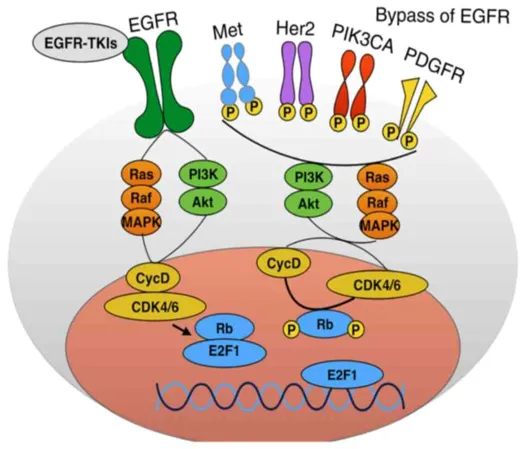
Palbociclib is a cyclin-dependent kinase 4/6 (CDK4/6) inhibitor that acts by binding to the ATP pocket with an IC50in the range of 9-15 mol/L. It is important to consider that it presents low to absent activity against other kinases.The CDK4/6 kinase is involved, with coregulatory partner cyclin D, in the G1-S transition. Hence, inhibition of this step prevents cell cycle progression in cells in whose this pathway is functioning. This step includes the pathways of the phosphorylation of retinoblastoma protein and the E2F family of transcription factor[8].
METHODS OF SYNTHESIS
Chemistry
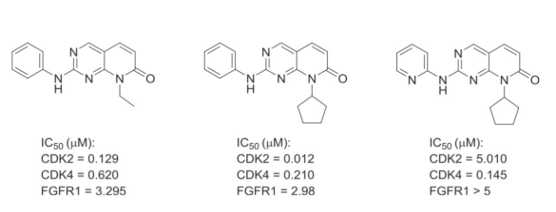
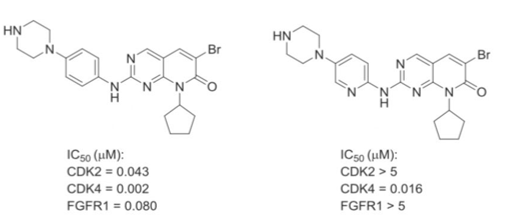
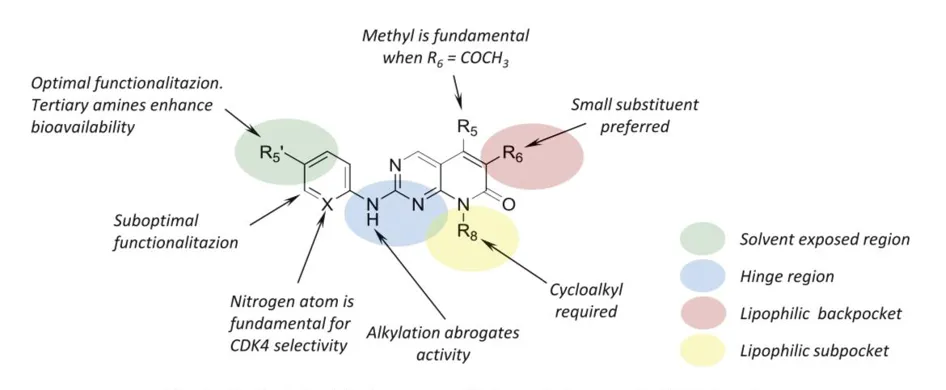
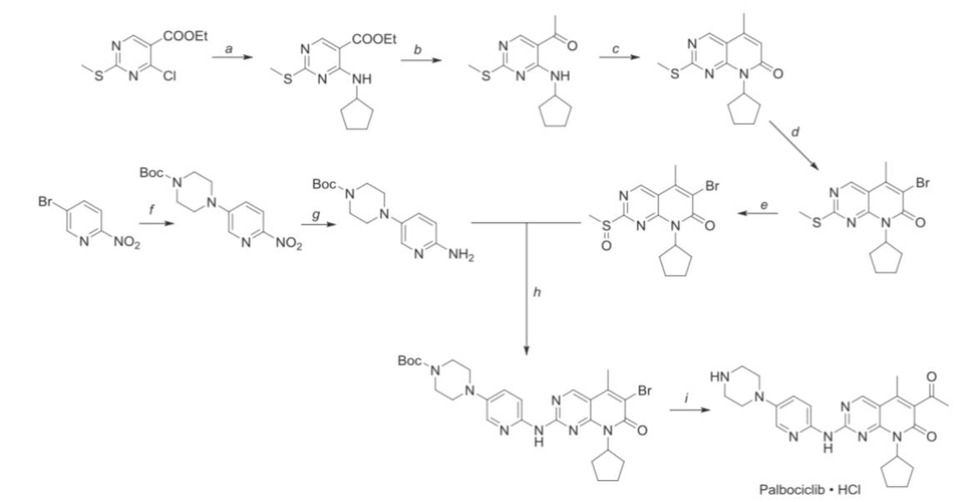
Palbociclib is a pyridopyrimidine compound bearing a pyr-idopyrazine side chain. The binding mode of pyr-idopyrimidines with the ATP binding pocket was elucidated by the resolution of the crystal structure of the complex PD173955-Abl kinase.
The original synthesis of Palbociclib started from ethyl 4-chloro- 2-(methylthio) pyrimidine-5-carboxylate that was condensed with cyclopentylamine [51e53]. LiAlH4 reduction of carboxylate to aldehyde intermediate and Grignard reaction afforded the acetyl analogue, that was in turn condensed with ethyl 2-(diethoxyphosphoryl)acetate to the desired heterocycle. Bromination at position 6 and subsequent sulfur oxidation led to intermediate suitable for the SNAr with the amine side chain, that was in turn prepared starting from 5-bromo-2-nitropyridine. In the final step, a Stille coupling followed by acid hydrolysis led to both the insertion of the acetyl function and the removal of the Boc protection, affording Palbociclib[9-11].
More efficient synthetic strategies were developed to accomplish industrial production requirements. Three major differences were reported:
1 The use of 5-bromo-2,4-dichloropyrimidine as starting material, laying the basis for a more efficient SNAr and avoiding the oxidation step. This modification led to a complete revision of the entire synthetic process Indeed, a Heck reaction followed by intramolecular cyclization was used to synthesize the heterocycle.
2. The improvement of the step, since the 2- aminopyridine sidechain proved to be a poor nucleophile.
3. The use of the Heck condensation in place of the Stille coupling followed by hydrolysis with isethionic acid, furnishing Palbociclib isethionate.
Later on, the use of isethionic acid to accomplish the final hydrolysis was abandoned due to production reasons. Indeed, the management of Palbociclib free base was found easier than those of Palbociclib salts, thus the use of the more readily accessible and economical hydrochloric acid was finally preferred. Heck re- action was deeply investigated, finally finding that the best catalyst for the reaction was Pd(OAc)2/DPEPhos[12].
Several alternative synthetic routes were also tested, comprising different annulation strategies, the inversion of SNAr reaction and final Heck condensation. None of these alternative routes led to a substantial improvement of the overall process and, in several cases, the desired product was not even obtained. Thus, these alternative ways were not investigated further[13-17]
MEDICINAL USE
Palbociclib is used to treat hormone receptor (HR)-positive , HER negative advanced or metastatic (cancer that has spread) breast cancer.
ADVERSE EFFECTS
In PALOMA-1 trial the most common side effects of the drug is grade 3/4 neutropenia which is remarkably higher in the palbociclib arm in comparison to letrozole alone (54% vs 1%), higher rate of grade 3/4 leucopenia (19%), pulmonary embolism (5%), fatigue (4%), diarrhea (2%), anemia, respiratory infection, nausea and vomiting, stomatitis, alopecia, thrombocytopenia, anorexia, asthenia, peripheral neuropathy and epistaxis. However, no reported case of febrile neutropenia or neutropenia-related infections was observed however caution is advised while use of the drug. The most frequently reported serious adverse events which let the discontinuation of palbociclib in the combination were pulmonary embolism (4%) and diarrhea (2%). Also, a decrease in hemoglobin (83% vs 40%), leukocytes (95% vs 26%), lymphocytes (81% vs 35%), and platelets (61% vs 16%) was observed at higher rate in patients treated with palbociclib plus letrozole vs letrozole alone.[18]
DRUG INTERACTIONS
Table No.02[19]
|
Drug class |
Agent |
Treatment application |
Recommendation |
|
Strong CYP3A inducers Antibiotics
Anticonvulsants
Other |
All rifamycin class agents (e.g., rifampin, rifabutin, rifapentine) Phenytoin, carbamazepine, barbiturates (e.g., Phenobarbital) Enzalutamide, St. John’s Wort |
Reduced exposure of Palbociclib |
Avoid concomitant use and consider alternative therapy. |
|
Strong CYP3A inhibitors Antibiotics Antifungals Antiretrovirals, Protease inhibitors
Other |
Clarithromycin, telithromycin itraconazole, ketoconazole, posaconazole, voriconazole Alazanavir. Garunavir. incinavir. lopinavir/ritonavir, nelfinavir, riconavir. saguinavir. elabreyir
Grapefruit or grapefruit juice, nefazogone |
Increased exposure of palbociclib |
Avoid concomitant use and consider alternative therapy. Reduce palbociclib dose to 75 mg or ribociclib dose to 400 mg once daily if patients must be coadministered a strong CYP3A inhibitor. Reinitiate previous palbociclib dose after 3-5 half-lives or ribociclib dose after 5 half-lives of inhibitorafter discontinuation |
CONVENTIONAL MARKETED FORMULATION
Table No.3
|
Dosage form |
Route of administration |
Brand name |
Company name |
Dose |
Price |
|
capsule |
oral |
Ibrance |
US Pharmaceuticals |
75mg 100mg 125mg
|
$15,886.35(for 21 cap) $15,886.35(for 21 cap) $15,886.35(for 21 cap) |
|
Tablet |
Oral |
Ibrance |
US Pharmaceuticals |
75mg 100mg 125mg
|
$15,886.35(for 21 tab) $15,886.35(for 21 tab) $15,886.35(for 21 tab) |
|
capsule |
oral |
Palbace |
Pfizer Europe Ma Eeig |
125mg
|
₹68,000(for 21 cap)
|
|
capsule |
oral |
Primcyv |
Dr.Reddy’s |
75mg 100mg 125mg
|
₹11600(for 21 cap bottle) ₹11600(for 21 cap bottle) ₹11600(for 21 cap bottle)
|
PATENTS
Table No.4[20]
|
Inventor |
Invention |
Year of grant |
Year of expiry |
|
Fady Makram Louiz IBRAHIM, Matthew Patrick MULLARNEY, Ravi Mysore Shanker, Barbara Rodriguez SPONG, Jian Wang |
solid dosage forms of palbociclib |
2019-11-06 |
2036-05-24 |
|
Maurizio Gallina , Novara (IT), Paolo Angioletti , Lainate (IT), Paolo S. Tiseni , Bresso (IT), Marina Ratkaj , Zagreb (HR) |
solid state forms of palbociclib dimesylate |
2022-05-17
|
2037-07-10
|
|
Haisheng Fan Xiaowen GUO Luning Huang Hong Gu |
Preparation methods for palbociclib free base crystal form A and crystal form B |
2020-09-08
|
2036-11-11 |
|
Sangeeta SANGWAN Anu ARYA Kallimulla Mohammad Bishwa Prakash Rai Ram Thaimattam Mohan Prasad |
solid state forms of palbociclib dimesylate |
- |
- |
|
郭彦亮 刘光 王政 孙长安 |
Preparation method of palbociclib crystal form B |
2021-10-15
|
2037-05-10
|
|
Mahdeshkumar Gadakar Dnyandeo PUNDE Rajendra Yadav Yogesh Wakchaure |
Polymorph of an intermediate for palbociclib synthesis |
2020-07-14
|
2037-10-04
|
CONCLUSION
The use of RT in patients with metastatic breast cancer receiving palbociclib resulted in minimal grade 1 to 2 and no grade 3+ toxicities. This preliminary work suggests that RT in this patient population is safe and feasible. Subsequent studies with longer follow-up are needed to confirm these results and investigate further use of palbociclib with RT. Deregulation of cell cycle control is a prominent feature of can cer, and the cyclin D-CDK4/6 Rb pathway, governing the cell cycle restriction point, is often altered in breast cancer, contrib uting to tumor progression and to the development of endo been noted with several chemotherapeutic agents crine resistance, Palbociclib, a small molecule and highly Preliminary results from clinical trials confirm the preferen selective, reversible inhibitor of CDK4 and CDK6, inhibits tial activity of the drag in ER positive numon and its progression of the cell cycle from GI into the S phase in Rb- potential synergism with letrazole iss proficient cells, exerting cytostatic activity on different tumor types in vitro and in vis. It is not active on Rb-negative p16 enverexpressing tumor cells[21].
REFERENCES

Prajkta Jadhav, Palbociclib: A Review on Early Stage of Metastatic Breast Cancer, Int. J. of Pharm. Sci., 2026, Vol 4, Issue 9, 891-898, https://doi.org/10.5281/zenodo.22655787
 10.5281/zenodo.22655787