

We use cookies to ensure our website works properly and to personalise your experience. Cookies policy
Department of Regulatory Affairs, Dayanand College of Pharmacy, Latur, Maharashtra, India.
India is now the world's top producer and exporter of high-quality, low-cost generic drugs. The Patents Act of 1970, which allowed process-based patents and let Indian companies reverse-engineer drugs, and the 2005 Patents (Amendment) Act, which brought Indian laws in line with global standards and encouraged new ideas, are two examples of important laws that helped this growth happen.Pharmaceutical exports from India are governed by the Central Drugs Standard Control Organisation (CDSCO) under the Drugs and Cosmetics Act, 1940. Exporters must comply with key regulatory requirements such as obtaining an Importer-Exporter Code (IEC), a valid manufacturing license, and, for specific categories of drugs, an Export No-Objection Certificate (NOC) via the CDSCO SUGAM portal. Additionally, adherence to Good Manufacturing Practices (GMP) and Good Distribution Practices (GDP) ensures product quality and integrity throughout the supply chain. International certification mechanisms like the WHO-GMP and the Certificate of Pharmaceutical Product (COPP) further validate compliance with global quality standards, facilitating entry into regulated and semi-regulated markets. While India’s export framework is comprehensive, it faces challenges including procedural complexities, manpower constraints, and varying international regulatory demands. Strengthening digital infrastructure, harmonizing regulations, and fostering innovation will be crucial for maintaining India’s role as the “pharmacy of the world” and expanding its global healthcare footprint.
India's rise as a global hub for generic drugs was largely due to smart changes in its laws. Before 1970, the drug market was controlled by foreign companies because India's patent laws protected both the final drug and the method used to create it.
This situation changed dramatically with the Patents Act of 1970. This crucial law introduced a new rule: it only protected the process of making a drug, not the final drug itself. This was a game-changer for Indian companies. It allowed them to legally "reverse-engineer" or find alternative ways to produce medicines that were already patented elsewhere, without paying fees to the original inventors. This led to a huge increase in the production of affordable generic drugs and caused the number of local drug companies to skyrocket from 2,000 in 1970 to 24,000 by 1995. This era built the foundation for India's future as a major exporter of low-cost, high-quality medicines.
Later, the economic liberalization in 1991 opened up India to the world, helping these companies expand their exports globally.
A final, significant turning point was the Patents (Amendment) Act of 2005. To align with international trade rules, India had to start recognizing patents on the final drug product again. This meant companies could no longer rely on copying existing drugs. The industry was forced to shift its focus from just manufacturing to innovation, investing more in research and development (R&D) to create its own new medicines and compete on a global [1] .
EDITORIAL CHECK — SOURCE TEXT RETAINED: Developing ovarian cancer and a 1 in 100 risk of dying from it. In Low/ Medium Human Development Index (HDI) countries ovarian cancer is the third most common cancer and the third leading cause of cancer death among women.
2.EXPORT PROCEDURE
a. Obtain IEC (Importer-Exporter Code)
b. Ensure valid drugs manufacturing/wholesale license (s)
c. Product registration or approval in importing country (if required)
d. Quality/GMP/manufacturing/testing compliance
e. Documentation Certification
f. Customs clearance / shipping formalities
g. Post- export compliance /record keeping
h. Incentives / benefits (if applicable)
3.LEGAL AND LICENSING REQUIREMENTS FOR EXPORT
A company intending to export pharmaceutical products from India must navigate a well-defined, multi-layered licensing and compliance framework. A fundamental requirement for all exporters is the possession of a valid Importer Exporter Code (IEC) issued by the Directorate General of Foreign Trade (DGFT) [2,3,4,5,6]. This code is a mandatory prerequisite for customs clearance and international trade transactions. In addition, exporters must hold a valid manufacturing license issued by the State Licensing Authority (SLA), such as a license in Form-25, Form-28, or Form-28D [7].
While not a direct legal requirement for all exports, obtaining a WHO-Good Manufacturing Practices (GMP) certification is critical for gaining access to and maintaining credibility in international markets. This certification, which is based on global guidelines, assures importing countries that the products have been manufactured in facilities that adhere to international quality and safety standards [8] .The certification process involves rigorous on-site audits and is essential for ensuring product quality and preventing contamination or errors.
4.THE EXPORT NO-OBJECTION CERTIFICATE (NOC) PROCESS
For certain categories of drugs, specifically new drugs (both approved and unapproved), as well as banned drugs, an Export No-Objection Certificate (NOC) is a mandatory requirement [9]. This certificate is granted by the CDSCO's zonal offices and serves as a crucial authorization for export. A significant policy trend has been the recent shift of the NOC application process from a fragmented state-level system to a centralized, online mode through the CDSCO's SUGAM portal [10]. This change, effective since May 15, 2024, consolidates power at the central level and aims to foster greater transparency and uniformity across the entire process, mitigating the inconsistencies that often arose from state-level discretion [9,10].
4.1 The NOC application procedure is a two-step online process:
4.2 DOCUMENTATION NEEDED FOR EXPORT NOC APPLICATION
A. A meticulously prepared dossier of documents is critical for a smooth and timely approval of the export NOC. While the specific requirements may vary depending on the nature of the drug, the following documents are generally required:[10,12]
a. A covering letter clearly stating the purpose of the application.
b. A copy of the valid manufacturing license.
c. A copy of the purchase order from the importing country.
B. A copy of the registration or import permission from the drug regulatory authority of the importing country.
C. A Certificate of Analysis for the batches to be exported.
D. For unapproved or new drugs, detailed information on the drug's status in India and the importing country.
E. In the case of banned drugs, a specific justification for export and evidence of its approval in the importing nation.
5.QUALITY CONTROL AND GOOD MANUFACTURING PRACTICES (GMP)
The CDSCO places immense emphasis on the quality of pharmaceuticals manufactured in India. Adherence to Good Manufacturing Practices (GMP) as prescribed in Schedule M of the Drugs and Cosmetics Act, 1940, is non-negotiable for exporters. Manufacturing facilities are subject to regular inspections by CDSCO officials to ensure compliance with these standards [9,10] .
6.PACKAGING AND LABELLING: ENSURING CLARITY AND COMPLIANCE
Proper packaging and labelling are critical to ensure the safety and integrity of pharmaceutical products during transit and to meet the regulatory requirements of the importing country. The CDSCO's guidelines on this aspect are primarily governed by Rule 94 of the Drugs and Cosmetics Rules, 1945 [9,12,13] .
Provisions of Rule 94 include:
Adaptation for Importing Country: The labelling of exported drugs must be adapted to meet the specific requirements of the law of the country to which the drug is being exported.
Mandatory Information: Despite adaptations, certain essential information must appear in a conspicuous position on the innermost container. This typically includes the name of the drug, the manufacturer's details (or an approved code number), the batch number, and the date of expiry.
Use of Code Numbers: In instances where the consignee requests that the manufacturer's name and address not be on the label, a unique code number approved by the licensing authority can be used instead.
Exporters must ensure that the packaging is robust enough to protect the product from environmental factors and maintain its therapeutic effectiveness throughout the supply chain.
7.GOOD DISTRIBUTION PRACTICES (GDP)
Beyond manufacturing, the CDSCO also emphasizes the importance of Good Distribution Practices (GDP). These guidelines are designed to ensure that the quality and integrity of pharmaceutical products are maintained throughout the distribution network, from the manufacturing plant to the end-user. Key aspects of GDP include proper storage conditions, temperature control for sensitive products, and robust security measures to prevent theft and counterfeiting.
7.1THE ROLE OF ZONAL AND SUB-ZONAL OFFICES
The CDSCO's Zonal and Sub-Zonal offices are instrumental in the regulation of pharmaceutical exports. They are the primary points of contact for manufacturers for the submission and processing of NOC applications.
These offices are responsible for:
a. Scrutinizing applications and accompanying documents.
b. Conducting inspections of manufacturing facilities.
c. Providing guidance to exporters on regulatory requirements.
d. Issuing the final NOC for export.
Exporters are encouraged to maintain open communication with their respective zonal offices to ensure a clear understanding of the requirements and to address any queries promptly.
In conclusion, exporting pharmaceuticals from India is a regulated process that demands a thorough understanding of and strict adherence to the CDSCO's guidelines. By prioritizing quality, maintaining comprehensive documentation, and engaging proactively with the regulatory authorities, Indian pharmaceutical companies can successfully navigate the export landscape and contribute to global healthcare.
7.2 CHECKLIST OF KEY DOCUMENTS FOR EXPORT NOC APPLICATION
While the specific requirements may vary, here is a general checklist of documents that are typically required when applying for an export NOC from the CDSCO:
a. Covering Letter: Clearly stating the purpose of the application.
b. Purchase Order: A valid and recent purchase order from the overseas buyer.
c. Manufacturing License: A copy of the valid manufacturing license issued by the State Licensing Authority.
d. Performa Invoice: In some cases, a proforma invoice may be required.
e. Registration Certificate: For banned drugs, a registration certificate from the importing country's NRA is mandatory.
f. Drug Details: Comprehensive information about the drug, including its generic name, brand name (if any), composition, dosage form, strength, and pack size.
g. Undertakings: Various undertakings and declarations as specified in the CDSCO guidelines.
8. WHO GOOD MANUFACTURING PRACTICES (WHO-GMP)
The pharmaceutical industry operates under stringent quality control frameworks to safeguard patient health across borders. With increasing international trade in medicines, importing countries often require exporting manufacturers to demonstrate compliance with Good Manufacturing Practices (GMP). The WHO-GMP Certificate has emerged as a globally accepted benchmark that assures product quality and facilitates international commerce. For India—one of the largest exporters of generic medicines—obtaining WHO-GMP certification is a strategic necessity to access regulated and semi-regulated markets worldwide [14] .
Definition: WHO-GMP refers to a set of principles and procedures recommended by the World Health Organization to ensure pharmaceutical products are consistently produced and controlled according to quality standards.
Scope: Covers manufacturing premises, equipment, documentation, sanitation, quality assurance, validation, personnel training, and storage/distribution.
Importance for Export:
a. Demonstrates compliance with international quality standards.
b. Facilitates product registration in importing countries.
c. Reduces inspection redundancy across multiple jurisdictions.
d. Boosts credibility of Indian pharmaceutical exports [15] .
8.1Role of WHO-GMP in Pharmaceutical Export.
Market Access: Many importing countries (e.g., African, CIS, GCC, ASEAN markets) require WHO-GMP as a precondition for product registration[26].
Regulatory Acceptance: WHO-GMP certificate is often recognized by multiple NRAs, reducing duplication of inspections.
Trade Facilitation: Strengthens trust between exporters and foreign regulators.
Complementary to WHO-COPP: While COPP certifies the product, WHO-GMP certifies the facility—together ensuring product quality and regulatory compliance.
8.2 Global Perspective
WHO-GMP certificates are widely accepted in non-ICH regions.
Regulated markets (like US, EU, Japan) usually require local GMP inspections but still consider WHO-GMP as a baseline [17,25].
8.3 WHO-GMP Application Process and Required Documentation [18] .
Application Process for WHO-GMP Certificate in India
Step 1: Eligibility
a. Applicant must be a pharmaceutical manufacturer holding a valid Manufacturing License under the Drugs & Cosmetics Act, 1940.
b. The facility should manufacture drugs intended for export.
Step 2: Submission of Application
a. Application is submitted to the State Licensing Authority (SLA) where the manufacturing site is located.
b. Some states (e.g., Maharashtra, Gujarat, Telangana) have online portals, while others accept offline submissions.
c. Application fee is prescribed under state drug licensing rules (varies by state).
Step 3: Document Submission
Applicant must submit technical and administrative documents (see below in section 2).
Step 4: Inspection by SLA
a. A team of Drug Inspectors and technical experts inspects the manufacturing facility.
b. Inspection is based on WHO-GMP guidelines and Schedule M of Drugs & Cosmetics Rules.
c. focus areas: premises, sanitation, personnel training, documentation, equipment calibration, quality control, and validation.
Step 5: Grant of Certificate
a. If facility is compliant, SLA issues a WHO-GMP Certificate mentioning:
b. Manufacturer’s details
c. Site address
d. Approved dosage forms/product categories
e. Validity period (usually 2–3 years)
8.4 Required Documentation for WHO-GMP Certificate
a. Typical list (varies slightly by state SLA):
b. Application Form (state-specific format).
c. Covering Letter (on company letterhead, signed by authorized person).
d. Valid Manufacturing License (Form 25/28 under D&C Act, 1940).
e. List of Products manufactured at the site (with strengths & dosage forms).
f. Site Master File (SMF) – detailed description of the manufacturing site as per WHO guidelines.
g. Plant Layout and Equipment List (with qualification/validation details).
h. Standard Operating Procedures (SOPs) (production, sanitation, calibration, cleaning, etc.).
i. Process Validation Documents (manufacturing processes, cleaning validation).
j. Analytical Method Validation Documents (QC testing methods).
k. Batch Manufacturing Records (BMRs) and Batch Packing Records (BPRs) (sample copies).
l. Quality Control & Quality Assurance Procedures.
m. Water System Validation & HVAC Qualification Reports.
n. Stability Study Data of representative products.
o. Training Records of personnel.
p. Environmental Monitoring Records.
q. Waste Management and Sanitation Records.
r. Recent Inspection/Audit Reports (if any, e.g., by CDSCO/foreign agencies).
s. Fee Receipt (as per state requirements)
GMP CERTIFICATE
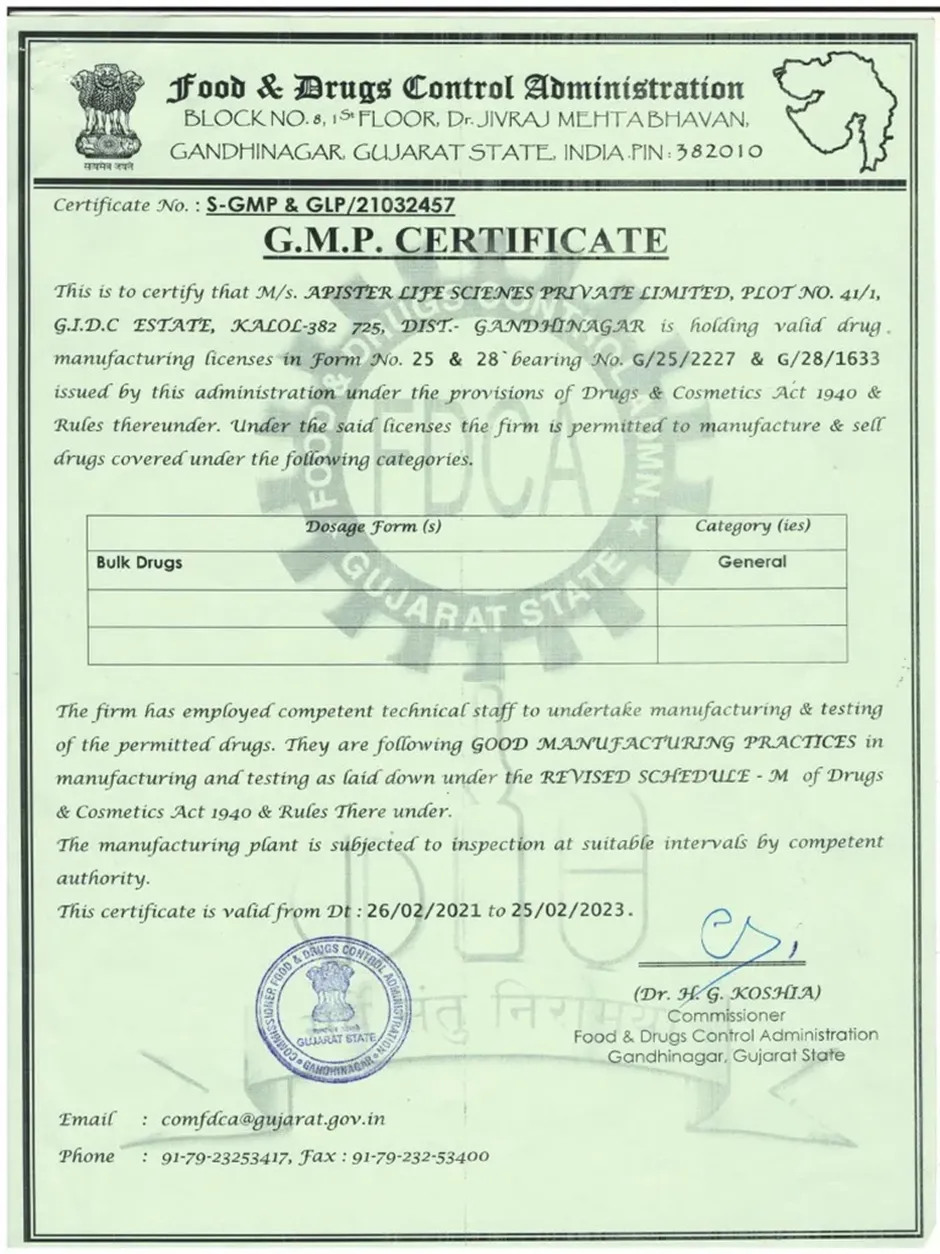
Figure 1: GMP Certificate
9. CERTIFICATE OF PHARMACEUTICAL PRODUCT (COPP)
Certificate of pharmaceutical product (COPP)[23]
The certificate of pharmaceutical product (abbreviated: COPP) is a certificate issued in the format recommended by the World Health Organization (WHO), which establishes the status of the pharmaceutical product and of the applicant for this certificate in the exporting country. It is issued for a single product, because manufacturing arrangements and approved information for different pharmaceutical forms and strengths can vary.
Scope
The use of the COPP by the following 18 countries across three regions:
LATAM (Latin America.): Argentina, Brazil, Colombia, Mexico.
Europe, Middle East and Africa: Algeria, Egypt, Israel, Saudi Arabia, South Africa, Russia, Turkey.
Asia Pacific (ASIA): India, China, Indonesia, Malaysia, Singapore, South Korea, Taiwan.
These countries were selected in 2007, when the Centre for Innovation in Regulatory Science (CIRS) established the Emerging Markets Regulatory Review Times (EMaRReT) database
Through member company identification of countries of commercial interest, data for which would help with global development strategy.
9.1 Inspection:
Types of COPP
9.2 Types of COPP [23]:
(a) WHO 1975 type COPP
The WHO 1975 version is a certificate to be issued by exporting country regulatory authority stating:
a) The authorized product has to be placed on the market for its use in the country also, the permit number and issue date, or
b) That the nonauthorized product has placed on the market for its use in the country and also add the reasons
9.2.1 why it is needed;
a) As recommended by World Health Organization, the manufacturer of product conforms to GMP requirements.
b) only within the country of origin the products to be sold or distributed; or
c) To be exported to manufacturing plant where the product is produced and at suitable intervals subject to inspections2)
(b) WHO 1988 type COPP
Unlike the WHO 1975 version, the competent authority of the exporting country should have:
●All labelling copies.
●Product detailed information in the country of origin (see annex 3)[20].
(c) WHO 1992 type COPP
This is intended for use by the competent authority of an importing country in two situations:
a) When the question arises related to importation and sale license; and
b) For license renew, extend, review or changes.
The following information required for the certificate:
i) Whether a licensed product is required to be placed on the market or not.
ii) Also, if the satisfied information submitted by the applicant that the certifying authority of the manufacture of the product undertaken by another party
iii) Inspection have been carried out of the manufacturer of product;
iv) If the certificate is provisional or permanent;
v) Are the dosage forms, packages and/or labels of a finished dosage form manufactured by an independent company or by the applicant;
vi) states the names of the importing and exporting
(certifying) countries
9.3 Obtaining COPP: Application, Content and Supporting Information
How to obtain COPP? [23]
●To obtain a COPP, a request is made to the exporting country’s health authority by the Marketing Authorization Holder (MAH).
●An authorized person issues the COPP and returns it to the MAH. Also, other documents required to obtain a COPP including an application for Export Certificate form, evidence of a GMP certificate (if applicable), Manufacturing License and the last approved SPC (Summary of Product Characteristics).
9.4 Content and format [23]
a. Importing country: The name of the country or regulatory authority requesting the CPP for registration, licensing, renewal, or other regulatory purposes.
b. Exporting (certifying) country: The country and competent national regulatory authority responsible for issuing the certificate.
c. Name and dosage form of the product: The pharmaceutical product name and its dosage form, such as tablet, capsule, injection, syrup, or cream.
d. Active pharmaceutical ingredient (s) and strength: The name of the active ingredient (s) and the amount present per unit dose. The WHO recommends the use of International Nonproprietary Names (INNs), where possible.
e. Composition of the product: The complete composition, including active ingredients and excipients, may be provided in the certificate or attached documentation.
f. Marketing authorization status: The certificate indicates whether the product is licensed for marketing in the exporting country and whether it is actually marketed there.
g. Product licence information: Where applicable, the product licence number, date of issue, product-licence holder, and relevant manufacturing information are provided.
h. Manufacturing and GMP status: The certificate provides information concerning inspection of the manufacturing site and whether the facilities and operations comply with applicable WHO Good Manufacturing Practices (GMP) requirements.
i. Applicant information: The name and address of the applicant requesting the certificate are included where the applicant is different from the product-licence holder.
j. Certification by the competent authority: The certificate contains the address of the certifying authority, details of the authorized official, signature, official stamp, and date of certification.
k. The WHO model specifies that the CPP is issued for a single pharmaceutical product because manufacturing arrangements and approved information may differ according to dosage form and strength.
9.5 Certificates, Eligible Products and Applicant Requirements
Importation for Personal Use
●Risky to health, such drugs are prevented from importation.
●Also, Enforcement actions have been taken domestically.
9.6 Types of drugs for which COPPs may be issued [23]
●Approved drug products
●Active pharmaceutical ingredients (API)
●Over the counter drug (OTC) products
●Unapproved drug products
●Homeopathic drugs
9.7 Who can apply for COPP?
A complete application for export certification must be submitted by the person/company who exports the drug.
The certification is intended for a drug which: meets the applicable requirements of the Act or Food Drug and Cosmetic Act 801 (e)(1) requirements [21 U.S.C.381 (e)(1)]
Process to apply for a COPP
9.7.1 Submit Form no. 3613b–Located on the FDA internet
www.fda.gov/downloads/AboutFDA/Reports Manuals
Forms/Forms/UCM052388
9.7.2 Requirements for COPP application:
a. Applicant Contact Information
b. Trade name (the drug product’s brand name)
c. Bulk Substance Generic Name
d. Name of Applicant
e. Status of Product License holder
f. Listing of manufacturing location on COPP
g. Complete Manufacturing Facility Address
h. Facility Registration Number
i. Importing countries
j. Authorization to Release Information
Foreign Manufactured Drugs Exportation certification from the country for the Sites of Foreign Manufacturing Approved Drug Products NDA, ANDA, BLA or Approval Letter.
a. Outer Container Label (s)
b. Package Insert
c. Package Container (Immediate)
d. Status of Product-license Holder
e. Number of certificates requested
f. Certification Statement
g. Billing contact
h. Marketing Status in the Exporting Country
Additional Required Information, Attachments and Processing
9.8 Additional Required Information.
a. Unapproved Drug Products Product Identification Statement Formulation page
b. Over-the-Counter (OTC) Drug products
c. Title of the applicable monograph
d. Product Label (s)
e. Immediate Package Container Label
f. Export only formulation page.
g. Active Pharmaceutical Ingredients (API) main sample of the bulk container
COPPs should be issued as per Model Certificate of Pharmaceutical Product recommended by World Health 1Organization, given in TRS 86[10] of WHO
9.9 Attachments to COPP
Two sets of attachments required for one country (one set to attach to the certificate package and one set for FDA files).
Attachments must not be more than five pages per certificate.
Applicant is responsible for consulting with the importing country to determine the type of the information required.
9.10 Process Time
Drugs in compliance are normally issued within twenty (20) government working days of receipt of complete and an accurate Cop application.
9.11 Certificates may not be issued
Returned –missing information application with a letter identifying the missing information.
Rejected –manufacturing facilities are not in compliance with good manufacturing practices (GMPs).
Denied –drug products are not compliance as per regulation (e.g., misbranded drug)
9.12 Ribbons on Copps
Coloured ribbons designate the type of COPP:
9.13 COPP Fee Schedule
9.14 Expiration of COPP
Certificate expires on 2 years from the notarization date or as noted.
After expiry date, a new COPP application has to be submitted
9.15 Benefits
CERTIFICATE OF PHARMACEUTICAL PRODUCT
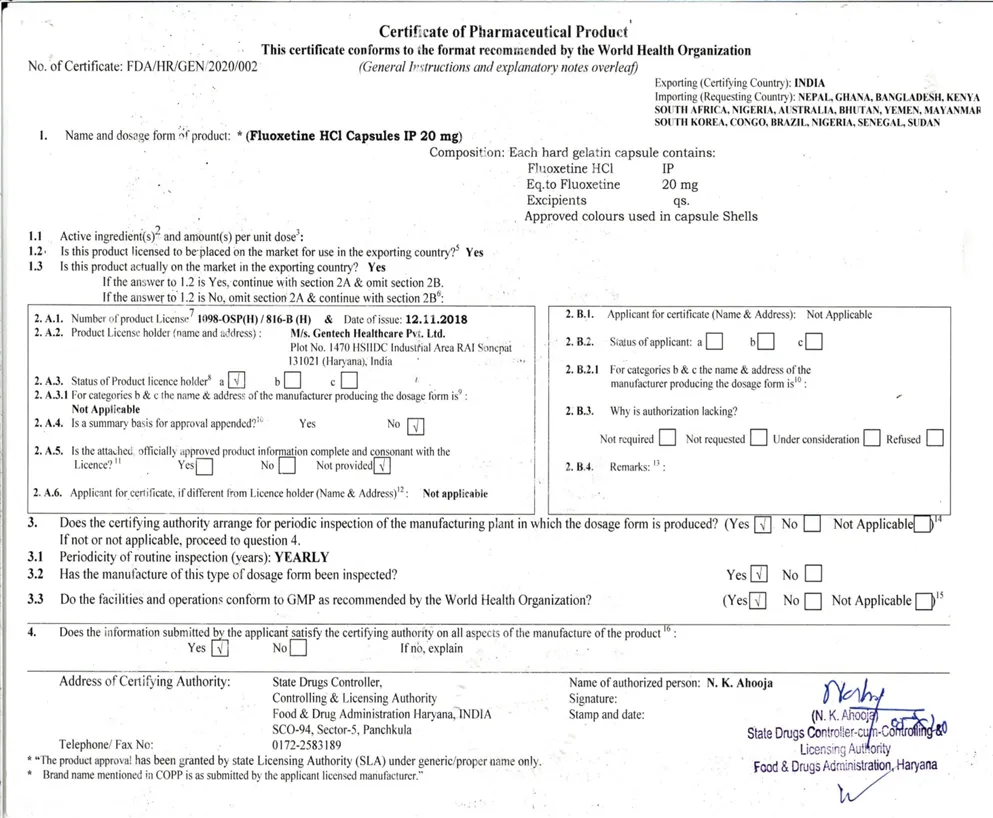
Figure 2: Certificate of Pharmaceutical Product
10.REGULATORY UPDATES RELEVANT TO INDIAN PHARMACEUTICAL EXPORTS
The regulatory environment for Indian pharmaceutical exports continues to evolve through digitalisation, quality-system strengthening and greater alignment with international regulatory expectations. The Directorate General of Foreign Trade (DGFT) identifies the Importer-Exporter Code (IEC) as a mandatory requirement for export or import activity except for specifically exempted categories. The IEC process is administered electronically by DGFT, supporting traceability of trade entities.[31]
CDSCO continues to use the SUGAM platform for regulatory services, including Export NOC functions. CDSCO issued a public notice on 7 March 2025 describing a streamlined online Export NOC system for unapproved and approved new drugs and a one-year NOC subject to prescribed conditions. The revised framework requires applications to be submitted through SUGAM with the prescribed checklist and supporting documents.[32]
India also notified a revised Schedule M in December 2023. The revised Schedule M places explicit emphasis on a pharmaceutical quality system and quality risk management, reinforcing the expectation that manufacturing quality is managed through documented, systematic controls rather than end-product testing alone.[33]
WHO describes GMP as a component of the pharmaceutical quality system intended to ensure that medicinal products are consistently produced and controlled according to their intended use and applicable quality standards. WHO GMP therefore provides an international quality framework that supports regulatory inspection, manufacturing authorisation and the WHO Certification Scheme.[34]
The WHO Certification Scheme on the quality of pharmaceutical products moving in international commerce remains a voluntary international regulatory-reliance mechanism. WHO updated its overview of the Scheme in 2025 and continues to provide a model Certificate of a Pharmaceutical Product (CPP). The model certificate records information such as the product, marketing status, manufacturing site inspection and GMP conformity, subject to the applicable national authority and importing-country requirements.[35,36]
11.GLOBAL MARKET ACCESS AND COUNTRY-SPECIFIC REGULATORY REQUIREMENTS
The country-specific requirements compiled in the original manuscript illustrate that pharmaceutical export compliance is destination-dependent. Marketing authorization, GMP evidence, product registration, certificates of pharmaceutical product, free-sale or other certificates, and local dossier requirements may apply in different combinations. These requirements should be confirmed against the current requirements of the importing country before each submission or shipment because regulatory frameworks and administrative procedures may change.
12.COUNTRY AND THEIR APPLICATION REQUIREMENTS
Table 1: Country and Their Application Requirements
| REGION/COUNTRY | CERTIFICATES/APPLICATIONS REQUIRED |
|---|---|
| USA [24] | ANDA/NDA+USFDA GMP approval (who-GMP not sufficient) |
| EU [25] | EMA/National MA+EU GMP Certificate |
| UK [26] | MHRA GMP approval + Marketing Authorization |
| Japan [27] | PMDA GMP clearance + MA |
| Australia [28] | TGA GMP certificate + Product dossier |
| GCC (UAE, KSA, Oman, etc) | WHO-COPP + WHO-GMP + FSC |
| ASEAN (Malaysia, Indonesia, etc.)[29] | ACTD Dossier + COPP + GMP |
| Russia & CIS | COPP + GMP + Local dossier submission |
| Africa (Nigeria, Kenya, Ghana, etc.) | WHO – GMP + WHO- COPP (SOMETIMES FSC) |
| Latin America (except Brazil)[30] | COPP+WHO-GMP (Brazil requires ANVISA GMP approval) |
13.REGULATORY CHALLENGES AFFECTING PHARMACEUTICAL EXPORTERS
India’s export framework combines domestic licensing, quality requirements, export-specific documentation and destination-country regulatory expectations. In practice, the principal compliance challenge is therefore not a single certificate but the coordination of multiple regulatory interfaces across manufacturers, State Licensing Authorities, CDSCO, customs authorities, overseas marketing authorisation holders and importing-country regulators.
Procedural complexity can arise when the same product must satisfy different requirements for manufacturing, product registration, labelling, certification and release in different markets. The original manuscript identifies fragmented oversight, manpower constraints and differences between state and central processes as operational challenges. These issues can increase administrative burden, extend preparation timelines and require dedicated regulatory expertise.
Digitalisation provides an important opportunity to reduce avoidable administrative steps. SUGAM already supports multiple CDSCO regulatory functions, including Export NOC services, while DGFT operates electronic IEC processes. Continued integration of electronic records, document verification, status tracking and secure digital certification could improve transparency and reduce duplication while preserving regulatory controls.[31,32]
Quality-system maturity is equally important. The revised Schedule M framework explicitly incorporates pharmaceutical quality systems and quality risk management. For exporters, this means that manufacturing quality, documentation, validation, deviation management, corrective and preventive actions, supplier controls and distribution practices should be treated as interconnected elements of export readiness.[33]
14.STRATEGIC CONSIDERATIONS FOR SUSTAINABLE GLOBAL MARKET ACCESS
A sustainable export strategy requires regulatory planning from product development through commercial distribution. Manufacturers should identify target markets early, map each market’s marketing authorisation and GMP expectations, establish a controlled regulatory document package, and maintain current evidence of manufacturing and product compliance.
Certification should be viewed as one component of a broader compliance system. WHO-GMP can provide internationally recognised evidence of manufacturing quality, while the Certificate of a Pharmaceutical Product supports regulatory communication regarding product status and manufacturing arrangements. Neither certificate should be assumed to replace the importing country’s own marketing authorisation, inspection or product-specific requirements.[34-36]
The increasing use of electronic regulatory systems also creates a need for strong data integrity, document control and change management. Export documentation should be consistent across manufacturing licences, product dossiers, certificates, labels, certificates of analysis, invoices and shipping documentation. Controlled master data can reduce discrepancies that otherwise lead to queries, shipment delays or regulatory action.
15.FUTURE PERSPECTIVES
Future development of India’s pharmaceutical export ecosystem is likely to depend on continued digital transformation, regulatory convergence, stronger inspection capacity and more systematic use of risk-based quality management. International regulatory cooperation and reliance mechanisms may reduce unnecessary duplication while maintaining national authority over product quality and patient protection. WHO’s continuing work on certification, GMP and regulatory convergence provides a global context for these developments.[34-36]
For pharmaceutical manufacturers, the practical priority is to build export readiness into the pharmaceutical quality system rather than treating export documentation as a final administrative step. Early regulatory intelligence, robust supplier qualification, validated processes, data integrity, effective change control and destination-specific labelling can collectively support reliable access to regulated and semi-regulated markets.
CONCLUSION
India’s pharmaceutical export sector is one of the strongest pillars of the nation’s economy, supplying affordable, high-quality medicines to more than 200 countries worldwide. Regulatory requirements such as the Importer-Exporter Code (IEC), manufacturing licenses, WHO-GMP certification, and the Export NOC through the SUGAM portal ensure quality, safety, and compliance with global standards. The COPP serves as an essential instrument for international trade, confirming both product authorization and GMP compliance. Despite this robust framework, challenges remain—fragmented regulatory oversight, limited manpower, and inconsistencies in state and central processes hinder smooth operations. Additionally, evolving global demands and country-specific requirements add complexity for exporters.
Looking ahead, digitalization of regulatory systems, strengthening CDSCO’s capacity, harmonization with international guidelines, and continued industry–government collaboration will be critical for India to maintain its competitive edge. By overcoming regulatory bottlenecks and fostering innovation in compliance, India can continue to expand its role as the “pharmacy of the world,” ensuring access to safe and effective medicines across both regulated and semi-regulated markets.
REFERENCES



Akanksha Chitte, Dr. Shetkar B. M., Thaware Sumit, Pharmaceutical Exports from India: Regulatory Challenges, Certification Requirements, and Global Market Access, Int. J. of Pharm. Sci., 2026, Vol 4, Issue 10, 2415-2428. https://doi.org/10.5281/zenodo.23393808
 10.5281/zenodo.23393808