

We use cookies to ensure our website works properly and to personalise your experience. Cookies policy
Ashokrao Mane Institute of Pharmaceutical Sciences and Research, Save, Maharashtra 416213.
Punica granatum L. (pomegranate) is a medicinal plant widely used in traditional medicine for the management of various diseases owing to its rich phytochemical composition and biological activities. The present study aimed to investigate the phytochemical constituents, antioxidant potential, and antibacterial activity of the ethanolic leaf extract of Punica granatum. Fresh leaves of P. granatum were collected, authenticated, shade-dried, and extracted using ethanol by Soxhlet extraction. Preliminary phytochemical screening was performed using standard qualitative tests. Antioxidant activity was evaluated by the DPPH radical scavenging assay using ascorbic acid as the reference standard. Antibacterial activity was assessed against Staphylococcus aureus (ATCC 6538) using the agar well diffusion method, with streptomycin as the standard drug. Phytochemical screening revealed the presence of alkaloids, terpenoids, steroids, saponins, and phenolic compounds, while tannins, carbohydrates, and amino acids were absent. The ethanolic extract exhibited concentration-dependent DPPH radical scavenging activity with an IC?? value of 84.59 ± 3.476 ?g/mL, compared with 4.71 ± 0.393 ?g/mL for ascorbic acid. In the antibacterial study, the extract demonstrated significant activity against S. aureus, producing zones of inhibition of 17 mm and 22 mm at concentrations of 5 mg/mL and 10 mg/mL, respectively. Streptomycin (1 mg/mL) produced a zone of inhibition of 32 mm, whereas the DMSO control showed no inhibitory effect. The ethanolic leaf extract of Punica granatum possesses appreciable antioxidant and antibacterial activities, which may be attributed to the presence of bioactive phytoconstituents such as alkaloids, terpenoids, steroids, saponins, and phenolic compounds. These findings support the traditional use of P. granatum and suggest its potential as a natural source of antioxidant and antimicrobial agents.
Medicinal plants have served as an integral component of healthcare systems since ancient times and continue to play a significant role in disease prevention and treatment worldwide. Ayurveda, one of the oldest traditional systems of medicine, has utilized a diverse range of herbs for maintaining health and treating various ailments for thousands of years [1,2]. Plants not only provide food and nutrition but also constitute a valuable source of bioactive compounds with therapeutic potential. It is estimated that nearly 80% of the global population, particularly in developing countries, relies on herbal medicines as a primary source of healthcare due to their affordability, accessibility, cultural acceptance, and relatively low incidence of adverse effects [3].
The therapeutic efficacy of medicinal plants is primarily attributed to the presence of secondary metabolites such as alkaloids, flavonoids, tannins, terpenoids, phenolic compounds, and glycosides. These phytoconstituents exhibit a wide spectrum of pharmacological activities and have contributed significantly to modern drug discovery [4]. In recent decades, there has been growing interest in plant-based therapies owing to the limitations associated with synthetic drugs, including adverse effects, high costs, and the emergence of drug resistance. Consequently, natural products are increasingly being explored as active pharmaceutical ingredients, excipients, drug carriers, and bioenhancers in pharmaceutical formulations [5].
The rich heritage of traditional Indian medicine is documented in ancient texts such as the Vedas, Charaka Samhita, and Sushruta Samhita, which describe the medicinal properties and therapeutic applications of numerous plant species. However, the global acceptance of herbal medicines requires proper standardization, quality control, and scientific validation in accordance with international guidelines, including those established by the World Health Organization and various pharmacopoeias [6,7]. Such efforts are essential to ensure the safety, efficacy, and reproducibility of herbal products in modern healthcare systems.
Among medicinal plants, Punica granatum L. (pomegranate) has attracted considerable scientific interest because of its extensive traditional use and diverse pharmacological properties. Native to Iran and northern India, pomegranate has been employed in traditional medicine across Asia, Africa, Europe, and the Americas for the treatment of infections, inflammatory disorders, digestive ailments, urinary tract diseases, and metabolic conditions [8]. Recent studies have identified several bioactive constituents in P. granatum, including ellagic acid, ellagitannins, punicic acid, flavonoids, anthocyanins, and other phenolic compounds, which contribute to its therapeutic potential [9].
Oxidative stress, resulting from excessive production of reactive oxygen species (ROS), plays a crucial role in the pathogenesis of numerous chronic diseases such as diabetes, cardiovascular disorders, cancer, and metabolic syndrome. Natural antioxidants derived from fruits and medicinal plants have gained increasing attention due to their ability to neutralize free radicals and protect biological systems from oxidative damage [10,11]. Moreover, concerns regarding the safety of synthetic antioxidants such as butylated hydroxyanisole (BHA) and butylated hydroxytoluene (BHT) have intensified the search for effective natural alternatives [12,13]. In addition to its antioxidant activity, P. granatum has demonstrated antibacterial, antifungal, and antiprotozoal properties, largely attributed to its rich phytochemical composition [14–17].
Therefore, the present study was undertaken to evaluate the phytochemical constituents, antioxidant potential, and antibacterial activity of Punica granatum L. leaf extracts, thereby providing scientific evidence for their potential therapeutic applications.

Figure 1: The plant Punica granatum
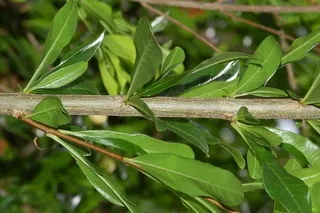
Figure 2: Leaves from Punica granatum
MATERIALS AND METHODS:
Material
Plant Resources
Fresh leaves of Punica granatum L. were collected from the surrounding areas of Kolhapur District, Maharashtra, India. The plant material used in the study was authenticated by the Department of Botany, Prof. Dr. N. D. Patil Mahavidyalaya, Malkapur-Perid, District Kolhapur. The authentication was carried out by Dr. Makarand Mohanrao Aitawade, M.Sc., M.Phil., Ph.D., Head and Assistant Professor, Department of Botany. The collected leaves were thoroughly washed under running tap water to remove dust and adhering impurities and subsequently blotted dry. The leaves were shade-dried for five days at a temperature of 40 ± 2°C until a constant weight was obtained. The dried leaves were then pulverized into a coarse powder and stored in airtight containers for further analysis.
For pharmacognostic and anatomical studies, healthy and disease-free plant specimens were selected. The required leaf samples were excised and immediately fixed in FAA (Formalin–Acetic Acid–Alcohol) solution consisting of 90 mL of 70% ethanol, 5 mL of glacial acetic acid, and 5 mL of formalin. The specimens were maintained in the fixative for 24 h to ensure proper preservation of cellular structures.
Following fixation, the samples were dehydrated through a graded series of tertiary butyl alcohol (TBA). The dehydrated specimens were subsequently infiltrated with molten paraffin wax having a melting point of 58–60°C until complete saturation was achieved. The infiltrated samples were then embedded in paraffin wax to form solid blocks suitable for sectioning and microscopic examination.
Preparation of plant extract:
To bring the solvent to its boiling point, a heating mantle was utilised. The vapours entered the condenser after passing through the distillation arm, condensed, and then fell onto the sample in the thimble. The extraction chamber was eventually filled with the solvent. When the solvent reached the syphon level, it automatically syphoned back into the flask with the dissolved analytes. The extraction cycle was one and only. The process was repeated 10–20 times (6–24 hours) until the solvent in the syphon tube turned colourless, indicating full extraction [1]. When it was finished, the device was allowed to cool. The solvent containing the extracted compounds was concentrated using a rotating evaporator running at low pressure. The extract that remained was collected. After being completely dried to eliminate any remaining solvent, the extract was kept in airtight containers at a low temperature (such as 4 °C) for further examination.
Preliminary phytochemical screening:
The leaf extract of Punica granatum was subjected to preliminary phytochemical screening using standard qualitative methods to detect the presence of major secondary metabolites.
.
Antioxidants' activity
DPPH radical scavenging examination:
The antioxidant activity of Punica granatum leaf extract was evaluated using the 2,2-diphenyl-1-picrylhydrazyl (DPPH) radical scavenging assay. Briefly, 1 mL of 0.1 mM DPPH solution in methanol was mixed with 1 mL of the extract at different concentrations (50, 100, 150, 175, and 200 μg/mL). Ascorbic acid (1, 2, 5, 8, and 9 μg/mL) was used as the reference standard, while ethanol served as the control. The reaction mixtures were incubated in the dark for 30 min at room temperature, and the absorbance was measured at 517 nm using a UV–Visible spectrophotometer (Multiskan Spectrum, Thermo Scientific). The percentage inhibition of DPPH radicals was calculated using the following equation:
% [A-B)/A] x 10 = %Inhibition,
where A is the absorbance of the control and B is the absorbance of the sample. The antioxidant activity was expressed as IC₅₀, representing the concentration required to inhibit 50% of DPPH radicals [18].
Antimicrobial Activity
Agar Well Diffusion Method
The antimicrobial activity of P. granatum leaf extract was evaluated using the agar well diffusion method. Antibiotic Assay Medium No. 19 was prepared according to standard procedures, adjusted to the required pH, sterilized by autoclaving at 121°C and 15 psi for 15 min, and cooled before use. The test microorganism used was Staphylococcus aureus (ATCC 6538). The bacterial culture was grown on nutrient agar slants and incubated at 30–35°C for 24 h. A homogeneous bacterial suspension was prepared in sterile saline and adjusted to an optical density of 0.60–0.70 at 530 nm. Sterile molten agar medium (15–20 mL) was poured into Petri dishes and allowed to solidify. Wells of 6 mm diameter were aseptically punched into the agar. The test extract (100 μL, 1 mg/mL) was introduced into the designated wells, while DMSO served as the negative control. A standard antimicrobial agent was used as the positive control. The plates were pre-incubated at 2–8°C for 15–20 min to facilitate diffusion and then incubated at 30–35°C for 24–48 h.
Following incubation, antimicrobial activity was assessed by measuring the diameter of the zone of inhibition (mm) surrounding each well. Larger inhibition zones indicated greater antimicrobial activity of the extract [19].
RESULTS AND DISCUSSION
Preliminary Phytochemical Screening
Preliminary phytochemical screening of the ethanolic extract of Punica granatum leaves revealed the presence of several bioactive secondary metabolites. The extract tested positive for alkaloids, terpenoids, steroids, saponins, and phenolic compounds, indicating its potential pharmacological significance.
Table 1: Initial phytochemical analysis of leaves from Punica granatum.
|
The constituents |
Extract of ethanol |
|
Alkaloids |
+ |
|
Terpenoids |
+ |
|
Steroids |
+ |
|
Tannins |
_ |
|
Saponins |
+ |
|
Phenols |
+ |
|
Carbohydrate |
_ |
|
Amino acids |
_ |
(+) Present, (-) Absent
Antioxidant activity
According to the study, the DPPH solution's absorbance is reduced by the ethanolic extract of Punica granatum leaves. The absorbance of the DPPH solution decreases when the antioxidant molecules in the ethanol extract react with the DPPH to produce hydrogen.
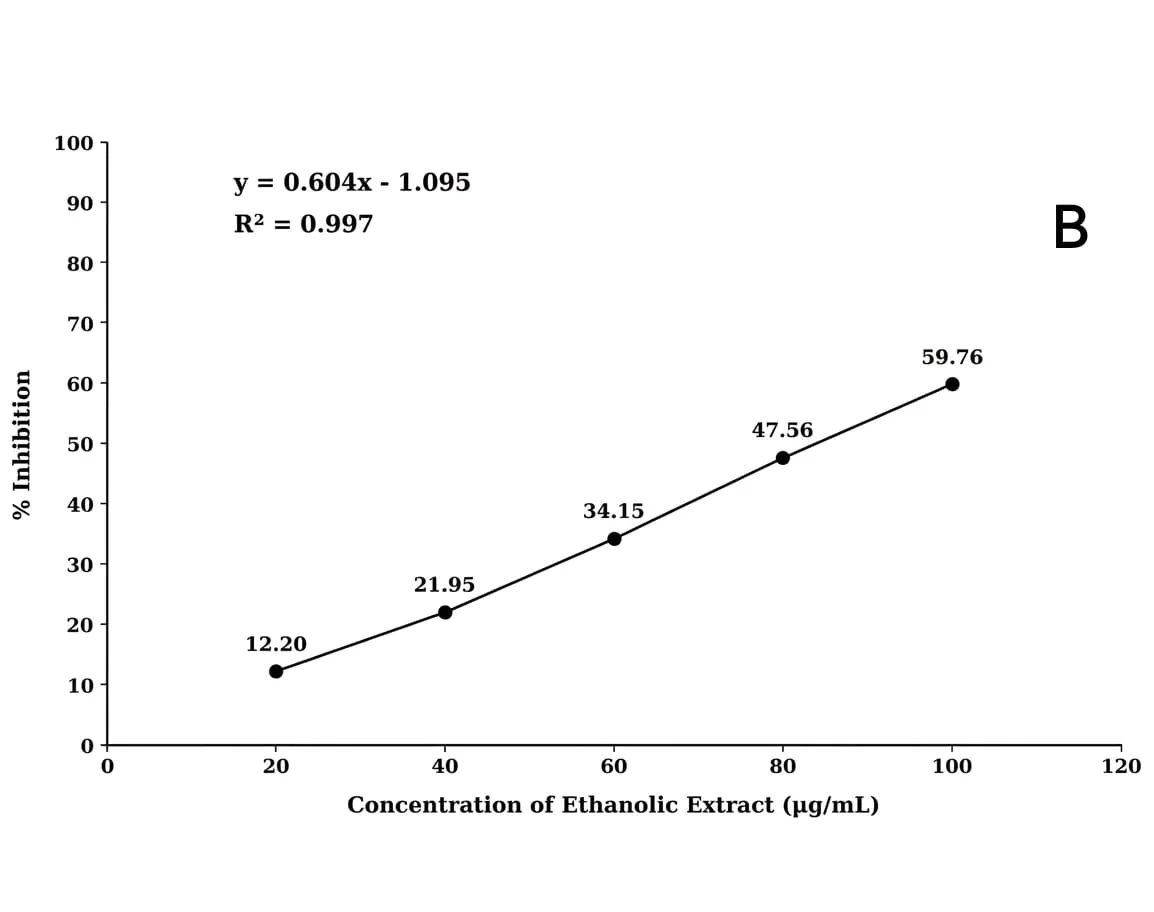
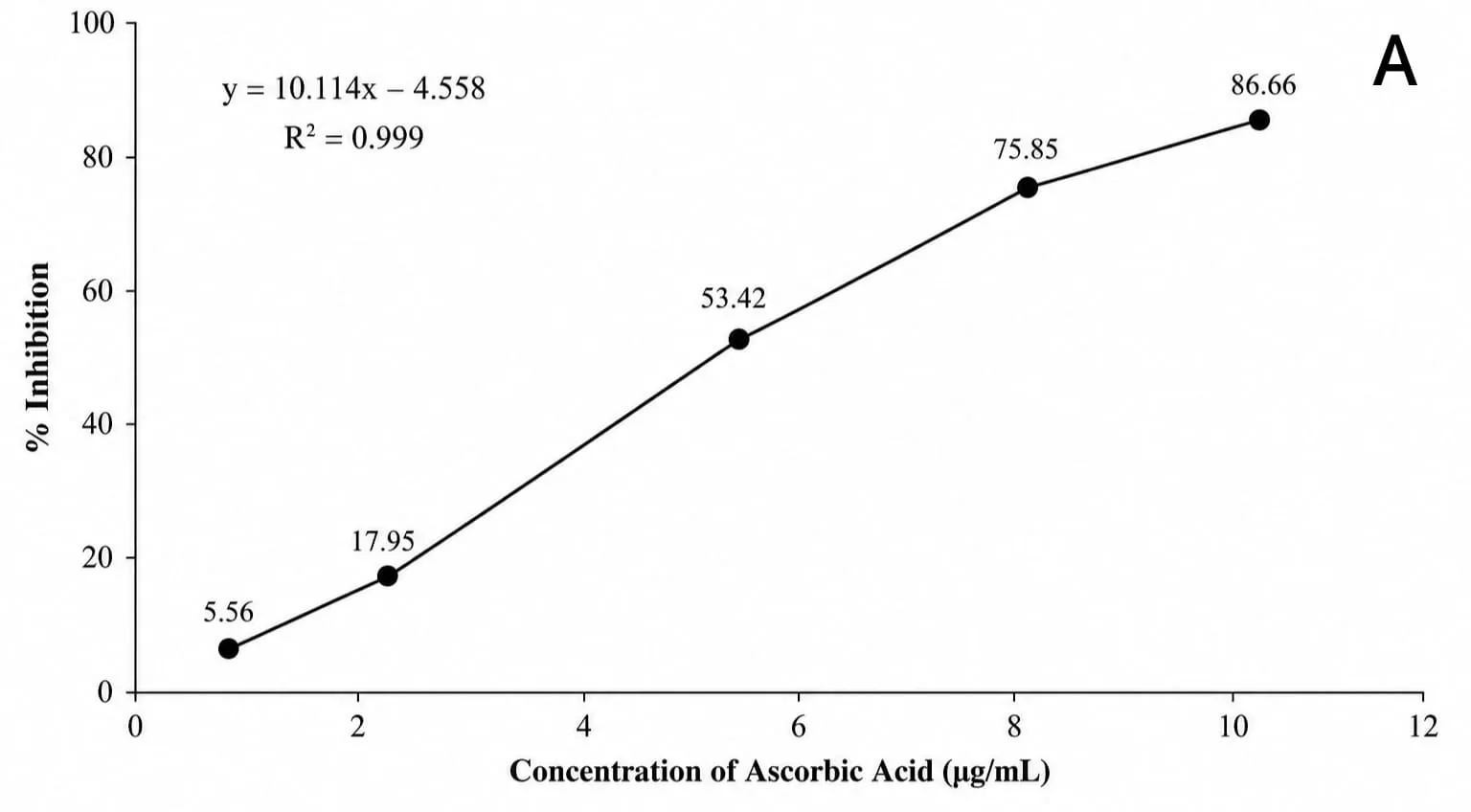
Figure 3: Percentage inhibition in the DPPH assay at various concentrations for (A) ascorbic acid and (B) Punica granatum leaf ethanol extract.
The scavenging activity was expressed using the extract's IC50 value, which was determined as the percentage of DPPH radical inhibition. Table 2 and Fig. 3B show that the IC50 value for the ethanol extract was 84.59±3.476 μg/mL. Ascorbic acid, the reference, has an IC50 of 4.71±0.393 μg/mL (Table 2 and Figure 3A).
Table 2: IC50 value for Punica granatum leaf ethanol extract's in vitro antioxidant activity
|
sample |
The in vitro IC50 value (μg/mL) |
|
Ascorbic acid |
4.71±0.393 |
|
Ethanol extract |
84.59±3.476 |
Anti-microbial activity (Agar well plate method)
Using streptomycin as the standard and DMSO as the reference, the ethanolic extract of Punica granatum leaves was tested for antibacterial activity against Staphylococcus aureus (ATCC 6538) using the agar well diffusion method. Significant, dose-dependent action was demonstrated by the extract. A 32 mm zone of inhibition was created by streptomycin (1 mg/ml). The control showed no inhibition, whereas the extract displayed 17 mm at 5 mg/ml and 22 mm at 10 mg/ml. Phytoconstituents including flavonoids, tannins, phenols, and alkaloids, which may operate by interfering with bacterial cell walls and membrane function, are probably responsible for the activity. Overall Punica granatum leaf extract demonstrates encouraging antibacterial activity; larger effects are shown at higher doses, indicating its potential utility as a natural antimicrobial source.
Observations:
Standard: 100µl
Compound: 5 mg/ml and 10 mg/ml
Control -DMSO
Staphylococcus aureus ATCC no-6538
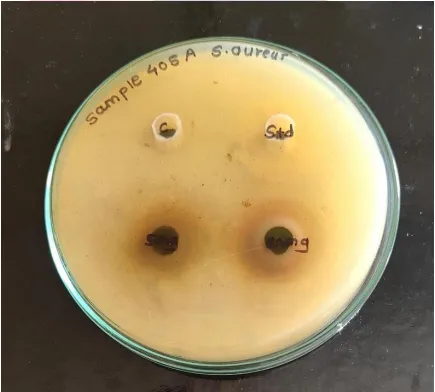
Table 3. Observation of antibacterial evaluation
|
Sample |
Concentrated |
Inhibition Zone (mm) |
|
Control |
|
- |
|
Standard (Streptomycin) |
1mg/ ml |
32 |
|
Sample- 405A |
5mg/ ml |
17 |
|
10mg/ ml |
22 |
CONCLUSION
The present study demonstrated that the ethanolic leaf extract of Punica granatum contains several biologically active phytoconstituents, including alkaloids, terpenoids, steroids, saponins, and phenolic compounds. The extract exhibited notable antioxidant activity in the DPPH radical scavenging assay, with an IC₅₀ value of 84.59 ± 3.476 μg/mL, indicating its ability to neutralize free radicals. Furthermore, the extract showed significant antibacterial activity against Staphylococcus aureus (ATCC 6538), producing concentration-dependent zones of inhibition of 17 mm and 22 mm at 5 mg/mL and 10 mg/mL, respectively.
The observed biological activities may be attributed to the synergistic effects of the phytochemicals present in the extract. These findings provide scientific evidence supporting the traditional medicinal use of P. granatum leaves and highlight their potential as a natural source of antioxidant and antibacterial agents. Further studies involving isolation, characterization, and mechanistic evaluation of the active constituents are warranted to explore their therapeutic applications and potential development into herbal pharmaceutical formulations.
REFERENCES





Shravani Chavan, Aniket Patil, Abhijeet Kulkarni, Ayan Mujawar, Aradhana Kamble, Phytochemical Screening, Antioxidant, and Antibacterial Evaluation of Ethanolic Leaf Extract of Punica granatum L, Int. J. of Pharm. Sci., 2026, Vol 4, Issue 6, 6454-6461, https://doi.org/10.5281/zenodo.20845402
 10.5281/zenodo.20845402