

We use cookies to ensure our website works properly and to personalise your experience. Cookies policy
Department of General Medicine, Government General Hospital, Kadapa, Andhra Pradesh, India., Department of Pharmacy Practice, P. Rami Reddy Memorial College of Pharmacy, AndhraPradesh, India.
Background: De Quervain’s tenosynovitis is a painful condition of the tendons of the first dorsal compartment of the wrist, the abductor pollicis longus (APL), and extensor pollicis brevis (EPB). It can occur after birth, due to hormonal changes, fluid retention and repetitive wrist and thumb movements from caring for the baby.
De Quervain’s tenosynovitis is an inflammatory stenosing tenosynovitis of the first dorsal compartment of the wrist, containing the abductor pollicis longus (APL) and extensor pollicis brevis (EPB) tendons. It typically presents with Pain and tenderness over radial aspect of wrist especially over radial styloid. It may cause difficulty to thumb movements and grasping. It is common in women during pregnancy and the post partum period. Hormonal and fluid changes in lactating mothers may also cause the swelling of tendons. Holding, lifting, and feeding the infant are repeated activities that may increase stress on the wrist and thumb. These can contribute to the development or worsening of symptoms. Clinically, patients commonly experience pain, tenderness and swelling over the radial side of the wrist, which may worsen with thumb movement. The Finkelstein test is commonly used as a clinical maneuver to support the diagnosis.
The early recognition of postpartum De Quervain’s tenosynovitis is important because wrist pain can interfere with activities of daily living, including infant care. We report a case of De Quervain's tenosynovitis in a 29-year-old lactating mother at 8 weeks post partum. Clinical presentation, diagnosis, and treatment are discussed.
Case Presentation
A 29-year-old lactating woman, 8 weeks postpartum following a normal vaginal delivery, presented with pain over the right wrist and base of the thumb for the past 3 weeks. The pain was gradual in onset and was rated 6/10 in severity. It was aggravated by repetitive activities such as holding, lifting and feeding her infant, and was relieved by rest and avoidance of wrist movements. On clinical examination, mild swelling and tenderness were noted over the radial styloid region and first dorsal compartment of the right wrist. Pain was elicited during thumb abduction and extension, with mildly reduced grip strength. The Finkelstein test was positive. No sensory deficit or signs of infection were observed. The patient had no
significant past medical or surgical history, was not taking any regular medications, and had no known drug allergies. Based on the clinical history and examination findings, a diagnosis of postpartum De Quervain's tenosynovitis of the right wrist was made.
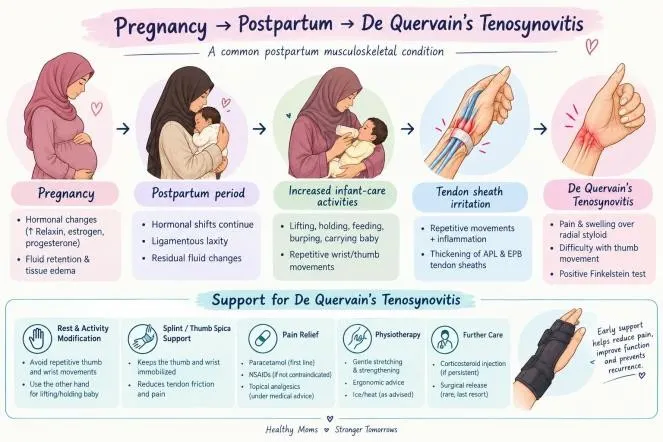
Figure 01: Pregnancy → Postpartum Period → Increased Infant-Care Activities → Tendon-sheath Irritation → De Quervain’s Tenosynovitis, with Supportive Management Measures.
Clinical Examination
On clinical examination patient was conscious, oriented and clinically stable.
On examination of the right wrist there was mild swelling and tenderness over the radial styloid and first dorsal compartment. Mildly reduced grip strength on the affected side, pain on abduction and extension of thumb. The Finkelstein test was positive for tenderness over the radial aspect of the wrist. There was no sensory loss, discoloration of the skin or any
evidence of local infection. The findings were compatible with De Quervain’s tenosynovitis of the right wrist.
Investigations
De Quervain's tenosynovitis is primarily a clinical diagnosis, so laboratory investigations are usually not required. For this case, the following assessment can be documented:
Finkelstein test: Positive, supporting the clinical diagnosis.
X- ray of the right wrist: May be performed to exclude bony abnormalities or other causes of wrist pain; typically shows no specific abnormality in De Quervain's tenosynovitis.
Ultrasonography of the wrist: Can demonstrate thickening of the tendon sheath and changes involving the APL and EPB tendons.
Routine blood investigations: Generally not required unless another inflammatory or systemic condition is suspected.
Treatment and Outcome Treatment
The patient was managed conservatively to reduce pain and inflammation and to avoid further strain on the affected wrist. She was advised to rest the involved hand, to avoid repetitive movements of the thumb and wrist, especially those that increased the pain when holding or lifting the infant. A thumb-spica wrist splint was recommended to immobilize the wrist and thumb and to allow adequate rest to the affected tendons. Since the patient was breastfeeding, the attending physician recommended supportive measures and appropriate analgesic/anti-inflammatory therapy. Patient was also counseled about proper positioning of wrist during breastfeeding and infant care.
Outcome
The patient was followed up for clinical improvement after conservative management comprising wrist/thumb immobilization, activity modification, rest, and appropriate symptomatic treatment. On follow up there was a reduction in pain and tenderness over the radial aspect of the wrist with improved thumb and wrist movements and better ability to perform routine infant-care activities. No new problems were reported. The advice was to avoid repeated wrist movements and to follow up.
DISCUSSION:
De Quervain’s tenosynovitis (DQT) is a stenosing pathology of the first dorsal compartment of the wrist affecting the abductor pollicis longus (APL) and the extensor pollicis brevis (EPB) tendons. It presents clinically as pain and tenderness on the radial side of the wrist, especially with thumb movement or gripping.[1] Diagnosis is mainly clinical, and provocative tests such as the Finkelstein test are often used to confirm diagnosis.
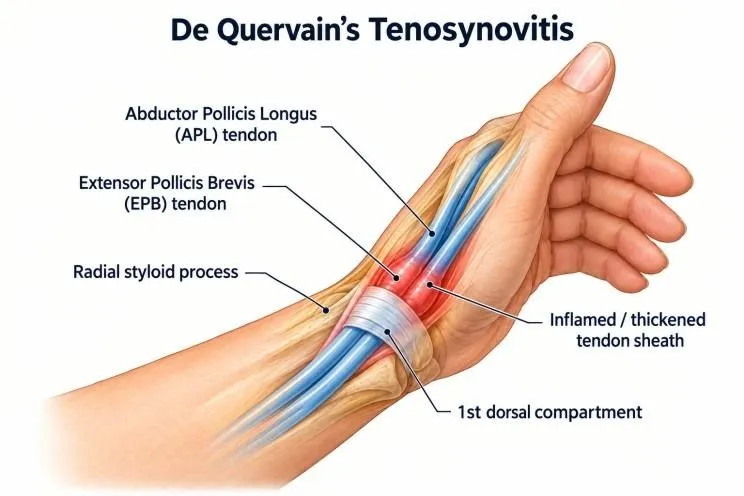
Figure 02: Anatomical Illustration of the First Dorsal Wrist Compartment Showing the Abductor Pollicis Longus (APL) and Extensor Pollicis Brevis (EPB) Tendons, Inflamed Tendon Sheath, and Radial Styloid Involved in De Quervain’s Tenosynovitis.
DQT has been reported in several studies in pregnancy and postpartum period (PPP). In a population based study from South Korea (>1.6 million pregnancies), ~2.1% of women were diagnosed with pregnancy-related DQT during pregnancy or the postpartum period.[2] Other important associations observed in the study were maternal age ≥30 years, multiple gestation, cesarean delivery, hypertensive disorders of pregnancy and rheumatoid arthritis. However, such associations should not be interpreted as one factor directly causing DQT.[3]
The relationship of DQT with the postpartum period seems to be multifactorial. Physiological changes of pregnancy and the postpartum period may modify the tendon sheath and the mechanical demands of newborn care may put repetitive stress on the APL and EPB tendons.[4] In a prior clinical series, 6 of 24 women with DQT were pregnant or postpartum at symptom onset and infant care activities worsened symptoms in 5 of these 6 patients. The authors suggested that pregnancy-related and mechanical factors may both be responsible for the condition.[5]
The mechanical aspect of postpartum DQT is of particular importance in lactating mothers. Holding, lifting, carrying and feeding an infant can require repetitive thumb and wrist motions and sustained wrist postures. [6]A study of primary caregivers provided evidence of a major role for the mechanical demands of new born care and did not support lactational hormonal changes as an important contributor. Thus it may be more scientifically accurate to say that DQT is associated with the postpartum/lactation period rather than that breastfeeding itself is a direct cause of the disorder.[7]
This association is further supported by one study that examined risk factors in postpartum women. A study of 63 postpartum women with DQT and 630 postpartum controls showed that first childbirth, pregnancy >40 weeks and BMI >25 kg/m2 were significantly associated with postpartum DQT [8]. Interestingly, in that study, infant birth weight and multiple gestation were not associated with increased risk. The findings indicate that postpartum DQT is multifactorial in etiology and involves gestational and postnatal factors.
The patient was a 29-year-old lactating woman, 8 weeks postpartum, who presented with pain at the right wrist and thumb base which was exacerbated by holding, lifting and feeding her infant.[9] Tenderness over the first dorsal compartment, pain with movement of the thumb and a positive Finkelstein test are consistent with DQT.[10] The timing of childbirth, onset of symptoms and repetitive infant-care activities are clinically relevant to the postpartum period. However, since this is a single case, a direct causal relationship between lactation and DQT cannot be established.
Treatment of DQT depends on the severity of symptoms and the clinical response. Conservative management consists of activity modification, patient education, wrist/thumb immobilization and symptomatic treatment.[11] Based on a systematic review and network meta-analysis, corticosteroid injection plus short-term thumb-spica immobilization may lead to a clinically meaningful improvement in pain and function. 10. In nursing women specifically, a retrospective study of 124 breastfeeding patients compared surgical treatment, corticosteroid injection and wrist splinting and reported improvement with each approach, but
the study design and treatment allocation should be taken into consideration when interpreting these findings.
To summarize, this case emphasizes the importance of including De Quervain’s tenosynovitis in the differential diagnosis of postpartum women presenting with radial-sided wrist pain, especially when the symptoms are exacerbated by infant-care activities.[12] Early recognition of the condition may facilitate early intervention to reduce functional limitations and support the mother’s ability to carry out essential childcare activities. More prospective studies are needed to better define the role of pregnancy-related physiological changes, lactation and mechanical infant care activities in postpartum DQT development.
Clinical Implications
Postpartum De Quervain’s tenosynovitis can greatly impact mother’s ability to perform daily infant-care activities such as holding, lifting and feeding the baby. Thus, early recognition of wrist pain and appropriate clinical evaluation is important in postpartum women.
This case serves as a reminder to clinicians the importance of a focused wrist exam including assessment of tenderness, thumb motion, grip strength and a Finkelstein test. Early management with activity modification, rest, wrist/thumb immobilization and appropriate symptomatic treatment may help in pain reduction and improved hand function.
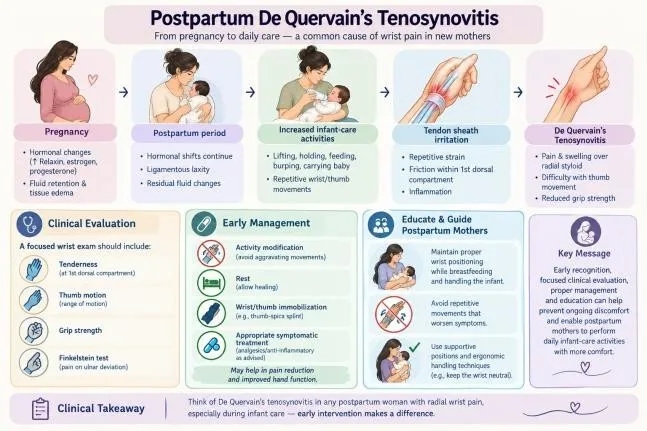
Figure 03: Clinical Implementation of Postpartum De Quervain’s Tenosynovitis, Highlighting Focused Clinical Evaluation, Early Conservative Management, Ergonomic Infant-Care Practices, and Patient Education.
Health care providers should also inform postpartum mothers about maintaining proper wrist positioning while breastfeeding and handling the infant and avoiding repetitive movements that worsen symptoms. Early intervention may help to avoid on going discomfort and enable the mother to undertake routine childcare activities with more comfort.
CONCLUSION
Postpartum De Quervain's tenosynovitis is an important cause of wrist and thumb pain in lactating mothers and might interfere with routine infant-care activities. In this case, the patient presented with radial sided wrist pain, tenderness, pain on thumb movements and a
positive Finkelstein test, which supported the clinical diagnosis. Early recognition, appropriate clinical assessment, activity modification, rest and conservative management can assist to reduce symptoms and improve hand function. Clinicians should be aware of this condition in postpartum women, especially when wrist pain is related to repetitive infant-care activities.
REFERENCES

S. Ayesha Iffath, Postpartum De Quervain’s Tenosynovitis: Unraveling the Role of Lactation and Infant Care, Int. J. of Pharm. Sci., 2026, Vol 4, Issue 11, 2808-2813. https://doi.org/10.5281/zenodo.24332082
 10.5281/zenodo.24332082