

We use cookies to ensure our website works properly and to personalise your experience. Cookies policy
1,4 Department of Pharmacy, Bharat Technology, Uluberia 711316
2,3 Bhawanipur Global Campus, Kolkata-700053
Failure in developing an effective process for the manufacturing of drug products may lead to severe consequences like product recalls and plant closure. As a result, process validation has gained a prime focus as an essential product development activity. In the limelight of this notion, the research goal of current work was to carry out prospective process validation for the manufacture of Remogliflozin Etabonate sustained release tablets along with a tablet containing them. Remogliflozin Etabonate mini tablets production was trialed and tested for results. The Formulation that gave promising results was considered and concluded for process validation. Protocol and batch manufacturing record (BMR) were prepared for three consecutive batches of the same size, method, equipment, and validation criteria. The critical process parameters were identified; mini-tablets were compressed by using the direct compression method and evaluated. The results of three consecutive batches were compiled with specifications. It indicated that the process employed here offers a high degree of assurance to produce quality products meeting pre-determined specification limits and quality attributes. Three process validation batches of same size, manufacturing process, equipment & validation criteria was taken. The critical parameter involved in sifting, dry mixing, preparation of granulating agent, wet mixing, wet milling, drying, sizing, lubrication and compression stages were identified and evaluated. The outcome indicated that this process validation data provides high degree of assurance that manufacturing process produces product meeting its predetermined specifications and quality attributes.
OBJECTIVE: The Validation protocol for Remogliflozin Etabonate Tablets has been prepared for the following purpose.
PRE- VALIDATION REQUIREMENT:
MANUFACTURING FORMULA FOR GRANULATION
|
Sr. No |
Ingredient |
Spec. |
% of overages |
Qt/ Tab (Mg) |
STD. Qt (Kg) |
|
1 |
Remogliflozin Etabonate |
IP |
--- |
100 |
-- |
|
2 |
PVP-K30 |
IP |
--- |
8 |
-- |
|
3 |
Microcrystalline Cellulose |
IP |
--- |
21.4 |
-- |
|
4 |
Magnesium Stearate |
IP |
--- |
3.6 |
-- |
|
5 |
HPMC-K100lv+Eudragit L-100 |
IP |
--- |
100+10 |
-- |
|
6 |
Talc |
IP |
--- |
5 |
-- |
|
7 |
Titanium Dioxide |
IP |
--- |
qs |
-- |
|
250 mg |
-- |
||||
MANUFACTURING FORMULA FOR COATING
|
Sr. No
|
Ingredient |
Spec. |
Qt/ Tab (Mg) |
STD. Qt (Kg) |
|
|
PVP-K30 |
IP |
8 |
-- |
|
|
Microcrystalline Cellulose |
IP |
21.4 |
-- |
|
|
Magnesium Stearate |
IP |
3.6 |
-- |
|
|
HPMC-K100lv+Eudragit L-100 |
IP |
100+10 |
-- |
|
|
Talc |
IP |
5 |
-- |
|
|
Titanium Dioxide |
IP |
qs |
-- |
MANUFACTURING PROCESS:
A] Granulation Process: Get the line clearance for granulation process: Before commencing the actual compounding of the batch ensure the complete cleaning of all Equipment’s and the area as per the standard operating procedure. Pass Remogliflozin Etabonate & Magnesium Stearate IP through 30 # sieve by using sifter.
Add H.P.M.C -K100lv and Eudragit L-100 slowly in 22.0 Lt purified water with continuous stirring for complete dispersion of H.P.M.C in water.
B] COMPRESSION
Compress the lubricated granules only after Reauthorization, if there is undue time lag between lubrication and further processing.
C] COATING:
|
Sr. No. |
OPERATION |
|||||||||||||||||||||
|
A |
PREPARATION OF COATING SOLUTION: |
|||||||||||||||||||||
|
1. |
Suspend HPMC-K100LV, Eudragit L-100 & Microcrystalline Cellulose in Isopropyl alcohol IP by using mechanical stirrer |
|||||||||||||||||||||
|
2. |
Pass Titanium Dioxide IP through the 100 # sieve of mechanical shifter. Add Titanium dioxide IP in Isopropyl alcohol IP with continuous stirring till dispersed uniformity. Then the mixture passes through double muslin clothes & collects in clean Dry S.S container. |
|||||||||||||||||||||
|
3. |
Add step 3 to step 2 with constant stirring for complete distribution. |
|||||||||||||||||||||
|
4. |
Add PVP K-30 and Talc in step 5 with continuous stirring. |
|||||||||||||||||||||
|
5. |
Pass the final solution through colloid mill & keep in well closed container. |
|||||||||||||||||||||
|
6. |
Place uncoated dedusted tablets in a clean, dry coating pan (36”). Heat the tablets by inching the coating pan. |
|||||||||||||||||||||
|
B |
COATING PROCESS |
|||||||||||||||||||||
|
7. |
Place uncoated tablets in a clean, dry Neocota. |
|||||||||||||||||||||
|
8. |
Before start up coating the using following setting
|
|||||||||||||||||||||
|
9. |
Tablets are coated to give in average coat of 8 to 10 mg & dry the film coated tablets in the pan with inlet temperature 40 to 50°C for 5 to 10 minutes to remove all the trace of solvents. |
Flow Chart
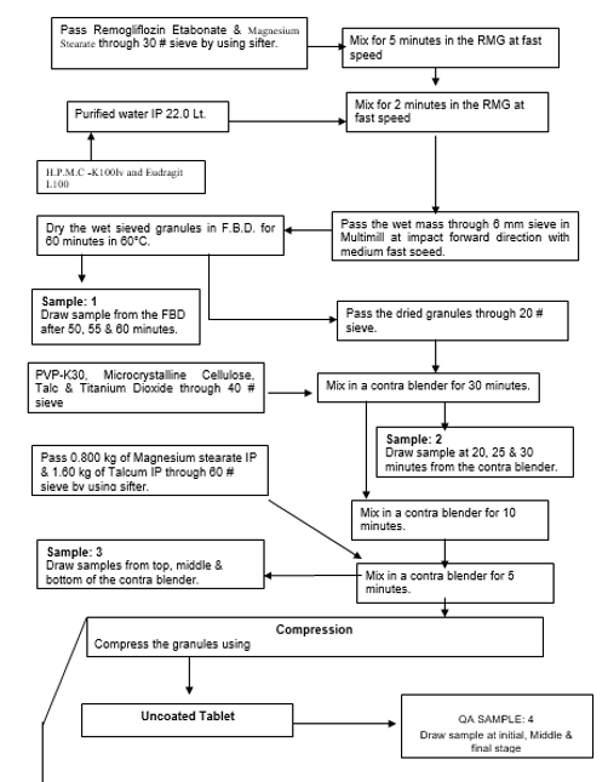
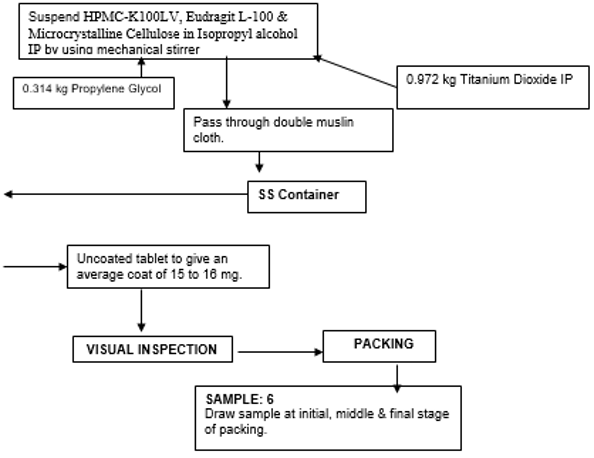
UNIFORMITY OF DRYING: Granulation (Stage 1)
Acceptance Criteria for Granulation of Stage 1
|
TEST |
ACCEPTANCE |
|
Description |
A White colored granular powder |
|
Moisture content |
NMT 2 % |
|
Tests |
Batch No:F4 |
||||||||
|
After 50 minutes |
After 55 minutes |
After 60 minutes |
|||||||
|
Top |
Middle |
Bottom |
Top |
Middle |
Bottom |
Top |
Middle |
Bottom |
|
|
Description |
A White colored powder |
A White colored powder |
A White colored powder |
A White colored powder |
A White colored powder |
A White colored powder |
A White colored powder |
A White colored powder |
A White colored powder |
|
Moisture content |
4.3% |
4.3% |
4.1% |
3.7% |
3.6% |
3.9% |
2% |
2.9% |
2.0% |
|
Mean |
4.23 % |
3.73% |
2.3% |
||||||
UNIFORMITY OF DRYING: Granulation (Stage 1)
|
Tests |
Batch No:F5 |
||||||||
|
After 50 minutes |
After 55 minutes |
After 60 minutes |
|||||||
|
Top |
Middle |
Bottom |
Top |
Middle |
Bottom |
Top |
Middle |
Bottom |
|
|
Description |
A White colored powder |
A White colored powder |
A White colored powder |
A White colored powder |
A White colored powder |
A White colored powder |
A White colored powder |
A White colored powder |
A White colored powder |
|
Moisture content |
4.2% |
4.1% |
4.2% |
3.6% |
3.7% |
3.9% |
1.9% |
2.0% |
2.1% |
|
Mean |
4.17% |
3.73% |
2.0% |
||||||
UNIFORMITY OF DRYING: Granulation (Stage 1)
|
Tests |
Batch No:F6 |
||||||||
|
After 50 minutes |
After 55 minutes |
After 60 minutes |
|||||||
|
Top |
Middle |
Bottom |
Top |
Middle |
Bottom |
Top |
Middle |
Bottom |
|
|
Description |
A White colored powder |
A White colored powder |
A White colored powder |
A White colored powder |
A White colored powder |
A White colored powder |
A White colored powder |
A White colored powder |
A White colored powder |
|
Moisture content |
4.2% |
4.2% |
4.3% |
3.8% |
3.7% |
3.9% |
2% |
2.9% |
2.9% |
|
Mean |
4.23 |
3.8 |
2.93 |
||||||
UNIFORMITY OF MIXING: (Stage 2)
The uniformity of mixing the limit of % Relative Standard deviation NMT 2.0 %
Acceptance Criteria for Granulation of stage 2
|
TEST |
ACCEPTANCE |
|
Description |
A White crystalline granular powder |
|
Remogliflozin Etabonate |
68.68 % (w/w) (65.25 % w/w to 75.55 % w/w) |
|
Tests |
Batch Number: F4 |
||||||||
|
After 20 Minutes. |
After 25 Minutes. |
After 30 Minutes. |
|||||||
|
Top |
Middle |
bottom |
Top |
Middle |
bottom |
Top |
Middle |
bottom |
|
|
Description
|
White crystal - line granules |
White crystal - line granules |
White crystal - line granules |
White crystal - line granules |
White crystal - line granules |
White crystal - line granules |
White crystal - line granules |
White crystal - line granules |
White crystal - line granules |
|
Remogliflozin Etabonate |
68.83% w/w |
68.79% w/w |
67.76% w/w |
67.61% w/w |
68.61% w/w |
68.64% w/w |
68.55% w/w |
68.25% w/w |
68.69% w/w |
|
Mean |
68.36% w/w |
68.29% w/w |
68.50% w/w |
||||||
|
Standard Deviation |
0.5374 |
0.5879 |
0.2257 |
||||||
|
% Relative Standard Deviation |
0.79 |
0.86 |
0.33 |
||||||
UNIFORMITY OF MIXING: Granulation (Stage 2)
|
Tests |
Batch Number: F5 |
||||||||
|
After 20 Minutes. |
After 25 Minutes. |
After 30 Minutes. |
|||||||
|
Top |
Middle |
bottom |
Top |
Middle |
bottom |
Top |
Middle |
bottom |
|
|
Description
|
White crystal - line granules |
White crystal - line granules |
White crystal - line granules |
White crystal - line granules |
White crystal - line granules |
White crystal - line granules |
White crystal - line granules |
White crystal - line granules |
White crystal - line granules |
|
Remogliflozin Etabonate |
68.78% w/w |
67.42% w/w |
69.33% w/w |
68.97% w/w |
68.29% w/w |
67.36% w/w |
68.45% w/w |
68.11% w/w |
68.81% w/w |
|
Mean |
68.51% w/w |
68.21% w/w |
68.46% w/w |
||||||
|
Standard Deviation |
0.9807 |
0.8054 |
0.3488 |
||||||
|
% Relative Standard Deviation |
1.43 |
1.18 |
0.51 |
||||||
UNIFORMITY OF MIXING: Granulation (Stage 2)
|
Tests |
Batch Number: F6 |
||||||||
|
After 20 Minutes. |
After 25 Minutes. |
After 30 Minutes. |
|||||||
|
Top |
Middle |
bottom |
Top |
Middle |
bottom |
Top |
Middle |
bottom |
|
|
Description
|
White crystal - line granules |
White crystal - line granules |
White crystal - line granules |
White crystal - line granules |
White crystal - line granules |
White crystal - line granules |
White crystal - line granules |
White crystal - line granules |
White crystal - line granules |
|
Remogliflozin Etabonate |
68.8% w/w |
68.40% w/w |
67.20% w/w |
68.70% w/w |
68.40% w/w |
69.40% w/w |
68.50% w/w |
68.10% w/w |
68.70% w/w |
|
Mean |
68.13% w/w |
68.83% w/w |
68.43% w/w |
||||||
|
Standard Deviation |
0.83266 |
0.51316 |
0.305505 |
||||||
|
% Relative Standard Deviation |
1.22% |
0.75% |
0.45% |
||||||
UNIFORMITY OF MIXING: Granulation (Stage 3)
The uniformity of mixing the limit of % of Relative standard deviation NMT 2.0 %
Acceptance Criteria for granulation of stage 3
|
Test |
Acceptance |
|
Description |
A White crystalline granular powder |
|
Remogliflozin Etabonate |
66.67 % (w/w) (63.33 to 73.33% w/w) |
|
Tests |
Batch No. F4 |
Batch No. F5 |
Batch No. F6 |
||||||
|
Top |
Middle |
Bottom |
Top |
Middle |
Bottom |
Top |
Middle |
Bottom |
|
|
Description |
White crystal - line granules |
White crystal - line granules |
White crystal - line granules |
White crystal - line granules |
White crystal - line granules |
White crystal - line granules |
White crystal - line granules |
White crystal - line granules |
White crystal - line granules |
|
Remogliflozin Etabonate |
66.86 % w/w |
67.11% w/w |
66.54% w/w |
66.34% w/w |
66.03% w/w |
66.70% w/w |
66.6 % w/w |
66.5% w/w |
66.8 % w/w |
|
Mean |
66.84% w/w |
66.35% w/w |
66.63% w/w |
||||||
|
Standard Deviation |
0.2863 |
0.3370 |
0.152753 |
||||||
|
% Relative Standard Deviation |
0.43% |
0.51% |
0.23% |
||||||
UNIFORMITY OF COMPRESSION:
Determine the results of three batches and record following tables.
Acceptance Criteria for Compressed Tablet
|
Test |
Acceptance |
|
Description. |
Whitish in colour solid roundish unit dosage form |
|
Individual Tablet Wt. |
250 mg ± 5 % (237.5 mg to 262.5 mg.) |
|
Wt of 20 Tablets |
12.5 g ± 5 % (12.44 to 12.57 gm) |
|
Thickness |
3.0 mm + 0.2 mm (2.8 to 3.2 mm) |
|
Disintegration Time |
--- |
|
Friability |
NMT 1.0 % |
|
Hardness |
NLT 4.0 kg / cm2 |
|
Dissolution Test |
NLT 80 % in 24hrs |
|
Assay of Remogliflozin Etabonate |
Between 95.0 to 110.0 % on label claim 250 mg. |
Uniformity for compressed tablets:-
|
Tests |
Batch Numbers |
||||||||
|
F4 |
F5 |
F6 |
|||||||
|
Initial |
Middle |
End |
Initial |
Middle |
End |
Initial |
Middle |
End |
|
|
Description
|
Whitish in colour solid roundish unit dosage form |
Whitish in colour solid roundish unit dosage form |
Whitish in colour solid roundish unit dosage form |
Whitish in colour solid roundish unit dosage form |
Whitish in colour solid roundish unit dosage form |
Whitish in colour solid roundish unit dosage form |
Whitish in colour solid roundish unit dosage form |
Whitish in colour solid roundish unit dosage form |
Whitish in colour solid roundish unit dosage form |
|
Individual Tablet wt.
|
242.9 to 258.4 mg |
235.8 to 258.9 mg |
239 to 259.2 mg |
243.8 to 258.2 mg |
243.8 to 258.2 mg |
243.8 to 255.3 mg |
242.9 to 258.4 mg |
242.0 to 258.0 mg |
243.9 to 259.4 mg |
|
Wt of 20 Tablets. |
5.013 gm |
4.992 gm |
5.004 gm |
5.027 gm |
5.047 gm |
5.044 gm |
5.016 gm |
4.988 gm |
5.008 gm |
|
Thickness
|
3.23 to 3.40 mm |
3.23 to 3.40 mm |
3.23 to 3.40 mm |
3.23 to 3.40 mm |
3.26 to 3.37 mm |
3.24 to 3.37 mm |
3.23 to 3.39 mm |
3.24 to 3.38 mm |
3.23 to 3.36 mm |
|
Disintegration time |
--- |
--- |
--- |
--- |
--- |
--- |
--- |
--- |
--- |
|
Hardness
|
4 to 4.5 kg / cm2 |
3 to 4.0 kg / cm2 |
3 to 4.5 kg / cm2 |
3 to 4.5 kg / cm2 |
4 to 4.5 kg / cm2 |
4 to 4.5 kg / cm2 |
4 to 5.0 kg / cm2 |
4 to 5.5 kg / cm2 |
4 to 5.5 kg / cm2 |
|
Friability |
0.08% |
0.12% |
0.08% |
0.06% |
0.08% |
0.06% |
0.02% |
0.02% |
0.00% |
|
Dissolution Test |
93.03% |
94.52% |
93.54% |
92.245% |
91.88% |
92.48% |
92.08% |
91.40% |
91.55% |
|
Assay |
100.58% |
100.70% |
100.14% |
100.07% |
100.98% |
100.03% |
100.84% |
100.67% |
100.27% |
UNIFORMITY OF FILM-COATED TABLETS
After compressed the Tablets, Coat the tablet as per Flow Chart. To collect the coated tablet at bottom, Middle & top of the coating pan.
Determine the results of three batches and record in the following tablets.
Acceptance Criteria for Film Coated Tablet
|
Test |
Acceptance |
|
Description. |
Whitish in colour solid roundish unit dosage form |
|
Identification Test of Remogliflozin Etabonate |
Should be positive. |
|
Uniformity of weight in mg. (Wt of 20 Tablets) |
250 mg ± 5 % (237.5 mg to 262.5 mg.) |
|
Average Weight |
12.5 g ± 5 % (12.44 to 12.57 gm) |
|
Disintegration Time |
--- |
|
Thickness |
3.0 mm + 0.2 mm (2.8 to 3.2 mm) |
|
Hardness |
NLT 4.0 kg / cm2 |
|
Dissolution Test |
NLT 80 % in 30 Min. |
|
Assay of Remogliflozin Etabonate |
Between 95.0 to 110.0 % on label claim 250 mg. |
Uniformity of Film coated Tablets.
|
Tests |
Batch Numbers |
||||||||
|
F4 |
F5 |
F6 |
|||||||
|
Initial |
Middle |
End |
Initial |
Middle |
End |
Initial |
Middle |
End |
|
|
Description
|
Whitish in colour solid roundish unit dosage form |
Whitish in colour solid roundish unit dosage form |
Whitish in colour solid roundish unit dosage form |
Whitish in colour solid roundish unit dosage form |
Whitish in colour solid roundish unit dosage form |
Whitish in colour solid roundish unit dosage form |
Whitish in colour solid roundish unit dosage form |
Whitish in colour solid roundish unit dosage form |
Whitish in colour solid roundish unit dosage form |
|
Identification Test |
Complies |
Complies |
Complies |
Complies |
Complies |
Complies |
Complies |
Complies |
Complies |
|
Uniformity of weight in mg. (wt. of 20 tabs) |
242.9 to 258.4 mg |
235.8 to 258.9 mg |
239 to 259.2 mg |
243.8 to 258.2 mg |
243.8 to 258.2 mg |
243.8 to 255.3 mg |
242.9 to 258.4 mg |
242.0 to 258.0 mg |
243.9 to 259.4 mg |
|
Average Weight. |
5.013 gm |
4.992 gm |
5.004 gm |
5.027 gm |
5.047 gm |
5.044 gm |
5.016 gm |
4.988 gm |
5.008 gm |
|
Disintegration time |
---- |
---- |
---- |
---- |
---- |
---- |
---- |
---- |
---- |
|
Dissolution Test |
93.25% |
93.15% |
92.82% |
97.28% |
96.20% |
96.38% |
95.47% |
95.59% |
95.41% |
|
Hardness
|
4 to 4.5 kg / cm2 |
3 to 4.0 kg / cm2 |
3 to 4.5 kg / cm2 |
3 to 4.5 kg / cm2 |
4 to 4.5 kg / cm2 |
4 to 4.5 kg / cm2 |
4 to 5.0 kg / cm2 |
4 to 5.5 kg / cm2 |
4 to 5.5 kg / cm2 |
|
Thickness
|
3.23 to 3.40 mm |
3.23 to 3.40 mm |
3.23 to 3.40 mm |
3.23 to 3.40 mm |
3.26 to 3.37 mm |
3.24 to 3.37 mm |
3.23 to 3.39 mm |
3.24 to 3.38 mm |
3.23 to 3.36 mm |
|
Assay of Remogliflozin Etabonate |
100.58% |
100.70% |
100.14% |
100.07% |
100.98% |
100.03% |
100.84% |
100.67% |
100.27% |
UNIFORMITY OF PACKING (FINISHED PRODUCT):
Acceptance Criteria for Finished Product:
|
Test |
Acceptance |
|
Description. |
Whitish in colour solid roundish unit dosage form |
|
Identification Test of Remogliflozin Etabonate |
Should be positive. |
|
Uniformity of weight in mg. (Wt of 20 Tablets) |
250 mg ± 5 % (237.5 mg to 262.5 mg.) |
|
Average Weight |
250 mg ± 5 % (237.5 mg to 262.5 mg.) |
|
Disintegration Time |
--- |
|
Thickness |
3.0 mm + 0.2 mm (2.8 to 3.2 mm) |
|
Hardness |
4.0 kg / cm2 |
|
Dissolution Test |
NLT 80 % in 30 Min. |
|
Assay of Remogliflozin Etabonate |
Between 95.0 to 110.0 % on label claim 250 mg. |
Uniformity of Finished product:
|
Tests |
Batch Numbers |
||||||||
|
2015 |
2025 |
2035 |
|||||||
|
Initial |
Middle |
End |
Initial |
Middle |
End |
Initial |
Middle |
End |
|
|
Description
|
Whitish in colour solid roundish unit dosage form |
Whitish in colour solid roundish unit dosage form |
Whitish in colour solid roundish unit dosage form |
Whitish in colour solid roundish unit dosage form |
Whitish in colour solid roundish unit dosage form |
Whitish in colour solid roundish unit dosage form |
Whitish in colour solid roundish unit dosage form |
Whitish in colour solid roundish unit dosage form |
Whitish in colour solid roundish unit dosage form |
|
Identification Test |
Complies |
Complies |
Complies |
Complies |
Complies |
Complies |
Complies |
Complies |
Complies |
|
Uniformity of weight in mg. (wt. of 20 tabs) |
242.9 to 258.4 mg |
235.8 to 258.9 mg |
239 to 259.2 mg |
243.8 to 258.2 mg |
243.8 to 258.2 mg |
243.8 to 255.3 mg |
242.9 to 258.4 mg |
242.0 to 258.0 mg |
243.9 to 259.4 mg |
|
Average Weight. |
5.013 gm |
4.992 gm |
5.004 gm |
5.027 gm |
5.047 gm |
5.044 gm |
5.016 gm |
4.988 gm |
5.008 gm |
|
Disintegration time |
---- |
---- |
---- |
---- |
---- |
---- |
---- |
---- |
---- |
|
Dissolution Test |
93.25% |
93.15% |
92.82% |
97.28% |
96.20% |
96.38% |
95.47% |
95.59% |
95.41% |
|
Hardness
|
4 to 4.5 kg / cm2 |
3 to 4.0 kg / cm2 |
3 to 4.5 kg / cm2 |
3 to 4.5 kg / cm2 |
4 to 4.5 kg / cm2 |
4 to 4.5 kg / cm2 |
4 to 5.0 kg / cm2 |
4 to 5.5 kg / cm2 |
4 to 5.5 kg / cm2 |
|
Thickness
|
3.23 to 3.40 mm |
3.23 to 3.40 mm |
3.23 to 3.40 mm |
3.23 to 3.40 mm |
3.26 to 3.37 mm |
3.24 to 3.37 mm |
3.23 to 3.39 mm |
3.24 to 3.38 mm |
3.23 to 3.36 mm |
|
Assay |
100.58% |
100.70% |
100.14% |
100.07% |
100.98% |
100.03% |
100.84% |
100.67% |
100.27% |
VALIDATION SUMMARY
ACCEPTANCE CRITERIA:
A minimum of three consecutive production Batches will monitored for concurrent process Validation. Final validation report summarizes the results of the validation study as per the protocol, which includes review of results for meeting specific consistently. From the above three consecutive batches data we can conclude that the results are meet with as per specification & also review the data at the granulation stage-1. So we can conclude that 60 minutes time’s is sufficient time for drying & batches having uniformity of drying at granulation stage -1. From the above three consecutive batches data we can conclude that the results are meet with as per specification & also review the data at the granulation stage-2, in 30 minutes mixing time having low RSD value. So we can conclude that 30 minutes time’s is sufficient time for mixing & batches having uniformity of mixing at granulation stage -2. From the above three consecutive batches data we can conclude that the results are meet with as per specification & also review the data at the granulation stage-3, all three batches having low RSD value. So, we can conclude that all three batches having uniformity of mixing at granulation stage -3.
REFERENCES


Aveek Datta, Dr. Subhasis Maity, Miltu Kumar Ghosh, Kuntal Hazra, Process Validation of Remogliflozin Etabonate Sustained Release Formulation, Int. J. of Pharm. Sci., 2026, Vol 4, Issue 6, 1705-1717. https://doi.org/10.5281/zenodo.20573662
 10.5281/zenodo.20573662