

We use cookies to ensure our website works properly and to personalise your experience. Cookies policy
Medical Administration, PGIM, University of Colombo
The Lady Ridgeway Hospital for Children (LRH), Sri Lanka, serves as the national tertiary referral center providing free pediatric healthcare. The Prosthetic and Orthotic (P&O) Department plays a crucial role in rehabilitative care for children with locomotor disabilities. This descriptive case study aimed to review the current activities of the P&O department, identify operational challenges, and propose evidence-based recommendations for improvement. Data were collected through key informant interviews, document review, and direct observation. Major issues identified included prolonged waiting times, human resource shortages, limited space, equipment breakdowns, and lack of standardized device specifications. Using the Nominal Group Technique, prolonged waiting time was identified as the most critical problem. Root causes included inadequate awareness among administrative and procurement staff, insufficient trained personnel, high patient load, space constraints, and delayed cadre revisions. Recommendations focus on improving awareness, strengthening supply chain management, enhancing workforce capacity, and optimizing departmental processes. Addressing these challenges will improve service efficiency and patient outcomes while ensuring sustainable rehabilitation services.
The Lady Ridgeway Hospital for Children (LRH) is the premier tertiary care pediatric hospital in Sri Lanka and functions as the final referral center for children under 14 years of age. It provides comprehensive healthcare services free of charge and operates 24-hour outpatient, emergency, and inpatient services. The hospital manages over 1.8 million outpatient visits annually and maintains over 1,000 inpatient beds supported by a workforce exceeding 2,500 personnel [1].
Rehabilitation services at LRH are delivered through multidisciplinary units, including physiotherapy, occupational therapy, speech therapy, and the Prosthetic and Orthotic (P&O) Department. The P&O Department provides essential services for children with neuromuscular and skeletal disorders by designing, fabricating, and fitting orthotic and prosthetic devices. These services significantly contribute to improving mobility, functional independence, and quality of life.
Globally, access to prosthetic and orthotic services remains limited, particularly in low- and middle-income countries, due to workforce shortages, financial constraints, and weak health system integration [2]. The World Health Organization (WHO) emphasizes strengthening prosthetic and orthotic services as a key component of universal health coverage and rehabilitation services [3].
Despite its importance, the P&O Department at LRH faces several operational challenges affecting service delivery. This study aims to review current activities, identify system gaps, and propose practical recommendations for improvement.
Prosthetics and Orthotics Department
The Prosthetics and Orthotics (P&O) Department provides essential rehabilitation services for individuals with locomotor disabilities, aiming to restore mobility, enhance functional independence, and improve quality of life. This specialized field focuses on the design, fabrication, and application of externally applied medical devices that support, correct, or replace lost or impaired limb functions [1,2].
The department primarily serves children with neuromuscular and skeletal disorders, including poliomyelitis, cerebral palsy, congenital limb deficiencies, and spinal cord injuries, as well as those with amputations resulting from trauma, infections, or other medical conditions. These patients require prosthetic and orthotic interventions to facilitate standing, ambulation, and performance of daily activities [2,3].
Prosthetists and orthotists are trained healthcare professionals responsible for the assessment, design, fabrication, and fitting of prosthetic limbs and orthotic devices. They play a critical role within a multidisciplinary team that includes orthopedic surgeons, neurosurgeons, rheumatologists, physiotherapists, and occupational therapists, ensuring comprehensive and patient-centered care [3].
The department delivers a wide range of services, including patient assessment, education on prosthetic and orthotic options, customized device fabrication, fitting, and training on proper use and maintenance. Continuous follow-up care is provided to ensure optimal comfort, functionality, and long-term adaptation to the devices [1].
Orthotic devices are used to support and correct musculoskeletal deformities, stabilize weakened limbs, and relieve pain. Common orthoses provided include lower limb devices such as Ankle-Foot Orthoses (AFO) and Knee-Ankle-Foot Orthoses (KAFO), upper limb devices such as Wrist-Hand Orthoses (WHO) and Elbow-Wrist-Hand Orthoses (EWHO), and spinal supports including Lumbo-Sacral Corsets and Thoraco-Lumbo-Sacral Orthoses (TLSO) [2].
For children with limb loss, prosthetic devices are designed to restore mobility, functional capacity, and cosmetic appearance. Both upper and lower limb prostheses are customized according to individual patient needs. At LRH, these devices are manufactured in-house using locally available materials, ensuring cost-effective, lightweight, and context-appropriate solutions. Table 02 presents the statistics of the department over the last two years.
Table 02: Statistics of the P&O department
|
year |
No of devices measured/ casted |
No of devices issued |
No of devices repaired |
Total works |
|
2023 |
Data not available |
1996 |
742 |
2735 |
|
2024 |
3320 |
2475 |
674 |
6312 |
Despite its critical role, the P&O sector faces several systemic challenges. Leadership and governance issues include lack of coordinated stewardship, weak inter-sectoral collaboration, and limited awareness among decision-makers. Financial constraints are evident through high out-of-pocket expenditure, inadequate insurance mechanisms, and insufficient government funding. Service delivery challenges include shortages of trained prosthetists and orthotists, weak referral systems, and reported inefficiencies. Human resource issues include inadequate practical skills among graduates, mismatch between theoretical training and clinical requirements, and limited opportunities for continuing professional development [2,4].
2. OBJECTIVES
General Objective
To review the Prosthetic and Orthotic Department at Lady Ridgeway Hospital and propose recommendations for improvement.
Specific Objectives
3. METHODOLOGY
This study was conducted as a descriptive case study using both qualitative and observational methods.
Data Collection
Primary data was collected through key informant interviews with:
Secondary data was obtained through document review of hospital records. Direct observation of departmental processes, including device fabrication and workflow, was also carried out.
Data Analysis
Identified problems were prioritized using the Nominal Group Technique (NGT), involving key stakeholders. Root cause analysis was performed using the Why–Why method.
4. RESULTS
Current Activities of the Department
The P&O Department provides comprehensive rehabilitative services for children with conditions such as cerebral palsy, poliomyelitis, congenital deformities, spinal cord injuries, and limb amputations. Services include patient assessment, device measurement and casting, fabrication, fitting, repair, and follow-up care.
The department manufactures orthotic and prosthetic devices in-house using locally available materials, ensuring cost-effectiveness. A notable increase in workload was observed, reflecting growing demand for services.
Problem analysis
Identified problems in department
The following key problems were identified:
Prioritization of problems
The Nominal Group Technique (NGT) was used to prioritize the problems identified in the department. Key stakeholders involved in this process included the Deputy Director, Medical Officer Planning, Medical Officer Quality, Medical Officer Public Health, and registrars in Medical Administration. A prioritization matrix was developed, and each participant was asked to score each identified problem out of ten according to selected criteria, including urgency, frequency, and importance.
The total score for each problem was calculated by summing the scores assigned under each criterion. Thereafter, the aggregate scores of all participants were averaged to derive the final ranking of problems. The prioritization matrix is presented in Table 02.
Among the identified issues, prolonged waiting times for clients receiving devices from the Prosthetics and Orthotics Department emerged as the highest priority problem. Following prioritization, a Why-Why analysis was carried out to identify the root causes contributing to this issue. The results of this analysis are illustrated in Figure 01.
Table 02: Prioritization matrix of identified problems
|
Problems |
Criteria |
Total score |
||||
|
Technical feasibility |
Administrative relevance |
Practical Possibility |
Financial feasibility |
Impact |
||
|
Prolonged Wait Times for Clients Receiving Devices from the O&P Department |
14 |
20 |
16 |
15 |
20 |
85 |
|
Frequent breakdown of machines and equipment |
10 |
15 |
4 |
8 |
15 |
52 |
|
Human resources problems |
4 |
20 |
08 |
08 |
12 |
52 |
|
Lack and unclear of device specifications |
20 |
16 |
20 |
10 |
12 |
72 |
|
Limited space availability for department |
4 |
8 |
8 |
8 |
10 |
40 |
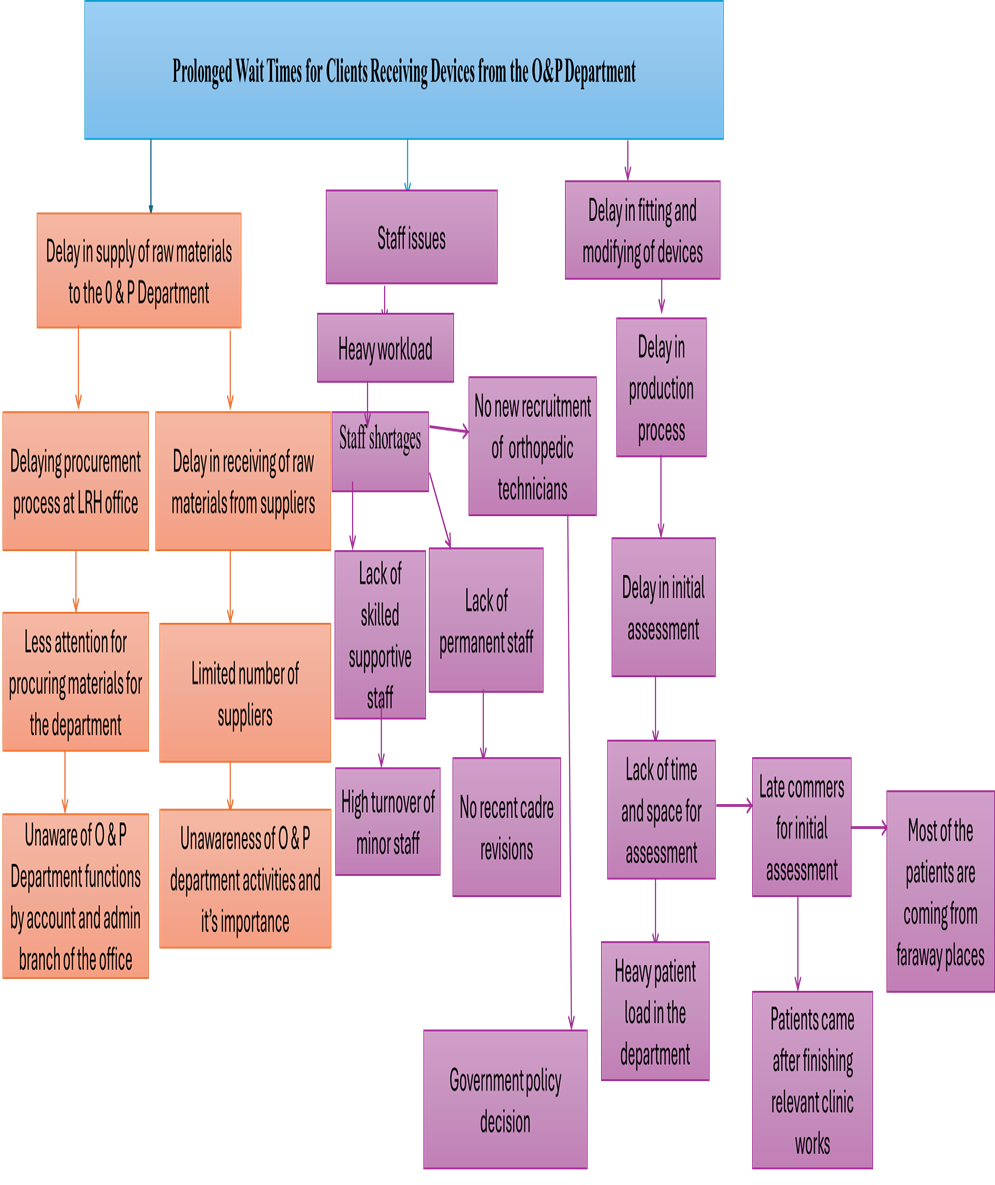
Figure 01: Why-Why diagram
Discussion
The findings highlight systemic challenges in delivering prosthetic and orthotic services in a resource-constrained setting. Similar challenges have been reported globally, particularly in low-resource health systems where rehabilitation services are often underprioritized [2].
Human resource shortages and inadequate training remain critical barriers to service delivery. WHO standards emphasize the importance of a well-trained workforce and continuous professional development in improving prosthetic and orthotic services [3].
Supply chain inefficiencies, including unclear specifications and procurement delays, further contribute to service delays. Strengthening procurement systems and standardizing device specifications are essential to improve efficiency.
Additionally, the lack of awareness among administrative and procurement staff reflects a gap in institutional coordination. Improving interdepartmental communication is crucial for timely service delivery.
Proposals
Based on the identified problems and root cause analysis, several proposals are recommended to improve the efficiency and effectiveness of the Prosthetics and Orthotics Department.
1. Enhance Awareness and Coordination
Awareness sessions should be conducted for administrative, accounting, and procurement staff to improve their understanding of the functions, service importance, and operational needs of the Prosthetics and Orthotics Department. These sessions should be conducted with the involvement of relevant consultants and departmental staff. In addition, regular discussions should be arranged with suppliers to improve their awareness of the department’s requirements and the importance of timely and uninterrupted material supply. A dedicated liaison officer, such as the Deputy Director, may also be assigned to strengthen communication and coordination between the department and hospital management.
2. Strengthen Supply Chain Management
Clear and standardized specifications for prosthetic and orthotic devices should be developed to minimize procurement delays and avoid misunderstandings during purchasing processes. A stock monitoring system should be introduced to prevent shortages of essential materials and improve inventory control. Establishing partnerships with reliable suppliers would further support the timely delivery of materials. In addition, coordination and collaboration with other Prosthetics and Orthotics units in the province should be strengthened to facilitate task sharing and service support, when necessary, such as with the Prosthetics and Orthotics Department at the Rehabilitation Hospital, Ragama.
3. Increase efficiency in the departmental process.
A performance monitoring system should be established to assess service efficiency, including patient waiting times and departmental output. Regular training programmes should be conducted for the supportive staff attached to the department to strengthen their practical skills and improve workflow efficiency. Staff retention strategies, including opportunities for career progression and appropriate recognition or reward mechanisms, should also be considered to reduce turnover and maintain continuity of services.
5. DISCUSSION
This study highlights critical operational challenges within the Prosthetics and Orthotics (P&O) Department at Lady Ridgeway Hospital for Children, with prolonged waiting time identified as the most significant issue. This finding reflects broader systemic inefficiencies rather than an isolated departmental problem. The observed delays are closely linked to workforce limitations, supply chain inefficiencies, infrastructure constraints, and gaps in administrative coordination.
Human resource shortages, particularly the limited availability of trained prosthetists and orthotists, emerged as a key contributor to service delays. This is consistent with global evidence indicating a significant shortage of rehabilitation professionals, especially in low- and middle-income countries (LMICs), where access to prosthetic and orthotic services remains inadequate [1,2]. In addition, the mismatch between training and practical skill requirements, along with insufficient opportunities for continuing professional development, further compounds service delivery challenges.
Supply chain inefficiencies were also identified as a major factor contributing to delays. The absence of standardized device specifications and limited awareness among procurement and administrative staff results in delays in material acquisition and interruptions in service delivery. Similar challenges have been reported in other settings, where weak procurement systems and poor coordination between clinical and administrative units negatively impact rehabilitation services [2]. Strengthening procurement processes and introducing standardized specifications are therefore essential to improving efficiency.
The high patient load observed in this setting is attributable to the role of LRH as the national pediatric referral center. Increased demand, coupled with limited infrastructure and space constraints, further exacerbates waiting times and reduces service throughput. According to WHO guidelines, effective rehabilitation services require adequate infrastructure, workforce capacity, and integrated service delivery systems to meet population needs [1,3].
Another important finding is the lack of awareness among administrative and decision-making personnel regarding the functions and importance of the P&O Department. This reflects a broader governance issue, where inadequate interdepartmental coordination and limited understanding of rehabilitation services hinder timely decision-making and resource allocation. WHO health system frameworks emphasize the importance of leadership and governance in ensuring efficient service delivery through coordinated planning and informed decision-making [3].
From a health systems perspective, the challenges identified in this study span multiple WHO building blocks, including service delivery, health workforce, medical products and technologies, and leadership and governance. Addressing prolonged waiting times therefore requires a comprehensive systems-based approach rather than isolated interventions.
The proposed recommendations are aligned with these findings. Improving awareness among administrative staff is expected to enhance procurement efficiency and coordination. Standardizing device specifications and strengthening supply chain mechanisms will reduce delays in material availability. Workforce strengthening through training and retention strategies will improve service capacity and continuity. Additionally, implementing performance monitoring systems will enable data-driven decision-making and continuous quality improvement.
Overall, this study underscores the need for integrated, system-level interventions to strengthen prosthetic and orthotic services in resource-limited settings. Similar approaches have been recommended globally to improve access, efficiency, and quality of rehabilitation services [1,2].
6. RECOMMENDATIONS
Short-term Recommendations.
Priority should be given to identifying essential training topics and ensuring their systematic delivery to supportive staff within the Prosthetics and Orthotics Department. Practical, hands-on training opportunities should be provided wherever feasible, particularly for healthcare assistants, to enhance their understanding of departmental activities and improve operational efficiency.
Awareness programmes should be strengthened to improve understanding among hospital staff and higher health authorities regarding the importance of the department and the impact of early provision of prosthetic and orthotic devices on children’s functional outcomes. Such initiatives may include structured awareness sessions, workshops, and exhibitions.
Regular review meetings should be conducted involving departmental staff, consultants, and hospital administration to monitor progress, address operational issues, and ensure continuous quality improvement.
Mid-Term Recommendations
Temporary staffing solutions should be explored to address immediate human resource gaps. This may include re-engagement of retired technicians or experienced personnel on a contractual basis.
Financial resource allocation should be prioritized to ensure the continuous availability of critical consumables and essential equipment required for uninterrupted service delivery.
Long-Term Recommendations
Advocacy should be undertaken to secure increased budget allocations to support departmental expansion, infrastructure development, and overall service improvement.
In addition, policy-level interventions should be pursued to facilitate permanent cadre revisions and strengthen recruitment mechanisms for prosthetic and orthotic personnel, ensuring sustainability of services.
ACTION PLAN
Table 3: Action plan
|
Action |
Responsibility |
Time frame |
Indicators |
|
Prioritize essential training topics |
Orthopedic surgeon, Rheumatologist Deputy Director, P & O officer |
Every 2 months |
Availability of set training topics for the P & O Departmental and hospital supportive staff |
|
Conduct training programs on devices preparation. |
Orthopedic surgeon, Rheumatologist Deputy Director, P & O officer, planning unit |
Monthly |
Percentage of planned training programmes conducted. |
|
Create awareness among all hospital staff |
Orthopedic surgeon, Rheumatologist Deputy Director, P & O officer |
Within 3 months |
Improved awareness among hospital staff. Pre and post evaluation. |
|
Conduct workload assessment |
Deputy Director, planning unit and quality unit |
Within 3 months |
Availability of workload assessment results. |
|
Arrange regular review meetings |
Quality unit, planning unit, Orthopedic surgeon, Rheumatologist Deputy Director, P & O officer |
Monthly |
Percentage of planned review meetings conducted |
|
Prepare SOP, guidelines and protocols for departmental process and display within the department. |
Quality unit, planning unit, Orthopedic surgeon, Rheumatologist Deputy Director, P & O officer |
Within 6 months |
Availability of guidelines, SOPs and protocols. |
|
Allocate financial resources for purchasing critical consumables for the department. |
Deputy Director, Accountant |
Monthly |
Number of instances run out of critical consumables |
|
Strengthen the supervision of department |
Director, deputy director |
Within a month |
Number of supervisory visits done in a month |
|
Conduct consultative meetings for preparation of different devices and prosthesis specifications |
with school of Orthotist and Prosthetic, Quality unit, planning unit, Orthopedic surgeon, Rheumatologist Deputy Director, P & O officer |
Within six months |
Percentage of planned consultative meetings conducted. |
CONCLUSION
The Prosthetics and Orthotics Department at Lady Ridgeway Hospital for Children plays a critical role in enhancing the mobility, functional independence, and overall quality of life of children with physical impairments. However, its operational efficiency is constrained by several challenges, including prolonged waiting times, human resource shortages, limited space, and frequent equipment-related issues. These challenges were systematically identified through stakeholder interviews, document review, and direct observation, enabling a focused analysis and development of targeted interventions.
The proposed strategies emphasize improving awareness among administrative and support systems, strengthening supply chain management, and optimizing internal departmental processes. Enhancing coordination between hospital administration and the department, introducing standardized device specifications, and ensuring consistent availability of materials are expected to significantly improve service delivery. In addition, strengthening staff capacity through training and implementing retention strategies will contribute to improved quality of care.
Implementation of these recommendations is expected to reduce patient waiting times and enhance overall departmental efficiency. While mid-term measures such as temporary staffing solutions and improved financial allocation may provide immediate relief, long-term sustainability will depend on policy-level interventions, including cadre revision, structured recruitment, and increased budgetary support. Together, these measures will ensure a more efficient, responsive, and sustainable prosthetic and orthotic service for children.
REFERENCES

Thotagamuwa TWAN, Remance MM, Pushpakumari HMN, Thennakoon TMCLB, Review of the Current Activities of the Prosthetic and Orthotic Department at Lady Ridgeway Hospital for Children and Recommendations for Improvement, Int. J. of Pharm. Sci., 2026, Vol 4, Issue 4, 2364-2372. https://doi.org/10.5281/zenodo.19593562
 10.5281/zenodo.19593562