

We use cookies to ensure our website works properly and to personalise your experience. Cookies policy
Department of Pharmacy Faculty of Medical Paramedical and Allied Health Science, Jagannath University, Jaipur, Rajasthan, 303901, India.
Nutraceuticals, which include dietary supplements, functional foods, herbal products, vitamins, minerals, and bioactive compounds, have gained attention as supportive therapy in hypertension management. They help regulate blood pressure through antioxidant, anti-inflammatory, vasodilatory, and lipid-lowering mechanisms. This review covers the role of nutraceuticals in hypertension management, their mechanisms of action, commonly used nutraceutraceuticals, limitations, and future prospects. Despite the effectiveness of synthetic antihypertensive medications, long-term treatment may result in side effects and low patient compliance. Dietary supplements, functional foods, herbal items, vitamins, minerals, and bioactive substances are examples of nutraceuticals that have drawn interest as supportive therapy for the treatment of hypertension. Through lipid-lowering, vasodilatory, anti-inflammatory, and antioxidant properties, nutraceuticals assist control blood pressure. The function of nutraceuticals in the treatment of hypertension, their modes of action, popular nutraceuticals, their benefits, drawbacks, and hopes for the future are all covered in this review.
The World Health Organization states that millions of people worldwide suffer from hypertension, also known as high blood pressure, which is a chronic medical condition in which arterial blood pressure remains persistently elevated above normal levels. The main causes of hypertension are lifestyle changes, stress, obesity, smoking, alcohol consumption, and unhealthy diets. Conventional antihypertensive medications, such as beta-blockers, calcium channel blockers, ACE inhibitors, and diuretics, but long-term use of these drugs can cause side effects like fatigue, dizziness, electrolyte imbalance, and metabolic disturbances. As interest in natural and preventive.
healthcare is growing. Millions of individuals worldwide suffer from hypertension, which greatly increases cardiovascular morbidity and mortality, according to the World Health Organization. The main causes of hypertension include altered lifestyles, stress, obesity, smoking, alcohol usage, and poor diets. Treatment often involves the use of traditional antihypertensive drugs such beta- blockers, calcium channel blockers, ACE inhibitors, and diuretics. Long-term usage of these medications, however, may cause side effects include exhaustion, lightheadedness, electrolyte imbalance, and metabolic problems. Nutraceuticals have become promising substitutes or supplements for managing hypertension as a result of growing interest in natural and preventive healthcare.
Products made from food sources that offer health advantages beyond basic nourishment are known as nutraceuticals. They include physiologically active substances that can control or prevent long-term conditions like hypertension.
Systolic blood pressure of 140 mmHg or higher and diastolic blood pressure of 90 mmHg or higher are considered hypertension.
|
Category |
Systolic BP (mmHg) |
Diastolic BP (mmHg) |
|
Normal |
<120 |
<80 |
|
Elevated |
120–129 |
<80 |
|
Stage 1 Hypertension |
130–139 |
80–89 |
|
Stage 2 Hypertension |
≥140 |
≥90 |
1.3 Causes of Hypertension
The words "nutrition" and "pharmaceutical" are combined to form the phrase "nutraceutical." Nutraceuticals are naturally occurring bioactive chemicals that are used to support medical therapy, prevent disease, and promote health. Natural bioactive compounds called nutraceuticals are utilized to complement medical care, prevent illness, and enhance health.
Products containing vitamins, minerals, amino acids, or herbs. Examples: omega-3 fatty acids, magnesium, coenzyme Q10.
Goods made from plants that have medicinal properties. Ginseng, hibiscus, and green tea are a few examples.
Garlic, oats, flaxseed, and soy products are a few examples.
Microbes or fibers that enhance cardiovascular and gastrointestinal health.
4.Mechanism of Nutraceuticals in Hypertension Management
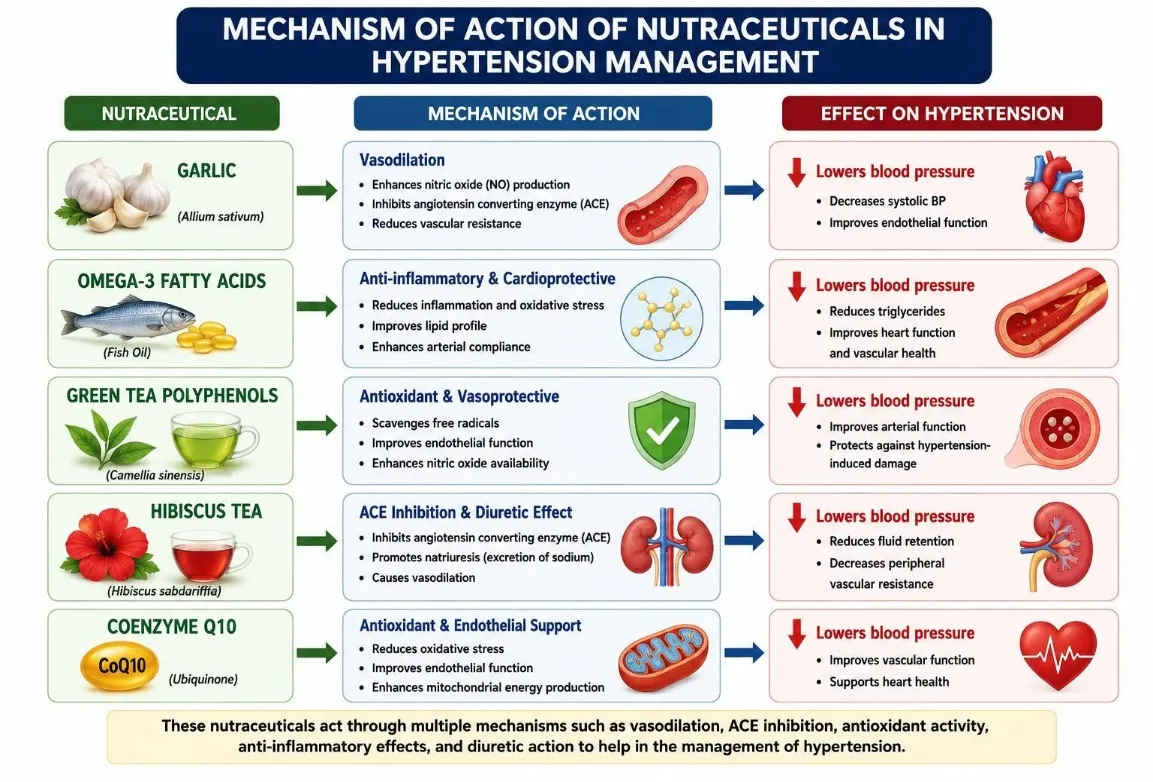
Antioxidant-rich nutraceuticals counteract free radicals and enhance vascular function. Oxidative stress damages blood vessels and causes hypertension. Antioxidant-rich nutraceuticals reduce free radical damage and enhance vascular health.
Some nutraceuticals produce more nitric oxide, which causes blood vessels to relax and blood pressure to drop.
Hypertension and vascular stiffness are both influenced by persistent inflammation. Nutraceuticals reduce inflammatory mediators and improve endothelial function.
Lowering triglycerides and cholesterol enhances cardiovascular health and indirectly lowers blood pressure.
Certain nutraceuticals reduce vasoconstriction and lower blood pressure by inhibiting the angiotensin-converting enzyme (ACE).
Allicin, an antioxidant and vasodilatory compound found in garlic, lowers both the systolic and diastolic blood pressure. It lowers both the diastolic and systolic blood pressure.
Benefits
Omega-3 fatty acids, which are found in fish oil, reduce inflammation and fortify the heart.
Sources
Benefits
As a potent antioxidant, CoQ10 aids in the synthesis of cellular energy.
Benefits
Catechins and polyphenols found in green tea have antioxidant properties.
Benefits
There is inherent ACE inhibitory action in hibiscus tea.
Benefits
Magnesium is essential for blood vessel control and muscle relaxation.
Sources
Benefits
Potassium preserves fluid equilibrium and mitigates the negative effects of sodium.
Sources
Benefits
Numerous clinical studies have shown that nutraceuticals are beneficial in managing hypertension. For example, garlic supplements have shown moderate reductions in systolic blood pressure; omega-3 fatty acids improve endothelial function and lower cardiovascular risk; hibiscus tea has shown antihypertensive effects comparable to mild medications in some studies; and CoQ10 supplementation improves vascular elasticity and reduces oxidative stress.
moderate medicines.
The majority of nutraceuticals come from natural sources and typically have fewer adverse effects.
They offer other advantages like lipid-lowering, anti-diabetic, and antioxidant properties.
Natural supplements are frequently preferred by patients because of their perceived accessibility and safety.
Nutraceuticals enhance general health and help avoid cardiovascular problems.
Therapeutic results may be impacted by variations in composition and dosage.
For many nutraceuticals, extensive clinical research is still lacking.
Antihypertensive drugs may interact with some nutraceuticals.
Long-term use of nutraceuticals may be necessary for their effects to become apparent.
The bioavailability of nutraceuticals may be enhanced using nanotechnology and tailored delivery methods.
Future approaches may involve individualized nutraceutical therapy based on genetic and metabolic profiles.
Nutraceuticals may improve antihypertensive efficacy and lessen negative effects when combined with traditional medications.
Standardized criteria for clinical application must be established through additional scientific confirmation.
CONCLUSION
Because they offer safe, natural, and multipurpose therapeutic advantages, nutraceuticals are crucial in the control of hypertension. Through antioxidant, vasodilatory, anti-inflammatory, and cardioprotective mechanisms, bioactive substances like garlic, omega-3 fatty acids, CoQ10, hibiscus, magnesium, and green tea help control blood pressure. Nutraceuticals are useful supportive therapy and preventative healthcare measures, but they cannot fully replace traditional hypertension medications. To increase their clinical use and treatment reliability, more study and standardization are required.
REFERENCES


Mohan Singh Choudhary, Naveen Jain, Role of Nutraceuticals in Hypertension Management: A Review, and Real-World Evidence, Int. J. of Pharm. Sci., 2026, Vol 4, Issue 6, 258-264. https://doi.org/10.5281/zenodo.20488894
 10.5281/zenodo.20488894