

We use cookies to ensure our website works properly and to personalise your experience. Cookies policy
DJPS College of Pharmacy, Pathri, Parbhani
A simple, precise, accurate, and AQbD-assisted reverse phase high performance liquid chromatographic (RP-HPLC) method was developed and validated for simultaneous estimation of Apixaban and Clopidogrel in synthetic mixture prepared from commercially available tablets procured from local pharmacies. Chromatographic separation was carried out using a Shimadzu LC-20AD HPLC system equipped with UV-Visible detector and LabSolutions chromatographic software. Separation was achieved on an Enable C18G column (250 mm × 4.6 mm, 5 µm) using Acetonitrile:Water (60:40 v/v) as mobile phase at a flow rate of 1.0 mL/min. Detection was performed at 254 nm with an injection volume of 20 µL and total run time of 10 min. AQbD principles were applied for systematic optimization of chromatographic conditions by evaluating the influence of critical analytical parameters on chromatographic performance. Optimization studies demonstrated satisfactory chromatographic separation with acceptable retention time and resolution. The developed method was validated according to ICH guidelines with respect to linearity, accuracy, precision, robustness, limit of detection, and limit of quantification. The developed RP-HPLC method was found to be simple, rapid, economical, reproducible, and suitable for routine simultaneous estimation of Apixaban and Clopidogrel in synthetic laboratory mixtures.
Cardiovascular disorders remain one of the leading causes of morbidity and mortality worldwide and require effective anticoagulant and antiplatelet therapy for prevention and management of thromboembolic complications.[1] Apixaban is a direct oral anticoagulant that selectively inhibits factor Xa and is widely used in prevention of stroke, pulmonary embolism, deep vein thrombosis, and systemic embolism in patients with atrial fibrillation.[2] [3] Clopidogrel is an antiplatelet agent belonging to the thienopyridine class that inhibits ADP-induced platelet aggregation and is commonly prescribed in myocardial infarction, acute coronary syndrome, and other cardiovascular disorders.[4] [5] simultaneous administration of anticoagulant and antiplatelet agents has become increasingly important in cardiovascular therapy.[6] Therefore, accurate and reliable analytical methods are essential for routine quality control and quantitative estimation of these drugs in pharmaceutical formulations and laboratory-prepared mixtures. Reverse phase high performance liquid chromatography (RP-HPLC) is one of the most commonly employed analytical techniques in pharmaceutical analysis because of its high sensitivity, selectivity, reproducibility, and rapid analytical performance. [7] [8]
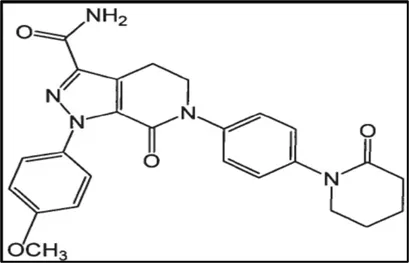
Fig 1. Apixaban chemical structure

Fig 2. Clopidogrel chemical structure
RP-HPLC methods offer advantages such as shorter analysis time, improved chromatographic resolution, and excellent precision for simultaneous estimation of multiple analytes.[9] Analytical Quality by Design (AQbD) is a systematic and scientific approach to analytical method development that focuses on predefined objectives, method understanding, and control of critical analytical variables affecting analytical performance.[10] AQbD facilitates method optimization and enhances reliability and robustness of analytical procedures.[11] Literature survey revealed that several analytical methods have been reported for estimation of Apixaban and Clopidogrel individually or in combination with other cardiovascular drugs.[12] [13] However, limited literature is available regarding simultaneous RP-HPLC estimation of Apixaban and Clopidogrel using AQbD-assisted chromatographic optimization. Therefore, the present work was aimed at developing and validating a simple, precise, accurate, economical, and reproducible RP-HPLC method for simultaneous estimation of Apixaban and Clopidogrel in synthetic mixture prepared from commercially available tablet formulations according to ICH guidelines.
MATERIALS AND METHODS
Chemicals and Reagents
Commercial tablets containing 5 mg of Apixaban and 75 mg of Clopidogrel were procured from local pharmacies and used for preparation of synthetic laboratory mixtures. HPLC grade Acetonitrile, Methanol, and Water were used throughout the study. All chemicals and reagents used were of analytical grade.
Instrumentation
The chromatographic analysis was performed using an Agilent 1260 Infinity II High Performance Liquid Chromatography (HPLC) system equipped with a UV-Visible detector and OpenLAB chromatographic software. Separation was carried out on an Enable C18G reversed-phase column (250 mm × 4.6 mm, 5 µm). An analytical balance with sensitivity of 0.1 mg, ultrasonic bath for degassing and sonication, pH meter, and filtration assembly fitted with 0.45 µm membrane filter were used during the study.Chromatographic Conditions
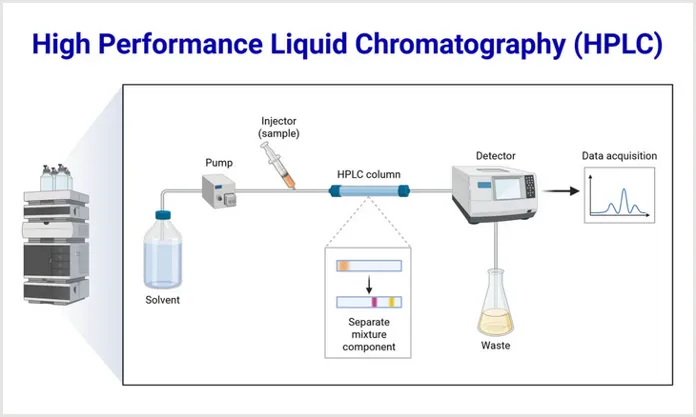
Fig 3. HPLC workflow
Preparation of Mobile Phase
The mobile phase was prepared by mixing Acetonitrile and Water in the ratio of 60:40 v/v. The prepared mobile phase was filtered through a 0.45 µm membrane filter and degassed using ultrasonic sonication before chromatographic analysis.
Preparation of Standard Stock Solution
Standard stock solutions of Apixaban and Clopidogrel were prepared separately by accurately weighing powdered tablet equivalent to 10 mg of Apixaban and 10 mg of Clopidogrel into two separate 100 mL volumetric flasks. The contents were dissolved in mobile phase and sonicated for 15 min to obtain clear solutions. The solutions were filtered through a 0.45 µm membrane filter and the volume was made up to the mark with mobile phase to obtain stock solutions containing 100 µg/mL of each drug.
RESULTS AND DISCUSSION
Method Development and Optimization
The RP-HPLC method for simultaneous estimation of Apixaban and Clopidogrel in synthetic mixture prepared from commercial tablets was developed using AQbD principles by systematic optimization of chromatographic parameters affecting analytical performance. Various chromatographic conditions were investigated to obtain satisfactory peak separation, acceptable retention time, good peak symmetry, and reproducible chromatographic response.
Different mobile phase combinations consisting of methanol, acetonitrile, and water in different ratios were evaluated during preliminary experimental trials. Among the investigated chromatographic systems, Acetonitrile:Water (60:40 v/v) provided satisfactory chromatographic separation with sharp peaks and acceptable resolution for both analytes.
Analytical Target Profile (ATP)
The Analytical Target Profile was established to obtain a simple, precise, accurate, robust, and reproducible RP-HPLC method suitable for simultaneous estimation of Apixaban and Clopidogrel with acceptable chromatographic separation, symmetrical peak shape, and short analysis time for routine pharmaceutical analysis.
Critical Quality Attributes (CQAs)
Table 1. Critical Quality Attributes Evaluated During Method Development
|
CQA |
Desired Analytical Performance |
|
Retention Time |
Should be consistent |
|
Resolution |
Should be greater than 2 |
|
Peak Symmetry |
Should be close to 1 |
|
Theoretical Plates |
Should indicate good column efficiency |
Critical Method Parameters (CMPs)
Table 2. Critical Method Parameters Affecting Analytical Performance
|
CMP |
Influence on Method |
|
Mobile Phase Composition |
Affects separation and resolution |
|
Flow Rate |
Influences retention time |
|
Detection Wavelength |
Influences detector response |
|
Injection Volume |
Affects peak response |
Experimental Design for Method Optimization
Table 3. Experimental Design Matrix
|
Run |
ACN (%) |
Flow Rate (mL/min) |
Wavelength (nm) |
Retention Time (min) |
Resolution |
|
1 |
55 |
0.8 |
250 |
4.5 |
3.2 |
|
2 |
65 |
0.8 |
254 |
3.8 |
2.8 |
|
3 |
60 |
1.0 |
254 |
3.2 |
3.4 |
|
4 |
60 |
1.2 |
258 |
2.9 |
2.5 |
|
5 |
55 |
1.0 |
258 |
4.1 |
3.0 |
|
6 |
65 |
1.2 |
250 |
2.7 |
2.3 |
Increase in Acetonitrile concentration and flow rate reduced retention time, whereas moderate chromatographic conditions provided better chromatographic resolution and satisfactory peak separation.
Mobile Phase Optimization
Table 4. Mobile Phase Optimization Trials
|
Trial No. |
Mobile Phase Composition |
Observation |
Result |
|
1 |
Methanol : Water (50:50 v/v) |
Peak tailing observed |
Rejected |
|
2 |
Methanol : Water (60:40 v/v) |
Broad peaks obtained |
Rejected |
|
3 |
Acetonitrile : Water (50:50 v/v) |
Moderate separation observed |
Modified |
|
4 |
Acetonitrile : Water (60:40 v/v) |
Sharp peaks with good resolution obtained |
Selected |
Wavelength Selection
Table 5. Wavelength Selection
|
Wavelength |
Observation |
|
230 nm |
Increased baseline noise |
|
254 nm |
Good sensitivity and stable baseline |
|
280 nm |
Reduced detector response |
Both analytes exhibited satisfactory absorbance at 254 nm with stable chromatographic baseline and adequate detector response. Therefore, 254 nm was selected as the optimized detection wavelength.
Flow Rate Optimization
Table 6. Flow Rate Optimization
|
Flow Rate |
Observation |
|
0.8 mL/min |
Increased retention time |
|
1.0 mL/min |
Optimal peak separation obtained |
|
1.2 mL/min |
Slight reduction in resolution observed |
The flow rate of 1.0 mL/min provided satisfactory chromatographic separation with acceptable retention time and peak symmetry and was therefore selected for further analysis.
Optimized Chromatographic Conditions
Table 7. Optimized Chromatographic Conditions
|
Parameter |
Optimized Condition |
|
Mobile Phase |
Acetonitrile:Water (60:40 v/v) |
|
Flow Rate |
1.0 mL/min |
|
Detection Wavelength |
254 nm |
|
Column |
Enable C18G Column (250 × 4.6 mm, 5 µm) |
|
Injection Volume |
20 µL |
|
Run Time |
10 min |
Chromatographic Analysis
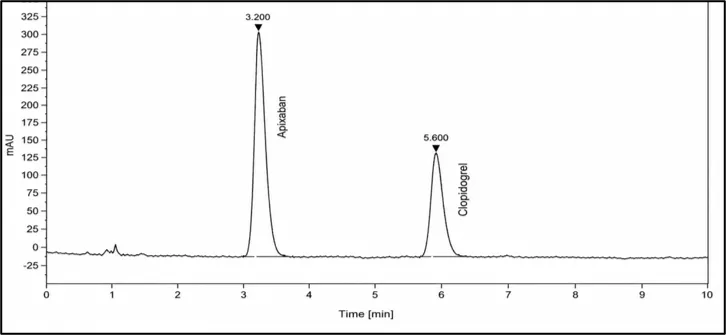
Fig 4. HPLC Chromatogram of drugs
Table 8. Observed Peak Characteristics
|
Parameter |
Apixaban |
Clopidogrel |
|
Retention Time (min) |
3.2 |
5.6 |
|
Peak Area |
452130 |
389245 |
|
Peak Height |
120000 |
95000 |
|
Tailing Factor |
1.12 |
1.18 |
|
Theoretical Plates |
4246 |
5123 |
|
Resolution |
— |
2.38 |
The developed RP-HPLC method produced well-resolved chromatographic peaks for both analytes with acceptable tailing factor and satisfactory theoretical plate count indicating good column efficiency.
Linearity Evaluation
Table 9. Linearity Data
|
Concentration (µg/mL) |
Apixaban Area |
Clopidogrel Area |
|
10 |
104582 |
90124 |
|
20 |
209864 |
180245 |
|
30 |
312548 |
269875 |
|
40 |
416925 |
358460 |
|
50 |
518240 |
447120 |
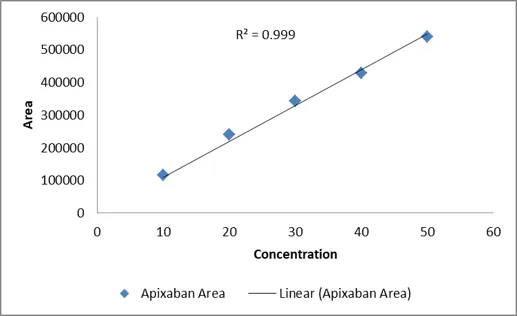
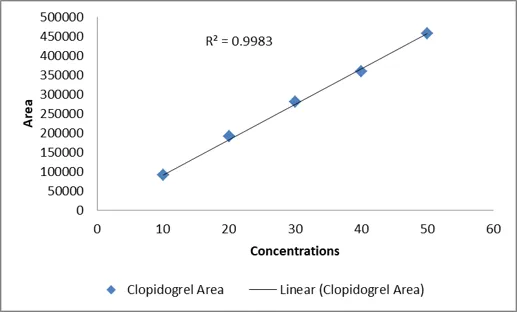
Accuracy (Recovery Evaluation)
Table 10. Accuracy / Recovery Studies
|
Level |
Amount Added (mg) |
Amount Found (mg) |
% Recovery |
|
80% |
8 |
7.93 |
99.12 |
|
80% |
8 |
7.98 |
99.75 |
|
80% |
8 |
7.95 |
99.37 |
|
100% |
10 |
10.02 |
100.20 |
|
100% |
10 |
9.98 |
99.80 |
|
100% |
10 |
10.01 |
100.10 |
|
120% |
12 |
12.04 |
100.33 |
|
120% |
12 |
12.01 |
100.08 |
|
120% |
12 |
12.03 |
100.25 |
Precision Evaluation
Table 11. Repeatability of RP-HPLC Method
|
Sr. No |
Conc. (µg/ mL) |
Apixaban Area |
Clopidogrel Area |
% Assay |
|
1 |
20 |
452100 |
389200 |
99.42 |
|
2 |
20 |
452320 |
389420 |
100.08 |
|
3 |
20 |
452180 |
389260 |
99.87 |
|
4 |
20 |
451980 |
389110 |
99.56 |
|
5 |
20 |
452410 |
389540 |
100.21 |
|
6 |
20 |
452240 |
389360 |
99.94 |
|
Statistical Parameter |
Value |
|
Mean Assay |
99.84 |
|
Standard Deviation |
0.30 |
|
% RSD |
0.30 |
Intermediate Precision
Table 12. Intraday and Interday Precision
|
Sr. No. |
Conc. (µg/mL) |
Intraday % Assay |
Interday % Assay |
|
1 |
20 |
99.92 |
99.74 |
|
2 |
20 |
100.08 |
99.96 |
|
3 |
20 |
99.85 |
99.90 |
|
4 |
20 |
100.12 |
100.05 |
|
5 |
20 |
99.98 |
99.80 |
|
6 |
20 |
100.06 |
100.01 |
Specificity
No interfering peaks were observed at the retention times of Apixaban and Clopidogrel under optimized chromatographic conditions. The developed RP-HPLC method demonstrated specificity for simultaneous estimation of both analytes without interference from formulation excipients or solvent peaks.
LOD and LOQ
Table 13. LOD and LOQ
|
Parameter |
Apixaban |
Clopidogrel |
|
LOD |
0.5 µg/mL |
0.7 µg/mL |
|
LOQ |
1.5 µg/mL |
2.1 µg/mL |
Robustness
Table 14. Robustness Study
|
Parameter Variation |
Observation |
% RSD |
|
Flow rate (0.8 mL/min) |
No significant effect |
0.42 |
|
Flow rate (1.2 mL/min) |
Minor RT variation |
0.51 |
|
Wavelength (252 nm) |
Stable response |
0.38 |
|
Wavelength (256 nm) |
Acceptable chromatogram |
0.44 |
|
Mobile phase variation (±2%) |
No significant change |
0.56 |
The developed RP-HPLC method remained unaffected by small deliberate variations in chromatographic conditions indicating robustness of the analytical procedure.
Assay of Synthetic Mixture
Table 15. Assay of Synthetic Mixture Prepared from Commercial Tablets
|
Drug |
Label Claim |
Amount Found |
% Assay |
|
Apixaban |
5 mg |
4.96 mg |
99.20 |
|
Clopidogrel |
75 mg |
74.48 mg |
99.31 |
The assay results indicated suitability of the developed RP-HPLC method for routine simultaneous quantitative estimation of both analytes in synthetic laboratory mixtures prepared from commercial tablets.
System Suitability
Table 16. System Suitability Parameters
|
Parameter |
Result |
|
Resolution |
2.38 |
|
Tailing Factor |
<1.2 |
|
Theoretical Plates |
>4000 |
|
%RSD |
<2% |
All system suitability parameters were found within acceptable analytical limits confirming suitability of the developed RP-HPLC method for routine pharmaceutical analysis.
CONCLUSION
A simple, rapid, precise, accurate, and AQbD-assisted RP-HPLC method was successfully developed and validated for simultaneous estimation of Apixaban and Clopidogrel in synthetic mixture prepared from commercially available tablets. The developed method demonstrated satisfactory chromatographic separation, acceptable system suitability, good linearity, accuracy, precision, robustness, and sensitivity according to ICH guidelines. The proposed analytical method was found to be economical, reproducible, and suitable for routine simultaneous quantitative estimation of Apixaban and Clopidogrel in synthetic laboratory mixtures.
ACKNOWLEDGEMENT
The authors are thankful to the Department of Pharmaceutical Quality Assurance, DJPS College of Pharmacy, Maharashtra, India, for providing necessary laboratory facilities and support for carrying out the research work.
CONFLICT OF INTEREST
The authors declare that there is no conflict of interest regarding publication of this research work.
REFERENCES


Udaykumar Gavali, Krushna Zagade, Ramesh Ingole, RP-HPLC Method Development and Validation for Simultaneous Estimation of Apixaban and Clopidogrel in Synthetic Mixture Prepared from Commercial Tablets using AQbD Approach, Int. J. of Pharm. Sci., 2026, Vol 4, Issue 6, 6484-6491. https://doi.org/10.5281/zenodo.20847797
 10.5281/zenodo.20847797