

We use cookies to ensure our website works properly and to personalise your experience. Cookies policy
Bharathi College of Pharmacy.
Medicinal plants are an important source of natural bioactive compounds. These have been widely used in traditional medicine for the prevention and treatment of various diseases. Among these, the Saussurea obvallata is a rare and endangered medicinal plant of the Himalayan alpine region, belonging to the family Asteraceae. It is highly valued for its ecological importance, cultural, traditional plant. This herb has also been used in Nepal, Tibet in India as a cultural, traditional plant. The flower and other part of this plant have medicinal importance which have been used for wound healing, inflammation, respiratory disorder, and as an antidiabetic. The main purpose of making this review is to get an information about the history, pharmacological studies, uses, and other beneficial information regarding the Saussurea obvallata
Medicinal plants have long been important sources of therapeutic agents and remain widely used in traditional medicine. Saussurea obvallata, commonly called Brahma Kamal, is a high-altitude Himalayan herb belonging to the family Asteraceae and the genus Saussurea. It is mainly distributed across India, Nepal, Tibet, and China at elevations of approximately 3,000–4,800 m. [1] The plant is characterized by its large, fragrant flower head and has considerable religious and cultural importance in India.[2] Traditionally, its flowers, leaves, rhizomes, and bracts have been used for conditions such as wounds, fever, cough, cold, inflammation, and intestinal disorders.[3] Recent studies have reported antioxidant, antimicrobial, antifungal, anti-inflammatory, radioprotective, and antihypoxic activities in different extracts of the plant.[1][3] However, excessive collection for medicinal and cultural purposes, along with its restricted habitat, has contributed to its conservation concerns.[4]
TAXONOMY CLASSIFICATION
|
Synonyms |
Aplotaxis / Theodorea obvallata |
|
Botanical Names |
Saussurea obvallata |
|
Kingdom |
Plantae |
|
Order |
Asterales |
|
Family |
Asteraceae |
|
Genus |
Saussurea |
|
Species |
Saussurea obvallata |
SAUSSUREA OBVALLATA
VERNACULAR NAMES
Saussurea obvallata is commonly known as Brahma Kamal, which translates to "the flower of Lord Brahma" in Hindu tradition. Owing to its sacred and auspicious significance, the plant is also popularly referred to as the "Sacred Lotus" in many regions.
|
LANGUAGE / REGION |
NAME |
|
Hindi |
Brahma Kamala – meaning “flower of Lord Brahma,” also known worldwide as the sacred lotus |
|
Sanskrit |
Brahma Kamal |
|
Nepali |
Dudhaphool |
|
Kumaoni |
Kapalphool |
|
Garhwali |
Bhramakamal |
|
Bengali |
Brahmakamal |
|
Gujarati |
Brahmakamal |
|
Marathi |
Brahmakamal |
|
Telugu |
Brahma Kamalam |
|
Kannada |
Brahma Kamala |
|
Malayalam |
Brahmakamalam |
|
Odia |
Brahmakamalam |
|
Chinese |
bāo yè xuě lián |
|
English |
Snow Lotus, King of Himalayan Flowers |
|
Other common names |
Shiv Kamal, Dev Pushp |
DISTRIBUTION AND HABITAT PREFERENCES
Saussurea obvallata (Brahma Kamal) is an endangered Himalayan species commonly found at 3,000–4,800 m altitude, particularly in Uttarakhand, including Kedarnath, Tungnath, the Valley of Flowers, and Hemkund Sahib. It is also distributed in other Himalayan regions of India, Nepal, Bhutan, Myanmar, and southwestern China.[1][5] The plant generally flowers during July–August and grows in alpine meadows and rocky habitats. Due to its medicinal value and association with Hindu traditions, it has considerable religious, cultural, and ecological importance.[6] The Trans-Himalayan region, including Ladakh and Lahaul–Spiti, supports diverse medicinal flora adapted to harsh climatic conditions. Surveys by Field Research Laboratory (FRL) and Defence Research and Development Organization (DRDO) have documented over 425 medicinal plant species traditionally used by local communities.[7][8] The endangered status and multiple medicinal and cultural values of S. obvallata highlight the importance of its conservation and sustainable utilization.[9]
Himalaya Brahma Kamal (Saussurea Obvallata) Flowers Blooming in Offseason Uttarakhand’s Chamoli District.
ETHNOBOTANICAL INFORMATION
|
Species |
Parts used |
Ethnobotanical application [1,6,10,11,12,13,14,15,16] |
Disease treated |
|
S. Obvallata (DC.) |
Seed |
The seed powder is soaked in water overnight and then filtered before use. |
Used traditionally to help manage certain mental disorders. |
|
|
Roots |
Fresh root juice or root paste is applied externally to wounds and cuts.
|
Antiseptic, wound healing, and leukoderma. |
|
Root decoction mixed with Cedrus deodara oil and applied externally over the chest. |
Cardiac disorders, bruises, and fractures. |
||
|
|
Leaf |
Fresh leaf extract is taken orally as a tonic. |
Cough and internal injuries |
|
100ml of dried leaves and their decoction, combined with a half spoon of salt and a few drops of this paste, were applied to the affected area (20 ml × 3 days). |
Wounds, cuts and Boils. |
||
|
|
Flower buds |
Flower heads are roasted in ghee and taken orally (1 teaspoon daily for 3-6 days). |
Hydrocele |
|
|
Entire plant |
The paste or dried plant powder is used. |
Haematuria is treated |
|
The paste prepared from the whole plant is applied |
In bruises, cuts, Headaches, and body pains. |
||
|
Whole inflorescence |
It protects woollen clothes from insect damage. |
||
|
|
Bract |
|
Cough and Respiratory disorders. |
PHYTOCHEMICAL ANALYSIS
Saussurea obvallata (Brahma Kamal) is reported to contain several bioactive secondary metabolites, including alkaloids, flavonoids, tannins, saponins, steroids, terpenoids, and glycosides. The phytochemical composition varies with the solvent used for extraction. Methanol, ethanol, chloroform, and distilled water extracts show different patterns of phytoconstituents. Sesquiterpene lactones have also been reported as important constituents of the species.[17]
|
CLASSES |
CONSTITUENTS |
METHOD OF ANALYSIS |
|
Phenolic |
Gallic acid Caffeic acid Chlorogenic acid |
HPLC LC-MS/MS |
|
Flavonoids |
Quercetin Kaempferol Rutin |
HPLC UHPLC-MS |
|
Terpenoids |
Sesquiterpenes Diterpenes |
GC-MS LC-MS |
|
Alkaloids |
Alkaloidal compounds (qualitative) |
Dragondroff’s test GC-MS |
|
Steroids |
β-Sitosterol Stigmasterol |
GC-MS FTIR |
|
Tannins |
Hydrolysable Condensed tannins |
Ferric chloride test UV-Visible Spectroscopy |
|
Saponins |
Triterpenoid Saponins Foam test |
Foam test HPLC |
|
Glycosides |
Cardiac Phenolic Glycosides |
Keller-Killani test HPLC |
|
Carbohydrates |
Reducing sugars Polysaccharides |
Molisch’s test Anthrone method |
|
Protein and Amino acids |
Free amino acids and proteins |
Ninhydrin test Bradford assay |
PHARMACOLOGICAL ACTIVITIES
Anti – diabetic activity
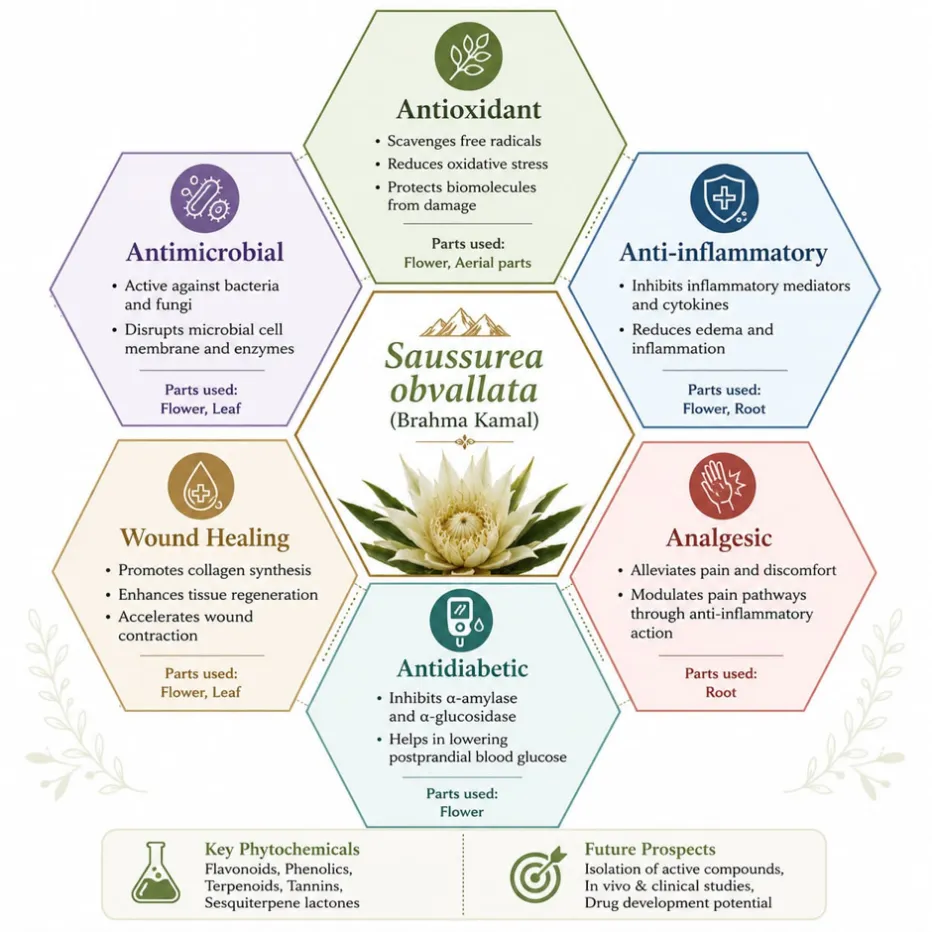
Saussurea obvallata contains flavonoids, phenolic compounds, terpenoids, and glycosides that may help control blood glucose levels. These phytochemicals may inhibit the α-amylase and α-glucosidase enzymes, thereby reducing the digestion and absorption of carbohydrates. The antioxidant constituents of the plant may protect pancreatic β-cells from oxidative damage and support insulin secretion. The plant may also improve glucose utilization and reduce oxidative stress associated with diabetes. Because of these properties, Saussurea obvallata has potential as a natural anti-diabetic agent. However, additional animal studies and clinical trials are required to confirm its anti-diabetic activity in humans.[18][19]
Antioxidant activity
Saussurea obvallata is a rich source of flavonoids and phenolic compounds with strong antioxidant properties. These compounds neutralize free radicals and reduce oxidative stress in the body. The antioxidant activity helps protect cells from damage caused by reactive oxygen species (ROS).[10][12] This protective effect may reduce the risk of chronic diseases associated with oxidative stress. The antioxidant property also contributes to the plant's anti-inflammatory and other pharmacological activities. Further studies are required to identify the active constituents responsible for these antioxidant effects and to confirm their clinical benefits.[18][19]
Anti-hypoxic activity
Aplotoxis obvallata naturally grows at high altitudes where oxygen levels are low.[20] The plant contains antioxidant compounds that may protect cells from oxidative stress caused by hypoxia. These bioactive compounds may help maintain normal cellular function under low-oxygen conditions and reduce hypoxia-induced tissue damage. This property indicates that the plant has potential anti-hypoxic activity. However, scientific evidence is still limited, and further detailed investigations are required.[18][19]
Anti-inflammatory activity
Saussurea obvallata has shown promising anti-inflammatory activity due to the presence of flavonoids, phenolic compounds and sesquiterpene lactones. Bioactive compounds isolated from the plant inhibit cyclooxygenase -2(COX-2), an enzyme involved in inflammation.[18] The plant also reduces the production of inflammatory mediators such as prostaglandins and nitric oxide. Its antioxidant compounds help reduce oxidative stress, which further decreases inflammation. These properties suggest that the plant may be useful in the management of inflammatory disorders. Further pharmacological and clinical studies are needed to establish its therapeutic efficacy and safety.[18][19]
Antioxidant activity
Saussurea obvallata is a rich source of flavonoids and phenolic compounds with strong antioxidant properties. These compounds neutralize free radicals and reduce oxidative stress in the body. The antioxidant activity helps protect cells from damage caused by reactive oxygen species (ROS). This protective effect may reduce the risk of chronic diseases associated with oxidative stress.[17] The antioxidant property also contributes to the plants anti-inflammatory and other pharmacological activities. Further studies are required to identify the active constituents responsible for these antioxidant effects and to confirm their clinical benefits.[18][19]
Antimicrobial activity
Aplotaxis obvallata contains flavonoids, phenolic compounds, terpenoids, and other secondary metabolites that are reported to possess antimicrobial properties. These phytochemicals may inhibit the growth of Pathogenic bacteria and fungi by damaging the microbial cell membrane and interfering with essential metabolic Process. The antimicrobial activity of the plant may help prevent infections and supports its traditional use in treating skin disorders and wounds. The antioxidant compounds present in the plant may also protect tissues from oxidative damage during microbial infections. Although these findings are promising further invitro, invivo and clinical studies are required to confirm its antimicrobial efficacy.[18][19]
Wound-healing activity
A. obvallata has traditionally been used for the treatment of cuts, wounds and skin injuries. The plant contains antioxidant and anti-inflammatory compounds that may reduce inflammation and protect damaged tissues from oxidative stress.[17] Its antimicrobial properties may help prevent wound infections and promote a healthy healing environment. These combined effects may accelerate tissue regeneration and wound closure.[19] However, additional experimental and clinical studies are necessary to establish its wound-healing mechanism and therapeutic efficacy.[20]
Analgesic / anti pyretic activity
In traditional medicine, Saussurea obvallata has been used to relieve pain associated with inflammation and injuries. The flavonoids and terpenoids present in the plant may reduce the production of inflammatory mediators such as prostaglandins, thereby decreasing pain.[18] The antioxidant activity of the plant may also help reduce oxidative stress associated with inflammatory pain. These properties suggest that the plant has potential as a natural analgesic agent. Nevertheless, further pharmacological and clinical studies are required to confirm its analgesic activity.[20]
|
Plants part |
Traditional use |
Bioactive compound |
Pharmacological activity |
|
Flower |
Wound healing Fever Inflammation Cuts bruises Bone ache |
Flavonoids Phenolics Sesquiterpenes Lactones Tannins |
Antioxidant Antimicrobial Anti-inflammatory Antidiabetic |
|
Leaf |
Skin infection Wound dressing |
Flavonoids Alkaloids Tannins |
Antioxidant Antimicrobial |
|
Stem |
Includes in herbal formulations |
Phenolics Flavonoids |
Antioxidant |
|
Root |
Fever Stomach disorder Weakness Cardiac disorder |
Terpenoids Sesquiterpene Lactones Phenolics |
Analgesic Antimicrobial Anti-inflammatory |
|
Whole aerial parts |
Used in herbal extracts for multiple traditional remedies |
Flavonoids Phenolics Tannins Terpenoids |
Antioxidant Antimicrobial Anti-inflammatory Enzyme inhibition |
CONCLUSION
Saussurea obvallata (Brahma Kamal) is a culturally significant Himalayan medicinal plant with considerable phytochemical and therapeutic potential. Preliminary studies have identified various secondary metabolites such as flavonoids, phenolic compounds, terpenoids, alkaloids, tannins, glycosides, and other constituents. These compounds may contribute to the antioxidant, antimicrobial, antifungal, and anti-inflammatory properties reported for the plant. However, detailed information regarding its individual bioactive compounds and their mechanisms is still limited. Further phytochemical screening, isolation, purification, and structural characterization are therefore required. In addition, increasing habitat loss and overharvesting may affect its natural populations. Hence, further scientific research along with sustainable utilization and conservation is necessary to preserve S. obvallata and explore its potential as a valuable source of natural bioactive compounds.
REFERENCES



Rakshitha S, Harshitha N N, Nandini B A, Sanjana Gowda, Saussurea Obvallata(Brahmakamala) Saussurea Obvallata(Brahmakamala) A Literature Review of Ethnobotany, Phytochemistry, And Pharmacology, Int. J. of Pharm. Sci., 2026, Vol 4, Issue 9, 666-673, https://doi.org/10.5281/zenodo.22332994
 10.5281/zenodo.22332994