

We use cookies to ensure our website works properly and to personalise your experience. Cookies policy
PRES's College of Pharmacy for Women, Chincholi, Nashik, Maharashtra, India 422102
Diabetes mellitus is a chronic metabolic disorder that adversely affects the normal wound-healing process and frequently leads to chronic wounds, particularly diabetic foot ulcers (DFUs). Persistent hyperglycemia contributes to vascular dysfunction, impaired angiogenesis, excessive oxidative stress, prolonged inflammation, neuropathy, and increased susceptibility to microbial infection. Together, these factors create a hostile wound microenvironment and interfere with the normal phases of healing, including inflammation, proliferation, and tissue remodeling. Conventional wound dressings primarily provide physical protection and moisture retention but often have limited ability to regulate the complex and continuously changing microenvironment of diabetic wounds. They may also require frequent replacement and provide inadequate control over therapeutic agent delivery . Smart hydrogels have emerged as promising advanced biomaterials for the management of diabetic wounds because of their ability to combine moisture management, tissue protection, and controlled therapeutic delivery within a single platform. These hydrogels are three-dimensional polymeric networks capable of absorbing and retaining substantial amounts of water while maintaining a moist environment that supports tissue regeneration. Their distinctive feature is responsiveness to specific stimuli present in the wound microenvironment. Depending on their composition, smart hydrogels can respond to changes in pH, glucose concentration, temperature, reactive oxygen species (ROS), and enzyme activity. Some systems can also be activated by external stimuli such as light, magnetic fields, or electrical signals. Such responsiveness enables controlled or on-demand release of antibiotics, anti-inflammatory agents, antioxidants, growth factors, and other therapeutic molecules at the wound site. Recent advances have focused on multifunctional smart hydrogels that simultaneously address several pathological factors associated with diabetic wounds. These systems can reduce excessive oxidative stress, regulate chronic inflammation, inhibit bacterial growth and biofilm formation, promote angiogenesis, support fibroblast proliferation, enhance collagen deposition, and facilitate re-epithelialization. Additional properties such as self-healing, injectability, tissue adhesion, oxygen generation, and real-time wound monitoring have further increased their therapeutic potential. This review discusses the fundamentals and pathophysiology of diabetic wound healing, major types of stimuli-responsive smart hydrogels, polymers used in their formulation, therapeutic mechanisms, and applications in diabetic wound management. Current limitations, including biosafety, manufacturing scalability, long-term stability, cost, and clinical translation, are also discussed. Future research should focus on developing multifunctional, personalized, and clinically translatable smart hydrogel systems capable of dynamically responding to the complex diabetic wound microenvironment.
Diabetes mellitus (DM) is a chronic metabolic disorder characterized by persistently elevated blood glucose levels and is associated with several long-term complications. [1] One of the most challenging complications is impaired wound healing, particularly in patients with diabetic foot ulcers (DFUs). Under normal conditions, wound healing is a well-coordinated process involving hemostasis, inflammation, proliferation, and tissue remodeling. In diabetic patients, this process is disturbed by persistent hyperglycemia, poor blood circulation, oxidative stress, prolonged inflammation, neuropathy, impaired immune responses, and increased susceptibility to microbial infection. As a result, diabetic wounds may remain open for prolonged periods and can progress to serious complications such as deep tissue infection, necrosis, and, in severe cases, amputation. Persistent hyperglycemia plays a central role in the development of diabetic wounds. Excess glucose promotes the formation of advanced glycation end products (AGEs), increases reactive oxygen species (ROS), and interferes with normal cellular functions. Excessive ROS can damage proteins, lipids, DNA, and cellular membranes, while prolonged inflammation prevents the wound from progressing normally into the proliferative and remodeling phases. At the same time, impaired angiogenesis reduces the supply of oxygen and nutrients to the injured tissue. Reduced fibroblast activity, abnormal collagen deposition, impaired re-epithelialization, and increased bacterial colonization further contribute to delayed wound closure. Therefore, effective treatment of diabetic wounds requires more than simple physical protection; it requires regulation of the complex wound microenvironment .Conventional wound dressings such as gauze, bandages, films, foams, and hydrocolloids are commonly used to protect wounds, absorb exudate, and reduce external contamination. Although these materials are useful for basic wound management, they generally act as passive barriers and have limited ability to respond to changes within a diabetic wound. They may also require frequent replacement and often provide inadequate control over the release of therapeutic agents. These limitations have encouraged the development of advanced wound-dressing systems that can interact with the wound environment and provide treatment according to its changing requirements.
Hydrogels have attracted considerable interest in wound management because of their three-dimensional, water-rich polymeric structure. Their high water content helps maintain a moist environment, which is favorable for cell migration and tissue repair. Hydrogels can also absorb wound exudate, provide a protective barrier, and act as carriers for drugs, antimicrobial agents, antioxidants, growth factors, peptides, and other therapeutic molecules. However, conventional hydrogels may not adequately respond to the dynamic pathological conditions of diabetic wounds. Smart hydrogels, also known as stimuli-responsive hydrogels, have been developed to overcome these limitations. These materials can sense specific changes in the wound microenvironment and respond through alterations in swelling, degradation, permeability, or drug-release behavior. Depending on their composition, smart hydrogels may respond to endogenous stimuli such as pH, glucose concentration, ROS, temperature, or enzymes. Some systems can also respond to external stimuli, including light, magnetic fields, or electrical signals. This responsiveness enables more precise and controlled delivery of therapeutic agents directly at the wound site.Recent advances have focused on multifunctional smart hydrogels that simultaneously address several problems associated with diabetic wounds. These systems can provide antimicrobial effects, reduce excessive oxidative stress, regulate inflammation, promote angiogenesis, support fibroblast proliferation, enhance collagen formation, and accelerate re-epithelialization. Additional properties such as self-healing, injectability, tissue adhesion, oxygen generation, and wound monitoring have further expanded their potential applications. Despite these promising developments, many smart hydrogel systems remain at the laboratory or preclinical stage. Challenges related to long-term safety, stability, large-scale manufacturing, cost, reproducibility, and clinical translation still need to be addressed. Therefore, continued research is required to develop safe, effective, multifunctional, and clinically applicable smart hydrogel systems. This review discusses the pathophysiology of diabetic wound healing, the fundamentals and types of smart hydrogels, polymers used in their development, therapeutic mechanisms, and their applications in diabetic wound management. Current challenges and future perspectives toward the clinical translation of smart hydrogel-based wound dressings are also highlighted.[2]
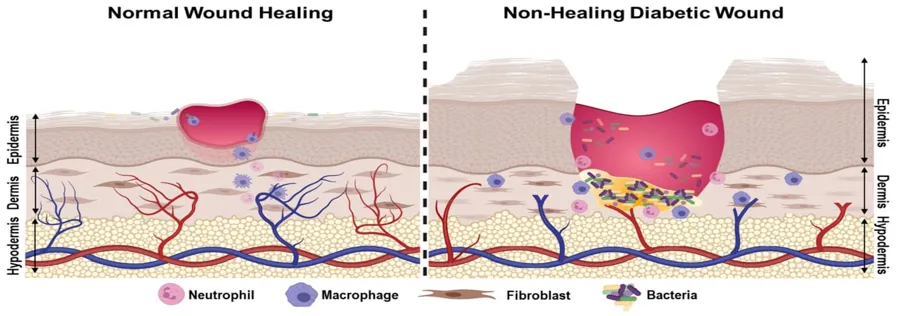
Figure: Normal verses Diabetic wound healing
PATHOPHYSIOLOGY
Diabetic wound healing is a complex process in which the normal sequence of inflammation, tissue formation, and remodeling becomes disturbed. [3,4] Persistent hyperglycemia promotes the formation of advanced glycation end products (AGEs), increases oxidative stress, and damages blood vessels, resulting in poor oxygen and nutrient supply to the wound. At the same time, excessive reactive oxygen species (ROS) and prolonged inflammation interfere with the normal activity of macrophages, fibroblasts, keratinocytes, and endothelial cells. Diabetes also reduces angiogenesis and causes neuropathy, which decreases protective sensation and increases the risk of repeated injury, particularly in the foot.[5,6,7] Impaired immune function further increases susceptibility to bacterial infection and biofilm formation. In addition, excessive matrix metalloproteinase (MMP) activity can break down extracellular matrix components and growth factors that are required for tissue repair. [8]Together, hyperglycemia, oxidative stress, chronic inflammation, impaired angiogenesis, neuropathy, infection, and abnormal extracellular matrix remodeling create a persistent wound environment that prevents normal progression toward tissue regeneration and wound closure.[9,10,11] Another important feature is impaired angiogenesis. Hyperglycemia and vascular dysfunction can disturb important angiogenic pathways, including HIF-1α/VEGF signaling, resulting in inadequate formation of new blood vessels. Consequently, the wound remains relatively hypoxic and receives insufficient oxygen and nutrients for effective tissue regeneration. [12,13]
Smart hydrogels
A hydrogel is a three-dimensional elastic and porous network made of hydrophilic polymers, with a minimum water content of 10% (usually >90%). Hydrogels are classified according to the method of preparation, the nature of the polymers, the ionic charge or the types of bonds between the polymer chains. Depending on the monomers that compose the hydrogel, the way it is obtained and the possible additives, the hydrogels have extremely varied properties. They can respond to stimuli such as temperature, pressure, pH, ionic charge or antigens with changes in certain characteristics (e.g., gel-soil transition) and then, when the stimulus ceases, it can return to its original state. Due to their remarkable properties, hydrogels can be included in the category of "smart" materials. In the medical field, hydrogels are used for wound treatment, drug delivery, cell therapies, tissue engineering, the manufacture of medical devices and biosensors.The use of hydrogels in the therapeutic strategy of patients suffering from wounds brings many benefits such as avoiding complications, shortening the healing time of the wound, increasing the quality of life of patients and obtaining a better therapeutic result. Hydrogels have properties that make them ideal for the treatment of deep wounds, such as non-adhesiveness, moisture retention, gas permeability, exudate absorption, biocompatibility and are comfortable for the patient.[14,15]
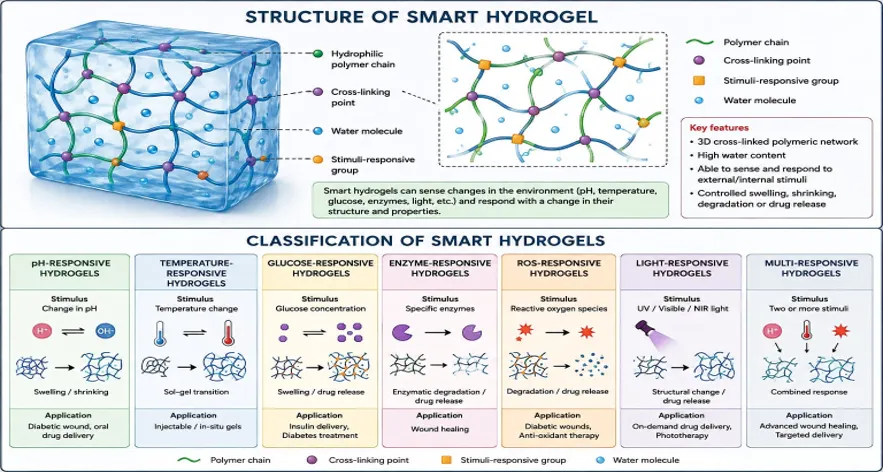
Figure: Structure and classification of smart hydrogels
TYPES OF SMART HYDROGELS
1. pH-Responsive Hydrogels
The pH of a wound is not constant. It can change during healing and may be altered further when infection or prolonged inflammation is present. pH-responsive hydrogels are designed to take advantage of these changes. They contain chemical groups that respond to the surrounding pH by gaining or losing protons. As a result, the hydrogel network can swell, contract, or become more permeable. This change can be used to control the release of drugs from the hydrogel. For instance, when the wound reaches a particular pH, the polymer network may become more swollen and allow the incorporated drug to diffuse out more readily. This makes it possible to deliver therapeutic agents preferentially under specific wound conditions. pH-responsive hydrogels have been investigated for wound dressing, antimicrobial treatment, controlled drug delivery, and wound monitoring. Xue et al. reported a self-healing, pH-responsive polysaccharide hydrogel with inherent antibacterial activity, demonstrating the potential of combining pH responsiveness with other useful properties in a single dressing. [16] Recent research has also explored pH-sensitive systems for monitoring changes in chronic wounds. [17, 18]
2. Glucose-Responsive Hydrogels
Glucose-responsive hydrogels are particularly relevant to diabetic wound healing because abnormal glucose levels are closely associated with diabetes. The basic idea is simple: the hydrogel contains a glucose-sensitive component that can recognize changes in glucose concentration and respond by altering its structure or permeability. Phenylboronic acid (PBA) and its derivatives are among the materials investigated for this purpose. PBA can interact reversibly with glucose, and this interaction can influence the cross-linking and swelling behavior of the hydrogel. Changes in the glucose level can consequently affect the release of the incorporated therapeutic agent. Other glucose-responsive systems use enzymatic reactions to convert changes in glucose concentration into a chemical signal. This signal can then alter the hydrogel network and regulate drug release. Such systems are attractive because they provide an opportunity for condition-dependent drug delivery, rather than releasing the entire therapeutic load at a constant rate. Glucose-responsive hydrogels have also been investigated for wound sensing and monitoring, which may support more individualized management of diabetic wounds. [19–24]
3. ROS-Responsive Hydrogels
Excessive reactive oxygen species (ROS) are a major feature of chronic diabetic wounds. A certain amount of ROS is required for normal wound defense and signaling, but excessive ROS can damage cells, prolong inflammation, and interfere with tissue regeneration. ROS-responsive hydrogels are designed to react specifically to this oxidative environment. They contain ROS-sensitive bonds or functional groups that undergo chemical changes when exposed to elevated ROS levels. This can weaken the hydrogel network, promote degradation, or increase the release of the incorporated therapeutic agent. An additional advantage is that these hydrogels can be loaded with antioxidant substances, enzymes, or nanozyme-based components. In this way, the hydrogel can respond to excessive ROS while also helping to reduce oxidative stress. For diabetic wounds, controlling ROS may have several beneficial effects. Lower oxidative stress can support cell survival, reduce excessive inflammation, improve angiogenic activity, and create a more favorable environment for tissue regeneration. Recent studies have therefore investigated ROS-responsive and ROS-scavenging hydrogel systems as multifunctional approaches to diabetic wound treatment. [25–27]
4. Enzyme-Responsive Hydrogels
Enzyme-responsive hydrogels use the activity of enzymes in the wound as a biological signal. Chronic wounds, including diabetic wounds, may contain increased levels of proteolytic enzymes such as matrix metallo proteinases (MMPs). Excessive activity of these enzymes can contribute to extracellular matrix degradation and interfere with normal tissue repair. To make a hydrogel enzyme-responsive, researchers incorporate enzyme-sensitive peptide sequences or chemical linkages into the polymer network. When the target enzyme interacts with these components, the sensitive bonds can be cleaved. This may cause the hydrogel to degrade or release its therapeutic cargo. The major advantage of this approach is that the hydrogel does not have to release its contents continuously. Instead, the pathological condition of the wound itself can trigger the response. This provides an opportunity for more localized and controlled delivery of antimicrobial, anti-inflammatory, or regenerative agents. Enzyme-responsive systems are therefore considered promising for adapting treatment to the biological condition of chronic wounds. [28].
Polymeric Materials Used in Smart Hydrogels
The performance of a smart hydrogel depends greatly on the polymer used to construct its three-dimensional network. The selected polymer influences important characteristics such as water retention, swelling, mechanical strength, biodegradability, biocompatibility, and drug-release behavior. Therefore, polymer selection should be based on the condition of the wound and the therapeutic purpose of the hydrogel. Natural and synthetic polymers are the two major groups used in hydrogel development, and combining them is often useful for obtaining a balance between biological activity and mechanical stability. [29,30]
1. Natural Polymers
Natural polymers are widely explored in wound-healing applications because they generally show good biocompatibility and biodegradability. Many of them also contain functional groups that can be modified or cross-linked to obtain the desired hydrogel properties. Their ability to retain water and interact with biological components makes them suitable for creating a moist environment around the wound. [29,30]Chitosan is one of the commonly investigated natural polymers for wound-care hydrogels. It is a polysaccharide with useful biological properties, including antibacterial activity and good compatibility with biological tissues. These characteristics make chitosan attractive for hydrogel systems intended to protect wounds and reduce the risk associated with microbial contamination. Its chemical structure also allows modification and incorporation of therapeutic substances. Alginate is another important natural polymer used in wound dressings. One of its major advantages is its ability to absorb wound fluid and maintain a hydrated environment. This makes alginate particularly useful when managing wounds with considerable exudate. Alginate can also be combined with other polymers or therapeutic agents to improve the overall performance of the hydrogel. [29,30]Gelatin, a protein-derived polymer related to collagen, is useful because of its favorable interaction with cells. Its biological characteristics can support cell attachment and tissue regeneration. However, gelatin-based hydrogels may require additional cross-linking or combination with other polymers when greater mechanical stability is needed. Hyaluronic acid (HA) is a naturally occurring component of the extracellular matrix. It has a high capacity for retaining water and is involved in several processes associated with tissue repair. Because of these properties, HA can provide a hydrated and biologically favorable environment for wound healing. Its structure can also be chemically modified to obtain hydrogels with specific properties. [30]
2. Synthetic Polymers
Synthetic polymers provide greater control over the physical and chemical properties of hydrogel networks. Their molecular structure, concentration, cross-linking, and degradation characteristics can be adjusted according to the intended application. This makes them useful when precise control over mechanical strength and therapeutic release is required. [29,30] Polyethylene glycol (PEG) is a commonly investigated synthetic polymer because of its good biocompatibility and chemical flexibility. PEG-based networks can be modified with different functional groups and cross-linking strategies. This makes PEG useful for developing hydrogels with controlled structural properties and for incorporating therapeutic molecules. Polyvinyl alcohol (PVA) is another synthetic polymer used in hydrogel preparation. It can provide flexibility and mechanical stability and can form hydrogel networks through different cross-linking approaches. PVA can also be combined with natural polymers to improve the overall properties of a wound dressing.
3. Combination of Natural and Synthetic Polymers
Using a single polymer does not always provide all the properties required for diabetic wound treatment. For this reason, researchers often combine natural and synthetic polymers. Natural polymers can contribute biological compatibility and hydration, while synthetic polymers can improve mechanical strength and provide better control over the structure of the hydrogel. Such combinations can be further modified to incorporate antimicrobial agents, antioxidants, growth factors, or stimulus-responsive components. This approach is particularly relevant to smart hydrogels because the polymer network can be designed not only to cover the wound but also to respond to changes in its microenvironment.
Table :- Polymers, Properties and Applications in Diabetic Wound Healing
|
POLYMER |
TYPE |
MAJOR PROPERTY |
APPLICATION |
|
Chitosan |
Natural |
Antibacterial |
Infection control |
|
Alginate |
Natural |
Moisture retention |
Wound dressing |
|
Gelatin |
Natural |
Cell adhesion |
Tissue regeneration |
|
HA |
Natural |
ECM-like property |
Regeneration |
|
PEG |
Synthetic |
Biocompatibility |
Drug delivery |
|
PVA |
Synthetic |
Mechanical Strength |
Hydrogel dressing |
Therapeutic mechanism of smart hydrogel
Smart hydrogels are stimuli-responsive, three-dimensional polymeric networks that can sense changes in the diabetic wound microenvironment and respond by changing their swelling, degradation, or drug-release behavior. Their therapeutic mechanism is therefore more adaptive than that of conventional passive dressings.
Diabetes / Hyperglycemia
↓
High ROS + abnormal pH + high glucose + excessive MMPs + bacterial infection
↓
Smart hydrogel senses the wound microenvironment
↓
Stimulus-responsive structural change
↓
Controlled / on-demand release of therapeutic agents
↓
Antibacterial + antioxidant + anti-inflammatory + pro-angiogenic effects
↓
Fibroblast proliferation + collagen deposition + re-epithelialization
↓
Accelerated wound closure and tissue regeneration
Advantages of smart hydrogel dressings in diabetic wound healing
1. Maintains a Suitable Moisture Environment
A balanced moisture level is important for normal wound repair. If the wound becomes excessively dry, cell migration and tissue formation may be affected, whereas excessive fluid accumulation can encourage microbial growth. Because hydrogels can retain considerable amounts of water, they help maintain hydration at the wound surface. Their porous structure can also accommodate wound exudate, depending on the formulation. This makes them useful for maintaining a more favorable environment for cell migration and tissue regeneration. [31]
2. Provides Controlled Drug Delivery
Smart hydrogels can act as local reservoirs for therapeutic substances. Drugs, antibiotics, antioxidants, growth factors, peptides, and other bioactive molecules can be incorporated into the hydrogel network. Instead of releasing the complete drug load immediately, the release can be regulated through diffusion, degradation, swelling, or a specific stimulus. For example, a hydrogel designed to respond to pH or ROS can alter its structure when the wound environment changes, resulting in increased release of the loaded therapeutic agent. This approach can improve local drug availability and may reduce unnecessary exposure to healthy tissues. [16–28, 32]
3. Helps Control Bacterial Infection
Infection is one of the major factors responsible for delayed healing in diabetic wounds. Bacteria can multiply within the wound and, in some cases, develop biofilms that make treatment more difficult. Smart hydrogels can help address this problem by incorporating antimicrobial drugs, antimicrobial peptides, nanoparticles, or naturally antibacterial polymers. Some systems are designed so that antimicrobial agents are released preferentially under specific wound conditions. This provides an opportunity to combine wound coverage with localized antimicrobial treatment. [16, 31, 33]
4. Helps Reduce Excessive Oxidative Stress
Oxidative stress is another important feature of chronic diabetic wounds. Excessive ROS can damage cells and extracellular matrix components and can interfere with normal tissue repair. Smart hydrogels can help manage this problem by incorporating antioxidant molecules, antioxidant enzymes, or nanozyme-based materials. In ROS-responsive formulations, the increased ROS level itself can trigger changes in the hydrogel and promote therapeutic release. Therefore, the same system can potentially respond to oxidative stress while simultaneously helping to reduce it. [25–27,33]
5. Supports Regulation of Prolonged Inflammation
Inflammation is necessary during the early stage of wound healing, but diabetic wounds often remain in an inflammatory state for an extended period. Persistent inflammation can interfere with cell proliferation, extracellular matrix formation, and tissue remodeling. Smart hydrogel systems can provide localized delivery of anti-inflammatory or immunomodulatory substances. Some advanced formulations are also designed to influence macrophage behavior and encourage a wound environment that is more favorable for tissue repair. This approach is particularly interesting because it attempts to correct the wound environment rather than simply suppressing inflammation indiscriminately. [33–35]
6. Supports Angiogenesis and Tissue Regeneration
Adequate blood-vessel formation is essential for supplying oxygen and nutrients to newly developing tissue. Diabetes can impair this process, contributing to poor wound closure. Hydrogels can provide a three-dimensional environment that supports cellular activity and can also serve as carriers for growth factors and other pro-angiogenic substances. Controlled local delivery may help maintain the therapeutic agent at the wound site for an appropriate period. These properties can contribute to angiogenesis, fibroblast activity, collagen formation, and re-epithelialization. [31,33]
7. Can Adapt to Irregular Wound Surfaces
Diabetic foot ulcers are often irregular in shape and may be exposed to repeated movement and mechanical stress. A dressing that cannot maintain proper contact with the wound may provide limited protection. Injectable and self-healing hydrogels offer a possible solution. Injectable formulations can be applied directly into irregular wound spaces, while self-healing materials can partially recover their structure after mechanical damage. These properties may improve wound coverage and help the dressing remain functional for longer periods. [32,36]
8. Offers the Possibility of Wound Monitoring
Some newer smart hydrogel systems combine therapeutic functions with sensing capabilities. Components that respond to changes in wound pH or other biological signals can provide information about the condition of the wound. This concept is particularly promising because future dressings may be able to detect a change, provide a therapeutic response, and monitor the wound using the same platform. Such systems could eventually support more personalized wound management. [18,32]
9. May Reduce Unnecessary Dressing Changes
A well-designed hydrogel can remain hydrated and maintain therapeutic activity for an extended period. Controlled release can also reduce the need for repeated application of certain therapeutic agents. Reducing unnecessary dressing changes may be beneficial because frequent removal can disturb newly formed tissue and cause discomfort. However, the appropriate replacement frequency depends on factors such as wound exudate, infection status, dressing composition, and the patient's clinical condition. [31,32]
10. Combines Multiple Therapeutic Functions
The most promising feature of smart hydrogels is their ability to combine several functions within one system. A single formulation may be designed to provide moisture management, antimicrobial protection, antioxidant activity, controlled drug release, immunomodulation, oxygen delivery, and support for tissue regeneration. This multifunctional approach is particularly relevant to diabetic wounds because delayed healing is caused by several interconnected problems rather than a single abnormality. Consequently, developing a dressing capable of addressing multiple aspects of the wound microenvironment may provide greater therapeutic potential than a simple passive dressing. [33–35]
FUTURE PERSPECTIVE
Smart hydrogels are becoming promising materials for diabetic wound care because they can combine wound protection with controlled drug delivery and responses to changes in the wound environment. Future research should focus on developing multifunctional and multi-stimuli-responsive hydrogels that can simultaneously manage infection, oxidative stress, inflammation, hypoxia, and poor angiogenesis. Integration of sensing systems may also allow future dressings to monitor wound conditions and provide treatment according to the needs of the wound. However, several challenges still need to be addressed before these materials can be widely used in clinical practice. These include improving long-term stability, safety, mechanical strength, manufacturing scalability, affordability, and reproducibility. More well-designed animal studies and clinical trials are also required to establish their therapeutic effectiveness. Overall, the future development of smart hydrogels should aim for safe, simple, affordable, and patient-friendly dressings that can sense, respond, and support healing in a controlled manner.
CONCLUSION
Smart hydrogels offer a promising approach for managing diabetic wounds because they can provide both wound protection and active therapeutic support. Unlike conventional dressings, these hydrogels can maintain a moist environment and, depending on their design, respond to changes such as pH, glucose, ROS, or enzyme activity. This allows therapeutic agents to be delivered more selectively at the wound site. Their ability to combine antibacterial, antioxidant, anti-inflammatory, pro-angiogenic, and tissue-regeneration properties makes them particularly useful for the complex nature of diabetic wounds. Advanced systems can also provide additional benefits such as self-healing, tissue adhesion, oxygen generation, and controlled drug release. However, most smart hydrogel systems are still being studied at the laboratory or preclinical level. Issues related to safety, stability, manufacturing, cost, sterilization, reproducibility, and clinical validation need further attention. Therefore, more detailed animal studies and well-designed clinical trials are necessary before these materials can be routinely used in diabetic wound care.
ACKNOWLEDGEMENT
The authors wish to express their deep gratitude to Dr. Rahul Khaire for his constant encouragement, expert supervision, and valuable suggestions during the compilation of this review paper. We are also highly grateful to Pravara Rural Education Society's College of Pharmacy (For Women), Chincholi, Tal-Sinnar, Dist-Nashik, for providing access to the necessary online journals, research databases, and administrative infrastructure required to successfully complete this work.
REFERENCES


Vaishnavi Devhad, Rahul Khaire, Kiran Rayte, Sharvari Mhaske, Namrata Godhari, Smart Hydrogels for Diabetic Wound Healing, Int. J. of Pharm. Sci., 2026, Vol 4, Issue 9, 2271-2282. https://doi.org/10.5281/zenodo.22846893
 10.5281/zenodo.22846893