

We use cookies to ensure our website works properly and to personalise your experience. Cookies policy
Department of Pharmacy, Royal School of Pharmacy, The Assam Royal Global University, Betkuchi, Guwahati-781035, Kamrup, Assam, INDIA.
Many pharmacological compounds suffer from poor aqueous solubility, variable bioavailability, fast degradation, unfavorable biodistribution and dose-related side effects, which restrict their therapeutic efficacy. Conventional dosage forms may not achieve the appropriate drug concentrations within the therapeutic window, necessitating the development of improved delivery platforms. Lipid-based nanocarriers, especially solid lipid nanoparticles (SLNs) and nanostructured lipid carriers (NLCs), provide intriguing methods owing to their biocompatibility, biodegradability and formulation diversity. SLNs are composed of a largely solid lipid matrix supported by surfactants, while NLCs are a mixture of solid and liquid lipids that form a less ordered matrix with more drug accommodation and less drug ejection during storage. This review critically discusses recent advances, with emphasis on literature published during 2021–2026, on the evolution, classification, structural characteristics, formulation components, preparation and characterization, drug-loading and release mechanisms, biological fate, surface engineering, administration routes, and therapeutic applications of SLNs and NLCs. Special attention is paid to safety, regulatory issues, scale-up, commercialization and emerging technologies including artificial intelligence-assisted optimization and microfluidic production. [There has been] considerable preclinical progress but little clinical translation. Long term stability, reproducible large scale manufacturing, regulatory uniformity, and rigorous clinical validation are significant difficulties that need to be systematically investigated.
The therapeutic response to a drug is determined not only by its intrinsic pharmacological activity but also by its capacity to reach the site of action at an adequate concentration and to remain accessible for an appropriate duration. Many drugs can be efficiently delivered using conventional dosage forms (tablets, capsules, solutions, and suspensions); however, their performance can be compromised by poor aqueous solubility, low permeability, rapid degradation, extensive first-pass metabolism, unfavorable biodistribution, or a narrow therapeutic window [3,4]. Immediate-release formulations may also lead to high plasma concentrations that fall rapidly, requiring frequent administration and perhaps exacerbating peak-related side effects. These restrictions have led to the development of sophisticated drug delivery technologies that are able to modulate drug solubility, release, absorption, distribution, and biological exposure. Among these techniques, lipid-based nanocarriers have gained much attention because to their potential biocompatibility, biodegradability, formulation flexibility and ability to include poorly water-soluble and labile medicinal compounds [2–5]. Lipid-based nanocarriers include liposomes, nanoemulsions, solid lipid nanoparticles (SLNs), nanostructured lipid carriers (NLCs), and several hybrid systems based on lipids, depending on their internal organization and content of lipids [2,5]. These systems can change the physicochemical and biological behavior of included pharmaceuticals and offer chances of regulated release and route-specific distribution. This review critically discusses the development and present status of SLNs and NLCs with a special emphasis on recent work. It deals with their composition and structural features, methods of synthesis and characterization, mechanisms of drug incorporation and release, biological fate, surface engineering, routes of administration and therapeutic uses. The review also compares the SLNs and NLCs in terms of formulation performance and stability and discusses safety, regulatory issues, scale-up and clinical translation. Finally, we highlight emerging approaches including artificial intelligence-assisted formulation optimization, microfluidic manufacturing, hybrid and theranostic systems, and personalized nanomedicine to identify current opportunities and future directions in the development of clinically relevant lipid nanocarriers.
Evolution of Lipid-Based Nanocarriers
Lipid-based drug-delivery systems have evolved from traditional emulsions and liposomes to more sophisticated nanoscale platforms. Liposomes marked a significant development in that their phospholipid bilayers could accept both hydrophilic and lipophilic molecules. But, concerns about drug leakage, lipid oxidation, poor storage stability and relatively difficult manufacturing and scale-up issues [13,14] prompted the creation of alternative lipid nanocarriers. SLNs arose in the 1990s as a next-generation lipid-based system in which the liquid oil phase of conventional emulsions was replaced mostly by a solid lipid. The formed solid lipid matrix can serve as a drug reservoir and support regulated or sustained drug release while using physiologically appropriate lipid excipients [13,14].
However, the highly structured crystalline structure of some SLNs can limit the incorporation of drugs and cause the ejection of drugs during lipid recrystallization or polymorphic transitions. To circumvent these restrictions, nanostructured lipid carriers (NLCs) were developed later by mixing solid and liquid lipids. The presence of the liquid lipid distorts the normal crystal lattice, increases the structural defects and provides more accommodation space for drug molecules [1,2,6]. Therefore, NLCs may offer more drug loading capacity and less drug ejection than standard SLNs, however their effectiveness is still highly reliant upon lipid composition and manufacture conditions. More recent advances have been in the direction of rational lipid selection, surface engineering, improved production, and inclusion of natural and plant-derived bioactive chemicals [15,16].
Advantages and Limitations of SLNs and NLCs
Several potential advantages of SLNs and NLCs over conventional dosage forms and other delivery platforms have been reported [3–6]. This includes: (i) enhanced solubilization of weakly water soluble pharmaceuticals in the lipid matrix; (ii) regulated or prolonged drug release by matrix-mediated diffusion and partitioning; (iii) protection of prone drug molecules against selective chemical and enzymatic degradation mechanisms; (iv) reduced dosing frequency due to sustained drug release.(v) compatibility with multiple administration routes, including oral, dermal, transdermal, nasal, pulmonary, ocular, and parenteral delivery; and (vi) opportunities for site-specific or targeted delivery through surface modification and selection of the appropriate route; (vii) increased drug absorption and systemic bioavailability; However, these benefits are not to be viewed as intrinsic of all lipid nanoparticles. Drug loading, release behavior, stability, bioavailability and targeting efficiency are influenced by lipid composition, surfactant content, particle properties, preparation conditions, drug-excipient interactions and the intended mode of administration. Therefore, rational design of formulation and comprehensive physicochemical, pharmacological and biological characterization are necessary to get meaningful therapeutic improvements over standard formulations [15–18].
Basics of Lipid Nanocarriers
Lipid nanocarriers are nanosized delivery systems in which lipids play an important role in the structure and control, at least in part, drug incorporation, particle organization, release and biological interactions. Depending on their internal architecture, they include vesicular systems like liposomes, liquid-lipid systems like nanoemulsions, solid-matrix systems like SLNs, mixed solid-liquid systems like NLCs and lipid-based hybrid nanocarriers [2,5].
SLNs and NLCs: Definition and Classification
Solid lipid nanoparticles (SLNs) are typically colloidal lipid particles in the nanometer size range. The lipid matrix is mainly solid in storage and physiological circumstances. Depending on the solubility of drug, lipid affinity, composition and preparation circumstances, the integrated drug can be molecularly disseminated, dissolved in the lipid matrix, connected with the lipid phase or selectively localized in certain parts of the particle [3,4].
Nanostructured lipid carriers (NLCs) are the second generation of lipid nanoparticles made of a mixture of solid and liquid lipids. The addition of liquid lipid to the solid lipid leads to a less ordered matrix and breaks the ordered structure of the solid lipid. Based on lipid ratio and processing circumstances, NLCs can have imperfect-crystal, amorphous or multiple-type structural organization [1,2].
Structural Organization of SLNs and NLCs
Usually, an SLN is considered as a solid lipid matrix covered by an interfacial layer of surfactants. However, its real internal organization depends on lipid composition, drug solubility, drug–lipid interactions, cooling rate, production process, and lipid polymorphism. The usually displayed homogeneous solid sphere should therefore be viewed as a simplified model, not a universal structural model [3,4]. Conversely, NLCs are meant to have a less organized lipid matrix. Three several structural models have been presented [1,2].
1. Imperfect-crystal model: Introduction of chemically or structurally diverse lipid molecules disturbs the ordered crystal lattice and creates new sites for drug binding.
2. Amorphous model: Lipid mixtures are chosen to avoid or reduce crystallization, resulting in a rather disorganized matrix.
3. Multiple-type model: the increased quantity of liquid lipid results in the formation of local oil-rich areas in the solid lipid matrix, thus offering more sites for drug integration.
These structural models offer a conceptual basis for understanding the possible higher drug-loading capacity and lower drug ejection associated with NLCs. Nevertheless, the real internal architecture of an NLC is formulation- and process-dependent and might vary during storage due to lipid recrystallization, polymorphic transitions or redistribution of the integrated medication.
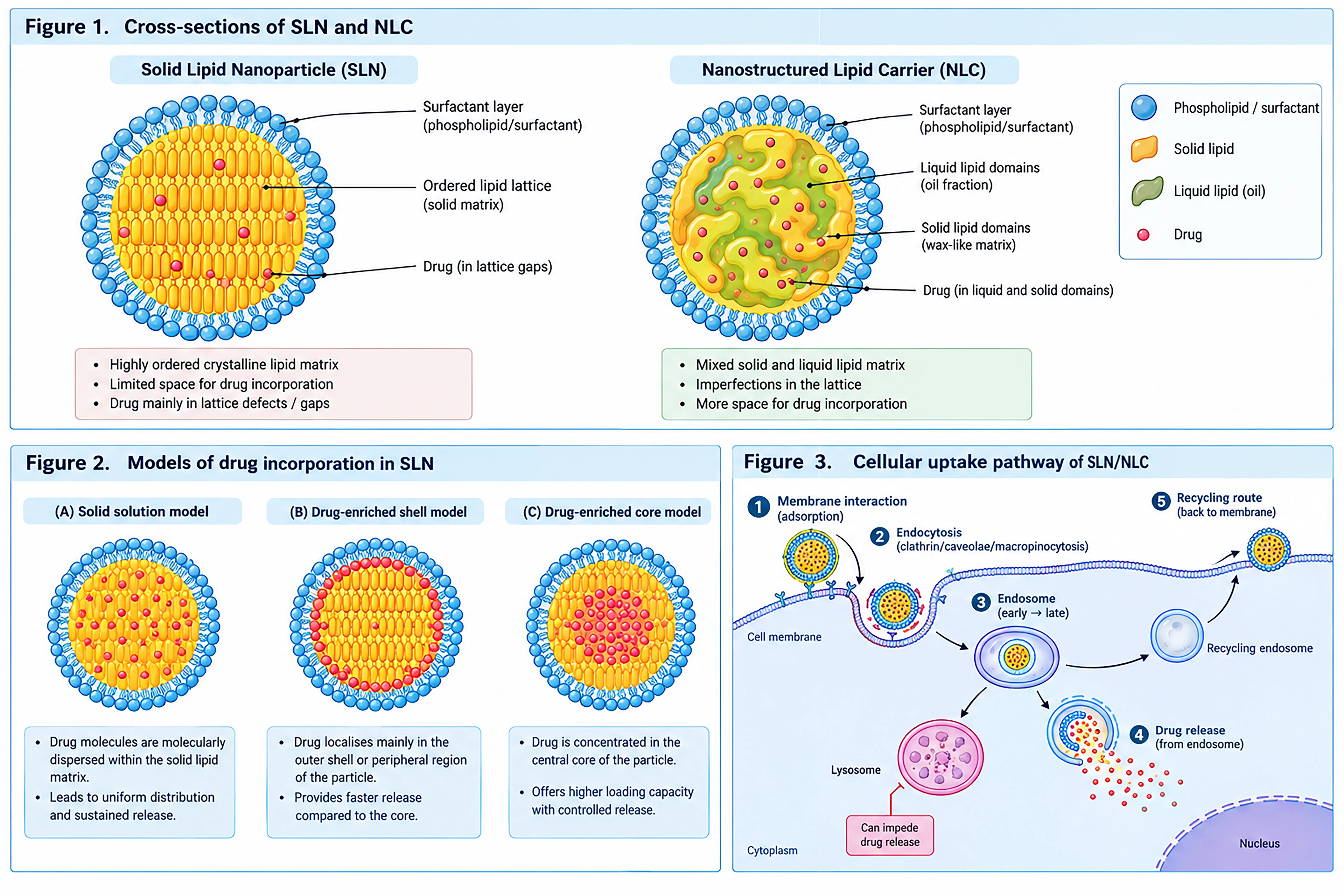
Figure 1: 3. Schematic Illustrations of SLN/NLC Structure, Drug-Incorporation Models, and Cellular Uptake, Trafficking, and Intracellular Drug Release Pathways.
Figure 1-3 is a three-panel figure explaining the making of SLNs and NLCs, the way they carry medications, and how they get to cells. SLNs contain a highly organized solid-lipid lattice with few spaces for drug accommodation leading to limited loading. NLCs are a blend of solid and liquid lipids which form defects and oil domains for loading additional medicine. The drug may be evenly dispersed (solid solution), located in the outer shell or located in the core, the distribution of which affects loading and release. Once supplied particles adsorb to the cell membrane, enter by endocytosis and travel through the endosome, in which the drug is released or the particle is recycled to the membrane. Lysosomal degradation can inhibit release.
Comparison of SLNs and NLCs
Table 1 summarizes a comparative review of solid lipid nanoparticles (SLNs) and nanostructured lipid carriers (NLCs), with focus on their main formulation features and performance qualities. SLNs mainly consist of solid lipids and have a reasonably organized lipid matrix, which may restrict drug-loading capacity and enhance drug expulsion during storage. In contrast, NLCs consist of a mixture of solid and liquid lipids that create a less organized matrix with more room for the medication . Therefore, NLCs generally provide superior drug-loading capability, enhanced physical stability, and lower drug ejection as compared to SLNs. Both technologies offer controlled drug release, nanoscale delivery and possible increases in bioavailability and therapeutic performance.
Table 1: Comparative Characteristics of SLNs and NLCs.
| Parameter | SLNs | NLCs |
|---|---|---|
| Main lipid phase | Predominantly solid lipid | Solid + liquid lipid |
| Matrix order | Relatively more crystalline | Less ordered, structurally imperfect |
| Drug accommodation | Can be limited by crystallinity | Generally greater potential |
| Drug expulsion | May occur during recrystallization | Potentially reduced |
| Formulation flexibility | Moderate | High; solid/liquid ratio adjustable |
| Release control | Possible | Possible and highly tunable |
| Main formulation challenge | Polymorphism and drug expulsion | Lipid-ratio optimization and physical stability |
Composition and functional elements
SLN and NLC performance strongly depends on composition. A typical system has a lipid phase, aqueous phase and one or more surfactants. Other components are added to promote stability, protect particles during drying, change the surface, boost permeability or offer targeting as presented in Table 2. It is the interaction of all components that determines the final behavior rather than a single excipient [15,16]. Solid lipids comprise the matrix of SLNs and a large fraction of NLCs. They should be stable throughout storage and under physiological settings. They should be pharmaceutically acceptable and compatible with the medicine. Glyceryl behenate, glyceryl monostearate, glyceryl palmitostearate, stearic acid and cetyl palmitate are the common investigated instances. Loading is dictated by drug–lipid affinity while particle formation during homogenization or ultrasonication is influenced by melting point and viscosity and crystalline state impacts release and long-term stability [3,4,15,16].
NLCs are defined as liquid lipids. Commonly used excipients are medium-chain triglycerides, long-chain triglycerides, oleic acid, oleyl alcohol and pharmaceutical grade vegetable oils; they should be capable of dissolving the medicine and be compatible with the solid lipid [1,6]. One of the most important parameters influencing particle size, loading, matrix organization, crystallinity and release is the solid-to-liquid ratio. For this reason comprehensive screening and optimization of lipids is advised [18].
Surfactants and co-surfactants lower interfacial tension, promote the production of tiny particles and provide steric or electrostatic stability against aggregation [15]. Polysorbates (e.g. Tween 80), poloxamers, lecithin and bile-salt derived surfactants are intensively explored. Too much surfactant can also lead to aggregation, whereas too less surfactant can change the release profile and increase tolerability problems. Role of co-surfactants in supporting interfacial stabilization and they should be improved along with primary surfactant and lipids. Stabilizers and Cryoprotectants Stabilizers prevent aggregation by steric, electrostatic or mixed mechanisms and their efficiency is evaluated by monitoring particle size, polydispersity and zeta potential. Cryoprotectants such as trehalose, sucrose and mannitol are used to protect particles during freeze-drying and promote redispersion. However, their concentration must be regulated so that size, loading and release are not changed after reconstitution. Functional excipients have specific roles other than particle formation: surface modifiers (stability, circulation, targeting), permeation enhancers (dermal, transdermal and mucosal delivery), antioxidants (protection of oxidation-sensitive lipids), pH modifiers and buffers, mucoadhesive polymers (longer mucosal residence) and targeting ligands (receptor- or tissue- selective interaction) [3,4,15].
Table 2: Major Formulation Components and Their Functional Roles.
| Component | Primary function | Examples / considerations |
|---|---|---|
| Solid lipid | Forms matrix; controls crystallinity and release | Glyceryl behenate, glyceryl monostearate, stearic acid |
| Liquid lipid | Disrupts crystal lattice in NLCs | MCTs, oleic acid, oils |
| Surfactant | Lowers interfacial tension; stabilizes particles | Tween 80, poloxamers, lecithin |
| Co-surfactant | Supports interfacial stabilization | Chosen per formulation |
| Stabilizer | Reduces aggregation | Surfactant- or polymer-based systems |
| Cryoprotectant | Protects particles during freeze-drying | Trehalose, sucrose, mannitol |
| Functional excipient | Targeting, permeation, antioxidant or mucoadhesive function | Polymers, ligands, antioxidants, permeation enhancers |
Methods of Preparation
Different methods for the creation of SLNs and NLCs vary in their energy requirements, thermal demands, solvent usage, scalability and applicability for various pharmaceuticals. The main approaches are summarized here.
High-Pressure Homogenization (HPH)
HPH is one of the most common techniques used to produce SLNs and NLCs and it is scalable. The medicine is dissolved or distributed in the molten lipid and emulsified with a hot aqueous surfactant phase. The emulsion is then homogenized at high pressure. In cold HPH the drug-lipid mixture is first melted and cooled fast to a solid mass which is then milled and distributed in a cold surfactant solution prior to homogenization. Cold HPH is very helpful when dealing with thermolabile medicines, since it reduces the protracted exposure to high temperature [26].
Ultrasonication and high-speed homogenization
Ultrasonication and high-speed homogenization are easy and affordable methods for creating lipid nanoparticles. These approaches allow for efficient mixing of the lipid and aqueous surfactant phases and can result in nanoparticles with satisfactory repeatability. However, compared to high-pressure homogenization, larger particle-size distributions may be obtained. Metal contamination may also be introduced by erosion of the probe by sonication. Particle size homogeneity can be improved by adjusting sonication energy and by using several processing cycles [26].
Solvent Emulsification-Evaporation
In this approach, the lipid and medication are dissolved in an appropriate volatile organic solvent and emulsified in an aqueous surfactant phase. The organic solvent is then evaporated, leading to precipitation of the lipids and production of nanoparticles. Particle size is affected by lipid concentration, emulsification conditions and rate of solvent elimination The procedure does not involve large temperature exposure and so can be helpful for thermolabile substances. However, residual solvent control and potential drug–solvent interactions need to be carefully assessed [26]. Microemulsion Technique
The microemulsion approach is based on the preparation of a hot microemulsion including molten lipid, drug, water and surfactant and then dispersing that into a huge volume of cold aqueous phase. Rapid cooling enhances lipid solidification and nanoparticle production. The process can be used to produce reproducible particles but usually involves rather high surfactant concentrations and additional concentration or purification stages which may limit its practical scalability [26].
Double emulsion technique
Double emulsification is especially effective for integrating hydrophilic medicines, peptides and proteins, which otherwise may partition into the exterior aqueous phase during conventional production. The hydrophilic medication is first incorporated in a primary water-in-oil (W/O) emulsion and then dispersed in an aqueous surfactant phase to produce a water-in-oil-in-water (W/O/W) system. Sonication or homogenization helps to create the nanoparticles, which are then purified by methods such as ultrafiltration or solvent evaporation [27].
Phase Inversion Temperature (PIT) Method
The PIT method utilizes temperature-dependent changes in curvature and hydration of non- ionic surfactants to invert the emulsion phase. The controlled temperature variation leads to the formation of a finely distributed lipid phase which can then solidify to generate SLNs or analogous lipid nanoparticles. The approach is relatively cheap, solvent free and theoretically scalable. However, it generally requires high surfactant concentrations and is relevant only to chosen lipid-surfactant-drug combinations. PIT has also been utilized to make SLNs with a high encapsulation efficiency from murumuru butter and SLNs incorporating aluminum phthalocyanine chloride for photodynamic treatment against B16-F10 melanoma cells [28].
Physicochemical characterization
Particle size and PDI
The size (about 10–1000 nm) is determined by dynamic light scattering, which determines the hydrodynamic diameter from Brownian motion according to Stokes–Einstein equation. The polydispersity index (PDI) is a measure of the width of the distribution; values of ~0.1–0.25 are often considered representative of a stable, thin population. Samples must be diluted properly before measurement, usually in ultrapure water [29].
Zeta potential
Measured via electrophoretic mobility, zeta potential is indicative of surface charge and interparticle repulsion; magnitudes close to ±30 mV often imply strong electrostatic stability. Results are dependent on dilution, ionic strength, pH and additions [29]. Morphology
Shape affects sustained release and encapsulation. Optical microscopy is affordable, but it has a poor resolution for particles smaller than around 500 nm, while electron microscopy has a resolution of roughly 1 nm and can provide extensive structural information [29].
Entrapment Efficiency and Loading Capacity
Encapsulation efficiency (EE) is defined as the ratio of drug entrapped to the total drug added. Loading capacity (LC) is defined as the ratio of the mass of drug to the mass of lipid phase. The free and trapped drug are separated by dialysis or centrifugation and measured by chromatography or spectroscopy [29].
Physical stability
Destabilization includes flocculation, creaming, sedimentation and coalescence. Changes in the solid lipid matrix add to these. The destabilization is followed throughout time by means of the Turbiscan backscattering analysis and the Turbiscan Stability Index [29].
In vitro release
Release is usually examined by dialysis bags at 37 °C or Franz diffusion cells and commonly reveals a biphasic pattern of initial burst followed by continuous release. Reported instances are docetaxel-loaded NLCs in which 77% of the drug was released over 96 h and tryptanthrin-loaded NLCs with 36–45% of the drug release within 48 h with zero-order kinetics. Release is influenced by lipid type, lipid and surfactant concentrations, particle size and manufacturing circumstances [30].
Mechanisms of drug loading and release
Drug incorporation models
Three entrapment models are described for SLNs [3,4].
1. Solid solution model: medication is molecularly dispersed in the matrix during solidification usually after cold homogenization without surfactant .
2. Drug enriched shell (core-shell) model Hot homogenization followed by cooling leads to re-partitioning of drug resulting in a drug-rich outer shell surrounding a drug-poor lipid core.
3. As the lipid recrystallizes around the melt, drug supersaturation becomes concentrated in the core, and a membrane-like shell forms. NLCs are able to solve the loading and leakage problems of SLNs . But they have disadvantages such possible cytotoxicity and surfactant sensitivity . The characterisation of the different kinds of NLCs (amorphous, numerous or defective) is crucial to obtain reproducible [4].
Factors impacting drug loading
(i) Drug solubility in the lipid: low solubility drives the drug to the aqueous phase or the particle surface, hence it is important to do pre-formulation solubility screening across lipids [1].
(ii) Drug-lipid miscibility: good compatibility prevents drug migration; solid and liquid lipids should also be miscible [1].
(iii) Lipid matrix composition: NLCs with a less ordered matrix are often able to load bigger amounts than SLNs [1].
(iv) Drug-to-lipid ratio: increased ratios increase incorporation, but over- incorporation results in precipitation or expulsion beyond matrix capacity [1].
(v) Surfactant type and concentration: They control the lipid-water interface, drug distribution and incorporation efficiency by hydrophilic-lipophilic balance [1].
(vi) Polymorphism and crystallinity: SLNs can release medication during polymorphic transition in storage, whereas liquid lipid in NLCs minimizes crystallinity and leakage [1].
Release mechanisms
Release from nanocarriers is often defined as diffusion, matrix disintegration or erosion, swelling and osmotic effects, and external stimulation [32]. The most relevant for SLNs and NLCs are diffusion through the lipid matrix and enzymatic or physiological breakdown of the lipid. Stimuli-responsive designs (pH, temperature, light) are explored in Section 8. Diffusion depends on particle size, drug solubility, and matrix structure, and can be designed for sustained release from hours to months. The rate of matrix erosion is dictated by the lipid type and the surface/volume ratio, with release generally being in a biphasic burst then sustained manner [30,32]. Some mechanistic details in the general nanocarrier literature (e.g., hydrolytic erosion of PLGA) arise from polymeric systems and apply to lipid carriers only by analogy.
Mathematical release models
Release data are commonly fitted to the following models [31]:
Zero-order kinetics describe release independent of concentration, as seen in osmotic and transdermal systems and in tryptanthrin-loaded NLCs. First-order kinetics describe release proportional to remaining drug, typical of porous matrices with water-soluble drugs. The Higuchi model relates cumulative release to the square root of time for matrix systems under sink conditions. The Korsmeyer–Peppas model, fitted to roughly the first 60% of release, distinguishes Fickian from non-Fickian mechanisms through the exponent n. The Hixson–Crowell model applies when surface area and diameter change during release [31].
Drug delivery networks and biological fate
The fate of SLNs and NLCs in the body includes interaction with biological fluids, cellular absorption, distribution, drug release, metabolism and removal. The key factors are particle size, surface charge, lipid makeup, and the way it is administered. Their biodegradability can increase exposure and lower toxicity. NLCs often have higher loading and less ordered matrices than SLNs, which affect release and biological performance [1,26].
Cellular internalization
Uptake predominantly occurs through endocytic mechanisms such as clathrin-mediated endocytosis and macropinocytosis and is size, charge and lipid content dependent. Positively charged particles may bind more to cells but pose cytotoxic risk. The most accepted pathway is membrane interaction and endocytosis followed by early and late endosomes, lysosomes or recycling pathways, lipid degradation and drug release. Lysosomal degradation may prevent release, so surface and lipid design are important [9,36]. Distribution in vivo
Upon systemic injection the particles interact with plasma proteins and macrophages and are predominantly taken up by the liver and spleen. The distribution and circulation time are dependent on size, charge, hydrophilic coatings (like PEG) and manner of administration (oral administration for example, promotes lymphatic transport). Carrier engineering can enhance delivery to the brain, but increased accumulation does not correspond to efficient therapeutic targeting [1,3,9,34]. Pharmacokinetic benefits
SLNs and NLCs may improve bioavailability (candesartan and felodipine) and decrease dose frequency through increased solubility and stability, protection from degradation and controlled release. The advantages depend on the medicine and the formulation [1,3,9,26,35]. Targeting Passive targeting relies on natural biodistribution, while active targeting means decorating particles with ligands for cellular receptors (e.g., transferrin for brain targeting). Efficiency depends on the ligand density, receptor expression and particle properties [3,26,34]. Biocompatibility and biodegradability
Biodegradable lipids and surfactants are generally compatible. Toxicity however depends on size, charge, lipid type and surfactant concentration. Cytotoxicity, immunological response and long term safety have to be studied and lipid composition controls both breakdown and release [1,3,26,35].
Functionalization and surface engineering
Proteins rapidly adsorb and remove unmodified carriers. Polymers, ligands and antibodies enhance stealth behavior, receptor contact and controlled release and so enable the carriers to traverse biological barriers. Important agents include PEG, antibodies, peptides, aptamers and hyaluronic acid [37,38]. PEGylation produces a hydrated shell that minimizes opsonization and non-specific binding, hence increasing circulation time and improving colloidal stability. The PEG molecular weight and density require careful tuning. For example, docetaxel PEGylated SLNs shown increased absorption and cytotoxicity in prostate cancer models [37–39]. Monoclonal antibodies are highly valuable for the antibody-mediated targeting of particulates to receptor-expressing cells, especially in cancer therapy. Antibodies can be added during or after particle generation while keeping activity as seen with trastuzumab-functionalized SLNs against HER2-positive breast cancer cells. Manufacturing and clinical problems remain [40–42]. Stimuli-responsive carriers respond to internal stimuli (pH, enzymes, redox conditions) or external stimuli (light, magnetic fields, heat) to release medication. pH-sensitive systems are appropriate for acidic tumor settings, and thermoresponsive SLNs are being examined for CNS tumors. External triggers allow for precise control, but they complicate the safety and clinical implementation [37,43,44].
Routes of administration
Table 3 outlines the main routes of administration for SLNs and NLCs that have been studied, their potential benefits and the specific obstacles related to the route. Oral delivery can increase solubility and protect medications from degradation in the gastrointestinal tract and intranasal devices provide quick absorption and nose-to-brain transfer. Transdermal and topical formulations allow for prolonged release and local deposition. Pulmonary and ocular distribution can give protection and residence, whereas intravenous administration can provide solubilization and focused delivery. Vaginal and rectal systems may promote local retention and in some instances minimize first pass metabolism. However, physiological barriers, clearance processes, stability, irritation and patient acceptance should be considered in formulation development [5,45].
Table 3: Routes of Administration for SLNs and NLCs.
| Route | Potential benefit | Main challenges | Refs |
|---|---|---|---|
| Oral | Better solubility, protection from GI degradation, improved absorption | GI stability, lipid solubility | [9,26,46] |
| Intranasal | Rapid absorption; nose-to-brain delivery | Mucociliary clearance, anatomical variation | [7,45,47] |
| Transdermal | Skin interaction, hydration, sustained release; NLCs give loading flexibility | Barrier properties of skin | [27,49,50] |
| Topical | Local deposition and protection; SLNs form an occlusive, hydrating film | Limited depth of penetration | [27,49,50] |
| Pulmonary | Protection and controlled release in inhalable forms | Aerodynamic properties, stability, mucus clearance | [34,51] |
| Ocular | Longer residence time, protection, controlled release | Irritation, deep-tissue penetration | [48,52] |
| Intravenous | Solubilization, controlled release, targeting, no GI degradation | Toxicity, formulation stability | [26,53] |
| Vaginal / rectal | Local retention, solubilization, reduced first-pass metabolism (rectal) | Mucus, pH variability, absorption, acceptability | [55,56] |
Biomedical and Therapeutic Applications of SLNs and NLCs
1. Cancer
2. Neurological Disorders
3. Infectious Diseases
4. Inflammatory Disorders
5. Diabetes
6. Cardiovascular Diseases
7. Ocular Disorders
8. Vaccines and Gene Delivery
9. Nutraceuticals and Phytochemicals
Table 4: Representative Therapeutic Applications of SLNs and NLCs.
| Application | Representative drug / example | Ref. |
|---|---|---|
| Cancer | Docetaxel (PEGylated SLNs, prostate cancer); fisetin (NLCs, melanoma) | [11,39] |
| Psoriasis | Methotrexate SLNs | [12] |
| Skin and soft tissue infection | Meropenem NLCs against Staphylococcus aureus | [8] |
| Migraine / brain targeting | Rizatriptan NLC in situ nasal gel | [7] |
| Antiviral | Favipiravir SLNs (anti-SARS-CoV-2 activity) | [23] |
| Anti-inflammatory | Hesperidin SLNs | [62] |
Table 4 summarizes the representative therapeutic applications of solid lipid nanoparticles (SLNs) and nanostructured lipid carriers (NLCs) in various illness states. The examples demonstrate their capability to enhance medication solubility, stability, targeted administration and therapeutic performance. Applications include anticancer delivery of docetaxel and fisetin, topical administration of methotrexate for psoriasis, antibacterial delivery of meropenem, and intranasal brain targeting of rizatriptan. SLNs have also been studied for antiviral delivery with favipiravir and persistent anti-inflammatory delivery of hesperidin, demonstrating the extensive therapeutic potential of lipid based nanocarriers [7,8,11,12,23,39,62].
Toxicity safety and regulatory factors
The safety of SLNs and NLCs relies on the kind and concentration of lipids, surfactants, medicines, and other formulation components [2]. Comprehensive safety study should cover cytotoxicity, hemocompatibility, immunogenicity and in vivo tolerance with specific regard to surfactant concentration, surface properties, particle size, lipid content and method of administration. In systemic applications, effects on erythrocytes, plasma proteins, platelets, coagulation, organ distribution and elimination should be addressed. Regulatory development also needs regular control of essential quality features such particle size, size distribution, surface charge, drug content, encapsulation efficiency, lipid composition, stability and drug release . Quality-by-Design (QbD) and Design of Experiments (DoE) are used to systematically optimize formulation and process variables to generate resilient and reproducible products [2,48].
Scale-up and industrial manufacturing
Laboratory techniques need to be optimized to transfer to larger scale production with the aim of consistent size, loading, stability and release [3, 63]. Critical process parameters include temperature, pressure, mixing intensity, number of homogenization cycles, flow rate, cooling rate and lipid-phase composition. Small changes can alter particle size, PDI, encapsulation efficiency and stability, so they need to be identified and controlled [4, 63]. Process Analytical Technology (PAT) and continuous manufacturing (e.g., microchannels and static mixers) can enhance monitoring and reduce batch-to-batch variation [5, 63]. Production must comply with Good Manufacturing Practice, including controlled raw materials, equipment, cleanliness, quality control and documentation [6, 63]. The main challenges to commercialization are difficulty in scale-up, batch-to-batch variation, long-term stability, manufacturing expense, regulatory requirements and lack of appropriate clinical evidence, apart from the absence of established large scale methods [7, 63].
Commercialization and clinical translation
NLCs are already utilized commercially in cosmetics and nutraceuticals for improving stability and delivery of actives but pharmaceutical products based on SLNs or NLCs are still limited. SLNs and NLCs should be separated from liposomes and from lipid nanoparticles developed for nucleic-acid delivery [54, 62]. Lipid nanoparticles have clinical investigations by topical, oral and parenteral routes, yet clinical development is significantly smaller than pre-clinical research, reflecting issues in stability, production, safety and approval [54, 63]. Patent activity ranges from formulations, manufacturing, targeting, cosmetic and nutraceutical uses. One examination of SLN patents from 2014 to 2019 indicated interest in medicinal and cosmetic applications has been sustained. Industry interest in biocompatible lipids, scalable technologies, but commercialization depends on reproducible manufacturing, sufficient stability, and acceptable safety and approval [52, 64].
Recent Advances in SLNs and NLCs
Recent advances in SLNs and NLCs are gradually merging data-driven formulation, enhanced manufacturing, multifunctional nanocarriers, and tailored nanomedicine. Artificial intelligence and machine-learning approaches are being investigated to correlate formulation and process variables with critical quality attributes such as particle size, polydispersity, encapsulation efficiency and stability, thus potentially reducing experimental workload. However, the predictive reliability is strongly dependent on the size, quality and representativeness of training datasets [3,61]. Microfluidic production offers controllable and reproducible mixing, with greater control over particle size, shape and encapsulation and batch-to-batch consistency, with potential for scale-up [4,62]. Hybrid and theranostic methods combine lipid nanoparticles with other elements such as targeted ligands, imaging components or controlled-release functions that allow simultaneous therapeutic delivery and monitoring [5,63]. Another emerging direction is personalized nanomedicine, where the lipid composition, drug loading, surface modification, and dosing could be tailored to individual patient or disease characteristics, but substantial biological, manufacturing, regulatory and clinical validation is still needed [7,64].
Current issues and future prospects
Despite their enormous potential, SLNs and NLCs are confronted with significant challenges in terms of long-term stability, scalable manufacturing, regulatory standardization and clinical translation. Changes in lipid crystallinity, particle aggregation and drug redistribution during storage might influence encapsulation and release properties. Although NLCs often lower drug ejection relative to SLNs, they can also experience physical instability [13,64]. Scale-up can affect particle size and other critical quality attributes because of changes in mixing, temperature, pressure, and processing conditions that require robust manufacturing approaches such as high- pressure homogenization, microfluidic systems, and static mixers [14,64]. The regulatory development demands precisely specified composition, critical quality qualities, established analytical methods, reproducible processes and thorough safety and stability data [5,64]. In addition, translation of promising in vitro and animal studies into clinical use is hampered by biological variability, manufacturing complexity and regulatory restrictions [16,64]. Therefore, future research should focus on rational lipid selection, improved stability, scalable and reproducible manufacturing, targeted delivery, formulation optimization aided by AI, microfluidic production and well-designed clinical studies establishing clear relationships between nanocarrier characteristics, pharmacokinetics, safety and therapeutic outcomes [17,64].
CONCLUSIONS
Solid lipid nanoparticles (SLNs) and nanostructured lipid carriers (NLCs) are flexible lipid-based nanocarriers with great promise to improve the solubility, stability, bioavailability and controlled administration of drugs. SLNs are based on a mostly solid lipid matrix, whereas NLCs integrate liquid lipids to generate a less ordered matrix, usually offering higher drug-loading capacity and lower drug ejection during storage. However, obstacles in drug loading, physical stability, reproducible scale-up, regulatory standardization, and clinical translation still exist. Emerging technologies, like high-pressure homogenization, microfluidic manufacturing, Quality-by-Design, and artificial intelligence-powered formulation optimization, are promising in improving product uniformity and production efficiency. Future research should focus on long-term safety, robust critical quality attributes, scalable manufacturing, pharmacokinetic–pharmacodynamic relationships, and well-designed clinical evaluation. Successful translation of SLNs and NLCs will ultimately depend on the translation of promising lab scale results to stable, reproducible, scalable, safe and clinically validated nanomedicine products.
REFERENCES

Sandip Kumar, Dr. Bipul Nath, Bahunshisha Kharsahnoh, Meker Shyrmang, Ruwa O. Padit, Solid Lipid Nanoparticles and Nanostructured Lipid Carriers in Drug Delivery: A Review, Int. J. of Pharm. Sci., 2026, Vol 4, Issue 10, 2384-2400. https://doi.org/10.5281/zenodo.23393444
 10.5281/zenodo.23393444