

We use cookies to ensure our website works properly and to personalise your experience. Cookies policy
Srinivas College of Pharmacy, Valachil, Farangipete, Mangalore 575143
Stimuli-responsive nanocarriers have emerged as an advanced approach in targeted drug delivery systems to improve therapeutic efficacy and reduce systemic side effects. Conventional drug delivery methods often suffer from poor bioavailability, non-specific distribution, and dose-related toxicity, which limit their clinical effectiveness. To overcome these limitations, smart nanocarriers capable of responding to specific internal or external stimuli have been developed. These systems are designed to release drugs in a controlled manner only at the desired site of action. Stimuli-responsive nanocarriers respond to various physiological and external signals such as pH, temperature, enzymes, redox potential, light, and magnetic fields. Commonly used nanocarriers include polymeric nanoparticles, liposomes, dendrimers, and micelles, which provide enhanced drug protection, improved solubility, and prolonged circulation time. The advantages of these systems include site-specific targeting, reduced drug wastage, improved patient compliance, and minimized adverse effects. Furthermore, recent advances in nanotechnology and pharmaceutical sciences have opened new opportunities for the development of personalized and precision medicine. In conclusion, stimuli-responsive nanocarriers represent a promising platform for future drug delivery systems and hold great potential for improving patient-centered therapy.
The science and technology has emerged in pharmaceutical research with focus on developing novel drug delivery systems. Conventional dosage forms are associated with a low bioavailability, frequent dosing, side effects and hence patient noncompliance. Novel drug delivery systems embraced an alternative to traditional drug delivery systems.
Novel drug delivery system (NDDS) is an formulation of new pharmaceutical forms which have refined capabilities such as smaller particle size, higher permeability parameters, and Site-specific targetting. NDDS can be used to overcome the limitations of conventional dosage forms.1
Targeted drug delivery is also called as smart drug delivery system because of which it has a miraculous properties in delivering the drug to a patient.2 Targeted drug delivery is a type of drug delivery system in which the medicament is selectively site targeted rather than to nontargeted site. The system is based on a method that delivers medication to a particular diseased location within the body over an extended period of time by improving efficacy and reducing adverse effects.3 Targeted drug delivery system has three main reasons where it is preferred over conventional drug delivery systems: The first is a pharmaceutical reason i.e., Conventional drugs have low solubility and more instability when compared to targeted drug delivery systems. Second reason is, conventional drugs also have poor absorption, shorter half-life and require large volume of distribution which constitute its pharmacokinetic properties. The third reason is the drugs pharmacodynamic properties. The conventional drugs have low specificity and low therapeutic index in comparison to targeted drug delivery system .Hence, targeted drug delivery system is preferred over conventional drug delivery systems.4 Pharmaceutical nanocarriers are drug delivery vehicles with size ranging around 10 to 200 nm and high versatility. They include polymeric, lipidic and inorganic nanoparticles, liposomes, nanotubes, nanocomplexes, niosomes and many others.5,6
However, nanocarriers also undergo inadequate delivery of therapeutics at targeted sites. To overcome limitations in targeted drug delivery, Stimuli-responsive nanocarriers have been developed. These stimuli-responsive nanocarriers which change their properties by various stimuli, leading to controlled and adequate delivery of drugs at the target site. Stimuli-responsive nanocarrier are composed of various environmental sensitive properties within their structures and thus it releases the loaded medication in response to various environmental stimuli such as temperature, pH, redox potential, enzymes, electromagnetic, light, radiation, ultrasound, etc.7
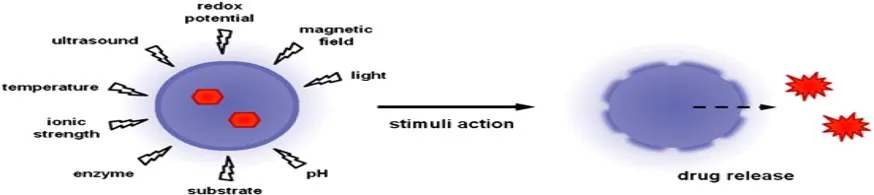
Figure no 1: Schematic illustration of stimuli-responsive smart nanocarriers showing drug release
CLASSIFICATION OF STIMULI RESPONSIVE NANOCARRIERS:
Internal stimuli-responsive:
Internal stimuli-responsive systems are the systems that take advantage of microenvironmental changes of the diseased tissues like change in pH, temperature, or concentration of specific enzymes or difference in redox potential. In response to such endogenous stimuli, such systems are designed to deliver the drug in a selective and predetermined manner accordingly improving drug’s biological effect and reducing side effects elsewhere in the body.
The most commonly used stimuli for delivery is pH, targeted at either whole organs or the internal structures within individual cells; it has also been used to release the therapeutics under altered pathological conditions, like cancer, inflammation, or ischemia with marked pH changes. pH-responsive polymers, which are capable of accepting or donating protons in pathological pH, allow moderate structural changes to occur, and are employed for these systems.
Temperature may be used as an both type of stimuli i.e., as an external stimulus or as an internal stimulus. In case of tumor tissue, it is slightly warmer than normal tissue. Heating the tumor site increases the local blood supply and permeability of the tumorous tissues. Temperature-responsive nanocarriers like liposomes, polymeric micelles and vesicles are used in combination with other stimuli. Among these nanocarriers, temperature responsive nanomaterials commonly uses polymer hydrogels as a vectors. The properties of the polymers enable them to have a critical solution temperature range, which the polymer becoming insoluble when the temperature increases beyond the lower critical solution temperature. Poly(N-isopropyl acrylamide) (PNIPAAm) is the most popular thermosensitive polymer used for the delivery of therapeutics. Another common type of temperature-responsive carrier is thermosensitive liposomes. The strategic parameter of thermosensitive liposomes is the transition temperature (Tm) of phospholipids from the gel phase to fluid phase.
Enzymes plays a important role in most metabolic processes. The levels and activities of enzymes are different in diverse tissues and organs, which means that enzymes have tissue-specificity or organ-specificity. Nanocarriers can be designed as enzyme-responsive systems when the enzyme activity is associated with a particular tissue or when there is increase in the level of an enzyme at the target site. Enzyme-responsive nanocarriers are more suitable for programmed delivery when compared with other stimuli delivery strategies due to changes in certain enzymes caused by the disease.Several enzyme responsive nanocarriers have been developed for achieving controlled release of medication like mesoporous silica nanoparticles, dendrimers, magnetic nanoparticles, polymeric micelles and liposomes etc. The enzyme-sensitive nanocarriers could be utilized in the following aspects: (1) Activating prodrugs, probes and ligands by cutting the enzyme-sensitive bonds; (2) Degradation of nanocarriers through enzyme triggered cleavage of polymer backbones; (3) Direct cleaving the conjugation between nanocarriers and drugs; (4) Enzyme triggered physical disruption of nanocarriers; (5) Enzyme-triggered controlled release of cargos.
The nanocarriers releases the therapeutics through a redox reaction where the nanocarriers are made up of redox sensitive bonds and linker such as di-sulfide bond. Nanocarriers that are made up of with di-sulfide-based bond that is known to cleave by glutathione (GSH), where therapeutics are delivered by the response of redox reaction.7 Redox-responsive polymer materials are of two types: glutathione (GSH) and reactive oxygen species (ROS). GSH types are sensitive to high GSH levels, resulting in precise delivery and rapid drug release into site specific region.
ROS is a by-product of aerobic metabolism induced by carcinogenic transformation; therefore, ROS level is higher in cancer cells when compared to normal cells. The functional groups that are susceptible to ROS are thioacetone, thioether, selenide, diselenide, ferrocene groups and boronic acid esters. Under ROS conditions, hydrophobic thioether- containing polymers are oxidised to hydrophilic sulfoxide or sulphone groups. Thus, the ROS-responsive nanocarriers are developed by polymers containing thioether groups.
External stimuli:
Stimuli-responsive system responds to external stimuli like magnetic,light, ultrasound, electric field.
Light is also a attractive variety of parameters, such as wavelength, duration, beam intensity and beam diameter, can be developed to achieve the desired release profile and penetration into tissues. Electromagnetic light wavelengths below 650 nm cannot deeply penetrate through tissue (>1 cm) due to the scattering and absorption by endogenous chromophores; Although UV light has the triggering power for many chemical reactions, it is useful in treating the superficial level on the skin and mucosa as a triggering agent. To strategize the deeper light penetration, near-infrared (NIR) light within the wavelength range of 650–1000 nm, which leads to the less damage to living Cells.The chromophore is the key element in the light-responsive NPs. Mechanisms like photo-crosslinking, photo-un-crosslinking, photochemical hydrophobicity switch, and photo-induced cleavage of chemical bonds are developed to induce light-triggered release of nanocarriers. Some important photo-sensitive chemical groups that undergo a photo-isomerization transition are azobenzene and spiropyran and that undergoes a photo-crosslinking reaction coumarin .
Magnetic nanoparticles (MNPs) is one of the broad spectrum of nanoscale materials thar are used for biomedical application, because of the intrinsic magnetic properties, which enable tracking through radiology and magnetic resonance (MR) imaging. In response to different types of magnetic field, permanent magnetic (PMF) or alternating magnetic field (AMF), MNPs, which can be applied to magnetic triggered drug delivery, hyperthermia and imaging-guided therapy.
MNPs commonly consist of iron, cobalt, nickel and their corresponding oxides. Among these, iron oxide nanoparticles (IONPs) are widely applied in biomedicine including magnetite, hematite, maghemite etc. The magnetite and maghemite nanoparticles are referred to as superparamagnetic iron oxide nanoparticles because they exhibit high magnetic magnetization and(SPIONs), characterized by their excellent biocompatibility, fine biodegradability, and stability. These SPIONs have found to have application in biomedical field like magnetic resonance imaging (MRI), drugs delivery, hyperthermia and biosensing.
The Spatiotemporal release of a drug from a nanocarriers systems is effectively achieved by Ultrasound (US) mediated imaging and drug delivery. Ultrasonic energy facilitates the release of medication from nanocarriers by acoustic energy(ultrasound). Ultrasonic energy induces (i) cavitation, (ii) mechanical stress (iii) localized heat in order to disrupt the nanoparticles and releases the medication. The Permeability of the cell is enhanced by mechanical forces of oscillation and destruction of microscopic and nanoscopic bubbles by exposing to ultrasound. It is advantageous because of its non-invasiveness, the absence of ionizing radiations, and the facile regulation of tissue penetration depth by tuning frequency, duty cycles and exposure time. Additionally, it could reach deeper sites into the body than light-trigger (except for NIR-responsive).
Electroresponsive drug delivery is another stimuli of choice for sustained, pulsed or “on demand” drug release. A weak electric field (1V) is applied for controlled delivery. Electroresponsive ones consist of polyelectrolytes, with ionizable groups, which give the opportunity for responsiveness to electrical stimuli. This behavior may result for the release of drug by various kinetic mechanisms. Another effective way for electroresponsive drug delivery is through electroporation. The Formation of pores in cell membranes due to the high transmembrane voltage leads enhanced permeability to drugs. This method has been studied for the delivery of a wide variety of APIs, including proteins, genes, drugs and diagnostic agents.
Various electro-responsive materials like biopolymers (cellulose and starch), inorganic particles (titania, zeolite, mesoporous materials, silica) and conducting polymers which shows electroresponsive behaviour.
Multi-stimuli responsive systems:19
Multi-stimuli responsive drug delivery systems has a ability to create complex trigger detection systems allows them to detect single triggers or activate multiple triggers sequentially. The combination of both the activation mechanisms in dual-responsive systems enhances specificity by creating pH/temperature and redox/enzyme sensitivity that results is better accumulation of single responsive nanoparticles. Stimuli-responsive elements in nanocarriers that permit precise spatiotemporal control of drug delivery profiles with minimal premature leakages at specific pH levels and temperatures. This system is designed with multiple, layered safety mechanisms that must be unlocked one after another. This system enhances delivery of nanoparticles by reponding to specific bloodstream conditions and environment triggers before responding to intracellular activation of enzymes. To achieve superior therapeutic results, synergistic responsive mechanisms are utilized by cooperative stimulation process than independent responses would achieve alone.
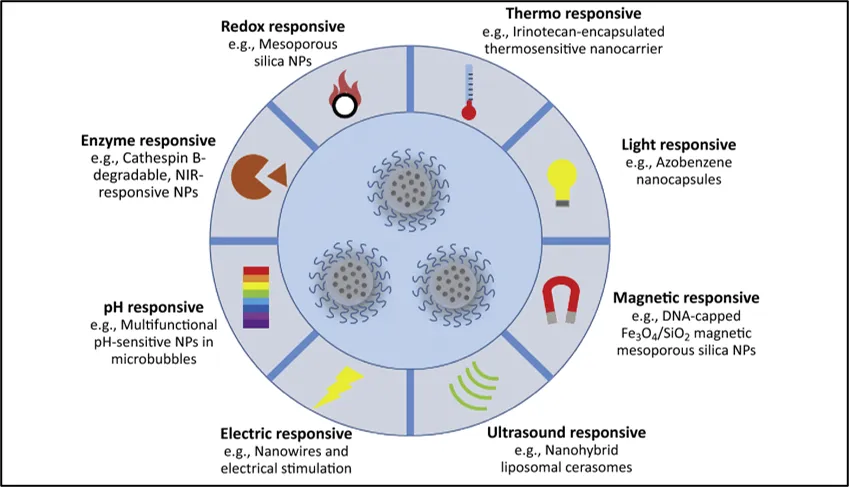
Figure no 2: Different types of stimuli responsive
Table 1: Types of stimuli with their mechanism of action20.
|
Stimulus type |
Mechanism of action |
Example of nanocarriers |
Advantages |
|
pH
|
Protonation/ deprotonation of materials or cleavage of acid sensitive linkers |
pH-sensitive liposomes, polymeric micelles |
Targeted drug release in acidic environments |
|
Temperature
|
Phase transition of thermoresponsive polymers |
PNIPAM based hydrogels, liposomes |
Controlled release in response to hyperthermia or localized heating |
|
Enzyme
|
Degradation of enzyme-cleavable linkers or coatings |
Enzyme sensitive polymeric nanoparticles |
Targeted release in tissues with overexpressed enzymes |
|
Redox
|
Cleavage of disulfide bonds or other redox sensitive linkers |
Redox sensitive micelles, liposomes |
Intracellular release in high glutathione environments |
|
Light
|
Activation of photo responsive materials via UV, visible, or NIR light |
Gold nanoparticle based carriers |
Precise spatial and temporal control |
|
Magnetic Field
|
Movement or heating of magnetic nanoparticles under an external magnetic field |
Magnetic nanoparticles, magnetoliposomes |
Non-invasive targeting and localized hyperthermia |
|
Ultrasound
|
Acoustic cavitation or disruption of nanocarrier structure |
Ultrasound sensitive liposomes |
Deep tissue penetration and on-demand release |
|
Electric |
charge change, conformation change and electrostatic interactions within the nanoparticles. |
Polymer Nanoparticles (polypyrrole (PPy) |
controlled with high accuracy |
Mechanisms Of Drug Release:21
The release of drugs from stimuli-responsive carriers depends on the interaction of carrier and the trigger (stimulus). These mechanisms determine drug therapeutic action in its target site more precisely and effectively.
4.1 Swelling and Deswelling
4.2 Bond Cleavage and Degradation
4.3 Structural Reconfiguration
4.4 Phase Transition
Materials used to Design Stimuli-Responsive Nanocarriers:
Lipid-Based Nanocarriers:
Liposomes are also a colloidal or microparticulate carriers. Liposome are a nanoparticulates with size ranging about 100nm. Liposomes are the sphere shaped vesicular structures made up of one or more phospholipid layers. Both hydrophilic and lipophilic drugs are loaded into liposomes.
Advantages:
Niosomes are nanoscale drug delivery systems with good biocompatibility, biodegradability and reduced toxicity. Niosomes are similar to liposomes but differs by bilayer membrane of niosomes which is comprised of non-ionic surfactants instead of phospholipids(Liposomes).
Advantages:
SLNs are the colloidal carriers of nanoscopic size 50–1000 nm, composed of solid lipids that can overcome the limitations of polymer nanoparticles and liposomes. This colloidal system consists of Spherical solid lipid particles with solid water- repellent core containing collection of single covering of protein attached lipids.
Advantages:
SLNs and NLCs has great encapsulating efficiency and are capable of encapsulating hydrophilic and lipophilic drugs when compared to liposomes. SLNs has a limitations like low entrapment efficiency and high risk of drug expulsion on storage due to polymorphic transitions. Therefore, to overcome the limitations of SLNs, NLCs are used because of the combination of nanostructured solid and lipids within the core SLNs comprised by solid lipids, whereas NLCs are modified by adding liquid lipids. Hence, NLCs are the spherical structures with oil droplets within a solid lipid droplets.
Advantages:
Cubosomes are the lipid-based nanoparticle which reflects their cubic molecular crystallography of submicron size particles (10-500nm). It is the bicontinuous cubic liquid crystalline phase. There are 3 stages in cubosomes like Im3m (Schwarz surface), Pn3m (Diamond surface), Ia3d (gyro surface) which explains about the shapes and also induces transportation of drug to the target site.
Advantages:
Lyotropic liquid crystalline nanoparticles are the nanocarriers with significant technological advantages in their internal morphology of 3D or 2D structured network of lipid bilayer in cubic or hexagonal mesophase.
Advantages:
Polymeric nanocarriers:
Polymeric nanoparticles have potential to improve the therapeutic efficacy by providing protection and facilitating drug delivery at target site. These nanoparticles have unique polymeric composition when compared with other delivery systems.
Advantages:
The polymeric micelles are the novel techniques to enhance the solubility and the problems associated in the administration of drugs. Polymeric micelles are nothing but supramolecular structure where aggregation of colloids formed in self-constructed amphipathic polymer solution. The the of Polymer size ranges between 10nm to 100nm.
Advantages:
The term dendrimer originated from the combination of two Greek words “dendron” means tree and “meros” means parts i.e.,branched structure. Dendrimers are the hyper-branched macromolecules with many end-group functionalities and a compact molecular structure. The multiple branches are emerged from the central core molecule which give a structural framework.
Advantages:
The IUPAC defines a nanogel (NG) as a particle of gel of any shape with an equivalent diameter of approximately 1–100 nm. NGs are the soft nanomaterials composed of swellable polymeric networks, which results in greater capacity for fluid retention. The unique features of NGs depends on the ability to sweel in different solvent, deformability, dynamic, permeable and network-like structure. made of swellable polymeric networks, which display a high capacity for retaining fluids such as water.
Advantages:
Polymeric nanowires are the emerging nanotechnology based drug delivery systems which improves the cellular uptake and endosomal escape of nucleic acids. These nanowires has the capability to bind with various biomolecules like proteins and nucleic acids that deliver the molecules to target site.
Advantages:
Hydrophilic polymeric networks that have the ability to absorb large amount of water and leads to swelling and shrinking that facilitates the controlled drug release are known as hydrogels. Enzymatic, hydrolytic or environmental stimuli influence hydrogels to release the drug at site of target.
Advantages:
Inorganic nanoparticles:
Gold Nanoparticles are one of the key systems in the targeted drug delivery system. Gold nanoparticles have unique features like precise target, simpler manufacturing process, surface functionalization, distinctive optical and photo thermal capabilities. These unique features makes gold nanoparticles to stand out from other nanoparticles. The size of Gold nanoparticles ranges from 1nm to 8 µm by exhibiting different shapes like spherical, sub-octahedral, octahedral, decahedral, icosahedral multiple twined, multiple twined, irregular shape, tetrahedral, nanotriangles, nanoprisms, hexagonal platelets and nanorods.
Advantages:
Magnetic nanomaterials have been used in the fields like catalysis, electromagnetic wave adsorption, and especially biomedicine. Conventional magnetic nanomaterials which contains magnetic elements like iron, cobalt, nickel, and manganese, and their size, shape, structures and chemical components are adjusted by optimizing the physical and chemical properties. This optimization leads to improving the utility in biomedicine. These nanoparticles are frequently used nanoparticles because of their low toxicity and good biocompatibility. The contribution of this type of nanoparticles are in magnetic resonance imaging (MRI), biosensing,and drug delivery.
Advantages:
MSNs are SiO2 nanoparticles have the size between 2 and 50 nm and with a total diameter of a maximum of 1 µm. The material known as mesoporous silica was discovered by Mobil Oil Corporation in 1992. Their first drug delivery application was demonstrated in 2001 when MCM-41 silica was used to release ibuprofen. Since then, MSNs have become a popular drug delivery system due to their advantageous properties and have been generally recognized as safe by the FDA.
Their pore size is located between microporous and macroporous systems which are used in various shapes like sphere, cube, ellipsoid, rod and with different pore sizes and structures.
Advantages:
Quantum dots (QDs) are semiconductor crystals with size of 2–10 nm enabling them to emit a wide range of bright, photobleaching-resistant light with distinguished chemical and physical properties. The QDs’ size and composition is adjusted by tuning the size of fluorescence. Spherical, cylindrical, pyramidal, conical, tetrahedral, and lens-shaped quantum dots are among the different shapes that are most commonly used. Quantum dots are mainly madeup of a single substance, often metallic chalcogenides such as cadmium telluride (CdTe) or lead sulfide (PbS).
Advantages:
Carbon-based nanoparticles have attracted more attention due to their wide distribution, low processing cost and easy method of preparation. Carbon based nanoparticles are classified into based on their physicochemical properties are carbon quantum dots (CQDs), fullerenes, carbon nanotubes, graphene and its derivatives, nanodiamond, and graphene oxide.
Advantages:
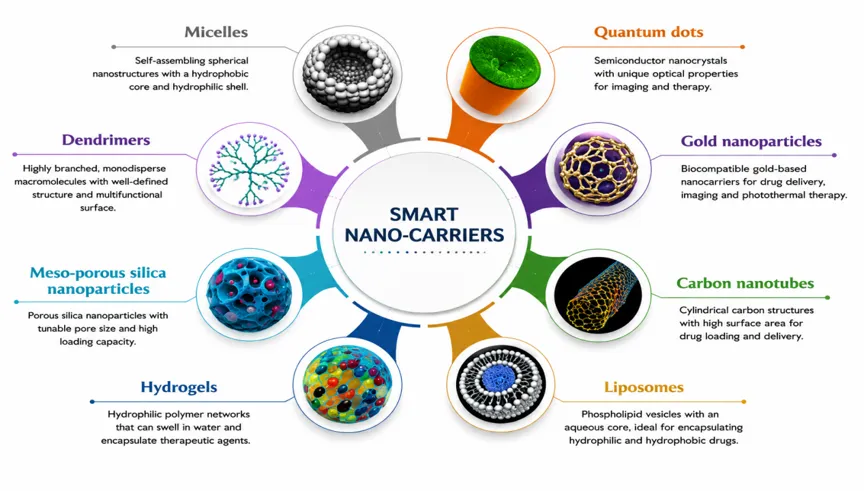
Figure no 3: Types of Smart nanocarriers
APPLICATIONS:
Cancer is one of the a very serious challenge with aging of the human population. Recent Advances in nanotechnology field have paved the way for treatment of cancer. By combining therapeutics and nanotechnology, nanomedicines are utilized in cancer treatment. Nanocarriers are advantageous in delivering therapeutic drugs with reduced side effects, Simplifying administration process and high therapeutic efficiency. Stimuli-responsive nanocarriers can enter deep into tissues by responding to internal and external triggerers by releasing the medicaments for cancer therapy. In cancer therapy, these stimuli-responsive nanocarriers deliver the therapeutic agents at tumor sites in controlled system by reducing the side effects when compared to systemic chemotherapy. These nanocarriers deliver the therapeutic drug more efficiently by releasing the medicaments in response external or internal stimuli. Therefore, stimuli responsive nanocarriers shows great potential for cancer treatment.
Alzheimer’s and Parkinson’s disease are the neurodegenerative diseases in affected tissues of brain causing changes in pH and temperature, high levels of ROS, high enzymes, and others. These suggest development of stimuli drug delivery systems. Neurotherapeutic agents are loaded into the nanocarriers that will respond to various internal and external stimuli where the medicaments are delivered to site specific area providing controlled release. However, risk associated with carriers causing undesired off-target effects on physiological tissues remains as a challenge. Therefore, stimuli responsive nanocarriers provides a promising strategy for targeted delivery of therapeutics for the management Alzheimer’s and Parkinson’s disease.
Drug-resistant bacteria and infectious diseases associated with biofilms create a substantial threat for the global health. The nanotechnological advancement in antibacterial field provides the strategy for resistance in bacteria. Nanomaterials have several advantages such as adjustable size and shapes, customizable designs and ability to synergistically utilize multiple active components, to achieve site specific targetting depending on microenvironmental variations. These make use of unique physicochemical properties of nanocarriers for achieving antibacterial effects. Nanocarriers exhibit response to external as well as internal stimuli for developing antibacterial nanocarriers. These nanocarriers shows enhanced antibacterial efficacy by responding to various internal and external stimulus. Hence, they provide promising strategy for developing safe antibacterial nanocarriers.
Insulin and glucagon-like peptide 1 (GLP-1) are the essential diabetic therapeutics that are used to regulate blood glucose levels. Although, Subcutaneous injections that are associated with drawbacks such as poor glucose control and patient incompliance. To overcome these drawbacks, stimuli responsive systems are utilized to treat diabetes by focusing on improved patient comfortness and prevent complications. The first system introduced for the treatment of diabetes was pH-responsive system for oral drug delivery. Then, the various closed-loop glucose-responsive systems are described based on different glucose-responsive moieties, including glucose oxidase, glucose binding protein, and phenylboronic acid. Finally, the on-demand delivery systems activated by external remote triggers are also discussed. We conclude by discussing advantages and limitations of current strategies, as well as future opportunities and challenges in this area.
Rheumatoid arthritis (RA) is a long-term inflammatory disease derived from an autoimmune disorder of the synovial membrane. Present therapy for rheumatoid arthritis aims to inhibit the macrophages' proliferation and reduce the production of pro-inflammatory cytokines. Therefore, the accumulation of therapeutic agents targeted at the inflammatory site should be a crucial therapeutic strategy. Recently, Stimuli responsive nanocarriers showed exceptional worth for arthritis management. Stimuli-responsive polymeric nanomaterials, as an important component of nanoparticulate carriers, have been utilized for various therapy. The development of nanocarriers that are responsive to internal and external stimuli represent a promising alternative for targeted drug delivery systems. Therefore, Stimuli-responsive nanocarriers offer promising drug delivery systems for the Arthritis therapy by offering the advantages such as improving therapeutic efficacy and reducing the side effects.
Gene therapy has made immense progress in the past years but still faces has limitations like reduced delivery of nucleic acid and also release efficiencies. The development synthetic gene delivery systems nanoparticles, liposomes etc, which is also known as Nanodelivery and release systems (NDRS), has led to the milestone in gene therapy. NDRS are the stimuli responsive delivery systems which responds to stimulus micro environment. This has shown exceptional loading and release for gene therapy. It limits the indepth application, gene therapy in clinical practice, owing to the presence of biological barriers in the body. Therefore, this is one of the most promising systems for gene therapy.
CONCLUSION
Stimuli-responsive nanocarriers are fairly novel in the realm of targeted drug delivery possessing the inherent feature of being on-demand triggered drug release systems. With the development of nanotechnology, nanocarriers possess advantages that include noninvasive administration, optimized drug distribution, elevated treatment outcomes, reduced systemic side effects and improved compliance.
These nanocarriers can be designed to respond to specific stimuli, such as pH, temperature, or light, to release therapeutic agents in a controlled manner. While there are still challenges to be addressed, the benefits of using stimuli responsive nanocarriers for site-specific drug delivery make them an attractive option for future research and development.
Stimuli-responsive nanocarriers have shown great promise for site-specific drug delivery in various diseases, including cancer, inflammatory arthritis, and neurological disorders. There is a need for additional research to thoroughly investigate the potential of these nanocarriers and to convert them into clinical applications. With ongoing advancements Stimuli responsive nanocarriers holds a significant promise for revolutionizing personalized medicine and improving the patient outcomes in a year ahead.
REFERENCES

Navami Alva, Prathiksha, A. R. Shabaraya, Stimuli Responsive Nanocarriers for Targeted Drug Delivery: A Review, Int. J. of Pharm. Sci., 2026, Vol 4, Issue 7, 4771-4786. https://doi.org/10.5281/zenodo.21510498
 10.5281/zenodo.21510498