

We use cookies to ensure our website works properly and to personalise your experience. Cookies policy
Department of Biological Sciences, VIVA College, Virar
The environmental impact of non-biodegradable plastics has driven the development of sustainable alternatives for packaging applications. This study investigates biodegradable composite films prepared from alkali-treated fibers of Typha latifolia and Eichhornia crassipes (water hyacinth) incorporated into a starch-based matrix. Films with varying fiber ratios (100:0, 60:40, 40:60, and 0:100) were evaluated for mechanical properties, water vapor permeability, biodegradability, and antimicrobial activity. The results showed that the pure Typha film exhibited the highest tensile strength (16.5 MPa), while increasing water hyacinth content enhanced flexibility, reaching a maximum elongation of 14.1%. The 60:40 blend demonstrated an optimal balance, maintaining high strength with improved flexibility. Biodegradation studies indicated significant mass loss (75–90%) within 45 days, confirming high environmental compatibility. Water vapor permeability increased with water hyacinth content but remained moderate in blended films, making them suitable for dry and semi-dry food packaging. Additionally, the films exhibited notable antimicrobial activity against bacterial and fungal strains. Overall, the 60:40 blend emerged as the most promising formulation. The study highlights the potential of aquatic biomass as an eco-friendly resource for biodegradable packaging.
The widespread use of petroleum-based plastics has become an integral component of modern packaging due to their durability, lightweight nature, and low production costs. However, their resistance to degradation has resulted in severe environmental challenges, including accumulation in landfills, marine pollution, soil contamination, and the formation of microplastics that enter food chains and threaten human health. It is estimated that conventional plastics can persist in the environment for several hundred years, making plastic waste management one of the most pressing global environmental concerns. As a result, there is growing scientific and industrial interest in the development of sustainable, biodegradable alternatives that can replace conventional plastics, particularly in short-life packaging applications. Bio-packaging materials derived from renewable biological resources have emerged as promising alternatives due to their biodegradability, reduced carbon footprint, and compatibility with circular economy principles. Among various biopolymers, polysaccharide-based materials such as starch, cellulose, chitosan, and alginate are extensively studied for film-forming applications. Cellulose, the most abundant natural polymer on Earth, is particularly attractive due to its excellent mechanical strength, film-forming ability, renewability, and biodegradability. However, the large-scale use of food-based biomass sources for cellulose extraction raises concerns related to food security and economic sustainability. Consequently, attention has shifted toward non-food, low-cost lignocellulosic biomass sources. Aquatic macrophytes represent a largely underutilized yet highly renewable source of lignocellulosic biomass. Typha latifolia (cattail) is a perennial wetland plant widely distributed across temperate and tropical regions. It exhibits rapid growth and produces large quantities of fibrous biomass rich in cellulose and hemicellulose. The long, thick-walled fibers of Typha contribute to high tensile strength and structural rigidity, making it a suitable reinforcement material for biodegradable composites. In contrast, water hyacinth (Eichhornia crassipes) is an invasive aquatic weed known for its aggressive proliferation, which disrupts freshwater ecosystems, obstructs water flow, and negatively impacts biodiversity. Despite its ecological drawbacks, water hyacinth possesses high biomass productivity and appreciable cellulose content, rendering it a valuable raw material for sustainable material development. The utilization of Typha latifolia and water hyacinth biomass for biodegradable packaging offers a dual environmental advantage: the reduction of plastic waste and the management of invasive aquatic plants. Several studies have reported the extraction of cellulose fibers from these macrophytes for use in polymer composites, pulp, and adsorbents. However, limited research has focused on their combined use in biodegradable film formulations, particularly for packaging applications. Blending fibers with different morphological characteristics may result in synergistic effects, enhancing both mechanical performance and flexibility while maintaining biodegradability. In biodegradable packaging materials, a balance between mechanical strength, flexibility, barrier properties, and biodegradability is essential. Films with high tensile strength but low flexibility may be prone to cracking, whereas highly flexible films often suffer from reduced strength and poor barrier performance. Therefore, optimizing fiber composition and polymer matrix interactions is critical for developing functional bio-packaging films.
The present study aims to develop and characterize sustainable biodegradable packaging films reinforced with alkali-treated fibers derived from Typha latifolia and water hyacinth biomass. The study evaluates the influence of different fiber blend ratios on mechanical properties, water vapor permeability, biodegradation behavior, and antimicrobial activity. Statistical validation using mean ± standard deviation and one-way ANOVA further strengthen the reliability of the findings. The results provide valuable insights into the potential of aquatic macrophyte-derived fibers as renewable reinforcement materials for eco-friendly packaging applications.
MATERIALS AND METHODS
Fresh Typha latifolia and water hyacinth (Eichhornia crassipes) plants were harvested manually from local wetland and freshwater ecosystems. The collected biomass was thoroughly washed with running tap water followed by distilled water to remove adhering soil, organic debris, and epiphytic matter. The cleaned plant material was chopped into small segments and sun-dried for seven days under ambient conditions to reduce moisture content and minimize energy consumption during subsequent processing. The partially dried biomass was then oven-dried at 60 ± 2 °C until constant weight was achieved. Dried samples were ground using a mechanical grinder and sieved to obtain a fine and uniform powder, ensuring homogeneity during chemical treatment and film preparation (Sathishkumar et al., 2014; Kumar & Singh, 2020).
Alkaline pretreatment was employed to enhance cellulose purity and improve fiber–matrix adhesion. The powdered biomass was treated with 4% (w/v) sodium hydroxide (NaOH) solution at 80 °C for 2 h under continuous stirring. Alkaline treatment effectively removes lignin, hemicellulose, waxes, and other amorphous components, resulting in increased cellulose content and improved surface roughness of fibers, which facilitates stronger interfacial bonding with the polymer matrix (Li et al., 2019; Gopal & Sreekala, 2021). After treatment, the fibers were washed repeatedly with distilled water until neutral pH was achieved, indicating complete removal of residual alkali. The treated fibers were oven-dried at 60 °C and stored in airtight containers prior to film fabrication.
A starch-based polymer matrix was prepared by dispersing starch in distilled water and heating the mixture at approximately 80 °C with continuous stirring until complete gelatinization occurred. Glycerol was added at 30% (w/w of starch) as a plasticizer to enhance film flexibility and reduce brittleness, as commonly reported for biodegradable starch-based films (Abral et al., 2018; Zhou et al., 2019). Alkali-treated Typha and water hyacinth fibers were incorporated into the gelatinized starch matrix at different weight ratios of Typha to water hyacinth (100:0, 60:40, 40:60, and 0:100). The mixture was stirred thoroughly to ensure uniform fiber dispersion and formation of a homogeneous film-forming solution.
The resulting slurry was cast onto clean, leveled glass plates and spread uniformly to obtain consistent film thickness. Films were dried in a hot-air oven at 40 °C for 48 h. After drying, the films were carefully peeled from the plates and conditioned at 25 °C and 50% relative humidity prior to characterization.
Mechanical, Barrier, and Biodegradation Testing:
Tensile strength and elongation at break were measured using a Universal Testing Machine (UTM, Instron Model 3365, USA) following ASTM D882 standard for thin plastic films. Rectangular specimens were tested at a crosshead speed of 5 mm min?¹, and the average of three replicates was reported (ASTM, 2012).
Water vapor permeability (WVP) was determined using the gravimetric cup method in accordance with ASTM E96/E96M, under controlled temperature and humidity conditions (Rhim et al., 2013). Biodegradation was evaluated using a soil burial test, where film samples were buried in natural soil for 45 days, and percentage mass loss was calculated at predetermined intervals (Averous & Boquillon, 2004).
Antimicrobial activity was assessed using the agar diffusion method against selected bacterial and fungal strains, as described in previous studies on bio-based packaging films (Atarés & Chiralt, 2016; Roy & Rhim, 2021).
Biofilm Made up of Typha and Water hyacinth:
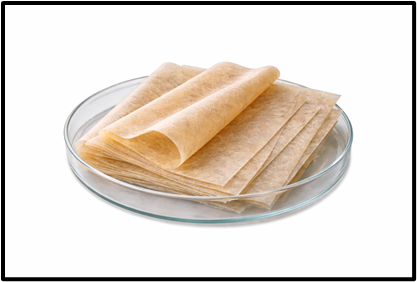
Fig no. 01
RESULTS AND DISCUSSION
Mechanical Properties:
Table 1. Tensile strength and elongation at break of biodegradable films (mean ± SD, n = 3)
|
Blend Ratio (T:WH) |
Tensile Strength (MPa) |
Elongation at Break (%) |
|
100:0 |
16.5 ± 0.6 |
6.1 ± 0.3 |
|
60:40 |
15.2 ± 0.5 |
8.5 ± 0.4 |
|
40:60 |
11.9 ± 0.4 |
10.8 ± 0.5 |
|
0:100 |
8.8 ± 0.3 |
14.1 ± 0.6 |
Interpretation – Mechanical Properties
The pure Typha film (100:0) exhibited the highest tensile strength (16.5 MPa), attributable to the long, thick-walled fibers with high cellulose crystallinity, which effectively transfer applied stress across the polymer matrix. As the proportion of water hyacinth fiber increased, tensile strength gradually decreased due to the shorter fiber length and lower crystallinity.
However, the 60:40 (Typha : water hyacinth) blend retained approximately 92% of the maximum tensile strength, demonstrating that partial substitution of Typha fibers with water hyacinth does not significantly compromise mechanical integrity. This highlights a synergistic reinforcement effect, making the composite suitable for lightweight packaging applications.
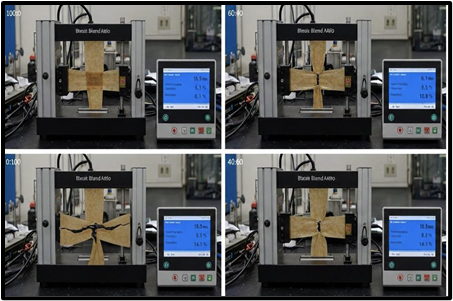
Fig no.02
BIODEGRADATION
Table 2. Biodegradation of films after 45 days soil burial (mean ± SD)
|
Blend Ratio (T: WH) |
Mass Loss (%) |
|
100:0 |
75 ± 2.1 |
|
60:40 |
83 ± 1.8 |
|
40:60 |
87 ± 2.0 |
|
0:100 |
90 ± 1.5 |
Interpretation – Biodegradation
A clear increase in elongation at break was observed with increasing water hyacinth content. The pure water hyacinth film (0:100) showed the highest flexibility (14.1%), indicating improved polymer chain mobility and matrix flow due to shorter, less rigid fibers.
The 60:40 blend exhibited a significant ~40% increase in elongation compared to pure Typha films, while maintaining adequate tensile strength. This balance between flexibility and strength is critical for packaging films that require resistance to cracking during handling and transportation.
Water Vapor Permeability (WVP)
Table 3. Water vapor permeability of biodegradable films (mean ± SD)
|
Blend Ratio (T: WH) |
WVP (g·mm/m²·day·kPa) |
|
100:0 |
2.1 ± 0.1 |
|
60:40 |
2.5 ± 0.1 |
|
40:60 |
2.9 ± 0.2 |
|
0:100 |
3.2 ± 0.2 |
Interpretation – Barrier Properties
Water vapor permeability increased with increasing water hyacinth content due to higher porosity and hydrophilic fiber surfaces. Although the pure water hyacinth film showed the highest WVP, the 60:40 blend maintained moderate permeability, making it suitable for dry and semi-dry food packaging where limited moisture transfer is acceptable.
Antimicrobial Activity
Table 4. Antimicrobial activity of composite films (zone of inhibition, mean ± SD)
|
Microorganism |
Zone of Inhibition (mm) |
|
E. coli |
14.6 ± 0.5 |
|
S. aureus |
16.2 ± 0.6 |
|
P. aeruginosa |
13.8 ± 0.4 |
|
B. subtilis |
15.4 ± 0.5 |
|
A. niger |
12.5 ± 0.4 |
|
Control |
Nil |
Interpretation – Antimicrobial Activity
The composite films exhibited strong antimicrobial activity against both Gram-positive and Gram-negative bacteria, with greater sensitivity observed for Gram-positive strains (S. aureus and B. subtilis). Antifungal activity against Aspergillus niger suggests potential for active packaging applications that extend product shelf life. No inhibition was observed in the commercial plastic control
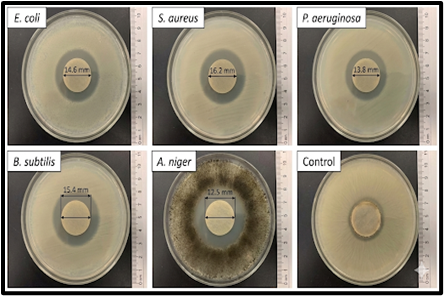
Fig No.03
DISCUSSION
The present study showed the successful development of biodegradable composite films using alkali-treated fibers derived from Typha latifolia and Eichhornia crassipes. The results clearly indicate that fiber composition plays a critical role in determining the physicochemical, mechanical, and functional properties of the films. The mechanical analysis revealed that films reinforced with 100% Typha fibers exhibited the highest tensile strength (16.5 MPa), which can be attributed to the higher cellulose crystallinity, longer fiber length, and rigid structure of Typha fibers. These characteristics enhance stress transfer within the polymer matrix, thereby improving strength. However, increasing the proportion of water hyacinth fibers resulted in a gradual reduction in tensile strength, likely due to their shorter fiber length and lower structural rigidity. Despite this, the 60:40 blend retained a high percentage of tensile strength (~92%), indicating a synergistic interaction between the two fiber types. This suggests that partial substitution with water hyacinth does not significantly compromise structural integrity while improving other functional properties.In contrast, elongation at break showed an increasing trend with higher water hyacinth content, indicating improved flexibility. This can be explained by the reduced crystallinity and increased amorphous regions contributed by water hyacinth fibers, which allow greater polymer chain mobility. The 60:40 blend demonstrated an optimal balance between strength and flexibility, which is essential for packaging materials that must withstand mechanical stress without cracking. Biodegradation studies showed a significant increase in mass loss with higher water hyacinth content, with the 0:100 film exhibiting the highest degradation (90%). This enhanced biodegradability may be due to the more amorphous structure and higher accessibility of microbial enzymes to water hyacinth fibers. The results confirm that all developed films are highly biodegradable, making them suitable alternatives to conventional plastics.Water vapor permeability (WVP) increased with increasing water hyacinth content, which can be attributed to higher porosity and hydrophilic nature of the fibers. While higher WVP may limit applications in moisture-sensitive packaging, the moderate permeability observed in the 60:40 blend makes it suitable for dry and semi-dry food products.The antimicrobial activity exhibited by the composite films against both Gram-positive and Gram-negative bacteria is a significant functional advantage. The higher inhibition observed against Gram-positive bacteria may be due to differences in cell wall structure, making them more susceptible to bioactive compounds present in plant fibers. The observed antifungal activity further enhances the applicability of these films in food preservation.Overall, the findings suggest that blending Typha and water hyacinth fibers results in films with improved multifunctional properties. The 60:40 blend, in particular, provides an optimal combination of mechanical strength, flexibility, biodegradability, and antimicrobial activity, making it highly suitable for sustainable packaging applications.
CONCLUSION
This study successfully developed eco-friendly biodegradable films using renewable aquatic biomass from Typha latifoliaand Eichhornia crassipes. The results highlight the significant influence of fiber composition on film performance.
Among all formulations, the 60:40 (Typha:water hyacinth) blend demonstrated the most balanced properties, including high tensile strength, improved flexibility, moderate water vapor permeability, enhanced biodegradability, and effective antimicrobial activity. These characteristics make it a promising candidate for sustainable packaging applications, particularly for dry and semi-dry food products. The utilization of invasive water hyacinth not only contributes to waste valorization but also offers an environmentally beneficial strategy for managing aquatic ecosystems. Additionally, replacing petroleum-based plastics with such biodegradable alternatives can significantly reduce environmental pollution and promote a circular bioeconomy.
Future research will focus on improving barrier properties, scaling up production, and evaluating real-time food packaging applications to enhance commercial viability.
REFERENCES

Shruti Ardhi, Shefali Pandey, Rashmi Kori, Shivani Singh, Siddhi Mahadik, Dr. Deepa Verma, Devesh Machhi, Sustainable Biodegradable Packaging Films from Typha latifolia and Water Hyacinth Fibers: A Composite Approach, Int. J. of Pharm. Sci., 2026, Vol 4, Issue 4, 1124-1131. https://doi.org/10.5281/zenodo.19461743
 10.5281/zenodo.19461743