

We use cookies to ensure our website works properly and to personalise your experience. Cookies policy
Department of Pharmacy, Vikas Group of Institutions, Nunna, Vijayawada, Andhra Pradesh -521212, India.
Conventional oral dosage forms are mass-produced in fixed strengths, which limits dose adjustment for children, older adults and patients with rare metabolic disorders. Three-dimensional (3D) printing builds dosage forms layer by layer from a digital design and can therefore produce small batches of personalised medicines on demand. This narrative review describes the main printing technologies used for oral solid dosage forms (fused deposition modelling, semi-solid extrusion, direct powder extrusion, selective laser sintering, stereolithography and powder-bed printing), the excipients and process constraints that govern their use, and the design of personalised printlets and multi-drug polypills. It then examines point-of-care evidence from paediatric and geriatric settings, including a prospective crossover study in children with maple syrup urine disease, and the quality-control and regulatory questions raised by printing medicines in hospitals and pharmacies. Twenty-two key articles identified by a structured literature search were appraised. The evidence shows that 3D printing is technically feasible and acceptable to patients, and that one printed product has reached the market, but clinical studies remain small, quality-control methods designed for batch manufacture do not fit small printed batches, and rules for prefilled feedstock cartridges are unsettled. Larger controlled studies, validated in-process monitoring and harmonised regulatory guidance are the main needs before routine point-of-care use.
Most oral medicines are manufactured as tablets or capsules in a limited number of fixed strengths. Patients who need a dose between those strengths, such as children dosed by body weight or patients whose therapy is titrated against blood levels, are therefore often given adapted products. In practice, hospital practitioners prepare extemporaneous formulations when no suitable oral product exists [1], and commercial adult tablets are split for children when no paediatric formulation is marketed [2]. These practices illustrate the gap between industrial manufacture and individual dosing needs (interpretation).
Three-dimensional (3D) printing, also called additive manufacturing, builds an object layer by layer from a digital design. In pharmaceutics it makes possible the production of small batches of dose-flexible medicines on demand, and the 3D printed tablets are commonly called printlets [3,4]. Reviews describe the technology as potentially transformative for the sector: it is expected to deliver tailored dosages, shapes, sizes and release characteristics, and so to bring personalised medicine closer to reality [5]. It has also been presented as a new branch of digital healthcare [6] and as a tool for designing customised drug delivery systems [7].
A regulatory milestone came when the United States Food and Drug Administration (FDA) approved a 3D printed drug product, levetiracetam tablets (Spritam), in August 2015. The FDA authors who reviewed this development described it as the start of a new chapter in pharmaceutical manufacturing [8]. Some later papers date the approval to 2016 [3,9], which probably reflects the commercial launch and not the approval itself; readers should be aware of this discrepancy when they cite the date. The same FDA review organised the literature into three topical areas, namely increased drug product complexity, personalisation and on-demand manufacturing [8], and these three themes recur throughout the present review.
Beyond personalised dosing, 3D printing may also shorten development timelines, because small batches of printlets can be made for preclinical studies, first-in-human studies and early-phase clinical trials [3], and its use could extend from drug development to frontline medical care [5]. Nevertheless, the clinical potential of the technology has not yet been fully realised [3]. The questions of who should print, how the printed product is checked and under which rules it is released are as important as the printing technology itself (interpretation).
This review concentrates on personalised oral dosage forms for the two patient groups for whom fixed-dose products are most limiting, children and older adults, and on the quality and regulatory questions raised by printing medicines at the point of care. Its objectives are: (i) to describe the main printing technologies used to make oral dosage forms; (ii) to summarise the excipients and process constraints that determine what can be printed; (iii) to examine printlets and polypills as examples of personalisation; (iv) to appraise the available paediatric, geriatric and pharmacy-practice evidence; and (v) to discuss quality control, regulatory aspects, challenges and future directions.
MATERIALS AND METHODS
2.1 Literature search
This narrative review followed a structured but non-systematic search. Records were identified in October 2026 from bibliographic databases, publisher platforms and institutional repositories using combinations of the terms “three-dimensional printing”, “3D printed drug products”, “printlets”, “personalised medicine”, “paediatric”, “polypill”, “point of care”, “compounding” and “quality control”. Only English-language, peer-reviewed articles were considered. Priority was given to recent reviews and to primary studies that (a) introduced or clearly illustrated a printing technology for oral dosage forms, (b) reported patient-facing or pharmacy-practice evidence, or (c) discussed quality or regulatory questions. A small number of earlier foundational papers were retained where they remain the standard reference for a technology.
2.2 Selection of sources
From the records screened, 22 articles were selected for relevance, recency and representativeness. The set comprises 7 review or overview articles and 15 primary studies and is summarised in Table 1; the characteristics of each article are given in Table 2. The list was kept deliberately focused so that every source could be read, checked against its publisher, PubMed or repository record, and used in more than one section of the review. Numerical data are reported as given by the cited authors.
Table 1: Summary of the Literature Search and Selection
| Item | Description |
|---|---|
| Time of search | October 2026 |
| Sources searched | Bibliographic databases, publisher platforms and institutional repositories |
| Search terms | Three-dimensional printing; 3D printed drug products; printlets; personalised medicine; paediatric; polypill; point of care; compounding; quality control |
| Inclusion criteria | Peer-reviewed; English language; addresses printing technologies for oral dosage forms, excipients, personalised or multi-drug dosage forms, paediatric or geriatric use, point-of-care or pharmacy practice, or quality and regulatory aspects |
| Exclusion criteria | Conference abstracts; non-peer-reviewed web pages; items whose bibliographic details could not be verified |
| Final set | 22 articles (7 reviews or overviews and 15 primary studies) |
Because no formal protocol such as PRISMA was applied and the number of sources is limited, selection bias cannot be excluded. The conclusions should therefore be read as an expert synthesis and not as a quantitative pooling of results. Statements marked “interpretation” are the author’s reasoning, not findings reported by the cited sources.
Table 2: Characteristics of the 22 Included Articles
| Source | Type | Focus | Main use in this review |
|---|---|---|---|
| Norman et al., 2017 [8] | Review by FDA authors | Progress in 3D printed drug products; approval of the first product | Introduction; regulation |
| Trenfield et al., 2018 [5] | Review | 3D printing from drug development to frontline care | Introduction; future |
| Awad et al., 2018 [6] | Review | 3D printed medicines as a branch of digital healthcare | Introduction |
| Seoane-Viaño et al., 2021 [3] | Review | Translation of printed pharmaceuticals to clinical use | Technologies; discussion |
| Goole and Amighi, 2016 [7] | Review | 3D printing for customised drug delivery systems | Introduction |
| Madla et al., 2018 [10] | Book chapter | Technologies, implementation and regulation | Regulation |
| Parhi, 2021 [11] | Review | Quality control and risk assessment | Quality control |
| Goyanes et al., 2014 [12] | Research Article | Fused-filament fabrication of tablets | FDM |
| Sadia et al., 2016 [13] | Research Article | Excipients for FDM immediate-release tablets | FDM; materials |
| Khaled et al., 2014 [14] | Research Article | Controlled-release bilayer tablets | Personalisation |
| Khaled et al., 2015 [15] | Research Article | Five-in-one cardiovascular polypill | Polypills |
| Fina et al., 2017 [16] | Research Article | Selective laser sintering of medicines | SLS |
| Robles-Martinez et al., 2019 [17] | Research Article | Six-drug polypill by stereolithography | SLA; polypills |
| Goyanes et al., 2019 [4] | Research Article | Direct powder extrusion of itraconazole | DPE |
| Boniatti et al., 2021 [2] | Research Article | Direct powder extrusion of paediatric praziquantel | Paediatric use |
| Goyanes et al., 2019 [1] | Prospective crossover study | Printed isoleucine therapy in children with MSUD | Clinical evidence |
| Lafeber et al., 2021 [18] | Research Article | Semi-solid extrusion of furosemide and sildenafil tablets | Quality control |
| Shokraneh et al., 2025 [19] | Research Article | Paediatric furosemide tablets with NIR monitoring | Quality control |
| Januskaite et al., 2020 [9] | Survey | Visual preferences of children for printlets | Paediatric use |
| Fastø et al., 2019 [20] | Interview study | Views of polypharmacy patients on printed medicine | Older adults |
| Trenfield et al., 2018 [21] | Research Article | Non-destructive dose verification | Quality control |
| Beer et al., 2023 [22] | Interview study | Magistral compounding with 3D printing | Pharmacy practice |
3. Printing Technologies for Oral Dosage Forms
3.1 General principle and digital workflow
All 3D printing technologies follow the same basic workflow (Figure 1). A dose, shape and release profile are designed in software; the design is converted into instructions for a printer that deposits or solidifies material layer by layer; and the printed product is checked and dispensed. Printers differ in the physical form of the feedstock and in the way layers are joined, and these differences decide which drugs, excipients and dosage forms each technology can handle. Seoane-Viaño and colleagues review the five technologies they regard as the most promising for pharmaceuticals and then discuss pre-clinical and clinical use [3].
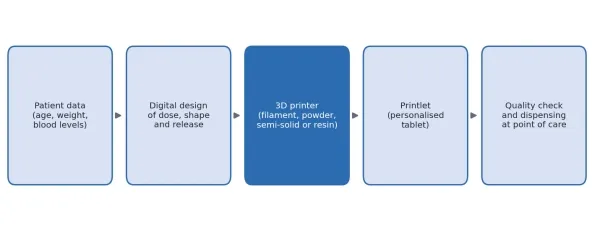
Figure 1: Conceptual Workflow of Point-Of-Care 3D Printing of a Personalised Oral Dosage Form (Author’s Synthesis Based on References [1,3,5]).
3.2 Fused deposition modelling
In fused deposition modelling (FDM), also called fused-filament fabrication, a thermoplastic filament is melted and extruded layer by layer to form the tablet. Early work demonstrated that tablets could be fabricated in this way [12], and later work adapted pharmaceutical excipients to the process [13]. FDM is attractive because it yields mechanically stable tablets [13], and it is described as the most widely used 3D printing technology in pharmaceutics owing to its cost-effectiveness and ease of operation [9]. Its main practical limitation is that drug-loaded filaments usually have to be prepared first by hot-melt extrusion (HME), which adds a second thermal step [4].
3.3 Direct powder extrusion
Direct powder extrusion (DPE) removes the filament step. Goyanes and colleagues reported it for the first time in 2019, printing itraconazole amorphous solid dispersions directly from powder mixtures with four grades of hydroxypropylcellulose [4]. They noted that avoiding hot-melt extrusion could make the method especially suited to preclinical studies in which drug quantities are limited [4]. DPE was later applied to the preparation of paediatric praziquantel printlets [2].
3.4 Semi-solid extrusion
Semi-solid extrusion (SSE) deposits a paste or gel through a nozzle. Because the feedstock needs only slight heating to reach a printable consistency, SSE has been used in hospital-oriented work on paediatric furosemide and sildenafil tablets [18] and in a study of furosemide tablets printed in doses from 2 to 10 mg from a gel-based excipient [19]. SSE printlets were also the form that children preferred once they had been told that they were chewable [9].
3.5 Selective laser sintering
Selective laser sintering (SLS) uses a laser to fuse powder particles layer by layer. Fina and colleagues were the first to report SLS for orally administered drug-loaded products. They printed paracetamol at 5, 20 and 35% loading in two pharmaceutical-grade polymers, added 3% Candurin gold sheen to aid sintering, and concluded that SLS is a versatile and practical technology for the manufacture of medicines [16]. The same technology, with different laser settings, has been used to vary porosity and so to prepare orally disintegrating and modified-release forms [9].
3.6 Stereolithography
Stereolithography (SLA) solidifies a liquid photopolymer resin with light. Robles-Martinez and colleagues developed an SLA method to print a multi-layer polypill containing six drugs (paracetamol, caffeine, naproxen, chloramphenicol, prednisolone and aspirin). Raman microscopy showed that separate layers were formed but that several drugs diffused between layers depending on whether they were amorphous or crystalline, and the constructs showed distinct release profiles for the six actives [17].
3.7 Powder-bed printing and the approved product
The first approved 3D printed drug product, Spritam, was made by a powder-bed printing process in which a liquid is printed onto layers of powder [8]. The FDA review also discusses the process considerations that apply to solid oral 3D-printed drug products, which are the starting point for any discussion of quality [8].
3.8 Comparison of the technologies
Table 3 compares the technologies using only the examples and statements found in the included articles. The comparison is descriptive: the studies used different drugs, excipients and endpoints, so the technologies cannot be ranked from these data (interpretation).
Table 3: Printing Technologies for Oral Dosage Forms: Examples from the Included Articles
| Technology | Principle | Feedstock | Example in the sources | Points to note | Refs |
|---|---|---|---|---|---|
| FDM | Melted filament extruded layer by layer | Drug-loaded thermoplastic filament | Eudragit E and TCP tablets with four model drugs | Mechanically stable tablets; filament preparation by HME adds a step | [4,12,13] |
| SSE | Paste or gel extruded through a nozzle | Semi-solid material | Paediatric furosemide and sildenafil tablets | Chewable forms; feasible for hospital use; layered tablets challenge standard tests | [9,18,19] |
| DPE | Powder mixture extruded directly | Powder blend, no filament | Itraconazole dispersions; praziquantel printlets | One-step process; suited to small drug quantities | [2,4] |
| SLS | Laser fuses powder particles | Powder with a sintering aid | Paracetamol in two polymers | First oral drug-loaded SLS report; versatile | [16] |
| SLA | Light solidifies liquid resin | Photopolymer resin containing drug | Six-drug multi-layer polypill | Drugs diffused between layers | [17] |
| Powder-bed printing | Liquid printed onto powder layers | Powder blend | Spritam (levetiracetam) | First approved 3D printed drug product | [8] |
4. Materials, Excipients and Process Constraints
4.1 Thermal stability and choice of filler
Every printing technology places conditions on the formulation, and the clearest illustration comes from FDM. In the work of Sadia and colleagues, directly compressible lactose, spray-dried lactose and microcrystalline cellulose showed a degree of degradation at 135 °C, whereas talc and tribasic calcium phosphate (TCP) allowed consistent filament flow and successful printing [13]. With a filament based on the methacrylic polymer Eudragit E and TCP, four model drugs of differing physicochemical character (5-aminosalicylic acid, captopril, theophylline and prednisolone) were made into mechanically stable immediate-release tablets [13].
Drug content after the two thermal steps, HME and FDM, was 94.22%, 88.53%, 96.51% and 93.04% for 5-aminosalicylic acid, captopril, theophylline and prednisolone, respectively [13] (Figure 2A). X-ray powder diffraction indicated that part of the 5-aminosalicylic acid, theophylline and prednisolone remained crystalline, whereas captopril was amorphous [13]. The lowest drug content, 88.53% for captopril, shows why drug content has to be verified after processing and cannot be assumed from the amount weighed into the formulation (interpretation).
4.2 Amorphous solid dispersions, solubility and taste
Printing from powder or pellets makes it practical to print amorphous solid dispersions, which are a standard approach to poorly soluble drugs. In the first DPE report, itraconazole was printed as an amorphous solid dispersion in four grades of hydroxypropylcellulose [4]. Boniatti and colleagues addressed three problems of paediatric praziquantel, namely low solubility, unacceptable taste and the need for high and variable doses, by printing praziquantel solid dispersions with Kollidon VA 64 and a second excipient; they highlighted the taste-masking capability of the technology without the need for additional taste-masking excipients [2]. Schistosomiasis affects around 250 million people in more than 70 countries, and no suitable paediatric formulation is currently marketed [2], which explains why this example is frequently used to show the value of printing for neglected diseases.
4.3 Excipients for semi-solid and powder-bed processes
Semi-solid extrusion depends on gel-forming excipient bases. In the furosemide study of Shokraneh and colleagues, 1% and 2% w/w formulations were prepared in a gel-based excipient, and surface imaging showed that excipient and surfactant levels influenced surface microtopography and potentially drug release kinetics [19]. Lafeber and colleagues used European Pharmacopoeia-grade furosemide, sildenafil citrate and polysorbate 80 in their semi-solid formulations [18]. For SLS, a sintering aid (Candurin gold sheen) was added to the powdered polymer–drug mixtures [16]. The common message is that excipients in 3D printing serve a processing function as well as a formulation function (interpretation).
4.4 Stability of printed products
Stability data for printed medicines are scarce. In the SSE furosemide study, all freshly printed formulations released more than 85% of the drug; after six months the 2% formulation still released 88.5%, whereas release from the 1% formulation fell to 76.3% [19] (Figure 2B). Infrared and X-ray diffraction analyses showed no significant drug–excipient interaction, and the crystalline structure of furosemide remained intact during storage [19]. The difference between the two strengths shows that stability must be tested for every printed formulation and strength (interpretation).
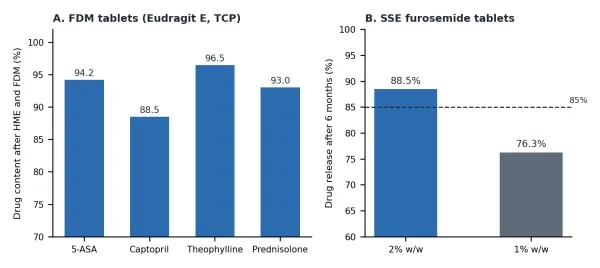
Figure 2: Examples of Quality Data from Printed Oral Dosage Forms. (a) Drug Content of FDM Tablets After Hot-Melt Extrusion and Printing [13]. (B) Drug Release from SSE Furosemide Tablets After Six Months of Storage; the Dashed Line Marks 85% [19].
Table 4: Examples of Drug–Excipient Systems and Processing Details Reported in the Included Articles
| Technology | Drug(s) | Excipients and processing details | Reported observation | Refs |
|---|---|---|---|---|
| FDM | 5-ASA, captopril, theophylline, prednisolone | Eudragit E with TCP filler; HME then FDM | Drug content 88.5–96.5%; captopril amorphous | [13] |
| DPE | Itraconazole | Four grades of hydroxypropylcellulose (UL, SSL, SL, L); no filament | Amorphous solid dispersions printed in one step | [4] |
| DPE | Praziquantel | Kollidon VA 64 and a second excipient; paediatric printlets | Low solubility, taste and dose challenges addressed | [2] |
| SLS | Paracetamol (5, 20, 35%) | Two pharmaceutical-grade polymers; 3% Candurin gold sheen | SLS shown to be versatile and practical | [16] |
| SSE | Furosemide (1% and 2% w/w) | Gel-based excipient; doses of 2 to 10 mg | Release after six months 88.5% (2%) and 76.3% (1%) | [19] |
5. Personalised Oral Dosage Forms
5.1 Printlets and dose flexibility
The central promise of 3D printing is that dose can be changed by changing the digital design, with no change in the formulation or in the equipment. Because printlets are made in small batches, strength, shape and release characteristics can differ from one patient to the next [3,5]. Two hospital-oriented studies show how this works in practice: Lafeber and colleagues printed paediatric furosemide and sildenafil tablets by semi-solid extrusion [18], and Shokraneh and colleagues printed furosemide doses from 2 to 10 mg from a single gel-based formulation [19]. In both cases the dose is set by the printed mass and not by splitting or by weighing powder into capsules (interpretation).
The same logic applies to drug release. Desktop extrusion printing has been used to make controlled-release bilayer tablets, in which the two layers differ in composition and therefore in release behaviour [14]. These early studies established that release can be programmed through the design of the printed object as well as through its composition, a feature that conventional compression does not offer in the same way (interpretation).
5.2 Polypills and multi-drug dosage forms
Polypills combine several drugs in one unit and are of particular interest for patients who take many separate tablets. Khaled and colleagues used extrusion printing to make a five-in-one polypill for cardiovascular treatment, with an immediate-release compartment containing aspirin and hydrochlorothiazide and three sustained-release compartments containing pravastatin, atenolol and ramipril. The compartments showed the intended immediate and sustained release, depending on the ratio of drug to excipient [15]. The authors proposed that such a product could improve adherence in patients taking many tablets and allow the combination and release to be tailored to the individual [15].
Robles-Martinez and colleagues extended the concept to six drugs by stereolithography, but their results also expose a risk of multi-drug printing: Raman microscopy showed that several of the drugs diffused across layers, depending on whether they were amorphous or crystalline [17]. This suggests that the compatibility of every drug–excipient pair and the physical state of each drug must be assessed when separate compartments are intended to behave independently (interpretation). Table 5 summarises the two polypill studies.
Table 5: Printed Polypills Described in the Included Articles
| Feature | Five-in-one polypill | Six-drug polypill |
|---|---|---|
| Technology | Extrusion printing | Stereolithography |
| Drugs | Aspirin, hydrochlorothiazide, pravastatin, atenolol, ramipril | Paracetamol, caffeine, naproxen, chloramphenicol, prednisolone, aspirin |
| Design | Immediate-release compartment plus three sustained-release compartments | Multi-layer construct with variable drug content and shape |
| Main finding | Intended immediate and sustained release obtained through drug-to-excipient ratio | Distinct release profiles; some drugs diffused between layers |
| Reference | [15] | [17] |
5.3 Design of the dosage form for the patient
Personalisation is not limited to dose. Shape, size, colour and flavour can also be chosen to suit the patient, and these features matter for acceptance, particularly in children and in older people who already manage complex regimens. The studies discussed in Section 6 show that the appearance of a printlet influences what children prefer [9] and that older patients with polypharmacy tend to prefer shapes similar to conventional medicines [20]. Design freedom therefore has to be used with the patient’s expectations in mind and not only with the printer’s capabilities (interpretation).
5.4 Printlets in early clinical development
Personalisation is not the only reason to print. Because printlets can be produced in small batches, printing could be used to prepare dosage forms for preclinical studies, first-in-human studies and early-phase clinical trials, and Seoane-Viaño and colleagues identify this as one of the ways in which the technology could reach the clinic sooner than individualised dosing [3]. Trenfield and colleagues similarly describe an extension of printing through the development process, from preclinical work and clinical trials to frontline care [5]. Direct powder extrusion is particularly suited to this use, because it avoids the preparation of filaments and so is attractive when only small amounts of drug are available [4].
This role has a practical consequence for the pharmaceutics student. A formulation that can be printed quickly from limited drug supply allows several doses or release profiles to be compared early, before large-scale manufacturing process development begins (interpretation). The same equipment and quality questions then arise in the research setting as in the pharmacy, so the control points listed in Table 8 are relevant to both.
6. Point-of-Care Printing for Paediatric and Geriatric Patients
6.1 Paediatric needs and acceptability
Children present several formulation challenges at once: dose flexibility, compliance, taste masking and fear of, or difficulty with, swallowing tablets. The adaptable nature of printing could help to overcome all of these [9]. Acceptability is part of the quality target product profile for a paediatric medicine, yet reports that evaluate the opinions of children themselves are scarce [9].
Januskaite and colleagues addressed this gap with a survey in which 368 children aged 4 to 11 years inspected placebo printlets made by four technologies (digital light processing, SLS, SSE and FDM) and chose the best and the worst. The digital light processing printlets were visually preferred most often (61.7%), followed by SLS (21.2%), SSE (11.7%) and FDM (5.4%) (Figure 3). However, once the children had been told that the SSE printlets were chewable, most changed their choice and favoured them, in line with the general preference of children for chewable forms [9]. Appearance, perceived taste, texture and familiarity were found to be equally important when defining the quality target product profile for paediatric printed tablets [9].
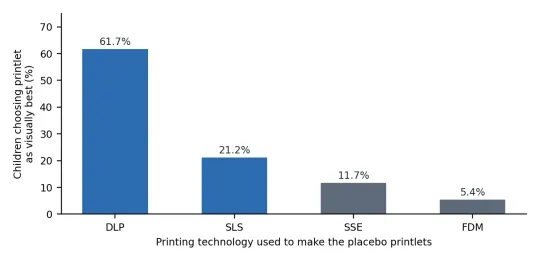
Figure 3: Visual Preference of 368 Children Aged 4 to 11 Years for Placebo Printlets Made by Four Printing Technologies (DLP, Digital Light Processing; SLS, Selective Laser Sintering; SSE, Semi-Solid Extrusion; FDM, Fused Deposition Modelling). Data from Reference [9].
6.2 The first hospital study in patients
The most informative clinical evidence in the included articles is the study of Goyanes and colleagues in children with maple syrup urine disease (MSUD). First-line treatment of MSUD is a strict dietary restriction of leucine together with oral isoleucine and valine, and the dose must be tailored to age, weight and blood levels. Practitioners therefore prepare extemporaneous formulations because suitable oral products are lacking [1]. The authors evaluated 3D printing for the first time in a hospital setting for the preparation of personalised therapies in paediatric patients with this disorder [1].
The study was a single-centre, prospective crossover investigation in four patients aged 3 to 16 years at the Clinic University Hospital in Santiago de Compostela. Over six months, isoleucine blood levels were compared between conventional capsules prepared by manual compounding and personalised chewable formulations prepared by automated 3D printing [1]. Blood levels were well controlled with both types of formulation, but the 3D printed therapy gave mean levels closer to the target value (200 to 400 µM) with less variability, and the printed formulations were well accepted in terms of flavour and colour [1]. The study shows that automated printing of tailored-dose oral therapy in a hospital is feasible; with only four patients, however, it cannot establish superiority (interpretation).
6.3 Hospital pharmacy studies of quality
Two further studies address whether printed paediatric tablets can meet pharmacopoeial standards. Lafeber and colleagues produced furosemide and sildenafil tablets by semi-solid extrusion and reported that the tablets complied with European Pharmacopoeia tests for uniformity of content and for dissolution, while noting that not every pharmacopoeial test may suit layered tablets made in small batches [18]. Shokraneh and colleagues combined SSE printing with a compounding-system approach and near-infrared monitoring to make immediate-release furosemide tablets for children. All formulations met the European Pharmacopoeia requirements for drug content (85.0 to 115.0%) and content uniformity (acceptance value below 15), and rapid release was confirmed for freshly printed tablets [19]. These results support point-of-care printing as a technically controllable process, but they are laboratory results and not patient outcomes (interpretation).
6.4 Older adults and polypharmacy
Evidence for older adults is thinner. Fastø and colleagues interviewed eight patients with polypharmacy in Denmark twice, first about their perceptions of 3D printed solid dosage forms, shapes, colours, embossing and polypills, and then about medicines the patients had designed themselves. The patients tended to prefer shapes similar to conventional medicines, and their acceptance of patient-designed medicine depended mainly on whether they trusted the printing technology to be reliable [20]. The polypill studies described in Section 5.2 are relevant to this population [15,17], but among the articles reviewed here none reports a clinical trial in older adults. This is an important gap, given that polypharmacy is the situation in which a single personalised unit could be most useful (interpretation).
6.5 Implementation in pharmacies
Beer and colleagues interviewed stakeholders in the Netherlands about integrating 3D printing into magistral compounding, which allows differentiation of doses and dosage forms between patients. All interviewees considered printing a promising compounding technique for community pharmacies because it offers an automated approach with high digital flexibility and allows adapted formulations, including polypills [22]. Printing was believed to become cost-effective over time, but the authors concluded that compounding with 3D printing would need incentives to stimulate the return of compounding to normal pharmacy practice, and that the regulation of prefilled cartridges had not yet been addressed [22]. Table 6 summarises the clinical and practice-oriented studies.
Table 6: Clinical and Practice-Oriented Studies in the Included Articles
| Study | Setting and participants | Approach | Key findings | Main limitation | Ref |
|---|---|---|---|---|---|
| MSUD study | Hospital; 4 children aged 3 to 16 years | Single-centre, prospective crossover; capsules versus printed chewable printlets for 6 months | Both controlled isoleucine; printlets closer to target (200 to 400 µM), less variability, good acceptance | Four patients | [1] |
| Furosemide and sildenafil tablets | Laboratory and hospital pharmacy | SSE printing; pharmacopoeial testing | Complied with uniformity and dissolution tests; some tests may not suit layered tablets | No patient data | [18] |
| Furosemide with NIR | Laboratory | SSE with NIR and PLS modelling | Met content and uniformity limits; 1% formulation released 76.3% at 6 months | No patient data | [19] |
| Visual preference survey | 368 children aged 4 to 11 years | Questionnaire on four types of placebo printlets | DLP preferred visually; most switched to SSE once told it was chewable | Visual inspection only | [9] |
| Polypharmacy interviews | 8 patients, Denmark | Two semi-structured interviews | Preferred familiar shapes; acceptance depended on trust in technology | Very small pilot | [20] |
| Compounding interviews | Stakeholders, Netherlands | Qualitative interviews | Printing seen as promising; cartridge regulation unresolved | Qualitative; one country | [22] |
6.6 Worked example: a titratable paediatric dose
A short scenario shows how the evidence can be applied. Suppose a hospital pharmacist is asked for a small, adjustable dose of furosemide for a child, for whom no suitable strength is marketed. The included articles describe one route: semi-solid extrusion of furosemide in a gel-based excipient, with doses from 2 to 10 mg, produced tablets that met the European Pharmacopoeia limits for drug content and content uniformity, and freshly printed tablets released more than 85% of the drug [19]. A comparable semi-solid approach has also been shown to give furosemide and sildenafil tablets that complied with uniformity and dissolution tests [18].
The same evidence also lists the points that the pharmacist would have to resolve before supplying such a product. Storage data are limited, because the 1% formulation released only 76.3% of its content after six months [19], so a short beyond-use period and strength-specific stability data would be needed (interpretation). Acceptability would have to be explored with the child and carer, bearing in mind that appearance, taste, texture and familiarity all matter [9]. Finally, the status of the feedstock and the legal basis for compounding with a printer would have to be clarified locally [22]. The scenario is illustrative and is not clinical advice.
7. Quality Control and Regulatory Perspectives
7.1 Regulatory starting point
The FDA authors who reviewed the first approved printed product stated that the agency encourages the development of advanced manufacturing technologies, including 3D printing, using science- and risk-based approaches [8]. That statement concerns industrial manufacture, where a single product is made under a marketing authorisation. Printing at the point of care is different, because a pharmacy or hospital would make individual batches of a product that has not been approved as a finished printed dosage form. For an overview of how printing technologies, implementation and regulation fit together, the chapter by Madla and colleagues is a useful entry point [10].
7.2 Quality testing of small printed batches
Pharmacopoeial tests were designed for large batches of compressed tablets. Lafeber and colleagues found that printed tablets complied with the tests for content uniformity and dissolution, but argued that some of the standard quality tests may be unsuitable for 3D printed tablets because of their layered structure and small batch size, and that the pharmacopoeia permits other suitable methods when the standard ones do not fit [18]. In-process monitoring is one alternative: Shokraneh and colleagues used near-infrared spectroscopy with partial least squares modelling to monitor blend uniformity non-destructively, with a coefficient of determination of 0.91 and a root mean square error of calibration of 3.37% [19]. Non-destructive dose verification of printed drug products by a rapid point-and-shoot approach has also been reported [21], and quality control and risk assessment are the focus of a dedicated review [11].
7.3 Compounding practice and regulation of feedstock
In pharmacy practice, one unresolved issue is the status of prefilled feedstock cartridges. Interviewees in the Dutch study considered printing from prefilled cartridges attractive, yet the regulation of such cartridges had not been addressed [22]. If the cartridge is treated as a component of the final product, its quality, labelling and supply chain would have to be controlled in the same way as other starting materials (interpretation). The study also noted that incentives would be needed to stimulate a return of compounding to normal pharmacy practice [22].
7.4 Relevance to India
None of the included articles examines Indian regulation of printed medicines or pharmacy compounding. Readers in India should therefore consult the relevant primary regulatory documents of the Central Drugs Standard Control Organisation and the Indian Pharmacopoeia Commission directly before drawing conclusions for local practice. This is a clear gap and a subject for a follow-up review (interpretation).
Table 7: Quality and Regulatory Issues Raised by the Included Articles
| Issue | What the sources report | Implication (interpretation) | Refs |
|---|---|---|---|
| Precedent for approval | FDA approved a 3D printed drug product in August 2015 and encourages science- and risk-based approaches | Industrial printing has a regulatory precedent; point-of-care printing needs its own framework | [8] |
| Pharmacopoeial tests | Printed tablets complied, but some tests may not suit layered tablets made in small batches | Adapted or alternative test methods should be defined and agreed | [18] |
| In-process monitoring | NIR with PLS modelling monitored blend uniformity (R² = 0.91; RMSEC 3.37%) | Real-time control can reduce reliance on destructive end-product testing | [19] |
| Dose verification | A non-destructive point-and-shoot approach has been reported for printed products | Verification could be done on every printed batch | [21] |
| Stability | 1% furosemide formulation released 76.3% after six months | Stability must be shown for each formulation and strength | [19] |
| Prefilled cartridges | Regulation not yet addressed | Cartridges may need to be treated as regulated starting materials | [22] |
| Quality and risk management | Quality control and risk assessment are reviewed as separate topics | Risk-based quality systems should cover the whole workflow | [11] |
| Local regulation (India) | Not covered by the included articles | Primary regulatory documents must be consulted | None |
7.5 A suggested quality framework for point-of-care printing
Drawing the findings of this section together, a point-of-care printing service could organise its quality system around the control points in Table 8. The framework is the author’s proposal: each control point is linked to the study that raises the issue, but no included article validates the framework as a whole (interpretation). Its purpose is to show that the questions raised in the literature can be turned into a practical checklist for a hospital or community pharmacy.
Table 8: Suggested Control Points for a Point-Of-Care 3D Printing Service (Author’s Proposal)
| Control point | Suggested control | Basis in the sources |
|---|---|---|
| Feedstock | Use starting materials of defined quality; clarify the status of prefilled cartridges | [22] |
| Formulation | Confirm thermal and chemical compatibility; verify drug content after processing | [13,17] |
| Printer and design files | Qualify the printer and control digital design files within a risk-based quality system | [11] |
| In-process control | Monitor blend uniformity and printed mass in real time, for example by NIR with PLS modelling | [19] |
| End-product testing | Test content uniformity and dissolution; justify any adapted tests | [18] |
| Dose verification | Verify printed units non-destructively where possible | [21] |
| Stability | Generate strength-specific stability data and set a beyond-use period | [19] |
| Documentation | Keep batch records, labelling and traceability for each printed batch | Author’s proposal |
DISCUSSION
8.1 Principal findings
Three findings stand out from the 22 articles. First, printing technologies for oral dosage forms are technically diverse and mature enough to make recognisable products: FDM, SSE, DPE, SLS, SLA and powder-bed printing have each been used to make tablets or polypills [4,8,13,16-18]. Second, patient-facing evidence exists but is small. The only prospective crossover study in patients included four children [1], the acceptability studies are surveys or interviews [9,20], and the pharmacy studies are laboratory or qualitative investigations [18,19,22]. Third, the practical barriers are now less about whether a tablet can be printed and more about how a printed medicine is checked, stored and regulated when it is made in a pharmacy [18,19,22].
8.2 Which technology suits the point of care?
The included articles do not compare technologies head to head for point-of-care use, but their descriptions point to features that matter in a hospital or pharmacy. Semi-solid extrusion needs only slight heating of the feedstock and has been the technology of choice in the hospital-oriented studies [18,19], and children preferred its chewable printlets once they understood what they were [9]. Direct powder extrusion removes the filament step and can print amorphous dispersions, so it suits small quantities of drug and paediatric taste-masking problems [2,4]. FDM is the most widely used technology because it is inexpensive and easy to operate [9], but it usually requires filament preparation by hot-melt extrusion [4]. SLS and SLA offer high precision and complex designs [16,17], although the diffusion between layers seen with SLA illustrates the formulation work that complex designs require [17]. On this evidence, SSE and DPE appear the most compatible with pharmacy workflows, but this is an interpretation and not a tested conclusion.
8.3 Comparison with conventional compounding
Printing is best judged against what it would replace. In the MSUD study, the comparator was manual compounding of capsules, and the printed chewable formulations gave mean blood levels closer to target with less variability, although both approaches kept levels controlled [1]. In the praziquantel example, the comparator was splitting of adult tablets, which cannot overcome the poor solubility and taste of the drug and does not provide a paediatric dose form [2]. Magistral compounding already allows doses and dosage forms to differ between patients, and Dutch interviewees saw printing as a way of adding automation and digital flexibility to that tradition, with polypills as an added possibility [22]. The reasonable conclusion is that printing is a complement to compounding, with potential gains in dose precision and consistency, and not a replacement for it (interpretation).
8.4 Strength and consistency of the evidence
The evidence is consistent in direction: every study reports that printing was feasible, that the printed products met the quality limits the authors applied, or that patients or stakeholders were open to the technology [1,9,18-20,22]. It is weak in strength. Sample sizes are small, there are no randomised trials, patients were not blinded, and several of the quality findings are specific to a single drug, excipient base and printer. Reviews also tend to repeat the promise of the technology more often than they test it, and the clinical potential is still described as unrealised [3]. Commercial involvement of some research groups in printer or software companies is a further reason for readers to look for independent replication (interpretation).
8.5 Challenges
The main challenges are summarised in Table 9. They fall into five groups: technical (thermal stress, layer diffusion, formulation constraints), quality (adapted tests, stability), clinical (small studies, no trials in older adults), regulatory (cartridges, local rules) and professional (incentives and workflow in pharmacies) [13,17-20,22].
Table 9: Challenges and Future Directions
| Domain | Challenge | Possible direction | Refs |
|---|---|---|---|
| Technical | Thermal degradation or incompatibility; drug diffusion between layers | Select filler and carrier by stability testing; assess each drug–excipient pair | [13,17] |
| Quality | Standard tests may not suit small layered batches; limited stability data | Agree alternative test methods; use in-process NIR monitoring; run stability studies per strength | [18,19] |
| Clinical | One four-patient crossover study; no trial in older adults | Larger controlled studies in children; first trials in polypharmacy patients | [1,20] |
| Regulatory | Status of prefilled cartridges unresolved; local rules not covered | Develop guidance for cartridges; examine Indian regulation directly | [22] |
| Professional | Need for incentives; trust in the technology | Define roles for pharmacists; communicate reliability to patients | [20,22] |
8.6 Future perspectives
Four developments would move the field forward. The first is larger, controlled studies that extend the MSUD design to other conditions in which doses are titrated, such as other inherited metabolic disorders and paediatric cardiology [1,18]. The second is validated in-process monitoring, so that each printed batch can be released on the basis of real-time data [19,21]. The third is harmonised regulatory guidance for point-of-care printing, including the feedstock cartridges that make printing practical in a pharmacy [10,22]. The fourth is studies in older adults, in whom a printed polypill is plausible but untested [15,20]. Because printlets can also support early clinical trials, the same infrastructure could serve drug development as well as patient care [3].
8.7 Implications for pharmacy practice and education
For pharmacists, the studies imply a change in the skills that matter at the bench. Formulation knowledge is needed to choose excipients that survive the printing process [13]; analytical reasoning is needed to decide which quality tests are appropriate for small layered batches [18]; and communication skills are needed because acceptance of patient-designed or printed medicines depends on whether patients trust the technology [20]. Pharmacy education that includes the pharmaceutics of printing, the principles of risk-based quality control and the regulatory position of compounding would therefore prepare students for a setting in which printers become part of the pharmacy [11,22]. These are inferences from the literature and not recommendations from the cited authors (interpretation).
8.8 Limitations of this review
This review is limited by its narrative design and by the restriction to 22 sources, which makes it a focused synthesis and not an exhaustive survey. No formal risk-of-bias tool was applied, only English-language articles were considered, and some topics that are important for the field, such as 3D printed products for veterinary use or the economics of printing, were not examined. Details of a few sources were available to the author only in abstract or repository form, and statements based on them are limited accordingly.
CONCLUSION
Three-dimensional printing can produce personalised oral dosage forms by several different technologies, and one printed product has been approved by the FDA [8]. The strongest patient-facing evidence is a small prospective crossover study in children with maple syrup urine disease, in which printed chewable therapy kept isoleucine levels well controlled with levels closer to target and less variable than capsules compounded manually [1]. Laboratory studies show that printed paediatric tablets can meet pharmacopoeial limits for content and uniformity [18,19], and surveys and interviews suggest that children and older patients are receptive when the design and the technology are trustworthy [9,20].
The remaining obstacles are largely practical. Standard quality tests do not fit small layered batches [18], stability must be shown for each strength [19], and the regulation of prefilled cartridges and of compounding with printers is unsettled [22]. For pharmacists, the central message is that the technology is ready for careful, supervised exploration, while routine point-of-care use will depend on larger controlled studies, validated in-process monitoring and clear regulatory guidance.
Acknowledgement
Conflict of interest: The authors declare no conflict of interest associated with this manuscript
Abbreviations
| Term | Meaning |
|---|---|
| 3DP | Three-dimensional printing |
| ASD | Amorphous solid dispersion |
| DLP | Digital light processing |
| DPE | Direct powder extrusion |
| EP | European Pharmacopoeia |
| FDA | United States Food and Drug Administration |
| FDM | Fused deposition modelling |
| HME | Hot-melt extrusion |
| MSUD | Maple syrup urine disease |
| NIR | Near-infrared spectroscopy |
| PLS | Partial least squares |
| SLA | Stereolithography |
| SLS | Selective laser sintering |
| SSE | Semi-solid extrusion |
| TCP | Tribasic calcium phosphate |
REFERENCES


Dr. K. Narendra Kumar Reddy, P. Sunil Kumar, Potla. Naga Chandra Pravallika, Palaparthi. Hasini., Three-Dimensional Printing of Personalised Oral Dosage Forms: Technologies, Point-of-Care Applications and Regulatory Perspectives, Int. J. of Pharm. Sci., 2026, Vol 4, Issue 11, 1209-1224. https://doi.org/10.5281/zenodo.24000102
 10.5281/zenodo.24000102