

We use cookies to ensure our website works properly and to personalise your experience. Cookies policy
S. C. S. M. S. S. Institute of Pharmacy, Maregaon, Yavatmal, Maharashtra, India.
Hand hygiene is a critical, low-cost strategy for preventing microbial transmission and hospital-acquired infections. Conventional alcohol-based sanitizers, though effective, often cause skin dryness, irritation, and pose flammability risks, creating demand for safer herbal alternatives. This study aimed to formulate and evaluate an alcohol-free herbal hand sanitizer gel using aqueous extracts of Neem (Azadirachta indica) and Peepal (Ficus religiosa) leaves, combined with aloe vera gel, glycerin, clove oil, and lavender oil, with Carbopol 940 as the gelling agent and triethanolamine as the neutralizer. Neem and Peepal leaves were shade-dried, powdered, and extracted via maceration, then incorporated into a Carbopol-based gel base along with essential oils and methyl paraben as preservative. The formulation was assessed for organoleptic characteristics, pH, viscosity, spreadability, and antimicrobial activity against Escherichia coli and Staphylococcus aureus using the agar well diffusion method. The prepared gel was light green, transparent, and smooth with a mild herbal odor, showing a skin-friendly pH of 6.5 ± 0.1, viscosity of 3200 ± 50 cP, and spreadability of 12.5 ± 0.2 g·cm/sec. antimicrobial evaluation demonstrated clear zones of inhibition against both test organisms, confirming notable antibacterial activity against gram-negative and gram-positive bacteria. Skin sensitivity testing indicated no irritation, confirming good dermal compatibility. The results establish the developed formulation as a stable, non-irritating, and antimicrobially effective alcohol-free alternative to conventional sanitizers, suitable for regular hand hygiene, particularly in sensitive-skin and alcohol-restricted settings, while supporting sustainable, eco-friendly product development.
Hands are the main way microbes and infections are transmitted. Consequently, proper hand hygiene is the key action to prevent the spread of dangerous germs and safeguard against infections. Hand hygiene is the most crucial, easiest, and most affordable way to avoid hospital-acquired infections. Contaminated hands can provide pathways for the spread of microorganisms (1). Prior to the development of modern medicine, herbs were the primary treatment for addressing a range of ailments. As various antibiotics emerge, microbes gradually build up resistance to these agents. These highlight the significance for researchers regarding plants with antimicrobial qualities. They strive to cultivate the unique capacity of various secondary metabolites to exhibit persistent and enduring effectiveness against numerous types of microorganisms (2). Hand hygiene is widely recognized as one of the most efficient strategies to avert the spread of infectious illnesses (3,4).
Alcohol-Free Hand Sanitizer Gel
The gel variant of sanitizer provides enhanced viscosity, application ease, and retention on the skin, guaranteeing extended contact duration and greater antimicrobial effectiveness (5). Gelling agents like carbopol or natural gums are utilized to ensure the formulation has the right consistency and stability (6). Additionally, The incorporation of essential oils enhances antimicrobial effectiveness and user satisfaction because of their appealing fragrance (5,6). Gel-based medication delivery systems are frequently utilized in topical formulations because of their non-greasy characteristics, simplicity of application, and improved patient adherence (7). In herbal hand sanitizer gels, the gel structure is essential for managing the release and effectiveness of added phytoconstituents (8, 9). The gel's viscosity enhances its retention time on the skin, prolonging the contact between antimicrobial agents and microorganisms, thus boosting effectiveness (10, 11).
Why Hand wash is Necessary?
Hands are the main way to transmit germs and illnesses; therefore, maintaining clean hands is the most effective defense against the transmission of harmful conditions and an easy, fashionable, and practical approach to assist [17]. Hospital-acquired infections. Ensuring proper hand hygiene is among the most vital methods to avert the spread of infectious diseases, such as respiratory issues like COVID-19 and intestinal diseases [18]. Health issues are a worry in nearly every region because of various factors, such as contagious diseases, including respiratory conditions like COVID-19 and gastrointestinal infections [18]. Health issues are a worry in nearly every region because of various factors, such as contagious diseases, dense populations, inadequate environments, and insufficient public knowledge about essential sanitation and hygiene methods, like washing hands [19].
Benefits of non-alcoholic hand sanitizer
Advantages of hand sanitizer
Materials Plants: Neem leaves, Peepal leaves.
Excipients: Glycerin, Clove aromatic oil, Lavender oil, Tea tree oil, fragrances, preservative, Carbopol 940, Triethanolamine, deionized water, and so on.
Equipment: Container, electric mixer, graduated cylinder, Filter paper, Maceration Method.
2. MATERIAL AND METHOD:
Material:
Materials Required
Plant Material:
Excipient material:
Method:
Fresh neem and peepal leaves were gathered, rinsed thoroughly with distilled water to eliminate dirt and impurities, and dried in the shade for 5 days at ambient temperature. The dried leaves were ground individually with a grinder and kept in a sealed container.
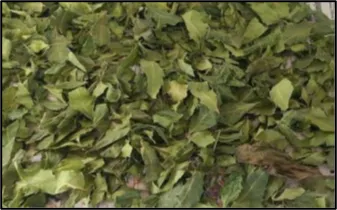
Fig 1: Neem Leaves
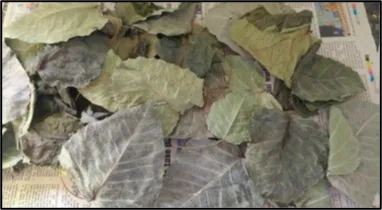
Fig 2: Peepal Leave
Method of Preparation:
Extraction of Neem :-
1. Fresh leaves of Azadirachta indica were gathered, washed thoroughly with distilled water to remove dirt and other contaminants, and air-dried in the shade at room temperature for 7 days. The leaves that had dried were then crushed into a powder with a mechanical grinder and kept in an airtight container.
2. For aqueous extraction, about 100 g of powdered neem leaves was soaked in 1000 mL of distilled water in a sterile conical flask (1:10 w/v ratio). The solution was kept at room temperature for 48 hours, with intermittent shaking to ensure proper extraction of phytoconstituents.
3. After maceration, the mixture was first filtered with muslin cloth and then through Whatman No.1 filter paper to obtain a clear filtrate. The filtrate was concentrated using a water bath
Extraction of Peepal Leaves:
1. Around 100 g of ground Peepal leaves was measured precisely and placed into a clean glass vessel.
2. Approximately 1000 mL of distilled water was mixed with the powder at a ratio of 1:10 (w/v).
3. The mixture was shaken thoroughly and left to macerate at room temperature for 72 hours, stirring every 6 hours to improve the extraction of bioactive compounds.
4. Upon finishing maceration, the extract was first filtered using muslin fabric to eliminate larger plant residues and subsequently filtered with Whatman No. 1 filter paper.
5. The filtrate gathered was concentrated using a rotary evaporator at reduced pressure or evaporated on a water bath at temperatures lower than 50°C until a semisolid mass was formed (14).
Formulation of alcohol-free Hand Sanitizer Gel
1. During the maceration process, coarsely powdered Neem extract is immersed in a water solvent for soaking.
2. Neem extract was obtained through the maceration method.
3. Carbopol was mixed into deionised water while stirring continuously.
4. Following uniform mixing, Triethanolamine was gradually incorporated with gentle stirring to prevent the creation of potential air bubbles in the product.
5. Set aside for 24 hours.
6. The essential oil combined with glycerine had the plant extract and Carbopol incorporated into the aqueous phase.
7. In the end, methyl paraben was incorporated as a preservative, and lavender oil was included for fragrance (15).
3. FORMULATION OF ALCOHOL HAND SANITIZER GEL (100ML)
Table No.1 : Formulation
|
Sr. No. |
Ingredients |
Quantity |
|
1 |
Neem Extract |
2 g |
|
2 |
Peepal Extract |
2 g |
|
3 |
Aloe vera gel |
10 g |
|
4 |
Glycerine |
3 mL |
|
5 |
Clove Oil |
0.5 mL |
|
6 |
Lavender Oil |
0.3 mL |
|
7 |
Carbopol 940 |
0.5 g |
|
8 |
Triethanolamine |
0.5 mL |
|
9 |
Methyl Paraben |
0.2 g |
4. ASSESSMENT CRITERIA:
Sensory Evaluation:
The samples prepared were visually inspected to evaluate the texture, aroma, and color of the gels in their semisolid forms.
pH Assessment:
The pH of the prepared gel was assessed with a digital pH meter (Mettler Toledo pH Meter, USA). pH values are shown as as the average ± standard deviation (SD) of three separate sample.
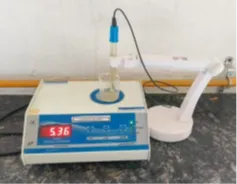
Fig 3: PH Meter
Gel spreadability:
0.5 g of every gel sample was applied to pre-labeled clear glass with a 2 cm diameter. Next, position another transparent glass on top and put a 500g weight for 5 minutes to separate the contents.
Using this approach, spreading is assessed by the sliding and pulling of the gel. Remove surplus gel from the borders. The mean ± SD of three replicates was used to express the standard deviation for each construct. The equation below was utilized to calculate the percentage of spreading:
Spread ability %=A2/A1 × 100
Where A1 represents the area before spreading (cm) and A2 denotes the area after spreading (cm).
Antimicrobial activity of hand sanitizer:
The antibacterial effectiveness of the crafted alcohol-free herbal hand sanitizer was assessed using the agar well diffusion method with selected pathogenic microorganisms such as Escherichia coli, responsible for infections, and Staphylococcus aureus. Sterile nutrient agar plates were inoculated with the test organisms, and wells were made using a sterile corn borer. An exact quantity of the hand sanitizer mixture was placed into each well and allowed to incubate at 37°C for 24 hours. After incubation, the formulation showed a clear area of inhibition.
Surrounding the wells, signifying potent antimicrobial action against the microorganisms tested. The findings indicated that the herbal components in the alcohol-free hand sanitizer demonstrated considerable antibacterial effects and could efficiently diminish microbial contamination, making the formulation appropriate for preserving hand hygiene and preventing infection transmission.
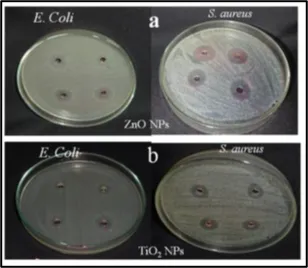
Fig.No.4: Antibacterial activity of synthesized (a) Zn ONPs and (b)T iO2NPs against E. coli and S. aureus.
Viscosity (Rheological Characteristics):
A key factor to manage is the viscosity of the gel formulation produced, as it will indicate the consistency and flow of the gel when applied to the skin. In this research, a TCV 300 viscometer was utilized to assess viscosity to determine sample thickness and investigate how gel composition impacts the rheological properties of the final product. The viscosity of the formulated solution exceeds that of ethanol and water (0.9 cP). The viscosity of the formulation was assessed as 0.4 cp.
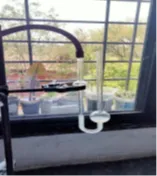
Fig No.5: Oswald Viscometer
Skin Sensitivity Testing:
The developed alcohol-free herbal hand sanitizer with extracts of Ficus religiosa demonstrated acceptable physicochemical characteristics and favorable skin compatibility, not leading to irritation or sensitivity. The formulation showed promising antimicrobial properties and could serve as a secure, organic, and eco-friendly alternative to conventional alcohol-based hand sanitizers for regular hand cleanliness (16).
5. RESULT:
Table No.2 : Formulation
|
Sr. No. |
Ingredients |
quantity |
|
1 |
Neem Extract |
2 g |
|
2 |
Peepal Extract |
2 g |
|
3 |
Aloe vera gel |
10 g |
|
4 |
Glycerine |
3 mL |
|
5 |
Clove Oil |
0.5 mL |
|
6 |
Lavender Oil |
0.3 mL |
|
7 |
Carbopol 940 |
0.5 g |
|
8 |
Triethanolamine |
0.5 mL |
|
9 |
Methyl Paraben |
0.2 g |
|
10 |
De-ionized Water |
q.s. to 100 mL |
Chemical Test
Table No.2 : Chemical Test
|
Phytochemical |
Chemical test |
Observation |
|
Alkaloids |
Dragendorff / Mayer’s test |
Orange or cream precipitate |
|
Flavonoids |
Shinoda test |
Pink/red coloration |
|
Tannins |
Ferric Chloride Test |
Blue-black or green colour |
|
Saponins |
Foam test |
Persistent froth |
Evaluation Parameter
Organoleptic evaluation:
Table No.3: Organoleptic evaluation
|
Parameter |
Result |
|
Color |
Light green |
|
Odor |
Mild Herbal |
|
Texture |
Smooth gel |
|
Appearance |
Transparent gel |
|
Feel on skin |
Non-sticky |
Physicochemical evaluation:
Table No.4 : Physicochemical evaluation
|
Parameter |
Result |
|
pH |
6.5 ± 0.1 |
|
Viscosity (cP) |
3200 ± 50cP |
|
Spreadability (g·cm/sec) |
12.5 ± 0.2g·cm/sec |
Antimicrobial Activity of Alcohol-Free Hand Sanitizer Gel
Table No.5 : Antimicrobial Activity of Alcohol-Free Hand Sanitizer Gel
|
Antimicrobial Activity of Alcohol-Free Hand Sanitizer Gel Sr. No. |
Test Microorganism |
Observation (Zone of Inhibition) |
Inference |
|
1 |
Escherichia coli |
A defined and noticeable inhibition zone appeared around the well after 24 hours of incubation at 37°C. |
The formulation demonstrated potent antibacterial action against Escherichia coli, showing its capacity to impede the growth of gram-negative bacteria. |
|
2 |
Staphylococcus aureus |
A significant area of inhibition was noted around the well that held the hand sanitizer formulation. |
The formulation exhibited notable antimicrobial activity against Staphylococcus aureus, highlighting its efficacy against gram-positive bacteria. |
6. CONCLUSION
The current research effectively showcased the development and assessment of a non-alcoholic herbal hand sanitizer gel utilizing natural extracts from neem (Azadirachta indica) and peepal (Ficus religiosa), combined with aloe vera, glycerin, essential oils, and Carbopol 940. The formulated products exhibited satisfactory physicochemical traits, featuring appropriate pH, optimal viscosity, acceptable spreadability, and favorable organoleptic qualities, demonstrating their appropriateness for topical usage.
DISCUSSION:
The current research effectively developed a herbal hand sanitizer gel without alcohol, including neem extract, peepal extract, aloe vera gel, glycerin, clove oil, lavender oil, and Carbopol 940 as the thickening agent. The formulation was created to deliver strong antimicrobial effectiveness while ensuring skin compatibility and user friendliness.
Prospective trends for non-alcoholic sanitizers
1. Request for Mild Skin Care
2. Utilization in Delicate Settings
3. Advancements in Durable Safeguarding
4. Trends in Sustainability
Perspectives on the Market
Consistent yet gradual expansion is anticipated. Significant possibilities are present in:
Conflict of Interest
The authors declare that there are no conflicts of interest regarding the publication of this paper.
Authors' Contributions
All authors contributed substantially to the conception and design of the study. Data collection, analysis, and interpretation were performed collaboratively. The manuscript was drafted, reviewed, and approved by all authors. All authors have read and agreed to the published version of the manuscript.
Acknowledgement
The authors are grateful to their Guide, Mr. Ajinkya D. Vaidya, for valuable guidance and continuous support throughout the study. The authors also thank the Principal, S. C. S. M. S. S. Institute of Pharmacy, Maregaon for providing the facilities and resources required for this research.
REFERENCES





Rathod Jay, Kshirsagar Shreya, Mande Dhanshree, Vaidya Ajinkya, Dr. Chachda Nilesh, To Prepare Alcohol Free Hand Sanitizer Gel, Int. J. of Pharm. Sci., 2026, Vol 4, Issue 7, 3300-3307. https://doi.org/10.5281/zenodo.21404114
 10.5281/zenodo.21404114