

We use cookies to ensure our website works properly and to personalise your experience. Cookies policy
Dayanand Institute of Pharmacy, Latur.
Wound healing is a complex biological process involving hemostasis, inflammation, proliferation, and tissue remodeling. Conventional wound dressings primarily provide physical protection and may have limitations such as inadequate moisture regulation, lack of controlled therapeutic delivery, and the need for frequent dressing changes. These limitations have encouraged the development of advanced smart wound dressings capable of responding to changes in the wound microenvironment and providing sustained delivery of therapeutic agents. The present study aims to develop and evaluate a pH-responsive sustained-release herbal smart wound dressing film containing neem (Azadirachta indica) and aloe vera (Aloe barbadensis Miller) for potential applications in wound management.The proposed formulation consists of sodium alginate and chitosan as film-forming and pH-responsive polymers, neem and aloe vera dry extracts as herbal active ingredients, glycerol as a plasticizer, calcium chloride dihydrate as an optional crosslinking agent, dilute acetic acid for chitosan dissolution, and purified water as the solvent. Neem has reported antimicrobial, anti-inflammatory, and antioxidant properties, while aloe vera is recognized for its moisturizing, soothing, and potential wound-healing properties. Their combination may provide complementary therapeutic benefits while supporting a favorable environment for tissue repair. The formulation will be prepared by separately dissolving the polymers, incorporating the herbal extracts, mixing the polymeric phases, casting the resulting mixture into a suitable mold, and drying under controlled conditions to obtain a flexible film. The developed dressing will be evaluated for physical appearance, thickness, weight variation, folding endurance, surface pH, moisture content, swelling index, herbal extract content, in-vitro sustained-release behavior, and stability. The pH-responsive characteristics will be investigated by assessing changes in swelling and release profiles under different pH conditions.
Wound healing is a complex biological process involving hemostasis, inflammation, proliferation, and tissue remodeling. Conventional wound dressings mainly provide physical protection but have limited ability to respond to wound conditions or deliver therapeutic agents in a controlled manner. Therefore, pH-sensitive smart wound dressings are being developed to provide responsive and sustained delivery of active ingredients.
Wound pH varies according to the healing stage, wound type, and microbial activity. Chronic and infected wounds may exhibit a more alkaline environment, making pH a potential stimulus for designing smart wound dressings. pH-sensitive polymers can change their swelling, solubility, or permeability in response to pH variations, thereby influencing the release of incorporated therapeutic agents.
Polymeric films offer flexibility, lightweight construction, and good wound coverage. Sodium alginate and chitosan are promising polymers for developing pH-responsive dressings. Glycerol improves film flexibility, while calcium chloride can crosslink alginate and modify the film's swelling and structural properties. Incorporating neem (Azadirachta indica) and aloe vera (Aloe barbadensis Miller) extracts may provide potential antimicrobial, moisturizing, antioxidant, and wound-healing benefits. Thus, the proposed formulation aims to develop a pH-sensitive, sustained-release herbal wound dressing for improved localized delivery and wound management.
What is wound
A wound is an injury or damage to the skin, mucous membrane, or underlying tissues caused by physical, chemical, thermal, or other factors, resulting in a break in the normal continuity of tissues.
Wounds may be classified as open wounds, in which the skin is broken, or closed wounds, in which the skin remains intact but the underlying tissues may be damaged.
Types of Wounds
Wounds are classified into the following main types:
1. Open Wounds
In open wounds, the skin or mucous membrane is broken, exposing the underlying tissues.
Abrasion: Superficial injury caused by scraping or friction of the skin.
Incised wound: A clean cut caused by a sharp object, such as a knife or blade.
Laceration: A wound characterized by torn tissue and irregular edges.
Puncture wound: A deep wound caused by a pointed object, such as a needle or nail.
Avulsion: A wound in which skin or tissue is partially or completely torn away.
2. Closed Wounds
In closed wounds, the skin remains intact, but damage occurs to the underlying tissues.
Contusion (bruise): Caused by blunt force, resulting in bleeding beneath the skin.
Hematoma: A localized collection of blood outside blood vessels.
Crush injury: Tissue damage caused by compression between heavy objects.
Classification Based on Healing Duration and Cause
Acute wounds: Heal within the expected period, such as minor cuts and surgical incisions.
Chronic wounds: Fail to heal normally within the expected period, such as diabetic foot ulcers and pressure ulcers.
Surgical wounds: Created intentionally during a surgical procedure.
Burn wounds: Caused by heat, chemicals, electricity, or radiation.
Infected wounds: Wounds in which microorganisms invade and multiply in the tissue, causing infection.
Mechanism of wound healing
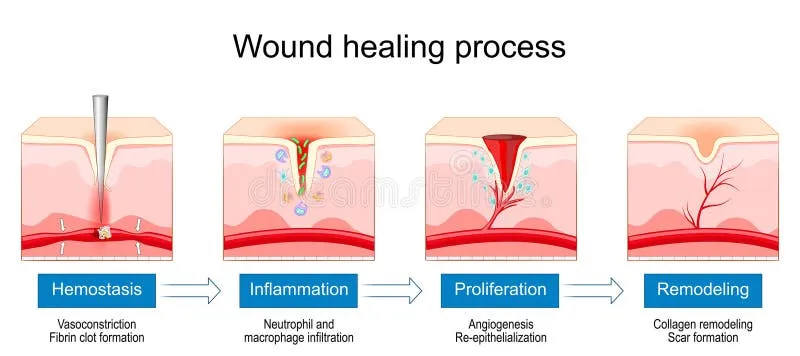
Fig. wound healing mechanism
Drug profile
Neem:
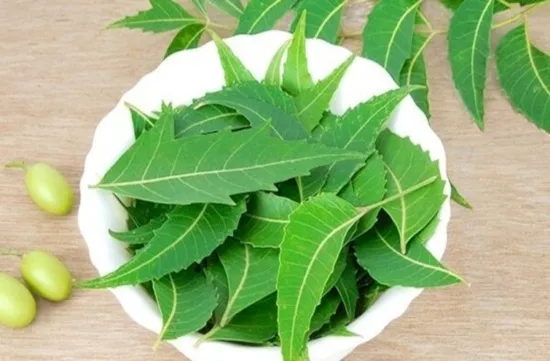
Botanical Name: Azadirachta Indica
Biological Name: Azadirachta Indica (commonly known as neem,nimtree and indian lilac) is a tree in the mahogany family of meliaceae. Neem consist of the fresh and dried leaves of Azadirachta indica.
Family: Meliaceae
Aloe:
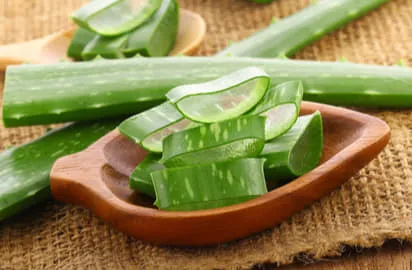
Botanical name: Aloe vera
Biological source: It consists of the dried latex or juice obtained from the leaves of Aloe barbadensis Mill. Aloe gel is obtained from the inner leaf tissue.
Family: Asphodelaceae or Liliaceae.
Role of Wound pH
Wound pH acts as a biological trigger in pH-responsive smart wound dressings. Changes in pH alter the swelling, solubility, and permeability of the polymer matrix, thereby controlling the release of neem and aloe constituents.
Importance of pH-Responsive Delivery
Acts as a natural trigger for drug release.
Responds to changes in the wound environment.
Provides controlled and sustained release.
Supports localized treatment.
May reduce unnecessary release of active ingredients.
pH-Responsive System
A pH-responsive dressing uses a sensitive polymer that changes its properties according to wound pH.
Ionization: pH changes alter the polymer's charge.
Swelling: Changes in fluid absorption influence drug diffusion.
Solubility: pH may affect polymer dissolution.
Permeability: Structural changes regulate drug movement.
Controlled release: Helps release neem and aloe constituents gradually.
Localized action: Delivers therapeutic agents directly to the wound.
Sustained Drug Release
Sustained release is the gradual delivery of neem and aloe constituents from the polymeric film over an extended period.
Gradual release: Prevents immediate release of all active ingredients.
Prolonged action: Maintains their availability at the wound site.
Controlled concentration: Helps avoid rapid initial release.
Reduced applications: May decrease dressing replacement frequency.
Protection: The polymer matrix may protect herbal constituents from degradation.
Patient convenience: May reduce frequent dressing changes.
Combined functionality: pH responsiveness can regulate sustained drug release
Objectives of study
To formulate a pH-responsive herbal smart wound dressing containing neem and aloe vera.
To select suitable polymers for pH-sensitive and sustained drug release.
To evaluate the physicochemical properties of the prepared dressing.
To study the pH-responsive behavior of the dressing.
To evaluate the in-vitro drug release profile under different pH conditions.
To assess the antimicrobial activity of the herbal dressing.
To evaluate the stability and wound-healing potential of the prepared formulation.
Increasing Need for Advanced Wound Care
Chronic wounds, such as diabetic foot ulcers, pressure ulcers and venous ulcers, often require prolonged healing time.
Increasing diabetes cases and an aging population contribute to the growing need for wound care.
Wound infections can delay healing and cause serious complications.
Burns and surgical wounds require proper protection, moisture balance and infection prevention.
Conventional dressings lack controlled drug delivery and responsiveness to wound conditions.
Therefore, advanced dressings are needed to provide sustained drug release, promote healing and reduce frequent dressing changes.
Smart pH-responsive dressings offer a promising approach for controlled and localized drug delivery.
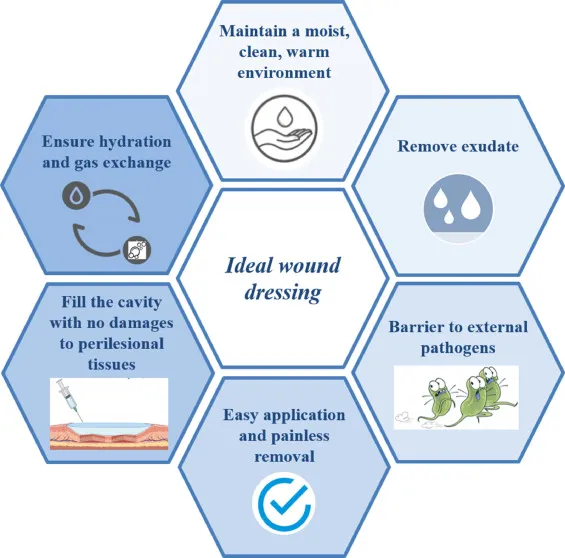
Fig . Ideal Wound Dressing
Limitations of Conventional Dressings
Limited therapeutic action: Mainly provide physical protection.
No controlled drug release: Cannot provide sustained delivery of therapeutic agents.
Frequent dressing changes: May increase discomfort and treatment costs.
Tissue damage: Removal may disturb newly formed tissue.
Poor responsiveness: Cannot respond to changes in wound pH, moisture or temperature.
Poor moisture management: May cause excessive dryness or exudate accumulation.
Limited infection management: Generally lack active antimicrobial drug-delivery systems.
Non-personalized treatment: Do not adapt to different wound conditions.
Need for advanced alternatives: Smart dressings can overcome several of these
limitations through responsive and controlled drug delivery.
Concept of Smart Wound Dressing
A smart wound dressing is an advanced dressing that protects the wound and responds to changes in its microenvironment.
pH as a trigger: Changes in wound pH can indicate alterations in wound conditions.
pH-sensitive polymers: These polymers change their swelling, solubility or permeability according to pH.
Controlled drug release: pH changes can regulate the release of incorporated therapeutic agents.
Localized treatment: Delivers the active ingredient directly to the wound site.
Sustained action: Provides gradual drug release over an extended period.
Infection management: May enhance therapeutic release under selected abnormal wound pH conditions.
Improved patient compliance: May reduce frequent dressing changes.
Herbal combination: Neem can provide potential antimicrobial activity, while Aloe vera can provide moisturizing and wound-healing support. Combining both in a pH-responsive dressing may offer complementary therapeutic benefits.
Preparation of PH-responsive film
Formulation (100 g)
| Sr. No. | Ingredient | Quantity | Function |
|---|---|---|---|
| 1 | Sodium alginate | 2 g | Film-forming polymer |
| 2 | Chitosan | 0.5 g | pH-responsive polymer |
| 3 | Neem dry extract | 0.5 g | Herbal active agent |
| 4 | Aloe vera dry extract | 0.5 g | Wound-healing agent |
| 5 | Glycerol | 1 g | Plasticizer |
| 6 | Calcium chloride | 0.1–0.2 g | Crosslinking agent |
| 7 | Dilute acetic acid | q.s. | Chitosan solvent |
| 8 | Purified water | q.s. to 100 g | Vehicle |
Method of Preparation
1. Sodium alginate solution: Dissolve sodium alginate in purified water with continuous stirring.
2. Chitosan solution: Dissolve chitosan in dilute acetic acid and add glycerol.
3. Herbal extract addition: Add neem and aloe vera extracts gradually with gentle stirring.
4. Film formation: Mix both polymer solutions uniformly, add calcium chloride if required, and pour into a level mould.
5. Drying: Dry under controlled conditions, peel off the film, and condition before evaluation.
Evaluation Parameters of pH-Responsive Sustained-Release Herbal Smart Wound Dressing Film
The developed herbal smart wound dressing film containing neem and aloe vera should be evaluated using various physicochemical, mechanical, pharmaceutical, and stability tests to ensure its quality, safety, and effectiveness.
1. Physical Appearance: The prepared film is visually examined for color, uniformity, surface smoothness, flexibility, and the presence of cracks, air bubbles, or other defects.
2. Thickness: Film thickness is measured at different locations using a digital micrometer to ensure uniform thickness and consistent formulation characteristics.
3. Weight Variation: Individual film samples are weighed to determine weight uniformity and consistency of the casting process.
4. Folding Endurance: The film is repeatedly folded at the same point until cracking or breaking occurs. This test evaluates the flexibility and mechanical strength of the film.
5. Surface pH: The surface pH is determined using a suitable aqueous medium to assess compatibility with the wound environment and minimize skin irritation.
6. Moisture Content: Moisture content is determined to evaluate the water-holding capacity, flexibility, physical stability, and storage characteristics of the film.
7. Swelling Index: The swelling capacity is evaluated by measuring the weight gain of the film after exposure to simulated wound fluid. This parameter is important for understanding pH-responsive behavior and fluid absorption.
8. Herbal Extract Content: The neem and aloe vera extract content is determined using suitable analytical methods to ensure uniform distribution and consistency of active constituents.
9. In-vitro Release Study: The release profile of selected herbal marker constituents is evaluated at predetermined time intervals under controlled conditions to determine the sustained-release characteristics of the formulation.
10. pH-Responsive Behaviour: The film is exposed to different pH conditions to evaluate changes in swelling, degradation, and herbal constituent release, demonstrating its responsiveness to the wound environment.
11. Antimicrobial Activity: The antimicrobial effectiveness of the film is evaluated against selected wound-associated microorganisms using suitable microbiological methods.
12. In-vitro Wound-Healing Study: The wound-healing potential is assessed using suitable cell-based methods, such as the scratch assay, to evaluate cell migration and wound closure.
13. Stability Study: The prepared films are stored under specified temperature and humidity conditions and periodically evaluated for changes in appearance, pH, moisture content, extract content, mechanical properties, and release characteristics.
REFERENCES




Dr. Kuldeep Pawar, Konale Amruta, Maheshwari Wadle, Bhakte Pooja, To Study Development and Evaluation of a PH-responsive Sustained Release Herbal Smart Wound Dressing., Int. J. of Pharm. Sci., 2026, Vol 4, Issue 11, 3862-3868. https://doi.org/10.5281/zenodo.24414743
 10.5281/zenodo.24414743