

We use cookies to ensure our website works properly and to personalise your experience. Cookies policy
1,2,3,4,5,6Analytical Chemical Research Laboratory, Rajarshi Chhatrapati Shahu College, Kolhapur, Maharashtra, India – 416003.
7Department of Chemistry, Gopal Krishn Gokhale College, Kolhapur, Maharashtra, India – 416012.
This study investigated the synthesis of substituted benzimidazole derivatives (1c–1g) by condensation of o-phenylenediamine with substituted aromatic carboxylic acids using conventional reflux and microwave-assisted methods, and evaluated their antibacterial activity. The products were purified by recrystallization and characterized by melting-point determination, FT-IR, ¹H NMR and ESI-MS. Antibacterial activity against Staphylococcus aureus and Klebsiella pneumoniae was assessed by agar well diffusion and broth microdilution assays. Microwave irradiation reduced reaction times from approximately 180 min to 1–10 min and improved the isolated yields of several derivatives. Compounds 1d, 1f and 1g showed comparatively higher antibacterial activity. Compound 1g exhibited an MIC of 15.62 µg mL?¹ against S. aureus, while compound 1f showed MIC values of 31.25 µg mL?¹ against both organisms. The results indicate that microwave-assisted synthesis provides a rapid route to the investigated benzimidazole derivatives and that aromatic substitution influences their antibacterial performance.
The rapid increase in antimicrobial resistance (AMR) has become one of the most critical challenges confronting global healthcare. The widespread emergence of multidrug-resistant bacterial pathogens has considerably reduced the therapeutic effectiveness of existing antibiotics, leading to prolonged illnesses, increased mortality, and escalating healthcare costs 1,2,3,4. Among the clinically important pathogens, Staphylococcus aureus and Klebsiella pneumoniae are frequently associated with hospital- and community-acquired infections and have developed resistance to multiple classes of antimicrobial agents. Consequently, the development of structurally novel antibacterial compounds remains an important objective in medicinal chemistry 1,2,3,4.
Nitrogen-containing heterocyclic compounds constitute an important class of bioactive molecules because of their structural diversity and ability to interact with a wide range of biological targets 5,6,7. Among these, benzimidazole has attracted considerable attention as a privileged pharmacophore due to the fusion of benzene and imidazole rings, which provides a rigid aromatic framework capable of forming multiple non-covalent interactions with enzymes, receptors, and nucleic acids 8. This unique structural feature has led to the incorporation of the benzimidazole nucleus into numerous clinically useful drugs with antibacterial, antifungal, antiviral, anti-inflammatory, antiparasitic, and anticancer activities 8,9,10,11.
The biological performance of benzimidazole derivatives can be effectively modulated through structural modification of the aromatic ring. Variations in the electronic characteristics, steric environment, and lipophilicity of substituents influence membrane permeability as well as interactions with biological targets, thereby affecting antimicrobial potency 9,10,11,12. Several studies have demonstrated that appropriate substitution of the benzimidazole scaffold enhances antibacterial activity against resistant microorganisms, making this heterocyclic system an attractive platform for the design of new therapeutic agents 9,10,12.
Conventionally, benzimidazole derivatives are synthesized through the condensation of o-phenylenediamine with carboxylic acids or related carbonyl compounds under acidic conditions. Although these methods generally provide satisfactory yields, they often require prolonged heating, high energy consumption, and extensive purification, which can reduce their efficiency and sustainability 13,14,15. The growing emphasis on environmentally benign synthetic methodologies has therefore encouraged the development of alternative approaches that combine operational simplicity with improved reaction efficiency.
Microwave-assisted organic synthesis has emerged as an effective strategy for accelerating heterocyclic reactions through rapid and uniform dielectric heating. Compared with conventional reflux methods, microwave irradiation frequently shortens reaction times, improves product yields, minimizes side reactions, and can reduce energy requirements 16,17,18. Furthermore, microwave-assisted protocols can support greener synthetic practices by shortening reaction times and potentially reducing energy requirements and waste generation while simplifying product isolation. These advantages have promoted the application of microwave technology in the synthesis of medicinally important heterocyclic compounds.
In the present study, a series of substituted benzimidazole derivatives (1c–1g) was synthesized using both conventional reflux and microwave-assisted methods. The synthesized compounds were characterized by melting point analysis, FT-IR, 1H NMR, and ESI-MS spectroscopy. The efficiency of microwave-assisted synthesis was evaluated by comparing reaction time and isolated yield with those obtained by the conventional method. Furthermore, the antibacterial activities of the synthesized derivatives were assessed against Staphylococcus aureus and Klebsiella pneumoniae using agar well diffusion and broth microdilution assays, and a preliminary structure–activity relationship was established to evaluate the influence of aromatic substitution on antibacterial performance.
MATERIALS AND METHODS
2.1 Chemicals and Reagents
All chemicals employed in this investigation were of analytical reagent (AR) grade and were used as received without additional purification. o-Phenylenediamine, substituted aromatic carboxylic acids, hydrochloric acid (HCl), ethanol, dimethyl sulfoxide (DMSO), Mueller–Hinton agar (MHA), and Mueller–Hinton broth (MHB) was obtained from commercial suppliers.
The antibacterial activity was evaluated using Staphylococcus aureus (Gram-positive) and Klebsiella pneumoniae (Gram-negative). The bacterial cultures were obtained from an accredited microbiology laboratory and maintained on Mueller–Hinton agar slants at 4 °C until use.
2.2 Instrumentation
Melting points were measured using the open capillary method and are reported without correction. Fourier-transform infrared (FT-IR) spectra were recorded on a Shimadzu spectrometer employing KBr pellets over the range of 4000–400 cm⁻¹. 1H NMR spectra were acquired in CDCl₃ using tetramethylsilane (TMS) as the internal reference, and chemical shifts are expressed in δ (ppm). Molecular masses were determined by electrospray ionization mass spectrometry (ESI-MS). Reaction progress and product purity were monitored by thin-layer chromatography (TLC) on silica gel 60 F₂₅₄ plates and visualized under ultraviolet light.
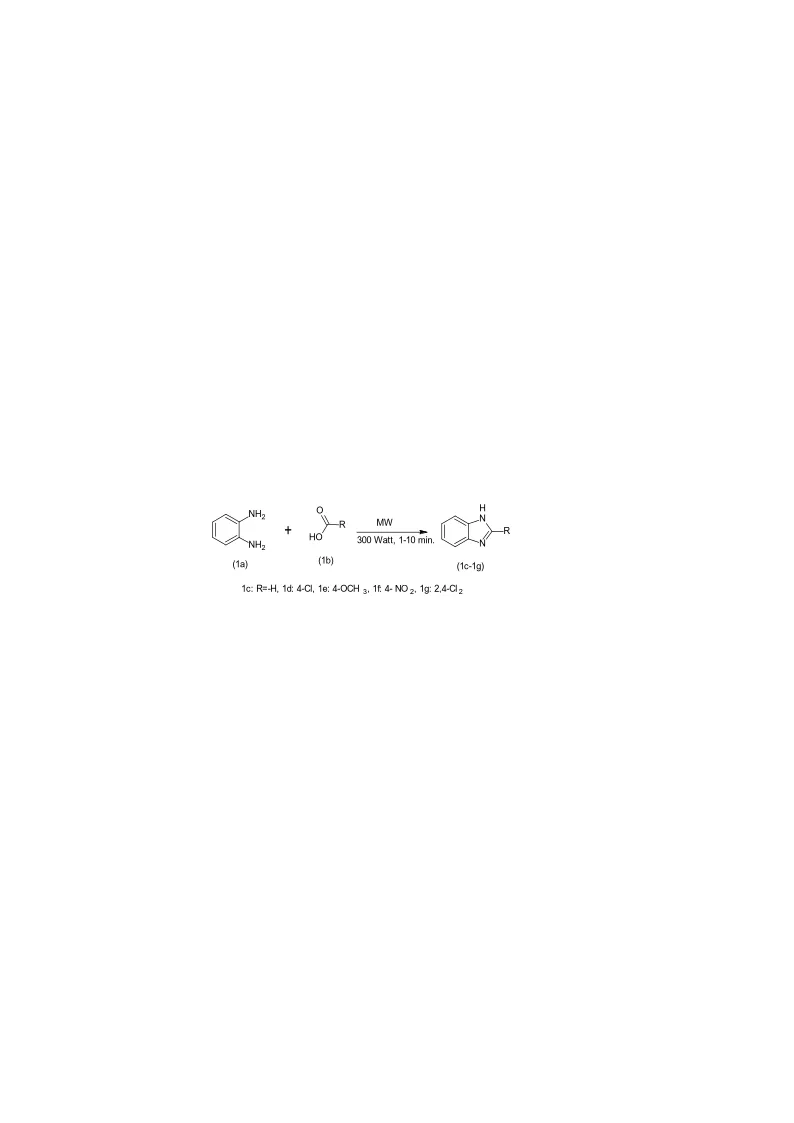
2.3 General Procedure for the Synthesis of Benzimidazole Derivatives (1c–1g)
A reaction mixture containing o-phenylenediamine (6.0 g, 0.055 mol), the appropriate substituted aromatic carboxylic acid (6.0 g), and 25 mL of 4 N hydrochloric acid was prepared in a round-bottom flask with continuous stirring before carrying out the synthesis by either the conventional or microwave-assisted method.
Conventional Method
The reaction mixture was heated under reflux for approximately 3 h using an oil bath maintained at 180–185 °C. The progress of the reaction was monitored by TLC at regular intervals. After completion, the reaction mixture was cooled to room temperature and poured onto crushed ice. The precipitated solid was filtered, washed with cold distilled water, dried, and recrystallized from ethanol to obtain the purified benzimidazole derivative.
Microwave-Assisted Method
An identical reaction mixture was subjected to microwave irradiation at 300 W using a domestic microwave oven. Depending on the substituent, complete conversion was achieved within 1–10 min, as confirmed by TLC analysis. After cooling, the reaction mixture was transferred onto crushed ice, and the precipitated product was isolated by filtration, washed with distilled water, dried, and recrystallized from ethanol. The purified products were subsequently characterized and evaluated for antibacterial activity as shown in Figure 1.
2.4 Purification and Structural Characterization
The isolated products were purified by recrystallization from ethanol before characterization. Chromatographic purity was assessed by TLC using ethyl acetate (7:3, v/v) as the developing solvent. UV irradiation at 254 nm was used to visualize chromatographic spots.
Structural confirmation of the synthesized derivatives was achieved through complementary spectroscopic techniques. The FT-IR spectra were examined to identify characteristic functional groups associated with the benzimidazole framework. The 1H NMR spectra established the proton environments within each molecule, while ESI-MS analysis verified the molecular masses through the corresponding protonated molecular ion peaks. Collectively, these analytical techniques confirmed the successful synthesis of the target benzimidazole derivatives as shown in Table 1.
Table 1: Physicochemical Properties and Spectral Characterization Data of Synthesized Benzimidazole Derivatives (1C–1G).
| Compound | Molecular Formula | M.P. (°C) | FT-IR (cm⁻¹) | ¹H NMR (δ, ppm) | ESI-MS m/z [M+H]⁺ |
|---|---|---|---|---|---|
| 1c | C13H10N2 | 140 | 3425, 3250, 1580 | 6.8–7.9 | 195 |
| 1d | C13H9ClN2 | 137 | 3425, 1620 | 6.8–7.4 | 229 |
| 1e | C14H12N2O | 89–91 | 3425, 1620 | 3.6, 6.8–7.4 | 225 |
| 1f | C13H9N3O2 | 170–172 | 3425, 1620 | 6.8–7.5 | 240 |
| 1g | C13H8Cl2N2 | 227–228 | 3250, 1640 | 6.8–7.5 | 264 |
2.5 Antibacterial Activity
Agar Well Diffusion Assay
The antibacterial potential of the synthesized compounds was evaluated against Staphylococcus aureus and Klebsiella pneumoniae using the agar well diffusion technique in accordance with the Clinical and Laboratory Standards Institute (CLSI) recommendations.
Fresh bacterial cultures grown in Mueller–Hinton broth were adjusted to the turbidity of a 0.5 McFarland standard (approximately 1 × 10⁸ CFU mL⁻¹). Sterile Mueller–Hinton agar plates were uniformly inoculated with the bacterial suspension using sterile cotton swabs. Wells measuring 6 mm in diameter were prepared aseptically using a sterile cork borer.
Each synthesized compound was dissolved in DMSO to prepare a stock solution of 1 mg mL⁻¹, and 100 µL of the test solution was transferred into the corresponding well. Ciprofloxacin served as the positive control, whereas DMSO was used as the negative control. The inoculated plates were allowed to stand at room temperature for 30 min before incubation at 37 ± 1 °C for 24 h. Antibacterial activity was assessed by measuring the diameter of the inhibition zone surrounding each well. All experiments were carried out in triplicate, and the results are presented as mean ± standard deviation (SD) as shown in Table 2.
Table 2: Antibacterial Activity of Synthesized Compounds Against Staphylococcus aureus and Klebsiella pneumoniae Determined by the Agar Well Diffusion Assay.
| Compound | Substituents (R) | Zone of inhibition against | |
|---|---|---|---|
| K. pneumoniae (mm) | S. aureus (mm) | ||
| 1c | -H | 18.0 ± 0.6 | 17.0 ± 0.5 |
| 1d | -4-Cl | 24.0 ± 0.4 | 24.0 ± 0.7 |
| 1e | -4-OCH3 | 17.0 ± 0.5 | 18.0 ± 0.6 |
| 1f | -4-NO2 | 22.0 ± 0.7 | 25.0 ± 0.4 |
| 1g | -2,4-Cl2 | 25.0 ± 0.5 | 23.0 ± 0.6 |
| Ciprofloxacin | Ciprofloxacin | 18.0 ± 0.3 | 25.0 ± 0.2 |
2.6 Determination of Minimum Inhibitory Concentration (MIC)
Minimum inhibitory concentrations were determined using the broth microdilution method according to CLSI guidelines. Serial two-fold dilutions of each synthesized compound were prepared in Mueller–Hinton broth to obtain concentrations ranging from 500 to 0.97 µg mL⁻¹.
Equal volumes of the diluted test solution and standardized bacterial inoculum (approximately 5 × 10⁵ CFU mL⁻¹) were dispensed into sterile 96-well microplates. Ciprofloxacin was included as the reference antibacterial drug, while broth containing DMSO served as the solvent control. Following incubation at 37 ± 1 °C for 24 h, bacterial growth was assessed visually. The MIC value was recorded as the lowest concentration at which no visible bacterial growth was observed as shown in Figure 2. Each determination was performed in triplicate and the MIC values are reported as endpoint concentrations in Table 3.
Table 3: Minimum Inhibitory Concentration (MIC) of Synthesized Benzimidazoles
| Compound | MIC against S. aureus (µg/mL) | MIC against K. pneumoniae (µg/mL) |
|---|---|---|
| 1c | 125 | 250 |
| 1d | 31.25 | 62.5 |
| 1e | 62.5 | 125 |
| 1f | 31.25 | 31.25 |
| 1g | 15.62 | 31.25 |
| Ciprofloxacin | 7.81 | 7.81 |
2.7 Statistical Analysis All experiments were performed in triplicate (n = 3), and the results are expressed as mean ± standard deviation (SD). The experimental data were compiled and summarized using Microsoft Excel 2019 (Microsoft Corp., Redmond, WA, USA). No inferential statistical analyses were performed because the study was designed to provide descriptive comparisons of the synthesized compounds. Antibacterial activities were therefore compared based on the mean values of the inhibition zones and the MIC endpoint concentrations.
RESULTS AND DISCUSSION
3.1 Synthesis of Benzimidazole Derivatives
A series of substituted benzimidazole derivatives (1c–1g) was successfully synthesized through the condensation of o-phenylenediamine with substituted aromatic carboxylic acids using both conventional reflux and microwave-assisted protocols. The synthetic procedure afforded the desired products in moderate to good yields after recrystallization from ethanol. The proposed structures of the synthesized compounds were supported by TLC and spectroscopic analyses (FT-IR, ¹H NMR, and ESI-MS).
The formation of the benzimidazole ring is proposed to proceed via acid-catalysed condensation between one amino group of o-phenylenediamine and the carboxylic acid, followed by intramolecular cyclization and subsequent dehydration to generate the fused benzimidazole nucleus. The acidic reaction medium facilitates carbonyl activation, thereby promoting cyclization and improving product formation. Similar reaction pathways have been reported for benzimidazole synthesis from aromatic carboxylic acids under acidic conditions 13,14,15.
3.2 Comparison of Conventional and Microwave-Assisted Synthesis
The efficiency of the microwave-assisted protocol was evaluated by comparing the reaction time and isolated yield with those obtained using conventional reflux, as shown in Table 4. A marked reduction in reaction time was observed under microwave irradiation. While the conventional procedure required approximately 180 min, the microwave-assisted method completed the reactions within 1–10 min, depending on the substituent present on the aromatic ring.
In addition to shortening the reaction time, microwave irradiation afforded higher isolated yields for most derivatives. The increase in yield may be associated with efficient dielectric heating of the reaction medium, which can promote rapid heating and facilitate the reaction process. Unlike conventional heating, in which heat is transferred from the vessel walls to the reaction mixture, microwave irradiation enables volumetric heating of the reaction medium. These characteristics have been reported to contribute to accelerated reaction rates in microwave-assisted organic synthesis 16,17,18.
Among the synthesized derivatives, compound 1f required the shortest irradiation time (1 min), whereas the other derivatives required 2–10 min under the conditions employed. The variation in reaction time may be related, in part, to differences in the electronic characteristics of the substituents. Substrates with substituents that decrease the electrophilic character of the reacting carbonyl group may require longer irradiation periods to achieve completion. Similar effects of substrate electronic properties on reaction rates have been reported in microwave-assisted synthesis of heterocyclic compounds 17,18.
The comparative data in Table 4 demonstrate a substantial reduction in reaction time under microwave irradiation. All reactions required approximately 180 min under conventional reflux, whereas the corresponding microwave-assisted reactions were completed within 1–10 min. The shortest reaction time was observed for compound 1f, which was obtained after 1 min of microwave irradiation.
Table 4: Comparison of Conventional and Microwave-Assisted Synthesis of Benzimidazole Derivatives
| Compound | M.P. (°C) | Yield (%) Conventional | Yield (%) Microwave | Time Conventional (min) | Time Microwave (min) |
|---|---|---|---|---|---|
| 1c | 140 | 45 | 50 | 180 | 10 |
| 1d | 137 | 55 | 55 | 180 | 8 |
| 1e | 89–91 | 39 | 50 | 180 | 2 |
| 1f | 170–172 | 43 | 52 | 180 | 1 |
| 1g | 227–228 | 50 | 53 | 180 | 2 |
The microwave-assisted method also resulted in improved isolated yields for several derivatives. The most notable increases were observed for compounds 1e and 1f, for which the yields increased from 39% to 50% and from 43% to 52%, respectively. Compound 1g exhibited the highest melting point (227–228 °C), whereas compound 1e showed the lowest melting point (89–91 °C). These differences may be associated with variations in molecular structure and crystal packing resulting from the different aromatic substituents.
Overall, the microwave-assisted protocol substantially reduced reaction time and improved the isolated yields of several derivatives compared with conventional reflux. These findings demonstrate that microwave irradiation can provide a rapid and efficient approach for the synthesis of the investigated benzimidazole derivatives.
3.3 Effect of Aromatic Substituents on Reaction Efficiency
The substituent attached to the aromatic carboxylic acid influenced both reaction yield and reaction rate. Within the present series, derivatives containing electron-withdrawing substituents showed higher isolated yields than the methoxy-substituted derivative, suggesting that substituent electronic effects may influence cyclization efficiency. This observation may be related to differences in the electrophilic character of the carbonyl group, which can affect nucleophilic attack by the amino group of o-phenylenediamine. Consequently, cyclization may proceed more readily for substrates bearing electron-withdrawing substituents, resulting in higher isolated yields.
Conversely, electron-donating substituents may decrease the electrophilicity of the carbonyl group and thereby retard ring closure to some extent. Nevertheless, under microwave irradiation, these substrates also afforded satisfactory yields, indicating that the microwave-assisted conditions were effective across substrates with different electronic characteristics.
Overall, the observed trend suggests that microwave-assisted synthesis provides a practical methodology that tolerates moderate electronic variations within the substrate series, supporting its applicability to the preparation of structurally diverse benzimidazole derivatives.
3.4 Spectral Characterization
The structures of the synthesized benzimidazole derivatives (1c–1g) were confirmed by FT-IR, ¹H NMR and ESI-MS analyses. The FT-IR spectra exhibited characteristic absorption bands at 3250–3425 cm⁻¹ corresponding to the N–H stretching vibration of the benzimidazole ring, while the absorption bands observed at 1580–1640 cm⁻¹ were assigned to the C=N stretching vibration, confirming successful cyclization of o-phenylenediamine with the corresponding substituted aromatic carboxylic acids. In addition, aromatic C=C stretching vibrations and substituent-specific absorption bands were observed in the expected spectral regions, supporting the proposed structures of the synthesized compounds.
The ¹H NMR spectra displayed aromatic proton signals in the region of δ 6.8–7.9 ppm, which were consistent with the benzimidazole framework. Compound 1e additionally exhibited a singlet at δ 3.6 ppm corresponding to the methoxy (–OCH₃) protons, thereby confirming the presence of the para-methoxy substituent. The observed chemical shifts and signal patterns agreed well with the proposed molecular structures of all synthesized derivatives.
The ESI-MS spectra showed the expected protonated molecular ion peaks [M+H] ⁺ at m/z 195 (1c), 229 (1d), 225 (1e), 240 (1f), and 264 (1g), which were in agreement with the calculated molecular masses of the respective compounds. Collectively, the FT-IR, ¹H NMR, and ESI-MS data confirmed the successful synthesis and structural assignment of the target benzimidazole derivatives.
3.5 Antibacterial Activity
The antibacterial potential of the synthesized benzimidazole derivatives (1c–1g) was evaluated against Staphylococcus aureus and Klebsiella pneumoniae using agar well diffusion and broth microdilution assays (Figure 2; Tables 2 and 3).
The agar well diffusion assay revealed inhibition zones ranging from 17–25 mm, indicating variable antibacterial efficacy among the synthesized compounds. Against K. pneumoniae, compound 1g exhibited the highest activity with an inhibition zone of 25.0 ± 0.5 mm, followed by compounds 1d (24.0 ± 0.4 mm) and 1f (22.0 ± 0.7 mm). In contrast, compounds 1c and 1e showed comparatively lower activities, producing inhibition zones of 18.0 ± 0.6 mm and 17.0 ± 0.5 mm, respectively.
A similar trend was observed against S. aureus. Compound 1f produced the largest inhibition zone (25.0 ± 0.4 mm), which was comparable to the activity of ciprofloxacin (25.0 ± 0.2 mm). Compounds 1d and 1g also exhibited pronounced antibacterial effects with inhibition zones of 24.0 ± 0.7 mm and 23.0 ± 0.6 mm, respectively. The activities of compounds 1c and 1e were noticeably lower, suggesting that their structural features are less favourable for antibacterial action.
The MIC values supported the agar diffusion results. Compound 1g showed the greatest potency against S. aureus, with an MIC of 15.62 µg mL⁻¹, while compound 1f demonstrated equal activity against both bacterial strains, exhibiting MIC values of 31.25 µg mL⁻¹. Compound 1d also showed promising activity, with MIC values of 31.25 µg mL⁻¹ against S. aureus and 62.5 µg mL⁻¹ against K. pneumoniae. In comparison, compounds 1c and 1e required substantially higher concentrations to inhibit bacterial growth, indicating lower antibacterial potency. Although ciprofloxacin remained the most active reference drug (MIC = 7.81 µg mL⁻¹), several synthesized benzimidazole derivatives demonstrated encouraging antibacterial activity.
The greater susceptibility of S. aureus compared with K. pneumoniae may be attributed to differences in bacterial cell envelope architecture. Gram-negative bacteria possess an additional outer membrane enriched with lipopolysaccharides, which restricts the penetration of many antimicrobial agents. Consequently, compounds generally exhibited lower MIC values and larger inhibition zones against the Gram-positive organism.
3.6 Structure–Activity Relationship (SAR)
The antibacterial activity of the synthesized benzimidazole derivatives was found to depend on the electronic nature and position of the substituents attached to the phenyl ring (Tables 2 and 3). Although all derivatives possess the same benzimidazole nucleus, differences in aromatic substitution produced noticeable variations in both the inhibition zones and MIC values against Staphylococcus aureus and Klebsiella pneumoniae.
Among the synthesized compounds, 1g, bearing a 2,4-dichloro substituent, exhibited the highest antibacterial activity against K. pneumoniae (25.0 ± 0.5 mm) and the lowest MIC against S. aureus (15.62 μg mL⁻¹). The superior performance of this derivative suggests that the presence of two chlorine atoms contributes favourably to antibacterial activity. Halogen substitution is known to increase molecular lipophilicity, which may improve penetration through bacterial cell membranes and consequently enhance biological activity.
The 4-chloro derivative (1d) also showed pronounced antibacterial activity against both bacterial strains, producing inhibition zones of 24.0 ± 0.4 mm against K. pneumoniae and 24.0 ± 0.7 mm against S. aureus. Compared with the unsubstituted analogue (1c), the introduction of a single chlorine atom resulted in a marked improvement in antibacterial efficacy, indicating that halogen substitution was associated with increased antibacterial activity within the present series.
Compound 1f, containing a para-nitro group, demonstrated the largest inhibition zone against S. aureus (25.0 ± 0.4 mm) and exhibited identical MIC values (31.25 μg/mL) against both bacterial strains, indicating activity against both tested bacterial strains. The electron-withdrawing nature of the nitro substituent may favour the antibacterial activity of the benzimidazole framework by modifying its electronic characteristics.
In contrast, the methoxy-substituted derivative (1e) exhibited comparatively lower antibacterial activity, while the unsubstituted compound (1c) showed only moderate inhibition against both microorganisms. These observations indicate that electron-donating substituents do not enhance antibacterial activity to the same extent as electron-withdrawing groups in the present series.
Overall, compounds 1g, 1d, and 1f showed higher antibacterial activity than compounds 1c and 1e across the tested assays, although the relative activity varied depending on the bacterial strain and assay endpoint. The observed trend suggests that within the present series, electron-withdrawing substituents, particularly halogen substituents, were associated with higher antibacterial activity. These findings provide a useful basis for the future design and optimization of benzimidazole-based antimicrobial agents.
3.7 Green Chemistry Perspective
Microwave-assisted synthesis offers several potential environmental and practical advantages over conventional reflux methods. In the present study, the reaction time was reduced from approximately 180 min under conventional reflux to as little as 1 min under microwave irradiation. This substantial reduction in reaction time may decrease the energy requirements associated with prolonged heating, although energy consumption was not directly measured in the present study. The shorter reaction time also simplifies the overall synthetic procedure and may facilitate more efficient reaction monitoring and product isolation.
The combination of shorter reaction times, improved or comparable isolated yields and simplified purification is consistent with several principles of green chemistry, particularly process efficiency and waste minimization. However, quantitative green chemistry metrics, such as energy consumption, E-factor, or solvent waste, were not determined in the present study. Therefore, the microwave-assisted methodology may be considered a potentially more efficient alternative to conventional reflux for the rapid synthesis of the investigated benzimidazole derivatives.
3.8 Limitations
The present study has several limitations. The antibacterial evaluation was restricted to two bacterial strains and a limited series of benzimidazole derivatives. The biological assessment was based on agar well diffusion and broth microdilution assays, and no mechanistic studies were performed to determine the molecular targets responsible for the observed antibacterial activity. In addition, cytotoxicity and selectivity toward mammalian cells were not evaluated. Therefore, further studies involving a broader panel of microorganisms, cytotoxicity assessment, target-based assays, and mechanistic investigations are required to establish the biological potential of these compounds.
CONCLUSION
In the present study, a series of substituted benzimidazole derivatives (1c–1g) was successfully synthesized using both conventional reflux and microwave-assisted methods. Comparison of the two approaches demonstrated that microwave irradiation considerably reduced the reaction time from approximately 180 min to 1–10 min, while providing improved product yields and simplified reaction work-up. These findings highlight the advantages of microwave-assisted synthesis as a rapid and efficient approach for the preparation of benzimidazole derivatives. The structures of the synthesized compounds were supported by FT-IR, ¹H NMR, and ESI-MS analyses, and the obtained spectral data were consistent with the proposed molecular structures.
Biological evaluation revealed that the synthesized derivatives possessed promising antibacterial activity against Staphylococcus aureus and Klebsiella pneumoniae. Among the tested compounds, 1d, 1f, and 1g exhibited the most pronounced antibacterial effects, producing larger zones of inhibition and lower minimum inhibitory concentration (MIC) values than the remaining derivatives. In particular, compound 1g showed the greatest potency against S. aureus (MIC = 15.62 µg mL⁻¹), whereas compound 1f demonstrated balanced activity against both bacterial strains (MIC = 31.25 µg mL⁻¹). These findings indicate that appropriate substitution on the benzimidazole nucleus plays an important role in modulating antibacterial activity.
Overall, the present investigation demonstrates that microwave-assisted synthesis offers an efficient methodology for generating biologically active benzimidazole derivatives. Although the synthesized compounds were less potent than the reference drug ciprofloxacin, the encouraging antibacterial activity observed for compounds 1d, 1f, and 1g suggests that they represent promising lead molecules for further optimization. Future studies involving molecular docking, target-based enzyme inhibition assays, cytotoxicity evaluation, and broader antimicrobial screening will be valuable for elucidating their mechanism of action and improving their therapeutic potential.
CONFLICT OF INTEREST
The authors declare that they have no known competing financial interests or personal relationships that could have influenced the work reported in this paper.
DATA AVAILABILITY STATEMENT
The data supporting the findings of this study are available from the corresponding author upon reasonable request.
AUTHOR CONTRIBUTIONS
Prof. Dr. Pravina Piste conceived and designed the study, supervised the research work, interpreted the results and critically reviewed and revised the manuscript. Shivani Bhosale and Madhuri Bidave carried out the synthesis of the compounds, performed the experimental work, analysed the data, and contributed to manuscript preparation. Aftab Gadakari and Pooja Jaigude conducted the antimicrobial studies, participated in data collection and analysis, and assisted in manuscript writing. Raisa Mahaldar and Prajkta Patil performed the spectroscopic characterization, contributed to data compilation and interpretation and conducted the literature review. Radhika Nikam contributed to supervised the experimental work and validated the results. All authors read and approved the final version of the manuscript.
ETHICAL APPROVAL
This study did not involve human participants or experimental animals and therefore ethical approval was not required.
ACKNOWLEDGEMENT
The authors are grateful to the Principal, Rajarshi Chhatrapati Shahu College, Kolhapur for providing the necessary laboratory facilities and institutional support to carry out this research work. The authors also sincerely acknowledge the support and cooperation of the Department of Chemistry and all those who directly or indirectly contributed to the successful completion of this research.
REFERENCES

Pravina Piste, Madhuri Bidave, Aftab Gadkari, Pooja Jaigude, Raisa Mahaldar, Prajkta Patil, Radhika Nikam, Rapid Microwave-Assisted Synthesis of Benzimidazole Derivatives and Their Antimicrobial Evaluation, Int. J. of Pharm. Sci., 2026, Vol 4, Issue 11, 3887-3896. https://doi.org/10.5281/zenodo.24415010
 10.5281/zenodo.24415010