

We use cookies to ensure our website works properly and to personalise your experience. Cookies policy
Shri Vishnu College of Pharmacy (Autonomous), Vishnupur, Bhimavaram-534202, Andhra Pradesh, India.
Stability studies are crucial to the development of pharmaceutical products because they guarantee that the formulation is safe, effective, and consistent for the duration of its shelf life. To determine how different environmental factors impact the physical, chemical, and microbiological characteristics of pharmaceutical goods, stability studies are carried out. These factors include exposure to oxygen, light, humidity, and temperature. Stability testing aids in figuring out the right packaging requirements, storage conditions, and product shelf life. Manufacturers use a variety of stability evaluations, such as long-term, accelerated, and intermediate studies, to describe drug products. Preventing the deterioration of pharmaceutical items also requires careful consideration of storage methods and containers. The concepts of stability studies, the different kinds of stability tests, and the variables affecting the stability of pharmaceutical products are all covered in this review
Drug storage: -
Keeping pharmaceuticals in good condition is one of a chemist's most crucial responsibilities. It is essential to develop and apply appropriate strategies in order to carry out these obligations. Pharmaceuticals must be kept in environments that minimize contamination and, if feasible, prevent deterioration. The product stays stable within the given parameters throughout storage and use. The impacts of light, heat, moisture, and climate variables are covered in the book along with the necessary safety precautions. Keeping pharmaceuticals in the right storage conditions is crucial to patient care. Pharmaceutical product quality can be significantly impacted by manufacturing and storage circumstances. The two environmental elements that have the biggest effects on drug deterioration are high temperatures and relative humidity.[1] Marketability is ultimately decided by the final quality of a product or batch, which is primarily influenced by factors like temperature, humidity, air quality, time, and particular components of the production process. Refrigeration plants are frequently used for this purpose, despite the fact that many products must be stored in cold settings. Careful monitoring is required to guarantee that the target temperature remains consistent. Inventory needs to be stored in appropriate, verified environments. [2] Temperature, ventilation, light, humidity, and security must all be suitable. The manufacturer's instructions and the conditions of their product authorizations must be followed when storing medications. The conditions of pharmaceutical inventory must be appropriate for each product's unique properties and stability needs. Infection, sunlight, UV radiation, humidity, air moisture, and extremely high or low temperatures must all be prevented. Prescription medications should always be stored in their original containerGood storage procedures, which require that pharmaceutical products be kept in integrity-preserving, tightly sealed packaging, must be followed in all circumstances involving their distribution. to both stop and shield the product from external contamination. [3] product deterioration under normal storage and handling circumstances. When storing drugs, the following factors need to be taken into account.
1. Sanitation
2. Temperature
3. Light
4. Moisture
5. Ventilation
6. Segregation process.
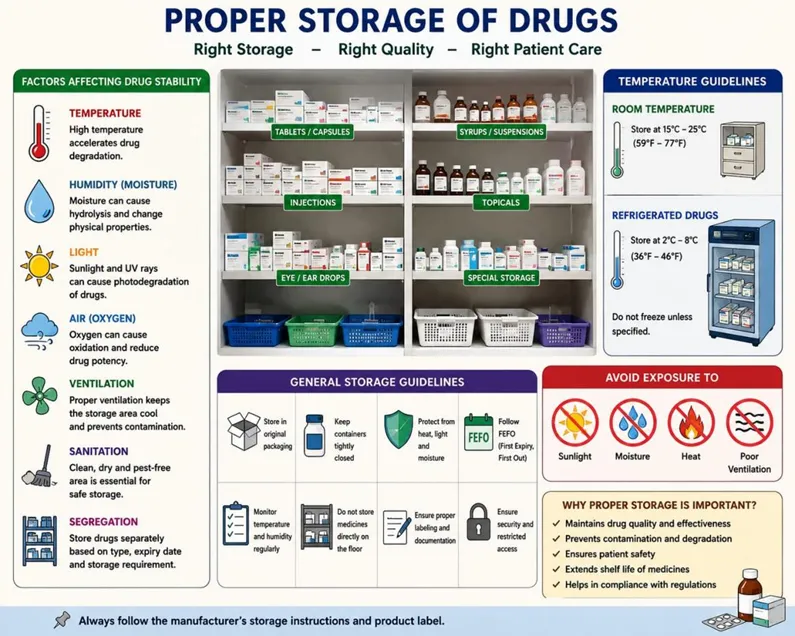
Figure 01: Proper Storage of Drugs
Stability of drugs
A stable medication maintains its original qualities, safety, efficacy, and features for the duration of its shelf life. It is described as the expiration period and should be supported by precise stability data and the recommended storage conditions. [4] Stability is determined by both product-specific factors like the properties of the active pharmaceutical ingredient (API), excipients, formulation, manufacturing process, and packaging system as well as environmental elements including temperature, humidity, and light. Because of the amount of current research and analytical methods, stability studies for well-known drugs often focus on the final dose form rather than the active ingredient.
Drug stability, which ensures a product's efficacy, safety, and quality throughout its shelf life, is an essential part of pharmaceutical development. It involves looking at how drugs change over time in response to formulation-related factors including the properties of the active ingredient, excipients, and packaging as well as environmental factors like light, humidity, and temperature. [5]
Drug breakdown processes and shelf life (expiration date) are determined by stability tests. They guarantee the medication's safety and efficacy for patient usage and are crucial for regulatory approval.
Pharmaceutical stability is the ability of a pharmaceutical product to retain its original properties, effectiveness, and quality throughout its shelf life. Stability investigations were conducted to determine the expiration date and ensure storage safety. These complex investigations are influenced by formulation factors like the active ingredient, excipients, manufacturing process, and packaging as well as environmental factors like temperature, humidity, and light. Understanding how the drug deteriorates over time and figuring out the ideal storage conditions to maintain it safe and effective for patient usage were the main objectives of this study. [6]
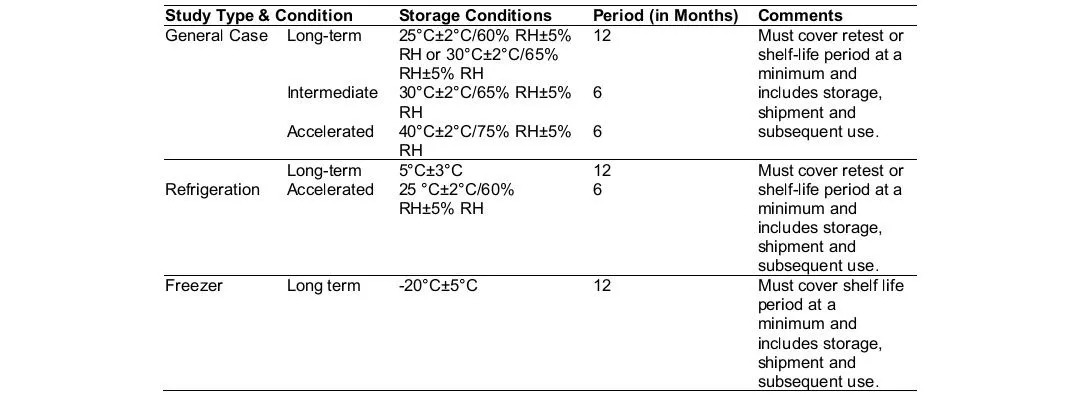
Table 01: Various Storage conditions
DRUG STORAGE:
Based on studies, the storage temperatures for several medications are listed below. Freezer: An area with a thermostat that maintains a temperature between -13°F and 14°F (-25°C and 10°C). Cold is defined as any temperature at or below 8 °C (46 °F). A thermally controlled area with a temperature range of 2 to 8 degrees Celsius is called a refrigerator Cool temperatures range from eight to fifteen degrees Celsius. any medicinal items. If the storage isn't kept in a refrigerator, it could be relocated to a cool location. In other situations, the requirements are covered in considerable depth in the pertinent monographs. All circumstances under which pharmaceutical products are kept in distribution operations are covered by Good Storage Practice (GSP). See theWHO on acceptable storage practices for further details on the general guidelines for the preservation of pharmaceutical products. [7]
Storage Conditions of Pharmaceutical Dosage Forms:
Table 02: General storage and label instructions
|
Dosage Form |
General Storage Conditions |
Label Instructions (Examples) |
|
Tablets |
Keep out of direct sunlight and dampness and store in a cool, dry, dark location. |
• Keep away from light and moisture and store in a cool place. Store in a dark, dry location. • Store in a dark, dry, and cold environment. |
|
Capsules |
Keep out of direct sunlight and in a cool, dry location. |
• Keep out of direct sunlight and store in a cool, dry location. |
|
Emulsion |
Store in airtight container; protect from light, heat, and freezing; keep cool |
— |
|
Suspension |
Store in a cool location; freezing and refrigeration will cause particles to aggregate. |
Store in a cool, dry location away from heat and light; store below 25°C, away from moisture; keep firmly closed; and don't store beyond 30°C. |
|
Ointment |
Keep out of direct sunlight and heat by storing in a well sealed container |
• Store in a cool location
|
|
Paste |
To stop moisture loss, store in a tightly sealed container in a cool location. |
— |
|
Syrup |
Store at ≤25°C in a well-sealed, stoppered bottle in a cool, dark location. |
• Keep in a dry, cold, and dark place. • Shield from light • Stay out of direct sunlight |
|
Oral Drops |
Store in cool, dry place; protect from light; ≤30°C |
Store at or below 30°C. Store it somewhere dry and dark. • Shield against the sun |
|
Injection |
Keep below 25–30°C and shield from light. |
• Keep at or below 25°C or 30°C, away from light.
|
Table 03: Special Storage Conditions & Label Meanings
|
Label Instruction |
Temperature Range / Meaning |
|
Do not store over 30°C |
+2°C to +30°C |
|
Do not store over 25°C |
+2°C to +25°C |
|
Do not store over 15°C |
+2°C to +15°C |
|
Do not store over 8°C |
+2°C to +8°C |
|
Do not store below 8°C |
+8°C to +25°C |
|
Protect from moisture |
≤60% relative humidity |
|
Protect from light |
Use light-resistant container |
Table 04: Special Case: Insulin Storage:
|
Drug |
Storage Requirement |
Reason |
|
Insulin |
Refrigeration at 2–8°C |
Sensitive to heat & sunlight; improper storage reduces potency |
DRUG STABILITY:
Importance of Stability Studies
• If a drug or product is not stable, it may not work as well because the amount of active medicine in it could be lower than needed. [8]
• Unstable drugs can break down into harmful substances, which could be dangerous for patients.
• Changes in the drug’s physical look, caused by chemical reactions over time,
help predict how long the drug will stay effective.
•By proving that a product maintains its strength and effectiveness over time, a manufacturer can protect their reputation and ensure the product works as intended while it’s on the market. [9]
Objectives of Stability Studies
• Stability testing aids in comprehending how a drug's quality varies over time in response to various environmental factors, such as heat, moisture, and light. [10]
• It assists in selecting the optimal method of manufacturing the medication and the appropriate packaging to ensure safe storage and a suitable shelf life.
• It backs up the assertion regarding the duration of the medication's safe use after manufacture. [11]
• It guarantees that no modifications were made to the edication's formula or manufacturing procedure that would compromise its efficacy or safety.
• The primary objective of a stability study is to develop a profile of the drug's stability so that its shelf life can be precisely estimated prior to market release. [12]
Guidelines for Stability Testing
The availability of stability data from manufacturers attests to the fact that the most stable compounds and products are produced, supplied, and given to patients, and many nations' regulatory bodies have created arrangements for this. [13] These recommendations, which were first published in the 1980s, include fundamental stability-related issues, stability information for application dossiers, and the procedures for carrying them out. Maintaining testing consistency between manufacturers was the major goal. In order to register the products in other nations and reduce market barriers, these were subsequently harmonized (rendered uniform) by the International Council for Harmonization (ICH). When the ICH was founded in 1991 as a confederacy made up of industry profits and regulatory agencies from the United States, Japan, and the European Commission, various standards for the efficacy, safety, and quality of drug ingredients and products went into effect. [14] These recommendations are referred to as multidisciplinary (Q, S, E, and M) quality, safety, and effectiveness guidelines. [15] The World Health Organization (WHO) changed the ICH guidelines in 1996 to only include new drug substances and products—not the previously developed products that were being distributed in the WHO umbrella countries—because the ICH guidelines did not address the extreme climatic conditions seen in many countries. [16]
The United States Food and Drug Administration (USFDA) published a navigation document titled "Expiration Dating of Solid Oral Dosage Form Containing Iron" in June 1997. [17]
Table 05: ICH Q1A summary of stability parameters(ICH, 2004):
|
Study Type & Condition |
Storage Conditions |
Period (Months) |
Comments |
|
General Case – Long-term |
25°C ±2°C / 60% RH ±5% RH OR 30°C ±2°C / 65% RH ±5% RH |
12 |
Must cover retest or shelf-life period at a minimum and includes storage, shipment and subsequent use |
|
General Case – Intermediate |
30°C ±2°C / 65% RH ±5% RH |
6 |
Same as above |
|
General Case – Accelerated |
40°C ±2°C / 75% RH ±5% RH |
6 |
Same as above |
|
Refrigeration – Long-term |
5°C ±3°C |
12 |
Must cover retest or shelf-life period at a minimum and includes storage, shipment and subsequent use |
|
Refrigeration – Accelerated |
25°C ±2°C / 60% RH ±5% RH |
6 |
Same as above |
|
Freezer – Long-term |
-20°C ±5°C |
12 |
Must cover shelf-life period at a minimum and includes storage, shipment and subsequent use |
Veterinary products were later added to the ICH recommendations. A technical monograph on the stability testing of pharmaceutical ingredients and goods made in India is also available from the India Drug Manufacturers Association. [18]
Table 06: Codes and titles used in ICH guidelines(ICH, 2004):
|
ICH Code |
Guidelines |
|
Q1A |
Stability testing of New Drug Substances and Products (Second Revision) |
|
Q1B |
Stability testing: Photostability Testing of New Drug Substances and Products |
|
Q1C |
Stability testing of New Dosage Forms |
|
Q1D |
Bracketing and Matrixing Designs for stability testing of Drug Substances and Products |
|
Q1E |
Evaluation of stability data |
|
Q1F |
Stability data package for Registration Applications in Climatic Zones III and IV |
|
Q5C |
Stability testing of Biotechnological/Biological Products |
Table 07: CPMP guidelines for stability:
|
CPMP Code |
Guideline Title |
|
CPMP/QWP/576/96 Rev.1 |
Guideline on Stability Testing for Applications for Variations to a Marketing Authorization |
|
CPMP/QWP/6142/03 |
Guideline on Stability Testing for Active Substances and Medicinal Products Manufactured in Climatic Zones III and IV to be marketed in the EU |
|
CPMP/QWP/609/96 Rev.1 |
Note for Guidance on Declaration of Storage Conditions for Medicinal Products Particulars and Active Substances |
|
CPMP/QWP/122/02 Rev.1 |
Note for Guidance on Stability Testing of Existing Active Substances and Related Finished Products |
|
CPMP/QWP/072/96 |
Note for Guidance on Start of Shelf Life of the Finished Dosage Form |
|
CPMP/QWP/2934/99 |
Note for Guidance for In-Use Stability Testing of Human Medicinal Products |
|
CPMP/QWP/576/96 |
Note for Guidance on Stability Testing for a Type 2 variation to a Marketing Authorization |
|
CPMP/QWP/159/96 |
Note for Guidance on Maximum Shelf-Life for Sterile Products after First Opening or Following Reconstitution |
Stability Research and Categorization
To ensure that the finished product stays safe, effective, and of high quality, stability studies are crucial. [19]
Physical stability studies
Examining the physical characteristics of the solution is particularly crucial for medications administered via intrathecal, ocular, or intra-arterial routes. [20]
Problems could result from physical changes. Tablets may become too soft or hard, which could lead to poor absorption and slow disintegration, thus it's important to carefully evaluate these changes. [21] A more complete physical examination is necessary to understand how treatment proteins may change over time. Among the methods that can be applied for this are turbidimetry, light blocking, dynamic light scattering, and microscopic inspection. [22]
Chemical stability analysis:
A ubiquitous element in chemical reactions, moisture can act as a reactant or solvent.
Molecules are more energetic and decompose more frequently when moisture is present. Moisture can also accelerate processes because it transfers heat more efficiently than solid objects. [23] Hydrolysis, oxidation, and fermentation are commonly brought on by moisture. Moisture causes these processes to proceed more quickly. Chemical changes are often examined utilizing methods such as HPLC, HPTLC, and capillary electrophoresis. [24]
Microbiological stability study:
Microorganisms can contaminate products that contain moisture, as well as solid dosage forms made with natural polymers. [25]
Many natural polymers can support the growth of microorganisms.
STABILITY TESTING PROCEDURE
Stability testing is a standard procedure used at various phases of the drug development process.
In order to determine how the product might degrade over time, accelerated stability testing is conducted in the early phases under increased temperatures and/or humidity. To ascertain the product's shelf life, controlled testing is conducted for long-term storage[26]. Stability testing's primary objective is to demonstrate that the product will continue to be safe and effective for the duration of its market availability and until the final dose is consumed. Depending on the objectives and techniques employed, there are various forms of stability testing. [27]
Testing for Real-Time Stability:
In real-time stability testing, the drug's deterioration over an extended period of time under typical storage settings is monitored. [28]
The test should be long enough to demonstrate that no major breakdown is occurring and to distinguish between daily changes and degradation. Data is often collected to find patterns. Using a reference material with proven stability improves the data analysis's accuracy. [29]
Testing for Accelerated Stability
Accelerated testing involves subjecting things to higher temperatures than usual to find the maximum heat that could lead to breakdown. [30]
When comparing various formulations for shelf life, they could be useful. Temperature, moisture, vibration, pH, light, gravity, and packing are examples of stressors. Compared to real-time testing, the tests are completed rapidly, which shortens the time required for analysis. The results of the stressed sample are given as a percentage of the unstressed sample, and the stressed and unstressed samples are evaluated in the same run. Stress temperatures are kept below levels that could denature the product to prevent damage. Four distinct temperatures are typically used for accelerated testing due to statistical considerations. [31]
The Arrhenius equation (1) and its modified form serve as the foundation for the accelerated stability study methodology.
In K= In A+ΔERT

(1)
K stands for degradation rate/s, A for frequency factor/s, ∆E for activation energy (kJ/mol), R for the universal gas constant (0.00831 kJ/mol), and T for absolute temperature (K).
Logk2k1=-Ea2.30311T2T1
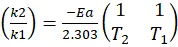
(2)
where Ea denotes activation energy, R is the gas constant, and k1 and k2 are rate constants at temperatures T1 and T2, expressed in degrees Kelvin. [32]
The relationship between storage temperatures and the rate of degradation is demonstrated by both equations. By examining stability from the deterioration rates observed at higher temperatures, some degradation processes can be anticipated using the Arrhenius equation. If the activation energy is known, the degradation rate at lower temperatures can be calculated from those seen at "stress" temperatures. A model that incorporates some activation energy served as the basis for the stress tests used in the current International Conference on Harmonization (ICH) standard, such as 40% for goods intended for controlled room temperature storage. Manufacturers in the pharmaceutical sector frequently employ shortcuts like the Q rule and bracket tables to anticipate the shelf life of medicines; these approaches are not formally recognized by the FDA or ICH. [33] According to the Q rule, when a product's storage temperature drops by 10°C, its deterioration rate decreases by a predetermined factor, Q10. Because these values correspond to practical activation energies, Q10 is usually set at 2, 3, or 4This model makes the assumption that the Q value remains constant with temperature. The activation energy of a specific material is assumed to fall between two limitations in bracket tables. This allows for the creation of a table that displays the number of days under stress at certain high temperatures. The majority of compounds and reagents of relevance in pharmaceutical and clinical laboratories have activation energies between 10 and 20 kcal, according to experience because of this, bracket tables make use of this range, and when more than fifty batches are sold, it is recommended to use them. This approach is more practical since it tests the product under both ideal and real-world storage circumstances. Cyclic temperature stress testing is not a standard procedure for products that are sold. Based on product knowledge, cyclic temperature stress tests are created to replicate actual storage circumstances. The majority of cycles are made to last 24 hours because the Earth's daily cycle lasts 24 hours. Pharmaceuticals are most likely to be impacted during storage at this time. The recommended storage temperatures and the physicochemical degradation characteristics of the product are taken into consideration when choosing the minimum and maximum temperatures for cyclic stress tests. It is usually advised to do 20 cycles. In pharmaceuticals and personal care items, preservatives or chemical additions assist stop contamination and the growth of dangerous microorganisms in cosmetics including sunscreens, lotions, shampoos, detergents, toothpaste, and makeup. [34]
Antimicrobial preservatives assist prevent contamination that can lead to skin irritation or infection by preventing the growth of bacteria, yeasts, and fungi in cosmetics and personal care items. By halting reactions that occur when specific compounds in cosmetics or personal care products interact with oxygen in the presence of light, heat, and specific minerals, antioxidant preservatives also aid in preventing the rotting of these goods. Antimicrobial preservatives found in cosmetics and personal care products stop bacteria, fungus, and yeasts from growing, preventing contamination that could irritate or infect skin by preventing reactions that happen when certain compounds in cosmetics or personal care products are exposed to oxygen in the presence of light, heat, and specific minerals, antioxidant preservatives can also be employed to keep these goods from spoiling. In the process of developing a novel medication or formulation, stability testing is a crucial component. An essential step in a pharmaceutical development program is assessing the drug's and its formulation's stability.
The active medication can be distinguished from any degradation products created under specific storage settings with the use of stability tests. In order to obtain sufficient information regarding the stability of the molecule in question, it is preferable to conduct a degradation study early in the development process. Additionally, the production process and storage conditions of drugs will be improved with the use of this information. In order to guarantee that this objective is achieved regardless of the circumstances the product encounters throughout its shelf life, regulatory criteria have grown more stringent throughout time and with increased expertise. Consequently, stability investigations have to be carried out in accordance with rules and scientific standards. [35]
Acknowledgement: We are thankful to Shri Vishnu College of Pharmacy (Autonomous), for providing library facility and encouragement for writing review article.
Conflict of interest: Authors have declared no conflict of interest.
Funding: Nil
REFERENCES



Vabbani Kiran, Kurevella Chakresh Kumar, Nagineni Sudarshan Rao, A Comprehensive Review on Drug Storage Conditions and Stability Assessment in Pharmaceutical Products, Int. J. of Pharm. Sci., 2026, Vol 4, Issue 7, 3038-3048, https://doi.org/10.5281/zenodo.21375689
 10.5281/zenodo.21375689