

We use cookies to ensure our website works properly and to personalise your experience. Cookies policy
Department of Pharmaceutical Quality Assurance, R.G Sapkal College of Pharmacy, Sapkal Knowledge Hub, Kalyani Hills, Anjaneri, Trimbakeshwar Rd, Nashik, 422213, Maharashtra, India.
The Present study focuses on the systematical method development and validation of quantitative determination by using analytical methods for Metoprolol Succinate and Azelnidipine. The study is simple, sensitive and highly accurate High-Performance Liquid Chromatography method has been studies as well as validated for determination of Metoprolol succinate and Azelnidipine in bulk and pharmaceutical dosage form. Both the drugs are anti-hypertensive medications. Metoprolol is cardio-selective ?1 adrenergic receptor blockers and Azelnidipine a calcium channel blocker. The present analytical method was developed on Shimadzu HPLC LC-2010. The HPLC chromatography was performed using a technique like Reversed Phase C18 column with mobile phase based are dependent on the polarity of the molecules. The overall study outlines the RP-HPLC determination of metoprolol succinate and azelnidipine. The calibration curves demonstrate the excellent result of linearity about the selected concentration ranges, with correlation coefficient values. Accuracy studies showed satisfactory percentage recovery within acceptable limits as well as precision study involving low Relative-Standard Deviation values, that confirm the quantification of the method. RP-High Performance Liquid Chromatography method is successfully applied for the quantitative estimation of Metoprolol Succinate and Azelnidipine in pharmaceutical dosage forms
Metoprolol succinate belongs to the class of selective β₁-adrenergic receptor blocker antagonist that is commonly prescribed for treatment of hypertension, angina pectoris, heart failure, and other cardiovascular disorders and Azelnidipine is Calcium Channel Blocker as well use in the treatment of hypertension. Due to its extensive use in pharmaceutical formulations, accurate and reliable analytical methods are essential to ensure drug quality, safety, and efficacy. The development and rigorous validation of analytical procedures are essential for the accurate quantitative determination of Metoprolol succinate and Azelnidipine in bulk drugs substance and finished dosage forms. Validated methods, following ICH guidelines, ensure precision, accuracy, reproducibility, and regulatory compliance in routine quality control analysis.
Chromatographic techniques are commonly employed due to their sensitivity, simplicity, and cost effectiveness. Therefore, developing and validating robust analytical methods for Metoprolol succinate and Azelnidipine.
1.2 Method Development-
Method validation is carried out to ensure that a laboratory or analytical method is for its required purpose and consistently produces reliable, accurate, and reproducible results. The objective is to provide evidence of documents that the method performs effectively under specified conditions and meets the defined requirements for its required use, whether in research, clinical, or industrial setting.
Components of method validation include:
1.2.1 VALIDATION OF ANALYTICAL METHOD:
Validating a quantitative method is the process by which it is established, by laboratory knowledge gaining, that performance characteristics of the technique meet the requirements for the intended analytical application. Typical analytical performance characteristic for Analytical method validation are listed below
The accuracy of a measurement is defined as the closeness of the measured value to the true value.
Precision describes the degree of agreement or the spread among a series of results obtained by repeated measurement of the same homogeneous sample under specified conditions. Precision is evaluated at three levels: repeatability, intermediate precision, and reproducibility.
It is defined as the ability of a method to measure accurately and unambiguously the analyte of interest in the presence of other components that may be present in the sample matrix, such as impurities, degradation products, or excipients.
Intermediate precision captures the variability observed within a single laboratory when measurements are made on different days, by different analysts, or using different equipment.
The linearity is quantitative study of capacity to generate test results that are directly proportional within a defined range to the concentration of substances in the sample.
Robustness reflects the intrinsic resilience of a method — its ability to remain unaffected by small, deliberate changes in critical method parameters. A robust method provides confidence in its reliability and suitability for routine usable under normal conditions.
Ruggedness is a calculation of how consistently an analytical method performs when deliberately subjected to variations in operating conditions — for instance, different laboratories, different analysts, different instruments, different reagent batches, different assay timings, or different temperatures.
1.3 CHROMATOGRAPHY
Chromatography encompasses a collection of analytical techniques that are used for separation, identification, and quantitative determination of chemical constituents present in complex mixtures.
In simple terms, chromatography may be defined as follows:
“It is the technique in which drug components of a mixtures are separated based upon the rates at which they are carried or moved through a stationary phase (column) by a gaseous or liquid mobile phase”. Chromatography is mainly classified into two categories based on the type of mobile phase:
Separation of components occurs due to factors such as differences in migration rates, capillary action, and adsorption.
Table 1. Various types of chromatographic techniques
|
Techniques |
Stationary phase |
Mobile phase |
|
Column chromatography |
Solid |
Liquid |
|
Partition chromatography |
Liquid |
Liquid |
|
Paper chromatography |
Liquid |
Liquid |
|
TLC |
Liquid or Solid |
Liquid |
|
Gas liquid chromatography (GLC) |
Liquid |
Gas |
|
Gas solid chromatography (GSC) |
Solid |
Gas |
|
Ion exchange chromatography |
Solid |
Liquid |
1.4 HPLC (High Performance Liquid Chromatography):
High performance liquid chromatography is the most widely used analytical technique utilizes the liquidified mobile phase separation of the components of mixture. These components are first dissolved in a solvent forced to flow through a chromatographic column under high pressure. In the column, the mixture is resolved into its components. From different choices of both solvent and stationary phases the interaction of solute with mobile and the stationary phase can be manipulated. HPLC is used either in the liquid-solid adsorption chromatography mode or the liquid-liquid partition chromatography mode, either normal or reversed phase. Both partition and adsorption chromatography operates on differences in solute polarity since polarity is important in determining both adsorption and solubility. As a result, HPLC acquires a high degree of versatility not found in other chromatographic systems and it could separate a wider variety of chemical mixtures.
Table 2. Scouting Parameters of HPLC
|
Parameters |
Description of Parameters |
|
Column |
C8 C18 |
|
Mobile Phase |
ACN: Buffur ACN :Water Methanol : Water Methanol: Buffur |
2. EXPERIMENTAL WORK:
2.1 Materials and Reagents:
Following list of Reagents/Standards/Equipment was required during method validation. Name of standards Drugs metoprolol succinate, azelnidipine. Reagents Potassium dihydrogen orthophosphate, Orthophosphoric acid, Acetonitrile, Water. Instruments/ Equipments HPLC System Shimadzu-LC-2010CHT, Software-LC Solution, pH Meter-Labman, Sonicator-Life Care Instruments Pvt. Ltd., Analytical Balance-Lab Man, HPLC Column: C18, (4.6 mm x 15-cm), 5µm-Agilent.
Chromatographic Conditions: To validate the analytical method for % Assay of Metoprolol Succinate and Azelnidipine tablet and active pharmaceutical ingredient by High Performance Liquid Chromatography. The method was validated for certain Parameters like specificity and, precision, solution stability, accuracy, linearity based on approved protocol with predetermined acceptance criteria.
Mobile Phase Preparation:
Buffer Preparation:0.01M ammonium dihydrogen orthophosphate in 1000ml of water.
Mobile Phase Preparation: Mixture of 40ml Buffer and 60ml of Acetonitrile. With pH of 3.2.
Diluent: Methanol
To validate the analytical method for % Assay of Metoprolol Succinate and Azelnidipine tablet and active pharmaceutical ingredient by High Performance Liquid Chromatography. HPLC method mainly used for content determination assay of metoprolol succinate as well as azelnidipine tablet. The method was validated for certain Parameters like specificity and selectivity, precision, solution stability, accuracy, linearity and Range based on approved protocol with predetermined acceptance criteria.
Table 3. Typical Chromatographic Conditions
|
Equipment |
Shimadzu (LC-2010CHT) |
|
Column |
HPLC Column: C18, (150 x 4.6mm),5µm |
|
Rate of Flow |
1.00 ml/min |
|
Wavelength |
275nm |
|
Injection volume |
20 µl |
2.1.1 Preparation of solution:
Measure accurately 16mg Azelnidipine API and 25mg Metoprolol succinate API transfer it into a 25ml measuring flask and add 15ml of methanol and sonicate till dissolve and makeup volume with methanol. Take both 5ml of above solution in 50 ml of measuring flask and volume makeup by using methanol.
Take 10 tablets and measure its average weight (Tablet weight). Crush the tablets into fine powder. Take powder equivalent to average weight into 50ml of volumetric flask add 30 ml of methanol sonicate for 10 mins. and makeup the volume with methanol. Filter above solution with whatmann filter paper No.41 and collect the filtrate. Take 5ml of above solution into 50 ml volumetric flask and makeup the volume with methanol.
The relative standard deviation of metoprolol succinate and azelnidipine should not be more than 2.
3. RESULTS AND DISCCUSION:
Table 4. Optimization of RP-HPLC
|
Trial No. |
Mobile Phase |
Observation |
Action |
|
1 |
Water and Acetonitrile Ratio-(50:50) |
No peak is observed
|
Add Buffer in mobile phase |
|
2 |
Potassium Dihydrogen Orthophosphate and Acetonitrile Ratio- (60:40) |
Only Peak is observed and peak shape is not clear |
Change buffer to NaH2PO4 |
|
3 |
Sodium Dihydrogen Orthophosphate and Acetonitrile Ratio- (60:40) |
Only one peak is observed
|
Change buffur to NH4H2PO4
|
|
4 |
Ammonium Dihydrogen Orthophosphate and Acetonitrile Ratio- (60:40) |
Only one peak is observed
|
Change in ratio of buffur NH4H2PO4 and acetonitrile |
|
5 |
Ammonium Dihydrogen Orthophosphate and Acetonitrile Ratio- (40:60) |
Two peaks are observed but distance is too long |
Add PH to mobile phase
|
|
6 |
Ammonium Dihydrogen Orthophosphate and Acetonitrile Ratio- (40:60) |
Peak is Observed & Method optimize
|
|
3.1 Metoprolol Succinate and Azelnidipine HPLC Method Development Parameters:
The specificity method was determined by analysing drugs and active pharmaceutical ingredients.
Table 5. System Suitability observed during Specificity
|
|
Area |
|
|
Sample |
Metoprolol Succinate |
Azelnidipine |
|
|
|
|
|
Blank |
|
|
|
Standard Solution |
2498996 |
1116433 |
|
Sample Solution |
2455773 |
1136053 |
The Precision of an quantitative study determines closeness of agreement between a series of measurements obtained from multiple sampling of the same sample solutions as per standards. Precision Three Levels Consideration As, System Repeatability, Analysis Repeatability, Ruggedness.
Precision under system repeatability conditions i.e. conditions where the system suitability was checked by injecting five replicate standard injections of pharmaceutical formulations like metoprolol succinate and azelnidipine.
Table 6. Observation of System Suitability
|
No. of Inj. |
Metoprolol Succinate |
Azelnidipine |
|
1 |
2251564 |
1214499 |
|
2 |
2241480 |
1201298 |
|
3 |
2238857 |
1222729 |
|
Average |
2243967 |
1212842 |
|
STDEV |
6708.639 |
10811.160 |
|
RSD |
0.30 |
0.89 |
Table 6. Observation of Intermediate Precision
|
|
Area |
|
|
No. of Inj. |
Metoprolol Succinate |
Azelnidipine |
|
1 |
2334630 |
1130335 |
|
2 |
2330691 |
1122195 |
|
3 |
2343615 |
1134031 |
Precision under analysis repeatability conditions where test results are independent and obtained with similar methodology of same test items like same laboratory to laboratory using same operator and equipment’s within short time interval.
Closeness to the true value, measured by % recovery of sample spikes or % error in the analysis of a reference sample. For establishing Accuracy of the method, prepared the sample solutions of different concentrations for Metoprolol Succinate and for Azelnidipine.
Table 7. Observation of accuracy
|
Standard Solution |
||
|
|
Area |
|
|
No. of Inj. |
Metoprolol Succinate |
Azelnidipine |
|
1 |
2387994 |
1306779 |
|
2 |
2373013 |
1302806 |
|
3 |
2363229 |
1314485 |
|
Average |
2374745 |
1308023 |
|
STDEV |
12473.053 |
5938.100 |
|
RSD |
0.53 |
0.45 |
Metoprolol Succinate- Azelnidipine-
= 3.3 ×Std.DeviationSlope
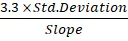
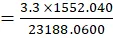
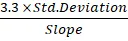
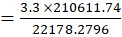
LOD = 0.2 ppm LOD = 1.6 ppm
Limit of Quantification: The Quantification limit of individual testing procedure having less amount of drug substance in the sample which is quantitatively determined by using suitable precision.
Linearity Sample Stock Solution:
Weigh 20 mg Metoprolol Succinate and 20mg of Azelnidipine in 50ml calibrated flask sonicate, dissolve and dilute upto volume by using mobile phase.
Linearity of Metoprolol Succinate
|
Area |
Conc in ppm |
Conc. of Solution |
|
|
||
|
0 |
0.0 |
|
|
1810326 |
80.0 |
80 |
|
2084216 |
90.0 |
90 |
|
2309666 |
100.0 |
100 |
|
2445390 |
110.0 |
110 |
|
2789142 |
120.0 |
120 |
Linearity of Azelnidipine
|
Avg. Area |
Conc. in ppm |
Conc. of Solution |
|
0 |
0.0 |
0 |
|
1,131,268 |
51.2 |
80 |
|
1,288,838 |
57.6 |
90 |
|
1,421,164 |
64.0 |
100 |
|
1,571,643 |
70.4 |
110 |
|
1,692,555 |
76.8 |
120 |
SUMMARY AND CONCLUSION
The Overall study determines the successful driven method development Reverse Phase -High Performance Liquid Chromatography methods and validation study for quantitative analysis of Azelnidipine and Metoprolol Succinate. Both methods were rigorously validated following ICH guidelines, are mainly simple, precise, accurate, linear, and robust for routine pharmaceutical analysis.
FUTURE SCOPE
The developed QbD-based UV spectroscopic and RP-HPLC methods provide a robust, accurate, and reliable approach for the simultaneous estimation of Metoprolol Succinate and Azelnidipine. Future work may involve application of these methods to stability studies, biological sample analysis, advanced chromatographic techniques, green analytical approaches, and routine industrial quality control, thereby expanding their utility in pharmaceutical research and manufacturing.
REFERENCES
Development and Validation of an RP-HPLC Method for Simultaneous Quantification
of Azelnidipine and Metoprolol Succinate in Synthetic Mixtures Pharmaceutical Sciences and Drug Design ISSN: 3062-4428 www.galaxypub.co/page/journals
WITHIN A SYNTHETIC MIXTURE Pharmacophore ISSN-2229-5402 http://www.pharmacophorejournal.com
Development and Validation of an RP-HPLC Method for Simultaneous Quantification
of Azelnidipine and Metoprolol Succinate in Synthetic Mixtures Pharmaceutical Sciences and Drug Design ISSN: 3062-4428 www.galaxypub.co/page/journals
WITHIN A SYNTHETIC MIXTURE Pharmacophore ISSN-2229-5402 http://www.pharmacophorejournal.com

Smita Aher, Vanita Sawant, Nikita Mawal, Pratiksha Wagh, A Comprehensive Review on RP-HPLC Method Development and Validation for Simultaneous Estimation of Metoprolol Succinate and Azelnidipine, Int. J. of Pharm. Sci., 2026, Vol 4, Issue 7, 5782-5789, https://doi.org/10.5281/zenodo.21698785
 10.5281/zenodo.21698785