

We use cookies to ensure our website works properly and to personalise your experience. Cookies policy
Department of Pharmaceutical Chemistry, Goel Institute of Pharmacy and Sciences, Lucknow, Uttar Pradesh, 226028.
Myrica esculenta Buch-Ham. Ex D. Don., also called kaphal or Himalayan bayberry, is a tree that people in the Himalayas use for food and medicine. This review brings together information about how the plant's used in traditional medicine, what chemicals are in different parts of the plant, what experiments have shown, and what challenges there are in using the plant for real treatments. This includes studies that were listed under the name M. Nagi. Traditional uses say the fruit is eaten and the bark is used to treat problems like coughs, stomach issues, swelling, and fever. Scientists have found chemicals in the plant like phenolic acids, flavonoids, tannins, and others. The chemicals change depending on which part of the plant's used, where it grows, and how it is processed. Some lab studies show the plant has antibacterial effects, and it might help with inflammation, ulcers, and other health issues. There are hints it could help with metabolism, the liver, the heart, reproduction, and the brain. The strongest signs are about how the chemicals affect oxidation and inflammation. The tests and samples are all different. Most of the results come from lab work, computer models, or animal studies. The information in this review does not prove that Myrica esculenta works in humans or how much people should take or if it is safe in the long term. The research suggests more study is needed to understand the plant and to use it in food or supplements. It is not proven that Myrica esculenta is a treatment. To move forward, scientists need to make sure the plant is correctly identified, the chemicals are consistent, toxicology is studied, how the body uses the plant is understood, human studies are done, and ways to grow the plant sustainably are found.
Myrica esculenta is a fruit tree found in the Himalayas. It is used both as food and in medicine. People in the region call it kaphal, kaiphal, or katphala. Some old studies and reports refer to it as M. Nagi thinking it is the plant. It’s important to note the correct scientific name and keep a sample (voucher specimen) because local names and old names can confuse. Maybe the study was actually about a plant in the same family, the Myricaceae. This review only talks about M. Esculenta. It does not use information from species to say anything about how effective M. Esculenta is. In the Indian Himalayas, people have traditionally used this plant for problems like coughs, colds, stomach issues, fever, swelling, and skin or wound care. The fruits are also eaten fresh. Turned into pickles and drinks.[1] I have read reviews that keep saying ethnomedicinal use is wide, but they say that pharmacological evidence is mostly just experimental. They also say that safety, cultivation, and clinical validation are still not settled.[2] [3]
This review looks at what the plant’s chemistry and experimental pharmacology show and how much we can rely on those findings when thinking about using them in people. The main idea is that there are different kinds of evidence, and they all exist together but aren’t the same. These include: known uses in food and traditional medicine; identifying the chemicals and testing them in lab dishes; testing in animal models of disease; computer predictions of targets; and actual clinical studies in humans. Each type gives us some information. None alone is enough to prove something works in people. For example, just because a plant compound acts as an antioxidant in a test tube doesn’t mean it does the thing in a human body. Even if something helps animals with an induced illness, that doesn’t mean it will help real patients with the same condition.
Development of the evidence base
I started with the chemical record, which grew from isolating bark polyphenols and tannins. Those bark polyphenols and tannins included acid, myricanol, myricanone, gallated flavan‑3‑ols, prodelphinidin dimers, and castalagin [4]. Later studies looked at leaf flavonoid glycosides and sterols [5]. They also isolated the leaf monoterpenoid glycoside myresculoside. Tested those isolated compounds for ACE inhibition [6]. Additionally, those studies advanced pharmacogenetic and chromatographic quality‑control methods for leaves and bark [7] [8]. Since the 2010s, fruit studies have linked polyphenol and flavonoid content with in vitro radical scavenging. I also noticed that solvent comparison experiments show that the extraction choice can materially change the measured composition and bioactivity.[9] [10]. More recent work has expanded into inflammation and colitis models, neuroprotection, nanoparticle formulation, cardioprotection, and computational target prediction [11] [12] [13] [14] [15]. This is a shift in model complexity, not yet a transition to demonstrated clinical benefit.
Methods and scope
A narrative literature search was done on 11 October 2026 in PubMed, OpenAlex, and Semantic Scholar. The search used combinations of these terms: Myrica esculenta, M. Nagi, kaphal/kaiphal, traditional or ethnomedicinal use, phytochemistry, bioactive compounds, pharmacological activities, clinical efficacy, safety/toxicity, conservation, nutrition, and processing. Only academic databases were used. Each record was checked for accuracy and for clear, direct evidence about traditional use, chemical identification, assay results, animal studies, quality standardization, safety, or conservation. Reviews were helpful for identifying themes, but primary studies were preferred when looking at actual experimental results. Most of the material for this review was abstracts or short extracted passages, not full papers. Because of that, it wasn’t possible to do a risk-of-bias assessment or check the methods, beyond what was reported in the abstracts. This is a synthesis. Not a systematic review or a meta-analysis. The studies used different kinds of assays, different parts of the plant, different extraction methods, and different units of measurement. Because of these differences, we can’t combine the results to get an estimate of pharmacological effect. Recent review studies also point out that outcome units don’t match up and variance data is often missing. Making it hard to do any kind of quantitative pooling [16].
Traditional uses and food value
Traditional reports are most consistent when it comes to bark and fruit, even though roots, leaves, flowers, and small branches also show up in records. Bark preparations are linked to cough, asthma, chronic bronchitis, fever, diarrhea, rheumatism, inflammation, and ulcer issues; fruit is eaten fresh. Made into pickles and drinks [1]. A later review also mentions uses for the system and the digestive system and adds fever, anemia, and ear, nose, and throat problems [17]. These reports show a pattern of use, not proof of effectiveness: the existing ethnomedical summaries do not consistently record recipe, dose, time, diagnostic standards, or side effects, and the review passages gathered information without showing the original community surveys.
The nutritional value and importance of the fruit for livelihoods should be considered separately from any claims about its benefits. Research and reviews show that the fruit contains carbohydrates, fiber, vitamin C, and minerals, as well as compounds like phenolics, flavonoids, and other secondary metabolites [18] [19]. A study on fruits from Mizoram found that M. Esculenta fruit had 89 ± 1% moisture and 23.8 ± 0.6 mg per 100 g of vitamin E, along with measurements of carbohydrates and minerals. The high moisture content highlights the importance of interpreting the composition based on the study's stated conditions rather than comparing it directly to dried extracts [20]. A 2026 review on fruit crops outlines processing methods such as making juices, frozen products, dried snacks, wine, vinegar, and other value-added foods. It also notes that the perishable nature of the fruit limits its use in form [21]. These processing options are food industry opportunities, not proof that processed fruit can prevent or treat disease.
Supply and conservation go hand in hand with development. M. Esculenta is described as a Himalayan tree that has poor natural regeneration partly due to seed-coat dormancy. Harvesting pressure and changes in habitat are raising concerns about populations [22]. One pharmacognostic study found that the phytochemical and HPTLC profiles in stem bark and small branches were broadly similar, suggesting that branch material could serve as a substitute. This is a conservation idea, but it still needs testing for equivalence across different locations, seasons, and pharmacological effects [23]. Reviews suggest micropropagation and germplasm conservation as solutions, but these are just proposals, not evidence of large-scale cultivation or sustainable harvesting [24] [2]. In general, the use and food value of M. Esculenta are well documented. However, ethnographic records and conservation results are not as standardized as laboratory studies often suggest.
Phytochemical composition and quality control
Chemical classes and plant-part differences
The species contains a chemically diverse mixture rather than one established active principle. Bark chemistry is especially notable for hydrolysable tannins and proanthocyanidin/prodelphinidin polymers, together with gallic acid, epigallocatechin gallate, myricanol, and myricanone [4]. Bark isolation studies later added compounds such as myricetin, myricitrin, taraxerol, barbaloin, sterols, and glycosides [25] [26]. The 2024 stem-bark isolation study identified six compounds, including myricetin, myricanol glycoside, myricanone, myricolol, and β-sitosterol derivatives; its HPLC report identifies myricetin as a major component in that particular crude extract, not as a universal species-level proportion [27].
Fruit studies repeatedly report gallic, hydroxybenzoic, caffeic, p-coumaric, chlorogenic, and ellagic acids, catechin, and myricetin, but profiles vary by location, maturity, solvent, and analytical platform [19] [9]. In a population comparison, fruit phenolics and flavonoids varied across sampled populations, and individual phenolic compounds also differed significantly [9]. A methanolic fruit study using several solvent systems reported more phenolics and flavonoids in polar extracts, whereas a separate acidic-acetone extraction produced the highest polyphenol recovery and cell-based antiproliferative activity within its own experimental comparison [28] [10]. These are not contradictory so much as method-dependent: extraction solvent, acidification, concentration basis, plant tissue, and assay determine what is recovered and measured.
Leaves contain flavonoid glycosides, quercetin-related compounds, sterols, phenolic acids, and volatile constituents. A liquid-chromatography/mass-spectrometry study of leaf extracts identified gallic acid, myricanol, myricanone, epigallocatechin gallate, quercetin, p-coumaric acid, sterols, triterpenes, and myresculoside among its reported constituents [29]. The isolation of leaf flavonoid glycosides and the new monoterpenoid glycoside myresculoside demonstrates structural diversity, while an ACE assay reported only modest inhibition for the most active isolated compounds at 100 μM [5] [6]. Volatile bark oil is compositionally distinct: a hydrodistilled oil study found long-chain alcohols, eudesmol acetate, palmitic acid, and cis-β-caryophyllene as major constituents and reported antimicrobial and topical anti-inflammatory activity [30]. Volatile oil chemistry should not be conflated with polar polyphenol extracts.
| S.No. | Compound | Structure | Plant Part |
|---|---|---|---|
| 1 | Myricanone | Bark, Leaf |
| 2 | Myricanol | Root, Bark |
|---|
Analytical standardization
Several pharmacognostic studies provide a foundation for authenticating materials. Leaf microscopy and HPTLC have been proposed as diagnostic standards [7], while gallic acid quantification has been examined in leaf samples [31]. Bark HPTLC methods identify gallic acid, lupeol, oleanolic acid, and stigmasterol, with marker amounts differing between collection sites [8]. A validated HPTLC/HPLC fruit method reported regional and plant-part differences in gallic acid content, demonstrating that botanical identity alone does not ensure chemically equivalent batches [32].
The list of chemicals that has been collected helps find things but is not yet a full description of a product. To prepare a candidate, you need a plant part that has been properly identified, a record of the plant, where it was collected, how mature it was when harvested, how it was dried and stored, what was used to extract it and in what amount, the range of marker tests for harmful substances, and how stable it is. Quality control based on markers should use a fingerprint that includes compounds because just one, like myricetin or gallic acid, cannot show all the differences in the mixture. The research shows that it is possible to analyze. Differences between areas and different methods mean that being able to repeat results is still a big challenge.
Pharmacological evidence
Antioxidant and anti-inflammatory effects
Antioxidant activity is a widely reported experimental property, especially for fruits and bark. In a 2010 study of fruit populations, total phenolics ranged from 1.78 to 2.51 mg equivalents per gram of fresh weight, and total flavonoids ranged from 1.31 to 1.59 mg quercetin equivalents per gram of fresh weight. Results from DPPH, ABTS, and FRAP assays matched these contents positively [9]. A 2024 comparison of fruit extracts also found that the methanol extract had the highest phenolic and flavonoid content and the strongest antioxidant activity among the solvents tested [33]. A study of leaf solvents reported results with methanol showing the greatest radical‑scavenging activity and the highest recovery of phenolics and flavonoids [29]. However, these numbers cannot be put into a ranking table because they vary by plant part, extraction method, assay type, reference standard, and unit of measurement. The fact that many different studies show the general trend confirms that the chemicals can act as antioxidants, but it does not prove that they give health benefits when eaten.
Mechanistic evidence is more convincing when isolated compounds and cellular results match up. A compound from bark called 3-acetylmyricadiol lowered oxide, IL-6, and TNF-α in macrophages that were triggered with LPS. The strongest effect was seen at 20; more than 90% of the cells stayed alive in that test [34]. Another study looked at bark and root extracts. Found they blocked lipoxygenase and hyaluronidase in lab tests. It also showed interactions between the extract’s components and target proteins through computer modeling. But those docking and molecular dynamics results are still predictions. They need to be checked in real biological systems to be sure [35]. In animal models like carrageenan paw edema and reactions, bark extract reduced signs of inflammation in rodents [36] [37]. Altogether, these findings point to an anti-inflammatory effect at the chemical, cell, and animal levels. They don’t show a proven dose for humans or prove that one single compound is responsible for all the effects seen with the full extract.
Antimicrobial, anti-ulcer, and gastrointestinal activity
Antimicrobial effects vary with how the extract's prepared and with the type of organism involved. In one study, methanolic leaf extracts showed greater antioxidant and antimicrobial activity than extracts made with water or ethyl acetate, and LC‑MS revealed a mix of polyphenols, terpenoids, and sterols [29]. Another study found that fruit solvent extracts could inhibit bacteria, but they did not work against other bacteria or fungi, showing that antimicrobial activity cannot be assumed for all pathogens [38]. A bark essential oil study showed activity against a range of bacteria and fungi and also provided topical anti‑inflammatory benefits in mice. However, the oil’s composition and the way it is applied topically differ from the edible fruit or oral bark decoctions that people might use [30]. A separate fish‑health study demonstrated that immersing rainbow trout in a leaf extract could boost the fish’s response against Aeromonas hydrophila, which is useful for aquaculture but does not prove that the same extract would treat human infections [39].
Gastrointestinal evidence includes a study with rats where the pylorus was tied off, and the ethanolic bark extract changed how the stomach secreted and how oxidative stress was measured [40]. Recently, a flavonoid-rich fraction made with ethyl acetate and an ethanolic extract helped with disease activity, colon measures, inflammatory cytokines, and tissue samples in mice that had colitis caused by DSS. This was most clear at 400 mg per kg [11] [41]. This later finding gives model-level proof about inflammation in the intestines, but colitis caused in mice is not the same as a real trial for ulcerative colitis in people. The available information does not show if the treatment is safe over time, how it works with regular care, or if the active parts of the plant work throughout the body or just in the gut.
Metabolic, hepatic, cardiovascular, and reproductive signals
Researchers have looked into the ability of substances to lower blood sugar by blocking an enzyme called α-amylase. However, this has not led to confirmed results in patients. Studies comparing plant extracts from Nepal showed that the bark of M. Esculenta can stop an enzyme from working in a lab. Other studies on the fruit and bark also found that they have properties and can block enzymes to different degrees. These findings can encourage research into possible medicines, but they do not prove that the substances can lower blood sugar in animals or people. Therefore, any claims that these substances can treat diabetes should be considered temporary. Not fully proven.
Hepatoprotective evidence is emerging from injury models that are induced. In a 2019 study, several northeastern fruit juices were evaluated. The 2019 study reported that M. Esculenta performed favorably on stress-related measures in gentamicin nephrotoxicity. However, the multi-fruit design makes species attribution less secure [44]. A 2026 abstract reports dose-dependent biochemical and histological improvement with aqueous fruit extract in CCl4-injured rats. The result is encouraging. The result should be treated as preliminary until the full study and independent replication are assessed [45]. Cardioprotection has likewise been reported in an isoproterenol-induced mouse model. In that model, methanolic fruit extract improved markers and tissue findings. The improvement was associated with Nrf2/HO-1 changes [14]. Both studies test. Attenuation in experimentally induced injury. Neither study tests treatment of human disease.
I have seen that reproductive and neurological research has also moved into animal models. A 2025 study with 25 Wistar rats reported sperm parameters and antioxidant markers after aqueous fruit extract in cyclophosphamide‑induced dysfunction. Since the model uses injury and the available evidence does not establish independent replication or human fertility outcomes, the study is preliminary. In haloperidol‑induced Parkinsonism in rats, a methanolic leaf extract improved biochemical and histological measures in the study. Anxiolytic‑like behavior is reported for ethanolic bark extract under behavioral assays, while antidepressant‑like outcomes were not seen in the same study. Computational docking of constituents to NOX2, gastric targets, or inflammatory proteins generates hypotheses, not proof of target inhibition or therapeutic action. The overall pattern shows promising breadth with a translational bridge in the study.
Antiproliferative and anticancer evidence
Anticancer claims need separation of cytotoxicity from therapeutic selectivity. A fruit‑solvent study reported that extracts reduced viability in cancer cell lines while no cytotoxicity was observed in the normal transformed lines that were tested under these conditions [10]. A seed versus pulp study found that the seed extract had phenolic content and stronger antiproliferative activity in breast cancer cells, whereas an albumin‑nanoparticle formulation of the plant extract induced cytotoxicity and apoptosis in pancreatic cancer cells in vitro [50] [13]. These findings support work on selectivity, exposure, active molecules and formulation. They do not establish anticancer efficacy in animals or patients.
Comparison of representative primary studies
| Study | Material and design | Main reported finding | Interpretive boundary |
|---|---|---|---|
| 2010 fruit-population study | Fruit samples from multiple Himalayan populations; phenolic profiling and antioxidant assays | Population differences in phenolic/flavonoid content; antioxidant measures correlated positively with these measures [9] | Chemical assays; population and fresh-weight variation limit direct comparison |
| 2013 solvent-comparison study | Fruit extracts, four solvent systems; antioxidant and cell assays | Acidic-acetone/acetone extracts recovered more phenolics; cervical cancer-cell viability fell 70–92% in tested lines [10] | In vitro cytotoxicity is not clinical anticancer efficacy |
| 2019 leaf-extract study | Leaf extracts in methanol, ethyl acetate, and water; antioxidant, antimicrobial, LC-MS | Methanol extract showed the highest reported phenolics and radical scavenging among tested solvents [29] | Findings are extract- and assay-specific |
| 2012 essential-oil study | Hydrodistilled bark oil; GC-MS, microbial tests, mouse topical inflammation | Oil yield 0.3%; major constituents included n-hexadecanol and eudesmol acetate; antimicrobial and topical effects reported [30] | Essential oil differs from aqueous/food preparations and route of use |
| 2010 anti-allergy study | Bark extract; mouse allergic pleurisy/permeability models | Reduced eosinophil accumulation and plasma exudation at tested oral doses [37] | Small preclinical signal; mechanism not directly established |
| 2024 colitis study | Flavonoid-rich fraction; DSS-induced mouse colitis | 400 mg/kg fraction improved disease activity, colon tissue, and cytokine measures [11] | Model-specific; not a human efficacy estimate |
| 2020 neuroprotection study | Methanolic leaves extract; haloperidol-induced rat Parkinsonism | Behavioral and oxidative-stress markers improved with treatment [12] | Induced rodent model; human relevance undetermined |
| 2026 cardioprotection study | Methanolic fruit extract; isoproterenol-induced mouse myocardial injury | Lower cardiac injury markers and improved histology reported, with Nrf2/HO-1 changes [14] | Preventive animal model; abstract-level evidence in this review |
Across this set, the most reproducible signal is that phenolic-rich extracts score in antioxidant assays and can influence oxidative/inflammatory markers in experimental models. Yet designs differ in material, solvent, dose, and endpoint, and few report outcomes in directly comparable units. A single pooled “effect” would be misleading.
Methodological assessment, safety, and translation
The evidence base covers a range of claimed activity but lacks depth in the standards required for clinical translation. Many studies use phytochemical screening and crude extracts that are not fully described; even chromatographic studies show differences in markers based on region and plant part [32] [8]. The way extracts are made can also change the activity observed, as seen in comparisons of fruit and leaf extracts using solvents [10] [29]. Because of this, two studies that both call their product "M. Esculenta extract" might actually be testing chemical combinations. Animal experiments give some context, but they often use induced injury, small groups of animals, short treatment periods, and look at things like enzymes or tissue samples instead of long-term function. Reports made using computer models should be considered less reliable than those that show biochemical or cell-based results.
Safety cannot be determined by how foods are used or by a single short-term toxicity test. Brine-shrimp death, cell health, and reports of low toxicity each look at different results and do not take the place of long-term toxicity studies, reproductive or genetic toxicity tests, drug interaction research, or studies on how the body processes a drug [51] [10]. The 2026 review also says that the toxicity information is limited and the area is still in the stages of research [2]. No human study or clinical effectiveness test was found in the search done for this review; this is a result of the search, not evidence that no study exists. The information available does not show a safe human dose, a real health benefit, or a full picture of safety.
The next studies need to focus on key areas. First, create one or more preparations that use plant material that has been officially identified, with samples kept as proof, a chemical picture, clear marker rules for each batch, and checks for stuff and how long it stays good. Second, repeat the results about inflammation and protecting organs by using studies where no one knows what treatment each person gets, making sure there are enough people in the study looking at different amounts of the treatment, using real treatments as a comparison, and including both men and women when it makes sense. Third, look at how the body uses and breaks down the treatment so that what happens in the lab can match what happens in the body. Fourth, find out about the safety. How it works with other treatments before testing it on people. Finally, the way the plants are grown or collected should show that they are grown properly or that a different part of the plant can be used instead and that local people are involved in how the plants are gathered; this is very important for treatments made from tree bark that can harm or take away trees [23] [22].
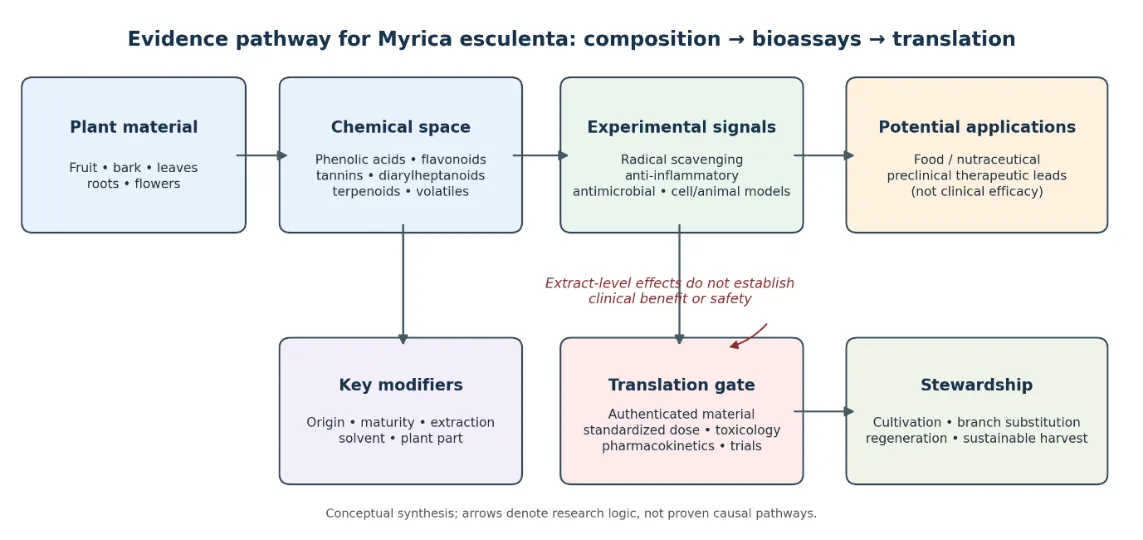
Conceptual evidence pathway from plant material and phytochemistry to pharmacological testing, translation, and stewardship. The arrows indicate research logic, not demonstrated causal pathways.
Research gaps
1. Ethnobotanical resolution: detailed primary surveys linking named communities, plant parts, recipes, routes, doses, indications, and adverse effects were not identified in the retrieved passages. Contemporary documentation should be community-led and preserve local intellectual rights.
2. Chemical comparability: studies use different origins, organs, maturity stages, solvents, and analytical bases; these factors obstruct cross-study dose comparisons and pooled estimates [16] [32].
3. Mechanism and attribution: many extract effects are associated with total phenolics or computational docking, but few studies demonstrate which molecules reach and modulate targets in vivo [3] [15].
4. Clinical evidence and safety: human efficacy, dose, pharmacokinetics, and long-term safety were not identified in this search; animal and cell findings do not fill these gaps [52] [2].
5. Conservation-linked development: propagation, regional cultivation, harvest impact, and branch substitution need outcome evaluation at scale rather than remaining recommendations [22] [23].
CONCLUSION
I believe Myrica esculenta is a nutritionally important Himalayan plant, and Myrica esculenta has a well-documented set of phenolics, flavonoids, tannins, diarylheptanoids, terpenoids, sterols, glycosides, and volatile constituents. Myrica esculenta traditional uses are closely aligned with early laboratory and animal studies focused on antioxidant inflammatory, antimicrobial, and gastrointestinal endpoints. Myrica esculenta recent studies broaden the focus to colitis, hepatic and cardiac injury, reproductive dysfunction, and neurobehavioral models. Myrica esculenta findings justify targeted mechanistic, toxicological, and translational research, but evidence remains preclinical and chemically heterogeneous. The defensible conclusion is therefore Myrica esculenta potential, not established therapy; future health claims require preparations with independently replicated efficacy, safety, and exposure data and controlled human studies, all developed alongside sustainable cultivation and harvesting.
REFERENCES


Zafar Ali, Garima Awasthi, Phytochemistry and Pharmacological Potential of Myrica Esculenta: An Updated Review of Traditional Uses, Bioactive Compounds, and Therapeutic Applications, Int. J. of Pharm. Sci., 2026, Vol 4, Issue 10, 2837-2848. https://doi.org/10.5281/zenodo.23466105
 10.5281/zenodo.23466105