

We use cookies to ensure our website works properly and to personalise your experience. Cookies policy
Department of Pharmaceutics DJPS college of pharmacy pathri Parbhani
The present study focuses on the development of an eco-friendly herbal perfume using natural floral extracts obtained from rose, mogra, and night-blooming jasmine flowers. Synthetic perfumes often contain harmful chemicals that may cause skin irritation and environmental pollution. Therefore, herbal perfumes prepared from natural plant sources provide a safer and sustainable alternative. Floral extracts were prepared using solvent extraction and blended with natural fixatives and essential oils to enhance fragrance retention. The formulated perfume was evaluated for fragrance stability, skin compatibility, pH, appearance, and longevity. The developed herbal perfume exhibited a pleasant aroma, good stability, and minimal adverse effects, making it suitable for cosmetic and aromatherapy applications. Objective: The objective of this project was to develop an eco-friendly herbal perfume using natural floral extracts of Rose, Mogra, and Night-Blooming Jasmine as sustainable alternatives to synthetic perfumes. The study aimed to formulate a skin-friendly, biodegradable, and pleasant-smelling natural perfume with good fragrance retention and stability. MethodFresh flowers were collected and cleaned before extraction. The floral extracts were prepared using the solvent extraction method with ethanol. The obtained extracts were filtered and blended in suitable proportions with ethanol, glycerin, and sandalwood oil as a natural fixative. The prepared perfume was stored in amber- colored bottles for maturation. Evaluation tests such as odor, appearance, pH, stability, skin irritation, and fragrance longevity were carried out. Result The formulated herbal perfume showed a pleasant and refreshing floral aroma with good stability and fragrance retention. The perfume remained clear without phase separation during storage. The addition of sandalwood oil improved the lasting effect of the fragrance. Skin irritation tests indicated that the formulation was safe and suitable for topical application. Conclusion: The study successfully demonstrated that natural floral extracts can be effectively used to prepare an eco-friendly herbal perfume. The developed formulation was stable, skin compatible, biodegradable, and free from harmful synthetic chemicals. Therefore, the herbal perfume can be considered a sustainable and safe alternative to commercial synthetic perfumes.
Perfumes have been used for centuries for personal grooming, cultural practices, and therapeutic purposes. In modern times, most commercial perfumes are manufactured using synthetic aromatic chemicals that may cause skin irritation, allergies, respiratory problems, and environmental pollution. Increasing awareness about the harmful effects of synthetic ingredients has created a growing demand for natural and eco-friendly cosmetic products. Herbal perfumes prepared from plant-based materials provide a safer, biodegradable, and environmentally sustainable alternative to synthetic fragrances.1
Natural flowers are rich sources of volatile oils and aromatic compounds responsible for their pleasant fragrance. Among them, Rose is widely known for its sweet floral aroma and calming properties. Mogra possesses an intense and refreshing fragrance commonly used in traditional perfumery and aromatherapy. Night-Blooming Jasmine is famous for its strong nocturnal fragrance and soothing sensory effects. These flowers contain natural essential oils that can be extracted and blended to prepare herbal perfumes with unique aromatic characteristics.
Eco-friendly herbal perfumes are advantageous because they are free from toxic synthetic chemicals, alcohol-heavy formulations, and artificial fixatives. They are generally skin-friendly, biodegradable, and less harmful to the environment. In addition to providing fragrance, natural floral extracts may also offer aromatherapeutic benefits such as stress relief, relaxation, and mood enhancement.2
The present project focuses on the development of an eco-friendly herbal perfume using natural floral extracts of rose, mogra, and night-blooming jasmine. The study involves extraction of floral essence, formulation of the perfume using natural ingredients, and evaluation of its fragrance stability, skin compatibility, and overall quality. This work aims to promote sustainable cosmetic products and encourage the use of herbal alternatives in the perfume industry.
MATERIALS AND METHODS
Fresh flowers of rose, mogra, and night-blooming jasmine were collected early in the morning to preserve maximum fragrance. The flowers were washed gently with distilled water to remove dust and impurities and then air-dried at room temperature. ethanol (95%) Distilled water Glycerine were collected from S K Enterprises Pune, Maharashtra. All other chemicals and reagents used in the study were analytical grade.3
Materials Required
ANALYTICAL METHOD
The extract of flower were analyzed for various parameter Organoleptic Evaluation Determination of pH Solubility Studies Phytochemical Screening Compatibility Study Fragrance retention test Skin irritation test Evaporation test specific gravity test and stability test various parameters are used to study to evaluate the formulation.
PREPARATION OF METHOD
Extraction of Essential Oils by Clevenger Apparatus Fresh flowers of rose, mogra, and night-blooming jasmine were collected early in the morning. The flowers were washed gently with distilled water to remove dust and impurities. The cleaned flowers were chopped or crushed lightly to increase the surface area for extraction. Setup of Clevenger Apparatus. A clean round-bottom flask was connected to the Clevenger apparatus and condenser. The apparatus was checked properly to avoid vapor leakage. Hydro-Distillation Process. About 100–150 g of crushed floral material was placed into the round-bottom flask. Distilled water was added sufficiently to immerse the flowers completely. The flask was heated using a heating mantle. The water started boiling, producing steam containing volatile aromatic oils. The steam carrying essential oils passed through the condenser where it cooled and converted into liquid. The condensed liquid collected in the graduated tube of the Clevenger apparatus. Due to density differences, the essential oil separated from water and accumulated in the oil collection chamber. The extracted essential oil was carefully collected using a separating funnel or dropper. The oil was stored in amber-colored airtight bottles to protect it from light and oxidation4,5.
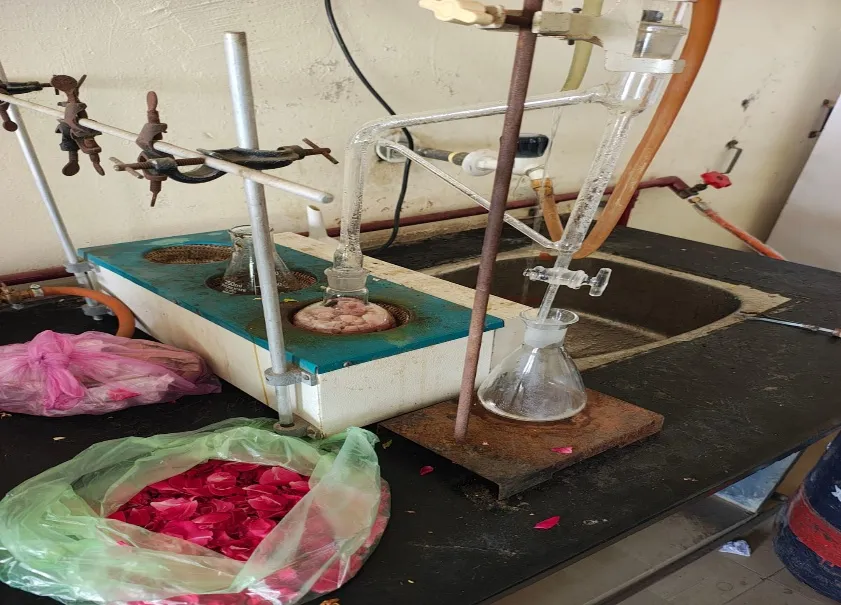
Fig No.1: Hydodistillation of Flower
EVALUATION OF EXTRACT7,8,9
1. Organoleptic Evaluation Take 1–2 drops of essential oil in a clean watch glass. Observe the color against white background. Smell the sample carefully to note fragrance characteristics. Record odor intensity, type, and pleasantness. Note appearance and clarity.
2. Odor Profile Analysis Apply a small amount of oil on blotter paper. Allow it to stand for 1–2 minutes. Smell at different time intervals (0 min, 10 min, 30 min). Record top, middle, and base notes of fragrance. Note changes in aroma over time.
3. Physical Property Testing Measure density using a specific gravity bottle or pycnometer. Determine viscosity by allowing oil to flow through a narrow tube and comparing flow time. Observe color consistency under light. Record all physical characteristics.
4. Solubility Test Take small quantity of essential oil in test tubes. Add ethanol to one tube and distilled water to another. Shake well and observe miscibility. Check for separation, precipitation, or clarity. Record observations.
5. Stability Study Store essential oil samples in amber bottles. Keep at room temperature and also in light exposure conditions. Observe periodically for 1–4 weeks. Note any changes in color, odor, or phase separation.
6. Volatility Test Place 1–2 drops of oil on filter paper. Leave it at room temperature. Observe evaporation rate at regular time intervals. Record fragrance persistence duration.
7. Purity Test Visually inspect oil for sediments or cloudiness. Smell for any artificial or chemical odor. Check for uniform appearance without separation. Record purity observations.
8. Yield Calculation Weigh the initial amount of fresh flowers used. Measure the quantity of extracted essential oil. Calculate yield using formula:
Yield (%)=Weight of oil obtainedWeight of plant material×100

Perfume Formulation Procedure
Measured quantities of all extracted essential oils were mixed in a clean beaker. Ethanol was added slowly with continuous stirring. Glycerine was incorporated to improve smoothness and skin feel. Sandalwood oil was added as a natural fixative for long-lasting fragrance. The mixture was stirred thoroughly to obtain a uniform solution. The prepared perfume was transferred into amber- colored spray bottles. The bottles were stored in a cool and dark place for 7 days for maturation and proper blending of fragrance.
|
Ingredient |
Quantity |
Rose essential oil (10ml), Mogra Essential oil (10ml), Night blooming jasmine essential oil (10ml) Ethanol 60 ml, glycerine 5ml
EVALUATION PARAMETER 10,11,12
The prepared eco-friendly herbal perfume was evaluated using the following parameters to determine its quality, stability, safety, and performance.
Specific Gravity=Weight of perfumeWeight of equal volume of water

Observations were recorded at regular intervals (initial, 7th day, 14th day, 28th day).
RESULT
Distilled water is the only solvent for separation of oil from the material
Preparation of Extract
Table No.1: Prepration of Extract
|
Plant |
Solvent Used |
Extraction Method |
|
Rose |
Distilled water |
Hydrodistillation (Clevenger) |
|
Mogra |
Distilled water |
Hydrodistillation |
|
Night-blooming jasmine |
Distilled water |
Hydrodistillation |
Various extract was prepared by using distilled water and gel a clear essential oil from the hydro distillation
Result of extraction
Organoleptic Evaluation
Organoleptic evaluation was done by checking various parameter like colour dour appearance clarity of extract and it get clear idea regarding extract.
Table No.2: Organoleptic Parameter of Extract
|
Parameter |
Rose Oil |
Mogra Oil |
Night-Blooming Jasmine Oil |
|
Colour |
Pale yellow |
Light yellow |
Pale greenish-yellow |
|
Odour |
Sweet floral |
Strong, rich floral |
Sharp musky floral |
|
Appearance |
Clear |
Clear |
Slightly tinted |
|
clarity |
High |
High |
Moderate–High |
Fragrance Intensity & Longevity
Fragrance was determined by various extract like mogra nightblooming jasmin and rose and it get a clear idea regarding fragrance intensity
Table No.3: Fragrance Parameter of Extract
|
Parameter |
Rose Oil |
Mogra Oil |
Night-Blooming Jasmine Oil |
|
Initial Intensity |
Medium |
Very High |
High |
|
Fragrance Duration |
Moderate–Long |
Long-lasting |
Moderate |
|
Stability of Scent |
Good |
Very Good |
Moderate |
Physical Properties
Various Physical parameters like density viscosity Refractive index homogeneity was determined by the various extract.
Table No.4: Physical Property of Extract
|
Parameter |
Rose Oil |
Mogra Oil |
Night-Blooming Jasmine Oil |
|
|
Density
|
Moderate |
Moderate |
Slightly low |
|
|
Viscosity
|
Low–Medium |
Medium |
Low |
|
|
Refractive Nature |
Clear |
Clear |
Slight variation |
|
|
Homogeneity |
Good |
Excellent |
Good |
Solubility Test
Solubility was determined by the various extract and it showed good result
Table No.5: Solubility Parameter of Extract
|
Solvent |
Rose Oil |
Mogra Oil |
Night-Blooming Jasmine Oil |
|
Ethanol |
Fully miscible |
Fully miscible |
Fully miscible |
|
Water |
Insoluble |
Insoluble |
Insoluble |
|
Stability in Solution |
Stable |
Very stable |
Moderately stable |
Stability Study
Stability study was done by various extract and it was shoewd a good result
Table No.6: Stability Parameter of Extract
|
Condition |
Rose Oil |
Mogra Oil |
Night-Blooming Jasmine Oil |
|
|
Room Temperature |
Stable |
Highly stable |
Stable |
|
|
Light Exposure |
Slight change |
Stable
|
Slight degradation |
|
|
Long Storage |
Good |
Very good |
Moderate |
Skin Compatibility (Patch Test)
Patch test or skin compatibility test was done by various extract and it showed a good result
Table No.7: Skin compatibility Parameter of Extract
|
Oil Type |
Result |
|
Rose Oil |
No irritation |
|
Mogra Oil |
No irritation |
|
Night-Blooming Jasmine Oil |
No irritation Mild sensitivity in rare case |
Table No.8: overall Skin compatibility Parameter of Extract
|
Essential Oil |
Overall Quality |
Perfume Suitability |
|
Rose |
High |
Excellent blending agent |
|
Mogra |
Very High |
Best fragrance contributor |
|
Night-Blooming Jasmine |
Moderate–High |
Fixes depth and uniqueness |
All three essential oils showed good physicochemical properties and are suitable for herbal perfume formulation. Among them, mogra oil exhibited the highest fragrance strength and stability, rose oil provided balance and softness, while night-blooming jasmine contributed a unique musky aromatic note enhancing overall perfume quality.
Formulation and Development of various Batches
The herbal perfume was developed using essential oils obtained from Rose, Mogra, and Night-Blooming Jasmine. Three different formulations (batches) were prepared by varying the ratio of essential oils to optimize fragrance quality, stability, and longevity.
Table No.9: Various formulations of Extract
|
Ingredients |
F1 (Rose Dominant) |
F2 (Mogra Dominant) |
F3 (Balanced) |
|
Rose oil |
7.5 mL (50%) |
3.75 mL (25%) |
5 mL (33%) |
|
Mogra oil |
3.75 mL (25%) |
7.5 mL (50%) |
5 mL (33%) |
|
Night-blooming jasmine oil |
3.75 mL (25%) |
3.75 mL (25%) |
5.1 mL (34%) |
|
Total essential oils |
15 mL |
15 mL |
15.1 mL |
|
Ethanol (95%) |
80 mL |
80 mL |
79.9 mL |
|
Glycerin |
5 mL |
5 mL |
5 mL |
|
Sandalwood oil |
0.5 mL |
0.5 mL |
0.5 mL |
Evaluation of various Batches
The herbal perfume formulations were prepared using essential oils of Rose, Mogra, and Night-Blooming Jasmine. The three batches (F1, F2, F3) were evaluated based on organoleptic properties, physicochemical parameters, stability, and fragrance performance.
Organoleptic Evaluation
Various organoleptic evaluation was done by F1 F2 and F3
Table No.10: Organoleptic Evaluation of Formulations
|
Parameter |
F1 (Rose Dominant) |
F2 (Mogra Dominant) |
F3 (Balanced) |
|
Color |
Light yellow |
Pale yellow |
Light yellow transparent |
|
Odor |
Soft floral, mild rose note |
Strong, rich jasmine floral |
Well-balanced floral blend |
|
Appearance |
Clear |
Clear |
Clear |
|
Overall acceptability |
Good |
Excellent |
Very Good |
Fragrance Evaluation
Various Fragrance test was done by F1 F2 and F3 from this all result are showed within Acceptable limit
Table No.11: Fragrance Evaluation of Formulations
|
Parameter |
F1 |
F2 |
F3 |
|
Initial smell intensity |
Medium |
Very High |
High |
|
Fragrance character |
Mild & soothing |
Strong & luxurious |
Harmonized floral |
|
Top notes |
Rose dominant |
Mogra dominant |
Balanced |
|
Middle notes |
Light floral blend |
Deep floral intensity |
Smooth floral mix |
|
Base notes |
Mild jasmine |
Strong jasmine base |
Balanced musky floral |
Fragrance Longevity Test
Table No.12: Fragrance longevity Evaluation of Formulations
|
Parameter |
F1 |
F2 |
F3 |
|
Skin longevity |
3–4 hours |
6–8 hours |
5–6 hours |
|
Fabric longevity |
6 hours |
10–12 hours |
8–10 hours |
|
Evaporation rate |
Fast |
Slow |
Moderate |
|
Overall performance |
Moderate |
Best |
Good |
Physicochemical Evaluation
Various physiochemical parameter like pH solubility clarity and homogeneity test was carried out by F1 F2 and F3 and from all formulation F2 formulation showed a good result
Table No.13: Physiochemical Evaluation of Formulations
|
Parameter |
F1 |
F2 |
F3 |
|
pH |
6.2–6.5 |
6.3–6.6 |
6.4–6.7 |
|
Solubility in ethanol |
Complete |
Complete |
Complete |
|
Clarity |
High |
High |
High |
|
Homogeneity |
Good |
Excellent |
Very Good |
Stability Study (4 Weeks)
Stability parameters for all formulations are done for F1 F2 and F3 the formulations are stored at various conditions like room temperature light exposure Refrigeration fragrance retention for 4 week and observed the result.
Table No.14: Stability Evaluation of Formulations
|
Condition |
F1 |
F2 |
F3 |
|
Room temperature |
Stable |
Highly stable |
Stable |
|
Light exposure |
Slight color change |
Minimal change |
Slight change |
|
Refrigeration |
Very stable |
Highly stable |
Very stable |
|
Fragrance retention |
Moderate loss |
Minimal loss |
Low loss |
Skin Compatibility (Patch Test)
Skin compatibility test was done of F1 F2 and F3 and all formulations are showed a good result and no any kind of irritation was observed
Table No.15: Patch test Evaluation of Formulations
|
Batch |
Observation |
|
F1 |
No irritation observed |
|
F2 |
No irritation observed |
|
F3 |
No irritation observed |
All (F1 = F2 = F3 equally safe) no any kind of irritation was observed.
Evaporation Test
F1: Evaporated quickly due to higher volatility of rose-based composition → lowest fragrance retention. F2: Showed slow evaporation and highest fragrance retention due to strong fixative effect of mogra oil → best performance. F3: Showed moderate evaporation rate with balanced fragrance release → medium performance.
Table No.16: Evaporation Evaluation of Formulations
|
Parameter |
F1 (Rose Dominant) |
F2 (Mogra Dominant) |
F3 (Balanced) |
|
Initial spread |
Fast |
Moderate |
Moderate |
|
Evaporation rate |
Fast |
Slow |
Moderate |
|
Time of complete evaporation |
~25–35 min |
~45–60 min |
~35–50 min |
|
Fragrance persistence |
Short |
Long-lasting |
Moderate-long |
The evaporation test clearly shows that F2 formulation is the most stable and long-lasting, while F1 is the most volatile and least persistent.
Specific Gravity test of formulations
Specific gravity was determined by various formulations and from all F1 F2 and F3 formulations F2 formulation showed a good result
Table No.17: Specific gravity Evaluation of Formulations
|
Formulation |
Weight of Sample |
Specific Gravity |
Observation |
|
F1 (Rose dominant) |
24.8 g |
0.86 |
Light, more volatile |
|
F2 (Mogra dominant) |
25.6 g |
0.89 |
Slightly denser, stable |
|
F3 (Balanced) |
25.2 g |
0.88 |
Moderate density |
F1:Lowest specific gravity due to higher volatility and lighter composition. F2: Highest specific gravity indicating better oil concentration and stability. F3: Intermediate value showing balanced formulation. The specific gravity test indicates that F2 formulation is the most stable and well-structured perfume, while F1 is the lightest and most volatile among all batches.
CONCLUSION
The present study focused on the development of an eco-friendly herbal perfume using essential oils extracted from Rose, Mogra, and Night-Blooming Jasmine. The project included extraction of essential oils, formulation of three batches (F1, F2, F3), and their detailed evaluation based on physicochemical, organoleptic, stability, and performance parameters. The study successfully demonstrated that eco-friendly herbal perfumes can be effectively formulated using natural floral extracts. Among all batches, the F2 formulation is the most optimized, stable, and commercially promising herbal perfume, while F3 serves as a well-balanced alternative and F1 as a mild fragrance option suitable for light perfume users.
AKNOWLEGEMENT
The authors are grateful to the DJPS College of Pharmacy, Pathri for providing research facilities.
FUNDING
Nil
AUTHORS CONTRIBUTIONS
All the authors have contributed equally
DISCUSSION
No irritation in patch test (safe for topical use) Superior Fragrance Highest stability under both room and accelerated conditions Best overall consumer acceptability and cosmetic elegance
CONFLICTS OF INTERESTS
Declare none
REFERENCES


Kanchan Jamkar, Dipanshu Jain, Vaibhav kadam, Pratiksha Rathod, Rushikesh Gonge, Adnan Rasul Sheikh, Ramesh Ingole, A Novel Development of Eco-Friendly Herbal Perfume Using Natural Floral Extracts, Int. J. of Pharm. Sci., 2026, Vol 4, Issue 6, 916-927. https://doi.org/10.5281/zenodo.20531331
 10.5281/zenodo.20531331