View Article

  • A Review article on Mechanistic Insight into Neuroprotection by Natural Antioxidants in Parkinson’s Disease

  • Department. of Pharmacy, Jagannath University, Jaipur, India

Abstract

Parkinson’s Disease (PD) is a neurodegenerative disorder characterized by progressive loss of dopaminergic neurons and decreased dopamine levels in the brain. The main contributing causes of the disease are oxidative stress, mitochondrial dysfunction, neuro-inflammation, ?-synuclein accumulation and apoptosis. Treatments like Levodopa relieve the symptoms but do not prevent neuronal degeneration. Natural antioxidants obtained from food and herbal plants are important due to their antioxidant, anti-inflammatory, anti-apoptotic, and neuroprotective effects. There are compounds that have neuroprotective effects in laboratory models by decreasing oxidative stress and improving antioxidant defense. Examples include Curcumin, Resveratrol, Quercetin, EGCG, Vitamin C, and Vitamin E. However, their clinical use is limited due to poor bioavailability and inability to cross the blood brain barrier. Advanced delivery techniques may be used in future approaches

Keywords

Parkinson’s disease, oxidative stress, neuroprotection, natural antioxidants, Curcumin, Resveratrol, mitochondrial dysfunction, neuroinflammation

Introduction

× Popup Image

Parkinson’s disease (PD) is a progressive neurological disorder resulting from the death of dopamine-producing cells and decreased dopamine production within the brain. PD causes various motor symptoms like tremors, rigidity, slow movements, and postural imbalance, along with non-motor manifestations including mood disorders, sleep disorders, fatigue, and cognitive decline. Various factors like oxidative stress, mitochondrial defects, neuroinflammation, alpha-synuclein protein accumulation, and apoptosis contribute significantly to the progression of Parkinson’s disease. Existing treatment methods like Levodopa can only provide temporary relief and are incapable of preventing nerve cell death. Therefore, natural antioxidants found in food sources and plants have been extensively researched to assess their neuroprotective, antioxidant, anti-inflammatory, and mitochondrial-preserving activities in managing PD. Various natural antioxidants like curcumin, resveratrol, quercetin, EGCG, vitamin C, and vitamin E have exhibited considerable neuroprotective properties in experimental research studies. They aid in mitigating oxidative stress, enhancing mitochondrial functionality, controlling inflammation, and safeguarding nerve cells from damage. Natural antioxidants have emerged as potent therapeutic support agents in the management of Parkinson’s disease.

2. PATHOPHYSIOLOGY OF PARKINSON’S DISEASE
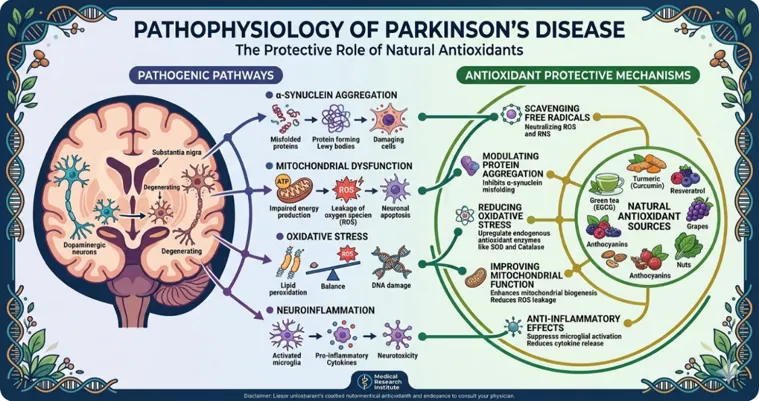
  •  The pathophysiology of Parkinson’s disease is complex and involves multiple interrelated processes that result in neuronal degeneration
  •  Oxidative Stress: Too much production of reactive oxygen species (ROS) leads to damage of lipids, proteins, DNA and mitochondria. Dopamine metabolism produces free radicals, and dopaminergic neurons are highly vulnerable.
  •  Mitochondrial Dysfunction: Mitochondria dysfunction leads to reduced ATP synthesis and increased ROS formation, thus causing neuronal injury and cell death.
  • Neuroinflammation: Inflammatory cytokines are released by activated microglia, including TNF-α, IL-1β, and IL-6, which can promote inflammation and accelerate the degeneration of neurons. All of these activities work together to support the development of Parkinson's  disease.

Figure 1. pathophysiology of Parkison’s disease

3. NATURAL ANTIOXIDANTS

a. Resveratrol

    •   ?Found in grapes
    •  ?Activates SIRT1 pathway
    •   ?Reduces oxidative stress Quercetin
    • Strong antioxidant and anti-inflammatory properties

b. Epigallocatechin Gallate (EGCG)

  • ?Found in green tea
  • ?Reduces neuroinflammation and oxidative damage

c. Vitamin E

  • Lipid-soluble antioxidant
  • ?Prevents lipid peroxidation

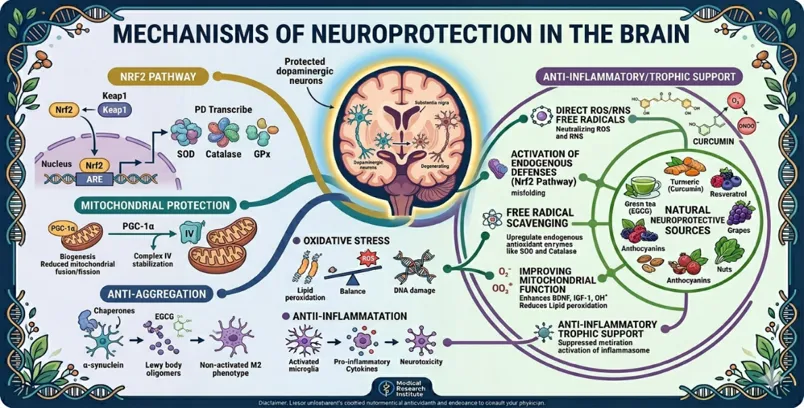
4. MECHANISMS OF NEUROPROTECTION BY NATURAL ANTIOXIDANTS

a.? ?Free Radical Scavenging

  • Natural antioxidants neutralize ROS and reduce oxidative stress.

b.? ?Activation of Nrf2 Pathway

  • ?Enhances antioxidant enzyme production
  • ?Protects neurons from oxidative damage

c.? ?Inhibition of NF-κB Pathway

  • ?Reduces inflammation
  • ?Suppresses cytokine release

d.? ?Mitochondrial Protection

  • ?Maintains mitochondrial integrity
  • ?Improves ATP production

e.? ?Anti-apoptotic Effects

  • ?Prevents neuronal cell death
  • ?Regulates Bcl-2 and caspase pathways

Figure 2. mechanism of neuroprotection in brain

5. EXPERIMENTAL AND CLINICAL EVIDENCE

a.? ?Experimental Evidence

Experimental studies show that natural antioxidants such as resveratrol, quercetin, and EGCG protect neurons by reducing oxidative stress, inhibiting α-synuclein aggregation, and improving motor function in animal models. Their action includes free radical scavenging, Nrf2 activation, and anti-inflammatory effects..

b.? ?Clinical Evidence

Clinical evidence is limited, but it suggests that Vitamin E, green tea (EGCG), and resveratrol may help lower disease risk and slow progression.

6. CONCLUSION

Natural antioxidants have shown significant potential in neuroprotection in Parkinson’s disease via targeting multiple pathological mechanisms such as oxidative stress, mitochondrial dysfunction, and neuroinflammation. They include compounds such as resveratrol, quercetin, EGCG, and vitamin E, which help in reducing neuronal damage and improving cellular defense systems. There is overwhelming experimental evidence in support of their effectiveness, and although the clinical evidence is limited, it is positive. These antioxidants act through pathways like free radical scavenging and induction of endogenous antioxidant systems. Poor bioavailability, and lack of large-scale clinical trials, among other factors, are still issues despite the encouraging results. Therefore, further researches are required to validate their therapeutic potential. Besides, enhanced drug delivery systems and formulation mechanisms may improve on the potency of these natural compounds. This approach of natural antioxidants, in combination with conventional therapies, could act synergistically to slow down the disease progression. Also, future studies should focus on personalized treatment approaches based on biomarkers. Overall, natural antioxidants may work well as adjuncts in the management of Parkinson’s disease.

REFERENCES

  1. Dauer W, Przedborski S. Parkinson’s disease: mechanisms and models. Neuron. 2003;39(6):889–909.
  2. ?Schapira AHV, Jenner P. Etiology and pathogenesis of Parkinson’s disease. Movement Disorders. 2011;26(6):1049–1055.
  3. ?Dias V, Junn E, Mouradian MM. The role of oxidative stress in Parkinson’s disease. Journal of Parkinson’s Disease. 2013;3(4):461–491.
  4. ?Dexter DT, Jenner P. Parkinson disease: from pathology to molecular disease mechanisms. Free Radical Biology and Medicine. 2013;62:132–144.
  5. ?Anandhan A, Jacome MS, Lei S, et al. Metabolic dysfunction in Parkinson’s disease: bioenergetics, redox homeostasis and central carbon metabolism. Brain Research Bulletin. 2017;133:12–30.
  6. ?Reale M, Iarlori C, Thomas A, et al. Peripheral cytokines profile in Parkinson’s disease. Brain, Behavior, and Immunity. 2009;23(1):55–63.
  7. ?Mandel S, Weinreb O, Amit T, Youdim MBH. Cell signaling pathways in the neuroprotective actions of the green tea polyphenol EGCG. Journal of Neurochemistry. 2004;88(6):1555–1569.
  8. ?Mythri RB, Bharath MMS. Curcumin: a potential neuroprotective agent in Parkinson’s disease. Current Pharmaceutical Design. 2012;18(1):91–99.
  9. ?Bournival J, Quessy P, Martinoli MG. Protective effects of resveratrol and quercetin against MPP+-induced oxidative stress act by modulating markers of apoptosis in dopaminergic neurons. Cellular and Molecular Neurobiology. 2009;29(8):1169–1180.
  10. ?Levy OA, Malagelada C, Greene LA. Cell death pathways in Parkinson’s disease: proximal triggers, distal effectors, and final steps. Apoptosis. 2009;14(4):478–500.

Reference

  1. Dauer W, Przedborski S. Parkinson’s disease: mechanisms and models. Neuron. 2003;39(6):889–909.
  2. ?Schapira AHV, Jenner P. Etiology and pathogenesis of Parkinson’s disease. Movement Disorders. 2011;26(6):1049–1055.
  3. ?Dias V, Junn E, Mouradian MM. The role of oxidative stress in Parkinson’s disease. Journal of Parkinson’s Disease. 2013;3(4):461–491.
  4. ?Dexter DT, Jenner P. Parkinson disease: from pathology to molecular disease mechanisms. Free Radical Biology and Medicine. 2013;62:132–144.
  5. ?Anandhan A, Jacome MS, Lei S, et al. Metabolic dysfunction in Parkinson’s disease: bioenergetics, redox homeostasis and central carbon metabolism. Brain Research Bulletin. 2017;133:12–30.
  6. ?Reale M, Iarlori C, Thomas A, et al. Peripheral cytokines profile in Parkinson’s disease. Brain, Behavior, and Immunity. 2009;23(1):55–63.
  7. ?Mandel S, Weinreb O, Amit T, Youdim MBH. Cell signaling pathways in the neuroprotective actions of the green tea polyphenol EGCG. Journal of Neurochemistry. 2004;88(6):1555–1569.
  8. ?Mythri RB, Bharath MMS. Curcumin: a potential neuroprotective agent in Parkinson’s disease. Current Pharmaceutical Design. 2012;18(1):91–99.
  9. ?Bournival J, Quessy P, Martinoli MG. Protective effects of resveratrol and quercetin against MPP+-induced oxidative stress act by modulating markers of apoptosis in dopaminergic neurons. Cellular and Molecular Neurobiology. 2009;29(8):1169–1180.
  10. ?Levy OA, Malagelada C, Greene LA. Cell death pathways in Parkinson’s disease: proximal triggers, distal effectors, and final steps. Apoptosis. 2009;14(4):478–500.

Photo
Tamanna Khokher
Corresponding author

Department. of Pharmacy, Jagannath University, Jaipur, India

Photo
Parveen Kumar
Co-author

Department. of Pharmacy, Jagannath University, Jaipur, India

Tamanna Khokher, Parveen Kumar, A Review article on Mechanistic Insight into Neuroprotection by Natural Antioxidants in Parkinson’s Disease, Int. J. of Pharm. Sci., 2026, Vol 4, Issue 6, 1152-1155. https://doi.org/10.5281/zenodo.20550729

More related articles
Formulation and Evaluation of Herbal Toothpaste by...
Puja Basule, Dr. Bhumeshkumar Wanjari, Digamber Rahangdale, Abhi...
MRSA PSOAS Abscess with Spondylodiscitis with MRSA...
Jeffnisha J., Shaiju Dharan, Shahabaz Zailu, Grace Raju...
Related Articles
A Review on SEDDS for Ulcerative Colitis...
Gautam Raj Puri, Seema Tomar, Neha Srivastava, Asha...
A Brief Review on "Advancements in High-Performance Liquid Chromatography: Innov...
Omkar Tandale, Dr. Abhishek Meher, Sameer Sonvane, Abhinil Rahate...
Development and Validation of RP-HPLC Method for Estimation of Methotrexate in B...
Dr. Sharad Usnale, Dr. S. P. Kumbhar, Sanket Hankarle, Dr. Siddheshwar Patil, P. D. Makne...
Solanum surattense: A Traditional Herb with Modern Relevance in Disease Manageme...
Dr. Dattaprasad Vikhe, Jatin Kudnar, Gaurao Damre, Vaibhav Bhone, Surabhi Nemade, Gayatri Mokate...
Formulation and Evaluation of Herbal Toothpaste by using Leucas Biflora leaves e...
Puja Basule, Dr. Bhumeshkumar Wanjari, Digamber Rahangdale, Abhineet Ujawaney...
More related articles
Formulation and Evaluation of Herbal Toothpaste by using Leucas Biflora leaves e...
Puja Basule, Dr. Bhumeshkumar Wanjari, Digamber Rahangdale, Abhineet Ujawaney...
MRSA PSOAS Abscess with Spondylodiscitis with MRSA Bacteremia: A Case Report...
Jeffnisha J., Shaiju Dharan, Shahabaz Zailu, Grace Raju...
Formulation and Evaluation of Herbal Toothpaste by using Leucas Biflora leaves e...
Puja Basule, Dr. Bhumeshkumar Wanjari, Digamber Rahangdale, Abhineet Ujawaney...
MRSA PSOAS Abscess with Spondylodiscitis with MRSA Bacteremia: A Case Report...
Jeffnisha J., Shaiju Dharan, Shahabaz Zailu, Grace Raju...