

We use cookies to ensure our website works properly and to personalise your experience. Cookies policy
Department of Pharmacy Practice, St. Johns College of Pharmaceutical Sciences, Yerrakota, Yemmiganur, Kurnool.
Gedatolisib (formerly PF-05212384/PKI-587; marketed as Rectory) is a potent, intravenously administered dual phosphoinositide 3-kinase (PI3K) and mammalian target of rapamycin (mTOR) inhibitor developed for the treatment of advanced cancers. It blocks all class I PI3K isoforms as well as both mTORC1 and mTORC2 complexes, thereby suppressing the PI3K/AKT/mTOR signalling pathway that promotes tumour cell growth, proliferation, survival, and resistance to therapy. This dual mechanism induces cell-cycle arrest, inhibits tumour proliferation, and promotes apoptosis in cancer cells. Clinical studies have demonstrated encouraging antitumor activity, particularly in hormone receptor (HR)-positive, HER2-negative advanced or metastatic breast cancer. Gedatolisib has shown improved progression-free survival when used in combination with endocrine therapy, with or without CDK4/6 inhibitors, while maintaining a manageable safety profile. The most common adverse effects include stomatitis, nausea, fatigue, hyperglycaemia, diarrhoea, and rash. In July 2026, the U.S. FDA approved gedatolisib in combination with fulvestrant, with or without palbociclib, for selected adults with HR-positive, HER2-negative locally advanced or metastatic breast cancer following progression on endocrine therapy
GEDATOLISIB (BRAND NAME: REVTORPYK) is a novel, targeted anticancer medication developed by Celcuity Inc. for the treatment of hormone receptor (HR)-positive, HER2-negative locally advanced or metastatic breast cancer. It belongs to a new generation of targeted therapies designed to overcome resistance to endocrine therapy by inhibiting the PI3K/AKT/mTOR (PAM) signaling pathway, a critical pathway responsible for tumor cell growth, proliferation, survival, metabolism, and resistance to anticancer treatment.
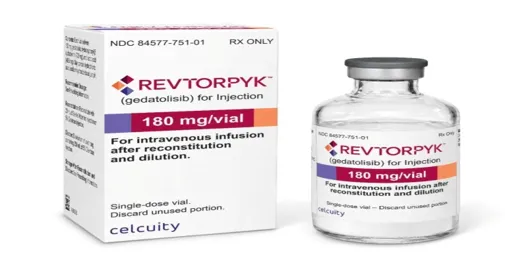
Brand name: Revtorpyk®
Generic name: Gedatolisib (also known as PF-05212384 or PKI-587)
Route of administration: Intravenous (IV) infusion over approximately 30minutes
Molecular weight: 615.73 g/mol (commonly reported as 615.7 g/mol)
Recommended dose (FDA-approved):
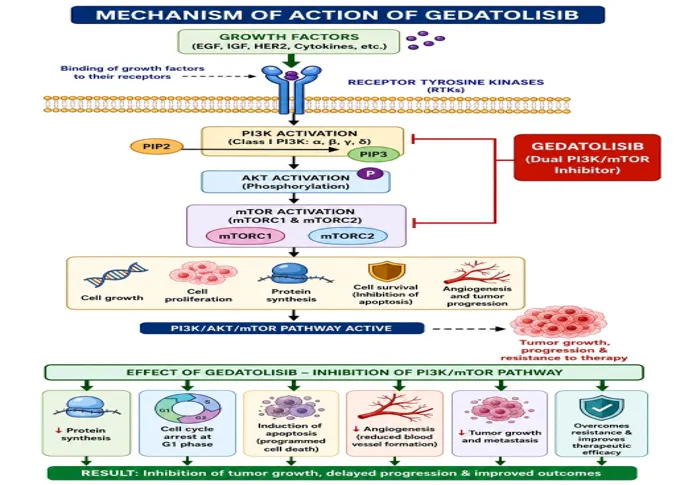
MECHANISM OF ACTION:
PHARMACOKINETICS OF GEDATOLISIB:
1. Absorption
2. Distribution
3. Metabolism
4. Excretion
5. Half-life
PHARMACODYNAMICS OF GEDATOLISIB:
Pharmacodynamics describes how gedatolisib produces its therapeutic effects in the body, particularly its actions on cancer cells.
Gedatolisib is a dual inhibitor of phosphoinositide 3-kinase (PI3K) and mammalian target of rapamycin (mTOR). The PI3K/AKT/mTOR signaling pathway is a key regulator of cell growth, proliferation, survival, metabolism, protein synthesis, and angiogenesis.
In many cancers, especially HR-positive, HER2-negative breast cancer with PIK3CA mutations, this pathway is abnormally activated, allowing cancer cells to grow rapidly, avoid apoptosis, and become resistant to endocrine therapy. Gedatolisib binds to the ATP-binding sites of both class I PI3K isoforms and mTOR complexes (mTORC1 and mTORC2), thereby blocking downstream signalling through AKT and its target proteins.
CLINICAL TRIALS OF GEDATOLISIB:
Gedatolisib has undergone extensive clinical evaluation in Phase I, II, and III clinical trials, primarily for the treatment of hormone receptor (HR)-positive, HER2-negative advanced or metastatic breast cancer. Early Phase I studies established that weekly intravenous gedatolisib was generally well tolerated and demonstrated promising antitumor activity by effectively inhibiting the PI3K/mTOR signaling pathway.
These studies identified the recommended dose and showed manageable adverse effects, including stomatitis, nausea, fatigue, diarrhoea, and hyperglycaemia. Subsequent Phase II trials evaluated gedatolisib in combination with endocrine therapies and CDK4/6 inhibitors, demonstrating improved disease control and progression-free survival in patients whose disease had progressed after prior endocrine treatment.
The pivotal Phase III VIKTORIA-1 trial (NCT05501886) compared gedatolisib plus fulvestrant with or without palbociclib against fulvestrant alone in patients with HR-positive, HER2-negative advanced breast cancer. The study showed a statistically significant improvement in progression-free survival, with the triplet regimen reducing the risk of disease progression or death by approximately 76%, leading to regulatory approval in 2026 for selected patients.
ADVERSE EFFECTS OF GEDATOLISIB:
INDICATION OF USE
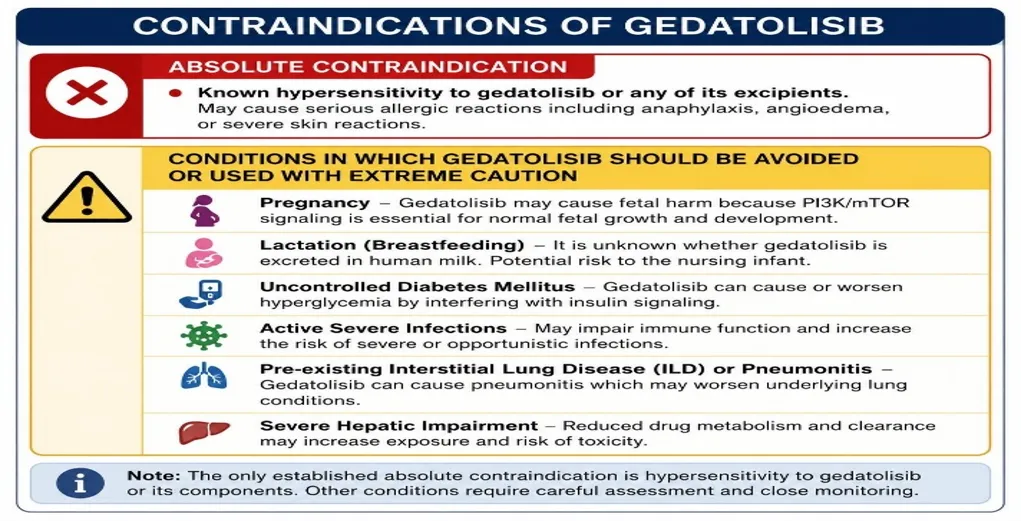
CONTRAINDICATIONS
REFERENCES

M. Taiba Anjum, A. Usha, S. Rajesh Raja, U. Venkatesh, A Review on Gedatolisib (Revtorpyk) for Selected HR-Positive/HER2-Negative Advanced Breast Cancer in Combination with Endocrine Therapy, Int. J. of Pharm. Sci., 2026, Vol 4, Issue 8, 707-710. https://doi.org/10.5281/zenodo.21801917
Severity: 8192
Message: substr(): Passing null to parameter #1 ($string) of type string is deprecated
Filename: frontend/article.php
Line Number: 706
Severity: 8192
Message: substr(): Passing null to parameter #1 ($string) of type string is deprecated
Filename: frontend/article.php
Line Number: 706
Severity: 8192
Message: substr(): Passing null to parameter #1 ($string) of type string is deprecated
Filename: frontend/article.php
Line Number: 706
 10.5281/zenodo.21801917
Severity: 8192
Message: substr(): Passing null to parameter #1 ($string) of type string is deprecated
Filename: frontend/article.php
Line Number: 890
Severity: 8192
Message: substr(): Passing null to parameter #1 ($string) of type string is deprecated
Filename: frontend/article.php
Line Number: 890
Severity: 8192
Message: substr(): Passing null to parameter #1 ($string) of type string is deprecated
Filename: frontend/article.php
Line Number: 925
Severity: 8192
Message: substr(): Passing null to parameter #1 ($string) of type string is deprecated
Filename: frontend/article.php
Line Number: 925
Severity: 8192
Message: substr(): Passing null to parameter #1 ($string) of type string is deprecated
Filename: frontend/article.php
Line Number: 925
Severity: 8192
Message: substr(): Passing null to parameter #1 ($string) of type string is deprecated
Filename: frontend/article.php
Line Number: 957
Severity: 8192
Message: substr(): Passing null to parameter #1 ($string) of type string is deprecated
Filename: frontend/article.php
Line Number: 957
Severity: 8192
Message: substr(): Passing null to parameter #1 ($string) of type string is deprecated
Filename: frontend/article.php
Line Number: 957