

We use cookies to ensure our website works properly and to personalise your experience. Cookies policy
1,2,3,4,5Department of Pharmaceutics : P. Wadhwani College of Pharmacy, Yavatmal
Hot melt extrusion (HME) technology has grown into a reputable pharmaceutical technique after decades of development. This technology greatly increases the solubility and bioavailability of difficult drugs by facilitating the dispersion of the drug within the carrier in different states, such as molecular, amorphous, or sub-stable, by extruding both drug and carrier materials in a molten state under particular pressure, velocity, and screw design conditions. As of right now, more than 20 medications have received FDA approval for manufacture and formulation using hot-melt extrusion, demonstrating the method's proven efficacy and reliability. A well-known, reliable, and successful method that improves the bioavailability of poorly soluble active medicinal ingredients and provides an effective continuous manufacturing process is hot-melt extrusion (HME). Using various combinations of conveying elements, kneading elements (forward and reverse configuration), and distributive mixing elements, the twin-screw extruder (TSE) provides an incredibly inventive and adaptable mixer for continuous compounding and granulation. Hot Melt Extrusion (HME) technology is a common production process used by pharmaceutical and plastic firms. It is a straightforward and efficient way to create a solid dispersion. Solvents are not needed in this continuous, eco-friendly process. It can be readily scaled up and saves money and effort. Additionally, HME can be combined with other advances to improve the solubility and dissolving of medications that are poorly soluble in water. The FDA has approved HME-based medicines, and numerous studies on the development of HME technology in the pharmaceutical business have been published.
To date HME has emerged as a novel processing technology in developing molecular dispersions of active pharmaceutical ingredients (APIs) into various polymer or/and lipid matrices which has led this technique to demonstrate time controlled,
modified, extended, and targeted drug delivery . HME has now provided opportunity for use of materials in order to mask the bitter taste of active substances. Since the industrial application of the extrusion process back in the 1930’s, HME has received considerable attention from both the pharmaceutical industry and academia in a range of applications for pharmaceutical dosage forms, such as tablets, capsules, films, and implants for drug delivery via oral, transdermal, and transmucosal routes. This makes HME an excellent alternative to other conventionally available techniques such as roll spinning and spray drying. In addition to being a proven manufacturing process, HME meets the goal of the US Food and Drug Administration’s (FDA) process analytical technology (PAT) scheme for designing, analyzing, and controlling the manufacturing process via quality control measurements during active extrusion process. In this chapter, the hot-melt extrusion technique is reviewed based on a holistic perspective of its various components, processing technologies, and the materials and novel formulation design and developments in its varied applications in oral drug delivery systems.[1]
1. The objective of the experimental phase involves, the in vitro drug release studies of all samples will have been performed according to USP XXIII utilizing a dissolution apparatus (Electrolab (TDT06L) USP, rotating paddle method). Accurately weighed samples corresponding to 100 mg of mesalamine will have been placed in 900 ml of 0.1N HCl (Simulated gastric fluid: pH 1.2) maintained at 37.0 ± 0.5°C with a rotation speed of 50 rpm.
2. Sampling and Spectrophotometric Analysis
By the final time point, specific sample aliquots (10 ml) will have been withdrawn via a 10 ml syringe at scheduled intervals of 10, 20, 30, 45, 60, and 90 min, and each volume will have been replaced with an equal volume of fresh medium. Furthermore, these collected samples will have been filtered through a 0.45 µm membrane filter and subsequently will have been analyzed using a UV-Visible Spectrophotometer (Jasco-V360) at a wavelength of 232 nm.
3. Solid-State Characterization and Stability Testing
Prior to final data compilation, all melt dispersion sample formulations will have been exposed to accelerated stress conditions of 40°C and 75% RH for a duration of 3 weeks in a Humidity Cabinet (Thermotech, IKON Instrument, India). Following this stability exposure, both Differential Scanning Calorimetry (DSC) and Fourier-Transform Infrared (FTIR) spectroscopy studies will have been performed to characterize the formulations.
Hot-melt extrusion technique was first invented for the manufacturing of lead pipes at the end of the eighteenth century. Since then, it has been used in the plastic, rubber, and food manufacturing industry to produce items ranging from pipes to sheets and bags. With the advent of high throughput screening, currently more than half of all plastic products including bags, sheets, and pipes are manufactured my HME and therefore various polymers have been used to melt and form different shapes for a variety of industrial and domestic applications. The technology (HME) has proven to be a robust method of producing numerous drug delivery systems and therefore it has been found to be useful in the pharmaceutical industry as well. Extrusion is the process of pumping raw materials at elevated controlled temperature and pressure through a heated barrel into a product of uniform shape and density . Breitenbach first introduced the development of melt extrusion process in pharmaceutical manufacturing operations; however, Follonier and his coworkers first examined the hot-melt technology to manufacture sustained release polymer-based pellets of various freely soluble drugs. HME involve h s te compaction and conversion of blends from a powder or a granular mix into a product of uniform shape. During this process, polymers are melted and formed into products of different shapes and sizes such as plastic bags, sheets, and pipes by forcing polymeric components and active substances including any additives or plasticisers through an orifice or die under controlled temperature, pressure, feeding rate, and screw speed. However, the theoretical approach to understanding the melt extrusion process summarized by classifying the whole procedure of HME compaction into the following:
The extruder generally consists of one or two rotating screws (either corotating or counter rotating) inside a stationary cylindrical barrel. The barrel is often manufactured in sections in order to shorten the residence time of molten materials. The sectioned parts of the barrel are then bolted or clamped together. An end-plate die is connected to the end of the barrel which is determined according to the shape of the extruded materials..[3]
A single-screw extruder is one of the most commonly utilized machines in the pharmaceutical, food, and polymer sectors for continuous mixing, melting, conveying, and shaping of materials. It features a rotating screw housed within a heated cylindrical barrel. The material is introduced through a hopper into the barrel, where the screw spins and advances the material through various zones: the feed zone, compression zone, and metering zone. In the feed zone, the raw material enters and begins to progress forward; in the compression zone, both temperature and pressure rise, leading to melting and mixing; and in the metering zone, the molten material becomes homogeneous and is forced through a die to achieve the intended shape. Heat is produced both externally by heaters and internally through friction that occurs.[4]
Single-screw extruders are extensively used in various industries due to their continuous processing capability and simplicity.
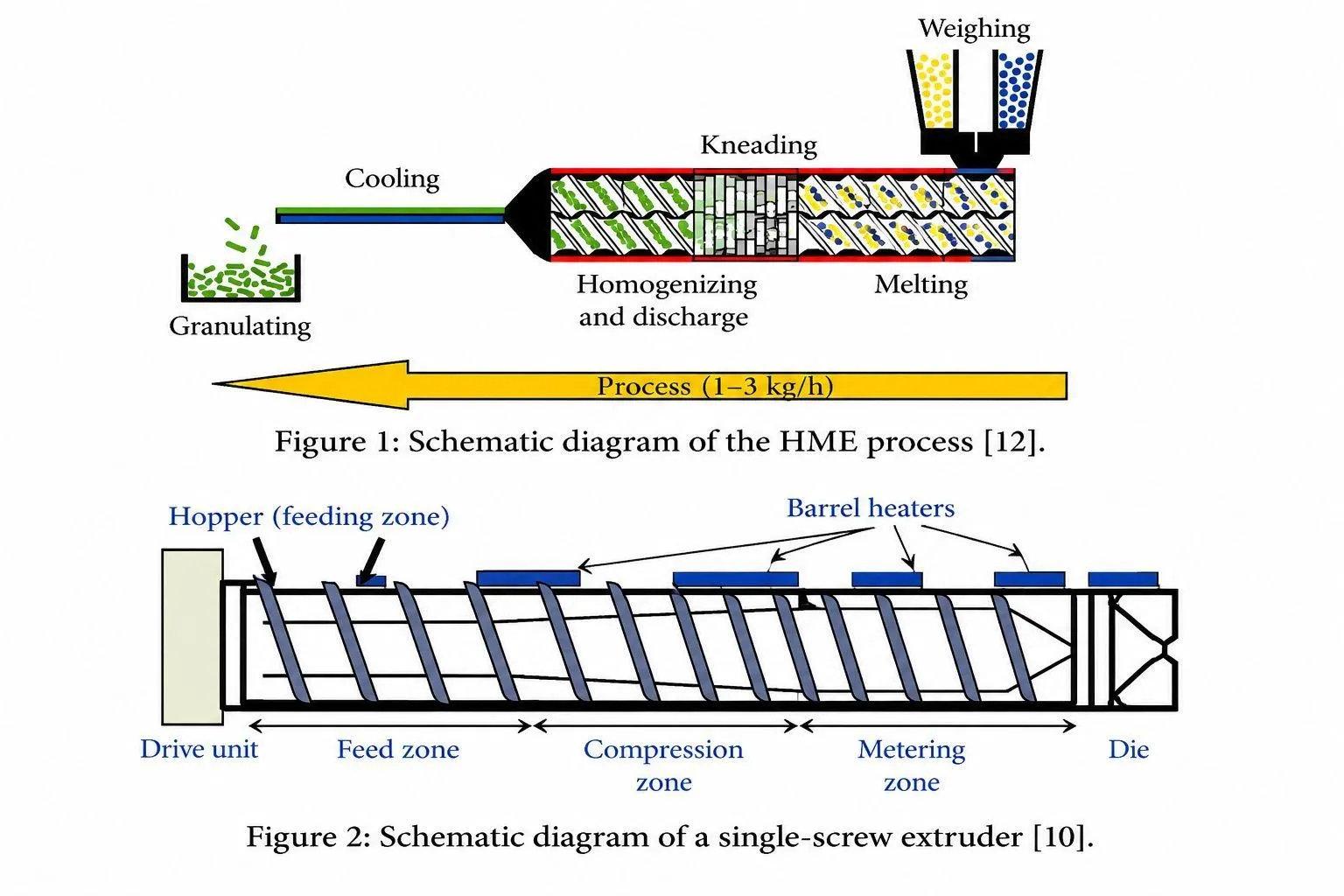
Fig No. 1 Single Screw Extruder
A twin-screw extruder is an advanced extrusion machine widely used in pharmaceutical, polymer, food, and chemical industries for efficient mixing, melting, kneading, and continuous processing of materials. It consists of two intermeshing screws rotating inside a heated barrel. The screws may rotate in the same direction (co-rotating) or opposite directions (counter-rotating). Material is fed through a hopper and transported along the barrel where it undergoes conveying, mixing, compression, melting, and homogenization before exiting through a die. The presence of two screws provides superior mixing efficiency, better temperature control, improved material transport, and uniform distribution of ingredients compared to a single-screw extruder. Twin-screw extruders can effectively process heat-sensitive, highly viscous, sticky, or poorly flowing materials and allow precise control over residence time and shear. They are highly versatile because different screw elements such as conveying, kneading, and mixing elements can be arranged according to processing needs. However, twin-screw extruders are more expensive, complex in design, and require higher maintenance and operational expertise than single-screw extruders.[6]
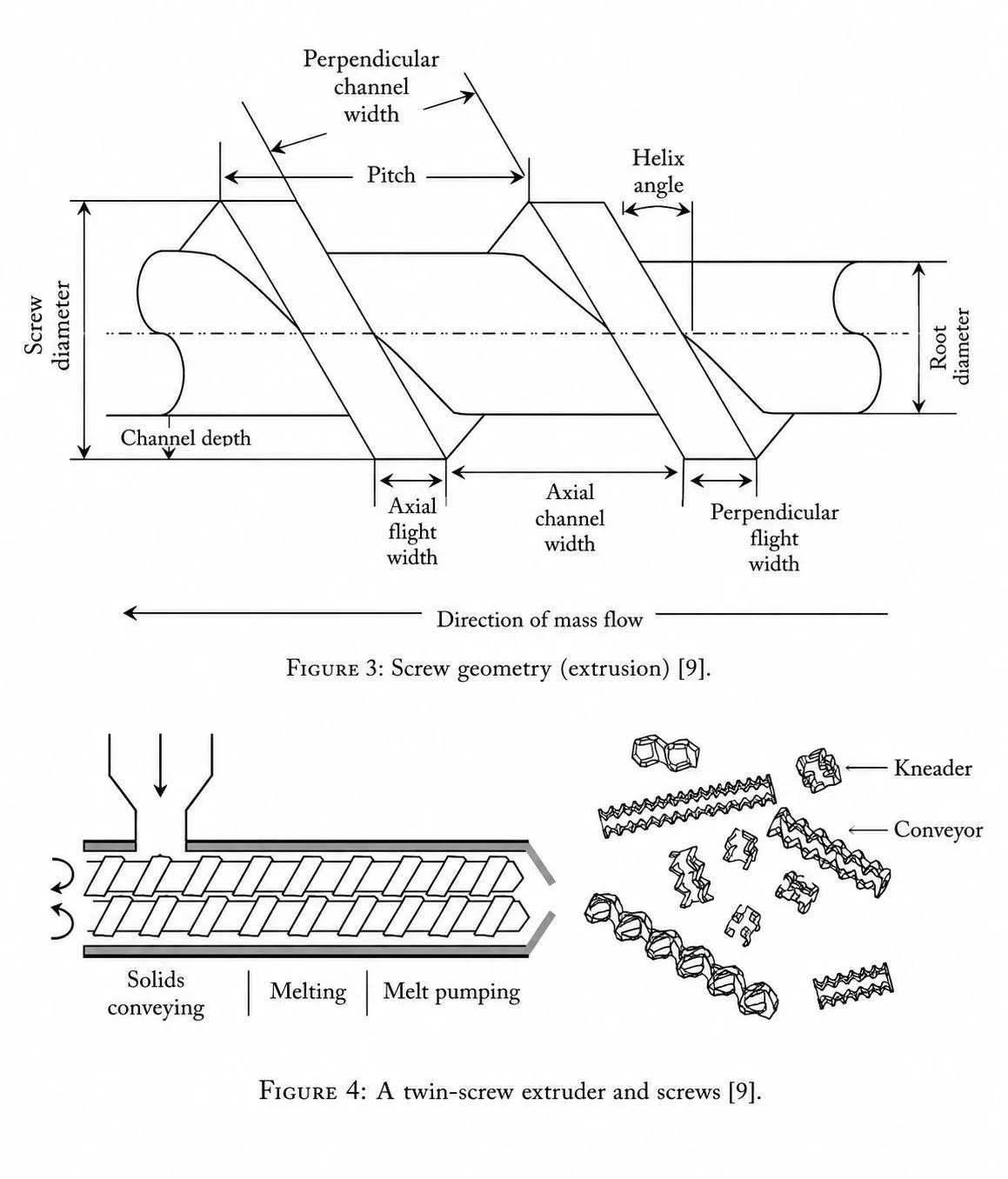
Fig No. 2 Twin Screw Extruder
Pharmaceutical Applications:
Polymer and Plastic Industry Applications:
Food Industry Applications:
Hot melt extrusion has several major pharmaceutical applications, especially in improving drug performance and patient convenience. One of its most important uses is solubility enhancement of poorly water-soluble drugs. Many drugs dissolve slowly in the body because they are crystalline and poorly soluble, but HME can convert them into amorphous solid dispersions, which dissolve faster and improve bioavailability. This happens because the drug is dispersed at a molecular level in a polymer matrix, particle size is effectively reduced, wettability is improved, and recrystallization is prevented. HME is commonly used for anticancer, antifungal, anti-inflammatory, and antiviral drugs.
HME is also widely used in controlled drug delivery systems. It helps prepare sustained-release, delayed-release, pulsatile-release, and extended-release dosage forms. In diffusion-controlled systems, body fluids enter the polymer matrix and the drug slowly diffuses out. In erosion-controlled systems, the polymer gradually breaks down and releases the drug over time. In swelling-controlled systems, hydrophilic polymers absorb water, swell, and form a gel barrier that slows drug release. These systems reduce dosing frequency, improve patient compliance, and help maintain stable plasma drug levels.
Another important application is taste masking of bitter drugs. This is especially useful in pediatric, geriatric, and chewable formulations. In HME, the drug is embedded inside a polymer carrier, which prevents direct contact with taste buds and reduces the perception of bitterness.
Overall, HME is a versatile and efficient technique used for solubility improvement, controlled release, and taste masking in modern pharmaceutical formulation7.
Hot melt extrusion is a solvent-free, continuous method used to prepare transdermal drug delivery systems such as films and patches. The drug is blended with polymers, plasticizers, and sometimes permeation enhancers, then heated and pushed through a die to produce a uniform extrudate. This technique improves drug distribution, controls release, and can enhance skin permeation by forming solid dispersions or flexible films.
Its main advantage is that it is simple, scalable, and suitable for manufacturing consistent dosage forms. However, it is not ideal for heat-sensitive drugs, and the choice of polymer and additives must be optimized carefully to avoid irritation or instability. Overall, HME is a promising technique for modern transdermal patch development8.
The drug used in a transdermal system should have low molecular weight, be effective in small doses, and possess suitable lipid and water solubility so it can pass through the skin barrier properly. These properties help the drug diffuse across the stratum corneum and reach systemic circulation more efficiently.
Polymers form the matrix of the patch and control the release of the drug. Commonly used polymers include ethylene vinyl acetate, Eudragit, polyethylene oxide, and hydroxypropyl cellulose. The choice of polymer affects the flexibility, stability, and release behavior of the patch.
Plasticizers are added to improve flexibility and processability of the formulation. A common example is polyethylene glycol, which helps make the patch softer and easier to handle.
Permeation Enhancers
Permeation enhancers are used in hot melt extrusion to improve how a drug crosses a biological barrier, especially in buccal, topical, and oral delivery systems. In HME, they are typically blended with the drug and polymer so the final extrudate can increase drug release and permeability without a separate coating step.
In hot melt extrusion, permeation enhancers can be incorporated into the polymer matrix to increase membrane transport, improve wetting, and sometimes soften or fluidize the barrier layer. For example, oleic acid has been studied as a buccal permeation enhancer in an HME-made tablet, where lower oleic acid concentration improved drug permeation.
HME is solvent-free, continuous, and scalable, which makes it attractive for loading enhancers into a uniform dosage form. It also helps create amorphous solid dispersions, which can raise solubility and, in turn, improve permeability and absorption.
A piperine-Soluplus formulation made by HME showed much higher solubility and greater intestinal permeability than pure piperine, illustrating how extrusion can improve both release and absorption behavior.
The enhancer must be balanced carefully because too much can irritate tissue, destabilize the formulation, or reduce product quality. In one buccal study, a lower level of oleic acid performed better than a higher level, showing that more enhancer is not always better.
Hot melt extrusion is an industrially feasible method for manufacturing films and thin strips, especially oral thin films and similar drug-loaded strips. In this process, the drug is mixed with polymers and other excipients in a dry state, heated until it becomes a molten mass, and then extruded through a die to form a uniform film that is cooled and cut into the required size.
The main advantage of HME is that it does not require solvents, which makes the process cleaner, faster, and easier to scale up. It also gives good control over film thickness, drug distribution, and mechanical strength, which is important for producing consistent thin strips.
Typical materials used in these films include film-forming polymers, plasticizers, and sometimes surfactants or taste-masking agents. The final film is then slit, cut, and packaged as strips or patches depending on the intended use.
A key limitation is that the drug and excipients must be stable at the processing temperature, so HME is not suitable for heat-sensitive compounds. Even with this limitation, it remains one of the most useful methods for making uniform, scalable, and solvent-free thin films.
HME helps formulate tamper-resistant opioid medicines.
Abuse-deterrent formulations (ADFs) are specially designed dosage forms that prevent or reduce misuse and abuse of drugs, especially opioid analgesics and other controlled substances.
Hot Melt Extrusion (HME) is widely used in the development of ADFs because it produces strong polymeric matrices that are difficult to crush, dissolve, inject, snort, or extract.8
Hot melt extrusion has several advantages over conventionally available pharmaceutical processing techniques includes
Hot Melt Extrusion (HME) is widely used in pharmaceutical and polymer industries for improving drug solubility and preparing solid dispersions. Despite its advantages, it also has several limitations and disadvantages.
Hot melt extrusion has several limitations that affect its use in pharmaceutical manufacturing. One major issue is thermal degradation, since the process uses high temperature and mechanical shear that can reduce drug potency, cause chemical instability, and form degradation products. Because of this, HME is not suitable for many thermolabile materials such as proteins, peptides, vitamins, and some antibiotics.
Another limitation is the high energy and equipment cost. The process requires continuous heating, mechanical power, and specialized extrusion systems, which increase production expenses. In addition, HME needs careful optimization of parameters such as barrel temperature, screw speed, feed rate, pressure, and residence time to maintain product quality and uniformity.
Drug–polymer incompatibility can also be a problem, as some formulations may show instability, recrystallization, phase separation, or reduced bioavailability. Moisture sensitivity is another concern because water can affect extrusion behavior and may cause hydrolytic degradation or lower stability. Scale-up from laboratory to industrial production is often difficult due to changes in heat transfer, mixing, and residence time. Finally, only certain thermoplastic polymers are suitable for HME, and the process may produce residual stress that can lead to brittleness, cracking, and storage instability9.
For a pharmaceutical material to be processed by hot melt extrusion, it must be able to deform easily inside the extruder and solidify upon its exit. The materials must meet the same levels of purity and safety as those prepared by traditional techniques. Most of the raw materials used in hot-melt extruded pharmaceuticals have been used in the production of other solid dosage forms such as tablets, pellets, granules, transdermal, and transmucosal systems. Thermal stability of the individual compounds is a prerequisite for the process, although the short processing times encountered in this process may not limit all thermolabile compounds.Hot melt extruded dosage forms are complex mixtures of active medicaments and functional excipients. Functional excipients may be broadly classified as matrix carriers, release modifying agents, bulking agents, antioxidants, thermal lubricants, and miscellaneous additives. The selection and use of various excipients can impart specific properties to hot-melt extruded pharmaceuticals in a manner similar to those in traditional dosage forms. The incorporation of plasticizers may lower the processing temperatures necessary for hot melt extrusion thus reducing drug and carrier degradation. Drug release from these systems can be modulated by the incorporation of various functional excipients. The dissolution rate of the active compound can be increased or decreased depending on the properties of the ratemodifying agent.[10]
The properties of the active drug substance often limit the formulation and processing choices available to the pharmaceutical scientist in the development of dosage forms. Hot melt extrusion is an anhydrous process, which avoids potential hydrolytic degradation pathways. In addition, poorly water soluble and high melting point APIs than the melting point of carriers to be selected should be considered for hot melt extrusion process and can be prepared as tablets, capsules, and pellets.
In hotmelt extruded drug delivery systems, the active compound is embedded in a carrier formulation often consists of one or more meltable substances and other functional excipients. The meltable substance is generally a polymer or low melting point wax. The selection of an appropriate carrier is important in the formulation and design of a hot-melt extruded dosage form. The physical and chemical properties of the carrier can control the release of the active compound from the final dosage form. The physical and chemical properties of the carrier can control the release of the active compound from the final dosage form. For systems employing nonpolymeric carrier materials, the compatibility between the drug substance and carrier should bead dressed. Drug release kinetics from hotmelt extruded dosage forms is highly dependent upon the choice of the carrier material.
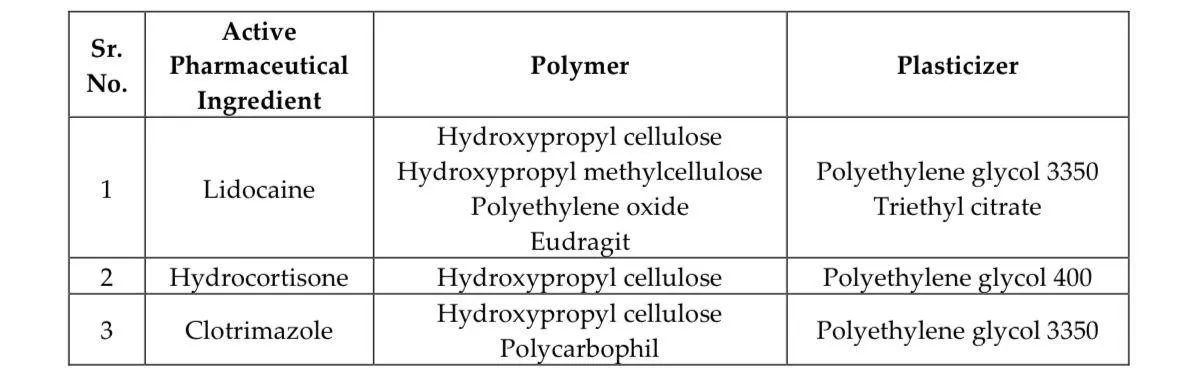
Plasticizers are typically low molecular weight compounds capable of softening polymers to make them more flexible. The use of polymeric carriers in hot melt extrusion often requires the incorporation of a plasticizer into the formulation to improve the processing conditions during the manufacturing of the extruded dosage form or to improve the physical and mechanical properties of the final product. Plasticization of the polymer is generally attributed to the intermolecular secondary valence forces between the plasticizer and the polymer. Plasticizers are able to decrease the glass transition temperature and the melt viscosity of a polymer by increasing the free volume between polymer chains. In doing so, the ease of movement of polymer chains with respect to each other is dramatically reduced. Plasticizers were also found to facilitate the fusion process of semicrystalline polymers. Less energy is usually required to melt semi-crystalline polymers following the addition of one or more plasticizers. With the addition of a plasticizer, a hot melt extrusion process can be conducted at lower temperatures and with less torque. Generally, both the active ingredient and the polymer will be more stable during the extrusion process due to these improved processing conditions. Plasticizers used for the preparation of pharmaceutical dosage forms must have good efficiency, stability, polymer plasticizer compatibility, and permanence. Triacetin, citrateesters, and low molecular weight polyethylene glycols have been investigated as plasticizers in hot-melt extruded systems. Recently, surfactants have also been shown to be promising plasticizers in producing solid dispersions by hot melt extrusion in addition to acting as solubilizers.
The stability of polymers that are susceptible to degradation can be improved with the addition of antioxidants, acid receptors and or light absorbers, thermal lubricants, thermal stabilizers during hot melt extrusion.[11]
Table No. 1 Examples of Combination of API Polymers & Plasticizers
Hot Melt Extrusion: Physicochemical Factors to Be Investigated While Designing and Optimizing a Hot Melt Extrusion Process:
First developed and used in the plastics industry, hot melt extrusion (HME) has been applied in the pharmaceutical industry as a simple, reproducible, and fast method for producing many solid dosage forms of drugs [1,2] for different delivery routes, such as the oral route (granules, pellets, and tablets) [3–6], the transdermal and transmucosal route, and the subcutaneous route (implants), some of the most widely developed applications are for:
The HME process makes it possible to convert a mix of raw materials into a product with specific characteristics, such as uniform shape and density, by forcing the mix through a die under controlled conditions. For this, HME exploits a molten system, the viscosity of which must be controlled to enable the flow through the die. First, the drug and excipients are mixed in the same equipment used for the extrusion, orina mixer. Possible excipients are bulking agents, matrix carriers, antioxidants, thermal lubricant, plasticizers and additives. Subsequently, under heating, one or more components of the mix melt while the plastic mass is being extruded through the equipment (for example, ram extruder, single-screw or twin-screw extruder). As the extrudate is ejected from the machine, it cools and solidifies, and then is subjected to further downstream processes. This continuous pharmaceutical process can be performed below the glass transition temperature (Tg) of the mix , but generally is carried out above the melting temperature (Tm) of the mix to reach the best operating procedures and, in particular, the appropriate rheological properties. The HME process offers many advantages and poses few disadvantages; these factors are summarized in Table 1. During the design and optimization of an HME process, one must examine both the process factors (selection of the appropriate equipment, mass feed rate, process temperature, shear stresses, etc.), as well as the physicochemical factors (drug and excipient properties, possible interactions among all the components of the mix, mix physical state, and physicochemical stability). More recently, Process Analytical Technology (PAT) frequently combined with Design of Experiment(DoE)has proven interesting for successful process optimization, particularly for evaluating both process parameters and formulation factors. Design and optimization of an HME process can be described in terms of pre-formulation, formulation and process, and post formulation phases. In particular, this review will describe the pre-formulation, formulation and process, and post formulation factors that should be investigated while designing and optimizing a hot melt extrusion process (Table 2): The chemical and thermal stability of extrudates The solid physical state of extrudates The drugpolymer interaction The miscibility/solubility of the drug-polymer systems The rheological properties of extrudates The physico mechanical properties of films produced by hot melt extrusion The drug particle dissolution from extrudates Before describing these factors in depth, a summary of the most widely applied technologies used in hot melt extrusion are considered.[12]
Drug and polymers can be sieved through the mesh screen (#20) and placed in an oven (45°C) overnight for removal of any residual moisture. The polymers can then physically mixed together with the drug as per formulation code tabulated in Table 1. Each powder mix sample can be subsequently hot-melt extruded using a corotating twinscrew laboratory extruder with a screw diameter of 10 mm d 12 mm (Do/Di ratio of 1.45). The blends can fed and extruded as per the settings (feed rate: 240 g/h, screw speed: 130-150 rpm, torque: 1.5- 3 Nm and residence time: about 60-90 s). Different processing temperature zones can be maintained in the hot melt extruder as: 80, 100, 150°C and chiller < 10°C. Chill rolls should be used for instantaneous solidification of the extruded strands. A vacuum pump should connected to ensure efficient degassing of the extrudates. The extrudates can be milled and passed through 60 # mesh screen.[13]
The drug release studies in vitro for all samples can be conducted as per USP XXIII using a dissolution apparatus (Electrolab (TDT06L) USP, rotating paddle technique). Carefully measured samples of 100 mg of mesalamine were added to 900 ml of 0.1N HCl (Simulated gastric fluid: pH 1.2) maintained at 37.0 ± 0.5°C and subjected to a rotation speed of 50 rpm. Samples (10 ml) were taken using a 10 ml syringe at intervals of 10, 20, 30, 45, 60, and 90 minutes and substituted with new medium. The samples were passed through a 0.45 µm membrane filter and examined using a UV-Visible Spectrophotometer (Jasco- V360) at a wavelength of 232 nm. The quantity of all the melt dispersion sample formulations should be subjected to 40°C and 75% RH for 3 weeks in a Humidity Cabinet (Thermotech, IKON Instrument, India), and DSC and FTIR spectroscopy analyses were conducted.[14]
Differential Scanning Calorimetry (DSC) is a thermal analysis method utilized to examine alterations in heat flow within a material when it is heated, cooled, or maintained at a steady temperature. It operates on the principle that when a material experiences physical or chemical transformations like melting, crystallization, or glass transition, it either takes in or emits heat, and the instrument captures this heat flow difference between the sample and a reference. In DSC analysis, a sample and an empty reference pan are exposed to a programmed temperature increase, and the resulting thermogram reveals details about the thermal events happening in the material. In pharmaceutical research, DSC is extensively applied to assess melting points, crystallinity, polymorphic alterations, and the compatibility of drugs with excipients. It is especially valuable in assessing formulations such as melt dispersions or hot-melt extruded systems, as it aids in determining if the drug stays crystalline or transforms into an amorphous state, and it evaluates any alterations in thermal properties following storage under challenging conditions like elevated temperature and humidity.[15]
Fourier Transform Infrared Spectroscopy (FTIR) is a method used for analyzing and examining the chemical composition of substances through their response to infrared light. It operates on the principle that various chemical bonds take in infrared light at designated wavelengths, leading to molecular vibrations like stretching and bending. In FTIR analysis, a beam of infrared light is transmitted through or reflected by a sample, and the produced spectrum is generated by measuring the absorbed frequencies through a Fourier transform computation. The obtained FTIR spectrum displays distinct peaks related to functional groups found in the drug or formulation. In pharmaceutical research, FTIR is commonly employed to verify drug identities, identify functional groups, and crucially, assess the compatibility of drugs and excipients in formulations. A change in peak position, the loss of peaks, or the emergence of new peaks may suggest a chemical interaction or incompatibility among the components. In systems like melt dispersions or hot-melt extruded formulations, FTIR is especially valuable for verifying that the drug remains chemically stable and does not experience unwanted interactions with polymers during storage or processing. [15]
Mesalamine HME was designed to improve in-vivo dissolution and help more drug reach the colon, where it can act locally in inflammatory bowel disease. The main idea is to protect the drug early in the GI tract, then allow better dissolution and sustained release as the dosage form moves toward the intestine and colon.
Mesalamine (5-ASA) works mainly in the colon, but conventional tablets may release too early in the upper GI tract, where part of the drug is absorbed or metabolized before reaching the target site. The HME system was therefore developed to improve dissolution, increase colonic drug availability, maintain a sustained local concentration, and enhance the therapeutic response.
After swallowing, the extrudate enters the stomach, where the acidic environment keeps the polymer matrix relatively stable and limits early drug release. This helps reduce premature drug loss before the formulation reaches the intestine.
As it moves into the small intestine, the rising pH and contact with fluid allow the hydrophilic components to swell and the drug to diffuse more readily. Because HME converted mesalamine from a crystalline state to a partly amorphous form, wettability and solubility improved, so dissolution became faster.
The most important target is the colon, where the HME formulation can provide controlled and sustained release during GI transit. This can increase local mesalamine concentration, improve mucosal contact, reduce inflammation, and lower systemic side effects by keeping the drug where it is needed.
The main reason is reduced crystallinity. SEM, DSC, and FTIR showed partial or complete amorphization and smaller crystal size, and amorphous drugs usually dissolve faster because they have higher free energy, better molecular mobility, and improved wettability. The reported similarity factors, with f1 at 0.3–11.1 and f2 at 26–49, indicate that the HME formulation released drug in a meaningfully different and improved way compared with pure mesalamine.
What is SEM?
Scanning Electron Microscopy (SEM) is a sophisticated imaging method employed to examine the surface structure and microfeatures of materials with extremely high magnification and resolution. It operates based on the concept of directing a concentrated stream of high-energy electrons across the sample's surface. As these electrons engage with the sample, they generate multiple signals like secondary electrons and backscattered electrons, which are captured and transformed into a detailed image of the surface. In drug research, SEM is extensively utilized to analyze the surface properties, shape, dimensions, and texture of drug particles and formulations. It is especially beneficial in assessing solid dispersions, melt extrudates, and various dosage forms to notice alterations in particle shape, drug distribution, and surface uniformity. SEM aids in determining if the drug is evenly distributed within the polymer matrix or if crystalline structures exist on the surface, thus offering crucial insights into formulation quality, stability, and performance.[16]
Hot melt extrusion method for preparation of ibuprofen/sucroesterWE15 solid dispersions: evaluation and stability assessment:
Solid dispersions (SDs) technique has attracted substantial interest as an efficient mean of improving the dissolution rate as well as the bioavailability of a wide range of poorly aqueous soluble drugs (Hasnain and Nayak, 2012). Also, SDs can be used to sustain the drug release by selecting an appropriate polymer . The two major processes of preparing SDs are melting (fusion) and solvent evaporation methods. Other various approaches include co-evaporation hot spin mixing (Dittgen et al., 1995), roll-mixing or comilling (Breitenbach, 2002), freeze-drying ( Sekikawa et al., 1983), spray drying (Caron et al., 2011), and supercritical fluid processing (SFP) (Gong et al., 2005). In the 1980s, hot melt extrusion (HME) was used for the first time in the formulation of pharmaceuticals (Stanković et al., 2013). The advantages of HME over the conventional approaches are: economical process, short production time, continuous operation with few processing steps and ease of scaling-up (Maniruzzaman et al., 2012). During HME of pharmaceutical dosage forms, a blend of active ingredient, thermoplastic polymeric carrier, and other processing aids (plasticizers and antioxidants) is heated and softened inside the extruder and then pressurized through a die into granules, cylinders, or films (Zhang and McGinity, 2000). Sucrose esters (SEs) are applied in HME technology as promising carriers, because of their low melting points and their surfactant properties, but the information available on these carriers is not sufficient and further investigations are needed.[17]
Pure Ibuprofen (IBU) was kindly donated from Sigma pharma, Cairo,
Egypt. Sucroester® WE15 (SE® WE15)(HLB=15) was obtained from Gattefose S.A., France. Sodium hydroxide pellets and potassium dihydrogen orthophosphate were purchased from Laboratory Rasayan, India. HPLC grade acetonitrile and Sodium dihydrogen phosphate (NaH2PO4) were purchased from Merck, (Germany). MilliQ purified water (Millipore Corp., Billerica, MA, USA) was used to prepare the dissolution medium.[18]
SDs of IBU/ SE®WE15 was processed using HME with two different IBU loading ratios, i.e. 60% and 30% w/w for HME1 and HME-2, respectively. Extrusion was performed using ¼ inch single screw extruder with a single rod die (Randcastle Microtruder RC-025, Randcastle Extrusion Systems, Inc., USA). The four zones of the extruder were heated to the required temperatures ranges from 55 – 65 C and screw rotation was set at 30 rpm. The extrusion conditions and steps required to form the final product was previously discussed (Emara et al., 2014) with slight modification. The prepared hot melt extrudates were cut manually into pellets with the following dimensions: length equals to 1 ± 0.1 mm and width equals to 0.6 ± 0.1 mm. Equivalent dose of IBU in each formula was 400 mg.[19]
SDs of IBU/ SE®WE15 was prepared by melting the required amount of drug and carrier for each formula in a hot plate on a water bath maintained at the specified temperature (65 C) for 10 minutes till complete melting. The fused mixture was cooled at room temperature, kept in vacuum oven overnight to solidify. The solidified mass was ground in a mortar, sieved to obtain particle size ranges of 850 µm – 710 µm and < 450 µm. The fusion mixtures were coded as FM-1 (60/40%w/w) and FM-2 (30/70 %w/w) for two different ratios of IBU / SE®WE15, respectively. [19]
(PM-1 & PM-2) of IBU and SE®WE15 in the same weight ratios as the
SDs were prepared by thoroughly mixing the appropriate amount of IBU and carrier in a mortar by trituration for 15 minutes, and then sieving through a 60 mesh sieve. Granules of 850 µm to 710 µm were then prepared by dry granulation.[20]
In vitro drug release studies of IBU powder, PM and the prepared
SDs were carried-out as described previously in details (Emara et al., 2014); using the closed loop setup of flow through. Cell (FTC) dissolution apparatus (USP IV, a Dissotest CE-6 equipped with a CY 750 piston pump, Sotax, Switzerland) in phosphate buffer pH 7.2. The dissolution studies were done in triplicate and the mean value was calculated. The FTC design selected to perform the dissolution studies had proven its efficacy to achieve the optimum conditions for IBU release from the proposed formulations; also it was able to discriminate between formulations containing different IBU loading ratios.
In vitro release study for fresh samples Our previous study on IBU/SE®WE15 sustained-release pellets using HME technique containing different drug concentrations were evaluated using specific operational conditions of the FTC dissolution apparatus (Emara et al., 2014). These specific features of the FTC were selected in order to develop a sensitive in vitro method to precisely discriminate between different formulations, ensure high reproducible in vitro results and to detect even minor differences which might occur after storage (Emara et al., 2014). SDs of different particle sizes prepared by fusion method showed the same release rate results. Therefore, the particle size range of 850 – 710 um was selected for further studies. SDs of IBU was previously prepared by different techniques and compared with its physical mixtures for better understanding of the effect of different methods on the physicochemical characteristics of the drug. IBU/SDs were previously prepared by the solvent and fusion-solvent methods using different carriers and compared with the physical mixtures (Dabbagh and Taghipour, 2007). In vitro dissolution results showed that SDs containing Eudragit or HPMC resulted in retardation of the dissolution of IBU, while SDs containing PEG gave faster dissolution rates than the physical mixtures (Dabbagh and Taghipour, 2007). Also, IBU/SDs was prepared by melt dispersion technique using macrogol 4000 and 6000 as carriers.
The results showed that the prepared SDs enhanced the dissolution of IBU relative to physical mixtures. Figure 1 showed the release profiles of different preparations of IBU/ SE®WE15 SDs (containing 60% and 30% w/w IBU) prepared by HME & FM, the prepared PM and comparing the results with pure IBU powder. Aggregation and agglomeration of PM were observed during dissolution study. [21]
The results showed that the physical mixtures (i.e. PM-1 & PM-2) and SDs prepared by fusion method (i.e. FM-1 & FM-2) did not cause any pronounced change in the amount of IBU released (Figures 1 A&B) compared to the observed sustained-release effect detected with hot melt extrudates (i.e. HME-1 & HME-2). In case of 60% w/w IBU, PM-1 and FM1 showed the same release profiles, while HME-1 significantly slowed the release rate (Figure 1A & Table 1). Figure 1B & Table 1 also showed that both PM-2 and FM-2 containing 30% w/w IBU, gave comparable release patterns with pure drug, while HME-2 showed the slowest release rate. These results clearly identify the advantages of HME technique over the other conventional methods as it provides uniform and intimate dispersion and/ or mixing of all ingredients by the high shear extruding forces. Thereafter, SDs prepared by different methods can have differences in product release properties, which might affect its performance based on a case by case study. [22]
RECENT INNOVATION FORMULATIONS VIA HOTMELT EXTRUSION:
HME, in particular twin-screw extrusion, is a robust processing method in producing ASDs. The rotating screws in twin-screw extrusion provide dispersive and distributive mixing of the API with polymeric excipients, providing enhanced mixing in comparison to single-screw extrusion (49). Twin-screw HME is also easily scalable, ensuring cost effective large volume production. The ability to produce ASDs cost-effectively at a large volume is a significant advantage over other solvent-based ASD preparation techniques, such as spray drying. The elimination of the use of a solvent in HME also makes it a green and environmentally friendly process, which is much preferred.[23]
Due to the challenges and stability challenges of ASDs, researchers have discovered other systems that similarly enhance the solubility and bioavailability of poorly soluble APIs. As APIs in crystalline state are generally more stable than in an amorphous state, the development of pharmaceutical co-crystals has emerged as an attractive alternative for solubility enhancement. Co-crystals are solid, neutral, crystalline materials containing two or more different molecular/ ionic compounds in a stoichiometric ratio, where the compounds are held together via non-covalent forces such as ionic interactions, hydrogen bonds and Van der Waals forces (63,64). An active pharmaceutical ingredient (API) and a co-former can make up a pharmaceutical co-crystal. The API and co-former typically interact via non-covalent bonding, and notably, there is no proton transfer between the API and co-former.[24]
RECENT INNOVATIONS IN HOT-MELT EXTRUSION TO PREVENT THERMAL AND CHEMICAL DEGRADATION:
High melting point APIs whose stability is primarily compromised by thermal degradation (i.e., thermally labile) compared to degradation driven by excipient incompatibilities (i.e., chemical instability) during the HME process experience the most significant benefit from decreasing the processing temperature. Contrarily, for molecules that experience chemical instability (i.e., amide or ester hydrolysis) during HME processing, reducing the processing temperature is not always sufficient to achieve a viable ASD. For molecules experiencing chemical instability during thermal processing, a fundamental understanding of the degradation pathway is essential in
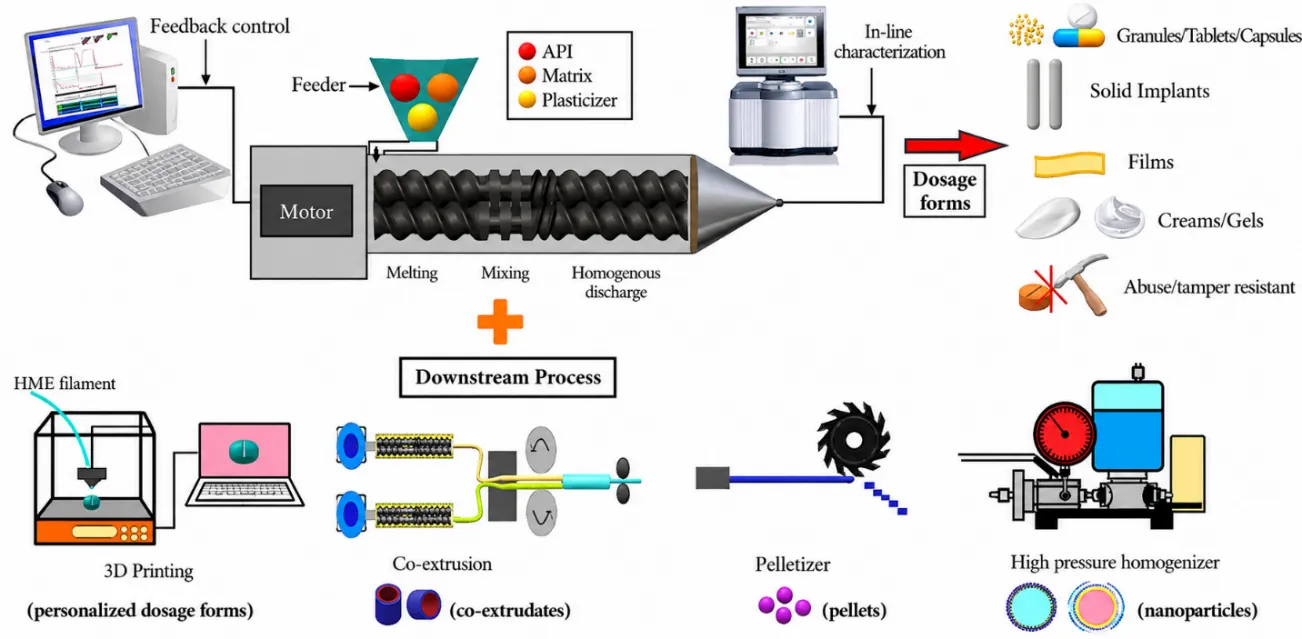
Fig. No. 3 Recent Innovation Formulations Via Hotmelt Extrusion
creating an ASD without trace crystallinity and acceptable degradation products. Hydrolysis is the most common chemical degradation pathway; two of the most susceptible groups are esters and amides. Ester hydrolysis occurs at a faster rate than amide hydrolysis, which is attributed to the differences in electronegativity between the functional groups.[25]
Prior to incorporating meglumine, in an attempt to eliminate degradation by hydrolysis, Haser et al. sought to reduce moisture during the extrusion process by venting the extruder, resulting in no change to the degradation profile (Fig. 6). Notably, the authors suggest that the closed-vent condition had an inflated purity value due to the retained water plasticizing the composition. This decreased the melt viscosity to an extent where more aggressive mixing conditions were needed for amorphous conversion.[26]
CONCLUSION
The hot-melt extrusion has established itself as a significant and versatile pharmaceutical processing technology with considerable potential for the development of advanced drug delivery systems. Its solvent-free, continuous, and scalable nature makes it highly suitable for modern pharmaceutical manufacturing, while its ability to enhance solubility, improve bioavailability, mask unpleasant taste, and support controlled and targeted drug release has led to its application in a wide range of dosage forms, including solid dispersions, transdermal systems, thin films, and modified-release formulations.
The review further indicates that, despite these advantages, the technique has certain limitations that must be carefully considered. Thermal degradation of drugs, incompatibility between drug and polymer, moisture sensitivity, high equipment cost, and the complexity of process optimization remain important challenges, particularly in the case of thermolabile and unstable compounds. Therefore, successful application of hot-melt extrusion depends on careful selection of suitable excipients, thorough preformulation studies, and precise control of processing parameters.
Overall, hot-melt extrusion represents a robust and promising platform for pharmaceutical product development. With continued advancements in polymer science, process analytical tools, and scale-up strategies, this technology is expected to play an increasingly important role in the design and manufacture of efficient, stable, and patient-friendly drug delivery systems.
REFERENCES





Nikesh Kawana*,Aditya Kale, Harshal Yadav,Rushikesh Wanole,Manisha Kitukale, A Review Of Hot-Melt Extrusion : Process Technology To Pharmaceutical Products, Int. J. of Pharm. Sci., 2026, Vol 4, Issue 7, 4249-4267. https://doi.org/10.5281/zenodo.21472937
 10.5281/zenodo.21472937