

We use cookies to ensure our website works properly and to personalise your experience. Cookies policy
Vidyaniketan College of Pharmacy, Takarkheda More Road Anjangaon Surji, Amravati, 444705, Maharashtra, India.
Its natural conduct is vulnerable modulation, repression of platelet aggregation and support of tissue rejuvenescence. Those mechanisms define bromelain as an important natural enzyme, generally used in the medicinal and nutraceutical industry. In order to achieve reproducible remedial goods and for harmonious dosing, dependable quantification and logical verification of bromelain is necessary. The selection of a suitable logical system determines perfection and trustworthiness, the factors demanded to inform the quality of the expression that determines the quality of formulas. Two methods, High-Performance Liquid Chromatography (HPLC) and Ultraviolet (UV) spectrophotometry, have been described as the most accurate, confirmatory, and scientifically validated analytical procedures. Because of ICH Q2(R1) demand, the logical confirmation parameters similar as linearity, delicacy, perfection, discovery limit, quantitation limit and robustness are critical parameters for trustability and reproducibility of the system. also, UV spectrophotometry is a comparatively quick and cheap system for a routine analysis, and it was named for artificial quality control at large scale, whereas perceptivity, selectivity and resolution are still at high situations. HPLC is the gold standard for bromelain quantitation in scientific and nonsupervisory assessment and operations. Advances have lately included the addition of advanced chromatographic and spectrophotometric tools like RP- HPLC, UPLC, and secondary UV spectroscopy, which offer a new position of perfection and delicacy in analysis. HPLC and UV ways combine for the high- quality control, stability checking and standardization of bromelain phrasings for different phrasings. The validated logical styles round each other, and their significance is vital for determining safety, effectiveness and the worldwide compliance of a bromelain containing medicinal and
Bromelain is an admixture of a composed proteolytic enzymes is primarily contained in Ananas comosus (pineapple) of fruit and stem. Due to the broad diapason of remedial goods of the enzyme,anti-inflammatory, antithrombotic,anti-edematous, and crack mending implicit ¹, it's a bioactive emulsion with a diapason of remedial goods, including inflammation mitigation and swelling relief, inhibition of platelet aggregation and acceleration of towel rejuvenescence ². Unlike utmost of the single- patch medicines, bromelain is a miscellaneous enzyme blend with several proteases and appurtenant proteins working synergistically ³. The characterization, exertion, and stability of the enzyme are affected by factors similar as source (fruit or stem), birth and sanctification process, and are of interest to pharmacology ?. The structural and functional characteristics of bromelain are explosively dependent on pH, temperature and the presence of stabilizing agents ?. confirmation of the logical ways is vital to deliver the same products of harmonious quality and remedial eventuality. Confirmation (pertaining to ICH Q2 R1), is proved as the process in which perfection, linearity, delicacy, discovery limit (LOD), quantitation limit (LOQ) and robustness of an analysis procedure are checked ?. and it has been a popular subject too. similar methodologies need to be a validated to insure that it's produces reproducible and harmonious results across the different laboratory circumstances ?. The confirmation of logical styles is of particular interest for enzyme- grounded phrasings (bromelain, for illustration) since natural exertion depends on environmental or other processing variables ?. The trustability of the logical process generates applicable lozenge, energy, and efficacity through product of batches, which also enhances patient safety and remedial pungency ?. Among the different logical styles employed, High- Performance Liquid Chromatography (HPLC) and Ultraviolet (UV) spectrophotometry remain the most established (but validated) styles used for bromelain estimation ¹?. HPLC technology possesses high perceptivity, selectivity, and quantitative values for in- depth study of parameters and stability ¹¹. UV spectrophotometry, on the other hand, is a quick, available, provident and simple fashion applied to performing standard quality control and webbing ¹². therefore, the complementariness of the two bromelain- analysis styles can be assessed by comparing their separate parcels. Although UV spectrophotometry provides high outturn system for standard characterisation, HPLC provides straightforward and precise and attesting dimension results which are useful to a more in- depth view of bromelain compositions like bromelain content, chastity & stability ¹³. With much further bromelain in use in drug it's essential for testing with validated HPLC and UV grounded results are needed to help in transnational regulation and harmonized bromelain for pharmaceutical products worldwide. The objectification of UV spectrophotometric test and HPLC grounded test would enhance the quality of bromelain products, the reproducibility and safety for both medical and nutraceutical purposes, quality control, reproducibility, safety and chastity independently according to ICH Q2 (R1) ¹?.
Drug Profile
|
Sr. No |
Parameter |
Details |
|
1 |
Structure |
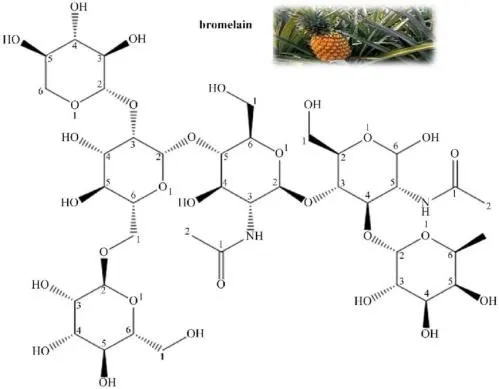
|
|
2 |
IUPAC Name |
Not applicable (bromelain is an enzyme mixture). |
|
3 |
Category |
Proteolytic enzyme (Thiol endopeptidase). |
|
4 |
Source |
Obtained from Ananas comosus (pineapple), mainly stem. |
|
5 |
Mechanism of Action
|
Hydrolyzes peptide bonds → reduces inflammation, edema, helps wound healing, modulates platelet aggregation. |
|
6 |
Physicochemical Properties
|
23–37 kDa; water-soluble; pH 5.5–8; heat-sensitive (>60°C). |
|
7 |
Pharmacological Actions |
Anti-inflammatory, mucolytic, digestive aid, immunomodulatory, fibrinolytic. |
|
8 |
Therapeutic Uses |
Swelling, sinusitis, digestion support, |
|
|
|
wound debridement. |
|
9 |
Dosage Forms |
Tablets, capsules, extracts, lyophilized powder, topical forms. |
|
10 |
Adverse Effects |
Nausea, vomiting, diarrhea, allergic reactions, increased bleeding. |
|
11 |
Contraindications |
Pineapple allergy, bleeding disorders; caution with anticoagulants. |
|
12 |
Drug Interactions |
Enhances effect of anticoagulants & antiplatelets. |
|
13 |
Storage Conditions |
Store cool & dry; protect from heat/moisture; stable at 2–8°C (lyophilized). |
|
14 |
Quality Control Tests |
HPLC, UV spectrophotometry, proteolytic activity assay, moisture content. |
Chemistry and Source of Bromelain:
Bromelain is a admixture of the cysteine protease enzymes belonging to the thiol endopeptidase family that has a reactive sulfhydryl (– SH) group at their active point and plays a part in peptide bond fractionalization ¹. They serve by hydrolysis by the proteases to lower peptides and amino acids, as a result showing endopeptidase exertion and exopeptidase exertion ². The catalytic medium is a cysteine – histidine – asparagine trio complex specific of thiol proteases like papain and ficin ³. This is catalytic trio an enables bromelain to act a efficiently at a wide range of a pH and temperature, which shows its good natural utility ?. In Ananas comosus (pineapple) there are two main kinds of a bromelain known as fruit bromelain and stem bromelain ? that's retain different physicochemical and enzymatic parcels. While a both isoforms partake analogous structural motifs and catalytic exertion, stem bromelain is a suitable for marketable and pharmaceutical product it has a advanced yield and provides a advanced proteolytic exertion, and is easier to prize from recycling waste ?. Stem bromelain a stems are used to prize this enzyme from the fruit waste product which after the fruit processing is discarded as a waste product and making it an environmentally-friendly and cost-effective volition ?. It's an glycoprotein with an approximate molecular weight of 23 – 37 kilodaltons (kDa) ?. The enzyme consists only of this single polypeptide chain of 200 – 300 amino acid residues ? Disulfide bonds and the hydrogen relations stabilise the tertiary structure while the carbohydrate half promotes solubility, thermostability, and proteolytic declination inhibition ¹?. The is isoelectric point (pI) of the enzyme ranges from 8.5 to 9.5, enabling it's to remain stable in mildly alkaline conditions ¹¹. Bromelain proves itself to be active on a pH scale from 6.0 to 8.0 and has significant enzymatic exertion at intermediate is temperature of 37 – 60 °C ¹². Conformational denaturation and catalytic loss can do in extremely hot and water-poor mediums ¹³, although the enzymatic exertion could be reduced in the presence of high heat or extremely high pH. Stability improvement of enzyme exertion during storehouse and processing is achieved by the use of stabilizing agents (e.g., calcium ions, reducing agents, e.g. cysteine) or minor buffers ¹?. In addition to proteolytically active substances, bromelain medications are supplemented with phosphatases, glucosidases, cellulases, peroxidases, and organically bound Ca2 ions, making it a protean biochemically active emulsion¹?. The enzyme complex evidences general substrate particularity, and it can hydrolyse casein along with gelatin, haemoglobin, and synthetic peptide substrates¹?. In the assiduity, stem bromelain is a precious crop and high-value resource because of its low cost, high yield, and the fact that it's an active extract within a gram ¹?. Processing of pineapple results in large quantities of bromelain deduced from peels, cores, and stems, which are well-grazed active bromelain budgets. The product of these wastes connects well with green chemistry and sustainable biotechnology, which is aimed at supporting indirect bioeconomy practices¹?. Biochemistry shows that bromelain contains both neutral and acidic protease fragments, each of which contributes to enzymatic effectiveness and substrate specificity ¹?. The neutral protease bit plays a significant part in degrading complex protein substrates, while the acidic bit has good stability under mild acidity ²?. Also, SDS- runner and electrophoretic analysis show the isoenzyme variety among different bromelain species, attesting the actuality of several active bands of different molecular weights ²¹. These variations are generally due to post-translational variations including glycosylation, sulfation, and confined proteolytic fragmentation, which modulate enzyme activity and stability ²². Bromelain is an enzyme complex with numerous biochemical expressions, the parcels of which nearly align with the endogenous origin of the emulsion, the birth conditions and sanctification fashion. For its high molecular structure, stability, and activity, stem bromelain is regarded as a successful biocatalyst in the field of pharmaceutical chemistry — that is salutary for medicinal, food and artificial operations. It owes its growing fashionability to similar considerations as the degree to which stem bromelain is preferred over fruit bromelain, not just due to enzymatic effectiveness as is true for this process, however, but also to its ecological and profitable sustainability ²³
Extraction and Purification of Bromelain:
The birth and sanctification of bromelain are pivotal ways that affect the enzyme’s yield, chastity, and natural exertion. It generally starts with segregating and handling pineapple biomass, such as the stem and fruit remainders (after juice/ food processing ?). After junking of dirt and answerable contaminants, the raw material is washed completely, also sliced into small pieces before being homogenised with a mechanical blender to release the intracellular enzyme-rich juice ?. The crude extract is filtered or strained through muslin cloth or through a Whatman sludge paper to exclude stringy remainders and produce a cell-free extract containing bromelain and its answerable proteins, carbohydrates, and phenolic composites ?. The excerpt is also centrifuged at 10,000 – 15,000 rpm to remove unbound debris and cellular patches¹?. The temperature and pH throughout the process should stay below 40 °C and 6.0 – 8.0, independently, to help prevent enzyme denaturation and save catalytic activity¹¹. After an explanation of this step, and bromelain enzyme is generally concentrated and incompletely purified through an ammonium sulfate rush and classical protein separation fashion ¹². Bromelain is widely researched through achromatism situations between 30 – 80 with lowmolecular-weight contaminations remaining in the result¹³. The rained enzyme is later centrifuged and redissolved in phosphate buffer( pH 7.0) for sanctification ¹?. For the junking of a redundant mariner and small motes, and dialysis is applied against phosphate buffer or deionised water; an incompletely purified bromelain result is attained in this manner ¹?. While these are traditional styles are straightforward and provident, they generally yield are enzyme medications that have despite their benefits, are of limited chastity and stability forcing the use of advanced sanctification approaches ¹?. utmost present-day biotechnology uses membrane- grounded separation technologies like ultrafiltration and microfiltration for bromelain sanctification¹?. These styles take advantage of differences in patch size and enable nonstopnon-destructive enzyme recovery with minimum declination and largely active natural function. Membrane is systems both ameliorate yield and attention and effectiveness, as well as reduce detergent are consumption and process time ¹?. Chromatographic styles are similar as IEC, GFC, and affinity chromatography (AC) ¹? are used to advance the process further. Ionexchange chromatography are separates proteins according to charge, with the bromelain protein are generally bound to DEAE- cellulose or CM- Sepharose matrices and eluted using a gradient buffer containing sodium chloride ²?. Gel filtration (size- rejection) grounded on bromelain molecular weight allows for the sanctification of low- molecular- weight contaminations and incompletely degraded proteins ²¹. Affinity chromatography is exercising ligands( cysteine or benzamidine) offers exceptionally picky and effective purification by exploiting the active- point relations of bromelain ²². Waterless is two-phase systems( ATPS) and deep eutectic detergent( DES) birth are recent inventions, representing an eco-friendly ( and scalable) druthers²³. Biphasic setting( frequently polyethene glycol and phosphate/ sulfate mariners) in ATPS is used for the treatment of bromelain, widely partitioning bromelain into one phase to produce both attention and partial sanctification contemporaneously ²?. This minimises denaturation threat and simplifies downstream processing ²?. Deep eutectic detergents( DES), which comprise biodegradable composites similar as choline chloride and organic acids, have been shown to maintain enzyme conformation and ameliorate birth effectiveness with respect to conventional detergents ²?. Likewise, the perpetration of paralyzed metal affinity chromatography( IMAC) and membrane-supported enzymatic reactors provides a doable path for the large-scale recovery of bromelain with low exertion loss ²?.
Flow illustration of bromelain birth and sanctification — Pineapple stem/ fruit → Washing and slicing → Homogenization → Filtration and centrifugation → Ammonium sulfate rush → Dialysis → Chromatography (Ion-exchange Affinity/ Gel filtration) → Lyophilisation → Purified bromelain. Following sanctification, bromelain is generally indurate- dried(lyophilised) to produce a stable powder form to be stored in the laboratory as a long-term option ²?. The lyophilised enzyme exhibits the same proteolytic activity for numerous months if held at 4 °C, where it should be shielded from humidity and direct sun ²?. The chastity and enzymatic exertion are also measured by SDS-runner electrophoresis, casein digestion, and protein quantification by the Lowry or Bradford system ³?. The final product, conforming to a single prominent protein band, corresponds to bromelain molecular weight (30 kDa); this indicates sanctification efficacity³¹.therefore, bromelain birth and sanctification are optimised, depending on pH, temperature, solvent composition and process time. Conventional rush and dialysis are veritably economically feasible, but ultramodern styles of membrane separation, affinity chromatography and green birth technologies have drastically enhanced enzyme yield, chastity and stability ³². The application of processing waste from pineapple processing reduces both product cost and aligns bromelain manufacturing with sustainable bioprocessing and indirect bioeconomy principles³³.
HPLC Method and Validation:
Due to its perceptivity, particularity, reproducibility, and perfection, high-performance liquid chromatography (HPLC) has now been the ultimate logical system for determining the attention of a bromelain ¹?. Compared with traditional spectrophotometric styles, this system offers superior resolution and quantitative delicacy. It's useful for assaying complex biochemical products in which bromelain factors make up a component or pharmaceutical products. HPLC analysis generally involves separation via Reverse-Phase High-Performance Liquid Chromatography (RP-HPLC), a system that counts on the hydrophobic list of the enzyme molecules to the stationary phase ²?. A typical system includes a C18 (octadecylsilane) column, in favour of ideal retention and resolution for protein-bound analytes ²¹. The mobile phase generally consists of 0.1 trifluoroacetic acid (TFA) in water and acetonitrile in the ratios of 6040 to 7030 (v/v), each grounded on the matrix and enzyme attention ²². The chromatographic system was characterised by working on an isocratic or gradient elution basis, depending on the complexity of the sample. Discovery is performed at 280 nm, the typical range of immersion for sweet amino acids like tryptophan, tyrosine, and phenylalanine, which are set up in bromelain’s peptide backbone ²³.
Typical Instrumental and Chromatographic Conditions
|
Parameter |
Optimized Setting |
|
Instrument |
HPLC system with UV/Photodiode Array detector |
|
Column |
C18 column (250 × 4.6 mm, 5 µm) |
|
Mobile Phase |
0.1% TFA in water : acetonitrile (60:40, v/v) |
|
Flow Rate |
1.0 mL/min |
|
Detection Wavelength |
280 nm |
|
Injection Volume |
20 µL |
|
Column Temperature |
25 ± 2°C |
|
Run Time |
10 minutes (average) |
These optimised conditions lead to sharp, symmetric peaks with a retention time of about 7.0 ± 0.2 twinkles, exhibiting excellent reproducibility ²?. Method Validation( according to ICH Q2( R1)). System confirmation for bromelain quantification by RP-HPLC is conducted to demonstrate the system is valid for its willed target. The following confirmation parameters are generally assessed ²?
Linearity in a wide attention diapason (similar to 5 – 100 µg/ mL) is tested. The R² of each of the estimation angles is over or equal to 0.999, demonstrating a largely direct relationship between peak area and attention ²?. delicacy( Recovery) Studies the recovery values are attained at 80, 100, and 120 of the target attention with a recovery-mean value range of 98 to 102, which confirms the delicacy of the system ²?.
Precision is repetition is assessed by examining the number of replicates of a single attention done on the same day; intermediate perfection measures inter-day differences. Typical RSD is lower than 2, demonstrating exceptional perfection ²?. Intermediate perfection can assess the variability in a single attention on varying days.
This system gives the system with good perceptivity towards trace situations( LOD = 0.58 µg/ mL), LOQ = 1.75 µg/ mL, permitting the discovery of situations of the bromelain present under delicate of phrasings ²?.
It's estimated in terms of robustness to introduce small deliberate changes in chromatographic conditions( inflow rate, pH, and discovery wavelength). These findings are substantiated by the lack of noteworthy differences in peak area or retention time, which easily verifies the robustness of the system ³?.
Theoretical plate count, trailing factor, and resolution are also studied previous to sample analysis as part of the SST parameters. permissible limits are Theoretical plates( N) ≥ 2000. o trailing factor ≤ 2. o RSD of retention time ≤ 1 per cent.
Representative Validation Results:
|
Parameter |
Result |
Acceptance Criteria |
|
Linearity |
5–100 µg/mL (r² = 0.9992) |
r² ≥ 0.999 |
|
Accuracy |
98–102% |
98–102% |
|
Precision (%RSD) |
0.65% |
≤ 2% |
|
LOD |
0.58 µg/mL |
— |
|
LOQ |
1.75 µg/mL |
— |
|
Robustness |
No significant variation |
Within limits |
The RP-HPLC, using a highly perfected and veritably low variability system, has been shown to be veritably dependable for quantitative estimation of bromelain in raw extracts and formulated products ³ Discussion. HPLC has been shown in numerous reports to be a precise and dependable method for bromelain assessment. Yantih et al.( 2019) linearities 5 – 100 µg/ mL, and recovery of 101 vindicated a robustness of the RP-HPLC system ³³. Goday et al.( 2019) optimised HPLC conditions for a bromelain-diclofenac combination, with a high selectivity and minimum hindrance ³?. Also, Reddy et al.( 2024) presented an HPLC method of delayed-release bromelain tablets with LOD and LOQ in agreement with ICH guidelines ³?. The time and resolution of analyses have also been further improved by advanced HPLC technologies like UPLC. UPLC can be used, and the runs are shorter (3 – 5 min), and the flyspeck size columns of 1.7 µm can be lower so as to increase the sensitivity and output ³?. Also, HPLC, in combination with Mass Spectrometry (HPLC–MS), enables the contemporaneous identification and quantification of bromelain and its degradation products, enhancing stem selectivity and usability for stability testing ³?. The are dependable and robust nature of HPLC also renders it an important logical instrument a quality control, standardisation and non-supervisory confirmation of bromelain formulas ³?. By separating all active bromelain isoenzymes and detecting minor contaminations, it consolidates its position as the ideal logical result for enzyme- grounded rectifiers ³?.
Conclusion of Section:
The RP-HPLC system has high perceptivity, selectivity and quantitative delicacy for bromelain estimation. Adherence to the ICH Q2( R1) confirmation criteria guarantees logical rigour and replicability. The grasp of HPLC for analysing bromelain paves the way for pharmaceutical quality assurance to assure a product that conforms to the global norms of regulation and safety in the form of an enzyme ??. Confirmation Principle & UV Spectrophotometric Method. UV spectrophotometry is one of these logical procedures, being both the simplest system easier to perform) and the most cost-effective and fast ²?. This system is performed according to the introductory Beer – Lambert law which establishes the direct relationship between the absorbance( A) and the attention( C) of the substance given by A = ε × l × C. where ε is the molar absorptivity( L · spook ?¹ · cm ?¹), l is the path length( cm), and C is the attention( spook · L ?¹) ²?. A proteinaceous enzyme, bromelain, contains sweet amino acids (tryptophan, tyrosine, phenylalanine, etc) with a strong absorptivity to UV around 280 nm. This characteristic attention is the basis for its spectrophotometrical quantitation. A close comparison of the absorbance at 280 nm with the attention of bromelain is observed, so that accurate and reproducible measures are possible at low attention ²?. Neutral phosphate buffer (pH 7.0) was preferred as the detergent or blank for enzyme stability and preservation of protein in its native shape during the analysis. The presence of neutral phosphate buffer( pH 7.0) is essential for enzyme stability and for maintaining the protein in its native state upon its final response step ²?. Buffers over this limit will lead to partial unfolding or denaturation of bromelain, resulting in loss of optic parcels and crimes of analysis ²?. Parameter Typical Condition. Solvent/ Blank Phosphate buffer( pH 7.0). λmax 280 nm. Path Length 1 cm( Quartz cell), attention Range 10 – 1000 µg/ mL. Used in an instrument UV-visible spectrophotometer. It was discovered that if these cuvettes were quartz, UV light would pass through the result, since plastics and glass absorb greatly in 200 to 350 nm ³?. The enzyme result should be freshly prepared, filtered to remove particulates, and tested continuously to avoid oxidation of sweet remainders ³¹. confirmation parameters (according to ICH Q2 (R1)). The confirmation of the UV spectrophotometry system confirms that the logical process gives unremarkable, dependable and reproducible results within specific operating conditions ³². Linearity 10 – 1000 µg/ mL(r²≥ 0.999) r²≥ 0.999 delicacy 98.5 – 101.5 98 – 102. Precision 1.2 RSD ≤ 2. LOD 3.34 µg/ mL — . LOQ 10.12 µg/ mL —. Robustness innocent (± 2 nm) harmonious. Linearity was determined by convolving absorbance versus attention, yielding a straight-line estimation wind over the working range. The system’s linearity ³³ is verified by a high correlation measure(r²≥ 0.999). The system was validated through recovery studies by spiking given quantities of bromelain standard to the topre-analyzed samples of different situations( 80, 100, 120) of bromelain standard. Average reclamations attained were 98.5 – 101.5, indicating the trustability of the system ³?. Precision was tested as intra- andinter-day reproducibility, with relative standard divagation( RSD) numbers of this method³?.
UV Spectrophotometric Method and Validation:
Principle
Bromelain absorbs UV light due to aromatic amino acids like tryptophan and tyrosine²?. The Beer–Lambert law relates absorbance with concentration??. The neutral phosphate buffer maintains enzyme stability?¹.
7.2 Analytical Condition
|
Parameter |
Typical Condition |
|
Solvent / Blank |
Phosphate buffer (pH 7.0) |
|
λmax |
280 nm |
|
Path Length |
1 cm quartz cell |
|
Concentration Range |
10–1000 µg/mL |
|
Instrument |
UV–Visible Spectrophotometer |
7.3 Validation Parameter
|
Parameter |
Result |
Acceptance Criteria |
|
Linearity |
10–1000 µg/mL (r² ≥ 0.999) |
r² ≥ 0.999 |
|
Accuracy |
98.5–101.5 % |
98–102 % |
|
Precision |
1.2 % RSD |
≤ 2 % |
|
LOD |
3.34 µg/mL |
— |
|
LOQ |
10.12 µg/mL |
— |
|
Robustness |
Unaffected (±2 nm) |
Consistent |
DISCUSSION
UV spectrophotometry is fundamentally less specific than HPLC but provides considerable value for the purposes of routine quality assurance in settings where rapid screening of multiple samples is necessary³?.UV process is non-destructive and necessitates little sample preparation, which is suitable for large scale production environments in which economy and throughput are critical³?. A number of studies have validated a bromelain estimation using UV spectrophotometric techniques. Thakur and Verma (2020) reported the method is 99.8% accurate and correlation coefficient r² = 0.999, confirming excellent method precision and recovery??. Singh et al. (2022) reported a simpler UV-assay for bromelain powder which was similar to the one employed before?¹, contributing to the robustness of the method. UV analysis has several advantages, the cheapest and operational ease of use in the absence of sophisticated chromatographic facilities being one of the main benefits?² for the laboratory. Furthermore, they offer fast reliable measurability for raw materials analyses, intermediate process control and the analysis of completed product?³. The UV spectrophotometric approach is shown to be low-cost, rapid and validated in quantifying bromelain in fresh extracts and the production of formulations.
CONCLUSION
The UV spectrophotometric approach is shown to be low-cost, rapid and validated in quantifying bromelain in fresh extracts and the production of formulations. The method can meet the ICH Q2(R1) validation criteria with high linearity, accuracy and precision. Less specific than chromatographic methods but convenient enough for routine industrial applications, inexpensive for an industrial, and widely adopted in production, it has become an essential tool for enzyme-based product quality management and homogenous assays??. Comparing with analytical technique criteria. The analytical characterization of bromelain by HPLC and UV spectrophotometry underscore the unique, yet related character of these two validation procedures. Depending on the method used, they may have different advantages and drawbacks with regard to accuracy, precision and specificity, cost-effectiveness and practicality to achieve it, a balanced analytical framework for enzyme standardization??. Being a chromatographic separation method, HPLC is a sensitive and high-selectivity approach, making it especially effective in differentiating bromelain from impurities, degradation products and excipients structurally similar to bromelain??. It allows for simultaneous quantification and identification of various constituents to ensure the purity and stability of bromelain in complicated pharmaceutical matrices??. High accuracy achieved by the method is evidenced by very low deviation in retention time and reproducible chromatographic profiles??. In addition, HPLC’s flexibility enables the incorporation of detectors such as the photodiode array (PDA) and mass spectrometry (MS) for further increased detection specificity?¹. UV spectrophotometry, on the other hand, has very little workarounds, and allows high throughput and low-cost; this is most useful for QC runs, batch release tests?². It offers a quick, non-causing method of quantifying bromelain in aqueous solution, showing a linear response at a large concentration range?³. Nevertheless, as it assesses total absorbance of aromatic amino acids, it is not selective for bromelain alone under presence of various proteinaceous materials??.
Analytical Comparision Table:
|
Analytical Parameter |
HPLC |
UV Spectrophotometry |
|
Accuracy |
Very high (98–102%) |
Moderate to high (98–101%) |
|
Precision |
Excellent (%RSD < 2%) |
Good (%RSD ≤ 2%) |
|
Specificity |
High – separates bromelain from impurities |
Limited – measures total protein absorbance |
|
Sensitivity (LOD/LOQ) |
0.58 / 1.75 µg/mL |
3.34 / 10.12 µg/mL |
|
Cost |
Expensive (instrument and solvents) |
Economical (basic setup) |
|
Analysis Time |
Moderate (≈10 min/sample) |
Very fast (<2 min/sample) |
|
Ease of Operation |
Requires trained analyst |
Simple and easy to perform |
|
Use Case |
Validation, purity, stability testing |
Routine QC, screening, raw material analysis |
Easily, as observed by the comparison above, despite the superiority of HPLC to give the logical particularity and reproducibility, UV spectrophotometry compensates through speed, simplicity, and affordability ??. The double exposure grounded approach combined the logical compass under a calibrated laboratory setting to meet artificial and nonsupervisory conditions for enzyme quantification ??. In addition, the approaches also meet a number of criteria according to ICH Q2 (R1) for logical confirmation — linearity, delicacy, and robustness ?? are satisfactory for both. Depending on the purpose, HPLC for detailed quantification, and UV spectrophotometry for high- outturn routine analysis ??, the system used is determined as over. Taken together, these data form a comprehensive logical approach, guaranteeing the batch-tobatch trustworthiness, quality, and quantity of bromelain ??.
FUTURE PERSPECTIVE:
Future research will focus on eco-friendly techniques such as ATPS, DES, ultrafiltration, and membrane-based systems to increase bromelain yield while reducing environmental impact.
Large-scale valorization of pineapple stems, peels, and cores will reduce production cost and support sustainable bioprocessing.
Development of high-efficiency purification methods like IMAC, affinity chromatography, and integrated membrane systems will enhance enzyme purity and activity.
Nano-encapsulation, polymer conjugation, and microencapsulation will improve bromelain’s thermal stability, controlled release, and bioavailability.
Future quality control will increasingly adopt UPLC, HPLC–MS, AI-assisted method development, and biosensor-based detection to improve sensitivity, specificity, and run time.
Analytical procedures will focus on improved precision, robustness, and global harmonization to meet regulatory standards for pharmaceutical products.
Bromelain may be incorporated into targeted delivery systems, controlled-release formulations, and novel dosage forms for enhanced therapeutic outcomes.
Research will expand into cancer therapy, immunomodulation, wound healing, antimicrobial applications, and anti-inflammatory uses where bromelain shows strong potential.
Machine learning and chemometrics will help predict chromatographic behaviour, optimize HPLC methods, and improve quality assurance workflows.
Combined use of validated HPLC and UV methods will support consistent batch-tobatch quality, facilitating worldwide regulatory acceptance.
CONCLUSION
Bromelain, a therapeutically significant proteolytic enzyme complex deduced substantially from Ananas comosus, requires accurate and validated logical styles to insure its quality, safety, and efficacity in medicinal and nutraceutical phrasings. Because bromelain is a miscellaneous admixture of proteases with variable exertion depending on its source, birth system, and storehouse conditions, dependable standardization becomes essential.
Both logical ways — HPLC and UV spectrophotometry — play pivotal places in the quantitative evaluation and quality control of bromelain.
HPLC, with its superior perceptivity, particularity, and capability to separate individual isoenzymes, stands as the gold- standard for confirmational analysis, stability evaluation, contamination profiling, and nonsupervisory compliance. It fulfills all ICH Q2( R1) parameters — linearity, perfection, delicacy, LOD/ LOQ, and robustness — making it ideal for advanced logical development and pharmaceutical confirmation.
UV spectrophotometry, however less specific, is rapid-fire, provident, and largely suitable for routine artificial quality control, batch release testing, and raw material analysis. Its simplicity and reproducibility make it a practical webbing tool in manufacturing surroundings.
Together, these methods complement each other:
The combined use of both ways establishes a strong logical frame for bromelain standardization, enabling harmonious batch- to- batch performance, bettered remedial trustability, and global nonsupervisory acceptance. Eventually, validated HPLC and UV styles support the product of high- quality bromelain- grounded medicinal and nutraceutical products that meet transnational norms for safety, chastity, and efficacity.
REFERENCES
Biochem J. 1990;266:869-75.
2020;302:112574.
Green Chem. 2021;23:1075-88.
Ind Microbiol Biotechnol. 2020;47:963-72.
Environ Manage. 2021;287:112341.
EMA; 2019.
2017;1500:1-13.
2020;15:1-10.
2019;9:34-45.
2023;415:1721-35.
Geneva: WHO; 2020.
Biochem J. 1990;266:869-75.
2020;302:112574.
Green Chem. 2021;23:1075-88.
Ind Microbiol Biotechnol. 2020;47:963-72.
Environ Manage. 2021;287:112341.
EMA; 2019.
2017;1500:1-13.
2020;15:1-10.
2019;9:34-45.
2023;415:1721-35.
Geneva: WHO; 2020.

Arpit Shinganjude, Nandini Tale, Shrutika Kawane, Om Iche, Dipti kavatkar, Mohd Faaiz, A Review on Analytical Evaluation and Validation of Bromelain Using HPLC and UV Spectrophotometry, Int. J. of Pharm. Sci., 2026, Vol 4, Issue 8, 195-210, https://doi.org/10.5281/zenodo.21768272
 10.5281/zenodo.21768272