

We use cookies to ensure our website works properly and to personalise your experience. Cookies policy
Ramanand Institute of Pharmacy and Management, Haridwar, Uttarakhand 249407
One of the most common endocrine illnesses in the world is thyroid problems. Over 42 million individuals in India alone suffer from this category of disorders that impair the thyroid gland's ability to operate. These conditions can show up as either an overactive thyroid (hyperthyroidism) or an underactive thyroid (hypothyroidism). It has a major effect on the human body's development, metabolism, and general health. The primary objective of this review article is to give a thorough overview of the thyroid glands anatomy and physiology, the different kinds of thyroid disorders, such as hypothyroidism, hyperthyroidism, thyroid cancer, goitre, thyroiditis, and thyroid disorders during pregnancy, as well as their causes, risk factors, clinical signs, diagnostic methods, and treatment options. For early discovery and successful treatment, it is essential to comprehend the pathophysiology of these illnesses. The article delves deeper into how environmental and genetic variables contribute to the development of thyroid disorders, as well as the most recent developments in diagnostic methods and treatment approaches. It also emphasizes the significance of early intervention and how thyroid dysfunction affects quality of life, especially in vulnerable groups like the elderly and pregnant women. This review attempts to contribute to a more comprehensive knowledge and improved management of thyroid problems by combining current research and clinical practices.
Hypothyroidism is a disorder in which the thyroid gland is underactive and produces insufficient thyroid hormones. The enlarged thyroid gland (galaganda), today known as goitre, is the most frequent form of this ailment specified in Ayurveda. Iodine deficiency is the most common cause of hypothyroidism, which is largely prevalent exclusively in iodine-deficient areas and is not even avoided by India's National Iodine Deficiency Disease Control Program. In many places of India, iodine deficiency still exists. [1] Hypothyroidism is the most prevalent thyroid illness, and it occurs more frequently than previously thought. The majority of people are unaware that they have it. Those who have this illness will experience symptoms due to a slowed metabolism. Subclinical hypothyroidism affects 3 to 8% of people, and it gets worse as they get older. Women are more likely than men to suffer from hypothyroidism. Thyroid hormone insufficiency affects around ten percent of women. Hypothyroidism can have an impact on lipid metabolism, neurological disorders, and other medical issues. [2] Hypothyroidism's effects on peripheral tissues Primary hypothyroidism is caused by a lack of hormone production by the thyroid gland, but secondary hypothyroidism can also be caused by insufficient secretion of either thyrotropin (similar to thyroid-stimulating hormone-TSH) from the pituitary gland or thyrotropin-releasing hormone (TRH) from the hypothalamus (tertiary hypothyroidism). Hypothyroidism is a highly common condition in today's population. Clinical hypothyroidism affects roughly 2% of adult women and 0.1-0.2 percent of males, whereas subclinical hypothyroidism affects up to 9% of the adult population, but this disease worsens with age. This hypothyroidism condition (congenital hypothyroidism) affects about 1 in 3500 infants [3]
TYPES AND CAUSES OF HYPOTHYROIDIS:
Hypothyroidism can be classified as follows: -
I. Primary hypothyroidism: (it includes 95% of cases)
Clinical sign and symptoms of hypothyroidism: -
PATHOPHYSIOLOGY
Hypothyroidism is generally caused by inadequate thyroid gland stimulation or by primary gland failure by the hypothalamus or pituitary gland. Congenital anomalies, autoimmune destruction (Hashimoto disease), iodine shortage, and infiltrative disorders are the most common causes of primary gland failure (primary hypothyroidism). In the United States, autoimmune thyroid disease is the most prevalent cause of hypothyroidism. Symptoms of induced forms of hypothyroidism include thyroid surgery, radioiodine therapy, and neck irradiation. Thyroiditis associated with thyroid-stimulating hormone (TSH) receptor-blocking antibodies, postpartum thyroiditis, subacute thyroiditis, silent thyroiditis, and thyroiditis associated with thyroid-stimulating hormone (TSH) receptor-blocking antibodies are the most common disorders associated with transient hypothyroidism. The central causes of hypothyroidism are manifested by abnormally normal or low TSH levels in relation to insufficient thyroid hormone, and are associated with various signs of hypothalamic or pituitary dysfunction. Lithium, amiodarone, interferon alfa, interleukin-2, and tyrosine kinase inhibitors are some of the drugs usually associated with thyroid dysfunction. [8]
Molecular and biochemical pathophysiology
Thyroid hormone actions are reduced in clinical hypothyroidism, including calorigenesis and oxygen consumption modulation in most tissues, as well as new organ-specific effects. Thyroxine, the thyroid gland's major product and circulating thyroid hormone, is converted to triiodothyronine in the cytoplasm and nucleus of target tissues via outer-ring monodeiodination by three separate tissue-specific deiodinases. Triiodothyronine binding to at least one of the nuclear receptor superfamily's tri-iodothyronine receptor isoforms is expected to mediate most classical thyroid hormone functions gnomically (TR1, TR1, and TR2). Triiodothyronine receptors have regions that allow them to bind triiodothyronine, DNA, and form dimers with other triiodothyronine receptors or nuclear receptors (such as the retinoic acid X receptor). Thyroid hormone-responsive genes have receptors that bind to DNA in the 5' regulatory regions at specific hexametric oligonucleotide sequences and at specific orientations of paired thyroid response elements. Tri-iodothyronine binds to its receptor, causing accessory protein cofactors to bind, either activating or repressing the transcription of a certain gene (as tri-iodothyronine does to the hypothalamus thyroid releasing hormone and thyrotropin component genes). Using this paradigm, several clinical indications of hypothyroidism can be comprehended at the molecular level. Failure to activate the growth hormone gene in pituitary somatotrophs, for example, results in poor stature in prepubescent children. [9]
SYNTHESIS AND SECREATION OF THE THYROID HORMONE:
ANATOMY OF THYROID GLAND
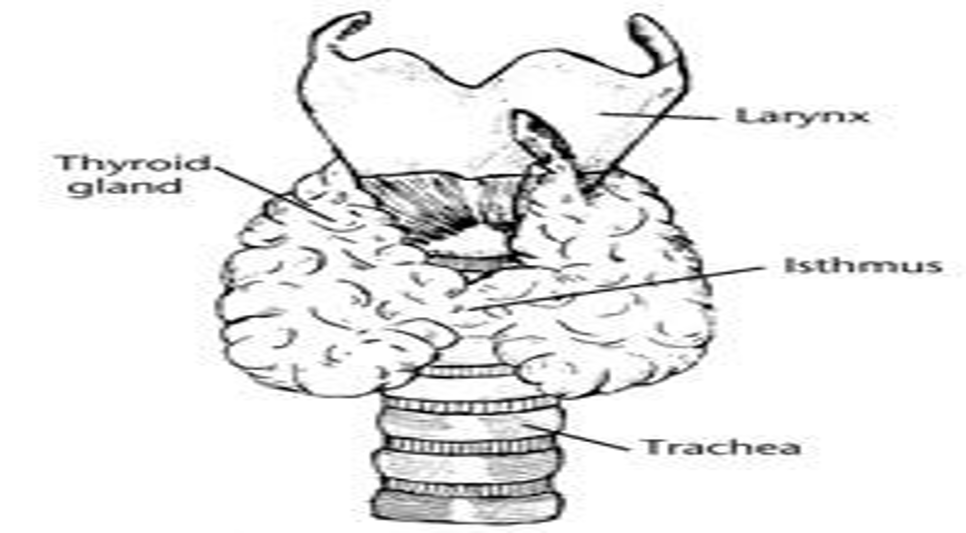
Thyroid gland is one of the largest endocrine glands in the body, weighing about 15 to 20 grams in adults (0.5 to 0.75 ounces). The thyroid gland is found beneath the larynx and in front of the upper section of the trachea. The thyroid gland is made up of two lateral lobes joined by the isthmus, a small strip of thyroid tissue. The region between the second and fourth tracheal cartilages is covered by the isthmus The thyroid gland is made up of several spherical and hollow structures with a significant number of closed follicles (100 to 300 in diameter) filled with colloid, a sticky and viscous substance. Thyroglobulin is the biggest glycoprotein with substantial colloid elements, and it contains thyroid hormones within its molecule.
THYROID HORMONE:
Triiodothyronine and thyroxine, generally known as T3 and T4, are two main hormones secreted by the thyroid gland. Although thyroxine (T4) is more common than triiodothyronine (T3), T3 is the more dominant thyroid hormone, hence T3 is considered the primary thyroid hormone. Both hormones enhance the body's metabolic rate in a satisfactory manner. Thyroid secretion is principally regulated by thyroid stimulating hormone (TSH), a hormone produced by the anterior pituitary gland. The calcitonin hormone, which is vital for calcium metabolism, is also secreted by thyroid hormone. Thyroid hormone synthesis and secretion are meticulously controlled by a system that includes the hypothalamus, pituitary, and thyroid gland (HPT) axis. TRH is a tripeptide that is generated in the paraventricular nucleus of the hypothalamus and then delivered by the portal capillary plexus through axons to the median and then to the anterior pituitary. It attaches to receptors in pituitary thyrotropes, a kind of pituitary cell that aids in thyroid stimulating hormone secretion (TSH). TRH activation causes the release and synthesis of new TSH in thyrotropes, and the hormone receptors are seven-transmembrane spanning receptors. [10]
THYROID HORMONES DISORDERS:
Thyroid disorders are classified into:
DIAGNOSIS OF HYPOTHYROIDISM
Medical History & Physical Check-up:
Doctor asks about your health history and symptoms. Then, they do a physical exam.
To confirm if you really have hypothyroidism and to find out the cause, doctors do the following tests:
a. TSH Test (Thyroid Stimulating Hormone):
b. T4 Test (Thyroxine):
This checks the level of actual thyroid hormone in your blood. In hypothyroidism, T4 levels are lower than normal.
c. Thyroid Antibody Test:
This test checks if your immune system is attacking your thyroid (as in Hashimoto’s disease). People with Hashimoto’s usually have these antibodies. If no antibodies are found, the cause may be something else. [12]
TREATMENT
CONCLUSION
Hypothyroidism is a condition when the thyroid gland is fail to produce sufficient thyroid hormone to meet the metabolic demand of the body. Hypothyroidism is a common, potentially, serious, often clinically overlooked, readily diagnosed by laboratory testing, and eminently treatable. The available treatments for hypothyroidism are very limited. The understanding of its pathophysiology opened possibilities for rational drug design, motivating innovative approaches in the search for hormone replacement therapy.
REFERENCES


Rabita Raturi, Naina Sikhola, A Review on Hypothyroidism, its Pathophysiology, Secretion of Thyroid Hormones, Diagnosis and Treatment, Int. J. of Pharm. Sci., 2026, Vol 4, Issue 8, 633-639. https://doi.org/10.5281/zenodo.21800632
 10.5281/zenodo.21800632