

We use cookies to ensure our website works properly and to personalise your experience. Cookies policy
Department of Pharmacy, Mansarovar Global University, Sehore, Madhya Pradesh, India.
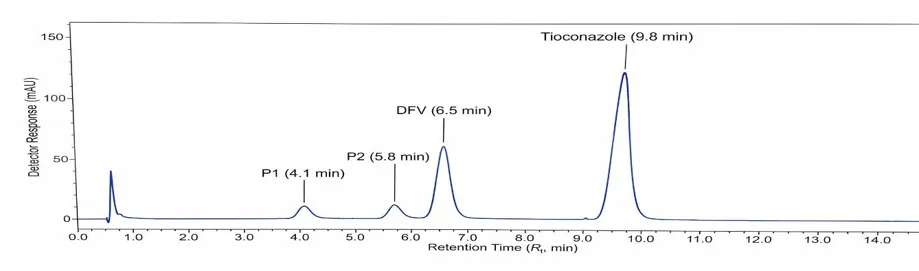
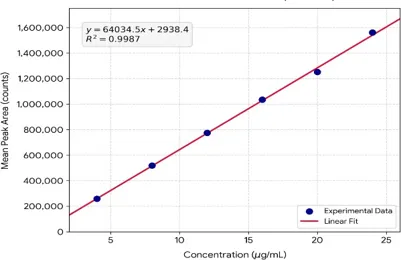
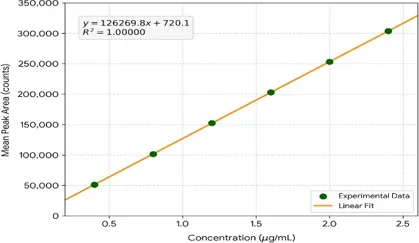
This study developed and validated a simple, precise, accurate, and stability-indicating RP-HPLC method for simultaneous estimation of Tioconazole (TCZ) and Diflucortolone Valerate (DFV) in topical cream formulations, addressing the limited analytical methods available for their simultaneous quantification in semi-solid dosage forms. Chromatographic separation was achieved on a Phenomenex Luna C18 column using an isocratic mobile phase of Acetonitrile and 0.05 M KH?PO? buffer pH 3.5 (70:30 v/v) at 1.0 mL/min with PDA detection at 254 nm, and validation was performed per ICH Q2(R1) guidelines alongside forced degradation studies under acid, alkali, oxidative, thermal, and photolytic stress conditions. The method resolved both drugs with retention times of 6.5 min (DFV) and 9.8 min (TCZ) with resolution >2.5, demonstrated excellent linearity (R² = 0.9998 for TCZ, 0.9997 for DFV), accuracy (98-102%), precision (%RSD <2.0%), and LOD/LOQ values of 0.18/0.55 ?g/mL for TCZ and 0.05/0.15 ?g/mL for DFV; forced degradation revealed DFV was most susceptible to alkaline hydrolysis (17.6%) while TCZ showed significant alkaline (12.4%) and oxidative (11.1%) degradation, with all degradation products well-resolved from parent peaks and spectral homogeneity confirmed by PDA. The robust, reproducible, and stability-indicating method is highly suitable for routine quality control, stability studies, and batch release testing of TCZ and DFV in bulk drugs and topical cream formulations.
Dermatomycoses represent highly prevalent superficial fungal infections restricted to keratinized layers of skin, hair, and nails. These infections are a major global public health concern with escalating incidence influenced by aging demographics and increasing immunocompromised populations.[1]
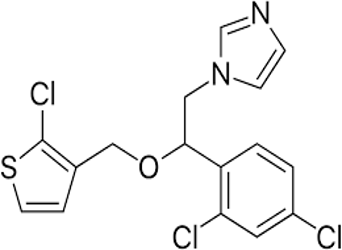
Classification: Synthetic, broad-spectrum imidazole derivative; topical antifungal agent
Chemical Properties:
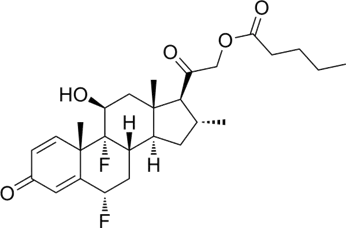
Classification: Synthetic, highly potent glucocorticoid for topical dermatological applications
Chemical Properties:
Primary Aim:
To develop and validate a precise, accurate, and stability-indicating HPLC method for simultaneous estimation of TCZ and DFV in combined pharmaceutical formulations.
Specific Objectives:
Drugs and Reference Standards:
Reagents and Chemicals:
Instruments:
|
Parameter |
Details |
|
Mobile Phase System |
Acetonitrile : Potassium Dihydrogen Phosphate Buffer (0.05 M, pH 3.5) |
|
Ratio (v/v) |
70 : 30 |
|
Flow Rate |
1.0 mL/min |
|
Detection Wavelength |
254 nm |
|
Column |
C18 (250 × 4.6 mm, 5 μm) |
Buffer Preparation:
2.2.4 Forced Degradation Studies
|
Stress Condition |
Reagent/ Condition |
Temperature |
Duration |
|
Acid Hydrolysis |
0.1 N HCl |
60°C |
2 hours |
|
Alkaline Hydrolysis |
0.1 N NaOH |
60°C |
2 hours |
|
Oxidative Stress |
3% H₂O₂ |
Ambient |
24 hours |
|
Thermal Degradation |
Dry heat |
80°C |
24 hours |
|
Photolytic Degradation |
UV/Visible light |
ICH Q1B |
As per ICH |
2.2.5 Method Validation Parameters (ICH Q2(R1))
|
Parameter |
Acceptance Criteria |
|
System Suitability |
%RSD ≤2%, Rs ≥2.0, T ≤1.5 |
|
Specificity |
No interference, PPI ≥0.999 |
|
Linearity |
R² ≥0.999 |
|
Accuracy |
98-102% recovery |
|
Precision |
%RSD ≤2.0% |
|
LOD/LOQ |
As per signal-to-noise ratio |
|
Robustness |
Unaffected by small changes |
3. RESULTS AND DISCUSSION
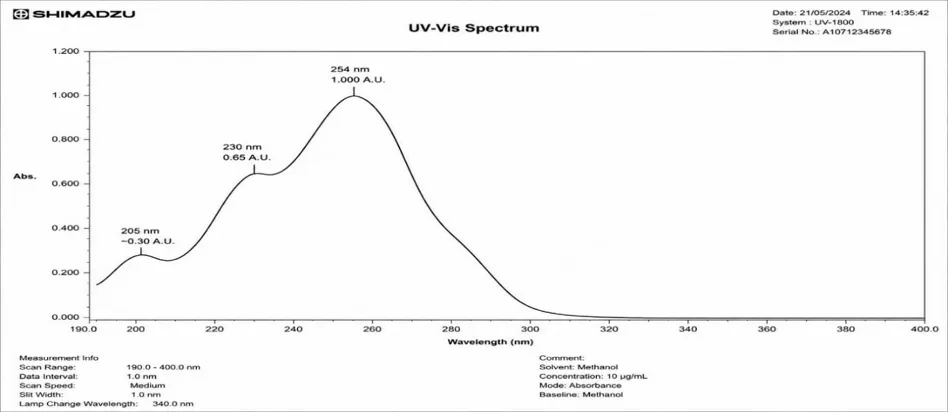
3.1 UV Spectral Analysis and Detection Wavelength Selection
Selection of 254 nm:
3.2 Method Development and Optimization
Column Selection:
|
Column |
Observation |
Outcome |
|
C8 (Octyl) |
Insufficient retention |
Rejected |
|
C18 (150 mm) |
Acceptable but poor resolution |
Rejected |
|
C18 (250 mm) – Phenomenex Luna |
Good retention and resolution |
Selected |
|
CN (Cyano) |
Severe tailing |
Rejected |
Mobile Phase Optimization:
Organic Modifier Selection:
|
Organic Modifier |
Observation |
Outcome |
|
Methanol |
Broader peaks, higher back pressure |
Rejected |
|
Acetonitrile |
Sharper peaks, lower pressure |
Selected |
Effect of Mobile Phase Ratio (CAN:Buffer):
|
Ratio |
DFV Rt (min) |
TCZ Rt (min) |
Resolution |
Observation |
|
50:50 |
12.4 |
18.2 |
2.8 |
Excessively long run time |
|
60:40 |
9.8 |
14.5 |
2.5 |
Acceptable but lengthy |
|
65:35 |
8.2 |
12.1 |
2.3 |
Good separation |
|
70:30 |
6.5 |
9.8 |
2.6 |
Optimum |
|
75:25 |
4.8 |
7.2 |
1.8 |
Peaks too close |
|
80:20 |
3.4 |
5.1 |
1.3 |
Co-elution risk |
Effect of Buffer pH:
|
pH |
Observation |
|
3.0 |
Slightly increased retention |
|
3.5 |
Best peak symmetry and reproducibility |
|
4.0 |
Slight retention variability |
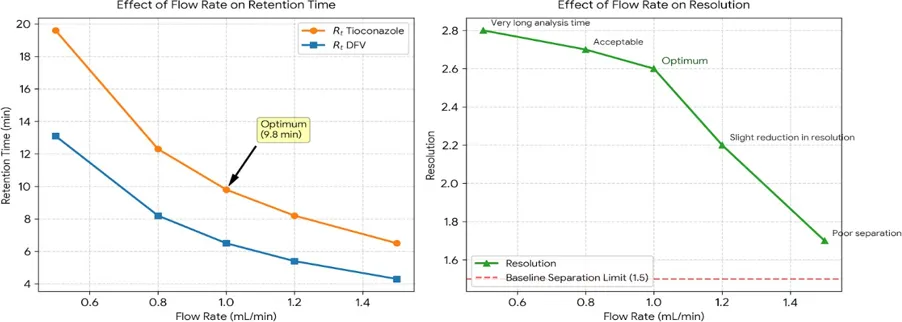
Effect of Flow Rate:
Optimized Chromatographic Conditions:
|
Parameter |
Optimized Condition |
|
HPLC System |
Shimadzu LC-2010 / Agilent 1200 with PDA |
|
Column |
Phenomenex Luna C18 (250 × 4.6 mm, 5 μm) |
|
Mobile Phase |
Acetonitrile : 0.05 M KH₂PO₄ buffer pH 3.5 (70:30 v/v) |
|
Flow Rate |
1.0 mL/min |
|
Detection Wavelength |
254 nm |
|
Injection Volume |
20 μL |
|
Column Temperature |
25°C |
|
Run Time |
15 minutes |
|
Elution Mode |
Isocratic |
3.3 System Suitability Results
|
Parameter |
Drug |
Acceptance Criterion |
Observed Result |
|
Retention Time %RSD |
TCZ |
≤2.0% |
≤1.0% |
|
Retention Time %RSD |
DFV |
≤2.0% |
≤1.0% |
|
Peak Area %RSD |
TCZ |
≤2.0% |
≤1.5% |
|
Peak Area %RSD |
DFV |
≤2.0% |
≤1.5% |
|
Theoretical Plates |
TCZ |
≥2000 |
>5000 |
|
Theoretical Plates |
DFV |
≥2000 |
>4500 |
|
Tailing Factor |
TCZ |
≤1.5 |
≤1.2 |
|
Tailing Factor |
DFV |
≤1.5 |
≤1.3 |
|
Resolution |
Between peaks |
≥2.0 |
>2.5 |
3.4 Forced Degradation Study Results
Acid Hydrolysis (0.1 N HCl, 60°C, 2 hours):
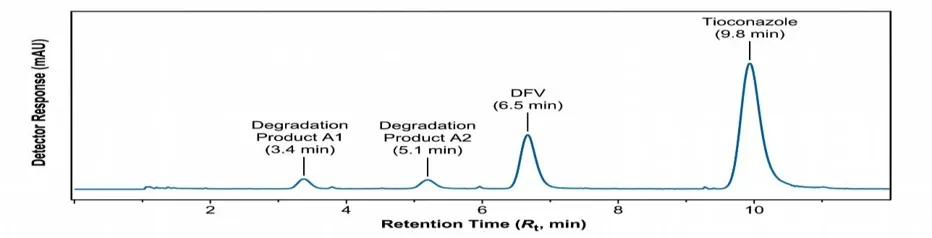
Alkaline Hydrolysis (0.1 N NaOH, 60°C, 2 hours):
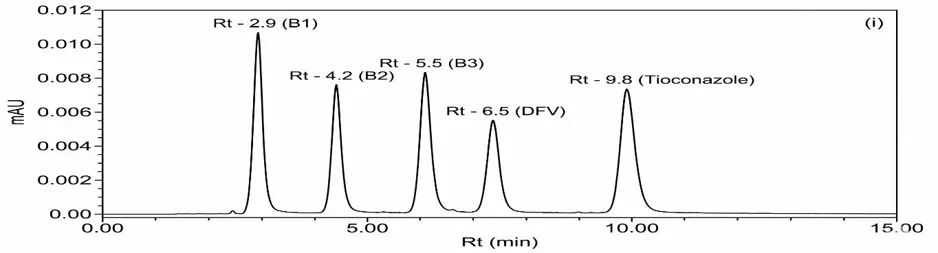
Oxidative Stress (3% H₂O₂, Ambient, 24 hours):
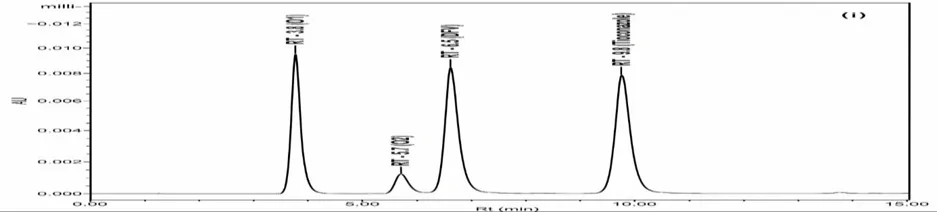
Thermal Degradation (80°C, 24 hours):
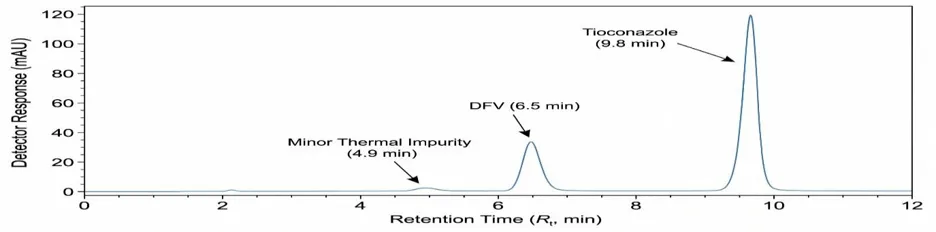
Photolytic Degradation (UV/Visible Light, 24 hours):
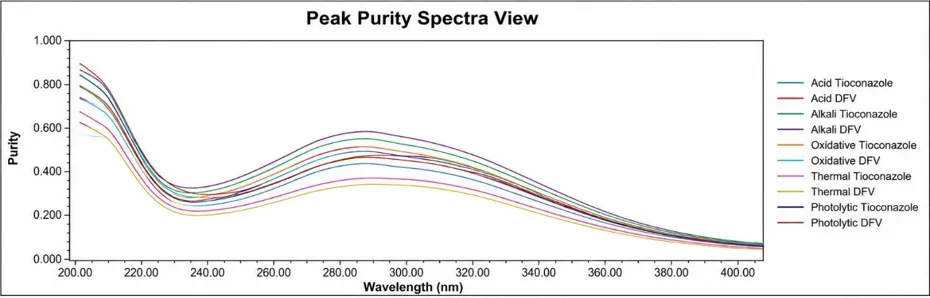
Peak Purity Analysis (PDA):
3.5 Method Validation Results
3.5.1 Linearity
Tioconazole Calibration (i) & Diflucortolone Valerate Calibration (ii)
3.5.3 Accuracy (Recovery Studies)
|
Recovery Level |
Tioconazole Recovery (%) |
DFV Recovery (%) |
|
80% |
99.12 |
99.45 |
|
100% |
100.24 |
100.31 |
|
120% |
100.67 |
99.84 |
|
Mean |
100.01 |
99.87 |
|
%RSD |
0.78 |
0.45 |
3.5.4 Precision
Repeatability (Intraday Precision):
|
Drug |
Mean Assay (%) |
%RSD |
|
Tioconazole |
99.82 |
0.74 |
|
Diflucortolone Valerate |
100.15 |
0.88 |
Intermediate Precision (Interday Precision):
|
Drug |
Mean Assay (%) |
%RSD |
|
Tioconazole |
99.67 |
1.12 |
|
Diflucortolone Valerate |
99.92 |
1.28 |
|
Parameter |
Tioconazole |
Diflucortolone Valerate |
|
LOD (μg/mL) |
0.18 |
0.05 |
|
LOQ (μg/mL) |
0.55 |
0.15 |
|
%RSD at LOQ (n=5) |
8.2% |
7.6% |
|
% Recovery at LOQ |
98.5% |
99.2% |
|
Parameter Changed |
Variation |
% Assay Recovery |
Resolution (Rs) |
|
Flow Rate |
0.9 mL/min |
98.8-101.2 |
2.4 |
|
Flow Rate |
1.1 mL/min |
99.1-101.5 |
2.3 |
|
Mobile Phase Composition |
65:35 |
98.6-101.2 |
2.2 |
|
Mobile Phase Composition |
75:25 |
98.9-101.8 |
2.1 |
|
Buffer pH |
3.3 |
98.7-101.4 |
2.3 |
|
Buffer pH |
3.7 |
98.9-101.6 |
2.2 |
|
Detection Wavelength |
252 nm |
98.5-101.3 |
2.4 |
|
Detection Wavelength |
256 nm |
98.8-101.7 |
2.3 |
All variations maintained Rs ≥2.0 and assay recovery within 98-102%
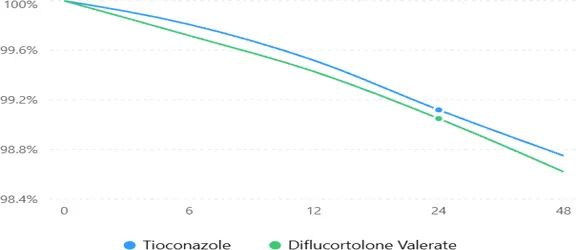
Solutions remained stable for at least 48 hours (%Change ≤2.0%)
|
Drug |
Sample No. |
Peak Area |
Concentration (μg/mL) |
Drug Content (mg/g) |
Mean ± SD (mg/g) |
%RSD |
|
TCZ |
1 |
2,857,462 |
19.86 |
9.93 |
9.91 ± 0.03 |
0.31 |
|
TCZ |
2 |
2,850,123 |
19.81 |
9.91 |
|
|
|
TCZ |
3 |
2,845,678 |
19.78 |
9.89 |
|
|
|
DFV |
1 |
412,398 |
1.98 |
0.99 |
0.99 ± 0.01 |
0.52 |
|
DFV |
2 |
410,567 |
1.97 |
0.99 |
|
|
|
DFV |
3 |
409,876 |
1.96 |
0.98 |
|
|
Comparison with Label Claim:
|
Drug |
Mean Content Found (mg/g) |
Label Claim (mg/g) |
% of Label Claim |
Conclusion |
|
Tioconazole |
9.91 |
10.0 |
99.1% |
Compliant |
|
Diflucortolone Valerate |
0.99 |
1.0 |
99.0% |
Compliant |
A C18 column was selected due to the lipophilic nature of both drugs (Log P: 5.53 for TCZ, 3.6–4.1 for DFV), ensuring adequate hydrophobic retention. Acetonitrile was preferred over methanol for its lower viscosity (0.37 vs 0.55 cP), reduced backpressure, and superior UV transparency at 254 nm; the optimized 70:30 acetonitrile:buffer ratio delivered optimal resolution (Rs = 2.6) with reasonable retention times. Buffer pH 3.5 was critical for peak symmetry—TCZ's imidazole nitrogen (pKa ~6.5) became fully protonated, suppressing silanol interactions and tailing, while DFV as a neutral steroid ester exhibited excellent symmetry.
Heated methanol extraction at 50°C with ultrasonication proved optimal by effectively dissolving both drugs while leaving lipid excipients insoluble, reducing cream viscosity, enhancing mass transfer, and disrupting drug-excipient associations via cavitation. Centrifugation yielded clear supernatant with minimal matrix interference, and 0.45 μm nylon filters showed no significant drug adsorption; discarding the first 0.5 mL filtrate prevented adsorptive losses, achieving >99% extraction efficiency..
3.9 Forced Degradation Interpretation
Alkaline hydrolysis was most severe—DFV showed 17.6% degradation (valerate ester saponification at C-21) and TCZ 12.4% (imidazole ring opening or benzyl ether cleavage). Acid hydrolysis caused 10.5% DFV and 7.2% TCZ degradation, consistent with ester hydrolysis. Oxidative stress affected TCZ more (11.1%) than DFV (6.6%) due to thioether sulfur oxidation to sulfoxide/sulfone derivatives. Thermal degradation was minimal (4.2–5.3%), confirming stability at normal manufacturing/storage temperatures (25–40°C), while photolytic degradation (6.2–8.5%) confirmed light sensitivity, necessitating amber packaging.
4. CONCLUSION
The present research successfully developed and validated a simple, precise, accurate, and stability-indicating RP-HPLC method for the simultaneous estimation of Tioconazole and Diflucortolone Valerate in combined topical cream formulations, employing a Phenomenex Luna C18 column (250 × 4.6 mm, 5 μm) with an isocratic mobile phase of acetonitrile and 0.05 M KH₂PO₄ buffer pH 3.5 (70:30 v/v) at 1.0 mL/min, detection at 254 nm, and 20 μL injection volume, achieving baseline resolution of DFV at ~6.5 min and TCZ at ~9.8 min (Rs >2.5). The method was validated per ICH Q2(R1) guidelines, meeting all acceptance criteria for specificity, linearity (R² ≥0.9997), accuracy (98-102% recovery), precision (%RSD ≤2.0%), LOD/LOQ, robustness, and solution stability; forced degradation studies confirmed its stability-indicating capability with degradation products well-resolved from parent peaks and PDA-confirmed spectral homogeneity (purity index ≥0.999), revealing alkaline hydrolysis as the most severe degradation pathway for both drugs (DFV: 17.6%, TCZ: 12.4%). The heated methanol extraction procedure (50°C) with ultrasonication yielded high recoveries (98-100%) with minimal matrix interference, and successful application to commercial topical cream demonstrated drug content of 99.1% of label claim for TCZ (9.91 mg/g) and 99.0% for DFV (0.99 mg/g), meeting pharmacopoeial specifications. Thus, this robust, reproducible, and regulatory-compliant method is highly suitable for routine quality control analysis, stability studies, and batch release testing of TCZ and DFV fixed-dose combination products in pharmaceutical industries.
REFERENCES



Pramod Kumar, Neetu Sahu, Dr. Satish Kumar Sarankar, A Validated Stability-Indicating HPLC Method for the Simultaneous Estimation of Tioconazole and Diflucortolone Valerate, Int. J. of Pharm. Sci., 2026, Vol 4, Issue 8, 1429-1439. https://doi.org/10.5281/zenodo.21842618
 10.5281/zenodo.21842618