

We use cookies to ensure our website works properly and to personalise your experience. Cookies policy
Pharmacology Division, AU College of Pharmaceutical Sciences, Andhra University, Vishakhapatnam, Andhra Pradesh
Despite more than three decades of research, no licensed prophylactic vaccine exists for Human Immunodeficiency Virus (HIV). Development is hindered by formidable biological barriers, including extensive viral genetic diversity, dense glycan shielding of the envelope glycoprotein (Env), conformational masking of vulnerable neutralizing epitopes, the rarity of natural broadly neutralizing antibody (bNAb) development, and the extensive affinity maturation required to reach protective potency. Over the past decade, preclinical HIV vaccine research has shifted from empirical, infection-mimicking strategies toward rational, structure-guided, and immunology-driven immunogen design. Emerging strategies include germline-targeted B-cell immunogens capable of priming rare bNAb precursor lineages, stabilized native-like Env trimers (SOSIP, NFL, MD39) that preserve prefusion antigenic architecture, multivalent nanoparticle-displayed immunogens that enhance B-cell receptor cross-linking, and mRNA-encoded Env immunogens delivered via lipid nanoparticles, often deployed within sequential prime-boost regimens. This review synthesises current preclinical approaches evaluated in humanized mice and non-human primate models, critically analyses their immunogenicity outcomes and translational limitations, and identifies key gaps, including undefined correlates of protection, immune tolerance constraints, and manufacturing scalability, that must be addressed. Future priorities are proposed to help translate these preclinical successes into a safe, effective, and globally deployable human HIV vaccine.
HIV continues to pose a global public health challenge. While antiretroviral therapy (ART) effectively controls viral replication and extends lifespan, it does not eliminate latent viral reservoirs and does not preclude transmission completely 1. Moreover, lifelong adherence, socio-economic barriers, drug resistance, and limited access in many regions underline the urgent need for a safe, effective, and globally deployable prophylactic vaccine 1,2.
However, HIV is unlike many other viruses for which vaccines are readily developed. The virus's envelope glycoprotein (Env), the only exposed target on the virion, is highly variable, heavily glycosylated, and conformationally dynamic 3. Natural infection rarely elicits broadly neutralizing antibodies (bNAbs), and the few individuals who do develop them, the so-called “elite neutralizers”, often do so only after years of chronic infection. Hence, conventional vaccine strategies that mimic “natural infection plus immune memory” have repeatedly failed. This realization has pushed the field toward rational vaccine design, immunogen engineering, and preclinical immunology to coax immune responses that rarely arise naturally.
This review provides a comprehensive and updated survey (as of 2025) of preclinical HIV vaccine design strategies, experimental outcomes, remaining barriers, and future priorities 2,3.
1.1 History of Vaccine Development
In 1793, Edward Jenner's landmark experiments in the prevention of smallpox by controlled exposure to the related, but less virulent, cowpox virus demonstrated that infectious disease could be prevented through vaccination 4. Since then, many infectious diseases that were once considered scourges of society have been conquered, controlled, and, in the case of smallpox, eradicated. Not since polio in the 1940s and 1950s has an infectious disease caused as much fear and misunderstanding as HIV and AIDS 8.
HIV vaccine development has spanned nearly 40 years. Early efforts focused on neutralizing antibodies to block the virus from entering cells, but this approach faced major challenges due to HIV's high mutation rate and variability 8,9. As a result, research shifted toward CD8+ T cells, which play a key role in controlling infection by killing infected cells and responding to multiple HIV strains. Their ability to limit viral escape makes them promising targets for developing a global multi-strain vaccine. To support this approach, recombinant viral vectors such as adenovirus and poxvirus are used to stimulate strong T-cell responses.
Recent HIV vaccine development has shifted toward improving antibody functions, T-cell responses, and innate immunity. Current research focuses on broadly neutralizing antibodies (bNAbs), which target conserved regions of HIV and can neutralize multiple strains, with advances driven by technologies like high-throughput assays and single-cell cloning. Second-generation bNAbs show greater potency and breadth and are undergoing clinical trials, though challenges such as viral resistance, diversity, and short durability remain. Strategies include both passive immunization and designing vaccines to induce bNAbs in the body. Additionally, RNA-based vaccines have emerged as a promising approach. Overall, an effective HIV vaccine likely requires a multidimensional strategy that combines antibody responses, T-cell immunity, and innate immune mechanisms for broader protection 10.
1.2 Preclinical Evaluation of HIV Vaccines in Non-Human Primates
Non-human primate (NHP) studies play a critical role in HIV vaccine development by providing essential data on safety, immunogenicity, and potential efficacy before human trials 10,11. Many vaccines tested in humans were first evaluated in these models, making them a key step in advancing vaccine research 11. These preclinical studies also help identify promising vaccine candidates that are yet to be tested in humans. Among NHP models, macaques are the most widely used due to their genetic and immunological similarity to humans 12.
Early research in the 1980s sought suitable animal models, leading to the discovery of simian immunodeficiency virus (SIV) in 1984. Although SIV does not cause disease in some African primates, it induces an AIDS-like condition in Asian macaques, making it a valuable model for studying HIV. As a result, SIV-infected macaque models are extensively used to understand HIV pathogenesis and to evaluate vaccine strategies before progressing to human clinical trials 12.
Early SIV vaccine studies in non-human primates showed promising but misleading results. Inactivated SIV vaccines, including formalin-inactivated versions, initially demonstrated partial to strong protection in rhesus macaques. However, later research revealed that this protection was not due to true anti-SIV immunity but rather to immune responses against human cell proteins (such as HLA molecules) present in the virus grown in human cell lines. This highlighted major challenges in AIDS vaccine development. Among various strategies, live attenuated SIV vaccines have shown the most consistent protection against infection in macaque models, although concerns about their safety remain 13. These models continue to provide valuable insights into immune mechanisms that could guide the development of an effective HIV vaccine.
1.3 Immunological and Molecular Barriers to Effective HIV Vaccination
Despite decades of effort, the development of a successful prophylactic HIV vaccine has been hindered by several biological barriers that distinguish HIV from other viral pathogens. These challenges arise from the virus's extraordinary adaptability, structural complexity, and interaction with host immune regulation. Understanding these barriers is essential for rational vaccine design and transitioning novel concepts from proof-of-concept models into clinically actionable candidates 13,14.
1.4 Genetic Diversity and Rapid Mutation
HIV-1 displays extreme genomic variability, making universal immunogenic targeting difficult. Globally, HIV-1 is distributed across multiple clades (A–K), recombinant forms, and quasi-species that differ substantially at the amino acid level, particularly within the env gene encoding the envelope glycoprotein (gp160). Variability within gp120 exceeds 20–35% between clades and can reach more than 10% even within the same subtype, a level unprecedented among common human viral pathogens.
This diversity arises primarily from the error-prone nature of HIV reverse transcriptase, which lacks proofreading capability, resulting in mutation rates estimated at approximately 3 × 10⁻⁵ mutations per nucleotide per cycle.
Additional pressures from the host immune system, including cytotoxic T-lymphocyte escape and antibody selection, drive adaptive evolution, generating a swarm of continuously evolving viral variants within a single host 15.
This dynamic means that a successful vaccine must elicit immune responses that are both broad and cross-reactive, able to neutralize diverse viral isolates rather than a single strain 16. Candidate vaccines producing autologous (strain-matched) neutralization have repeatedly failed to demonstrate durable heterologous protection in primate challenge studies or early human trials. Therefore, the induction of broadly neutralizing antibodies (bNAbs) capable of targeting conserved viral structures is considered a critical prerequisite for a viable HIV vaccine candidate 15,16.
1.5 Glycan Shield and Conformational Masking
The HIV Env spike is further protected by an unusually dense N-linked glycan layer that accounts for nearly 50% of molecular mass, forming a “glycan shield” that restricts antibody access to protein epitopes. Many of these glycans are derived from host biosynthetic pathways, enabling immune camouflage that decreases recognition by germline antibodies and facilitates immune evasion 16
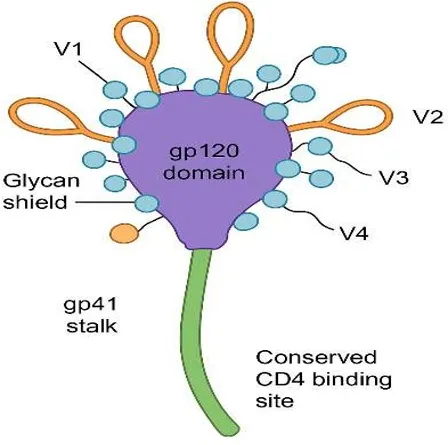
FIGURE 1: STRUCTURAL OVERVIEW OF THE HIV-1 ENVELOPE GLYCOPROTEIN (ENV) SHOWING THE GLYCAN SHIELD, VARIABLE LOOPS (V1–V4), GP41 STALK, AND THE CONSERVED CD4-BINDING SITE
Additionally, Env is conformationally dynamic. gp120 undergoes sequential structural transitions during CD4 and CCR5/CXCR4 receptor engagement, transiently exposing neutralization-sensitive epitopes only after viral attachment. As a result, many epitopes relevant for neutralization are not readily accessible in the prefusion conformation, the state in which vaccines must present the antigen 16.
Previous vaccine efforts using monomeric gp120, as seen in early-phase trials, failed largely because the structure was immunologically non-representative, exposing irrelevant surfaces and masking conserved neutralization regions. Modern immunogen engineering now focuses on stabilized Env trimers that mimic native prefusion architecture; however, reproducing physiologically accurate glycan composition remains technically challenging 17.
1.6 Lack of Natural Sterilizing Immunity and Rare Development of Broadly Neutralizing Antibodies
Unlike infections caused by viruses such as measles or smallpox, natural HIV infection rarely results in sterilizing immunity. Individuals do not clear the infection, and re-exposure does not reliably prevent reinfection. In only approximately 1–2% of people living with HIV, broadly neutralizing antibodies eventually emerge, often years after initial infection and following prolonged antigen exposure and viral diversification. This delayed bNAb development is characterized by highly unusual immunological features, including long complementarity-determining region loops, extensive somatic hypermutation (>20–30%), and high affinity for conserved epitopes. The fact that bNAbs arise only in chronic infection, and rarely, suggests that their development is not a default or rapid immune outcome, but one requiring specific evolutionary pressures and iterative antigen diversification not typical of conventional vaccination 17.
Thus, HIV vaccinology must not only simulate biologically rare processes but also accelerate and direct them deliberately, a demanding task compared to traditional vaccine models.
1.7 Requirement for Multiple Neutralizing Epitopes and Extensive Affinity Maturation
Given HIV's mutational flexibility, a single antibody specificity is unlikely to confer durable protection. Escape mutations arise rapidly and can restore viral replication fitness with minimal structural compromise. Therefore, an effective vaccine likely must induce multiple complementary bNAbs, each targeting distinct conserved regions such as:
These epitopes are structurally constrained due to functional requirements of viral entry, making them ideal targets; however, they are also immunologically subdominant and poorly recognized by naive B-cell repertoires. Furthermore, the extent of somatic hypermutation required to reach bNAb potency is significantly greater than that seen with most viral vaccines, necessitating sequential vaccination regimens, tailored antigen exposure, and precision adjuvanting to support germinal centre evolution 12.
1.8 Safety Constraints, Immune Tolerance, and Host Biological Limitations
Many bNAbs possess features associated with autoreactivity, including lipid or glycan cross-reactivity, leading to partial deletion or regulation of precursor B cells via immune tolerance checkpoints 14. This means that even if an immunogen is structurally optimal, the host immune system may restrict expansion of required B-cell lineages.
Additionally, conventional vaccine approaches (e.g., live attenuated or whole-inactivated virus) are unsuitable for HIV. Live attenuated HIV poses an unacceptable risk because of genomic integration and potential reversion to pathogenicity, and inactivated formulations fail to present the native Env conformation necessary for bNAb induction. Therefore, modern HIV vaccine development relies predominantly on engineered subunit proteins, viral vectors, DNA vaccines, and mRNA platforms, each requiring optimization of delivery, antigen stability, and immune activation 13.
2. Preclinical Vaccine Design Strategies: Current State and Progress
Given the barriers above, preclinical HIV-vaccine research has largely moved toward structure-guided immunogen design, rational engineering, and novel delivery platforms. The following subsections describe the major approaches being pursued, as well as key experimental findings 12,13.
2.1 Germline-Targeting and B-Cell Lineage Design
One of the most promising paradigm shifts has been the development of germline-targeting vaccines: immunogens specifically designed to bind naive B-cell receptors (BCRs) that are precursors to bNAb lineages, thereby priming the immune system to eventually produce bNAbs upon appropriate boosting 15.
For example, a recent preclinical study reported a novel trimeric Env SOSIP immunogen named 3nv.2, engineered to display three major bNAb epitopes, the CD4-binding site (CD4bs), V3 glycan, and V2 apex, on a single stable trimer. Immunization in mice and rhesus macaques with this construct elicited B-cell responses targeting all three epitopes, demonstrating proof-of-concept that multi-epitope germline-targeted immunogens can activate multiple bNAb precursor lineages simultaneously.
This is significant because earlier germline-targeting immunogens typically focused on single epitope classes (e.g., VRC01-class CD4bs). The success of 3nv.2 suggests that future vaccine candidates might combine multiple epitope targets in a single immunogen, potentially increasing breadth and reducing logistical complexity 16.
However, important caveats remain. While precursor activation was achieved, the study did not yet show fully matured bNAbs with broad neutralization, the immunogenicity demonstrated was preliminary (binding plus early B-cell activation), not final protective neutralization 13. Therefore, sequential boosting strategies, with diverse immunogens that gradually steer B-cell maturation and somatic mutation, remain essential. The timeline, optimal boosting sequence, and adjuvant requirements are still undefined. Such “lineage-based vaccine design” demands careful iterative immunogen design, as well as rigorous preclinical testing in humanized mice or non-human primate (NHP) models.
2.2 Stabilized Native-Like Env Trimers (SOSIP / NFL / MD39)
Another major advance has been structural vaccinology: stabilizing the HIV-1 Env in its prefusion trimeric conformation to present epitopes as they naturally appear on virions. The design of stabilized trimers (e.g., SOSIP, NFL, MD39) aims to minimize exposure of non-neutralizing, immunodominant surfaces and focus immune responses on conserved vulnerable sites.
Early versions of stabilized trimers improved antigenic fidelity but induced mainly autologous neutralizing antibodies (i.e., neutralization of the same or very similar viral strain) rather than broad heterologous responses 12,13.
The importance of correctly folded, native-like trimers has been emphasized repeatedly: only such trimers expose critical bNAb epitopes properly, including the CD4-binding site, V2 apex, V3 glycan region, and gp120–gp41 interface. Improperly folded or monomeric antigens tend to elicit non-neutralizing or narrow, strain-specific responses.
Moreover, the engineering of trimers has advanced: modern designs incorporate mutations that stabilize the prefusion conformation, lock the trimer, and manage glycosylation patterns to better mimic native Env.
However, even with these improvements, achieving broad neutralization remains challenging. One major limitation is that a single Env variant (e.g., derived from a single HIV clade) may not represent the breadth of global diversity; hence, immunogens may need to incorporate multiple Env variants or consensus/mosaic designs.

FIGURE 2: EVOLUTION OF HIV ANTIGEN DESIGN
2.3 Nanoparticle-Presented Immunogens and Multivalent Display
Nanoparticle vaccines offer a versatile platform: by displaying multiple copies of Env (or Env-derived immunogens) in a dense, repetitive array, they can potentiate B-cell receptor cross-linking, enhance germinal centre formation, and improve immunogenicity compared to soluble immunogens.
Several nanoparticle platforms are being explored:
Advantages of nanoparticle vaccines include enhanced immunogenicity, lower antigen dose per immunization, and better priming of B-cell responses, especially relevant when aiming to initiate rare bNAb precursor lineages.
Moreover, researchers are exploring mosaic nanoparticle designs, where Env immunogens derived from different clades are displayed simultaneously. This may help address global viral diversity by exposing the immune system to multiple variant epitopes at once, potentially broadening the resultant antibody response 17.
Despite promise, challenges remain: correct folding and glycosylation of Env trimers on nanoparticles, predictable spacing/orientation for optimal B-cell engagement, and ensuring manufacturing scalability and stability.
2.4 mRNA-Based HIV Vaccines
The success of mRNA vaccine platforms in other infectious diseases (e.g., SARS-CoV-2) has spurred interest in applying this technology to HIV. mRNA vaccines for HIV carry multiple advantages: they can encode structurally complex immunogens (e.g., stabilized Env trimers, germline-targeting immunogens), ensure proper post-translational modifications (glycosylation, folding), and allow rapid iteration of design 12,15.
In a recent 2025 study, researchers demonstrated that lipid-nanoparticle-formulated mRNA encoding membrane-anchored Env trimers elicited strong binding antibody responses and moderate neutralization in non-human primates 19.
The flexibility of mRNA platforms permits sequential prime-boost regimens, in which a germline-targeting mRNA prime is followed by boosts with either mRNA or protein immunogens (e.g., nanoparticle-displayed trimers). This approach may better mimic the long-term antigen exposure and iterative B-cell maturation required for potent bNAb generation.
However, limitations include immune reactogenicity, stability and storage concerns, and the need to ensure that the in vivo-expressed Env mimics native virion glycosylation and conformation for effective bNAb induction. Moreover, the durability of response and induction of B-cell memory remains to be demonstrated in long-term preclinical studies 20.
2.5 Viral-Vector and DNA Vaccines (T-cell-Centered Strategies)
Earlier HIV vaccine efforts were heavily centered on viral vector or DNA vaccines, aiming to elicit strong cellular immunity (CD8+ cytotoxic T lymphocytes, CD4+ helper responses). Examples include adenovirus-based vectors, poxvirus vectors, and DNA plasmid vaccines.
While these strategies proved relatively effective at inducing T-cell responses, they failed to confer robust protection in large-scale efficacy trials. In many cases, vectors delivered Env or Gag/Pol/Nef antigens, yet did not elicit broadly neutralizing antibodies, and some trials were terminated for lack of efficacy.
Consequently, the field has largely moved away from purely T-cell-centric vaccines. However, combination regimens that integrate a T-cell component (via vector/DNA) with B-cell-focused immunogens (e.g., Env trimers, nanoparticles, mRNA) remain a promising avenue to achieve both durable humoral and cellular immunity 15,20.
3. Preclinical Evidence: What Has Worked (So Far) & What Remains to Be Achieved
3.1 Evidence from Small Animal Models
Humanized mice (mice engineered to express human immunoglobulin genes) have been instrumental in proving that germline-targeting immunogens can activate naive B-cell precursors corresponding to known bNAb lineages. This is a critical proof-of-concept, as these precursors are rare and often not naturally activated in uninfected individuals 17.
However, mice have limitations: their immune system, B-cell repertoire, lymphoid architecture, mutation, and affinity-maturation dynamics differ from humans. Hence, success in mice does not guarantee similar outcomes in humans or non-human primates.
3.2 Evidence from Non-Human Primate (NHP) Models
Non-human primates (e.g., rhesus macaques) remain the gold standard for preclinical HIV vaccine testing due to immunological similarity and the relevance of SHIV (simian-human immunodeficiency virus) challenge models.
Recent experiments with the 3nv.2 germline-targeting trimer (see above) in macaques demonstrated activation of multiple bNAb precursor lineages, a milestone in preclinical vaccine design 17,20.
Similarly, mRNA-encoded Env vaccines in NHPs have yielded binding antibody responses and moderate neutralization titers, a promising step toward translating mRNA platforms to HIV immunization.
Nevertheless, no NHP immunization regimen to date has high potency across diverse HIV-1 strains, nor has any regimen achieved sterilizing immunity or complete protection against repeated high-dose SHIV challenge. This highlights the substantial gap between preclinical immunogenicity and clinically relevant efficacy 15.
3.3 Lessons from Past Clinical Failures Informing Preclinical Design
Historical vaccine trials (protein subunit, vector-based, and DNA vaccines) have largely failed to provide durable protection, underlining the insufficiency of generating either narrow antibody responses or T-cell responses alone.
Analyses of these failures emphasized three key takeaways that now shape preclinical design:
1. The need to present Env in its native trimeric conformation to display bNAb-sensitive epitopes properly.
2. The importance of immunogen design that can engage rare naive B-cell precursors, leading to the germline-targeting paradigm.
3. The requirement for combination strategies that stimulate both humoral (bNAbs) and cellular immunity for broader protection, especially given difficulties with antibody breadth and viral escape.
These insights have refined the preclinical research agenda, leading to iterative immunogen redesign, advanced delivery systems, and layered immunization regimens.
4. Challenges, Gaps, and Critical Considerations for Future Preclinical Work
Even with recent progress, several major obstacles remain.
4.1 Ensuring Breadth and Durable bNAb Responses
Inducing bNAbs that neutralize the global diversity of HIV-1 remains the centerpiece challenge. The rarity of B-cell precursors, the need for extensive somatic hypermutation (SHM), and the requirement for multi-epitope targeting make this inherently difficult. There is also the issue of maintaining high titers and memory B-cell populations over time, a necessity for long-term protection 8,12.
Sequential immunization regimens, while theoretically sound, pose practical and logistical challenges: they may require multiple boosts over months or years, making them less feasible for mass vaccination campaigns, especially in resource-limited settings 12.
4.2 Immune Tolerance, Host Variation, and Safety
Some bNAb lineages display autoreactivity or polyreactivity, which may lead to immune tolerance or deletion of B cells. Designing immunogens that successfully circumvent these tolerance mechanisms without triggering autoimmunity requires careful balancing, adjuvant optimization, and perhaps transient immune modulation.
Additionally, variation in human genetic backgrounds, B-cell repertoires, glycosylation patterns, HLA types, and immune history may influence vaccine responsiveness, making universal vaccine design more complex 16.
4.3 Manufacturing, Stability, and Global Deployment Constraints
While nanoparticle and mRNA platforms offer flexibility and scalability, they also pose manufacturing, stability, cold-chain, and cost challenges, particularly for global deployment. Nanoparticle-Env constructs must maintain correct folding and glycosylation, which may be sensitive to processing conditions. mRNA vaccines require lipid nanoparticle formulations and cold storage and may provoke reactogenicity, which could limit acceptability 16.
For global HIV prevention, especially in low- and middle-income countries (LMICs), these logistical challenges are nontrivial.
4.4 Defining Immune Correlates of Protection and Translational Uncertainty
Perhaps the largest barrier is that we lack clearly defined correlates of protection for HIV. Unlike other viruses, where neutralizing antibody titer thresholds or specific T-cell responses correlate with protection, for HIV we do not yet know what level, breadth, or quality of immune response will reliably prevent infection. This makes it difficult to evaluate whether preclinical immunogenicity is “good enough” until large-scale human trials are conducted 17.
Given the risks and costs of large-scale trials, bridging this translational gap demands robust preclinical data, improved surrogate markers, and perhaps challenging regulatory and ethical design.
5. Future Directions and Recommendations for Preclinical HIV Vaccine Research
Based on current knowledge and gaps, the following directions are recommended for the next generation of preclinical HIV vaccine research:
1. Design and test multi-epitope germline-targeting immunogens: following the proof-of-concept of constructs like 3nv.2, future immunogens should incorporate multiple conserved epitopes simultaneously to drive breadth and reduce reliance on single-epitope response.
2. Optimize sequential prime-boost regimens: using platforms like mRNA, nanoparticle, and protein immunogens in combinations that guide B-cell evolution through affinity maturation, while monitoring tolerance, safety, and immunological memory.
3. Incorporate mosaic or consensus Env sequences to better reflect global HIV diversity, and test immunogen panels against multiple clades in preclinical models, particularly non-human primates.
4. Develop and validate correlates of protection in animal models beyond neutralizing antibody titers: include B-cell repertoire analyses, memory B-cell persistence, Fc-mediated effector functions (ADCC, ADCP), T-cell help, and mucosal immunity.
5. Advance delivery platforms for global scalability: focus on manufacturability, stability, storage, cold-chain logistics, and cost; explore thermostable nanoparticles or mRNA formulations optimized for LMIC settings.
6. Investigate combination immunization strategies: integrate humoral-focused immunogens with cellular immunity via viral vectors or DNA; consider heterologous prime-boost to engage multiple arms of the immune system.
7. Monitor safety and host tolerance carefully, especially given the potential autoreactivity of bNAb precursors; design adjuvants or immunomodulatory strategies to minimize adverse effects while encouraging affinity maturation.
TABLE 1: COMPARISON OF PRECLINICAL HIV VACCINE PLATFORM MECHANISMS
|
Vaccine Platform |
Antigen Delivery Mechanism |
Primary Immune Pathway Activated |
Expected Immunological Outcome |
|
Protein nanoparticle vaccine |
Multivalent HIV Env displayed on a nanoparticle scaffold enables efficient cross-linking of the B-cell receptor (BCR). |
Strong germinal centre responses and T follicular helper (Tfh) cell engagement. |
High-affinity B cells, somatic hypermutation, and induction of early neutralizing antibody precursors. |
|
mRNA vaccine |
Host cells translate the encoded Env antigen, generating membrane-bound or secreted forms in vivo. |
Antigen presentation via MHC-I and MHC-II pathways; balanced CD4+ and CD8+ responses. |
Robust antibody production, memory B-cell development, and balanced T-cell responses. |
|
Viral vector vaccine (Ad26/MVA) |
Replication-deficient vectors express Env and activate innate immune sensors. |
Strong innate activation leading to CD8+ cytotoxic T-lymphocyte priming and helper T-cell activation. |
Potent cellular immunity and improved durability of humoral responses. |
|
DNA vaccine |
Plasmid DNA encoding HIV Env taken up and expressed by host cells; often used in prime-boost regimens. |
Moderate antigen expression and immune activation, primarily through MHC-II pathways. |
Useful priming effect enhancing booster responses from other platforms. |
CONCLUSION
Preclinical HIV-vaccine research has evolved significantly from early subunit or vector-based efforts to a sophisticated, multi-pronged, immunology-driven field. Advances in structural biology, immunogen engineering, nanoparticle and mRNA technologies, and B-cell lineage targeting have brought us closer than ever to inducing broadly neutralizing antibodies via vaccination.
Nonetheless, the path remains challenging: viral diversity, immune tolerance, durability, translational uncertainty, and practical constraints all complicate progress.
Continued iterative preclinical research, informed by structural immunology, B-cell biology, and real-world public health considerations, is essential. With sustained global commitment and collaboration, achieving a safe, effective, and globally deployable HIV vaccine remains a challenging but plausible goal.
REFERENCES

Jagannadham Nuthana Yaswanth, Pushpanjali Dharavathu, Chinni Krishna Khandavalli, Eswar Kumar Kilari, Routhu Pratyusha, Advances in Preclinical HIV Vaccine Development: Strategies, Evidence, and Future Directions, Int. J. of Pharm. Sci., 2026, Vol 4, Issue 10, 879-890. https://doi.org/10.5281/zenodo.23191855
 10.5281/zenodo.23191855