

We use cookies to ensure our website works properly and to personalise your experience. Cookies policy
Delonix Society’s Baramati College of Pharmacy, Barhanpur, Maharashtra, India.
Artificial Intelligence (AI) is transforming regulation submission and compliance management by bringing innovative solutions to the pharmaceutical sector. The processes of Investigational New Drug (IND), New Drug Application (NDA), Biologics License Application (BLA), and Abbreviated New Drug Application (ANDA) have become complicated in recent years, requiring a substantial amount of information, extensive data evaluation, and close conformity to regulatory requirements. The application of artificial intelligence in regulatory science has proven effective in automating dossier preparation, enhancing regulatory intelligence, improving regulatory document analysis, facilitating rapid literature searches, and shortening submission times. Moreover, AI is applied in compliance management to achieve continuous control of processes, risk management, audit readiness, pharmacovigilance, and real-time regulatory intelligence while ensuring safe drug production. However, there are several challenges facing the use of AI in regulation submission and compliance management, including data privacy, regulatory constraints, implementation costs, and model transparency. These challenges could be addressed through improved validation methods and a solid understanding of the data’s credibility for building appropriate AI models. Artificial intelligence has vast potential in revolutionizing the pharmaceutical sector and achieving patient-centric drug development while ensuring safe, efficient, and high-quality pharmaceutical products.
Artificial Intelligence (AI) is defined as the ability of a computer or a machine to mimic human intellectual activity, such as learning, reasoning, using heuristics, acting, solving problems, and making decisions (14,15). Recently, it has become one of the most promising technologies in the field of pharmaceuticals, especially in regulatory affairs, since they serve as an integral link between drug discovery and regulatory authorities (1,4). Regulatory affairs ensure the preparation, submission, and maintenance of all regulatory documents, including IND, NDA, and ANDA, for pharmaceutical products to meet the strict requirements of regulatory authorities worldwide (6,7).
At the same time, the processes involved are complicated, associated with high costs and time-consuming (8). Additionally, they are highly regulated by different jurisdictions worldwide, requiring continuous documentation updates and the implementation of various measures to ensure the appropriate quality of the submitted data (9,10). Therefore, they generate a significant amount of data that must be analyzed and processed to identify patterns and support high-level administrative and regulatory activities (23). All these factors prompt the pharmaceutical industry to seek innovative approaches to optimize and make the regulatory submission process more efficient and cost-effective (2,25). One of the ways to achieve these goals is to implement artificial intelligence in regulatory affairs (26). It can be applied in different areas, from automating the submission process and managing communication to analyzing data and supporting regulatory decision-making (28).
2. Overview of Regulatory Submissions and Compliance Management
Regulatory submissions and compliance management are integral elements of the pharmaceutical product life cycle. Regulatory submissions, which may include IND, NDA,
Biologics License Application (BLA), and ANDA are formal requests for marketing authorization of pharmaceuticals to regulatory agencies (6,7). Regulatory submissions and compliance management involve a range of activities that are applied to drug discovery and development, spanning preclinical research, clinical evaluation, marketing authorization, and surveillances after authorization to ensure the quality, safety, and efficacy of medicines (13). Compliance management is the process of ensuring that pharmaceutical organizations meet regulatory requirements during the drug development process (10). Regulatory agencies such as the U.S. Food and Drug Administration (FDA), the European Medicines Agency (EMA), and Central Drugs Standard Control Organization (CDSCO) among others, develop regulatory guidelines (7,10,9). Some of the regulations developed by these agencies include Good Manufacturing Practices (GMP), Good Laboratory Practices (GLP), and Good Clinical Practices (GCP) guidelines for manufacturing, laboratory practice, and clinical trials respectively (9,11,12,13). Additionally, the International Council for Harmonization of Technical Requirements for Pharmaceuticals for Human Use (ICH) provides guideline frameworks to standardize the study design, conduct, reporting, and registration of clinical studies to facilitate the development of new pharmaceuticals and expediting the regulatory review process (15). Effective compliance management assists in establishing processes that are fit for purpose, facilitating traceability, and ensuring process robustness to minimize failure risks and support regulatory approvals (10).
3. Artificial Intelligence Technologies Used
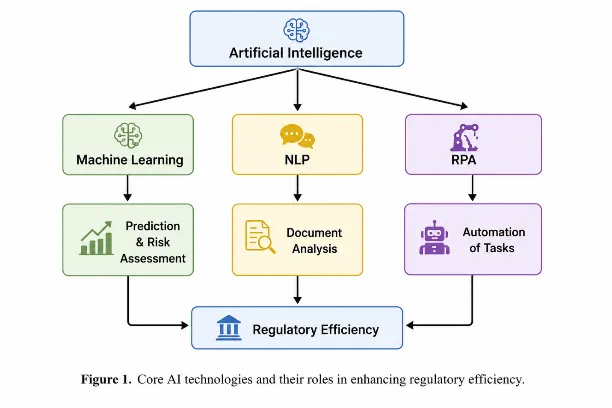
The application of artificial intelligence is made possible by a number of technologies, including machine learning, natural language processing, robotic process automation, predictive analytics, and deep learning. The technologies enable effective regulation and compliance management of pharmaceutical products with the use of algorithms. Machine learning involves training algorithms using historical data for prediction and decision-making purposes without being explicitly programmed (16). Natural language processing is a technique used in text mining, which allows computers to understand, extract, and analyze information from natural language sources such as digital text (14).
Robotic process automation uses software robots to perform rule-based, repetitive tasks, such as invoice processing, data entry, and report generation, thereby enhancing effective regulatory submission and compliance management (14). Predictive analytics consists of algorithms that use statistical and machine learning models to predict future events or behaviors based on historical data, such as identifying patterns associated with adverse drug reactions (20). Deep learning is a subset of machine learning that uses neural networks to analyze complex data sets to make accurate predictions in pharmacovigilance and clinical data analysis (15).
Table 1: Key AI technologies used in regulatory affairs
|
Technology |
Application |
Benefit |
|
Machine Learning |
Prediction & classification |
Better decision-making |
|
NLP |
Document analysis |
Faster data extraction |
|
RPA |
Task automation |
Reduced workload |
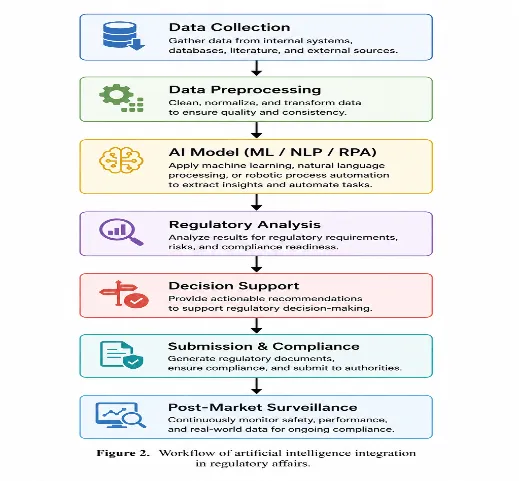
4. Role of Artificial Intelligence in Regulatory Submissions
The use of Artificial Intelligence in regulatory submissions is expected to increase, as it helps to make the processes more efficient and rapid, as well as ensuring higher accuracy and analytical power (18,27).
4.1 Document preparation
Using AI can help to prepare documents for regulatory submissions in eCTD or other formats with the use of ML and NLP to organize and present the data, thus facilitating the process and saving time and effort (18).
4.2 Data analysis
AI can help analyze the data in a more efficient manner, as ML can be used for examining patterns, interconnections, and trends, as well as identifying potential issues and even predicting the outcomes of the submission (21,26).
4.3 Literature search
NLP can help to quickly go through relevant literature and summarize the information, which can be valuable both for the researchers and the reviewers (40).
4.4 Regulatory intelligence
AI can also help get regulatory intelligence, which is critical for the submission process, as it allows to determine trends in the field and even predict the results of the submission (21,56).
5. Role of Artificial Intelligence in Compliance Management
The role of AI in compliance management includes ensuring higher levels of compliance, as well as improving multiple aspects of the process (43).
5.1 Compliance monitoring
AI can help to ensure compliance by constantly tracking the relevant processes and notifying the responsible persons on any irregularities.
5.2 Risk management
Predictive analytics can help in determining the key risks and even eliminating them, thus ensuring higher levels of compliance (20).
5.3 Audit trails
AI can help to facilitate audits and inspections, as it can ensure easier management, storage, and finding of relevant documents (48).
5.4 Pharmacovigilance
The process of pharmacovigilance can also be automated with the help of AI, as it can collect and analyze the necessary information from various sources, including clinical, commercial, and digital ones, regarding drug safety (24).
Table 2: Role of AI in compliance management
|
. Area |
AI Role |
Outcome |
|
Monitoring |
Real-time tracking |
Early detection |
|
Risk Assessment |
Predictive modeling |
Reduced violations |
|
Audit |
Automated documentation |
Faster audits |
|
Pharmacovigilance |
Signal detection |
Improved safety |
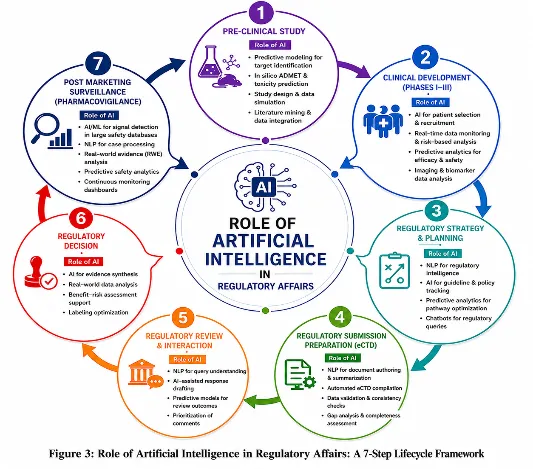
6. Advantages of Artificial Intelligence in Regulatory Affairs
7. Applications of Artificial Intelligence in Regulatory Affairs
Artificial Intelligence (AI)’s application in pharmaceutical regulatory affairs has crossed the frontiers of imagination and entered the realm of reality. The following sub-sections provide an insight into the practical implementations of AI-enabled solutions within the regulatory domain.
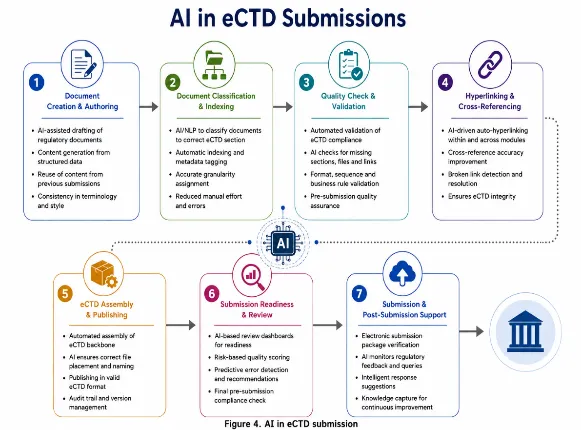
7.1 AI Enabled Regulatory Affairs: eCTD Submissions or Regulatory Document Authoring
Problem: Electronic Common Technical Document (eCTD) submissions require an extensive amount of paperwork which involves formatting and regulatory compliance checks before approval. This process is very time-consuming, error-prone, and regulatory-heavy for humans to handle on a large scale.
AI-based solution: Regulatory affairs AI tools like are helping humans to perform tasks such as authoring, formatting, and validating eCTD submissions effortlessly with the power of Natural Language Processing (NLP). These AI-driven solutions enable users to manage eCTD submissions comprehensively and accurately.
Benefits:
7.2 AI in Pharmacovigilance (Signal Detection)
The issue:
The field of pharmacovigilance produces thousands of adverse event reports that need to be assessed and analyzed for possible safety signals, which is challenging work.
The AI-enabled solution:
AI-based pharmacovigilance solutions such as Argus Safety and Life Sphere harness the power of machine learning and data mining algorithms to analyze structured and unstructured safety data, including social media and clinical data.
The benefits:
These systems enable faster identification of adverse drug reactions, thus improving patient safety while reducing the time spent on adverse event processing and management, as well as ensuring reliable signals for effective drug safety surveillance.
7.3 AI for Regulatory Intelligence and Automation
The issue:
Regulatory affairs specialists are tasked with the responsibility of staying updated on emerging global regulatory trends, guidelines, and requirements, which can be time-consuming and challenging.
The AI-enabled solution:
AI-driven regulatory intelligence solutions such as and are designed to help companies stay on top of global regulatory developments while gaining actionable regulatory insights by employing natural language processing and machine learning algorithms to analyze and summarize critical regulatory information.
The benefits:
In addition to improving compliance through continuous tracking of regulatory developments, these solutions also increase operational efficiencies by providing up-to-date regulatory guidance and enhancing informed decision-making.
8. Comparative Analysis of the Traditional and AI Approaches to Regulatory Affairs
To fully appreciate the unprecedented potential of AI in revolutionizing the pharmaceutical regulatory affairs field, a comparison between the traditional and AI-driven approaches is provided below. As can be gathered from the comparison below, pharmaceutical companies that employ AI-based solutions stand to gain tremendously by improving compliance while at the same time realizing significant gains in terms of operational efficiencies and enhanced accuracy. (27,39)
Table 3: Comparative Analysis of Traditional and AI-Based Regulatory Approaches.
|
Parameter |
Traditional Approach |
AI-Based Approach |
|
Time Efficiency |
High time consumption |
Significantly reduced processing time |
|
Error Rate |
Prone to human errors |
Minimal errors due to automation |
|
Data Handling |
Manual data entry and processing |
Automated data processing using AI |
|
Compliance Tracking |
Reactive and periodic monitoring |
Real-time monitoring and alerts |
|
Decision Making |
Based on limited data analysis |
Data-driven and predictive decision-making |
|
Document Processing |
Manual review of large documents |
NLP-based automated document analysis |
|
Scalability |
Limited scalability |
Highly scalable systems |
|
Cost Efficiency |
High operational cost |
Reduced long-term operational cost |
9. Challenges and Limitations
In spite of the benefits of using AI in regulatory affairs, there are some challenges. First, the collection, storage, and processing of clinical data pose a threat to data privacy and security (51). Additionally, there are no uniform worldwide regulations for the use of artificial intelligence; therefore, it is difficult to validate the results (23). The other challenge is the high cost of implementing and using AI in regulatory affairs (21).
Moreover, it is important that AI developers pay special attention to the quality of datasets because the results are only as good as the data inputs (50). Several ethical issues are also associated with the application of AI in regulatory affairs (42).
10. Regulation of Artificial Intelligence in Pharmaceutical Regulatory Affairs
Regulation of Artificial Intelligence (AI) is significant to pharmaceutical regulatory affairs because it promotes transparency, trust, and accountability. Various regulatory agencies have formulated policies regarding the use of AI in pharmaceutical research and development and in regulatory decision-making processes (31,34).
10.1 Regulatory Guidelines for AI
Some regulatory agencies such as the US Food and Drug Administration (FDA) have proposed a framework for regulating the use of software powered by AI and machine learning (AI/ML). It is significant to note that FDA’s Framework focuses on the whole product lifecycle, which involves continuous learning from the use of these products to monitor the intended performance after launching in the market (56). Similarly, the EMA has issued a reflection paper on the use of AI in the medicinal product lifecycle and put forth guidelines for using AI as an integral part of drug development (57).
The guidelines highlight some of the critical considerations and factors that should be taken into account when applying AI in drug discovery or regulating the drug lifecycle. Additionally, the World Health Organization has issued ethical guidelines for developing AI in health, which are based on transparency, inclusiveness, and accountability principles among other considerations (54). This is important because it provides an ethical framework that promotes trust and adherence to privacy and security rules when developing AI in health.
10.2 Validation Requirements
The validation of AI is one of the significant requirements in regulating the use of AI in pharmaceutical regulatory affairs. AI systems require extensive and appropriate validation of computer software, and this presents an enormous challenge for validation. Additionally, model verification is also essential to ensure that the design meets the specification, and model validation helps to ensure that the outputs are accurate (55).
The regulatory guidelines require appropriate training sets and the use of well-established benchmarks to assess the performance of models that use AI to determine their accuracy, appropriateness, and compliance with the intended use. Finally, documentation of model development, model training, and performance assessments are needed to provide evidence of compliance.
10.3 Data Integrity
Data integrity is a crucial component of AI application in pharmaceutical regulatory affairs. The AI systems require both unstructured and structured data, making data integrity validation challenging. The data integrity guidelines and standards such as GMP, GCP, and other data management requirements that apply to all data generated by AI systems must be considered to ensure that the data are reliable and trustworthy.
Using a given AI model, inappropriate and unreliable data may result in erroneous decisions in regulatory affairs, which could cause serious adverse effects. Therefore, organizations must establish appropriate procedures and protocols for collecting, storing, validating, and managing these data to ensure that they meet regulatory requirements (30). It is essential to note that AI models that use unstructured data should meet the requirements for electronic records and signatures (52).
10.4 Explainability and Transparency
Explainability and transparency are critical aspects of applying AI in pharmaceutical regulatory affairs, and they present some of the most significant challenges. The problem of black box is one of the most significant concerns associated with AI because, in several cases, black box AI systems are difficult to interpret (50).
Therefore, regulatory agencies have called for the need to ensure the explainability of AI. Additionally, it is essential for developers of AI to consider the principles of transparency, interpretability, and audibility of AI models in order for the results to be trusted, adopted, and used with confidence in pharmaceutical regulatory affairs. Finally, human oversight should always be exercised during the AI-driven decision-making process (43).
FUTURE PERSPECTIVES
Artificial intelligence is likely to play a critical role in the future of regulatory affairs. The future of pharmaceutical regulatory affairs will rely on AI to facilitate the submission of electronic regulatory documents and for making regulatory decisions (74). AI-powered systems will ensure accurate and reliable results by integrating with big data analytics and blockchain technology, thus, enhancing traceability in the pharmaceutical supply chain (37,38). For instance, it is likely that the use of predictive analytics in regulatory affairs will increase.
Moreover, AI will help meet the need for personalized medicine by supporting the adoption of a data-driven approach to treatment, diagnosis, and therapy (22). Additionally, there is a likelihood that many regulatory agencies around the globe will adopt AI, thus, improving regulatory sciences and promoting modernized, efficient, and transparent regulatory systems to boost public health (69). Therefore, it is essential to embrace AI in pharmaceutical regulatory affairs to achieve a harmonized, integrated, and digital future in regulatory affairs that is patient-centred (64).
CONCLUSION
Artificial Intelligence (AI) is transforming the pharmaceutical industry by improving the efficiency and accuracy of regulatory submissions. The integration of advanced AI technologies such as machine learning, big data analytics, natural language processing, robotic process automation, and regulatory intelligence will revolutionize the way in which regulatory affairs are handled. AI can be used in several ways, including automating the preparation of regulatory documents and reports, facilitating efficient data analysis, and enabling continuous monitoring and auditing of regulatory compliance. As a result, AI will reduce the time taken to prepare and submit regulatory documents. In addition, it will help improve pharmacovigilance and patient safety while minimizing manual interventions and errors.
For compliance management, AI can promote proactive and effective approaches to risk management and monitoring of compliance. Additionally, AI can help to ensure audit readiness and support pharmacovigilance and safety, thus, minimizing the occurrence of adverse events. The benefits of using AI in pharmaceutical regulatory affairs outweigh those of using traditional methods. The use of AI-driven strategies in pharmaceutical regulatory affairs will result in cost savings and increased efficiency in the long run. Therefore, organizations should consider implementing AI in various aspects of regulatory affairs to promote efficiency and compliance.
However, it is critical to address the issue of data privacy and security when using AI in pharmaceutical regulatory affairs. Additionally, there is a need for appropriate, standard, and uniform regulatory guidelines for the application of AI in pharmaceutical regulatory affairs worldwide. Some of the most critical areas in the use of AI in pharmaceutical regulatory affairs that require more research include addressing the high cost of adopting and implementing AI systems in regulatory agencies and overcoming the challenges with regard to ethical issues, transparency, bias, and data privacy and security.
As the various regulatory agencies continue to develop and publish guidelines for the application of AI in pharmaceutical regulatory affairs, the future of pharmaceutical regulation is likely to be dependent on AI-powered automated and efficient systems that are reliable and transparent. The use of AI in conjunction with several other emerging technologies such as big data will play a significant role in ensuring traceability in the pharmaceutical supply chain and enabling timely regulatory decisions. This will ultimately increase the rate at which new, high-quality, and safe drugs reach the market while ensuring compliance with the appropriate regulatory guidelines.
REFERENCES

Arti Dagadkhair, Rupali Waghmode, Anisha Nalwade, Sayali Nanware, Dr. Gauri Patil, Dr. Rajendra Patil, Artificial Intelligence in Regulatory Submissions and Compliance Management in the Pharmaceutical Industry, Int. J. of Pharm. Sci., 2026, Vol 4, Issue 8, 1530-1542, https://doi.org/10.5281/zenodo.21850872
 10.5281/zenodo.21850872