

We use cookies to ensure our website works properly and to personalise your experience. Cookies policy
Central India College of Pharmacy, Lonara, Nagpur, Maharashtra 441111
Bacteria are microscopic single?celled organisms that reproduce mainly by binary fission and can be beneficial, commensal, or pathogenic to humans. Pathogenic bacteria cause infections by adhering to host tissues, forming biofilms, and producing toxins, so increasing resistance to conventional antibiotics has created an urgent need for safer, plant?based antimicrobial agents. Piper nigrum L. (black pepper), a widely used culinary spice, is rich in bioactive phytochemicals such as the alkaloid piperine, phenolics, and essential oils that exhibit significant antioxidant and antimicrobial activities. These compounds can damage bacterial cell walls and membranes, increase permeability, and interfere with enzyme systems, leading to growth inhibition of both Gram?positive and Gram?negative bacteria. Antioxidant properties of P. nigrum extracts, demonstrated by free?radical scavenging and reducing assays, help neutralize reactive oxygen species and may enhance overall protective effects in biological systems. The present research envisages evaluating the antimicrobial activity of P. nigrum extracts against selected bacterial strains using nutrient agar media, alongside phytochemical analysis to identify major constituent groups responsible for bioactivity, and designing a structured experimental plan to correlate extract composition with observed antibacterial and antioxidant effects.
Plants are an excellent source of various types of drugs, as they produce a wide range of bioactive compounds. Plants with potential antibacterial activity should be evaluated against a suitable microbiological model to validate their activity and identify the traits associated with it. Since the beginning of time, plants have been the main source of medicines because of the abundance of chemical compounds having therapeutic qualities. The general public is increasingly using herbal supplements as dietary supplements to alleviate and treat a variety of human illnesses [1][2]. Many herbs and spices are part of the human diet. The human diet includes a lot of herbs and spices. From ancient times, they have been used to improve the flavour, colour, and perfume of food. Herbs and spices not only enhance flavour but are also prized for their medicinal and preservation properties, which date back to one of the earliest sciences. However, modern science has only just begun to pay attention to the characteristics of spices. Plants used as spices and medicine are renewable basic materials. Their production offers an alternative to agriculture's overproduction of conventional crops. They are also becoming increasingly important economically [3][4]. Spices are any dry. fragrant, aromatic, or pungent plant or vegetable substances that can be whole, broken, or ground, flavour, whose main purpose in food is seasoning rather than nourishment, may add to the enjoyment or pungency of some foods and beverages. Coriander, mint, clove, flowers, bulbs, fruits, red chillies, black pepper, stems, and other plant parts are examples of leaves that are used as spices [5].
Spices should only be used sparingly as medicine, despite the fact that they are naturally occurring chemicals that our bodies can easily absorb and normally do not have any negative side effects. This is because just because a drug comes from a plant doesn't mean it is always safe [6]. One medication used to treat one condition can actually make it harder to treat another. According to the most recent research, spices may contain compounds that are mutagens, carcinogens, allergens, and reproductive toxicants. The use of and search for drugs and dietary supplements derived from plants has accelerated in recent years. Ethnopharmacologists, botanists, microbiologists, and natural products chemists are scouring the Earth for phytochemicals and "leads" that could be developed for the treatment of infectious diseases. The establishment of new directions towards the propagation of alternative medicinal crops that offer better economic and social benefits is made possible by the discovery of medicinal plants in various parts of the world [7]. This is important for the agriculture and medicine sectors. Antimicrobial compounds can be derived from a wide range of medicinal plants.
Root, stem, flower, leaf, fruit, and modified plant organs are a few of the different sections that are utilised. Several nations employ plants as medicine, and they are the source of several strong and dangerous medications. Plant extracts' antibacterial properties could be found in a range of various places. The combination of secondary products found in plants is usually what gives plant materials their positive therapeutic properties [8][9].
WHAT ARE BACTERIA?
The basic one-celled organisms known as bacteria were initially discovered by van Leeuwenhoek in the 1670s. Just one is called a "bacterium." The planet is home to millions, if not billions, of different kinds of bacteria, including those in your body. They are in your mouth, airways, and on your skin. Additionally, they are found in your urinary tract, reproductive system, and digestive system. According to scientists, your body has ten times as many bacterial cells as human cells[10][11].
LIFE CYCLE OF BACTERIA
The life cycle of bacteria consists of four phases: the stationary phase, the declining phase, the log or exponential phase, and the lag phase. Several elements that promote bacterial growth have a significant impact on this cycle.
SCIENTIFIC NAME
The genus and species of the bacteria have been included in the scientific name, which is based on the bacteria's features. The bacterium that causes botulism, for instance, is known scientifically as "Clostridium botulinum". Within a species, scientists may uncover several varieties, or strains, of a bacterium [14][15].
SHAPES OF BACTERIA
Three fundamental bacterial shapes are as follows:
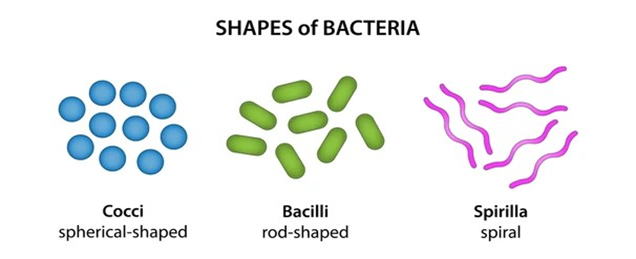
Figure 1Types of bacteria
NEED FOR OXYGEN: The foundation of bacteria is their requirement for oxygen to survive and proliferate. Aerobes comprise bacteria that require oxygen to survive. Anaerobic organisms are bacteria that cannot survive or proliferate in the presence of oxygen. With or without gas, some bacteria can survive and proliferate.We refer to these as facultative bacteria [16].
GENETIC MAKEUP: Every bacterium has a unique genetic composition. We refer to this as their genotype. The variations in each bacterium's genotype can be identified via specialized testing.
STAINING: The color that bacteria change after being exposed to particular chemicals (stains) is used to categorize them. The Gram stain is a popular staining method. Gram-positive and gram-negative bacteria can be categorized. Because gram-positive and gram-negative bacteria react differently to certain antibiotics, Gram staining also helps guide treatment[17].
What are gram-positive bacteria?
Gram-positive bacteria look blue to purple under a Gram stain. Examples: Corynebacterium, Clostridium, Listeria.
What are gram-negative bacteria?
Gram-negative bacteria look red to pink under a Gram stain. They cause different types of infections than gram-positive bacteria. They also need different types of antibiotics to treat them. Examples: Pseudomonas, Proteus, Klebsiella.[18][19]
BACTERIAL INFECTION
Table 1.Bacteria and its causative disease
|
Bacteria |
Disease |
|
E. coli |
Foodborne disease |
|
Pseudomonas |
Infection in the blood, lungs (pneumonia) |
|
Proteus |
Gastroenteritis |
|
Klebsiella |
Wound or surgical site infection, Pneumonia |
|
Corynebacterium |
Diphtheria |
|
Clostridium |
Food poisoning |
PLANT PROFILE
PIPER NIGRUM (BLACK PEPPER)
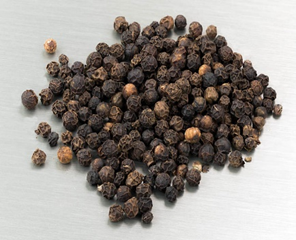
Figure 2 Piper Nigrum Fruits
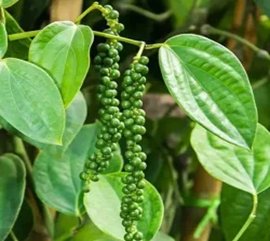
Figure 3 Piper Nigrum Leaves
SYNONYM: Black pepper, common pepper, Kali Mirch, pepper
BIOLOGICAL SOURCE: It is obtained from dried unripe fruit belonging to the Piperacea family.
CULTIVATION: India is one of the major producers, consumers, and exporter of black pepper in the world. Black pepper is cultivated to a large extent in Kerala, Karnataka, and Tamil Nadu, and to a limited extent in Maharashtra, the eastern states, and the Andaman & Nicobar Islands. Kerala and Karnataka account for a significant portion of the country's black pepper production [21][22][23].
THE PLANT: The pepper plant is a perennial woody vine that can grow up to 4 meters (13 ft) in height on supporting trees, poles, or trellises. It is a spreading vine, rooting readily where trailing stems touch the ground.
A single stem will bear 20 to 30 fruiting spikes. The harvest begins as soon as one or two fruits at the base of the spikes begin to turn red, and before the fruit is fully mature, and still hard, if allowed to ripen completely, the fruit loses pungency, and ultimately falls off and is lost. The spikes are collected and spread out to dry in the sun, and then the peppercorns are stripped off the spikes. The cuttings are usually cultivars, selected both for yield and quality of fruit[24].
THE ROOTS: The branches are pruned twice a year, and the roots are coated with manure and leaf mulch. Young plants on dry soils need to be watered every other day for the first three years of the dry season.
THE LEAVES: The leaves measure 5 to 10 centimeters (2.0 to 3.9 in) in length and 3 to 6 centimeters (1.2 to 2.4 in) in width. They are alternating and whole [25][26].
THE FRUITS: A peppercorn is the dried form of the black pepper's fruit, which is termed a drupe. The pepper berries are picked when they are half ripe and beginning to turn red in order to make black peppercorns. After that, they are allowed to dry, which makes them shrivel and turn dark. White peppercorns are collected when very ripe and then steeped in brine to remove their dark outer shell, leaving only the white pepper seed. On the other hand, green peppercorns are picked while still unripe and green in color.
THE SEEDS: The pepper berry, which is a drupe, has a solitary, big seed in the middle [27][28].
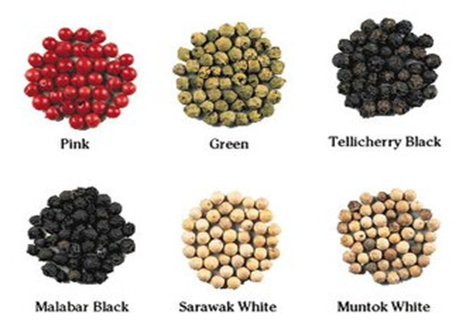
Figure 4 Types of Piper Nigrum seeds
HABITAT: Montane tropical evergreen forest.
CHEMICAL CONSTITUENTS
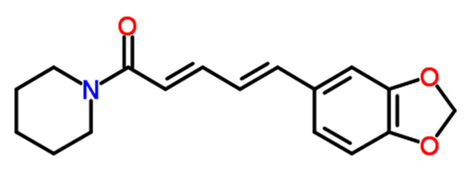
Figure 5 Structure of Piperine
Molecular Formula - C17H19NO3
Molecular Weight - 285.34
IUPAC Name (2E,4E)-5-(1,3-benzodioxol-5-yl)-1-piperidin-1-ylpenta-2,4-dien-1-one
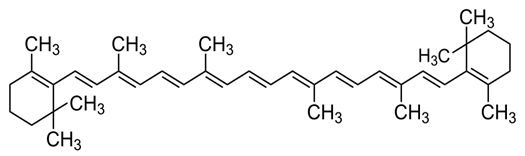
Figure 6 Structure of Beta carotene
Piperine, one of the several alkaloids found in black pepper, has a depressive effect on the central nervous system. According to some research, piperine may be used to treat vitiligo since it promotes skin pigmentation. Other parts of black pepper, particularly the leaves, contain specific phytochemical substances that were extracted using various solvents, and their antibacterial properties were examined[31].
MOA OF PIPER NIGRUM:
By interfering with the TCA pathway, pepper's antibacterial properties inhibited cellular respiration. The buildup of pyruvic acid and the decrease in ATP demonstrate that BPCE can alter the permeability of cell membranes, disrupt bacterial respiratory metabolism, and ultimately result in pyknosis and cell death[32].
APPLICATIONS
Its uses in pharmaceutical sciences include the following:
ANTI-BACTERIAL METHODS
MATERIAL AND METHOD:
The fine powder of the Piper Nigrum was collected from Manas Ayurveda in Aura Park, Nagpur.
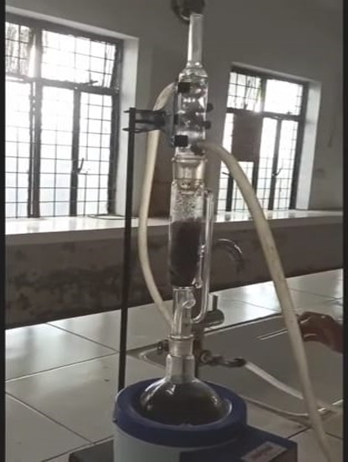
Figure 7 Soxhlet assembly
The sum of 15 g of fine powder of piper nigrum was subjected to continuous extraction with solvent chloroform by using a Soxhlet extractor. The process was allowed to run for 21 cycles, or until the color solvent disappeared in the siphon. After complete extraction, the solvent was removed with the help of distillation. The flask was constantly heated at 65°C. Pure chloroform was extracted [37][38].
Weight of extract before drying = 64.5 gm
Weight of empty petri dish = 52.65 gm
Weight extract with petri plate = 64.52 gm
Weight of extract = 64.52 - 52.65 = 11.87 gm
PHYTOCHEMICAL ANALYSIS.
2 g of the extract was mixed with 20 ml of solvent and utilized as the sample for phytochemical examination.
TEST FOR ALKALOIDS
Add Wagner's reagent to 0.1 ml of the extract. The appearance of a reddish-brown precipitate confirms the presence of alkaloids[39]
TEST FOR FLAVONOIDS
When 0.1 mL of the test sample was combined with a few drops of ferric chloride, a blackish-red precipitate appeared.
When 0.1 mL of the test sample is mixed with sodium hydroxide solution, a strong yellow color develops. This color becomes colorless upon the addition of a few drops of diluted hydrochloric acid, indicating the presence of flavonoids[40][41]
TEST FOR TANNINS AND PHENOL
A mixture of 5% glacial acetic acid and sodium nitrite was added to 0.1 mL of plant extract, resulting in a muddy Niger brown color, which indicates the presence of phenols.
TEST FOR GLYCOSIDES
To 0.1 mL of the extract, 1 mL of concentrated sulfuric acid was added and mixed thoroughly. Following that, 2 mL of glacial acetic acid was introduced along with a drop of ferric chloride, resulting in the appearance of a blue color[42].
TEST FOR STEROLS
Combine 0.1 mL of the extract with 0.1 mL of chloroform and mix well; subsequently, add a few drops of concentrated sulfuric acid, leading to the emergence of a red color in the lower layer, indicating the presence of sterols.
TEST FOR QUINONES
2 ml of aqueous ammonia was added to the extract and shaken well. A change in the colour of the aqueous layer, like red, pink, or violet was seen[43][44].
Table 2.Phytochemical screening
|
Phytochemical Compound |
Test |
Observation |
Inference |
Result |
|
Alkaloids |
Wagner's test |
Reddish ppt |
Alkaloids Present |
Positive |
|
Flavonoids |
Ferric chloride test Alkaline reagent test |
No blackish red ppt
When NaOH sol is added, it turns dark yellow, a few drops of dil. HCL is added it turns colorless |
Flavonoids Present
|
Negative
Positive |
|
Tannins And Phenol |
Ellagic acid test
|
Didn't turn into muddy niger brown colour |
Tannins Absent |
Negative |
|
Glycosides |
Kellar-Kiliani test |
Blue colour appeared |
Glycosides Present |
Positive |
|
Sterols |
Salkowski test |
Red colour lower layer/ppt appeared |
Sterols Present |
Positive |
|
Quinones |
--- |
No change in colour |
Quinones Absent |
Negative |
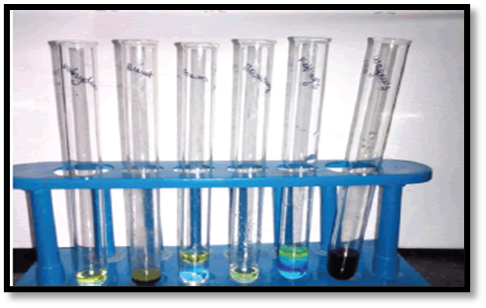
Figure 8.Phytochemical Testing
PREPARATION OF SLANT FOR CULTURING OF MICROORGANISMS:
Composition of Nutrient Agar:
It is a solid medium, and its composition is
Weigh the nutrient agar powder in a conical flask and dissolve it in water to make the desired volume (28 g in 1000 ml of water).Insert the cotton plug and cover the flask's opening with aluminum foil to prevent contamination. Allow the medium to undergo steam sterilization under specified conditions, which include 121°C for 60 minutes, reaching the temperature first before maintaining it for 60 minutes. At the same time, sterilize the glass equipment using hot air sterilization at 121 °C for 15 to 20 minutes at a pressure of 15 lbs, wrapping them with paper to protect against mechanical damage. After sterilization, transfer the nutrient mixture into the test tube within a laminar airflow hood in the sterilization area. Incubate the test tubes at 37 °C for 24 hours to monitor for colony growth. Position the test tube at an angle to facilitate microbial culturing. In the event of turbidity, dispose of the test tubes and repeat the procedure.
If no turbidity is observed, send the prepared test tubes to Vishakha Laboratory in Ramdaspeth, Nagpur[45][46][47].
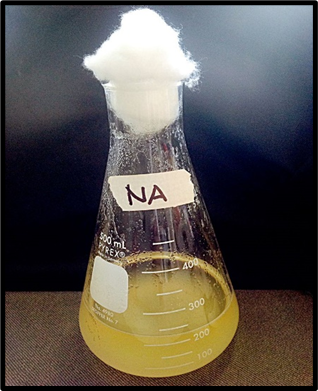
Figure 9 Nutrient Agar Medium Solution
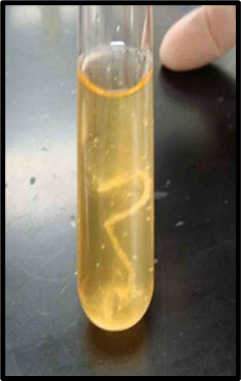
Figure 10Test tube for slant
PROCUREMENT OF AN ORGANISM:
The test bacteria utilized for the antimicrobial investigation were acquired from Vishakha Laboratory, Ramdaspeth, Nagpur.
PREPARATION OF A PETRI DISH FOR MICROBIAL TESTING
Weigh the nutrient agar powder in a conical flask and dissolve it in water to achieve the required volume (28 g in 1000 ml of water).Insert a cotton plug and cover the top of the flask with aluminum foil to prevent contamination[48].Allow the medium to sterilize through steam sterilization under the appropriate conditions, i.e., at 121°C for 60 minutes; let it reach the temperature, then maintain it for 60 minutes. Concurrently, sterilize the glassware, such as petri dishes, inoculating loops, and cotton swabs, using hot air sterilization at 121°C for 30 minutes at 1 atm pressure, wrapping them in paper to avoid physical damage. Following sterilization, pour the nutrient mixture into the petri dish under laminar airflow in the sterilization area. Incubate at 37°C for 24 hours to check for colony growth. Tilt the test tube in preparation for culturing the microorganisms. If turbidity is observed, discard the test tubes and repeat the procedure. If no turbidity is evident, continue with the antimicrobial testing [49][50].
ANTIBACTERIAL ACTIVITY
Clean with disinfectant.Place the Bunsen burner in front of you, all tubes and other equipment in a suitable location which will allow you to reach them without any difficulty and without burning yourself.Take in one hand a tube containing broth culture or one containing sterile nutrient broth.Take an inoculation loop with the other hand and flame the entire wire to redness.Remove the plugs from the tube by grasping them between the fingers of the hand holding the inoculation instrument.Be careful not to bring plugs near the Bunsen burner [51].Flame the mouth of broth tubes, insert an inoculating loop into the culture, and obtain a loopful of inoculum.Introduce the inoculum into the tube of sterile medium by immersing the loop full of culture in broth. When removing the inoculation loop, gently touch it to the inner surface of the tube to remove any remaining inoculum [52][53].
The necessary materials were measured, and a nutrient agar medium was created. It was sterilized using autoclaving at 121°C at 15 psi for 15-20 minutes.Once sterilized, E. coli was inoculated into the medium; then, the medium was poured into sterilized Petri dishes.Various concentrations of Piper nigrum extract (2, 4, 8, 10 mg/ml) were prepared.Create wells or bores for each extract of different concentrations.The Petri plates were allowed tosit for 45 minutes.They were then incubated at 37°C for 18-24 hours in an inverted position. After the incubation period, the zones of inhibition were measured [54].
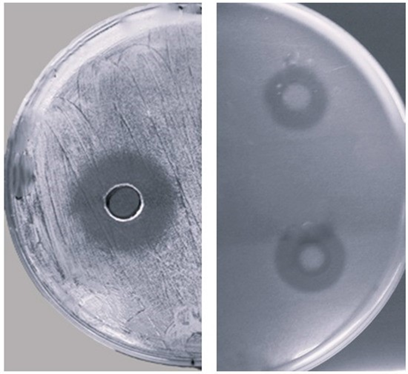
Figure 11.Inoculated petri plate
RESULT AND DISCUSSION
In the present study the antibacterial effect of Piper Nigrum was shown. By extracting Piper nigrum, it has exhibited antimicrobial activity against the selected bacterial strain, i.e., E. coli, with a zone of inhibition ranging from 1.3cm to 1.9cm. ZOI was 1.3cm for A, 1.4cm for B, 1.8 cm for C, and 1.9 cm for D. This indicates that the zone of inhibition increases as the concentration of pipernigrum extract increases.
Table 3.Zone of inhibition Vs Concentration
|
Sample |
Concentration (mg/ml) |
Zone of Inhibition (cm) |
|
A |
2 |
1.3 |
|
B |
4 |
1.4 |
|
C |
8 |
1.8 |
|
D |
10 |
1.9 |
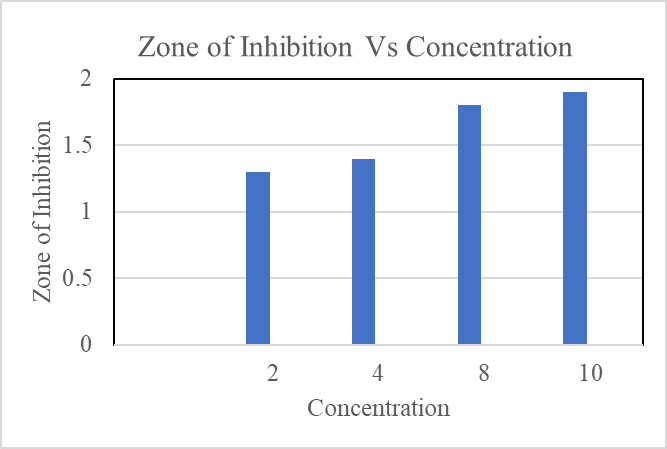
Graph 1 Zone of inhibition Vs Concentration
CONCLUSION
In this study, we conducted antimicrobial testing on an extract of Piper nigrum. We utilized dried fruits of the plant, which we pulverized, and then prepared a thimble containing 15 grams of fine powder for the Soxhlet extraction apparatus. After completing 21 cycles of Soxhlet extraction, we concluded the extraction process. We performed phytochemical screening on the extract obtained, which revealed the presence of alkaloids, glycosides, and sterols that tested positive. Microbial species were obtained from a pathological laboratory; the microbes were maintained under appropriate conditions. We prepared Petri dishes filled with nutrient agar medium. Before this, the agar solution and glassware were sterilized using methods such as autoclaving and heating in a hot air oven. We inoculated the microbial samples into the plates using the cup-plate technique. We prepared various concentrations of the raw extract, finding that an 8 mg/ml concentration produced a significant zone of inhibition, while a 10 mg/ml concentration showed only a slight variation. The primary goal of this project is to assess the antibacterial activity and its effectiveness against E. coli, which we selected as our specimen for testing.
REFERENCES

Gayatri Chinchulkar, Pranali Burde, Masarrat Ali, Kavita Khedade, Prerona Das, Anti-Microbial Activity of Piper Nigrum L.: A Systematic Research Paper of its Standardization, Botanical Characteristics, Phytochemistry, and Pharmacological Activities, Int. J. of Pharm. Sci., 2026, Vol 4, Issue 1, 2582-2594. https://doi.org/10.5281/zenodo.18350822
 10.5281/zenodo.18350822