

We use cookies to ensure our website works properly and to personalise your experience. Cookies policy
1 Assistant Professor, Department of Pharmaceutical chemistry, KMCH College of Pharmacy, Coimbatore, Tamilnadu, India.
2 Vice Principal& Professor, Department of Pharmaceutical chemistry, KMCH College of Pharmacy, Coimbatore, Tamilnadu, India.
3 B. Pharm IV Year, Department of Pharmacy Chemistry, KMCH College of Pharmacy, Coimbatore, Tamilnadu, India
The identification of protein–ligand interactions is fundamental to modern drug discovery, structural biology, and medicinal chemistry. Molecular docking has become an indispensable computational technique for predicting ligand binding modes and estimating binding affinities. However, conventional docking approaches often require prior knowledge of the active site, limiting their applicability to newly characterized proteins. Blind docking methods overcome this challenge by exploring the entire protein surface to identify potential binding pockets. CB-Dock2 represents a significant advancement in blind docking technology by integrating cavity detection, molecular docking, and template-based fitting into a unified platform. This review critically examines the development, methodology, applications, strengths, limitations, and future prospects of CB-Dock2. The integration of CurPocket, AutoDock Vina, and FitDock enables improved binding site identification and docking pose prediction compared with traditional docking platforms. Furthermore, the emergence of AlphaFold2 and AI-assisted protein structure prediction has expanded the need for reliable blind docking tools, making CB-Dock2 increasingly relevant in modern drug discovery. The review also discusses current challenges and future opportunities for integrating artificial intelligence, molecular dynamics simulations, and high-throughput virtual screening within the CB-Dock2 framework.
Drug discovery is a complex and expensive process requiring identification of suitable molecular targets and development of compounds capable of modulating biological activity. Protein–ligand interactions form the basis of therapeutic intervention, making their characterization essential for rational drug design.
Experimental methods such as X-ray crystallography, cryo-electron microscopy, and nuclear magnetic resonance spectroscopy provide valuable structural information; however, these approaches are time-consuming and resource-intensive. Consequently, computational approaches have emerged as attractive alternatives.
Molecular docking predicts the preferred orientation of a ligand within a protein binding site and estimates the stability of the resulting complex. Traditionally, docking studies require prior knowledge of the active site. However, many proteins lack experimentally validated binding sites, particularly newly predicted structures generated by AlphaFold2 and RoseTTAFold.
Blind docking addresses this challenge by scanning the entire protein surface for potential binding cavities. The increasing availability of protein structures has accelerated the development of blind docking platforms such as SwissDock, COACH-D, EDock, MTiAutoDock, and CB-Dock. Among these, CB-Dock2 has emerged as a powerful and user-friendly platform integrating cavity detection and template-assisted docking. [1-2]
2. Evolution of Molecular Docking Technologies: -
Molecular docking has undergone remarkable advancements since its emergence in the 1980s, evolving from simple rigid-body approaches to sophisticated artificial intelligence-assisted techniques. The first generation of docking methods employed rigid receptor and ligand models with simplified scoring functions, resulting in limited computational accuracy and predictive capability. Subsequently, the second generation introduced flexible ligand docking, improved energy calculation methods, and genetic algorithm-based optimization strategies, significantly enhancing docking precision and efficiency.[3]
The third generation of docking technologies marked a major breakthrough with the development of blind docking approaches, advanced binding cavity detection algorithms, and high-throughput virtual screening capabilities, enabling the rapid evaluation of large compound libraries. More recently, the fourth generation has incorporated template-based docking techniques, machine learning-assisted scoring functions, and seamless integration with extensive structural and biological databases, thereby improving prediction accuracy, reducing computational time, and facilitating modern drug discovery and design processes.[4]
CB-Dock2 belongs to this advanced generation by combining structure-based and knowledge-based docking approaches
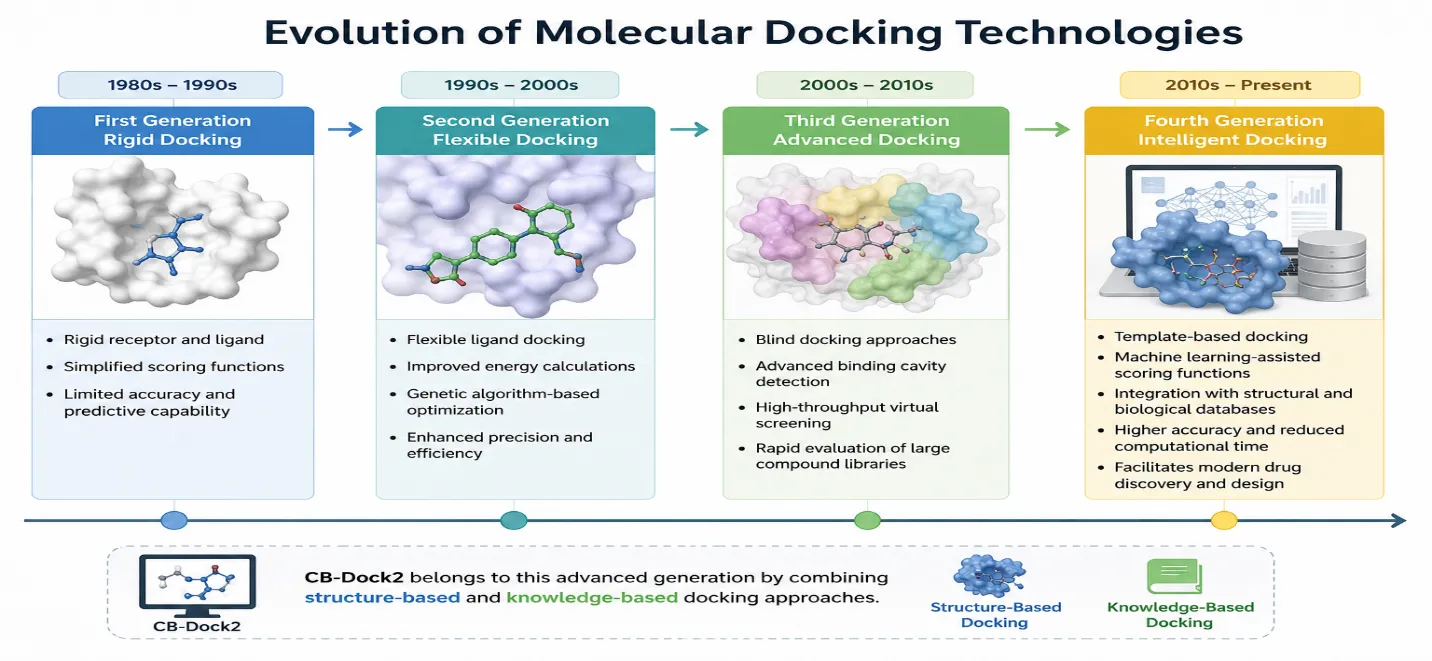
FIG 1: Evolution of Molecular Docking Technologies
3. Architecture of CB-Dock2: -
CB-Dock2 is designed with four major modules that work together to provide an efficient and accurate protein–ligand docking workflow. These modules include the input module, data preprocessing module, cavity detection module, and docking engine.
3.1 Input Module
The input module of CB-Dock2 supports multiple formats for both proteins and ligands, ensuring broad compatibility with commonly used molecular data. Protein structures can be uploaded in Protein Data Bank (PDB) format, while ligand structures are accepted in SDF, MOL2, and PDB formats. Additionally, users can directly input molecular structures using SMILES notation or construct molecules interactively through the JSME molecular editor. This versatility makes CB-Dock2 accessible to both experimental scientists and computational researchers. [5,6]
3.2 Data Preprocessing Module
Before docking, CB-Dock2 performs a series of preprocessing steps to improve the quality and reliability of the docking results. Protein preparation includes the addition of missing hydrogen atoms, reconstruction of incomplete side chains, removal of crystallographic water molecules, and correction of structural irregularities. Similarly, ligand preparation involves geometry optimization to obtain energetically favorable conformations, assignment of atomic charges, and generation of multiple conformers. These preprocessing procedures ensure that both protein and ligand structures are suitable for accurate molecular docking simulations.[7]
3.3 Cavity Detection Module
A key feature of CB-Dock2 is its cavity detection module, which utilizes the CurPocket algorithm to identify potential ligand-binding sites. CurPocket detects binding cavities by analyzing the curvature of the protein surface and identifying regions capable of accommodating small molecules. This approach enables rapid and precise localization of binding pockets while minimizing false-positive predictions. The identified cavities are subsequently ranked based on their volume, depth, and accessibility, allowing users to focus on the most probable ligand-binding regions.[8]
3.4 Docking Engine
The docking engine of CB-Dock2 integrates both AutoDock Vina and FitDock to enhance docking performance and prediction accuracy. AutoDock Vina serves as the primary docking algorithm, offering fast docking calculations, efficient scoring functions, and reliable prediction of ligand-binding poses. To further improve docking outcomes, CB-Dock2 incorporates FitDock, a template-based docking strategy that leverages information from previously solved protein–ligand complex structures. By utilizing structural templates, FitDock enhances docking accuracy, accelerates convergence toward optimal binding poses, and provides more reliable predictions of protein–ligand interactions. The combination of these docking methods enables CB-Dock2 to achieve robust performance in both blind docking and targeted docking applications.[9]
4. Workflow of CB-Dock2: -
The CB-Dock2 workflow follows a systematic sequence of computational steps designed to accurately predict protein–ligand binding interactions. The process begins with the submission of protein and ligand structures and proceeds through cavity detection, docking, result evaluation, and visualization.
Initially, the user uploads the target protein structure along with the ligand molecule. The submitted structures then undergo preparation and optimization, including correction of structural inconsistencies, hydrogen atom addition, charge assignment, and geometry refinement. Following preprocessing, the CurPocket algorithm identifies potential ligand-binding cavities by analyzing the geometric characteristics and surface curvature of the protein.
Once the binding pockets are detected, CB-Dock2 searches for structurally similar protein–ligand complexes within the BioLip database to obtain suitable docking templates. Subsequently, two complementary docking strategies are employed. The first is structure-based docking, which uses AutoDock Vina to predict ligand-binding poses within the identified cavities. The second is template-based docking, performed using FitDock, which utilizes information from experimentally resolved protein–ligand complexes to improve docking accuracy. [10,11]
The docking poses generated from both approaches are then evaluated using scoring functions and ranking algorithms. The results are integrated to identify the most probable binding conformations and interaction patterns. Finally, CB-Dock2 provides interactive visualization tools that allow users to examine docking poses, binding affinities, and molecular interactions in detail.[12]
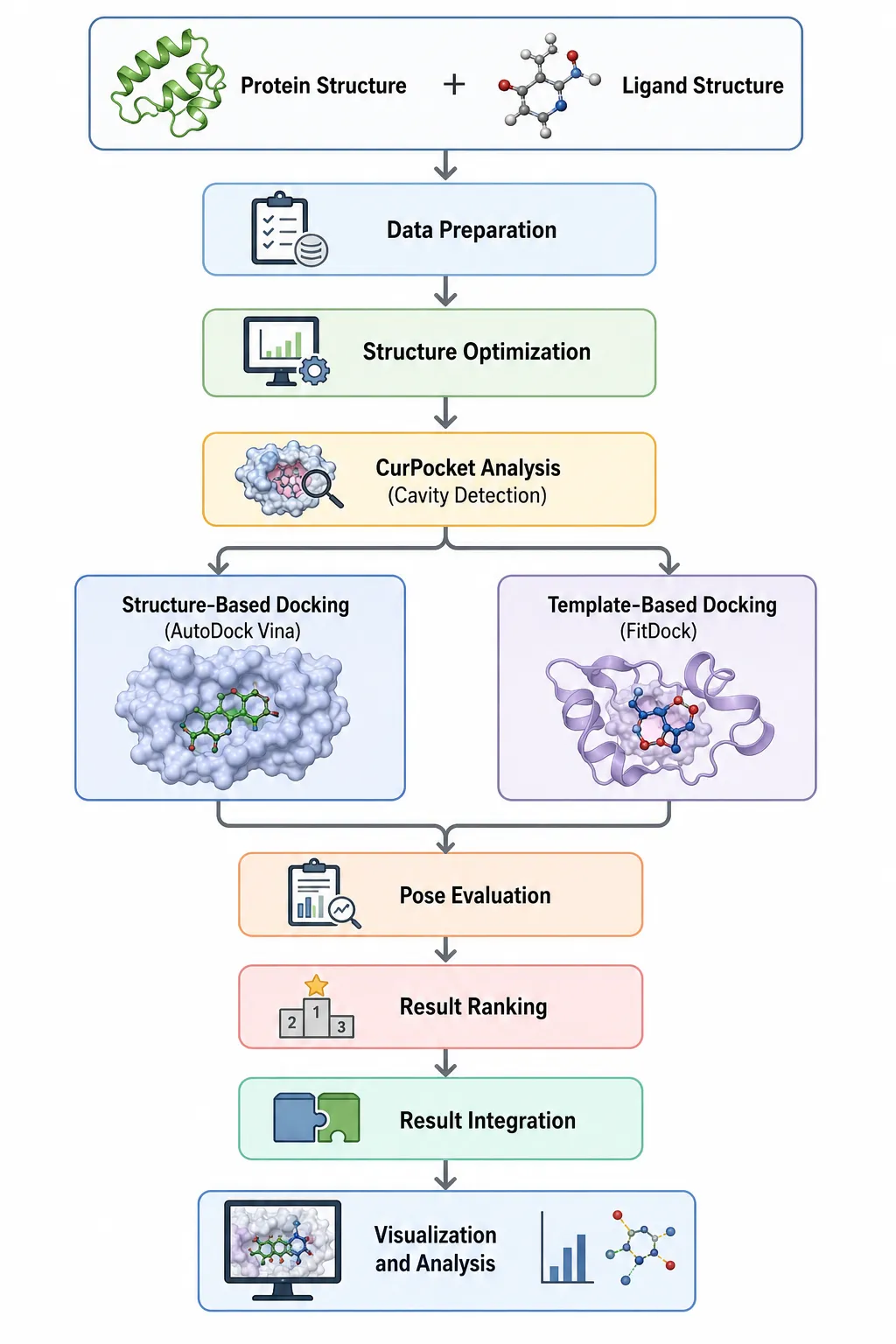
FIG 2: CB-Dock2 workflow illustrating protein and ligand preparation, cavity detection using Cur Pocket, parallel structure-based and template-based docking, pose evaluation, result integration, and final visualization of protein–ligand interactions.
5. Comparative Analysis of Blind Docking Servers: -
Several web-based blind docking platforms have been developed to facilitate protein–ligand interaction studies. These servers differ in terms of cavity detection methods, docking algorithms, visualization capabilities, and prediction accuracy. Among the currently available platforms, CB-Dock2 represents a significant advancement by integrating both structure-based and template-based docking strategies.[13,14,15]
Table 1- Comparative Analysis of Blind Docking Servers
|
Feature |
SwissDock |
COACH-D |
MTiAutoDock |
CB-Dock |
CB-Dock2 |
|
Blind Docking |
Yes |
Yes |
Yes |
Yes |
Yes |
|
Template-Based Docking |
No |
Partial |
No |
No |
Yes |
|
Automatic Cavity Detection |
Limited |
Yes |
Limited |
Yes |
Yes |
|
Interactive Visualization |
Moderate |
Moderate |
Limited |
Good |
Excellent |
|
Docking Accuracy |
Moderate |
Moderate |
Moderate |
High |
Very High |
Discussion: -
A comparison of widely used blind docking servers highlights the technological improvements introduced by CB-Dock2. While all platforms support blind docking, only CB-Dock2 fully integrates template-based docking through the FitDock algorithm, enabling the utilization of structural information from experimentally resolved protein–ligand complexes. This feature significantly enhances docking reliability and binding pose prediction.
In terms of cavity detection, CB-Dock2 employs the CurPocket algorithm, which provides rapid and accurate identification of ligand-binding pockets with fewer false-positive predictions compared to conventional methods. The platform also offers superior interactive visualization tools, allowing users to inspect docking poses, binding interactions, and cavity structures in a user-friendly environment.
Furthermore, the combined use of AutoDock Vina for structure-based docking and FitDock for template-guided docking contributes to the higher docking accuracy observed in CB-Dock2. Consequently, CB-Dock2 has emerged as one of the most advanced blind docking servers available for modern structure-based drug discovery and virtual screening applications.
CONCLUSION: -
CB-Dock2 is a powerful and efficient platform for protein–ligand blind docking. It combines automatic cavity detection with advanced docking algorithms to improve binding pose prediction. The integration of structure-based and template-based docking enhances accuracy and reliability. Its user-friendly web interface makes it accessible to both beginners and experienced researchers. CB-Dock2 supports rapid identification of potential binding sites without prior knowledge of the active site. The platform is widely applicable in drug discovery, virtual screening, and target identification studies. Compared with many existing docking servers, it offers improved performance and visualization capabilities. The use of CurPocket and FitDock further strengthens its predictive power. Ongoing developments in artificial intelligence and structural biology are expected to enhance its functionality. Therefore, CB-Dock2 represents an important tool for modern computational drug discovery and molecular modeling research.
Future Perspectives: -
The future of molecular docking is expected to be shaped by advances in artificial intelligence and computational technologies. Artificial intelligence and machine learning can improve binding pocket detection, scoring functions, and ligand pose prediction. Integration with AlphaFold predicted protein structures will expand docking studies to previously unexplored targets. Molecular dynamics simulations will provide validation of docking stability and binding interactions. High-performance computing will enable large-scale virtual screening of millions of compounds in a shorter time. Cloud-based platforms will support real-time collaboration and remote access to computational resources. These developments will improve docking accuracy, efficiency, and scalability. Consequently, next-generation docking platforms such as CB-Dock2 are expected to play a crucial role in future drug discovery and development.
REFERENCES

Dhinesh Kumar Sambasivam, Suresh Kumar Krishnan, Dhayagesh R. , Ajay Kumaran P., Naveen D., Soumian T. V., Sowmian P., CB-Dock2: An Emerging Platform for Protein–Ligand Blind Docking and Structure-Based Drug Discovery – A Comprehensive Review, Int. J. of Pharm. Sci., 2026, Vol 4, Issue 9, 804-810. https://doi.org/10.5281/zenodo.22337545
 10.5281/zenodo.22337545