

We use cookies to ensure our website works properly and to personalise your experience. Cookies policy
Department of Pharmaceutics, Deccan School of Pharmacy, Hyderabad
Transethosomal gel is considered an innovative approach in advanced transdermal drug delivery, offering improved drug permeation and sustained therapeutic action. Conventional transdermal systems are often restricted by the stratum corneum, which serves as a major barrier to the passage of many drugs through the skin. Transethosomes are highly flexible vesicular carriers containing phospholipids, ethanol, and edge activators, which allow them to deform and penetrate through the skin more efficiently. When incorporated into a gel base, these vesicles provide better skin contact, prolonged residence time, controlled drug release, and convenient application. This review focuses on the formulation approaches used in the preparation of transethosomal gels, with emphasis on the role of vesicle components and gelling agents in optimizing drug delivery. Important evaluation parameters, including vesicle size, surface charge, entrapment efficiency, deformability, drug release, and transdermal permeation, are also discussed. The application of transethosomal gels in the treatment of various disorders, including pain, inflammation, migraine, and other therapeutic conditions, is highlighted. In addition, current challenges related to formulation stability, manufacturing, optimization, and clinical application are considered. Future research may focus on improving formulation performance, establishing large-scale manufacturing methods, and evaluating clinical effectiveness. Overall, transethosomal gel offers a promising and versatile platform for enhancing transdermal drug delivery and may improve drug efficacy, bioavailability, and patient convenience.
The advancement of nanotechnology has revolutionized pharmaceutical research by enabling the development of innovative drug delivery systems that improve therapeutic efficacy while minimizing adverse effects. Conventional drug delivery methods, including oral and parenteral administration, remain the most widely employed approaches for the treatment of acute and chronic diseases. However, these routes are frequently associated with several limitations, such as poor aqueous solubility of drugs, extensive first-pass hepatic metabolism, gastrointestinal degradation, low bioavailability, fluctuating plasma drug concentrations, and poor patient compliance. These challenges have encouraged researchers to explore alternative delivery strategies capable of overcoming the drawbacks of traditional dosage forms.
Among the various alternatives, transdermal drug delivery systems (tdds) have emerged as a promising and patient-friendly approach for systemic and localized drug delivery. The transdermal route allows therapeutic agents to penetrate the skin and enter systemic circulation while bypassing gastrointestinal degradation and hepatic first-pass metabolism. This route offers several advantages, including sustained drug release, improved patient compliance, reduced dosing frequency, stable plasma drug concentrations, and the possibility of immediate termination of therapy by removing the formulation from the skin. Despite these benefits, the highly organized structure of the skin, particularly the stratum corneum, presents a significant barrier that restricts the penetration of many therapeutic molecules.
To overcome this challenge, nanotechnology-based vesicular carriers have gained considerable attention. Vesicular systems such as liposomes, niosomes, ethosomes, and transfersomes have been extensively investigated for enhancing transdermal drug delivery. These nanocarriers improve drug solubility, protect encapsulated drugs from degradation, increase skin permeation, and provide controlled drug release. Among these systems, transethosomes represent an advanced generation of lipid vesicles that combine the advantages of ethosomes and transfersomes. They are composed primarily of phospholipids, a relatively high concentration of ethanol, water, and an edge activator such as tween 80, span 80, or sodium cholate. This unique composition imparts exceptional deformability and flexibility, allowing transethosomes to penetrate deeply through the skin and deliver drugs efficiently to target tissues.
The presence of ethanol fluidizes the lipid structure of the stratum corneum, thereby increasing skin permeability, while edge activators enhance vesicle elasticity, enabling the vesicles to pass through microscopic pores significantly smaller than their own diameter. Consequently, transethosomes exhibit superior drug penetration, higher encapsulation efficiency, enhanced stability, and improved therapeutic performance compared with conventional vesicular carriers.
In recent years, transethosomal gel formulations have attracted increasing interest because they combine the advantages of nanovesicular carriers with the convenience of topical gel dosage forms. The incorporation of transethosomes into polymeric gels such as carbopol or hpmc improves formulation viscosity, spreadability, residence time on the skin, and patient acceptability while maintaining the enhanced permeation characteristics of transethosomes. Such formulations have demonstrated promising outcomes in the treatment of inflammatory disorders, fungal infections, pain management, diabetes, cancer, neurological disorders, and migraine therapy.
One of the most promising applications is the incorporation of rimegepant, a calcitonin gene-related peptide (cgrp) receptor antagonist approved for the acute treatment and prevention of migraine. Rimegepant belongs to the biopharmaceutics classification system (bcs) class ii, characterized by low aqueous solubility and high permeability. Oral administration of rimegepant is associated with limited solubility and variable bioavailability, making it an ideal candidate for transdermal delivery using transethosomal gel technology. Encapsulation within transethosomes has the potential to enhance drug solubility, improve skin permeation, prolong drug release, and reduce dosing frequency, ultimately improving therapeutic efficacy and patient adherence.
The growing interest in nanotechnology, personalized medicine, and targeted drug delivery has further accelerated research on transethosomal formulations. Numerous preclinical studies have demonstrated improved pharmacokinetic behavior, enhanced skin permeation, greater drug retention within skin layers, and superior therapeutic outcomes compared with conventional formulations. However, challenges related to large-scale manufacturing, long-term stability, regulatory approval, and commercialization still require further investigation.
Therefore, this review aims to comprehensively discuss the formulation design, preparation methods, characterization techniques, therapeutic applications, recent advancements, clinical prospects, and future perspectives of transethosomal gel as an advanced transdermal drug delivery platform, with particular emphasis on its potential application in the delivery of rimegepant and other poorly water-soluble therapeutic agents.
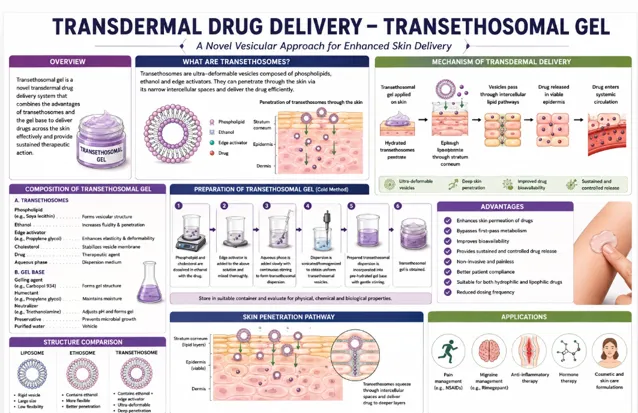
Applications of Transdermal Drug Delivery
Disadvantages of Transdermal Drug Delivery
Pharmaceutical Uses and Route of Administration of Transethosomal Gel
Pharmaceutical Uses:
Routes of Administration of Gel Formulations
In the case of transethosomal gel, the transdermal route is the most important route of administration, as it facilitates enhanced drug penetration through the skin and supports controlled and sustained drug delivery.
General Considerations Before Preparation
Before initiating the formulation process, the following factors should be considered:
Cold Method
Principle
The cold method is based on the formation of lipid vesicles by dissolving phospholipids and edge activators in ethanol, followed by gradual hydration with an aqueous phase under continuous stirring. The spontaneous self-assembly of phospholipid molecules results in the formation of nanosized transethosomes.
Materials Required
Procedure
Advantages
Limitations
Hot Method
Principle
In the hot method, phospholipids are dissolved in hot water, while ethanol containing the drug and edge activator is heated separately. Both phases are mixed at the same temperature to produce vesicles.
Procedure
Advantages
Limitations
Thin-Film Hydration Method
Principle
A thin lipid film is first formed by evaporating organic solvents under reduced pressure. Hydration of the dry lipid film with an aqueous phase results in vesicle formation.
Procedure
Advantages
Limitations
Ethanol Injection Method
Principle
An ethanolic solution of phospholipids is injected into an aqueous phase under continuous stirring, leading to spontaneous formation of vesicles.
Procedure
Advantages
Limitations
Reverse-Phase Evaporation Method
Principle
Water-in-oil emulsions are prepared first, followed by solvent evaporation to produce large unilamellar vesicles.
Advantages
Limitations
Probe Sonication
Purpose
Probe sonication is employed to reduce vesicle size and achieve a narrow particle size distribution.
Procedure
Advantages
Preparation of Transethosomal Gel
After preparing the transethosomal suspension, it is incorporated into a gel base.
Materials
Procedure
Factors Affecting Preparation
Several process parameters influence vesicle quality.
|
Parameter |
Effect |
|
Stirring speed |
Controls vesicle formation |
|
Sonication time |
Reduces particle size |
|
Ethanol concentration |
Affects skin permeation |
|
Hydration temperature |
Influences vesicle stability |
|
Lipid concentration |
Affects entrapment efficiency |
|
Edge activator concentration |
Controls deformability |
Storage of Transethosomal Gel
Prepared formulations should be stored under refrigerated conditions.
Recommended storage conditions:
Advantages of the Cold Method
Challenges During Preparation
The preparation method plays a pivotal role in determining the physicochemical properties and therapeutic performance of transethosomal formulations. Among the available techniques, the cold method is the most widely preferred due to its simplicity, high reproducibility, and suitability for thermolabile drugs. Other methods, including the hot method, thin-film hydration, ethanol injection, and reverse-phase evaporation, may be selected based on drug characteristics and formulation requirements. Following vesicle preparation, incorporation into a suitable polymeric gel base yields a stable transethosomal gel with improved skin retention, enhanced permeation, and sustained drug release. Careful optimization of formulation and process variables is essential for obtaining a robust, reproducible, and clinically effective transethosomal gel.
|
Method |
Principle |
Advantages |
Limitations |
|
Cold method |
Ethanol-based hydration |
Simple, suitable for heat-sensitive drugs |
Ethanol evaporation |
|
Hot method |
Mixing heated phases |
Uniform mixing |
Not suitable for thermolabile drugs |
|
Thin-film hydration |
Hydration of lipid film |
High entrapment efficiency |
Requires rotary evaporator |
|
Ethanol injection |
Injection of ethanolic phase |
Easy and reproducible |
Lower encapsulation for some drugs |
|
Reverse-phase evaporation |
Water-in-oil emulsion |
High drug loading |
Complex and solvent-intensive |
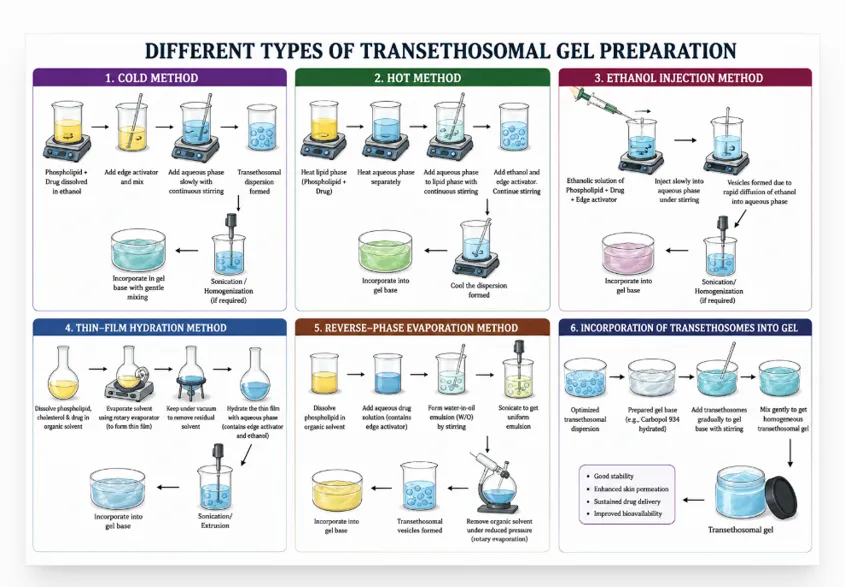
CHARACTERIZATION OF TRANSETHOSOMAL GEL
Vesicle Size, Polydispersity Index (PDI), and Zeta Potential
Vesicle size is a critical factor influencing the stability and transdermal performance of transethosomal formulations. The size distribution and uniformity of the vesicles are commonly assessed by dynamic light scattering. PDI provides information regarding the homogeneity of the vesicle population, while zeta potential indicates the surface charge and helps predict the physical stability of the formulation.
Morphology of Transethosomes
The morphology of transethosomal vesicles is examined using techniques such as transmission electron microscopy (TEM), scanning electron microscopy (SEM), or atomic force microscopy (AFM). These methods provide information about the shape, surface characteristics, and structural integrity of the vesicles.
Entrapment Efficiency
Entrapment efficiency determines the proportion of drug incorporated within the transethosomal vesicles. The free drug is separated from the vesicular dispersion using an appropriate separation technique, and the amount of entrapped drug is quantified by a suitable analytical method. Higher entrapment efficiency indicates effective incorporation of the drug into the vesicular system.
Deformability
Deformability is a significant characteristic of transethosomes that facilitates their passage through the narrow intercellular spaces of the stratum corneum. The flexibility of the vesicles allows them to undergo deformation without losing their structural integrity, thereby supporting enhanced transdermal drug permeation.
Drug Content
Drug content analysis is carried out to determine the quantity and uniformity of drug present in the transethosomal gel. A known amount of formulation is appropriately diluted or extracted, and the drug concentration is estimated using a validated analytical technique.
In-vitro Drug Release
In-vitro release studies are performed to evaluate the release pattern and rate of drug liberation from the transethosomal gel. The released drug is collected at predetermined time intervals and analyzed using a suitable method. The obtained data can be further fitted to different kinetic models to understand the mechanism of drug release.
Ex-vivo Skin Permeation
Ex-vivo skin permeation studies are conducted using suitable excised skin to investigate the ability of the transethosomal gel to transport the drug across the skin barrier. The cumulative amount of drug permeated and other permeation parameters are determined to evaluate the efficiency of transdermal delivery.
Stability Studies
Stability studies are performed under predetermined storage conditions to evaluate the physical and chemical stability of the transethosomal gel. Changes in appearance, pH, drug content, viscosity, vesicle size, PDI, and zeta potential are monitored at specific intervals to confirm the stability and integrity of the formulation.
Therapeutic Applications
Transethosomal gels have attracted considerable interest as advanced transdermal and topical delivery systems because their highly deformable vesicles can enhance drug permeation through the skin while the gel matrix improves skin retention and sustained release. Their therapeutic applications include the following:
Transethosomal gel provides a versatile platform for localized and systemic transdermal drug delivery, with promising applications in pain management, inflammation, fungal and bacterial infections, dermatological disorders, wound healing, cancer therapy, and delivery of natural bioactive compounds. Its ability to enhance skin permeation while providing sustained drug release makes it a promising approach for advanced drug delivery
Future Perspectives
The field of transethosomal drug delivery continues to evolve rapidly with advances in pharmaceutical nanotechnology, biomaterials, and personalized medicine. Future research should focus on the following areas:
1. Clinical Translation
2. Commercial Scale-Up
3. Quality by Design (QbD)
4. Artificial Intelligence and Machine Learning
5. Personalized Drug Delivery
6. Combination Therapy
7. Biologics and Peptide Delivery
8. Smart and Stimuli-Responsive Systems
9. Integration with Advanced Technologies
Future transethosomal systems may be combined with:
These technologies can further enhance skin penetration and therapeutic outcomes.
10. Regulatory Standardization
CONCLUSION
Transethosomal gel has emerged as one of the most promising nanovesicular drug delivery systems for topical and transdermal drug administration. The combination of phospholipids, ethanol, and edge activators provides exceptional vesicle deformability, enabling efficient penetration through the highly organized lipid structure of the stratum corneum. Compared with conventional topical formulations and earlier vesicular systems such as liposomes, niosomes, ethosomes, and transfersomes, transethosomes demonstrate superior skin permeation, higher drug encapsulation efficiency, improved stability, sustained drug release, and enhanced therapeutic efficacy.
This review comprehensively discussed the fundamental concepts of skin anatomy and transdermal drug delivery, the evolution of vesicular drug delivery systems, the composition and mechanism of transethosomes, formulation design, preparation techniques, characterization methods, factors affecting formulation performance, and diverse therapeutic applications. The literature clearly indicates that transethosomal technology has significantly expanded the possibilities for delivering poorly soluble drugs, peptides, proteins, herbal compounds, and other therapeutic agents through the skin.
One of the major advantages of transethosomal gel is its ability to overcome several limitations associated with oral drug delivery, including poor aqueous solubility, hepatic first-pass metabolism, gastrointestinal irritation, and poor patient compliance. The flexible vesicular structure, together with ethanol-induced lipid fluidization, allows enhanced drug permeation and prolonged retention within skin tissues, resulting in improved bioavailability and sustained therapeutic effects.
Although transethosomes have shown excellent performance in preclinical studies, several challenges remain before widespread clinical application can be achieved. These include formulation stability, large-scale manufacturing, quality control, regulatory approval, long-term safety evaluation, and cost-effective commercialization. Addressing these limitations through systematic formulation optimization and robust clinical studies will be essential for translating laboratory research into successful pharmaceutical products.
Overall, transethosomal gel represents a versatile, efficient, and innovative nanocarrier system with significant potential to improve transdermal drug delivery. Its unique physicochemical properties and therapeutic advantages position it as an important platform for the future development of advanced pharmaceutical formulations.
REFERENCES


Shahid Mohammed, Mariya Begum, Transethosomal Gel in Advanced Transdermal Drug Delivery: Formulation Strategies, Functional Characterization, Therapeutic Applications, and Future Perspectives, Int. J. of Pharm. Sci., 2026, Vol 4, Issue 9, 790-803. https://doi.org/10.5281/zenodo.22336522
 10.5281/zenodo.22336522