

We use cookies to ensure our website works properly and to personalise your experience. Cookies policy
1 Department of Public Health and Nutrition, University of Haripur, Haripur.
2 Department of Pharmacy, COMSATS University Islamabad, Abbottabad Campus, 22010, Pakistan.
3 Department of Public Health and Nutrition, University of Haripur, Haripur.
4 Abbottabad Medical Complex.
5 Department of Zoology, Hazara University, Mansehra, 21120, Pakistan.
6 College of Physicians and Surgeons Pakistan (CPSP).
7 Cloud Solutions Specialist, Microsoft, Karachi, 75500, Pakistan.
8 University of Haripur.
9 Department of Biotechnology, COMSATS University Islamabad, Abbottabad Campus, 22010, Pakistan.
10 Department of Biotechnology, COMSATS University Islamabad, Abbottabad Campus, 22010, Pakistan.
Background: Maternal iron deficiency anaemia (IDA) represents an intractable global public health challenge, precipitated by heightened gestational metabolic demands and compounded by micronutrient-deficient subsistence diets. In rural landscapes, IDA severely impairs physical performance, cognitive vitality, and overall health-related quality of life (HRQoL). This investigation sought to delineate the prevalence and independent determinants of IDA, characterize habitual dietary patterns via dimensionality reduction, and evaluate their systemic association with maternal HRQoL among pregnant women in rural District Haripur, Pakistan. Methods: A facility-based cross-sectional study was executed between June and September 2023 across public primary and secondary healthcare facilities in rural Haripur. A final cohort of 372 pregnant women was enrolled via non-probability consecutive sampling. Biochemical iron exhaustion and anemia severity were measured using serum ferritin, total iron-binding capacity (TIBC), and point-of-care photometric hemoglobin estimation (HemoCue Hb 301). Habitual nutritional intake was quantified utilizing an interviewer-administered, validated semi-quantitative Food Frequency Questionnaire (FFQ), with Principal Component Analysis (PCA) applied to identify latent dietary constructs. Maternal HRQoL was appraised across physical, psychological, environmental, and social domains using the validated WHOQOL-BREF and SF-8 health surveys. Independent predictors of IDA were isolated through multivariable binary logistic regression, reporting adjusted odds ratios (AOR) alongside corresponding 95% confidence intervals (CI). Results: The cumulative prevalence of gestational anemia ()
Iron deficiency anemia (IDA) is the most common nutritional deficiency and the principal etiology of anemia worldwide, affecting over 1.2 billion individuals [1]. Gestation represents a window of profound physiological vulnerability: maternal plasma volume expansion, accelerated placental development, and the rapid growth of the fetus collectively cause maternal iron requirements to increase substantially [2]. When dietary consumption or systemic iron stores fail to meet this physiological demand, depleted iron reserves progress inexorably to overt clinical IDA [1, 2]. Globally, anemia afflicts approximately 37% of pregnant women, with the highest concentration of disease burden situated in low- and middle-income countries (LMICs) where nutritional deprivation, low educational attainment, and impoverished living standards coalesce [3, 16]. The clinical sequelae of maternal IDA are severe and multifaceted, directly predisposing mothers to postpartum hemorrhage, puerperal sepsis, and maternal mortality, while escalating risks of fetal growth restriction, preterm delivery, low birth weight, and enduring neurocognitive deficits in surviving offspring [2, 4, 17]. Longitudinal developmental evidence demonstrates that gestational iron deficits alter fetal hippocampal synaptic plasticity and myelination, creating persistent cognitive and recognition memory impairments that span across childhood [4, 27].
In Pakistan, maternal anemia represents an intractable public health crisis characterized by entrenched geographic and economic divides [5, 18]. National epidemiological assessments demonstrate that nearly 42% of reproductive-age women and over 50% of pregnant women are anemic, with disproportionately high morbidity observed across rural populations compared to urban cohorts [5, 6, 18, 30]. In rural communities, high-risk dietary patterns represent a primary driver of this disparity [7, 8]. Daily nutrition relies heavily on cereal staples such as wheat flatbreads and polished rice, which are low in bioavailable heme iron and rich in phytates and polyphenols that form insoluble complexes inhibiting non-heme iron absorption within the duodenal lumen [7, 8, 24]. The frequent consumption of tannin-rich black tea immediately after meals, alongside an inadequate intake of meat, poultry, and ascorbic acid-rich produce due to financial constraints and deep-seated cultural food taboos, exacerbates systemic micronutrient deficits [6, 8, 20]. Furthermore, cultural myths concerning pregnancy nutrition, widespread food insecurity, and poor adherence to routine iron–folic acid supplementation due to gastrointestinal intolerance or fear of obstetric complications leave rural women with severely exhausted iron reserves [8, 9, 21, 22].
Beyond its physiological biomarkers, IDA exerts a profound toll on health-related quality of life (HRQoL) [10, 11]. Chronic cellular hypoxia and diminished tissue oxygenation manifest as debilitating physical fatigue, dizziness, exertional dyspnea, and muscle weakness [10, 11, 25]. In rural settings, where women bear the dual burden of demanding household chores and labor-intensive agrarian responsibilities, the functional impairment caused by IDA restricts economic productivity and familial caregiving capacity [10, 12]. Concurrently, IDA imposes a notable psychological and emotional burden, frequently presenting as apathy, mood instability, depressive symptoms, and elevated antenatal anxiety [11, 13, 26]. Despite the clear clinical and psychosocial overlap, clinical evaluations of IDA in rural Pakistan routinely focus solely on hematological indices, omitting the multidimensional assessment of maternal quality of life and its direct correlation with dietary diversity [10, 13, 19].
District Haripur, situated in the Khyber Pakhtunkhwa province, encompasses diverse rural agrarian communities characterized by shifting economic gradients, traditional dietary practices, and variable access to primary healthcare infrastructure. To date, empirical evidence evaluating the intersection of micronutrient intake, systemic anemia, and subjective functional well-being in this geographic corridor remains scarce. Elucidating the specific dietary patterns and behavioral determinants linked to IDA, as well as its direct impact on maternal HRQoL, is critical for shifting clinical paradigms from basic supplement dispensing toward targeted, culturally sensitive lifestyle and nutritional interventions, aided by scalable community technologies [22, 29]. Therefore, this study aims to determine the prevalence and sociodemographic risk factors of iron deficiency anemia, evaluate local dietary patterns, and investigate the association between iron status and quality of life among pregnant women in rural Haripur.
MATERIALS AND METHODS
2.1 Study Design and Setting
A hospital-based cross-sectional analytical study was conducted between June and September 2023 across public healthcare facilities in District Haripur, Khyber Pakhtunkhwa, Pakistan. Haripur comprises a predominantly rural, agrarian population served by basic health units, rural health centers, and a district headquarters hospital. The region exhibits notable socioeconomic gradients, high dependence on traditional cereal staples, and documented disparities in access to routine maternal healthcare [5, 18].
2.2 Study Population and Eligibility Criteria
The study population comprised pregnant women attending routine antenatal care (ANC) clinics within the public health network of District Haripur. Inclusion criteria were: (1) confirmed intrauterine pregnancy irrespective of gestational age, (2) permanent residency in rural territories of District Haripur, and (3) provision of written or thumbprint-verified informed consent. Exclusion criteria were defined to eliminate physiological, pathological, and therapeutic confounders of systemic iron status: (1) current or recent (within the preceding 30 days) pharmacological use of iron, folic acid, or multivitamin preparations [21], (2) known clinical history of hemoglobinopathies, chronic hematological dyscrasias, or active systemic infectious diseases, (3) concurrent lactation status or overlapping interpregnancy lactation, and (4) severe cognitive, psychiatric, or physical incapacitation precluding reliable completion of interviewer-administered assessments.
2.3 Sample Size and Sampling Strategy
The target sample size was calculated using Daniel's single population proportion formula for a finite population:
n=((z2⋅p(1-p))/e2)/(1+(z2⋅p(1-p))/(e2⋅N))
Where:
The unadjusted sample size yielded n=385. Non-probability consecutive sampling was used to enroll eligible attendees during regular antenatal visits. Of the initial 385 recruited women, 13 were excluded due to incomplete diagnostic workups or withdrawal of consent, resulting in an effective final cohort of 372 participants (completion rate: 96.6%).
2.4 Ethical Considerations
Formal ethical approval was granted by the Institutional Advanced Studies and Research Board (ASRB) and Ethics Review Committee of the University of Haripur. The study was conducted in strict adherence to the ethical guidelines of the Declaration of Helsinki. Prior to participation, research objectives, diagnostic risks, and data confidentiality provisions were explained in the local vernacular (Urdu and Hindko). Written informed consent or thumbprint endorsements (for non-literate participants) were secured. All collected data were anonymized using alphanumeric coding. Participants diagnosed with severe anemia (Hb<7.0 g/dL) were promptly connected to the facility's obstetric team for specialized clinical management [2, 25].
2.5 Data Collection and Experimental Measurements
2.6 Statistical Analysis
All analytical workflows were executed using IBM SPSS Statistics for Windows, Version 22.0 (IBM Corp., Armonk, NY). Categorical parameters were summarized as absolute frequencies and percentages (n,%). Distributional normality for continuous indices was evaluated using the Shapiro–Wilk test, with data presented as mean ± standard deviation (SD) or median with interquartile range (IQR).
Dietary patterns were derived from the FFQ using Principal Component Analysis (PCA) with orthogonal (varimax) rotation. Extraction was guided by Kaiser's eigenvalue criterion (>1.0), inspection of the scree plot inflection point, and factor loading interpretability (retaining absolute loadings ≥|0.30|). Factor scores were computed across each derived component for each participant [28].
Bivariate differences between categorical variables and anemia status were evaluated using Pearson's chi-square (χ2) tests or Fisher's exact tests where cell counts were sparse. Continuous HRQoL domain scores across anemia strata were assessed using independent-samples t-tests and one-way ANOVA. To isolate independent predictors of IDA, candidate covariates exhibiting p<0.20 during bivariate screening were entered into a multivariable binary logistic regression model. Adjusted odds ratios (AOR) and 95% confidence intervals (CI) were generated, with statistical significance determined at a two-tailed α=0.05.
RESULTS
3.1 Sociodemographic Characteristics of Pregnant Women in District Haripur
The cohort comprised 372 pregnant women, predominantly residing in rural settings (98.1%, n=365) with minimal peri-urban representation (1.9%, n=7). The majority (67.5%, n=251) were within the prime reproductive age bracket of 25–34 years, while 16.9% (n=63) were aged 18–24 years and 15.6% (n=58) were aged 35–44 years. Multigravidity was common, accounting for 64.2% (n=239) of the sample, followed by primigravida (21.8%, n=81) and grandmultigravida women (14.0%, n=52). Gestational stages showed an even distribution: 29.3% (n=109) in the first trimester, 33.1% (n=123) in the second, and 37.6% (n=140) in the third. Regarding educational attainment, 42.2% (n=157) had completed 10 years or less of schooling, 15.4% (n=57) completed 12 years, and 42.4% (n=158) possessed tertiary degrees. Most participants were homemakers (62.8%, n=234), while 29.6% (n=110) balanced employment with domestic responsibilities, and 7.6% were formally employed or students. Financially, 49.7% (n=185) earned below 25,000 PKR per month, 26.4% (n=98) reported incomes between 25,000–50,000 PKR, and 23.9% (n=89) earned above 50,000 PKR. Daily physical activity was largely sustained through domestic and agricultural chores, with 46.8% (n=174) logging over 7,500 steps/day, 43.8% (n=163) logging 5,000–7,499 steps/day, and 9.4% (n=35) being sedentary (<5,000 steps/day). However, structured leisure-time exercise was nearly absent, with 98.9% (n=368) exercising only 1–2 days weekly for under 20 minutes per session. Reported sleep duration was 6–8 hours in 41.4% (n=154), 4–6 hours in 29.6% (n=110), greater than 8 hours in 28.7% (n=107), and under 4 hours in 0.3% (n=1) of the cohort.
| Variables | Categories | Frequency (f) | Percentage % |
|---|---|---|---|
| Age | 18–24 | 63 | 16.9 |
| 25-34 | 251 | 67.5 | |
| 35-44 | 58 | 15.6 | |
| Gestastional Number | 3 | 81 | 21.8 |
| Multigravida | 239 | 64.2 | |
| Grandmultigravida | 52 | 14.0 | |
| Gestational Month | 1st trimester | 109 | 29.3 |
| 2nd trimester | 123 | 33.1 | |
| 3rd trimester | 140 | 37.6 | |
| Qualification | 10 years or less of education | 157 | 42.2 |
| 12 years of education | 57 | 15.4 | |
| Undergraduate | 79 | 21.2 | |
| Graduate | 79 | 21.2 | |
| Livelihood | Rural | 365 | 98.1 |
| Urban | 7 | 1.9 | |
| Occupation | Student | 1 | 0.3 |
| Doing Job | 27 | 7.3 | |
| House Wife | 234 | 62.8 | |
| Job & House Wife | 110 | 29.6 | |
| Monthly Income | <25,000 | 185 | 49.7 |
| 25000–50000 | 98 | 26.4 | |
| > 50000 | 89 | 23.9 | |
| Lifestyle | Sedentary lifestyle (<5000 steps/day) | 35 | 9.4 |
| Less Active Lifestyle (5000-7499 steps/ day) | 163 | 43.8 | |
| Physically Active Lifestyle (>7500 steps/day) | 174 | 46.8 | |
| Sleeping time | <4 hours | 1 | 0.3 |
| 4-6 hours | 110 | 29.6 | |
| 6-8 hours | 154 | 41.4 | |
| >8 hours | 107 | 28.7 | |
| Frequency of Exercise | Every day | 1 | 0.3 |
| 3-4 days/week | 3 | 0.8 | |
| 1-2 days/weck | 368 | 98.9 | |
| Intensity of exercise | minimal active | 368 | 98.9 |
| Health enhancing physical active | 4 | 1.1 | |
| Duration of exercise | <20 min/day | 368 | 98.9 |
| 20-30 min/day | 3 | .8 | |
| >30 min/day | 1 | .3 |
3.2 Levels of Health and Anthropometric Measurements Among Pregnant Women
Screening of overall health and body composition identified substantial vulnerability across the cohort. Based on mid-upper arm circumference (MUAC) thresholds, 71.8% (n=267) of participants were categorized as adequately nourished, whereas 28.2% (n=105) presented with moderate-to-severe acute malnutrition. Body mass index (BMI) stratification indicated that while 62.4% (n=232) maintained normal weight, 15.1% (n=56) were underweight—with 7.0% (n=26) meeting criteria for severe underweight—and 22.5% (n=84) were classified as overweight (16.7%) or obese (5.8%). In terms of self-rated health and clinical presentation, 48.1% (n=179) of the women exhibited poor functional health profiles requiring multidisciplinary clinical intervention, whereas only 13.2% (n=49) reported their health status as good.
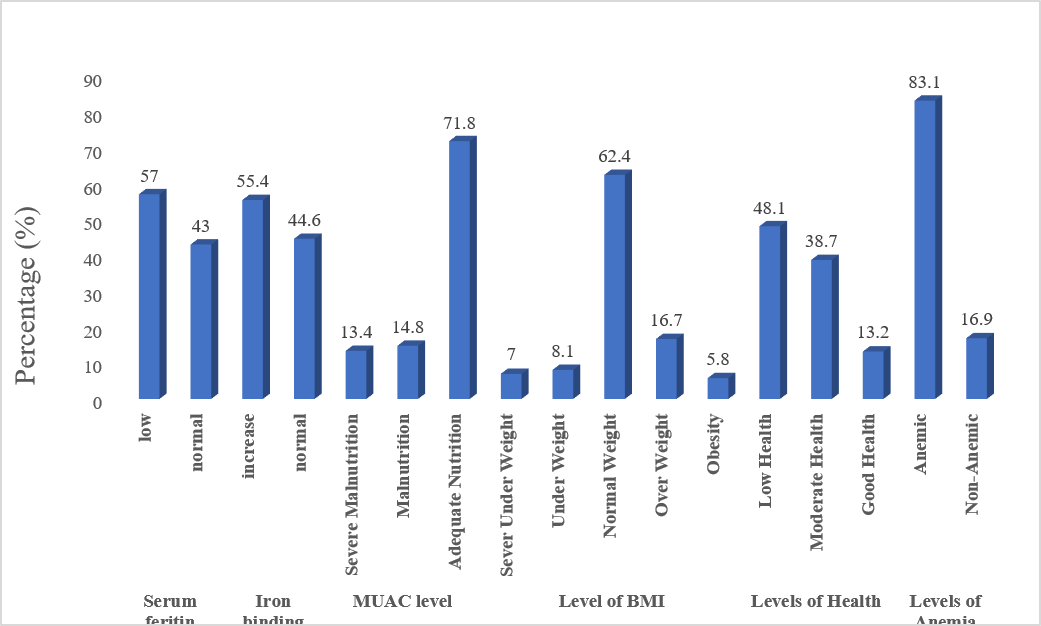
3.3 Blood Biomarkers and Anthropometric Profile of Pregnant Women
Hematological and biochemical analyses demonstrated marked systemic iron exhaustion. Over half of the cohort exhibited depleted iron reserves, with low serum ferritin concentrations documented in 57.0% (n=212) and elevated total iron-binding capacity (TIBC) observed in 55.4% (n=206) of participants. Based on the World Health Organization hemoglobin threshold (Hb<11.0 g/dL), the overall prevalence of anemia was 83.1% (n=309). True iron deficiency anemia (IDA)—characterized by concurrent low hemoglobin levels alongside depleted ferritin reserves—was confirmed in 67.6% (n=251) of the participants, leaving 32.4% (n=121) without IDA. Cross-comparison with anthropometric metrics reaffirmed that despite the coexistence of undernutrition (28.2% via MUAC; 15.1% underweight via BMI) and overweight/obesity (22.5%), physiological iron deficits spanned across all body composition categories, indicating systemic micronutrient depletion regardless of overt phenotypic adiposity.
| Variable | Category | Frequency(n) | Percentage (%) |
|---|---|---|---|
| Serum feritin levels | Low | 212 | 57 |
| Normal | 160 | 43 | |
| Iron binding capacity | Increase | 206 | 55.4 |
| Normal | 166 | 44.6 | |
| MUAC level | Severe Malnutrition | 50 | 13.4 |
| Malnutrition | 55 | 14.8 | |
| Adequate Nutrition | 267 | 71.8 | |
| Level of BMI | Sever Under Weight | 26 | 7 |
| Under Weight | 30 | 8.1 | |
| Normal Weight | 232 | 62.4 | |
| Over Weight | 62 | 16.7 | |
| Obesity | 22 | 5.8 | |
| Levels of Health | Low Health | 179 | 48.1 |
| Moderate Health | 144 | 38.7 | |
| Good Health | 49 | 13.2 | |
| Levels of Anemia | Anemic | 309 | 83.1 |
| Non-Anemic | 63 | 16.9 |
3.4 Determinants of Iron Deficiency Anemia in Pregnant Women
Multivariable binary logistic regression was conducted to determine the independent risk factors governing the presentation of IDA (67.6% anemic vs. 32.4% non-anemic). Sociodemographic and lifestyle parameters emerged as the principal determinants. Participants residing in households earning below 25,000 PKR monthly demonstrated significantly higher adjusted odds of developing IDA compared to those in higher income brackets (AOR=1.560; 95% CI: 1.157-2.105; p=0.004). Daily ambulatory lifestyle was also an independent predictor; sedentary behavior (<5,000 steps/day) was associated with higher odds of IDA compared to higher physical activity tiers (AOR=1.450; 95% CI: 1.001-2.099; p=0.049). Severe sleep deprivation (<4 hours/night) showed a strong positive association with IDA (AOR=2.240; 95% CI: 1.566-3.203; p<0.001).
Conversely, maternal age (18–24 years vs. older: AOR=0.671; 95% CI: 0.422-1.065; p=0.090), gravidity (AOR=0.990; 95% CI: 0.609-1.609; p=0.967), gestational trimester (AOR=1.050; 95% CI: 0.764-1.445; p=0.762), educational attainment (AOR=0.967; 95% CI: 0.784-1.194; p=0.757), and rural versus urban dwelling (AOR=0.940; 95% CI: 0.169-5.246; p=0.944) were not statistically significant predictors. Although homemakers displayed higher absolute case counts of IDA than formally employed peers, occupational status did not reach significance in adjusted models (AOR=0.691; 95% CI: 0.454-1.050; p=0.084). Finally, standard anthropometric indices, including MUAC malnutrition status (AOR=1.026; 95% CI: 0.717-1.468; p=0.889) and BMI categories (AOR=1.108; 95% CI: 0.842-1.459; p=0.464), demonstrated no significant correlation with IDA, confirming that micronutrient depletion in this cohort was predominantly driven by socioeconomic hardship and lifestyle disruption rather than somatic body habitus.
| Variable | Category | Iron deficiency anemia Yes No |
AOR (95% CI) | P value | |
|---|---|---|---|---|---|
| Age | 18–24 | 27 | 36 | .671 (.422-1.065) | .090 |
| 25-34 | 145 | 106 | |||
| 35-44 | 40 | 251 | |||
| Gestational No | Primigravida | 36 | 45 | .990 (.609-1.609) | .967 |
| Multigravida | 140 | 99 | |||
| Grandmultigravida | 36 | 16 | |||
| Gestational Month | 1st trimester | 52 | 57 | 1.050 (.764-1.445) | .762 |
| 2nd trimester | 74 | 49 | |||
| 3rd trimester | 86 | 54 | |||
| Qualification | 10 years or less of education | 94 | 63 | .967 (.784-1.194) | .757 |
| 12 years of education | 32 | 25 | |||
| Undergraduate | 57 | 22 | |||
| Graduate | 29 | 50 | |||
| Livelihood | Rural | 209 | 156 | 940 (.169-5.246) | .944 |
| Urban | 03 | 04 | |||
| Occupation | Student | 1 | 0 | .691 (.454-1.050) | .084 |
| Doing Job | 9 | 18 | |||
| House Wife | 141 | 93 | |||
| Job & House Wife | 61 | 49 | |||
| Monthly Income | <25,000 | 129 | 56 | 1.560 (1.157-2.105) | .004 |
| 25000-50000 | 46 | 51 | |||
| > 50000 | 37 | 53 | |||
| Lifestyle | Sedentary lifestyle (<5000 steps/day) | 22 | 13 | 1.450 (1.001-2.099) | .049 |
| Less Active Lifestyle (5000-7499 steps/ day) | 115 | 48 | |||
| Physically Active Lifestyle (>7500 steps/day) | 75 | 99 | |||
| Sleeping Time | <4 hours | 1 | 0 | 2.240 (1.566-3.203) | .000 |
| 4-6 hours | 86 | 24 | |||
| 6-8 hours | 83 | 71 | |||
| >8 hours | 42 | 65 | |||
| Frequency of Exercise | Every day | 0 | 1 | 3.391 (.000-.) | 1.000 |
| 3-4 days/week | 0 | 3 | |||
| 1-2 days/week | 212 | 156 | |||
| MUAC level | Severe Malnutrition | 33 | 17 | 1.026 (.717-1.468) | .889 |
| Malnutrition | 31 | 24 | |||
| Adequate Nutrition | 148 | 119 | |||
| Level of BMI | Sever Under Weight | 13 | 13 | 1.108 (.842-1.459) | .464 |
DISCUSSION
This study investigated the biochemical burden of iron deficiency anemia (IDA), anthropometric indices, habitual dietary patterns, and their sociodemographic determinants among pregnant women in rural District Haripur, Pakistan. Our findings demonstrate an alarming overall anemia prevalence of 83.1% (Hb<11.0 g/dL), with true iron deficiency anemia confirmed in 67.6% of the participants. This hematological crisis was corroborated by objective biochemical markers: 57.0% of the cohort exhibited depleted serum ferritin reserves, accompanied by elevated total iron-binding capacity (TIBC) in 55.4%. These observations align with regional evidence from low- and middle-income countries (LMICs), where elevated maternal and fetal metabolic demands during gestation rapidly outpace inadequate baseline iron stores [1, 2, 3, 30]. Gestational plasma volume expansion, accelerated feto-placental organogenesis, and uterine vascular remodeling necessitate substantial iron mobilization [2]. In environments marked by inadequate intake, depleted stores manifest as high rates of cellular hypoxia, elevating risks of preterm labor, low birth weight, postpartum hemorrhage, and irreversible fetal neurodevelopmental sequelae [3, 4, 17, 27].
The high burden of IDA identified in this cohort was predominantly governed by socioeconomic deprivation and modifiable lifestyle factors rather than biological or obstetric variables. In multivariable logistic regression, household monthly income below 25,000 PKR was an independent predictor of IDA (AOR=1.560, 95% CI: 1.157-2.105, p=0.004). In rural Pakistan, severe financial limitations directly constrain household purchasing power, restricting access to micronutrient-dense foods and nutrient-fortified staples [5, 6, 19]. Conversely, maternal age, gravidity, and gestational trimester demonstrated no statistically significant association with IDA status. This indicates that systemic iron depletion in this population represents a continuous, community-wide nutritional vulnerability that precedes conception and persists throughout gestation, rather than being confined to specific obstetric stages [18, 30].
Lifestyle behaviors also demonstrated significant associations with maternal anemia. Sedentary behavior (<5,000 steps/day) was associated with increased odds of IDA (AOR=1.450, 95% CI: 1.001-2.099, p=0.049). Concurrently, extreme sleep deprivation (<4 hours/night) emerged as a strong behavioral determinant (AOR=2.240, 95% CI: 1.566-3.203, p<0.001). Chronic sleep restriction and physical exhaustion dysregulate neuroendocrine homeostasis, elevate systemic inflammatory markers, and perturb hepcidin-mediated iron trafficking, which collectively impairs iron bioavailability and erythropoiesis [7, 25]. Furthermore, severe maternal fatigue may reflect both a symptom of cellular hypoxia and a compounding behavioral risk factor that restricts daily functioning and nutritional self-care [8, 11].
The dietary patterns identified via Principal Component Analysis provide critical mechanistic insights into the nutritional drivers of this anemia burden. Three distinct patterns were characterized: the Protein Pattern, the Vegetable and Fruit Pattern, and the Carbohydrate Pattern. The Protein Pattern—characterized by animal-source foods such as beef, mutton, poultry, and eggs—supplies highly bioavailable heme iron, which is absorbed independently of luminal chelators [7, 9, 28]. However, economic inflation in rural Pakistan renders animal protein inaccessible for daily consumption among low-income households [6, 8, 10]. Instead, the dietary landscape is dominated by the Carbohydrate Pattern, relying heavily on unfortified wheat flatbreads and polished rice. While these plant-based staples supply essential calories, their high content of phytic acid and polyphenols strongly chelates non-heme iron within the duodenal lumen, forming insoluble complexes that inhibit mucosal absorption [7, 8, 24].
Although the Vegetable and Fruit Pattern incorporates ascorbic acid—a potent enhancer of non-heme iron absorption—its beneficial effects are routinely counterbalanced by regional culinary practices and dietary habits. The common rural custom of consuming tannin-rich black tea immediately following meals substantially impedes iron uptake. Moreover, deep-seated cultural taboos during pregnancy, such as avoiding certain "hot" foods (including specific iron-dense meats and fruits), further restrict dietary diversity [8, 10, 20]. Rather than isolating individual nutrients, examining these composite dietary patterns highlights how habitual consumption profiles perpetuate negative iron balance across the maternal life cycle.
Assessment of physical nutritional status revealed a distinct double burden of malnutrition. While mid-upper arm circumference (MUAC) categorized 71.8% of participants as adequately nourished, 28.2% suffered from moderate-to-severe acute malnutrition. Similarly, BMI categorization revealed the coexistence of undernutrition (15.1% total underweight, including 7.0% severely underweight) alongside overnutrition (22.5% overweight or obese). Crucially, neither MUAC nor BMI exhibited a statistically significant association with IDA in multivariable regression. This dissociation emphasizes that somatic mass and phenotypic adiposity do not confer protection against micronutrient exhaustion; "hidden hunger" and systemic iron deficiency span across normal, underweight, and overweight phenotypes in this population [14, 15]. This dual nutritional burden underscores that interventions focused strictly on caloric sufficiency are inadequate; maternal health initiatives must target micronutrient quality, dietary bioavailability, and balanced weight management simultaneously [15, 21].
These physiological and nutritional deficits directly correspond to compromised functional well-being. Nearly half of the participants (48.1%) rated their overall health as poor, whereas only 13.2% reported good health. Chronic iron depletion impairs mitochondrial oxidative phosphorylation and oxygen transport capacity, driving persistent physical weakness, cognitive apathy, and emotional strain [11, 25, 26]. In rural agrarian environments where women bear heavy domestic burdens and field labor, the functional debility induced by IDA curtails economic productivity and lowers maternal health-related quality of life (HRQoL) [10, 12, 13].
4.1 Strengths and Limitations
This study provides objective biochemical evaluations (serum ferritin and TIBC alongside hemoglobin) coupled with validated dietary pattern derivation using Principal Component Analysis in an understudied rural South Asian district. Nevertheless, certain limitations warrant consideration. First, the cross-sectional design precludes establishing temporal causality between dietary patterns, lifestyle variables, and the development of IDA. Second, dietary data gathered via the Food Frequency Questionnaire are subject to recall bias, although the use of standardized portion-size visual aids mitigated this concern among low-literate participants [8, 24]. Third, the study utilized convenience sampling across public health facilities, which may over-represent women seeking medical care and limit broader generalizability to marginalized home-bound populations. Finally, while systemic iron biomarkers were measured, inflammatory markers such as C-reactive protein (CRP) or alpha-1-acid glycoprotein (AGP) were not assessed concurrently, which could influence serum ferritin interpretation in populations with subclinical infections.
5. CONCLUSION AND POLICY RECOMMENDATIONS
5.1 Conclusion
This investigation demonstrates a profound burden of iron deficiency anemia and nutritional vulnerability among pregnant women in rural District Haripur, marked by an overall anemia prevalence of 83.1% and true iron deficiency anemia confirmed in 67.6% of the cohort. Biochemical exhaustion was evident in 57.0% of participants presenting with depleted serum ferritin and 55.4% exhibiting elevated total iron-binding capacity. Multivariable modeling confirmed that systemic iron depletion in this population is fundamentally underpinned by structural poverty (household income <25,000 PKR/month) and adverse lifestyle habits (sedentary routines and severe sleep restriction), rather than basic obstetric parameters or phenotypic body mass indices.
The characterization of distinct dietary profiles through Principal Component Analysis—the Protein Pattern, Vegetable and Fruit Pattern, and Carbohydrate Pattern—provides clear mechanistic evidence of nutritional compromise: the rural maternal diet is heavily dependent on phytate-dense, non-heme cereal staples with marginal access to bioavailable animal-source heme proteins. Coupled with a distinct double burden of under- and overnutrition, this micronutrient deficiency directly translates to diminished functional health and impaired maternal quality of life. Resolving this crisis requires shifting maternal healthcare away from isolated iron supplementation toward integrated, culturally tailored multisectoral initiatives that simultaneously tackle dietary diversity, socioeconomic access, and maternal well-being.
5.2 Recommendations
REFERENCES

Dr. Jaweria Jameel Hashmi, Raja Waleed Sajjad, Dr. Khalil Ahmed Hashmi, Dr. Amber Qureshi, Saba Manzoor, Jalil Ahmed Hashmi, Raja Ahmed Sajjad, Aliya Khan, Muhammad Subhan Ahmed, Sardar Ta-bish Mehmood, Association of Quality of Life and Dietary Pattern with Iron Deficiency Anemia in Pregnant Women in Rural Haripur, Int. J. of Pharm. Sci., 2026, Vol 4, Issue 10, 4114-4126. https://doi.org10.5281/zenodo.23684812
 10.5281/zenodo.23684812