

We use cookies to ensure our website works properly and to personalise your experience. Cookies policy
Smt. Kishoritai Bhoyar College Of pharmacy kamptee-441002.
Orphan diseases present a critical global public health challenge, affecting millions of patients with highly complex genetic or degenerative conditions that frequently lack effective therapeutic options. While the development of traditional orphan drugs is often hindered by high financial burdens and limited target populations, the emergence of biosimilar orphan drugs offers a promising, cost-effective alternative to enhance patient access to life-saving biologics. This review paper examines the evolving landscape of biosimilar orphan medications, exploring their structural and functional alignments with innovator products. It provides a comprehensive comparative analysis of the regulatory frameworks governing these therapeutics in the United States and the European Union, specifically contrasting the Biologics Price Competition and Innovation (BPCI) Act and FDA designations against the EMA’s Regulation 141/2000 and member-state policies. Key parameters such as market exclusivity periods (12 years in the US versus 10 years in the EU) and unique pharmacovigilance surveillance mechanisms, such as the EU's inverted black triangle system, are critically evaluated. The findings emphasize that despite substantial market growth projections, inadequate incentive structures and regulatory variations continue to pose hurdles to global optimization. The study concludes that international regulatory harmonization among the US, EU, and emerging economies is vital to mitigate financial barriers, streamline approval pathways, and safeguard public health.
A Medicinal product designated as an Orphan Drug or Biosimilar Orphan Drug is specifically developed to treat rare conditions known as “Orphan Diseases.” These medicines are often not pursued by the pharmaceutical industry due to economic factors, despite addressing significant public health needs. The rising costs associated with drug development, along with stringent regulatory compliance and limited patient populations, create a disincentive for pharmaceutical innovators. Approximately 80% of rare diseases are genetic; others stem from infections, allergies, or degenerative and proliferative causes. This prevalence of rare diseases presents a crucial public health challenge, as current treatment options remain scarce. Consequently, the increasing demand for public health protection exacerbates the financial burden faced by patients afflicted with these conditions.[1]
Scientific developments have given researchers new ways to study rare diseases, which are usually more complicated than common illnesses. Given that there are over 7,000 different varieties of these rare diseases, and that number is constantly increasing due to new discoveries, they cannot all be considered rare. Approximately 250 new cases are thought to occur globally each year, but only 200 to 300 orphan illnesses have effective therapies. Interestingly, bacterial or viral infections, environmental factors, or unknown causes may be responsible for the remaining 80% of these uncommon disorders. Additionally, orphan diseases exhibit traits including chronicity, progressive decline, and the possibility of impairment or fatal consequences. Despite their high complexity and low prevalence rates, several of these illnesses have effective treatment options.[1]
Orphan Drug
An Orphan Drug is used to treat, prevent, or diagnose an orphan disease. An orphan disease is a rare disease or condition that affects the patient in many countries. A medicinal product designed as an orphan drug that one that is developed specifically to treat a rare medical condition referred to as an orphan disease”. Due to special orphan drug regulations in both the US and EU, the number of approved orphan drugs is steadily increasing in the world.[2]
Biosimilars
A Biosimilar drug is a medicine that is very similar in structure and function to a biological medicine. A biological drug is a medicine made from living organisms such as yeast, bacteria, animal cells, etc.[3]
Biosimilar Orphan Drug is a biological that is almost an identical copy of an original product that is manufactured by a different company in the world. Biosimilars orphan drugs are officially approved new versions of original "innovator" products and can be manufactured when the original product's patent expires.[4] Biosimilar orphan medications are biological pharmaceuticals whose active components are produced by living organisms through controlled gene expression or recombinant DNA technology.[5] The biosimilars market is projected to reach a value of US$19.4 billion by 2014, with a compound annual growth rate (CAGR) of 89.1% between 2009 and 2014. Biosimilars are a safe and efficient way to treat a variety of disorders, including cancer, kidney diseases, arthritis, and chronic skin and intestinal conditions.[6] Biosimilar medications increase access to possibly less expensive life-saving medications. A medication that shares structural and functional similarities with a biological therapy is called a biosimilar. Living things like bacteria, yeast, or animal cells are used to make biological medicine. Products made from blood and plasma, pure non-recombinant proteins from natural sources, monoclonal antibodies, recombinant proteins, cell-cultured cells and tissues, vaccinations, and derived protein products are examples of biosimilars. Biosimilar medicines enhance access to essential treatments at potentially reduced prices. A biosimilar is a drug that closely resembles a biological medicine in both structure and function, which is produced by living organisms like yeast, bacteria, or animal cells. Biosimilars can include various products such as those derived from blood and plasma, non-recombinant proteins, monoclonal antibodies, recombinant proteins, cultured cells and tissues, vaccines, and derived protein products. They are developed for conditions including rheumatoid arthritis, non-Hodgkin's lymphoma, diabetes mellitus, and macular degeneration. Biosimilars demonstrate safety and efficacy comparable to original drugs and are considered interchangeable, meaning they can replace the original product while achieving the same clinical effect in patients as shown in specific clinical trials.[5]
United States biosimilar orphan drug conditions
The US Biosimilar Orphan Act of 2003 facilitated the creation of three biosimilars for rare diseases: somatropin (human growth hormone), filgrastim (human granulocyte colony-stimulating factor), and epoetin, among others. As of now, the FDA has approved 39 biosimilars for various reference biologics, with 23 currently on the market. Additionally, 10 biosimilars are anticipated to launch soon, particularly for adalimumab. Approximately 7,000 rare diseases impact 25 to 30 million Americans, with 95% lacking effective treatments. The previous year marked a record with 40 specialty drug approvals from the FDA, representing 75% of all drug approvals, and 222 novel medications have been sanctioned this year, with 16 more expected by the end of 2023. [7]
European Union Biosimilar Orphan Drug Conditions.
The European Medicine Agency (EMA) defines “A biosimilar as a biological medicinal product containing a version of the active substance of an already authorized original biological orphan product in the European Economic Area (EEA).” Now the European medicines agency (EMA) is starting to develop advanced pharmaceutical technology for the production or manufacture of biosimilar medicine for orphan diseases in the EU. They are the therapeutic equivalents of originator drugs and offer the opportunity to reduce the high cost of biological treatment in EMA.[8] In many countries, their respective country governments and regulators should implement incentive structures for the development of orphan biosimilars around the world. In addition, the government has paved the way for a clear trend toward the development of orphan drugs. However, this positive effect has serious implications for access to affordable biosimilar medicines for rare diseases. [29] In Europe, all new biosimilar approvals for biologics and small molecule orphan drugs are subject to an enhanced mandatory pharmacovigilance surveillance study and are marked with an inverted black triangle in the prescribing information. This requirement also applies to biosimilars and provides a safe comfort zone. EU pharmacovigilance has not identified any particular safety concerns or new safety signals for any of the biosimilars authorized in the EU since 2006.[9]
Table 1: List of Biosimilar Orphan Drugs and their Indications.[6]
|
Sr. No. |
Drug |
Indication |
Company |
|
1 |
Remicade/Infliximab |
Crohn’s diseases |
Pfizer |
|
2 |
Palivizumab |
Respiratory syncytial virus |
AstraZeneca |
|
3 |
Omni trope |
Turner syndrome |
Sandoz Biopharmaceuticals |
|
4 |
Romiplostim |
Immune thrombocytopenic purpura |
Amgen |
|
5 |
Eculizumab |
Paroxysmal nocturnal haemoglobinurias |
Alexion |
|
6 |
Avastin, bevacizumab |
Adenocarcinoma of ovary |
Genentech |
Table No.02: Comparison for USA and EU
|
Sr.No |
Parameters |
USA |
EU |
|
1 |
Legal framework |
BPCI Act [10] |
Regulation 141/2000 [11] |
|
2. |
Exclusivity |
12 years [12] |
10 years [11] |
|
3. |
Interchangeability |
FDA designated [10] |
Member-state policy [10] |
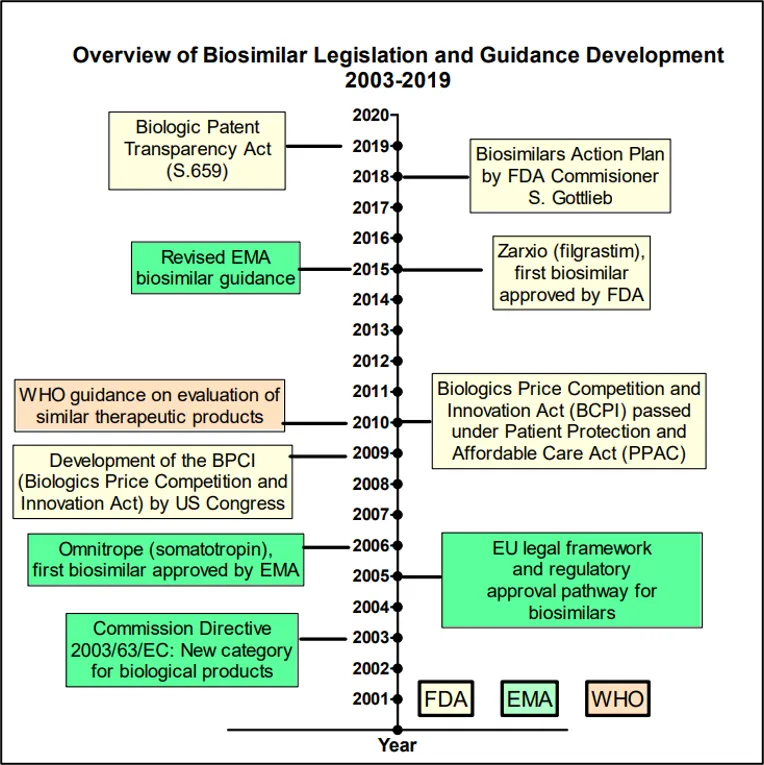
Fig no.01: Overview of biosimilar [13]
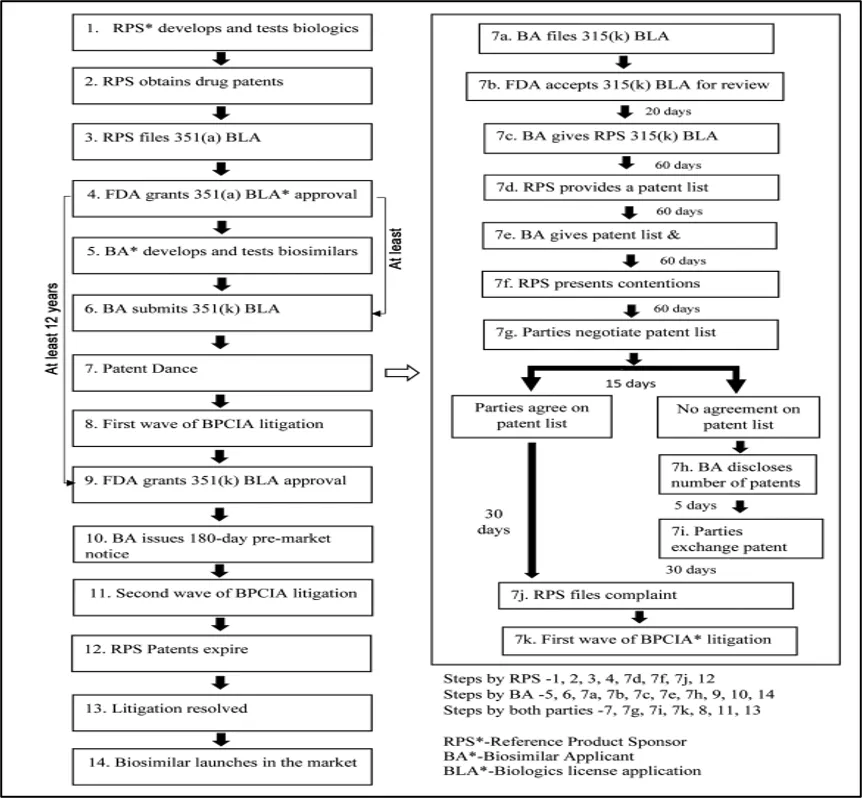
Fig No .02: biosimilar approval pathway in USA[14]
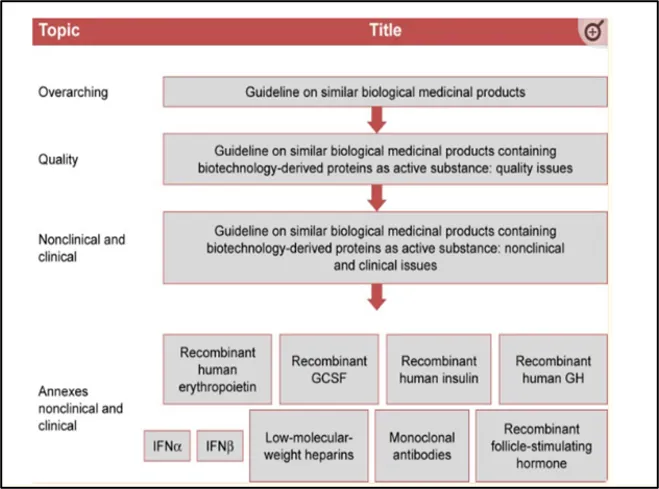
Fig No.03: Biosimilar approval pathway in EU[15]
CONCLUSION
The orphan drug and biosimilar programs for rare diseases have faced challenges in achieving success due to inadequate incentives. The Orphan Drug Act (ODA) has played a role in advancing orphan products. For global benefits, countries must evaluate their R&D investments, returns, tax incentives, and regulatory frameworks. While the US and Europe are leaders in biosimilar development, regulatory approaches vary. Recent efforts by the US, EU, and India focus on harmonizing biosimilar regulations to enhance affordability. Orphan drugs and biosimilar drugs are vital for treating rare genetic diseases and are projected to grow, benefiting public health and offering hope for future treatments.
REFERENCES

Kunal Kamdi, Pranjali Patil, Neha Meshram, Dr. Milind Umekar, Biosimilar Orphan Drugs For Rare Diseases: A Comparative Review Of Regulatory Frameworks And Market Dynamics In The US And EU, Int. J. of Pharm. Sci., 2026, Vol 4, Issue 8, 4087-4093, https://doi.org/10.5281/zenodo.22093120
 10.5281/zenodo.22093120