

We use cookies to ensure our website works properly and to personalise your experience. Cookies policy
KMCH College of Pharmacy, Coimbatore – 641048, Tamil Nadu, India.
One of the biggest challenges in developing oral medications is the poor aqueous solubility of active pharmaceutical ingredients (APIs). Approximately 90% of drug candidates in the development pipeline and 40% of commercialized drugs are classed as poorly water-soluble. To overcome this difficulty, co-amorphous (CAM) drug delivery systems have become a popular and adaptable formulation approach. CAM systems are composed of two or more low-molecular-weight components, usually a drug combined with another drug or a small-molecule co-former, that form a single homogeneous amorphous phase stabilized by specific intermolecular interactions, in contrast to conventional amorphous solid dispersions (ASDs), which rely on high-molecular-weight polymers. CAM systems have significant improvements in dissolution rate, solubility, and oral bioavailability due to their thermodynamic and kinetic benefits. A critical analysis is conducted of mechanistic insights into solubility and stability increase, including hydrogen bonding, ionic interactions, ?-? stacking, and anti-plasticization effects. There is discussion of pharmaceutical uses in diabetes, cardiovascular illness, cancer, and anti-inflammatory therapy. Recent developments are highlighted, such as ternary CAM systems, machine learning, and computational tools. Future research directions are suggested, and challenges of physical stability, scale-up, in vitro-in vivo correlation, and regulatory issues are evaluated.
Because of its ease of use, patient compliance, and affordability, the oral route remains the most favoured and therapeutically practical method of drug delivery. Class II (low solubility, high permeability) and Class IV (low solubility, low permeability) pharmaceuticals provide the biggest formulation issues, according to the Biopharmaceutical Classification System (BCS). Drug development is significantly hampered by the fact that approximately 70% of novel chemical entities (NCEs) found through high-throughput screening have insufficient water solubility, as epidemiological assessments of drug pipelines regularly show (1,2).
Inadequate solubility limits drug absorption and lowers oral bioavailability by causing incomplete dissolution in the gastrointestinal (GI) tract. This frequently calls for greater dosages, which have negative side effects and raise production costs. Particle size reduction, salt creation, prodrug methods, surfactant utilization, cyclodextrin complexation, lipid-based drug delivery systems, and solid dispersion technologies are just a few of the several ways pharmaceutical scientists have historically tackled this problem. Some ASD-based medicines, such as KALETRA®, ZELBORAF®, and INCIVEK®, have received regulatory approval. Among these, amorphous solid dispersions (ASDs), in which a crystalline medication is molecularly dispersed inside a hydrophilic polymeric matrix, have shown notable commercial success (3).
Despite the demonstrated advantages of ASDs, they carry notable limitations. The requirement for large quantities of polymeric excipients (often comprising 60-90% w/w of the formulation) to stabilize the amorphous state leads to high tablet or capsule volumes, potentially compromising patient compliance. In order to retain the amorphous state, these restrictions have prompted the investigation of alternate stabilization techniques that make use of low-molecular-weight co-formers that can create strong intermolecular contacts with the drug (4).
A novel and potential substitute for polymeric ASDs is co-amorphous (CAM) systems, which are single-phase amorphous blends of two or more low-molecular-weight components. The cimetidine-naproxen system by Allesø et al. (5) and the simvastatin-glipizide system by Kübmann et al. (6) were the first drug-drug mixes to be thoroughly detailed. In order to stabilize the disordered amorphous state, lessen the tendency toward crystallization, and improve dissolving performance, CAM systems take advantage of particular non-covalent interactions, such as hydrogen bonding and ionic contacts between the drug and co-former.
The field of CAM drug delivery has witnessed remarkable growth over the past decade, with numerous publications documenting diverse co-amorphous combinations, innovative preparation technologies, advanced characterization methodologies, and expanded pharmaceutical applications (7,8). Recent developments at the frontier of this field include the application of computational tools such as molecular dynamics (MD) simulations, Hansen solubility parameters (HSPs), Flory-Huggins interaction parameter (χ), and machine learning (ML)-based algorithms to facilitate rational co-former selection and predict formulation performance (9).
The goal of this review is to offer a thorough, current, and critical evaluation of co-amorphous drug delivery methods. The conceptual foundations of CAM technology, the categorization of CAM types, co-former selection strategies, preparation techniques, physicochemical characterization, mechanisms of solubility and stability enhancement, pharmaceutical applications across therapeutic domains, recent technological advancements, and the obstacles and outlook that define the trajectory of this quickly developing field are all methodically covered.
2. The Concept and Need for Co-Amorphous Drug Delivery Systems
2.1 Limitations of Conventional ASD
Despite being quite successful in increasing solubility, conventional amorphous solid dispersions have a number of intrinsic drawbacks. A propensity for recrystallization (devitrification) is driven by the thermodynamic instability of the amorphous state, especially in situations of high temperature and humidity that arise during production, storage, and in vivo dissolution. ASDs are created by the physical mixing and molecular dispersion of polymeric stabilizers, including hydroxypropyl methylcellulose (HPMC), polyvinylpyrrolidone (PVP), polyvinylpyrrolidone-vinyl acetate (PVP-VA), and Soluplus®. However, the degree of supersaturation that can be achieved may be limited due to the restricted miscibility window between the drug and the polymer, phase separation that might happen upon moisture absorption or heat stress, and the high viscosity of polymer matrices that may slow drug diffusion during dissolution (10).
The drug's propensity for crystallization and the drug-polymer miscibility frequently limit the drug loading that can be achieved in ASDs. Amorphous-amorphous phase separation or rapid crystallization are common outcomes of high drug loadings (>50% w/w). Additionally, the bulky final dosage forms caused by the substantial amount of the polymer excipient needed for stabilization can be troublesome in Pediatric or Elderly populations (10).
2.2 Rationale for Co-Amorphous Systems
Co-amorphous systems address these limitations by replacing the polymeric stabilizer with a pharmacologically or pharmaceutically relevant low-molecular-weight component. The co-former interacts with the drug at the molecular level to form a thermodynamically more stable amorphous phase than either component alone. The resultant CAM system demonstrates an elevated glass transition temperature (Tg) relative to the individual amorphous components, reduced molecular mobility, and improved physical stability (11).
Co-amorphization, the process by which two or more crystalline materials are transformed into a single homogeneous amorphous phase upon co-processing, is the basic idea behind CAM systems. The absence of crystalline diffraction peaks in XRPD, a single heat capacity step in DSC investigations, and a single Tg intermediate between those of the pure components (defined by the Gordon-Taylor equation) are thermodynamic characteristics of this. Both amorphization and stabilization are driven by the molecular-level interaction between the drug and co-formers, as demonstrated by FTIR spectrum shifts, solid-state NMR alterations, and computational simulations (12).
Compared to polymeric ASDs, CAM systems offer several distinct advantages:
(i) smaller quantity of the co-former required for amorphization and stabilization;
(ii) potential for synergistic therapeutic activity in drug-drug CAM combinations;
(iii) improved processability due to reduced hygroscopicity and viscosity;
(iv) more predictable and homogeneous dispersion at the molecular scale; and
(v) compatibility with established pharmaceutical manufacturing platforms (20)
Table No. 1. Comparative attributes of crystalline, amorphous, polymeric ASD, & co-amorphous systems.
|
Feature |
Crystalline Drug |
Amorphous Drug |
ASD (Polymer) |
Co-Amorphous System |
|
Aqueous Solubility |
Baseline |
Higher (thermodynamic) |
High (kinetic) |
High + sustained supersaturation |
|
Physical Stability |
High |
Low |
Moderate |
Moderate to High |
|
Excipient Load |
Minimal |
N/A |
Very High (60-90% w/w) |
Low (10-50% w/w) |
|
Drug Loading |
High |
Limited |
Low to Moderate |
High |
|
Tg Elevation |
N/A |
Single-component Tg |
Polymer-driven |
Mutual elevation (Gordon-Taylor) |
|
Dosage Form Size |
Normal |
Normal |
Bulky |
Compact |
|
Scale-Up Feasibility |
High |
Moderate |
Moderate |
Moderate to High |
3. Types Of Co-Amorphous Systems
Co-amorphous systems can be generically divided into binary and ternary systems according to the characteristics of their constituent parts. A drug and another drug (drug-drug) or a drug and a small-molecule excipient (drug-co-former) make up binary CAM systems. To further enhance stability or alter dissolution behaviour, ternary systems add an extra component, usually a polymer or surfactant.
3.1. Co-Amorphous Drug-Drug System
Because both components contribute to pharmacological activity, drug-drug co-amorphous systems are the most clinically appealing subclass. This strategy works especially well for fixed-dose combination therapy, in which two complementary medications that target similar or complementary pathways can be co-formulated. The milestone example is the naproxen-cimetidine CAM system (5), which demonstrated markedly enhanced dissolution compared to crystalline counterparts. Subsequent work extended this concept to simvastatin-glipizide, achieving co-amorphization by ball milling and showing improved dissolution for the poorly soluble glipizide (6).
Other prominent examples include:
(i) telmisartan-hydrochlorothiazide, an antihypertensive combination showing 79-fold improvement in apparent solubility and 10-fold improvement in dissolution; (28)
(ii) docetaxel-bicalutamide, an anticancer co-amorphous system where bicalutamide additionally acts as a P-glycoprotein (P-gp) efflux pump inhibitor, synergistically enhancing oral bioavailability of the efflux substrate docetaxel; (29) and
(iii) ezetimibe-simvastatin, a cardiovascular combination offering dual cholesterol-lowering activity with mutual amorphization stability (6)
3.2 Co-Amorphous System of Drugs and Amino Acids
Amino acids (AAs) constitute the most extensively studied class of co-formers for CAM systems. Their zwitterionic nature enables both hydrogen bonding and ionic (charge-assisted) interactions with drug molecules, providing robust stabilization. The physicochemical diversity of amino acids, varying in side chain polarity, charge, and bulk, allows tailored interaction with specific drug functional groups (13,14).
L-Arginine has emerged as one of the most effective co-formers for acidic drugs such as indomethacin, naproxen, and carbamazepine, due to its basic guanidinium group that forms strong ionic bonds with carboxylic acid moieties. L-Lysine similarly engages in acid-base interactions with anionic drugs. Neutral amino acids such as tryptophan and phenylalanine engage in additional pi-pi aromatic interactions with ring-containing drugs, while proline is recognized for its ability to inhibit crystal nucleation through unique conformational mobility. In contrast, aliphatic amino acids with nonpolar side chains (valine, leucine, isoleucine) offer weaker interactions and are generally less effective co-formers (13). Mechanistic studies using Raman spectroscopy revealed that L-arginine stiffens the hydrogen-bond network in amorphous indomethacin, dramatically improving thermal stability above the glass transition temperature (15).
3.3 Co-Amorphous Systems of Drug-Organic Acid
Carboxylic acids and hydroxy acids represent another important class of co-formers, especially for basic drugs. Salicylic acid, succinic acid, glutaric acid, fumaric acid, maleic acid, tartaric acid, citric acid, and malic acid have all been reported as effective CAM co-formers. These organic acids form hydrogen bonds or ionic interactions with basic nitrogen-containing drugs, enhancing amorphization propensity and dissolution. The sinomenine-salicylic acid/dihydroxybenzoic acid co-amorphous system showed sustained release behaviour and stability for up to 12 months under low-humidity conditions (16). The natural bile acid surfactant sodium taurocholate (NaTC) has been investigated as a novel co-former, with a comprehensive study demonstrating co-amorphization of 14 out of 18 tested drugs and significant dissolution advantages for carbamazepine, indomethacin, and mefenamic acid (17).
3.4 Co-Amorphous Systems of Drug-Saccharide/Sugar
Mannitol, sorbitol, inositol, and raffinose are examples of sugars and polyols that have been used as co-formers. They mainly take advantage of their large hydroxyl group network to create hydrogen bonds with medications that contain hydroxyl, amine, or carbonyl functionality. Due to their proven safety profile, broad regulatory acceptability, and ability to donate hydrogen bonds, sugars are especially appealing (11). Certain sugars, however, are hygroscopic, which could jeopardize storage stability and call for cautious packing and selection (10).
3.5 Ternary Co-Amorphous Systems
Ternary CAM systems incorporate a third component, commonly a hydrophilic polymer (PVP, HPMC, Soluplus®, HPC) or surfactant (poloxamer, TPGS) in addition to the drug and low-molecular-weight co-former. The rationale is to combine the rapid dissolution enhancement of CAM systems with the crystallization inhibition and supersaturation maintenance capability of polymers. Studies have demonstrated that the addition of small amounts of polymer (1-10% w/w) to drug-amino acid CAM systems markedly prolongs supersaturation in dissolution media and prevents precipitation, effectively achieving a 'spring-and-parachute' dissolution profile (18). Furthermore, ternary systems can exhibit higher Tg values than binary CAM systems due to the anti-plasticizing effect of the polymer, further reducing recrystallization risk during storage (19).
4. Selection of Co-Formers
The selection of an appropriate co-former is critical to the success of a CAM formulation. Co-former selection must balance chemical complementarity, pharmacological compatibility (particularly in drug-drug systems), physicochemical suitability, regulatory acceptability, and practical processability (20). A rational selection framework considers several key criteria.
4.1 Molecular Complementarity and Interaction Potential
The most fundamental criterion is the ability of the co-former to form specific and strong non-covalent interactions with the drug. Complementary hydrogen bond donor-acceptor pairs, acid-base (charge transfer) interactions, and aromatic stacking are the primary interaction modes. Drugs with carboxylic acid groups pair well with basic amino acids (arginine, lysine) or amines, while basic drugs interact favourably with acidic co-formers. The degree of potential interaction can be assessed through pKa analysis: co-formers whose pKa differs from the drug pKa by 2-3 units or more are anticipated to form ionic interactions, which are generally stronger and more stabilizing than pure hydrogen bonds (21).
4.2 Flory-Huggins and Hansen Solubility Parameters (HSP) Parameter of Interaction
The total solubility parameter (δ) is broken down into three components by Hansen Solubility Parameters (HSPs), which represent dispersive (δD), polar (δP), and hydrogen-bonding (δH) contributions. Small differences in HSP values (Ra < 5-7 MPa0.5) between drug and co-former indicate thermodynamic miscibility and guide co-former selection. Complementarily, the Flory-Huggins (F-H) lattice theory provides a thermodynamic framework for predicting miscibility in binary systems: a negative or near-zero χ parameter indicates thermodynamic miscibility and predicts stable amorphous blending. χ can be calculated from solubility parameter differences or estimated experimentally from melting point depression data (22).
4.3 Molecular Dynamics Simulations
Molecular dynamics simulation has emerged as a powerful computational tool for predicting co-amorphous system stability and interaction mechanisms at the atomic level. MD allows visualization and quantification of hydrogen bond formation, ionic pairing, and pi-pi stacking between drug and co-former in the simulated amorphous state. Radial distribution functions, interaction energy calculations, and hydrogen bond occupancy analyses derived from MD trajectories provide mechanistic insights and predictive data that guide co-former selection and molar ratio optimization without extensive experimental trials (23). A key advantage of MD simulation is the ability to explicitly account for temperature, pressure, hydration effects, and molar ratio factors that simpler thermodynamic models do not incorporate.
4.4 Machine Learning and Artificial Intelligence Approaches
The integration of machine learning (ML) algorithms into co-former screening workflows represents a transformative advance. ML models trained on large sets of molecular descriptors, including physicochemical properties, structural fingerprints, and thermodynamic parameters, have demonstrated promise in predicting drug-co-former miscibility, crystallization tendency, and dissolution performance (24). Random forest, support vector machine, gradient boosting, and deep neural network architectures have all been applied to co-former prediction tasks, enabling high-throughput in silico screening and dramatically reducing experimental burden.
Table No. 2. Summary of co-former classes, representative examples, interaction types, and suitable drug profiles.
|
Co-former Class |
Representative Examples |
Primary Interaction |
Suitable Drug Profile |
|
Amino Acids |
L-Arg, L-Lys, L-Trp, L-Pro |
H-bond, ionic (charge-assisted) |
Acidic BCS II APIs |
|
Organic Acids |
Salicylic, succinic, fumaric, citric acid |
H-bond, ionic |
Basic nitrogen-containing APIs |
|
Bile Acid Derivatives |
Sodium taurocholate (NaTC) |
H-bond, hydrophobic interactions |
BCS II/IV drugs broadly |
|
Saccharides/Polyols |
Trehalose, mannitol, sorbitol |
H-bond (multiple -OH groups) |
APIs with -OH, -NH2, C=O groups |
|
Co-drugs |
Naproxen, bicalutamide, HCT |
H-bond, pi-pi, ionic |
Complementary therapeutic pairs |
|
Polyphenols |
Naringin, gallic acid, quercetin |
H-bond, pi-pi stacking |
Anticancer BCS II APIs |
|
Nicotinamide/Urea |
Nicotinamide, urea |
H-bond (donor/acceptor) |
Various BCS II APIs |
5. Preparation Methods
Several methods have been developed for the preparation of co-amorphous systems, each with distinct mechanistic underpinnings, scalability profiles, and suitability for specific drug-co-former combinations. The choice of preparation method can markedly influence the degree of amorphization, homogeneity, intermolecular interactions, and physical stability of the resultant CAM system (25).
5.1 Ball Milling (Mechanochemical Co-Amorphization)
Ball milling, particularly vibrational or planetary ball milling, is the most widely employed laboratory-scale method for CAM preparation. The technique subjects the physical mixture of drug and co-former to repetitive mechanical impact and shear forces in milling jars, progressively disrupting crystalline lattice structures and facilitating intimate molecular mixing. The energy input generates localized heat, which, combined with mechanical force, drives co-amorphization. Key parameters include milling frequency (typically 25-30 Hz), duration (30-120 minutes), ball size and material, filling ratio, and temperature (4).
Studies comparing preparation methods have demonstrated that ball milling can achieve the highest dissolution enhancement in many systems, for example, showing a 12.9-fold improvement in aqueous dissolution compared to solvent evaporation and freeze drying for certain drug combinations. Cryogenic ball milling (cryo-milling at -20°C or below) is employed for heat-sensitive drugs to prevent thermal degradation and reduce molecular mobility during milling, affording greater amorphization efficiency.
5.2 Solvent Evaporation
In the solvent evaporation method, the drug and co-former are dissolved in a common organic solvent (or solvent mixture) to achieve molecular-level mixing, followed by evaporation of the solvent under reduced pressure (rotary evaporation) or elevated temperature to yield a co-amorphous solid (4). The choice of solvent is critical: it must dissolve both components simultaneously and evaporate cleanly without leaving residual solvent above ICH Q3C limits. Methanol, ethanol, acetone, dichloromethane, and their mixtures are commonly employed (25). Solvent evaporation generally produces highly homogeneous CAM systems with strong intermolecular interactions, since co-amorphization occurs from solution, where molecules are in intimate contact.
5.3 Spray Drying
Spray drying is an industrially established and scalable continuous manufacturing technique adaptable for CAM production. The drug-co-former solution is atomized into fine droplets by a nozzle and rapidly dried by hot gas (inlet temperature 80-180°C), yielding spherical amorphous particles. The extremely rapid solvent evaporation kinetically traps the amorphous state and promotes homogeneous molecular mixing (26). Jensen et al. showed that the solvent composition used during spray drying significantly influences drug-co-former interactions; complete salt formation in indomethacin-arginine and indomethacin-lysine systems was preserved when ethanolic solutions were employed (27). A notable advantage of spray drying is its compatibility with continuous processing paradigms aligned with Quality by Design (QbD) principles and industrial-scale production.
5.4 Freeze Drying (Lyophilization)
Freeze drying is applicable when heat-labile drugs or co-formers are used. The drug and co-former are dissolved in a suitable solvent system, frozen, and then subjected to sublimation under high vacuum. The resultant lyophilizate is typically porous, brittle, and highly amorphous. While effective for achieving amorphization, freeze-dried products may exhibit lower bulk density, poor flow properties, and extended drying cycles, limiting throughput. Nonetheless, for biologics-derived co-amorphous systems or thermally sensitive APIs, freeze-drying offers a viable preparation route (25).
5.5 Hot-Melt Extrusion (HME)
Hot-melt extrusion processes the drug-co-former mixture in the molten state using a twin-screw extruder at elevated temperatures. The mechanical shear and thermal energy applied in the extruder barrel facilitate co-amorphization as the molten mass is forced through a die. HME is a highly scalable, solvent-free, continuous manufacturing process with demonstrated industrial applicability (25). Recent investigations have extended HME to CAM systems, particularly for drug-organic acid combinations where the co-former serves as a plasticizer, reducing processing temperature and enabling extrusion at temperatures compatible with thermally sensitive APIs (4).
Table 3. Comparison of preparation methods for co-amorphous drug delivery systems.
|
Method |
Mechanism |
Scale-Up |
Solvent |
Key Advantages |
Main Limitations |
|
Ball Milling |
Mechanical impact and shear |
Limited (lab scale) |
No |
High dissolution enhancement; strong interactions |
Low throughput; heat generation risk |
|
Solvent Evaporation |
Solution co-precipitation |
Moderate |
Yes |
Homogeneous; strong intermolecular interactions |
Solvent residue; batch process only |
|
Spray Drying |
Rapid atomization and drying |
High (industrial) |
Yes |
Scalable; controlled particle size; continuous |
Solvent handling; temperature limits |
|
Freeze Drying |
Sublimation under vacuum |
Moderate |
Yes |
Suitable for heat-labile drugs |
Long drying cycles; poor powder flow |
|
Hot-Melt Extrusion |
Thermal and mechanical energy |
High (industrial) |
No |
Continuous; QbD-compatible; green process |
High temperature; co-former must plasticize. |
6. Characterization Techniques
Thorough physicochemical characterization is essential to confirm the amorphous nature of the co-amorphous system, elucidate the nature and extent of drug-co-former interactions, evaluate physical stability, and predict in vitro and in vivo performance. A multi-technique approach is universally recommended, since no single analytical method provides a complete picture of the solid-state landscape.
6.1 X-Ray Powder Diffraction (XRPD)
XRPD is the primary and gold-standard technique for confirming the amorphous state. In crystalline materials, long-range order produces sharp diffraction peaks at specific 2θ angles. Upon co-amorphization, these sharp peaks are replaced by a broad amorphous halo, indicating the absence of long-range crystalline order. XRPD is used to confirm:
(i) complete amorphization of both components;
(ii) absence of residual crystallinity; and
(iii) physical stability upon storage by monitoring the re-appearance of Bragg peaks.
Variable-temperature XRPD allows simultaneous thermal and structural analysis, while synchrotron X-ray sources provide higher resolution for identifying trace crystallinity at sub-1% levels (11).
6.2 Differential Scanning Calorimetry (DSC)
DSC is indispensable for thermal characterization of CAM systems (12). Key thermal events include:
(i) Glass transition temperature (Tg): a single, intermediate Tg between those of the pure amorphous components confirms single-phase amorphous mixing;
(ii) Crystallization exotherm absence or elevation of the crystallization onset temperature confirms stabilization;
(iii) Melting endotherm absence of melting peaks confirms complete amorphization.
Modulated DSC (mDSC) separates reversible (Tg) from non-reversible (crystallization, melting) events, improving resolution. The Gordon-Taylor equation models the theoretical Tg for a homogeneous binary amorphous blend; comparison with the experimentally measured Tg provides insight into the extent of miscibility (12). Onset of crystallization temperatures measured by DSC can be used to estimate CAM system stability under accelerated storage conditions (10).
6.3 Fourier-Transform Infrared Spectroscopy (FTIR)
FTIR provides molecular-level evidence of intermolecular interactions by detecting shifts in characteristic vibrational bands (15). Hydrogen bond formation typically causes broadening and red-shift of O-H or N-H stretching vibrations, and shifts in carbonyl (C=O) stretching frequencies. Salt formation between an acidic drug and a basic co-former results in characteristic carboxylate (COO⁻) bands replacing carboxylic acid (COOH) stretching, accompanied by ammonium (NH₃⁺) or guanidinium deformation bands (13). Attenuated Total Reflectance (ATR)-FTIR enables measurement without sample preparation, while two-dimensional (2D) correlation spectroscopy can reveal subtle interaction changes not apparent in conventional one-dimensional spectra (11).
6.4 Solid-State Nuclear Magnetic Resonance (ssNMR)
Solid-state ¹H, ¹³C, and ¹⁵N NMR spectroscopies provide highly sensitive and site-specific information on molecular environment and chemical interactions in the amorphous state (11). Chemical shift perturbations in ¹³C spectra reflect changes in the electronic environment due to hydrogen bonding or ionic interactions (12). Cross-polarization magic-angle spinning (CP-MAS) experiments are routinely used for structural assignment. ¹H T₁ and T₁ρ relaxation time measurements report on molecular mobility and spatial homogeneity; identical relaxation times for drug and co-former signals indicate true single-phase mixing at the nanometer scale (12).
6.5 Raman Spectroscopy and Dynamic Vapor Sorption (DVS)
Raman spectroscopy provides complementary vibrational information to FTIR with the advantage of non-destructive, non-contact measurement and high spatial resolution when coupled with confocal microscopy (Raman mapping). For CAM systems, Raman bands in the low-frequency region (50-300 cm⁻¹) are particularly informative for probing changes in the hydrogen-bond network and intermolecular interactions (15).
6.6 In Vitro Dissolution and Supersaturation Testing
In vitro dissolution testing is the ultimate functional assessment of CAM systems. Dissolution studies are typically conducted in physiologically relevant media such as simulated gastric fluid (SGF, pH 1.2), fasted-state simulated intestinal fluid (FaSSIF), or phosphate buffer (pH 6.8) using USP Apparatus I (basket) or Apparatus II (paddle) (34). CAM systems typically produce a 'spring-and-parachute' dissolution profile: a rapid supersaturation phase ('spring') followed by a plateau or gradual decline ('parachute '), indicative of amorphous dissolution advantage followed by crystallization or precipitation. Non-sink conditions more accurately reflect in vivo intestinal supersaturation and are increasingly recommended for evaluating amorphous systems (34).
7. Mechanism of Solubility and Stability Enhancement
7.1 Thermodynamic Basis of Solubility Enhancement
The higher apparent solubility of amorphous drugs relative to their crystalline counterparts arises from the excess Gibbs free energy stored in the disordered amorphous solid. This thermodynamic advantage translates into a higher chemical potential and activity coefficient compared to the crystalline form, resulting in a greater driving force for dissolution. The theoretical maximum solubility enhancement achievable by amorphization (the amorphous solubility advantage) can be estimated from the crystalline to amorphous free energy difference using calorimetric data (33).
In CAM systems, the co-former further modifies the thermodynamic environment by disrupting drug-drug intermolecular contacts at the molecular level. This disruption prevents re-establishment of the crystal lattice energy barrier and maintains a supersaturated dissolved state for prolonged periods. Supersaturation drives passive transcellular permeation across the GI epithelium, directly translating to improved oral bioavailability for high-permeability BCS Class II drugs (34).
7.2 Intermolecular Interactions and Stabilization Mechanisms
The specific intermolecular interactions between drug and co-former are the mechanistic cornerstone of CAM stability and encompass the following:
(a) Hydrogen Bonding:
Hydrogen bonds between drug and co-former are the most prevalent interaction in CAM systems (4). The co-former hydroxyl (-OH), amine (-NH₂, -NH-), or carboxylate (-COOH) groups act as hydrogen bond donors or acceptors toward complementary acceptors/donors on the drug. These H-bonds reduce molecular mobility by effectively increasing the energy barrier to crystallization (19). FTIR band shifts (red-shift of O-H or N-H stretching, shift in C=O stretching) and ssNMR chemical shift changes provide direct evidence of H-bond formation (15).
(b) Ionic Interactions (Charge-Assisted Hydrogen Bonds):
When drug and co-former differ sufficiently in pKa (ΔpKa ≥2), proton transfer occurs, generating charged species that engage in strong ionic interactions (12). Salt formation between an acidic drug (e.g., indomethacin, naproxen) and a basic co-former (e.g., arginine, lysine) yields a drug carboxylate anion (COO⁻) and co-former ammonium/guanidinium cation (13). The Coulombic attraction between ion pairs dramatically increases interaction strength (>10 kcal/mol) compared to neutral hydrogen bonds (<5 kcal/mol), providing superior stabilization and dramatically enhancing aqueous solubility, often >100-fold (21).
(c) π-π Stacking and Aromatic Interactions:
Drugs or co-formers containing aromatic rings (phenyl, indole, imidazole) can engage in pi-pi stacking, edge-to-face CH-pi interactions, and cation-pi interactions. Amino acids tryptophan and phenylalanine form pi-pi interactions with aromatic drugs, providing additional stabilization beyond hydrogen bonding. These interactions are particularly important for aromatic-rich drug molecules common in oncology pipelines (15).
(d) Anti-plasticization and Molecular Mobility Reduction:
The co-former elevates the Tg of the CAM system through mixing entropy effects and specific interactions, reducing molecular mobility below that of the pure amorphous drug (19). Reduced molecular mobility is inversely correlated with crystallization tendency: at temperatures significantly below Tg (>50°C below Tg), crystallization rates are negligible. Experimentally observed Tgs higher than the Gordon-Taylor prediction indicates specific interactions contributing to anti-plasticization (12).
7.3 Supersaturation Maintenance and Precipitation Inhibition
Following dissolution of CAM systems, the drug exists in a supersaturated dissolved state. Maintenance of supersaturation during the absorption window is crucial for enhancing oral bioavailability. Co-formers and polymeric additives in ternary CAM systems inhibit nucleation and crystal growth from supersaturated solutions through:
(i) adsorption onto crystal nuclei surfaces, sterically blocking growth;
(ii) complex formation with dissolved drug molecules that reduces their thermodynamic activity; and
(iii) increasing solution viscosity to reduce molecular diffusion to crystal surfaces.
Amino acid co-formers have demonstrated intrinsic solution crystallization inhibitory activity, partly attributable to their amphiphilic character enabling surfactant-like adsorption at crystal-solution interfaces (34).
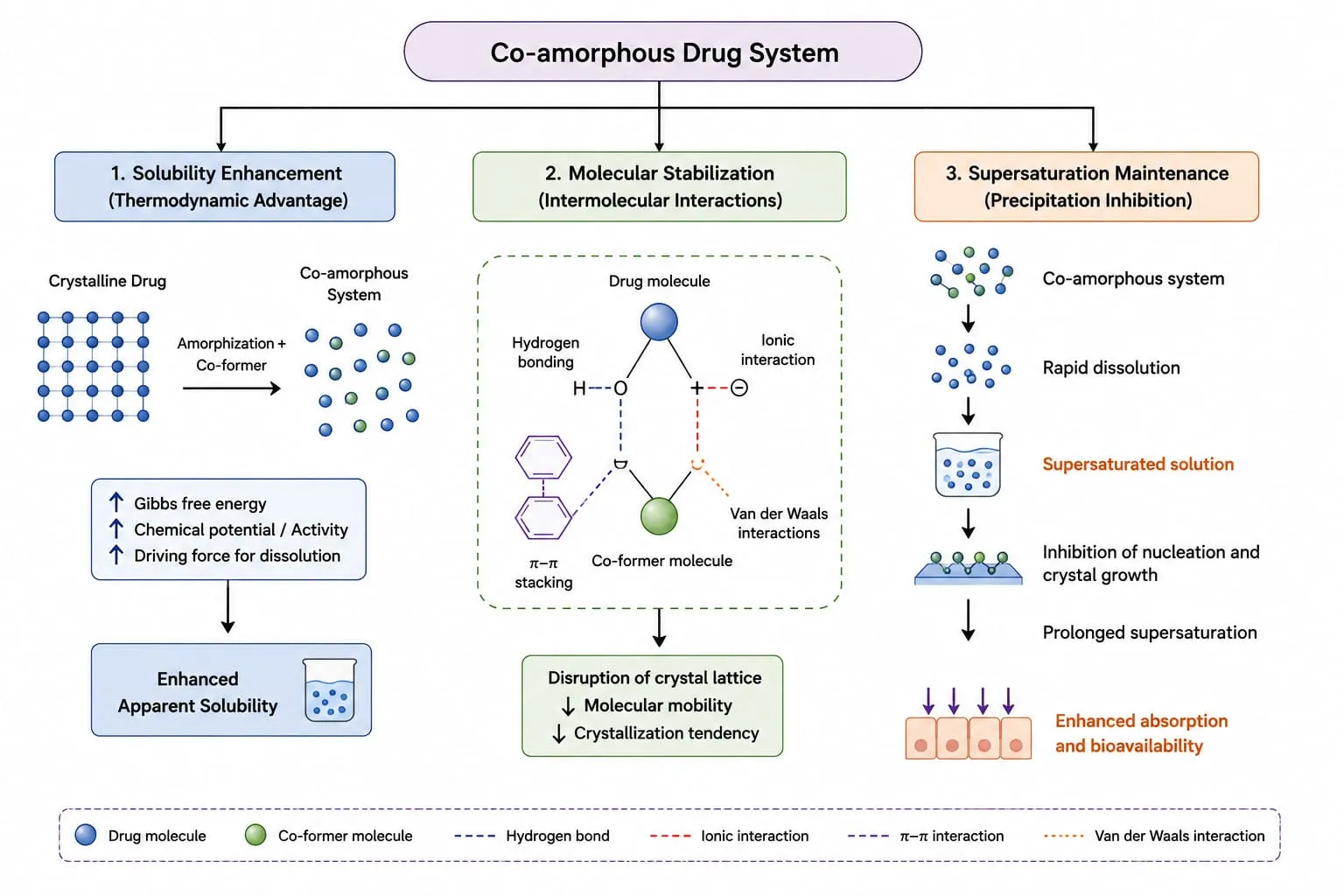
Fig. 1 – Proposed mechanisms underlying solubility enhancement, molecular stabilization, and maintenance of supersaturation in co-amorphous drug delivery systems
8. Pharmaceutical Applications
8.1 Cardiovascular Drugs
Cardiovascular drugs, particularly statins (simvastatin, atorvastatin), angiotensin receptor blockers (ARBs; telmisartan, valsartan), and diuretics (hydrochlorothiazide), have been extensively studied in CAM systems. Telmisartan-hydrochlorothiazide CAM systems prepared by ball milling demonstrated 79-fold improvement in apparent solubility and superior dissolution compared to individual crystalline drugs (28). The ezetimibe-simvastatin co-amorphous system offers a dual cholesterol-lowering strategy with mutual amorphization stabilization (6).
8.2 Antidiabetic Drugs
BCS Class II antidiabetic agents including glibenclamide, glipizide, repaglinide, and tadalafil have been formulated as CAM systems with diverse co-formers. The simvastatin-glipizide drug-drug combination system demonstrated a 4.7-fold improvement in glipizide dissolution and the amorphization of simvastatin, enabling single-dose co-administration (6). CAM systems with amino acids (arginine, lysine) have shown particular efficacy for sulfonylurea class drugs with carboxylic acid functionalities, leveraging ionic interactions for superior stabilization (13).
8.3 Anti-Cancer Drugs
Anticancer drugs frequently exhibit poor solubility, narrow therapeutic windows, and efflux pump-mediated resistance challenges well-suited to a co-amorphous formulation strategy. The docetaxel-bicalutamide CAM system demonstrated that bicalutamide acts both as a dissolution enhancer and a P-gp inhibitor, synergistically improving docetaxel bioavailability in rats (29). The ceritinib-naringin CAM system, developed using computational simulations, demonstrated improved solubility and CYP enzyme inhibition by naringin, reducing ceritinib metabolism and enhancing its bioavailability- a paradigm for computationally designed dual-function CAM systems in oncology (30). Co-amorphous systems of erlotinib hydrochloride-gallic acid showed enhanced anti-tumour effects and improved aqueous solubility of erlotinib (31).
8.4 Anti-Inflammatory and Analgesic Drugs
NSAIDs, particularly indomethacin and naproxen, have served as model BCS Class II drugs in foundational CAM research. Drug-amino acid CAM systems of indomethacin with arginine, lysine, histidine, and tryptophan have been comprehensively studied, with arginine and lysine consistently showing the greatest solubility enhancement (10-100-fold) due to salt formation (5,14). Dissolution studies have demonstrated sustained supersaturation for >2 hours in FaSSIF, approximating intestinal transit time and predicting in vivo bioavailability advantage.
8.5 Immunosuppressants and Other Drug Classes
Tacrolimus, a BCS Class II immunosuppressant with narrow therapeutic index and highly variable bioavailability, has been formulated as a co-amorphous dispersion (CAD) with sucrose acetate isobutyrate (SAIB). Mohamed et al. demonstrated complete amorphization and >85% drug release in 90 minutes, with improved pharmacokinetics in animal models and stability for 6 months at both 25°C/60% RH and 40°C/75% RH (32). Co-amorphous systems have also been extended to antifungal drugs (griseofulvin, itraconazole), herbal medicine-derived APIs (curcumin, sinomenine, matrine alkaloids), and antiparasitic drugs, illustrating the broad applicability of the platform across pharmacological classes (16,17,18).
9. Recent Advances
9.1 Computational Tools and In Silico Co-Former Screening
The most transformative recent advance in CAM research is the maturation of computational screening platforms for rational co-former selection. MD simulations have evolved from qualitative interaction visualization to quantitative prediction of interaction energies, co-amorphization propensity, and supersaturation profiles (23). COSMO-RS-based computation of mixing enthalpy and activity coefficients provides a prior thermodynamic evaluation of drug-co-former miscibility, applicable to both binary and ternary system design. Integration of HSP calculations, Flory-Huggins modeling, and MD simulation into sequential computational screening workflows enables efficient virtual library screening (22).
9.2 Machine Learning-Driven Formulation Development
Machine learning approaches have accelerated co-former discovery by mining large molecular descriptor databases to identify physicochemical features predictive of CAM formation and stability. Random forest models trained on experimental CAM formation data have achieved prediction accuracies of >80% in cross-validation (24). High-throughput experimental screening combined with ML data analysis (active learning loops) has been proposed as a 'digital laboratory' paradigm for CAM development, where each experimental result feeds back into improved model predictions, exponentially reducing the experimental burden and accelerating formulation optimization timelines.
9.3 Ternary and Multi-Component Co-Amorphous Systems
The design of ternary CAM systems has emerged as a major research focus, driven by the recognition that binary systems may not fully maintain supersaturation during GI transit. By incorporating a crystallization-inhibiting polymer (HPMC-AS, PVP-VA, Soluplus®) or surfactant (TPGS, poloxamer 407) at low concentrations (typically 5-20% w/w), ternary systems combine the rapid dissolution spring of co-amorphization with the parachute effect of polymer-mediated supersaturation maintenance (18,19). Ternary systems additionally exhibit higher Tg values due to the anti-plasticizing polymer contribution, providing further storage stability enhancement.
9.4 Green Chemistry and Sustainable Manufacturing
Environmental sustainability considerations have driven the investigation of greener preparation methods for CAM systems (25). Mechanochemical co-amorphization by ball milling is inherently solvent-free, and sustainable mechanochemical approaches using vibration mills with minimal energy input have been validated for ternary CAM systems of antiparasitic drugs, including praziquantel, niclosamide, and mebendazole, demonstrating reproducible amorphization within 4 hours without any solvent (4). These approaches align with the ICH Q3C guideline on residual solvents and pharmaceutical green chemistry initiatives, positioning CAM technology favourably in terms of environmental impact (25).
9.5 Nano-Scale Co-Amorphous Systems and Benchmarking
Integration of nanotechnology with CAM formulation represents an emerging direction. Nanosized co-amorphous particles produced by anti-solvent precipitation or wet nano-milling offer dramatically increased surface area, further accelerating dissolution kinetics beyond the enhancement already afforded by co-amorphization. Benchmarking studies comparing drug-polyelectrolyte nanoplex systems against CAM systems found that CAM systems generally show superior storage stability while nanoplexes achieve faster initial dissolution kinetics (35). Hybrid nanoparticle-CAM strategies that capture the benefits of both approaches represent a productive area for future investigation (35)
10. Challenges and Future Perspectives
10.1 Physical Stability and Recrystallization
The most significant challenge facing CAM system development remains the potential for recrystallization, the thermodynamic driving force for amorphous systems to revert to their more stable crystalline form. Recrystallization can occur during:
(i) processing and milling (mechanically-induced stress);
(ii) spray drying (exposure to elevated temperature and moisture);
(iii) storage (temperature and humidity-induced molecular mobility); and
(iv) dissolution (precipitation from supersaturated solution).
The effect of co-formers on nucleation kinetics and the mechanism by which they inhibit recrystallization of specific drugs remains incompletely understood and requires systematic mechanistic investigation (10,11)
Strategies to address stability challenges include: optimal co-former selection based on strong specific interactions; ternary formulation with crystallization-inhibiting polymer additives; packaging under low-humidity conditions with desiccants; and storage at temperatures ≥50°C below Tg. Molecular mobility measurements including isothermal microcalorimetry, dielectric spectroscopy, and relaxation time determination by ssNMR are being investigated as more sensitive early-warning tools for detecting pre-crystallization changes in amorphous systems (10,11).
10.2 In Vitro-In Vivo Correlation (IVIVC) and Biorelevant Testing
Establishing robust IVIVC for CAM systems is challenging due to the complex interplay of dissolution kinetics, supersaturation maintenance, and absorption in the GI environment. Biorelevant dissolution media (FaSSIF, FeSSIF) better approximate in vivo conditions but still imperfectly model the dynamic intestinal environment, including motility, changing pH gradients, bile salt concentrations, and intestinal efflux. Physiologically based pharmacokinetic (PBPK) modelling integrated with supersaturation dissolution data offers a promising framework for predicting in vivo bioavailability from in vitro dissolution profiles of CAM systems (34).
10.4 Regulatory Considerations
The regulatory pathway for CAM products presents unique challenges. Drug-drug CAM systems are classified as combination drug products and require demonstration that both components contribute to the therapeutic indication. Drug-co-former CAM systems using GRAS (Generally Recognized as Safe) or approved excipients face a more straightforward path, but still require extensive characterization of the co-amorphous nature and its reproducibility. Regulatory agencies require that quality control specifications ensure consistency of the amorphous state throughout the product lifecycle from manufacture through storage to in vivo performance. The selection of a co-former in a drug-drug or drug-excipient CAM system is cardinal from a regulatory perspective and should meet the requirements of the FDA and EMA (20).
FUTURE PERSPECTIVES
The future of co-amorphous drug delivery systems is rich with opportunity. Key directions anticipated to shape the field include:
(i) integration of AI/ML-driven co-former prediction with high-throughput experimental validation to create efficient, data-driven pipelines capable of identifying optimal CAM formulations rapidly; (24)
(ii) development of multicomponent ternary and quaternary CAM systems combining co-former stabilization, polymer supersaturation maintenance, and surfactant wettability enhancement; (18,19)
(iii) application of continuous manufacturing platforms with embedded PAT for real-time monitoring of amorphous content and homogeneity;
(iv) exploration of CAM technology beyond oral delivery for inhaled, ophthalmic, and transdermal applications;
(v) development of validated PBPK models specifically for CAM systems; (34) and
(vi) environmental sustainability initiatives, including solvent-free mechanochemical production and biodegradable packaging, aligned with pharmaceutical green chemistry goals.
CONCLUSION
Co-amorphous drug delivery systems represent a scientifically elegant and practically impactful approach to the long-standing challenge of poor aqueous solubility in pharmaceuticals. By replacing high-molecular-weight polymers with small-molecule co-formers capable of forming specific, strong intermolecular interactions with the drug, CAM systems achieve robust amorphous stabilization, marked dissolution enhancement, and improved oral bioavailability at significantly reduced excipient loads compared to conventional amorphous solid dispersions (1,4)
The versatility of the CAM platform is evident in the diversity of co-former classes (amino acids, organic acids, bile acid derivatives, sugars, and co-drugs), preparation methods (ball milling, solvent evaporation, spray drying, hot-melt extrusion), and therapeutic applications (cardiovascular, metabolic, oncological, anti-inflammatory, and immunosuppressive) documented in the literature (7,8). The mechanistic understanding of CAM stability, grounded in hydrogen bonding, ionic interactions, pi-pi stacking, and molecular mobility reduction, now provides a rational framework for predictive formulation design (33,34).
Recent advances in computational tools, including MD simulations, HSP modeling, and machine learning algorithms, are transforming co-former selection from empirical trial-and-error to a rational, data-driven process (23,24). The emergence of ternary CAM systems and nano-CAM particles further expands the formulation toolkit.18,35 However, challenges remain in ensuring long-term physical stability, establishing industrially scalable manufacturing processes, generating predictive IVIVC models, and navigating regulatory requirements for co-amorphous combination products (10,20).
With continued multidisciplinary research bridging pharmaceutical sciences, materials science, computational chemistry, and clinical pharmacology, co-amorphous systems are poised to fulfil their promise as transformative enabling technologies for the next generation of poorly soluble drugs, ultimately translating improved formulation science into enhanced patient outcomes.
REFERENCES


Sundaramoorthi, Gowtham P, Jayalakshmi E, Preethi C, Ranjana R, Samiyuktha S , Co-Amorphous Drug Delivery Systems: From Molecular Interactions to Solubility Enhancement, Stabilization, and Drug Performance, Int. J. of Pharm. Sci., 2026, Vol 4, Issue 8, 5110-5127, https://doi.org/10.5281/zenodo.22202337
 10.5281/zenodo.22202337