

We use cookies to ensure our website works properly and to personalise your experience. Cookies policy
Delonix Society’s Baramati College of Pharmacy, Barhanpur, Maharashtra, India..
In order to guarantee the dependability, quality, and consistency of data produced throughout the product lifecycle, data integrity has emerged as a crucial necessity in the pharmaceutical sector. In order to safeguard patient safety and guarantee product quality, regulatory bodies like the US Food and Drug Administration (FDA), World Health Organization (WHO), Medicines and Healthcare Products Regulatory Agency (MHRA), and Pharmaceutical Inspection Co-operation Scheme (PIC/S) have stressed the significance of preserving data integrity. A organized framework for preserving accurate and comprehensive data in both paper-based and electronic record systems is offered by the ALCOA and ALCOA+ principles. However, additional issues with data security, electronic record management, and regulatory compliance have been brought about by growing digitalization, computerized systems, and intricate manufacturing processes. ALCOA+ and the idea of data integrity are covered in this evaluation. the importance of quality assurance, typical causes of data integrity problems, global regulatory expectations, and future prospects for improving data governance in pharmaceutical production. The evaluation also identifies current issues and methods for enhancing compliance through digital technologies, employee training, and efficient quality management systems [1–5].
Because pharmaceuticals have a direct impact on patient safety and human health, the pharmaceutical business is one of the most heavily regulated in the world. Pharmaceutical producers are required by regulatory bodies to produce comprehensive, accurate, and trustworthy data throughout the production, testing, packaging, storage, and distribution of pharmaceutical products. These documents offer proof that goods are produced consistently in accordance with Good Manufacturing Practices (GMP) and satisfy predetermined quality criteria. The completeness, consistency, accuracy, and dependability of data over the course of its whole lifecycle are referred to as data integrity. It guarantees that all recorded data is accurate, contemporaneous, original, traceable, readable, and accessible whenever needed. Regulatory compliance, product quality, patient safety, and organizational reputation all depend on maintaining data integrity.[1-4]
During inspections, regulatory bodies like the US FDA, MHRA, WHO, and PIC/S have found many data integrity infractions in recent years. Incomplete documentation, uncontrolled data alteration, electronic record deletion, insufficient audit trails, shared user passwords, and subpar documentation standards are examples of common flaws. Pharmaceutical businesses may face warning letters, product recalls, import alerts, regulatory actions, and large financial losses as a result of such infractions. The ALCOA principles—Attributable, Legible, Contemporaneous, Original, and Accurate—were established as the cornerstone of excellent documentation processes in order to overcome these issues. In order to improve data governance in contemporary pharmaceutical operations, these concepts were then extended into ALCOA+, which included other standards including Complete, Consistent, Enduring, and Available.[2-4]
The necessity for strong data integrity controls has been further highlighted by the growing usage of computerized systems, electronic batch records, manufacturing execution systems (MES), laboratory information management systems (LIMS), and cloud-based technologies. Pharmaceutical Quality Assurance (QA) departments are essential to the implementation of quality systems, audits, employee training, computerized system validation, and compliance with international regulatory standards. In addition to discussing potential future opportunities for enhancing compliance through digital transformation and advanced quality management techniques, this review attempts to give a thorough overview of data integrity principles, ALCOA+, regulatory guidelines, common challenges, and the role of quality assurance in maintaining trustworthy pharmaceutical data.[7, 8]
The idea of data integrity
The preservation of data in a comprehensive, consistent, accurate, and trustworthy manner during its whole lifecycle is referred to as data integrity. It guarantees that all information produced during the production, testing, packing, storage, and distribution of pharmaceuticals is reliable and can be utilized to prove adherence to Good Manufacturing Practices (GMP). Data integrity is applicable to both electronic and paper-based records.[9, 12]
Since recorded information is the foundation for pharmacological decisions, maintaining data integrity is crucial. Any data loss, change, deletion, or manipulation could result in risks to patient safety, product recalls, regulatory non-compliance, or poor quality judgments. To preserve data throughout its lifecycle, pharmaceutical businesses must set up efficient quality processes, documented procedures, computerized system controls, audit trails, access management, and employee training programs. Data generation, recording, processing, review, reporting, archiving, retrieval, and destruction are all included in the data lifecycle. Every step should have the proper controls in place to guarantee that the data is correct and comprehensive.[2, 5]
1. ALCOA Principles:
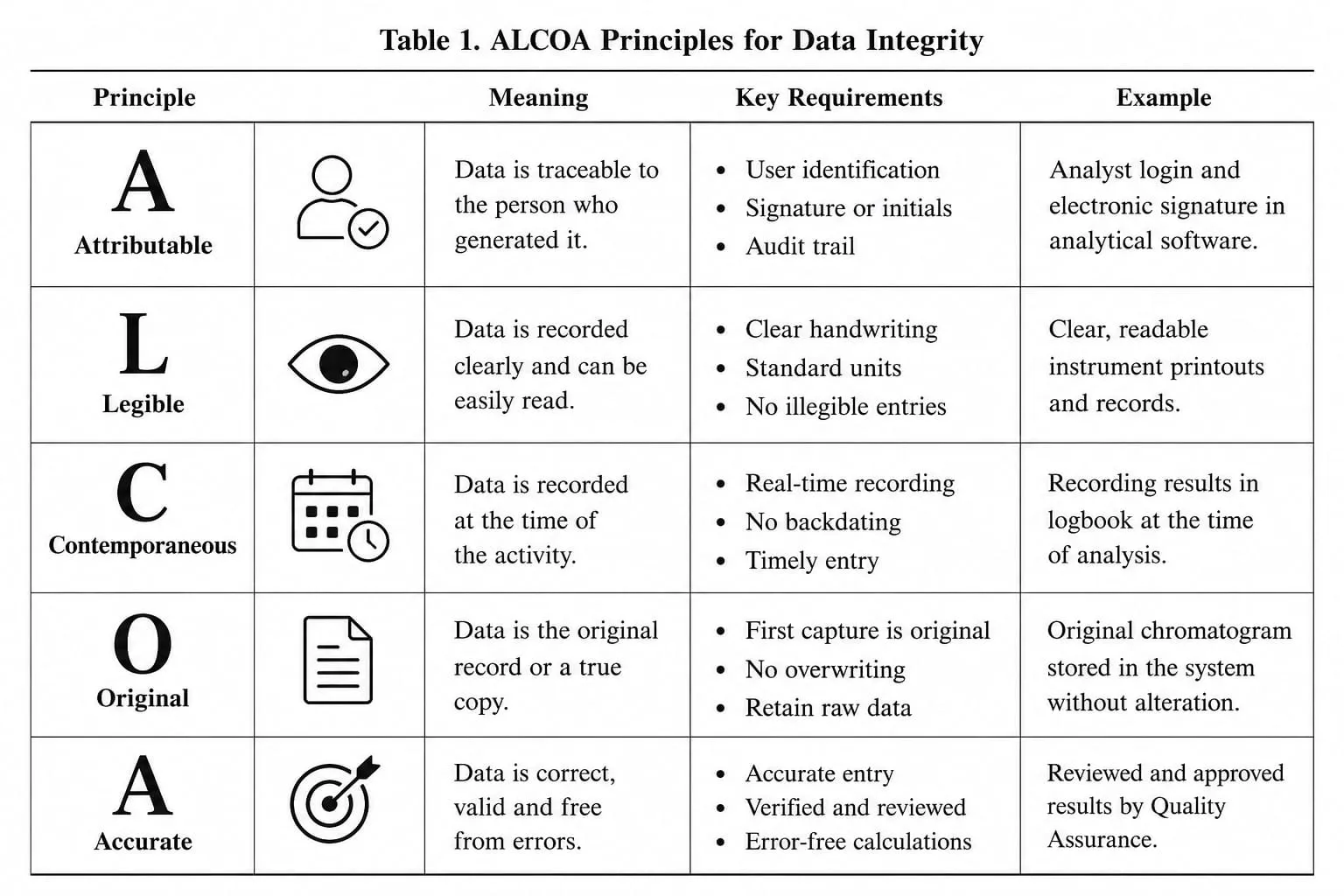
Table 2. ALCOA +

The person who completed the task and the time it was completed should be noted in every record. For the duration of their preservation, records must remain legible and comprehensible. As soon as the activity is completed, data should be recorded. It is always important to preserve original documents or authentic copies. Error-free data should accurately reflect the activity that was carried out. Regulatory bodies extended ALCOA to include the requirement that all data be kept, including audit trails and repeat analyses. Consistent information should have no inexplicable gaps and follow the proper order of occurrences. For the duration of the retention period, enduring records should be kept safe and permanent. When data is needed for review or inspection, it should be simple to obtain. Pharmaceutical companies can improve regulatory compliance and build robust documentation procedures by putting ALCOA+ concepts into effect.[2-4, 15]
Legal Requirements for Data Integrity:
To guarantee adherence to data integrity regulations, international regulatory bodies have released a number of guidelines.
FDA in the US:
All records created during pharmaceutical manufacture must be accurate, complete, traceable, and shielded against unauthorized manipulation, according to the US FDA. In addition, the FDA mandates computerized system validation, controlled user access, electronic audit trails, and adherence to 21 CFR Part 11 for electronic signatures and records. [1, 5, 12]
WHO
The World Health Organization advises pharmaceutical companies to set up quality systems that can guarantee accurate documentation at every stage of the product's lifespan. The WHO's standards place a strong emphasis on risk management, employee training, Good Documentation Practices (GDP), and routine computer system reviews.[2,9,11]
MHRA
Comprehensive guidelines on data governance, senior management accountability, audit trails, computerized system controls, and organizational quality culture were released by the Medicines and Healthcare Products Regulatory Agency (MHRA). Data integrity is regarded by MHRA as a crucial component of GMP compliance.[3, 4]
PICS
To guarantee reliable pharmaceutical data, the Pharmaceutical Inspection Co-operation Scheme (PIC/S) suggests putting in place efficient quality management systems, data governance guidelines, risk-based strategies, computerized system validation, and ongoing monitoring.[4, 6]
Data creation, data recording, data processing, data review, data approval, data storage, data retrieval, and data archiving.
Typical Pharmaceutical Industry Data Integrity Violations
One of the most common flaws found during regulatory inspections is data integrity violations. These problems jeopardize the accuracy of pharmaceutical 2 data and could lead to warning letters, product recalls, regulatory measures, or the suspension of production operations. The following are the most frequent infractions: [1-4]
1 Inadequate Records
Information may be absent or untrustworthy if manufacturing or laboratory activities are not precisely and thoroughly documented. Common examples include missing signatures, blank entries, and undocumented corrections.[9, 11, 2]
2. Unauthorized Modification of Data
It is a major breach of GMP regulations to alter or remove data without the required authorization or explanation. Any record correction should be traceable, documented, and supported by scientific evidence. [3, 5, 1]
3 Passwords and User IDs Shared
It is impossible to identify the person in charge of an action when common login credentials are used. To ensure accountability, each employee should have a distinct user ID and password. [3,5]
4 Lack of Audit Trails
Evidence of who generated, altered, or removed electronic records can be found in audit trails. Data manipulation is more likely when audit trails are disabled or not reviewed. [1, 3, 15]
5 Backdating or Record Falsification
The contemporaneous documentation principle is violated and may result in regulatory non-compliance when data is recorded after the activity is finished or when inaccurate information is purposefully entered. [1, 3, 2]
6 Ineffective Electronic Record Keeping
Critical pharmaceutical data may be lost or corrupted due to improper backup methods, insufficient access controls, and a failure to validate computerized systems. [15, 20, 4]
Fundamental Reasons for Data Integrity Issues
Data integrity issues in pharmaceutical organizations are caused by a number of variables.
Inadequate training for employees,
To reduce recurrence, organizations should apply the proper Corrective and Preventive Actions (CAPA) after identifying these underlying causes through methodical investigations. (7, 8, 18)
Quality Assurance's Function in Data Integrity
Throughout the lifecycle of pharmaceutical products, the Quality Assurance (QA) department is crucial to guaranteeing adherence to data integrity regulations.[7, 8]
The following are the main duties of QA:
Creating and putting into practice data integrity policies.
Examining laboratory documentation and batch manufacturing records.
Performing GMP audits within the company.
Observing adherence to ALCOA+ principles.
Standard operating procedures (SOPs) are approved.
Ensuring certification of computerized systems.
Putting together programs for employee training.
Examining electronic records and audit trails.
Conducting risk evaluations.
Tracking the efficacy of CAPA.
Getting the company ready for regulatory inspections.
A robust QA system lowers the risk of data integrity breaches while fostering responsibility, openness, and ongoing development. [7, 8, 10]
CAPA and Risk Management
One crucial method for detecting and managing data integrity threats is quality risk management, or QRM. Organizations can prioritize crucial areas that need more robust controls by using risk assessments. [7, 18]
The CAPA procedure listed below should be used when a data integrity problem is found:
1)Take corrective action and look into the underlying reason.
2)When necessary, make corrections to incomplete or erroneous records.
3)Examine testing results and impacted batches.
4)Retrain those who are responsible.
5)SOPs are strengthened by preventive actions.
6)Boost the security of electronic systems.
7)Review audit trails on a regular basis.
8)Boost the frequency of internal audits.
Regular GMP and data integrity training can help raise employee knowledge. Recurring errors are decreased and regulatory compliance is strengthened by an efficient CAPA system. [7, 8, 10]
Common data integrity
1 Inadequate Records
One of the most common data integrity flaws found during regulatory inspections is incomplete documentation. Every action carried out in pharmaceutical manufacturing and quality control labs needs to be recorded right away. Data reliability can be severely impacted by missing signatures, incomplete batch manufacturing records, unreported analytical observations, blank spaces in logbooks, and missing computations. These flaws make it harder for investigators to reconstruct events during regulatory inspections and decrease traceability. To reduce documentation-related errors, organizations should adopt Good Documentation Practices (GDP), conduct regular document reviews, and provide employee training.
2 Unauthorized Modification of Data
Unauthorized record change is regarded as a serious breach of data integrity guidelines. Changes to electronic records should never be made without the proper authorization, scientific support, and thorough documentation. Every change must be traceable through an audit trail, according to regulatory bodies.
To stop unwanted changes, businesses should implement role-based access control, password protection, electronic signatures, and frequent audit trail checks.
3 Passwords and User IDs Shared
When using computerized systems, each employee should have their own user account.
Shared usernames and passwords violate ALCOA+'s Attributable principle by making it impossible to identify the person in charge of an activity. Unique login credentials, password policies, regular password updates, and the timely deactivation of accounts belonging to transferred or resigned personnel should all be included in user account management 5.
4.Deficiencies in the Audit Trail
Audit trails automatically document who completed a task, when it was completed, and any modifications made to electronic documents. Unauthorized data tampering may go unnoticed if audit trails are not enabled or routinely reviewed. Regulatory bodies highly advise regular audit trail assessment as a component of laboratory data evaluation and batch release.
5. Data Loss and Deletion
A major GMP infraction is the removal of original records without the proper authorization. Product quality investigations may also be jeopardized by unintentional loss of electronic records as a result of system failure, insufficient backup measures, or cybersecurity attacks.
To guarantee the long-term preservation of vital data, organizations should put in place secure archival practices, disaster recovery plans, and automated backup systems. 5.6 Inadequate Good Documentation Procedures (GDP)
Data integrity is based on good documentation practices. Using correction fluid, overwriting entries, backdating records, poor handwriting, and neglecting to note deviations are examples of common GDP errors. Regular training on GDP standards and documentation methods should be provided to pharmaceutical staff.
6. Fundamental Reasons for Data Integrity Issues
Failures in data integrity are rarely caused by a single factor. They arise in the majority of pharmaceutical companies as a result of a confluence of human error, insufficient technical controls, poor documentation standards, weak managerial oversight, and inadequate quality systems. Implementing successful preventative measures and guaranteeing long-term adherence to Good Manufacturing Practices (GMP) require an understanding of these underlying reasons.
Organizations should look into the true reason of every data integrity incident rather than just fixing the observed problem, according to regulatory bodies like the US FDA, MHRA, WHO, and PIC/S.
Inadequate employee training is one of the main reasons why data integrity failures occur.
Good documentation practices (GDP), ALCOA+ concepts, computerized systems, and GMP regulations must be sufficiently understood by pharmaceutical employees working in manufacturing, quality control, quality assurance, and warehouse departments. Inadequately trained workers may inadvertently disregard Standard Operating Procedures (SOPs), record inaccurate data, and make unauthorized corrections. Typical time: 17:45 AM If properly trained, Unio may record inaccurate data, postpone making necessary adjustments to paperwork, or neglect to follow:
SOPs are standard operating procedures. Thus, to ensure compliance, regular induction training, recurring refresher training, and competency evaluations are crucial.
Inadequate documentation practices are another important cause. Legal proof that all pharmaceutical operations were carried out in accordance with authorized protocols is provided by documentation. Common documentation errors found during regulatory inspections include incomplete batch records, missing signatures, unclear handwriting, overwriting, usage of correction fluid, unreported variances, and delayed activity recording. These flaws make manufacturing and laboratory data less trustworthy and traceable.
Data integrity issues are also greatly exacerbated by a weak quality culture. Honesty, openness, responsibility, and ongoing development are all encouraged by a good quality culture. However, businesses who put production goals ahead of quality may
unintentionally foster an atmosphere where workers feel under pressure to falsify or leave out information in order to fulfill deadlines. Senior management should always prioritize quality over productivity and encourage ethical behavior.
There are now more difficulties due to our growing reliance on digital technologies.
Modern pharmaceutical firms widely employ Laboratory Information Management Systems (LIMS), Manufacturing Execution Systems (MES), Enterprise Resource Planning (ERP) systems, and Electronic Batch Records (EBR). If these computerized systems are not adequately vetted or maintained, they may become exposed to unauthorized access, inadvertent deletion of documents, software faults, or cybersecurity concerns. As a result, computerized systems must be validated in accordance with legal requirements, using suitable audit trails, user access controls, and data backup protocols.
Another key fundamental reason is the absence of appropriate audit trail review. Every electronic record creation, alteration, and deletion is documented by audit trails. Unauthorized data tampering may go unnoticed for extended periods of time if audit trails are not routinely reviewed. Labor data review, batch record review, and qua should all include routine audit trail review. ↓ surance activities. Maintaining data integrity also requires management supervision. Recurring compliance problems are common in organizations with poor internal communication, insufficient oversight, and inefficient quality management systems. Senior management should set aside enough funds, keep an eye on compliance metrics, carry out frequent management evaluations, and guarantee that corrective and preventive actions (CAPA) are carried out successfully.
Lastly, persistent data integrity issues could be caused by inadequate internal audits and poor CAPA implementation. Effective CAPA systems guarantee that errors are permanently fixed, while internal audits assist in identifying holes prior to regulatory inspections. Data integrity events can be investigated and long-term preventive measures put in place using root cause analysis tools like Fishbone Diagram, Five Why Analysis, and Failure Mode and Effects Analysis (FMEA). In general, a combination of staff awareness, strong leadership commitment, efficient quality procedures, computerized system validation, frequent audits, and continuous improvement is needed to eradicate these underlying problems.
Organizations that build a proactive quality culture are more likely to keep reliable, accurate, and regulatory-compliant data throughout the product lifecycle.
Challenges in Maintaining Data Integrity:
Rapid technical improvements, intricate production procedures, changing regulatory requirements, and a growing reliance on computerized systems have made maintaining data integrity in the pharmaceutical sector more difficult. During production, quality assurance, control, validation, stability studies, and distribution, pharmaceutical businesses produce a significant amount of data. Strong organizational commitment and a strong quality management system are necessary to guarantee that all of these data are correct, consistent, complete, and dependable throughout their existence.[1, 2, 7]
The shift from paper-based documentation to electronic data management systems is one of the main obstacles. Computerized systems increase operational efficiency, but they also come with dangers such software malfunctions, cybersecurity concerns, unintentional data deletion, unauthorized access, and poor audit trail management. To reduce these risks, businesses must put in place verified computerized systems, role-based access controls, secure backup protocols, and disaster recovery plans.[5,15]
Sustaining staff understanding of data integrity principles is another major difficulty. One of the biggest reasons for data integrity issues is still human mistake. Workers may inadvertently break Good Documentation Practices (GDP) as a result of insufficient training, stress at work, ignorance of legal requirements, or bad
oversight. To create a culture of compliance, regular GMP and data integrity training programs are crucial. Data governance is now a major focus of regulatory inspections. In addition to assessing manufacturing processes, inspectors also examine data backup protocols, audit trails, user access control, electronic documents, and computerized system validation. Businesses that don't show good data governance may be subject to import alerts, warning letters, or legal repercussions.[2, 7, 8]
varying health authorities have varying regulatory expectations, which presents issues for global pharmaceutical organizations. Despite having similar goals, organizations like the FDA, MHRA, WHO, and PIC/S may have different guidelines and methods for conducting inspections.
In order to guarantee compliance throughout all manufacturing locations, international corporations should create uniform global data integrity rules.
Lastly, new technological and legal issues are brought about by the growing use of automation, cloud computing, artificial intelligence, and digital manufacturing technologies. In order to stay compliant with regulations and keep up with technological changes, organizations must constantly upgrade their cybersecurity protocols, quality systems, and personnel capabilities.
[15, 20, 25]
FUTURE PERSPECTIVE
The future of data integrity in pharmaceutical manufacturing will be strongly influenced by digital transformation, automation, and advanced quality management systems. Modern pharmaceutical industries are rapidly adopting Industry 4.0 technologies, including Artificial Intelligence (AI), Machine Learning (ML), Internet of Things (IoT), cloud computing, and advanced data analytics to improve manufacturing efficiency and regulatory compliance.[15, 20]
Artificial Intelligence has significant potential to strengthen data integrity by detecting unusual data patterns, identifying deviations, predicting equipment failures, and supporting risk-based decision making. Al-based monitoring systems can continuously evaluate manufacturing and laboratory data, thereby reducing human errors and improving operational reliability. [15, 22]
Another interesting tool for safeguarding pharmaceutical records is block chain technology. Block chain can enhance the traceability, transparency, and validity of electronic records throughout the product lifecycle since it keeps data in a safe and unchangeable way.[23, 25]
Because they provide safe data storage, remote monitoring, and real-time collaboration between many manufacturing sites, cloud-based electronic documentation solutions are growing in popularity. However, strong cybersecurity controls, vendor qualification, and adherence to global regulatory requirements are necessary for the deployment of cloud technologies. [5, 15]
Future data integrity initiatives will continue to require ongoing training for staff members. At every organizational level, companies should create competency-based training programs, support moral behavior, encourage open reporting of deviations, and fortify their quality culture. [7,8]
More advice documents on developing digital technologies, cybersecurity threats, and artificial intelligence applications are anticipated to be released by regulatory bodies. [1, 2, 3, 4]
Therefore, pharmaceutical businesses should continue to be proactive in implementing new technology while adhering strictly to GMP and ALCOA+ guidelines.
All things considered, a mix of technical innovation, efficient quality management systems, robust regulatory monitoring, and organizational dedication to ongoing development will determine the future of data integrity.[7, 8, 15, 25]
CONCLUSION
One of the most important elements of pharmaceutical quality systems and regulatory compliance is data integrity. The public's trust in pharmaceutical products, patient safety, and product quality all depend on accurate, complete, consistent, and reliable data. A solid basis for preserving reliable documentation throughout the product lifespan is provided by the application of ALCOA and ALCOA+ principles. In order to prevent data integrity problems, this review emphasizes the significance of Good Documentation Practices, computerized system validation, audit trail review, quality risk management, and efficient Corrective and Preventive Actions (CAPA). Additionally, it highlights how crucial the Quality Assurance division is to building strong quality systems. carrying out internal audits, educating staff, and guaranteeing adherence to international regulatory standards. Pharmaceutical companies still have to deal with issues like digitalization, cybersecurity, and changing regulations, but these issues can be successfully handled with strong management commitment, employee awareness, ongoing oversight, and adoption of cutting-edge technologies like block chain and artificial intelligence. Compliance will be strengthened and organizational performance will be enhanced by creating a sustainable quality culture where data integrity is viewed as a shared responsibility rather than a legal requirement. In summary, preserving data integrity is not just a legal necessity but also an essential duty that directly affects patient safety, product effectiveness, and the general legitimacy of the pharmaceutical sector. The fundamental forces behind attaining excellence in pharmaceutical data management will continue to be technical innovation, ongoing progress, and compliance with international regulations. [1–10, 1
REFERENCES


Omkar Fule, Dr Swati Burungale, Dr. Rajendra Patil, Keshav Pawar, Sanika Gavde , Data Integrity in Pharmaceutical Manufacturing: ALCOA Principles, Regulatory Expectations, Challenges, and Future Perspectives, Int. J. of Pharm. Sci., 2026, Vol 4, Issue 7, 3855-3865, https://doi.org/10.5281/zenodo.21451073
 10.5281/zenodo.21451073