

We use cookies to ensure our website works properly and to personalise your experience. Cookies policy
Department of Pharmaceutical Chemistry, Vidya Niketan College of Pharmacy, Lakhewadi, Indapur, Pune
The emergence of antimicrobial resistance has become a major global health concern, necessitating the development of new and effective antimicrobial agents. Heterocyclic compounds containing the 1,2,4-triazole nucleus have attracted significant attention in medicinal chemistry due to their diverse biological activities, including antibacterial, antifungal, anti-inflammatory, and anticancer properties. The present research work focuses on the design, synthesis, characterization, and antimicrobial evaluation of novel triazole derivatives as potential antimicrobial agents. A series of five triazole derivatives were synthesized using appropriate synthetic routes and reaction conditions. The synthesized compounds include 3-Phenyl-5-Amino-1,2,4-Triazole, 3,5-Diphenyl-1,2,4-Triazole. The structures of the obtained triazole derivatives were confirmed by various spectroscopic techniques including Infrared (IR) Spectroscopy, Proton Nuclear Magnetic Resonance (^1H NMR) Spectroscopy, Carbon-13 Nuclear Magnetic Resonance (^13C NMR) Spectroscopy, and Mass Spectrometry. IR spectral studies confirmed the presence of characteristic functional groups such as amino (–NH?), aromatic C–H, C=N, C–N, and nitro (–NO?) groups. The ^1H NMR and ^13C NMR spectra provided detailed information regarding the proton and carbon environments present in the synthesized molecules, confirming their proposed structures. Mass spectrometric analysis further established the molecular weights and fragmentation patterns of the compounds, supporting successful synthesis. (1)
The fast rise in microbe resistance to current antibiotics has made the creation of novel antimicrobial drugs one of the most significant areas of pharmaceutical and medicinal chemistry. Globally, infectious diseases brought on by bacteria, fungus, and other microbes continue to cause major health issues. Due to overuse and misuse, many traditional antibiotics have progressively lost their effectiveness, resulting in antimicrobial resistance (AMR). As a result, scientists are always looking for new heterocyclic compounds with potent antibacterial qualities and low toxicity. The 1,2,4-triazole nucleus has become one of the most important heterocyclic compounds due to its diverse biological and pharmacological properties. Five-membered aromatic heterocyclic compounds with three nitrogen atoms are known as triazole derivatives. Excellent biological effects, including antibacterial, antifungal, antiviral, anti-inflammatory, antioxidant, anticancer, anticonvulsant, and analgesic qualities, are displayed by these nitrogen-rich compounds. Triazole derivatives are widely used in medicinal chemistry and drug development because of their exceptional therapeutic potential. The triazole ring's nitrogen atoms increase electron density and strengthen binding interactions with biological targets such microorganism proteins and enzymes. Triazole compounds work by interfering with DNA synthesis, affecting the creation of cell membranes, blocking microbial enzyme systems, and stopping microbial growth. They are good prospects for the development of new antibacterial medications due to their potent aromatic character and great chemical stability. Antimicrobial agents are compounds that either stop germs from growing or kill them. These substances are primarily categorised as antiviral, antifungal, antibacterial, and antiparasitic medications. Antifungal agents prevent the growth of fungi, whereas antibacterial treatments combat bacteria. The capacity of antimicrobial drugs to specifically target microbial cells without harming human cells determines how successful they are. To combat the growing resistance that harmful microbes have gained, new antimicrobial chemicals must be discovered. Pharmaceutical products that include triazoles show how crucial this heterocyclic nucleus is to contemporary medicine. The following are a few commercially available triazole derivatives:
These commercially available medications unequivocally show that triazole derivatives have great therapeutic promise and can be further altered to produce molecules with increased antibacterial activity. The design and synthesis of new triazole derivatives as antibacterial agents is the main focus of the current research project. By adding phenyl, amino, and nitro substituents to the triazole nucleus' structure, antibacterial efficacy, lipophilicity, and contact with microbial targets may all be enhanced. Because of the combined actions of electron-withdrawing functional groups and aromatic substitution, the produced compounds are anticipated to exhibit excellent antibacterial and antifungal characteristics. [3,4]
EXPERIMENTAL METHODOLOGY
SCHEMES
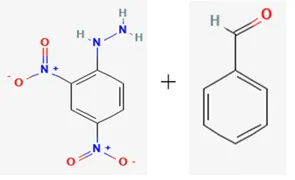
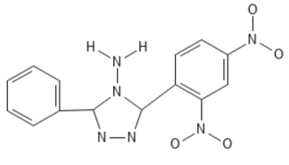
2,4-Dinitrophenylhydrazine + Benzaldehyde
↓ (Ethanol, Ammonium acetate)
→ 4-Amino-3-Phenyl-5-(2,4-dinitrophenyl)-1,2,4-Triazole
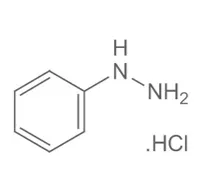
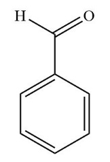
Phenylhydrazine·HCl + Benzaldehyde
↓ (Urea ,Ethanol, Reflux)
→ 4-Amino-3,5-Diphenyl-1,2,4-triazole
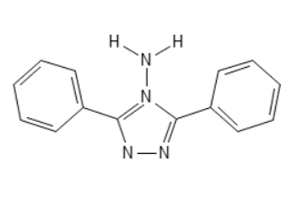
IDENTIFICATION TEST WITH RESULT
Table No. 1: List Of Parameters
|
Sr. no. |
Name of Parameter |
COMP A |
COMP B |
|
1 |
Practical Yield |
2.2 gm |
1.80 gm |
|
2 |
Theoretical Yield |
3.2 g/mol |
2.52 g/mol |
|
3 |
% Practical Yield |
68 % w/w |
71% w/w |
|
4 |
Appearance |
Crystalline Solid |
Light yellow crystalline solid |
|
5 |
Color |
– Yellow to orange |
Brown to greenish |
|
6 |
Odour |
Aromatic odour |
Odour less or characteristic aromatic odour |
|
7 |
Solubility |
Soluble in ethanol, chloroform, DMSO and DMF; sparingly soluble in water. |
Soluble in ethanol, methanol and DMSO; sparingly soluble in water. |
|
8 |
Melting Point |
260–270 °C |
182–184 °C |
Table No. 2: List Of Chemical Tests [9,10]
|
Sr. No. |
Test |
Procedure |
Observation |
|
|
Compound A |
Compound B |
|||
|
1 |
Ferric Chloride Test |
Dissolve a small amount of compound in ethanol. Add 2–3 drops of neutral FeCl₃ solution. |
No color change |
Decolorization |
|
2 |
Bromine Water Test |
Asmall quantity of the compound was dissolved In ethanol and treated with bromine water. |
Decolorization of bromine water. |
Decolorization of bromine water. |
|
3 |
Ninhydrin test |
Add 2–3 drops of ninhydrin solution to the sample solution. Heat gently. |
Purple/blue color formation. |
Purple/blue color formation. |
|
4 |
Sodium Bicarbonate Test |
Add compound to NaHCO₃ solution |
No effervescence |
No effervescence |

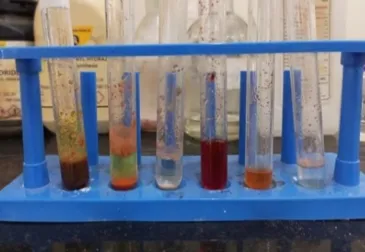
Compound A Compound B
Fig.1: Physical test and Chemical test of Compound A and B
TLC of chemical compound
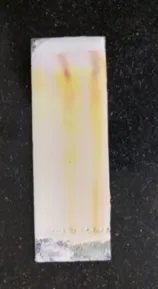
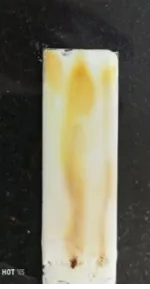
Compound A TLC Compound B TLC
Fig.2:TLC of Compound A and B
Table No. 3: TLC of Compound A and B
|
Compound |
|
Distance travel (in CM) |
R.F Value |
|
Compound A |
Solvent |
6.5 |
--- |
|
Benzaldehyde |
5.9 |
0.90 |
|
|
End product |
6.2 |
0.95 |
|
|
Compound B |
Solvent |
6.5 |
--- |
|
Benzaldehyde |
6 |
0.9 |
|
|
End product |
5.7 |
0.8 |
Biological test
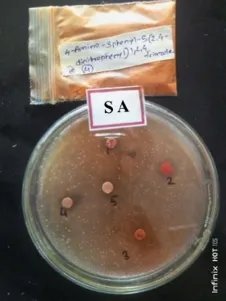
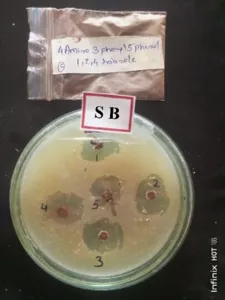
Compound A Compound B
Fig.3: Disc Diffusion Method of Compound A and B
Table No. 4: Disc Diffusion Method for Compound A and B
|
Test Organism |
Type |
Zone of Inhibition |
|
|
Compound A |
Compound B |
||
|
Escherichia coli |
Gram-negative |
14 mm |
11–14 mm |
|
Staphylococcus aureus |
Gram-positive |
18 mm |
14–18 mm |
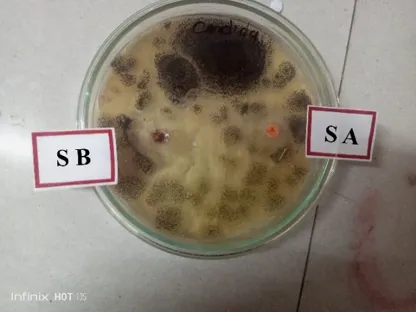
Fig.4: Antifungal Activity test Compound A and B
Table No. 5: Antifungal Activity test for Compound A and B
|
Test Fungus |
|
Activity Level |
Zone of Inhibition |
|
|
|
Compound A |
Compound B |
||
|
Aspergillus niger |
|
Moderate |
8 mm |
9 mm |
CHARACTERIZATION OF COMPOUND
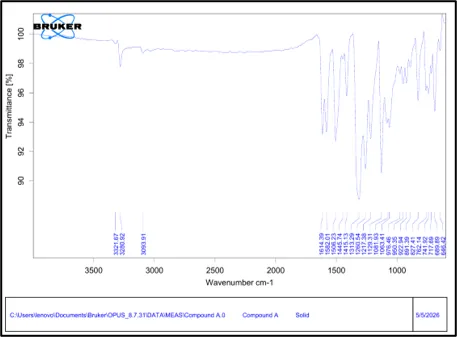
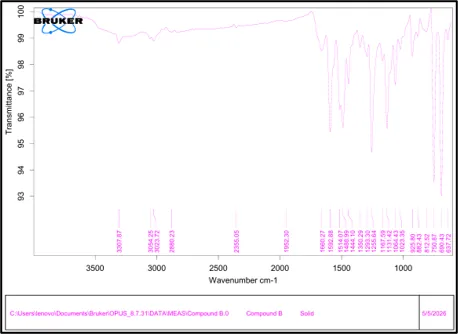
Fig. 5: IR Spectroscopy of Compound A and B
Table No. 5: Interpretation of Compound A and B. (IR)
|
Compound A |
Compound B |
||
|
IR Peak (cm⁻¹) |
Functional Group |
IR Peak (cm⁻¹) |
Functional Group |
|
3321, 3280 |
–NH₂ stretching |
3307 |
N–H stretching (amino group) |
|
3093 |
Aromatic C–H |
3054, 3023 |
Aromatic C–H stretching |
|
1614 |
C=N (triazole ring) |
1660 |
C=N stretching of triazole ring |
|
1582, 1506 |
Aromatic C=C |
1592, 1514 |
Aromatic C=C stretching |
|
1313–1217 |
C–N stretching |
1350–1167 |
C–N stretching |
|
762–689 |
Monosubstituted phenyl ring |
750, 690 |
Monosubstituted phenyl ring |
2.1 Mass Spectroscopy of Compound A
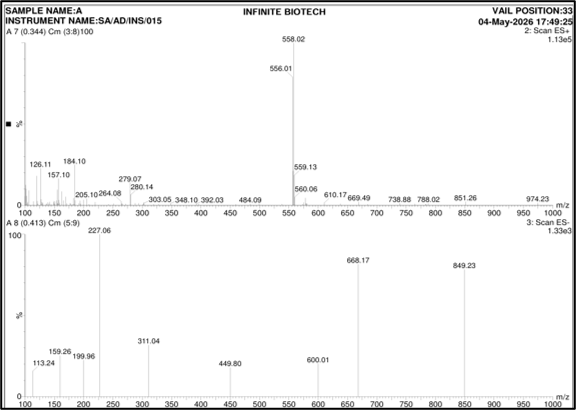
Fig. 6: Mass Spectroscopy of Compound A
Table No. 6: Mass Spectroscopy of Compound A
|
M/z (observed) |
Relative Intensity (%) |
Possible Assignment |
M/z (observed) |
Relative Intensity (%) |
Possible Assignment |
|
126.11 |
15 |
Fragment ion |
449.80 |
18 |
Fragment ion |
|
157.10 |
18 |
Fragment ion |
558.02 |
100 |
[M+H] + |
|
184.10 |
22 |
Fragment ion |
668.17 |
60 |
Adduct /Dimer ion |
|
227.06 |
100 |
[M+H – NO2] + |
849.23 |
65 |
Adduct /Dimer ion |
|
279.07 |
25 |
[M+H – NH2] + |
974.23 |
12 |
High mass fragment |
|
311.04 |
30 |
Fragment ion |
|
|
|
2.2 Mass Spectroscopy of Compound B
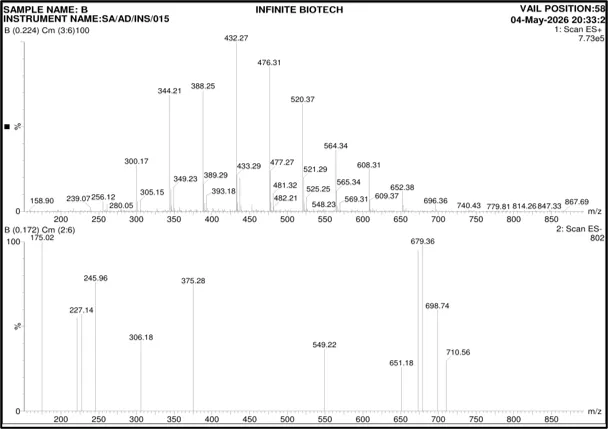
Fig. 7: Mass Spectroscopy of Compound B
Table No.7: Mass Spectroscopy of Compound B
|
M/z (observed) |
Relative Intensity (%) |
Possible Assignment |
M/z (observed) |
Relative Intensity (%) |
Possible Assignment |
|
158.90 |
8.2 |
Fragment ion |
476.31 |
78.4 |
Fragment ion |
|
175.02 |
22.4 |
Aromatic fragment |
520.37 |
60.6 |
Fragment ion |
|
227.14 |
18.6 |
Fragment ion |
564.34 |
42.7 |
Fragment ion |
|
245.96 |
28.7 |
Phenyl fragment |
608.31 |
30.5 |
Fragment ion |
|
256.12 |
15.3 |
Fragment ion |
652.38 |
24.8 |
Fragment ion |
|
300.17 |
35.1 |
Fragment ion |
679.36 |
85.2 |
High mass fragment |
|
305.15 |
20.5 |
Fragment ion |
740.43 |
16.7 |
High mass fragment |
|
344.21 |
48.6 |
Fragment ion |
779.81 |
12.3 |
High mass fragment |
|
375.28 |
32.9 |
Fragment ion |
814.26 |
10.5 |
High mass fragment |
|
388.25 |
62.3 |
Fragment ion |
867.69 |
9.4 |
High mass fragment |
|
432.27 |
100.0 |
Base peak (M+H) ⁺ |
975.83 |
6.2 |
High mass fragment |
3.1 ¹H NMR Spectroscopy of Compound A
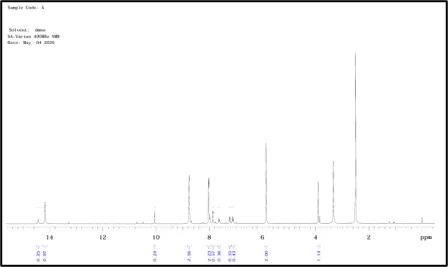
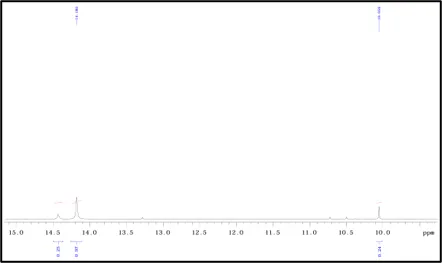
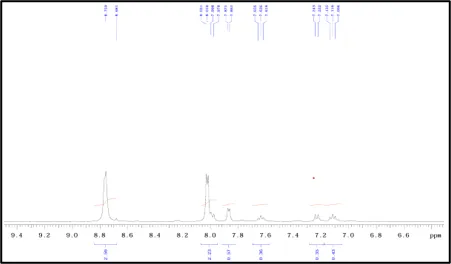
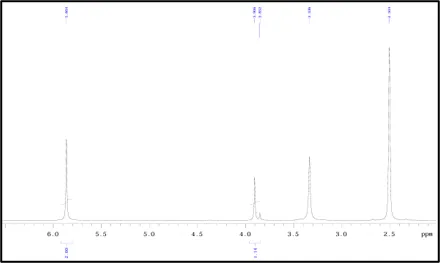
Fig. 8: ¹H NMR Spectroscopy of Compound A
Table no. 8: ¹H NMR Spectroscopy of Compound A
|
δ (ppm) |
Assignment |
δ (ppm) |
Assignment |
|
14.18 |
N–H proton of triazole ring (strongly deshielded) |
7.66–7.62 |
Aromatic protons |
|
10.06 |
Amino proton (–NH₂) / exchangeable proton |
7.24–7.10 |
Phenyl ring protons |
|
8.76–8.68 |
Aromatic proton adjacent to electron-withdrawing group |
3.34 |
Residual water in DMSO |
|
8.03–7.98 |
Aromatic protons |
2.50 |
Residual DMSO-d₆ solvent peak |
|
7.88–7.86 |
Aromatic protons |
7.66–7.62 |
Aromatic protons |
Interpretation
The spectrum contains: One highly deshielded N–H signal at δ 14.18 ppm, One exchangeable –NH₂ signal around δ 10.06 ppm, Multiple aromatic proton signals between δ 7.1–8.8 ppm, No aliphatic proton signals
This pattern is characteristic of a 1,2,4-triazole derivative containing an amino group and a nitro-substituted aromatic ring.
Based on the NMR data together with the IR spectrum you previously uploaded (showing NH₂ and strong aromatic/nitro absorptions), the compound is most consistent with: 4-Amino-3-Phenyl-5-(2,4-dinitrophenyl)-1,2,4-Triazole
¹H NMR (400 MHz, DMSO-d₆, δ ppm): δ 14.18 (s, 1H, N–H), 10.06 (s, 2H, NH₂), 8.76–8.68 (m, aromatic H adjacent to NO₂), 8.03–7.98 (m, aromatic H), 7.88–7.86 (m, aromatic H), 7.66–7.62 (m, aromatic H), 7.24–7.10 (m, phenyl H).
3.2 ¹H NMR Spectroscopy of compound B
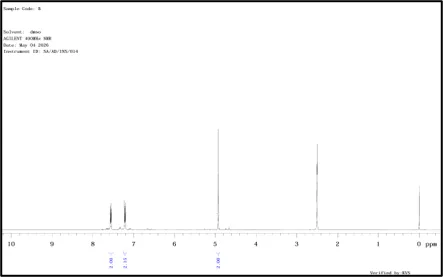
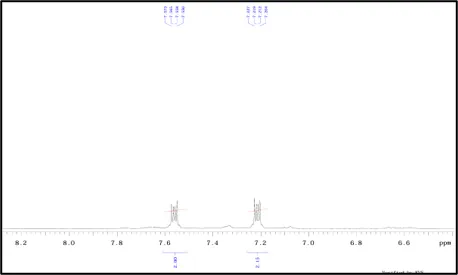
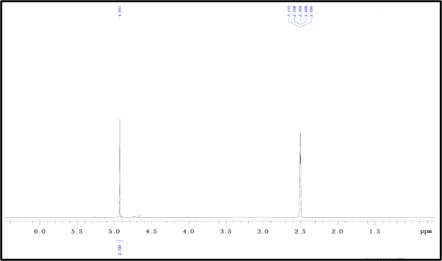
Fig. 9: ¹H NMR Spectroscopy of Compound B
Table no. 9: ¹H NMR Spectroscopy of Compound B
|
δ (ppm) |
Multiplicity |
Assignment |
|
7.57–7.55 |
Multiplet |
Aromatic protons (Phenyl ring) |
|
7.23–7.20 |
Multiplet |
Aromatic protons (Phenyl ring) |
|
4.93 |
Broad singlet |
–NH₂ protons |
|
2.50 |
Residual DMSO-d₆ solvent peak |
Interpretation
The spectrum shows: A broad signal at δ 4.93 ppm corresponding to an amino group (–NH₂). Aromatic proton signals between δ 7.20–7.57 ppm, indicating the presence of phenyl rings. No aliphatic proton signals are observed. The total aromatic integration is consistent with two phenyl rings attached to a heterocyclic nucleus.
Most Probable Compound
The NMR pattern is most consistent with: 4-Amino-3,5-Diphenyl-1,2,4-Triazole
Expected Structure ¹H NMR (400 MHz, DMSO-d₆, δ ppm): δ 7.57–7.55 (m, aromatic H, phenyl rings), 7.23–7.20 (m, aromatic H, phenyl rings), 4.93 (br s, 2H, NH₂). These data support the structure of 4-Amino-3,5-Diphenyl-1,2,4-Triazole (C₁₄H₁₂N₄).
3.3 ¹³C NMR Spectroscopy of Compound A
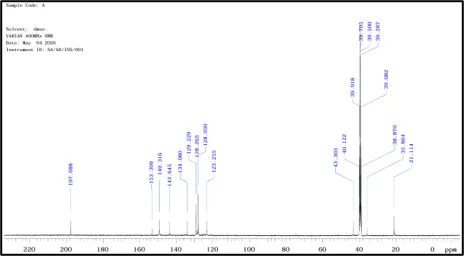
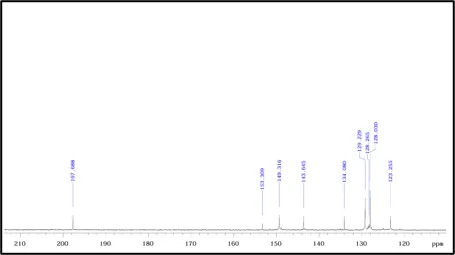
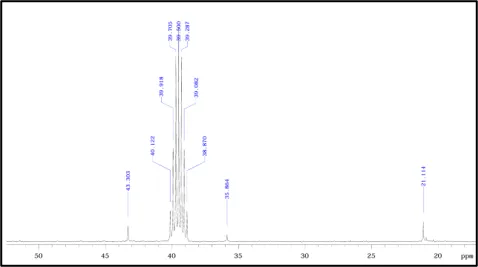
Fig. 10: ¹³C NMR Spectroscopy of Compound A
Table no. 10: ¹³C NMR Spectroscopy of Compound A
|
δ (ppm) |
Assignment |
|
197.69 |
Highly deshielded carbon (likely C=N/C=S region or impurity) |
|
153.31 |
Triazole ring carbon attached to N |
|
149.32 |
Triazole/aromatic carbon attached to electron-withdrawing group |
|
143.65 |
Aromatic carbon bonded to NO₂ |
|
134.08 |
Quaternary aromatic carbon |
|
129.23 |
Aromatic CH carbon |
|
128.27 |
Aromatic CH carbon |
|
128.03 |
Aromatic CH carbon |
|
123.26 |
Aromatic carbon adjacent to NO₂ group |
Additional peaks at 39–40 ppm are due to DMSO-d₆ solvent and should not be assigned to the compound.
Interpretation
The spectrum contains: Multiple aromatic carbons between 123–134 ppm, Deshielded carbons at 143–153 ppm, characteristic of carbons attached to nitrogen and nitro groups, A pattern consistent with a 1,2,4-triazole ring, A nitro-substituted aromatic ring
Most Probable Compound
Combining this ¹³C NMR data with the previously supplied IR and ¹H NMR data, the compound is most consistent with: 4-Amino-3-Phenyl-5-(2,4-dinitrophenyl)-1,2,4-Triazole
Carbon Assignments ¹³C NMR (100 MHz, DMSO-d₆, δ ppm): 153.31, 149.32, 143.65, 134.08, 129.23, 128.27, 128.03, 123.26. Signals at ~39.5 ppm correspond to DMSO-d₆ solvent.
Therefore, the spectral data support the structure of 4-Amino-3-Phenyl-5-(2,4-dinitrophenyl)-1,2,4-Triazole.
3.4 ¹³C NMR Spectroscopy of Compound B
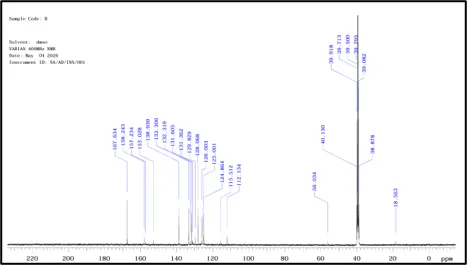
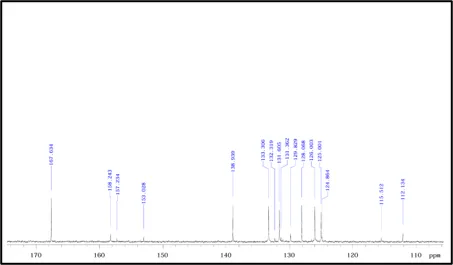
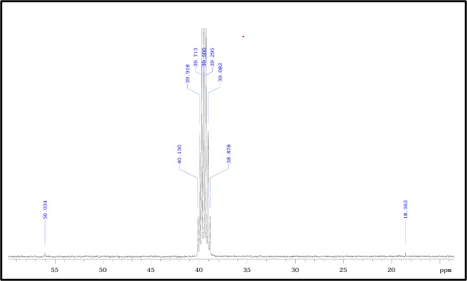
Fig. 11: ¹³C NMR Spectroscopy of Compound B
Based on the ¹³C NMR spectrum (DMSO-d₆) of Sample B, the significant carbon signals are:
Table no. 11: ¹³C NMR Spectroscopy of Compound B
|
δ (ppm) |
Assignment |
δ (ppm) |
Assignment |
|
167.63 |
Triazole ring C=N carbon |
131.36 |
Aromatic carbon |
|
158.24 |
Triazole/aromatic carbon attached to heteroatom |
129.83 |
Aromatic CH carbon |
|
157.23 |
Triazole C=N carbon |
128.07 |
Aromatic CH carbon |
|
153.03 |
Aromatic carbon bonded to electron-withdrawing substituent |
126.00 |
Aromatic CH carbon |
|
138.94 |
Quaternary aromatic carbon |
125.00 |
Aromatic CH carbon |
|
133.31 |
Ipso phenyl carbon |
124.86 |
Aromatic CH carbon |
|
132.32 |
Aromatic carbon |
115.51 |
Aromatic carbon |
|
131.61 |
Aromatic carbon |
112.13 |
Aromatic carbon |
Additional peaks:
Interpretation
The spectrum shows: Multiple aromatic carbons (112–139 ppm), Three highly deshielded carbons at 167.63, 158.24, and 157.23 ppm, characteristic of a 1,2,4-triazole ring, No aliphatic carbon signals attributable to the main compound, Carbon count and aromatic pattern consistent with a diphenyl-substituted triazole
When combined with the previously provided ¹H NMR spectrum, which showed: NH₂ signal at ~4.93 ppm, Aromatic protons only in the 7.2–7.6 ppm region the data are most consistent with: 4-Amino-3,5-Diphenyl-1,2,4-Triazole (Molecular Formula: C₁₄H₁₂N₄)
¹³C NMR (100 MHz, DMSO-d₆, δ ppm): 167.63, 158.24, 157.23, 153.03, 138.94, 133.31, 132.32, 131.61, 131.36, 129.83, 128.07, 126.00, 125.00, 124.86, 115.51, 112.13. Signals at δ 39–40 ppm correspond to DMSO-d₆ solvent.
Therefore, the spectral data support the identification of 4-Amino-3,5-Diphenyl-1,2,4-Triazole.
CONCLUSION
Two new 1,2,4-triazole derivatives were effectively synthesized and described in this study: 4-Amino-3-Phenyl-5-(2,4-dinitrophenyl)-1,2,4-Triazole and 4-Amino-3-Phenyl-5-Phenyl-1,2,4-Triazole. To verify their structure and determine their antibacterial ability, the produced compounds underwent a variety of identification and biological evaluation assays.[13,14]
The successful production of the intended triazole derivatives was demonstrated by the preliminary identification tests, which included chemical tests like the Ninhydrin test for the amino group and physical characterization (appearance, color, melting point, and solubility investigations). Spectral analyses, such as IR, Mass Spectrometry, and NMR spectroscopy, provided additional structural support by revealing distinctive absorption bands and signals that corresponded to the triazole ring, amino group, aromatic protons, and substituted phenyl moieties.
Using biological techniques as the Antifungal Activity and Disc Diffusion Method against certain bacteria strains, the antibiotic activity of the produced compounds was assessed. Effective antibacterial activity was demonstrated by both drugs' discernible zones of inhibition. The nitro-substituted compound, 4-Amino-3-Phenyl-5-(2,4-dinitrophenyl)-1,2,4-Triazole, exhibited relatively higher antimicrobial and antifungal activity among the synthesized derivatives. This could be explained by the presence of electron-withdrawing nitro groups that improve interaction with microbial targets. The significance of the 1,2,4-triazole scaffold in antibacterial drug design was confirmed by the molecule 4-Amino-3-Phenyl-5-Phenyl-1,2,4-Triazole, which also showed notable activity. [15,16,17]
Overall, the findings indicate that the produced triazole derivatives have encouraging antibacterial qualities and could be useful lead compounds for the creation of novel antimicrobial drugs. To determine their medicinal potential, more research involving thorough pharmacological analysis, toxicity assessment, and structure–activity connection studies is advised. [18,19]
REFERENCES


Dr. Samrat Khedkar, Mahesh Pingale, Om Walke, Nikita Pol, Priyanka Chendke, Design and Synthesis of Novel Triazole Derivative as Antimicrobial Agents, Int. J. of Pharm. Sci., 2026, Vol 4, Issue 6, 7414-7427. https://doi.org/10.5281/zenodo.21045193
 10.5281/zenodo.21045193