

We use cookies to ensure our website works properly and to personalise your experience. Cookies policy
Arunai College of Pharmacy, Tiruvannamalai, Tamil Nadu 606803
The present study focuses on the development and validation of a simple, precise, and reliable analytical method for the estimation of brivaracetam in bulk and tablet dosage form using reverse phase high performance liquid chromatography (RP-HPLC). The primary objective of this work was to establish an efficient chromatographic method suitable for routine quality control analysis. Chromatographic separation was achieved using a c18 column with a mobile phase consisting of methanol, acetonitrile, and sulphate buffer in the ratio of 15:35:50. The analysis was carried out at a detection wavelength of 208 nm. The optimized conditions provided a well-defined chromatogram with good peak shape and resolution for brivaracetam. The developed method was validated according to ICH guidelines, demonstrating acceptable levels of accuracy, precision, linearity, and specificity. The method showed consistent and reproducible results for the quantification of brivaracetam in both bulk and tablet formulations.
Brivaracetam is a racetam derivative of levetiracetam that binds SV2A with 20 times higher affinity than levetiracetam. It is an anti-Epileptic drug which is used in the treatment of partial onset seizures.
A seizure is a paroxysmal alteration of neurologic function caused by the excessive, hyper synchronous discharge of neurons in the brain. “Epileptic seizure” is used to distinguish a seizure caused by abnormal neuronal firing from a nonepileptic event, such as psychogenic seizure. “Epilepsy is the condition of recurrent, unprovoked seizure. Epilepsy has numerous causes, each reflecting underlying brain dysfunction. A seizure provoked by a reversible insult (e.g., fever, hypoglycaemia) does not fall under the definition of epilepsy because it is a short- lived secondary condition, not a chronic state.
High performance liquid chromatography is an efficient type of chromatography that uses a high-pressure gradient, rather than simply gravity, to propel a sample through a column. A sample is injected, then a pump containing high amount of pressure helps to mov the sample along a packed column, where it is separated and quantitated as individual components. The separation is than analysed by a detector to results.
Most of the drugs in the multi components dosage forms can be analysed by HPLC method because of the several advantage like rapidity, specificity, accuracy, precision and ease of automation in this method. HPLC method eliminates tedious extraction and isolation procedure.
The principle of separation in normal phase and reverse phase mode is adsorption. When a mixture of components is introduced into a HPLC column, they travel according to their relative affinities towards the stationary phase. The component which has more affinity towards the adsorbent travels slower. The components which have less affinity towards the stationary phase travel faster. Since no two components have the same affinity towards the stationary phase, the components are separated.
DRUG PROFILE:
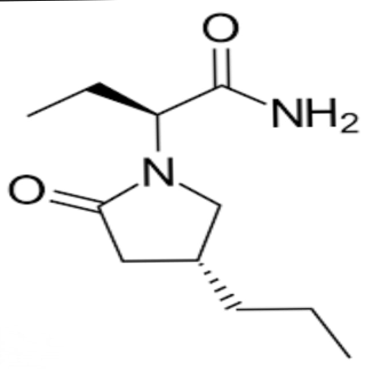
Chemical name : (2S)-2-[(4R)-2-oxo-4-propylpyrrolidin-1-yl] butanamide
Molecular formula : C11H20N2O2
Molecular weight : 212.29 g/mol
Appearance : White to off-white, odourless, bitter-tasting powder
Melting point : 72°C to 79°C (162°F to 174°F)
Route of administration : orally (tablets or oral solution) or by intravenous (IV) injection/infusion.
Dosage form and strength:
Storage : It should be stored at room temperature in a dry place, away from moisture and light
Approval date: February 18, 2016.[40]
Mechanism of action:
The antiepileptic/anticonvulsive action of brivaracetam is considered to occur via modulation of synaptic vesicle protein 2A (SV2A); however, the pharmacological mechanisms of action have not been fully characterised.[42]
Contraindication:
Hypersensitivity to brivaracetam or any of the inactive ingredients may causes bronchospasm and angioedema.
Adverse effects:
Most common adverse reactions seen in adult and paediatric patients are,
MATERIALS AND METHODS:
Chemicals and reagents
Instrumentation
PROCEDURE:
Preparation of buffer solution:
7.1gm of sodium sulphate is dissolved in 800ml of milli-Q-water and adjust the PH for 3 at 0.1N of diluted sulphuric acid.
Preparation of mobile phase:
Sodium sulphate 50ml (50%),35ml of acetonitrile (35%) and 15ml of methanol (15%) with HPLC grade were transferred into 1000ml standard flask and mixed well. After the mobile phase was degassed in sonicator for 10 minutes.
Preparation of standard stock solution:
About 50mg of brivaracetam was accurately weighed and transferred into a 100ml volumetric flask. Then the standard was dissolved with the solvent (Acetonitrile: water,50:50) and made the volume upto the mark with the same solvent. Then pipette out 1ml from the above solution and transferred into 10 ml of volumetric flask. Then add the solvent to dissolve it completely and made volume upto the mark with the same solvent. The concentration of the resultant solution was 50µg/ml.
Preparation of sample solution:
10 tablets were weighed and powered; tablets powder equivalent to 50mg of Brivaracetam was transferred into 100ml of volumetric flask dissolve and makeup to the volume with the solvent.
METHOD DEVELOPMENT:
The developed method was fully validated for the parameters as per ICH guidelines.
Linearity
Weigh accurately and transfer about 50mg of brivaracetam into 100ml of volumetric flask dissolve and make up with solvent. Take 0.5ml, 0.75ml,1ml,1.25ml,1.5ml of stock solution is transfer into 10ml of volumetric flask and make up with solvent upto the volume. To make the linearity concentration of 50%, 75%, 100%, 125%, 150%.
Accuracy
Weigh accurately tablet average weight of sample and transfer into 100ml of volumetric flask dissolve and makeup to the volume with the solvent. Take 0.8ml,1ml,1.2ml of stock solution was transferred into 10ml of volumetric flask and makeup with solvent upto the volume. To make the concentration of 80%, 100%,120%.
Precision
Weigh accurately tablet average weight of sample and transfer into 100ml of volumetric flask dissolve and makeup to the volume with the solvent.1ml of stock solution was transferred into 10ml of volumetric flask and makeup with the solvent upto the volume. Six-time replicate of injection to produce the similar of the result no maximum deviation.
Robustness
Small deliberate changes in method like flow rate, wavelength, mobile phase and ratio were made but there was no recognized change in the result and were within range as per ICH guidelines. Robustness conditions like flow minus, flow rate, wavelength decreasing, wavelength increasing, mobile phase decreasing, mobile phase increasing, ratio increasing and ratio decreasing was maintained and sample were injected in duplicated manner system suitability parameters were not much effected and all the parameters were passed. % RSD was within the limit.
Ruggedness
Ruggedness is a measure of reproducibility of test results under normal, expected operational conditions from laboratory to laboratory and from analyst to analyst. The method was fully validated for the parameters as per ICH guidelines.
RESULTS AND DISCUSSION:
A simple Reverse phase high performance liquid chromatographic method has been developed and subsequently validated for Brivaracetam.
The separation was carried out by using a Buffer (sodium sulphate): Acetonitrile : methanol [50:35:15]. The detection was carried out at 208 nm. The column used is C18 Column (250 mm x 5,4.5micron). The flow rate was selected as 0.9mL/min.
Method development:
Mode of operation : Isocratic
Stationary phase : C18 Column (250 mm x 5,4.5micron)
Mobile phase : Buffer: acetonitrile: methanol (50:35:15)
Detection wavelength: 208 nm
Flow rate : 0.9 ml/min
Temperature : 33℃
Retention time : 5.3 minutes
Run time :10 minutes
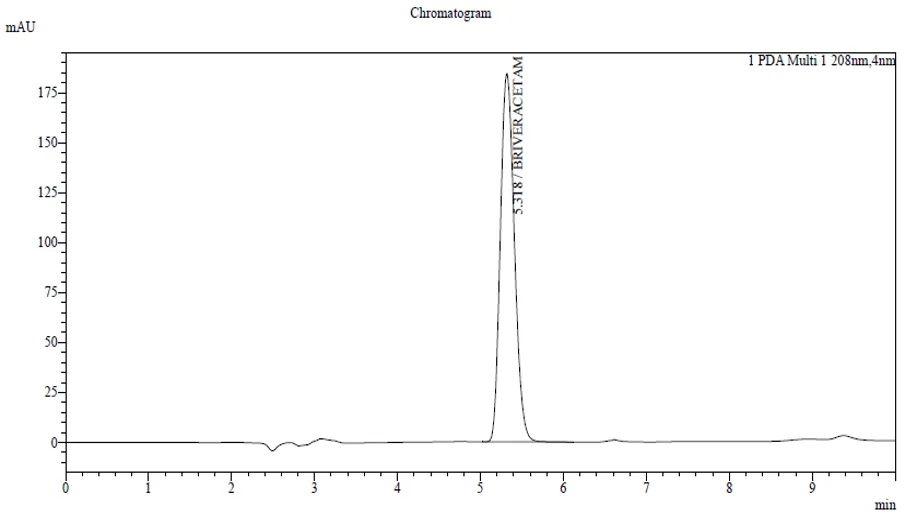
|
Peak |
Retention time |
Area |
Theoretical plate |
Tailing factor |
|
1 |
5.318 |
2166404 |
4619 |
1.179 |
|
Total |
|
2166404 |
|
|
Linearity:
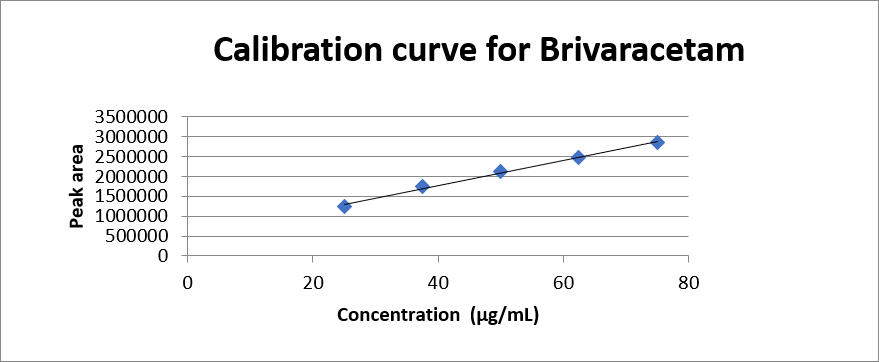
Table 1: linearity
|
Concentration |
Retention time |
Area |
Theoretical plate |
Tailing factor |
|
50% |
5.394 |
1235728 |
4526 |
1.201 |
|
75% |
5.790 |
1742164 |
5556 |
1.170 |
|
100% |
5.692 |
2136189 |
4394 |
1.172 |
|
125% |
5.968 |
2475106 |
4757 |
1.157 |
|
150% |
5.988 |
2859754 |
4841 |
1.165 |
Accuracy:
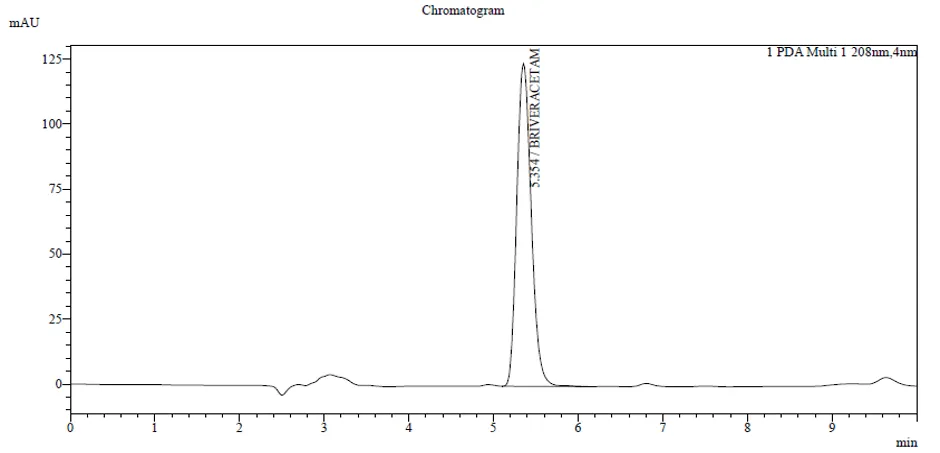
Accuracy – 80%
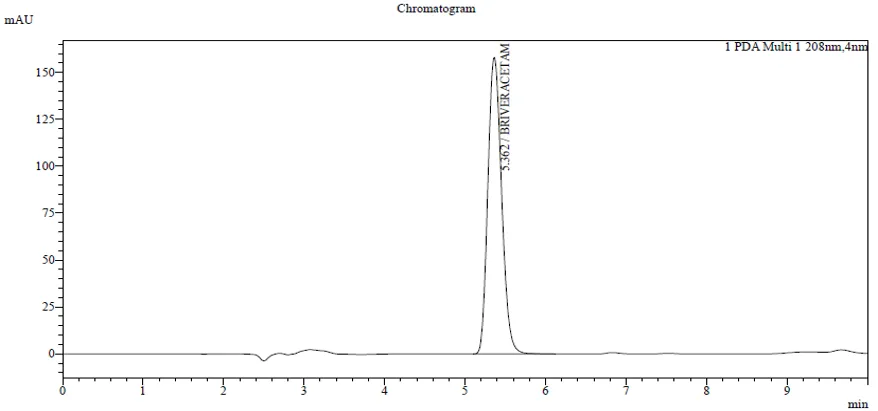
Accuracy -100%
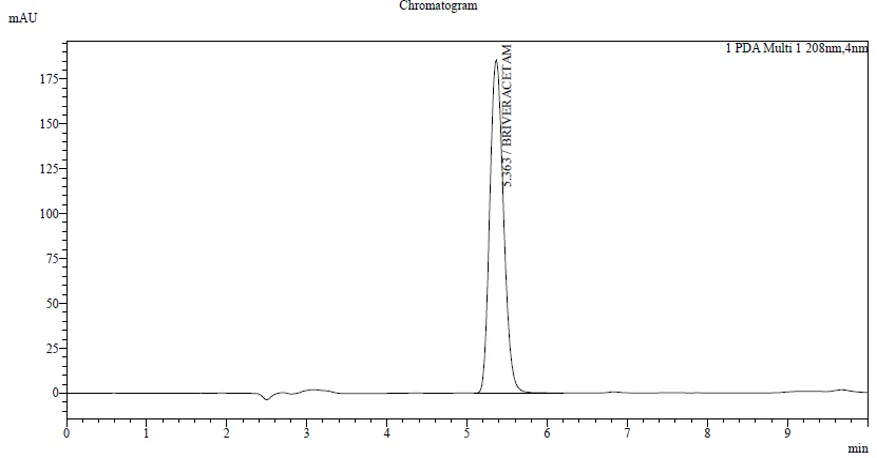
Accuracy -120%
Table 2: Accuracy
|
Percentage concentration |
Average area |
Percentage recovery |
Mean recovery |
SD |
%RSD |
|
80% |
1524289 |
100.34% |
100.64% |
302886.5 |
15.38% |
|
100% |
1898427 |
99.97% |
|||
|
120% |
2315117 |
101.61% |
Precision:
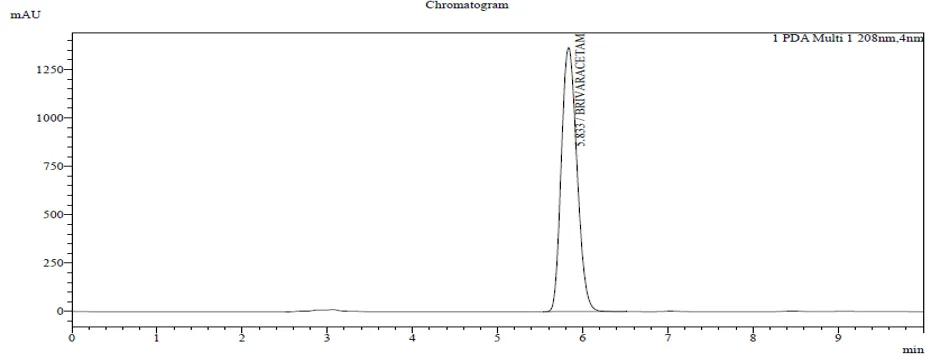
Precision injection - 1
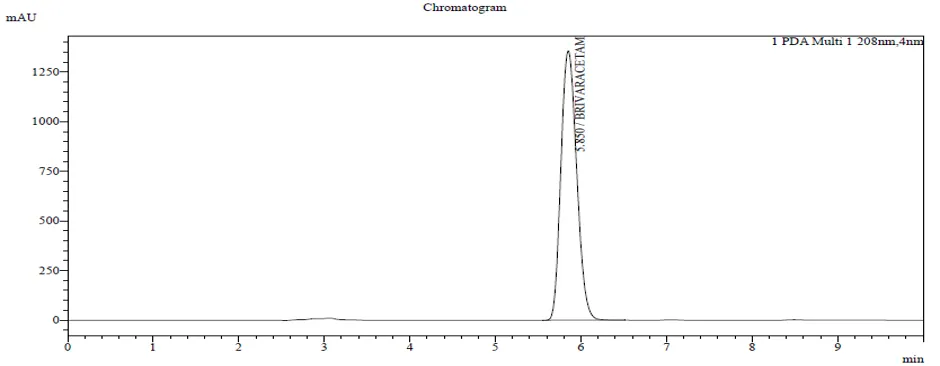
Precision injection – 2
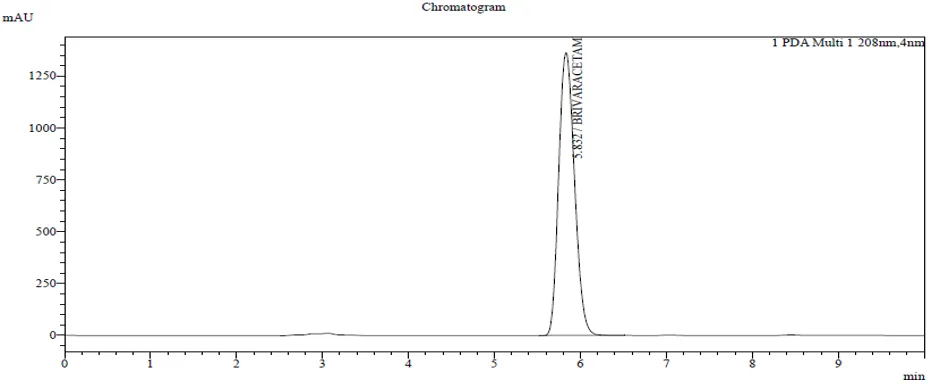
Precision injection – 3
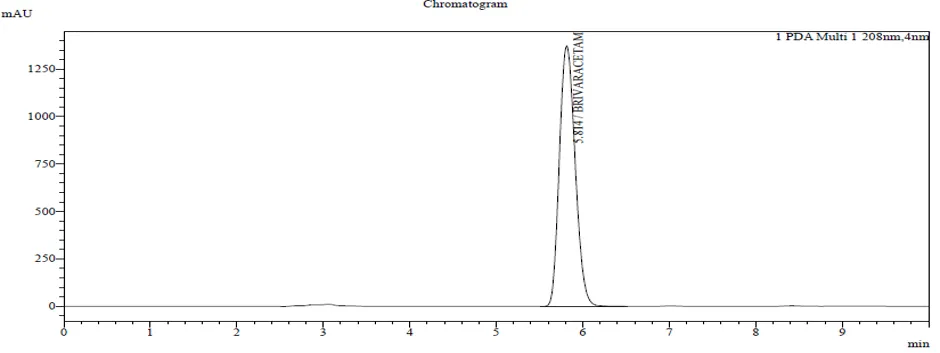
Precision injection - 4
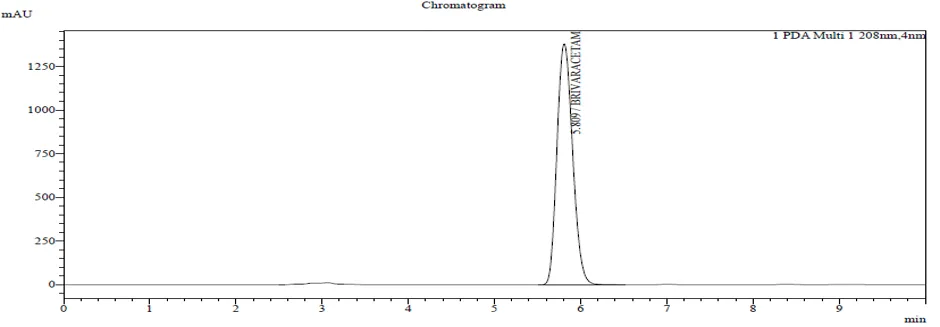
Precision injection - 5
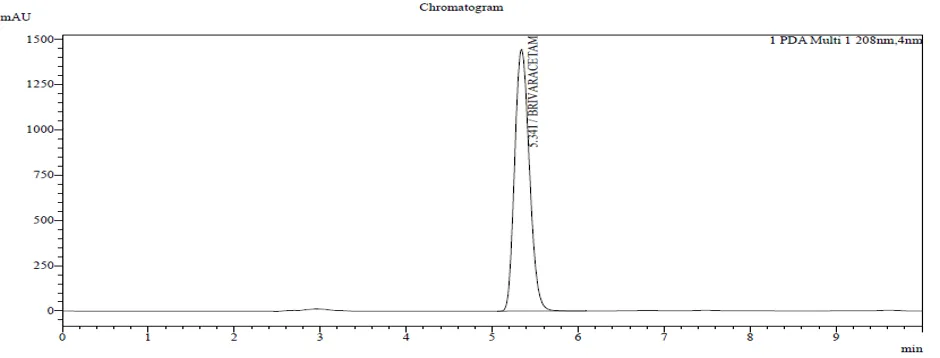
Precision injection – 6
Table 3: precision
|
Interday precision |
Intraday precision |
||||
|
Injection |
Retention time |
Area |
Injection |
Retention time |
Area |
|
1 |
5.833 |
17412210 |
1 |
7.052 |
2106569 |
|
2 |
5.850 |
17418960 |
2 |
7.070 |
2108272 |
|
3 |
5.832 |
17410279 |
3 |
7.608 |
2106146 |
|
4 |
5.814 |
17403357 |
4 |
6.890 |
2105108 |
|
5 |
5.809 |
17388670 |
5 |
6.850 |
2094189 |
|
6 |
5.341 |
17210180 |
6 |
6.823 |
2098512 |
Robustness:
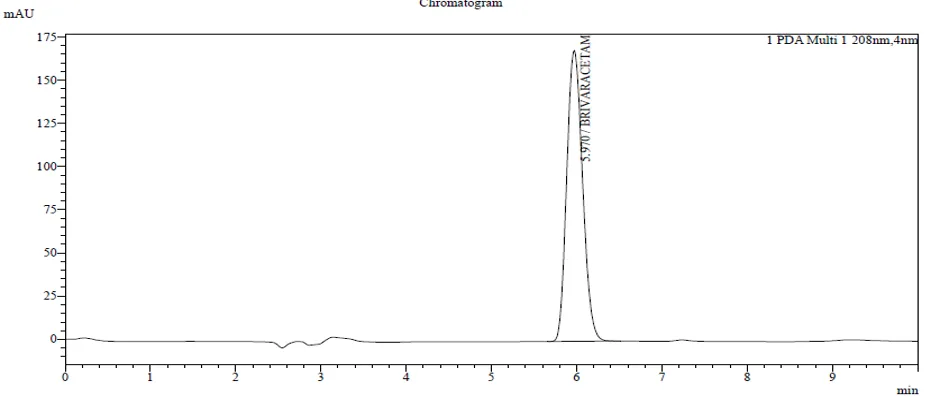
Robustness [change in mobile phase ratio]
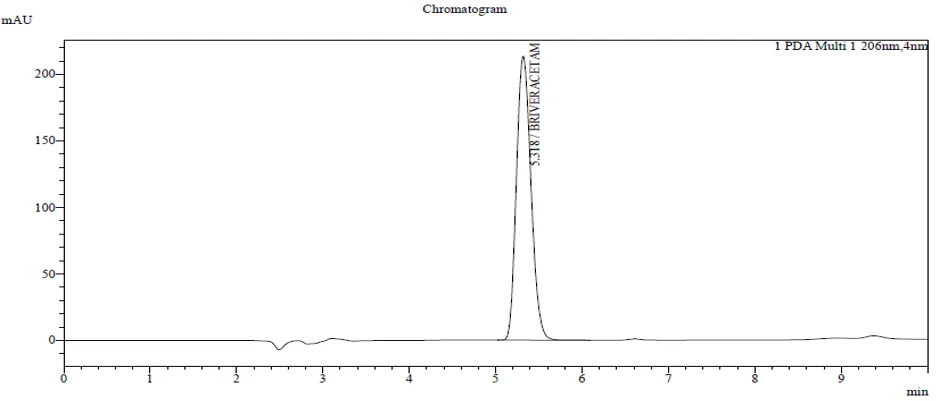
Robustness [change in wavelength]
Table 4: Robustness
|
|
Retention time |
Area |
Theoretical plate |
Tailing factor |
|
Change in mobile phase |
5.970 |
2173107 |
4779 |
1.16 |
|
Change in wavelength |
5.318 |
2104218 |
4626 |
1.178 |
Ruggedness:
Table 5: Ruggedness
|
Analyst |
Average percentage |
Average standard area |
SD |
%RSD |
|
Analyst-1 |
97.7595 |
2170185.667 |
2562.019 |
0.11805 |
|
Analyst-2 |
97.5726 |
2175486.333 |
3868.611 |
0.17782 |
CONCULSION
Analytical methods using RP-HPLC were successfully developed for estimation of Brivaracetam.
The developed methods were validated with various parameters like accuracy, precision, linearity, robustness, ruggedness, interday precision etc,. as per ICH guidelines. The results obtained were within the limits of Indian pharmacopoeia (IP).
The simple, rapid, accurate and an isocratic RP-HPLC method showed excelled sensitivity, reproducibility, accuracy, and repeatability. Hence it is suggested that the proposed an isocratic RP-HPLC method can be effectively applied for the routine quality control analysis of the drug Brivaracetam in bulk and in tablet formulation.
REFERENCES




R. Tamilselvan, Dr. S. k. Senthil Kumar, C. Lakshmi, P. S. Lokesh, K. Loshni, P. Mahathi, K. Mathivanan, Development and Validation of a Reverse-Phase High Performance Liquid Chromatography (Rp-HPLC) Method for The Quantitative Determination of Brivaracetam in Bulk Drug and Tablet Dosage Forms, Int. J. of Pharm. Sci., 2026, Vol 4, Issue 6, 6583-6593. https://doi.org/10.5281/zenodo.20911383
 10.5281/zenodo.20911383