

We use cookies to ensure our website works properly and to personalise your experience. Cookies policy
Department of Quality Assurance, Indore Institute of Pharmacy, Pithampur road, Opposite to IIM, Rau, Indore, Madhya Pradesh, Pin code – 453331, India.
A simple, accurate, as well as precise Reverse Phase High-Performance Liquid Chromatography (RP-HPLC) method was developed to estimate Glimepiride in pharmaceutical dosage forms with bulk. For optimization regarding retention time as well as peak characteristics, different columns, mobile phase ratios, and flow rates were used in various chromatographic trials. Optimal conditions were reached by an Xterra ODS C18 column (150 mm × 4.6 mm, 5 µm), using a mobile phase of Water: Acetonitrile (60:40 v/v) plus a flow rate of 0.8 mL/min. A sharp symmetric peak occurred, with a 2.9-minute retention time. The ICH guidelines validated the method in terms of specificity, accuracy, precision, and linearity. They also validated the method for system suitability. The technique is efficient, so it is suitable for routine quality control. It applies to Glimepiride as a bulk and formulation.
First introduced back in 1995, glimepiride improves upon glycaemic control and manages type 2 diabetes mellitus (T2DM) as it is a member of the second-generation sulfonylurea (SU) class of drugs. Type 2 diabetes is a metabolic disorder of sorts. It is becoming more common globally. Glimepiride stimulates the secretion of insulin granules from pancreatic beta cells by way of blocking ATP-sensitive potassium channels (KATP channels) as well as causing depolarization of the cells. Compared to glipizide, another second-generation SU drug, glimepiride has a longer duration of action. Because it has more substitutions than other second-generation SUs, it is occasionally categorised as a third-generation SU. In clinical trials, glimepiride was linked to a decreased risk of weight gain and hypoglycaemia when compared to other SUs. [1,2]. Glimepiride, also known as 3-ethyl-4-methyl-N-(1-(4-(2-(methylamino)-2-oxoethyl) phenyl) sulfonyl)-2-oxo-2,5-dihydro-1H-pyrrole-1-carboxamide, is a second-generation sulfonylurea antidiabetic agent. Because of its capacity to increase the secretion of insulin from pancreatic β-cells, it is frequently prescribed for the treatment of Type 2 diabetes mellitus. [3,4,5]. Glimepiride exhibits lipophilic properties and has moderate solubility in methanol and ethanol, but limited solubility in water. These physicochemical characteristics render it amenable to detection via reverse-phase chromatography. Because it only needs a small amount (usually 1–4 mg per tablet) and has a narrow therapeutic index, it is very important to measure it accurately in pharmaceutical quality control.[6]
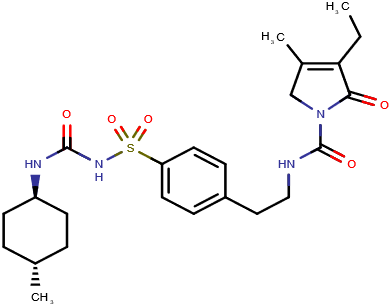
Figure no. 1: Structure of Glimepiride
Glimepiride is metabolized in the liver to form two main metabolites: M1 (cyclohexyl hydroxymethyl derivative) and M2 (carboxyl derivative). M1 is formed via oxidative biotransformation by the CYP2C9 enzyme, and it's pharmacologically active. M2 is formed from M1 by cytosolic enzymes and is pharmacologically inactive.[7]
was first approved by the U.S. Food and Drug Administration (FDA) in 1995 under the brand name Amaryl®, developed by Aventis Pharmaceuticals (now part of Sanofi) [8]. Since its approval, it has gained regulatory clearance from several major agencies, including the European Medicines Agency (EMA) and the Central Drugs Standard Control Organization (CDSCO), India, for oral administration either as monotherapy or in combination with other hypoglycaemic agents.[9]
Glimepiride is officially recognized in multiple pharmacopoeias, including the United States Pharmacopeia (USP) and the Indian Pharmacopoeia (IP), where it is listed under oral hypoglycaemic agents for quality control and assay purposes. The drug continues to be a cornerstone in diabetes therapy due to its efficacy, safety, and once-daily dosing advantage [10]
Glimepiride, a sulfonylurea, lowers blood sugar by stimulating the release of insulin from pancreatic beta cells and improving insulin sensitivity in peripheral tissues. It works by closing ATP-sensitive potassium channels in beta cells, leading to depolarization, calcium influx, and subsequently, insulin exocytosis.[9]
The R&D Department of Axiom Analytical Services, Rau, Indore, supplied the Glimepiride API, which Rusan Pharma Ltd., Pithampur, Indore produced. Rankem Laboratory Chemicals provides HPLC-grade water, whereas Advent Chembio Pvt. Ltd. provides HPLC-grade acetonitrile.
The chromatographic analysis was carried out using a Waters Alliance 2695 HPLC system equipped with a Photodiode Array (PDA) Detector 2998 and controlled through Empower 3 software. The system included an automatic injector and a quaternary gradient pump capable of delivering precise and reproducible solvent flow.
The separation of Glimepiride was achieved on a Waters Xterra ODS C18 column (150 mm × 4.6 mm, 5 µm particle size). The mobile phase consisted of Water and Acetonitrile in the ratio of 60:40 (v/v). The flow rate was maintained at 0.8 mL/min, and the detection was performed at a wavelength of 228 nm. The injection volume was set to 10 µL, and the run time for each analysis was 15 minutes. The chromatographic process was carried out at ambient temperature.
Accurately weighed 25 mg of Glimepiride was transferred into a 100 mL volumetric flask. Dissolved using 70 mL of methanol and sonicated. Final volume was made up to 100 mL with methanol, yielding a concentration of 250 µg/mL (250 ppm).
Accurately weighed 25 mg of Glimepiride was transferred into a 100 mL volumetric flask. Dissolved using 70 mL of methanol and sonicated. Final volume was made up to 100 mL with methanol, yielding a concentration of 250 µg/mL (250 ppm).
4. Method development: The creation of an effective RP-HPLC method for Glimepiride started with the goal of obtaining a sharp, symmetrical peak that has minimal tailing, a suitable retention time, and high resolution in a short analysis time. Different chromatographic conditions were carefully adjusted to achieve these objectives, including the composition of the mobile phase, the flow rate, the wavelength for detection, and the type of column used.
At first, experiments were performed with various mixtures of water and acetonitrile in ratios ranging from 90:10 to 50:50 (volume to volume). However, the initial results did not meet the desired standards for peak symmetry and retention time. Later, a water: acetonitrile ratio of 60:40 (v/v) was found to produce a clear, sharp peak with minimal tailing and a good number of theoretical plates. A Waters Xterra ODS C18 column (150 × 4.6 mm, 5 µm) was chosen because it offers better retention for compounds with moderate lipophilicity, such as Glimepiride. The flow rate was adjusted to 0.8 mL/min, which provided a good balance between peak resolution and the overall run time. Detection was performed at 228 nm, as this wavelength allowed for a strong absorbance signal from Glimepiride, improving the sensitivity of the method. An injection volume of 10 µL was used, and the total runtime was 10 minutes. Under these conditions, Glimepiride consistently eluted at 2.993 minutes.
|
HPLC System |
WATERS 2695 Alliance with 2996 PDA detector |
|
Column |
Xterra ODS C18 (150 mm × 4.6 mm, 5 µm) |
|
Mobile Phase |
Water: Acetonitrile (HPLC grade) |
|
Diluent |
Methanol
|
|
Wavelength |
228 nm
|
|
Injection Volume |
10 µL
|
|
Column Temperature |
30°C
|
|
Run time |
15 min. |
|
Retention time |
2.993 |
|
Flow rate |
0.3 mL/min |
|
System Suitability |
Tailing factor <2.0 and Theoretical Plates > 2000 |
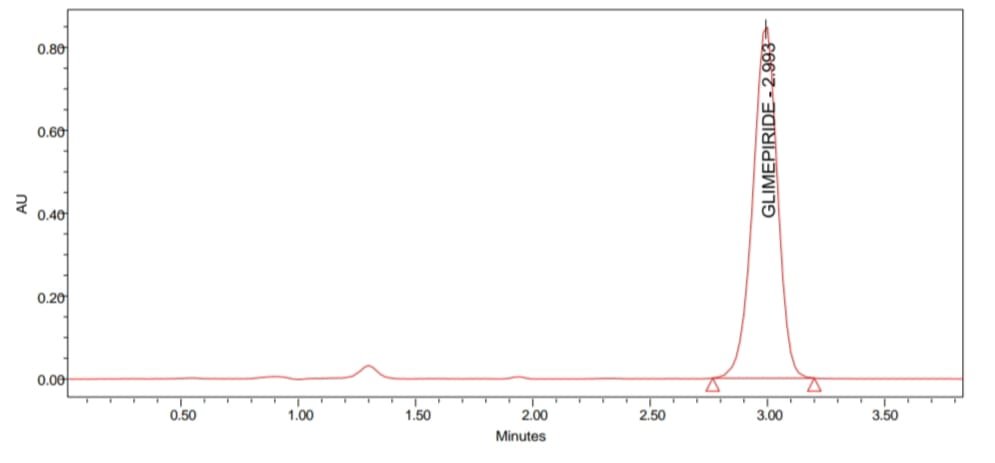
Figure no. 2: Optimized chromatogram of Glimepiride
The developed RP-HPLC method for Glimepiride was validated as per the International Conference on Harmonisation (ICH) Q2(R1) guidelines. The method was assessed for system suitability, specificity, linearity, accuracy, precision, and ensuring it is reliable for routine analysis.
The system's suitability was evaluated by injecting a blank sample and five copies of the standard solution. Key parameters such as retention time, theoretical plates (N), tailing factor (T), and the percentage RSD of peak area were all found to be within the acceptable limits, confirming that the system was functioning properly for further validation steps.
Acceptance criteria:
Table: System Suitability of Glimepiride
|
Standard Solution |
Retention time |
USP Tailing Factor (< 2) |
USP Plate Count (> 2000) |
Peak Area of Glimepiride |
|
Standard solution 1 |
2.983 |
0.94 |
3352 |
6230152 |
|
Standard solution 2 |
2.978 |
0.93 |
3528 |
6215783 |
|
Standard solution 3 |
2.981 |
0.95 |
3578 |
6194726 |
|
Standard solution 4 |
2.982 |
0.91 |
3459 |
6204751 |
|
Standard solution 5 |
2.979 |
0.95 |
3385 |
6217319 |
|
|
|
|
|
|
|
Mean |
2.9806 |
|
|
6212546 |
|
SD (±) |
0.002074 |
|
|
13430.8 |
|
% RSD (< 2%) |
143737.3 |
|
|
46255.97 |
Table: Specificity of Glimepiride
|
Sr. No. |
Injection |
Observation (Interference) |
Result |
Assay (%) |
|
1 |
Blank (Diluent) |
No peak found at analyte RT |
No interference |
99.89% |
|
2 |
Standard Solution |
RT at 2.98 min |
Pass |
|
|
3 |
Sample Solution |
RT at 2.97 min |
Pass |
Table: Linearity of Glimepiride
|
(%) Level |
Standard Concentration (µg/ml) |
Peak Area |
|
20% |
50 |
1246393 |
|
50% |
125 |
3115981 |
|
80% |
200 |
4985570 |
|
100% |
250 |
6231963 |
|
120% |
300 |
7478355 |
|
150% |
375 |
9348944 |
|
Correlation coefficient (r2) |
0.9999 |
|
Table: Precision of Glimepiride:
|
Sample |
Sample wt. mg |
Glimepiride |
Assay (%) |
|
Precision sample-1 |
25.2 |
6230568 |
99.53 |
|
Precision sample-2 |
25.3 |
6215754 |
98.91 |
|
Precision sample-3 |
25.1 |
6194457 |
99.35 |
|
Precision sample-4 |
25.2 |
6204458 |
99.12 |
|
Precision sample-5 |
25.4 |
6217216 |
98.54 |
|
Precision sample-6 |
25.3 |
6198278 |
98.63 |
|
Mean |
|
99.01 |
|
|
SD (±) |
0.393 |
||
|
%RSD (< 2%) |
0.251 |
||
Table: Accuracy of Glimepiride:
|
Spiked amount (%) |
Amount added (mg) |
Amount found (mg) |
Recovery (%) |
Mean recovery (%) |
% RSD |
|
50% |
12.5 |
12.45 |
99.6% |
100.0 |
0.40
|
|
12.5 |
12.55 |
100.4% |
|||
|
12.5 |
12.50 |
100.0% |
|||
|
100% |
25 |
24.85 |
99.4% |
100.0 |
0.40 |
|
25 |
25.05 |
100.2% |
|||
|
25 |
25.10 |
100.4% |
|||
|
150% |
37.5 |
37.10 |
98.9% |
99.7 |
0.60 |
|
37.5 |
37.35 |
99.6% |
|||
|
37.5 |
37.65 |
100.4% |
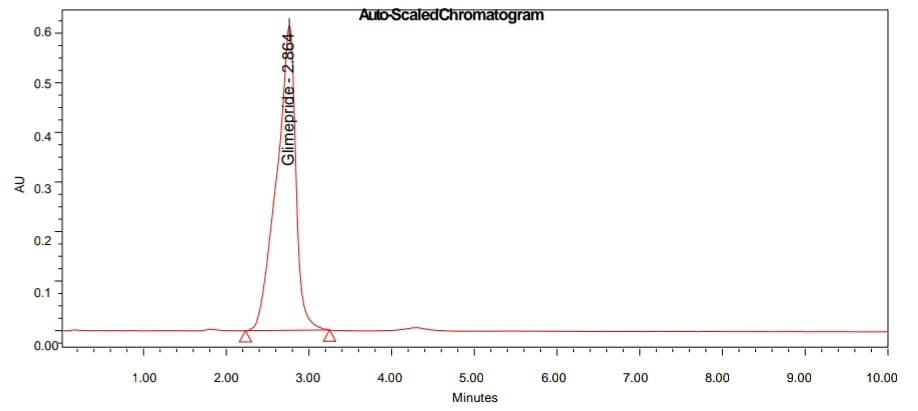
Figure no.3.Chromatogram 50%
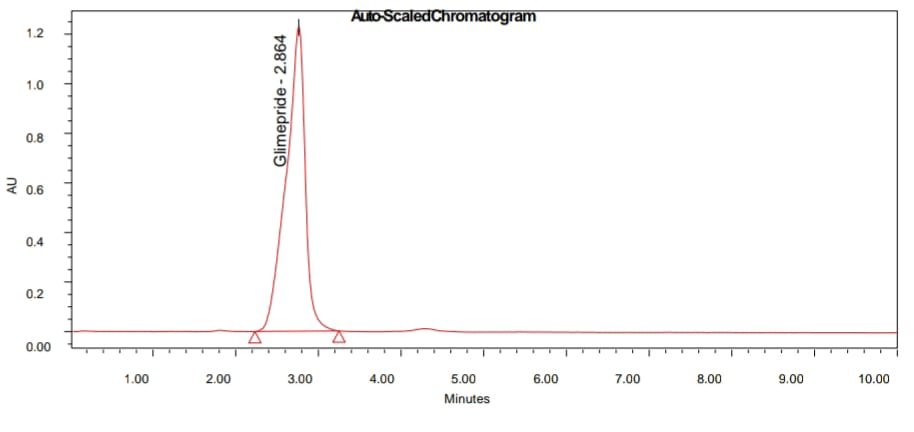
Figure no.3.Chromatogram 50%
RESULTS AND DISCUSSION: The development of the RP-HPLC method for Glimepiride aimed to achieve shorter retention times, high sensitivity, and consistent peak characteristics. Early experiments using standard C18 columns, such as Kromasil and Thermo, with a mobile phase composed of Water and ACN in an 80:20 ratio, resulted in longer retention times of 12. 3 and 7. 2 minutes, respectively. This was due to strong hydrophobic interactions between the analyte and the stationary phase. Through optimization, an Inertsil C18 column was used with a higher flow rate of 1.2 mL/min, leading to a reduced retention time of 5.8 minutes and better peak shape. The most notable improvement came from using an Xterra ODS C18 column, which is 150 mm long, 4.6 mm in diameter, and 5 µm in particle size. This hybrid silica-based column offered improved peak symmetry and mechanical strength. Under the optimized conditions of a Water: ACN ratio of 60:40 and a flow rate of 0. 8 mL/min, the retention time was reduced to 2.9 minutes with excellent peak performance. Validation of the method, following ICH guidelines, confirmed its system suitability, with a retention time of approximately 2.98 minutes, a USP tailing factor below 1.0, and a plate count exceeding 3000. The method also demonstrated specificity, with no interference at the retention time of Glimepiride. It showed high accuracy, with recovery rates ranging from 98. 9% to 100. 4%, and linearity, as evidenced by an r² value greater than 0.999 in the concentration range of 50 to 375 µg/mL. The method also met precision requirements, with a relative standard deviation (RSD) less than 2%. Overall, the conditions from Trial 9 were found to be optimal, offering a fast, dependable, and environmentally friendly method suitable for the routine quality control of Glimepiride.
CONCLUSION: The developed RP-HPLC method for Glimepiride is straightforward, quick, reliable, consistent, and economical, making it very appropriate for regular quality control testing in the pharmaceutical industry. Using a shorter column and a carefully adjusted mobile phase significantly cut down the time needed for analysis without affecting the separation quality or the purity of the peaks. This method improves efficiency and lowers the amount of solvent used, supporting environmentally responsible laboratory practices. In summary, the validated method meets all necessary standards and regulatory guidelines and can be reliably used for measuring Glimepiride in both raw material and finished product forms as part of standard testing procedures or product release checks.
We gratefully thank Axiom Analytical Services for providing a gift sample of Glimepiride.
REFERENCES


Vaishnavi Verma, Dr. Nimita Manocha*, Gyanendra Patel, Dr. Ritesh Patel, Development and Validation of an RP-HPLC Method for the Estimation of Glimepiride in Compliance with Quality Assurance Standards, Int. J. of Pharm. Sci., 2025, Vol 3, Issue 8, 2963-2970 https://doi.org/10.5281/zenodo.16991082
 10.5281/zenodo.16991082