

We use cookies to ensure our website works properly and to personalise your experience. Cookies policy
Department of Clinical pharmacy, Sri Ramakrishna Hospital, Coimbatore
Adverse cutaneous drug reactions are an important clinical entity requiring identification of the offending agent to prevent recurrence. Finasteride, a 5-alpha-reductase inhibitor commonly prescribed for benign prostatic hyperplasia (BPH), is generally well tolerated but rarely associated with hypersensitivity reactions. We report the case of a 72-year-old male who developed a generalized erythematous rash resembling erythema centrifugum during treatment for right epididymo-orchitis; initially, the reaction was attributed to amikacin, but further evaluation revealed finasteride as the causative agent, and cessation of finasteride led to resolution of lesions, confirming a finasteride-induced hypersensitivity reaction. To our knowledge, this is only the second documented case of a finasteride-induced erythema annulare centrifugum-like eruption worldwide, and the first in a patient using the drug for BPH rather than androgenetic alopecia; unlike the original report, in which the diagnosis was relatively straightforward, our patient was concurrently receiving a new intravenous antibiotic for a severe infection, so the eruption was initially — and reasonably — attributed to the antibiotic, and recognizing finasteride as the true cause required a complete medication reconciliation and a structured dechallenge-rechallenge assessment, illustrating a diagnostic pitfall that is broadly relevant whenever a patient develops a new eruption while receiving several recently introduced drugs. This report highlights finasteride as a rare but potential cause of erythema centrifugum-like drug eruptions, and clinicians should maintain a high index of suspicion for such unusual reactions in patients receiving commonly prescribed medications like finasteride.
Erythema annulare centrifugum (EAC) is an uncommon reactive cutaneous disorder characterized by annular, erythematous, centrifugally spreading lesions with central clearing. It is considered a hypersensitivity pattern rather than a distinct disease entity and has been associated with infections, malignancies, autoimmune conditions, and drug exposure. Drug-induced cases are particularly important as they are reversible upon withdrawal of the offending agent but may be misdiagnosed due to overlapping clinical features with other dermatoses.
Drug-induced cutaneous adverse reactions represent a significant proportion of adverse drug reactions encountered in clinical practice, especially in elderly patients receiving multiple medications. Identification of the causative drug is often challenging and relies on careful temporal correlation, exclusion of alternative causes, and response to drug withdrawal (dechallenge) and re-exposure (rechallenge) when ethically appropriate. Pattern-based classification of drug eruptions further aids in diagnosis, as many drugs can produce similar morphologic skin reactions regardless of mechanism.1
Finasteride is a selective inhibitor of 5-alpha reductase commonly used in the management of benign prostatic hyperplasia and androgenetic alopecia. It is generally well tolerated, with most adverse effects being mild and related to sexual dysfunction. However, rare cutaneous adverse drug reactions have been increasingly reported. These include erythema annulare centrifugum, psoriasiform eruptions, urticaria, fixed drug eruptions, vasculitis, and other hypersensitivity patterns, suggesting a wider spectrum of dermatological involvement than previously recognized.
LITERATURE REVIEW
Finasteride-induced cutaneous reactions are rare but increasingly recognized. Documented reports include:
These cases reveal finasteride's capacity to elicit diverse hypersensitivity manifestations ranging from mild to systemic involvement.
MATERIALS & METHODS
A 72-year-old male presented with painful right testicular swelling and fever with chills for four days. He had a known history of benign prostatic hyperplasia (BPH) and was recently started on a combination drug of finasteride 5 mg + tamsulosin 0.4 mg.
He was diagnosed clinically and radiologically with right epididymo-orchitis with funiculitis and commenced on intravenous meropenem and amikacin. Within 24 hours, he developed a generalized erythematous rash with concentric rings, predominantly over the trunk and limbs, resembling erythema centrifugum (Figure 1). Clinical photographs were obtained with the patient's consent approximately 12 hours after onset of the eruption, at the time of maximal lesion extent and prior to initiation of dechallenge.
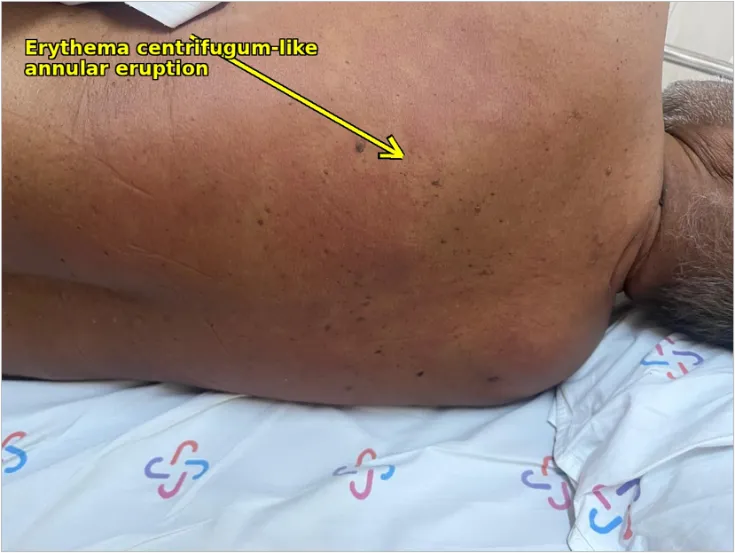
Figure 1. Erythema centrifugum-like eruption, 12 hours after onset.
Photograph of the right flank/trunk showing a blanching, erythematous-to-violaceous annular patch with partial central clearing and an actively spreading, slightly raised border (arrow), consistent with a centrifugally expanding figurate erythema. The eruption developed within 24 hours of finasteride-tamsulosin initiation and coincided with the start of intravenous amikacin, which was the agent initially suspected.
Amikacin-induced hypersensitivity was initially suspected; the drug was discontinued while steroids and antihistamines were initiated. However, upon rechallenge with amikacin under supervision, no reaction occurred. A review of recent medications identified the initiation of finasteride as a coinciding factor.
Finasteride-tamsulosin combination was withheld, and cutaneous lesions regressed completely within 72 hours, indicating a hypersensitivity reaction to finasteride rather than the antibiotic.
RESULT
Following cessation of finasteride, the patient's rash resolved without recurrence. He completed the antibiotic course uneventfully, and follow-up at two weeks confirmed complete resolution of erythematous lesions and no residual hyperpigmentation.
Summary Table:
|
Parameter |
Observation |
|
Age/Sex |
72/Male |
|
Diagnosis |
Right epididymo-orchitis with funiculitis |
|
Suspected Drug |
Amikacin → Ruled out |
|
Confirmed Causative Drug |
Finasteride (Veltam F) |
|
Skin Lesion Type |
Erythema centrifugum-like rash |
|
Reaction Outcome |
Complete recovery after drug withdrawal |
|
Time to Onset |
Within 24–48 hours of starting finasteride |
|
Management |
Drug withdrawal, oral steroids, antihistamines |
DISCUSSION
Finasteride is generally regarded as a well-tolerated agent, and post-marketing surveillance has traditionally emphasized its endocrine and sexual adverse effects over cutaneous ones. Against that background, the eruption in the present case — a generalized erythematous rash with concentric, centrifugally expanding rings and partial central clearing — is notable for closely mimicking erythema centrifugum (annulare), a reactive erythema more classically attributed to occult infection, internal malignancy, or autoimmune disease than to a routinely prescribed benign prostatic hyperplasia medication.
Drug-induced erythema annulare centrifugum remains one of the least common recognized triggers of this reaction pattern. In one of the largest recent retrospective analyses of the condition, medications accounted for only a small fraction of identified precipitants, well behind infections and malignancy.11 This relative rarity likely contributes to the diagnostic delay and misattribution that frequently accompany drug-induced EAC, including in our patient, where the concurrently administered intravenous antibiotic was — understandably — the first agent suspected.
Establishing finasteride, rather than amikacin, as the true offending agent depended on more than temporal association alone. Sequential dechallenge — discontinuation of the suspected antibiotic without resolution of the eruption, followed by supervised antibiotic rechallenge without recurrence — effectively excluded amikacin, while withdrawal of finasteride was followed by complete resolution within 72 hours. Applying a structured causality framework such as the Naranjo Adverse Drug Reaction Probability Scale to this sequence — a plausible temporal relationship, resolution on withdrawal, absence of recurrence with the alternative agent, and no other identifiable cause — situates the reaction in the probable-to-definite range, lending objective, reproducible support to the clinical reasoning used to identify finasteride rather than relying on temporal correlation alone.12
Immunologically, finasteride-associated eruptions are believed to involve a CD8+ T-cell–mediated delayed-type hypersensitivity response, as proposed for finasteride-induced fixed drug eruption and acute localized exanthematous pustulosis.4,5 The breadth of cutaneous phenotypes attributed to finasteride in the literature — urticaria,6 maculopapular exanthema,7 cutaneous vasculitis,3 psoriasiform dermatitis,2 and photosensitivity10 — suggests that the drug, or an immunogenic metabolite, may act as a hapten capable of engaging multiple, host-dependent immune pathways rather than producing a single stereotyped reaction. A 2025 pharmacovigilance analysis of the FDA Adverse Event Reporting System corroborates this, confirming cutaneous eruptions as a genuine, if infrequent, class of finasteride-related adverse events across a large real-world population.8
Within this spectrum, an EAC-like presentation remains exceptionally rare. To our knowledge, only Al Hammadi et al. have previously documented finasteride-induced erythema annulare centrifugum, in a younger patient treated for androgenetic alopecia, with recurrence confirmed on rechallenge.9 The present case extends this observation to a substantially different clinical setting — an elderly man receiving finasteride for BPH while being treated for a severe urogenital infection — and suggests that this reaction pattern is not restricted to a particular indication, dose, or patient demographic.
This case also illustrates a broader diagnostic principle relevant to hospitalized, polypharmacy patients: the most recently escalated or historically most notorious agent — here, an aminoglycoside antibiotic — is not always the true culprit behind a new eruption. A systematic medication reconciliation encompassing all recently introduced drugs, including those started for unrelated indications shortly before hospitalization, was essential to correctly identifying finasteride and avoiding unnecessary discontinuation of a clinically necessary antibiotic.
This report has limitations inherent to a single case. Skin biopsy, patch testing, and lymphocyte transformation testing were not performed, so the diagnosis rests on clinical morphology, temporal correlation, and response to dechallenge rather than histological or immunological confirmation. As with any single case report, causality — however well supported — cannot establish population-level incidence, and publication bias likely means that milder or self-resolving finasteride-associated eruptions are under-reported.
CONCLUSION
This case adds finasteride to the differential of drugs capable of inducing an erythema centrifugum-like eruption and reinforces that such reactions, though rare, are readily reversible once the offending agent is identified and withdrawn. In a patient receiving multiple new medications for an acute infection, clinicians should resist the reflex assumption that the most recently escalated or most pharmacologically 'notorious' drug is automatically responsible for a new eruption; a complete medication history, careful dechallenge, and — where clinically appropriate — supervised rechallenge of the alternative suspect remain the most reliable tools for correct attribution.
Recognizing finasteride-induced hypersensitivity, including atypical figurate patterns such as erythema centrifugum, can prevent unnecessary discontinuation of essential antimicrobial therapy, shorten diagnostic delay, and spare patients avoidable morbidity. Given the widespread use of finasteride for both benign prostatic hyperplasia and androgenetic alopecia, we encourage clinicians encountering similar eruptions to report them to national pharmacovigilance systems, which will help refine the true incidence and clinical spectrum of this uncommon but clinically significant adverse reaction.
ACKNOWLEDGEMENT: None
SOURCE OF FUNDING: None
CONFLICT OF INTEREST: No conflicts of interest declared.
REFERENCES

Dr. Pricilla Vincent, Erythema Centrifugum: The Unexpected Hidden Cause, Int. J. of Pharm. Sci., 2026, Vol 4, Issue 8, 1440-1445. https://doi.org/10.5281/zenodo.21842739
 10.5281/zenodo.21842739