

We use cookies to ensure our website works properly and to personalise your experience. Cookies policy
1 Department of Pharmaceutics, D.S.T.S. Mandal’s College of Pharmacy, Solapur, 413004, Maharashtra, India.
2 Department of Pharmacognosy, D.S.T.S. Mandal’s College of Pharmacy, Solapur, 413004 Maharashtra, India.
3 Department of Pharmaceutics, D.S.T.S. Mandal’s College of Pharmacy, Solapur, 413004, Maharashtra, India.
4 Department of Chemistry, Dr. Shivajirao Kadam College of Pharmacy, Kasabe Digraj, Sangali, Maharashtra, India, 416301
This study focuses on the formulation and evaluation of teneligliptin-loaded microbeads using fenugreek (Trigonella foenum-graecum) seed mucilage as a natural controlled-release polymer. Teneligliptin, a dipeptidyl peptidase-4 (DPP-4) inhibitor widely used in the management of type 2 diabetes mellitus, is a BCS Class II drug with a short half-life that necessitates frequent dosing, reducing patient compliance. Microbeads were prepared using the ionic gelation technique with fenugreek seed mucilage (FSM) in combination with sodium alginate, calcium chloride as a cross-linking agent, and microcrystalline cellulose. A 3² factorial design was employed, with FSM and calcium chloride concentrations as independent variables, to optimize the entrapment efficiency and in vitro drug release. The nine formulated batches (F1–F9) exhibited entrapment efficiencies of 98.67–99.36%, drug loading of 3.30–4.34%, particle sizes of 632.70–901.68 µm, polydispersity indices of 0.197–0.722, and zeta potentials of ?19.0 to ?32.0 mV. Fourier-transform infrared (FTIR) and differential scanning calorimetry (DSC) analyses confirmed drug–excipient compatibility, and scanning electron microscopy (SEM) revealed spherical, smooth-surfaced beads. The optimized batch, F1, showed the highest entrapment efficiency (99.36%) and a sustained cumulative drug release of 85.05% over 12 hours, best fitted to the zero-order kinetic model (R² = 0.9978). Batch F1 was successfully encapsulated in size '0' hard gelatine capsules and retained its controlled-release performance on stability testing. These findings demonstrate that fenugreek seed mucilage is an effective, biocompatible, and low-cost natural polymer for developing a sustained-release oral delivery system for Teneligliptin, with potential to improve therapeutic outcomes and patient adherence in type 2 diabetes management.
Diabetes mellitus is a chronic metabolic disorder characterized by hyperglycemia due to defects in insulin secretion, insulin action, or both. Type 2 diabetes mellitus (T2DM) accounts for over 90% of all diabetes cases worldwide, and its global prevalence continues to rise; the International Diabetes Federation estimated that 830 million people were living with diabetes in 2022, a figure projected to increase substantially in the coming decades. Chronic hyperglycemia leads to microvascular (retinopathy, nephropathy, and neuropathy) and macrovascular (cardiovascular, cerebrovascular, and peripheral vascular) complications, underscoring the need for effective and well-tolerated glycemic control strategies [1-3].
Dipeptidyl peptidase-4 (DPP-4) inhibitors, such as teneligliptin, improve glycemic control by prolonging the activity of incretin hormones, thereby enhancing glucose-dependent insulin secretion and suppressing glucagon release. Teneligliptin is favoured for its efficacy, tolerability, and suitability in patients with renal impairment; however, it belongs to BCS Class II, exhibiting low aqueous solubility, and its relatively short half-life necessitates frequent dosing, which can compromise patient compliance in a disease that requires life-long therapy.
Controlled-release drug delivery systems offer a means of maintaining stable plasma drug concentrations, reducing dosing frequency, and improving compliance. While synthetic polymers, such as hydroxypropyl methylcellulose (HPMC) and ethyl cellulose, are conventionally used for this purpose, they are relatively costly and may be associated with adverse effects. Natural polymers, which are biocompatible, biodegradable, and economical, are being increasingly explored as alternatives. Fenugreek (Trigonella foenum-graecum) seed mucilage is one such polysaccharide, rich in galactomannan, that exhibits swelling, gelling, and sustained-release properties, and has additionally been reported to possess intrinsic antidiabetic activity, raising possibility of synergistic effect when combined with antidiabetic drug such as teneligliptin [9-15].
Microbeads prepared via ionic gelation are a well-established platform for controlled oral drug delivery owing to their simplicity, mild processing conditions, and scalability. In this study, teneligliptin-loaded microbeads were formulated using fenugreek seed mucilage as the primary controlled-release polymer, sodium alginate as a co-gelling agent, calcium chloride as a cross-linker, and microcrystalline cellulose as a stabilizer. A 3² factorial design was applied to systematically optimize the formulation, and the resulting microbeads were characterized for their physicochemical properties, in vitro release behavior, and stability, with the optimized batch further evaluated as an encapsulated hard gelatine capsule dosage form [8,10,14].
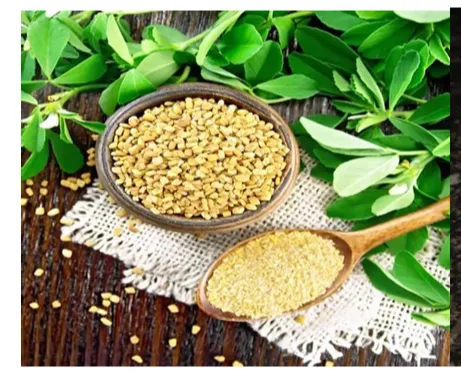
Figure 1: Fenugreek seeds
MATERIALS AND METHODS
Materials
Teneligliptin hydrobromide hydrate was procured from Soujanya Life Sciences Pvt. Ltd. (Navi Mumbai, India). Fenugreek seeds were procured from a local market (Nasrapur, Bhor, Pune). Sodium alginate and calcium chloride were obtained from Research Lab Fine Chem Industries (Mumbai, India), and microcrystalline cellulose was procured from SISCO Research Laboratories (Mumbai, India). All other chemicals and reagents used were of analytical grade.
Isolation of Fenugreek Seed Mucilage (FSM)
Fenugreek seed mucilage was isolated from fenugreek seeds, and its percentage yield was calculated as: Percentage yield = (weight of extracted mucilage ÷ initial weight of fenugreek seeds) × 100. The isolated mucilage was characterized for organoleptic properties and screened for phytochemical constituents (carbohydrates, proteins, amino acids, flavonoids, alkaloids, tannins/phenols, and saponins) using standard qualitative reagent tests (Molisch's, Biuret, Ninhydrin, Shinoda, Mayer's, ferric chloride, and foam tests) [9].
Pre-formulation Studies
The organoleptic properties of teneligliptin were also examined. The solubility was determined using the shake-flask method in distilled water, phosphate buffer pH 6.8, and 0.1 N HCl using a UV-visible spectrophotometer at the respective λmax of the drug in each medium. The melting point was determined using the capillary method with a Thiele tube. The absorption maximum (λmax) of teneligliptin was determined by scanning a standard solution over 200–400 nm using a double-beam UV-visible spectrophotometer (JASCO V-730), and calibration curves were constructed for each medium. Drug–excipient compatibility was assessed by FTIR (4000–400 cm?¹) and differential scanning calorimetry (30–300 °C at 10 °C/min under nitrogen) for the pure drug, individual excipients, and their physical mixtures [8,10].
Experimental Design
A 3² factorial design was applied using Design-Expert software (version 13) to study the effect of FSM concentration (X1: 75, 100, 125 mg) and calcium chloride concentration (X2: 2.5, 3.0, 3.5 g) on entrapment efficiency and in vitro drug release as dependent responses. Nine batches (F1–F9) were prepared and evaluated; the model was analyzed using ANOVA, and response surface, contour, predicted-vs-actual, and perturbation plots were generated to identify significant factors and interactions.
Table 1. Composition of teneligliptin-loaded microbead batches (F1–F9) according to the 3² factorial design.
|
Batch |
Teneligliptin (mg) |
FSM (mg) |
MCC (mg) |
Calcium chloride (g) |
Sodium alginate (mg |
|
F1 |
100 |
75 |
100 |
2.5 |
100 |
|
F2 |
100 |
100 |
100 |
2.5 |
100 |
|
F3 |
100 |
125 |
100 |
2.5 |
100 |
|
F4 |
100 |
75 |
100 |
3 |
100 |
|
F5 |
100 |
100 |
100 |
3 |
100 |
|
F6 |
100 |
125 |
100 |
3 |
100 |
|
F7 |
100 |
75 |
100 |
3.5 |
100 |
|
F8 |
100 |
100 |
100 |
3.5 |
100 |
|
F9 |
100 |
125 |
100 |
3.5 |
100 |
Preparation of Teneligliptin-Loaded Microbeads
Microbeads were prepared via ionic gelation. Fenugreek seed mucilage and sodium alginate were dissolved in water to form a polymer solution, into which teneligliptin was uniformly dispersed, followed by the incorporation of microcrystalline cellulose. The resulting mixture was added dropwise to a 2% (w/v) calcium chloride solution to induce bead formation via ionic cross-linking. The formed beads were cured under stirring for 30–60 min, filtered, washed to remove excess calcium ions, dried in a hot-air oven/desiccator, and stored for further evaluation.
Evaluation of Microbeads
The prepared microbeads were evaluated for percentage yield, entrapment efficiency, and drug loading (by dispersing 50 mg beads in phosphate buffer pH 6.8, centrifuging, and analyzing the supernatant at 244 nm); particle size, polydispersity index, and zeta potential (by dynamic light scattering); swelling behavior (gravimetrically in phosphate buffer pH 6.8 at 37 ± 0.5 °C); and surface morphology by scanning electron microscopy (SEM) of the optimized batch. In vitro drug release was studied using a USP Type I (basket) apparatus in 0.1 N HCl (pH 1.2) for the first 2 h, followed by phosphate buffer (pH 6.8) for the subsequent 10 h, at 37 ± 0.5 °C and 100 rpm, with samples analyzed by UV-visible spectrophotometry at 244 nm. Release data were fitted to zero-order, first-order, Higuchi, Korsmeyer–Peppas, and Hixson–Crowell kinetic models to elucidate the release mechanisms.
Encapsulation and Evaluation of Capsules
The optimized batch was manually filled into size '0' hard gelatine capsules and evaluated for shape and size, weight variation, disintegration time, and in vitro drug release under the same dissolution conditions described above. Stability studies of both the optimized microbeads and filled capsules were performed for one month (0, 15, and 30 days) according to the ICH guidelines, monitoring entrapment efficiency, weight variation, and drug release profile.
RESULTS AND DISCUSSION
Pre-formulation Studies
Teneligliptin appeared as a white to off-white, crystalline, free flowing, odourless, slightly bitter powder, while the isolated fenugreek seed mucilage was a light brown to yellowish-brown, slightly bitter powder that formed a smooth, sticky dispersion in water. Phytochemical screening confirmed the presence of carbohydrates, proteins, amino acids, flavonoids, alkaloids, tannins/phenols, and saponins in the mucilage, consistent with its identity as a polysaccharide-rich natural gum. The extraction yield of FSM from fenugreek seeds was 10% (25 g mucilage from 250 g of seeds).
Teneligliptin showed maximum solubility in distilled water (17.17 µg/mL, λmax 246 nm), followed by phosphate buffer pH 6.8 (15.42 µg/mL, λmax 244 nm), and 0.1 N HCl (13.59 µg/mL, λmax 248 nm), each with high linearity (R² = 0.96–0.99), confirming the drug's BCS Class II solubility-limited character. The observed melting point (206–210 °C, mean of three determinations) was close to the IP-reported value (211 °C), confirming drug purity. The calibration curve constructed in phosphate buffer pH 6.8 (y = 0.0648x + 0.0009, R² = 0.9989) obeyed the Beer–Lambert law and was used for subsequent quantitative release analysis. FTIR and DSC studies of the physical mixtures showed retention of the characteristic drug peaks and thermal transitions without the appearance of new peaks or significant shifts, indicating the absence of any major drug–excipient interaction.
Percentage Yield, Entrapment Efficiency, and Drug Loading
Table 2. Percentage yield, entrapment efficiency, and drug loading of batches F1–F9
|
Batch |
Theoretical yield (mg) |
Practical yield (mg) |
Yield (%) |
Entrapment efficiency (% |
Drug loading (%) |
|
F1 |
2875 |
2300 |
80 |
99.36 |
4.32 |
|
F2 |
2900 |
2378 |
82 |
99.12 |
4.16 |
|
F3 |
2925 |
2281 |
78 |
99.04 |
4.34 |
|
F4 |
3375 |
2463 |
73 |
99.09 |
4.02 |
|
F5 |
3400 |
2992 |
88 |
99.02 |
3.3 |
|
F6 |
3425 |
273 |
79 |
99.11 |
3.63 |
|
F7 |
3875 |
2710 |
69 |
99.05 |
3.68 |
|
F8 |
3900 |
2690 |
68 |
98.76 |
3.67 |
|
F9 |
3925 |
2860 |
72 |
98.67 |
3.45 |
The percentage yield ranged from 68% (F8) to 88% (F5). The entrapment efficiency was consistently high across all batches (98.67–99.36%), reflecting efficient drug encapsulation, with drug loading ranging from 3.30% (F5) to 4.34% (F3). Batch F1 showed the highest entrapment efficiency (99.36%), attributable to an optimal FSM-to-cross-linker ratio that minimized drug loss during bead formation, identifying it as the leading candidate for further development.
3.3. Particle Size, Polydispersity Index, and Zeta Potential
Table 3. Particle size, polydispersity index, and zeta potential of batches F1–F9.
|
Batch |
Particle size (µm) |
Polydispersity index |
Zeta potential (mV) |
|
F1 |
871.48 |
0.623 |
-22.4 |
|
F2 |
641.23 |
0.417 |
-25.6 |
|
F3 |
739.01 |
0.39 |
-30. |
|
F4 |
842.8 |
0.722 |
-21.5 |
|
F5 |
639.04 |
0.59 |
-26.2 |
|
F6 |
898.3 |
0.197 |
-32 |
|
F7 |
901.68 |
0.704 |
-19 |
|
F8 |
632.7 |
0.364 |
-24.8 |
|
F9 |
792.86 |
0.639 |
-28.9 |
The particle size ranged from 632.70 µm (F8) to 901.68 µm (F7), with polydispersity indices between 0.197 and 0.722, indicating moderate-to-good size uniformity. The zeta potential values ranged from −19.0 mV (F7) to −32.0 mV (F6); the consistently negative charge, contributed by the carboxylate groups of alginate and FSM, indicates adequate electrostatic stabilization of the bead dispersions.
Swelling Behaviour
Swelling percentage increased progressively with exposure time across all batches, ranging from 89.0% (F2) to 96.8% (F9), consistent with the hydrophilic, water-uptake character of FSM. Higher FSM content correlated with greater water absorption, which in turn supports a more prolonged, diffusion-mediated drug release.
In Vitro Drug Release and Kinetics
Cumulative drug release was studied over 12 h (2 h in 0.1 N HCl followed by 10 h in phosphate buffer pH 6.8). Batch F1 exhibited a sustained, controlled release profile, with cumulative release increasing from 9.55% at 1 h to 85.05% at 12 h and was therefore selected as the optimized batch. Fitting of the release data to kinetic models showed the best fit with the zero-order model (R² = 0.9978), indicating a constant, concentration-independent release rate. The first-order, Higuchi, and Korsmeyer–Peppas models gave comparatively lower correlations, suggesting a release process governed predominantly by polymer relaxation/erosion with a contribution from diffusion. Hixson–Crowell analysis (R² = 0.9667) further supported a component of surface area- and dissolution-dependent release, consistent with the gradual erosion of the FSM–alginate matrix.
Statistical Optimization
ANOVA of the 3² factorial design confirmed that FSM concentration exerted a statistically significant effect (p < 0.05) on both entrapment efficiency and drug release, validating the experimental design. Response surface, contour, predicted-vs-actual, and perturbation plots were used to visualize and confirm these factor effects and the adequacy of the fitted quadratic models.
Surface Morphology (SEM) and Compatibility of the Optimized Batch
SEM imaging of the optimized batch (F1) revealed discrete, spherical microbeads with smooth surfaces and uniform morphology. FTIR and DSC analyses of the optimized formulation showed retention of the characteristic drug peaks and thermal events without evidence of new peak formation or major shifts, confirming that teneligliptin remained chemically compatible with FSM, sodium alginate, calcium chloride, and microcrystalline cellulose after microbead formation.
Encapsulation and Stability
The optimized F1 microbeads, filled into size '0' hard gelatine capsules, met pharmacopoeial requirements for weight variation, shape/size uniformity, and disintegration time, while retaining a controlled-release dissolution profile equivalent to that of the unencapsulated microbeads. During stability testing (0, 15, and 30 days), both the optimized microbeads and filled capsules retained their entrapment efficiency and drug release characteristics, indicating that the formulation was physically and chemically stable under the tested storage conditions.
CONCLUSION
Teneligliptin-loaded controlled-release microbeads were successfully developed and optimized using fenugreek seed mucilage, a natural, biocompatible, and biodegradable polymer, via ionic gelation and a 3² factorial design. The optimized batch (F1) exhibited a high entrapment efficiency (99.36%), narrow particle size distribution, stable zeta potential, spherical smooth-surfaced morphology, and a sustained release of 85.05% teneligliptin over 12 h following zero-order kinetics. Statistical analysis confirmed the significant influence of FSM concentration on formulation performance, and the optimized microbeads retained their controlled-release characteristics after encapsulation in hard gelatin capsules and short-term stability testing. These findings support fenugreek seed mucilage as a promising, low-cost natural alternative to synthetic polymers for oral sustained-release delivery of teneligliptin, with potential to improve glycemic control and patient compliance in type 2 diabetes mellitus. Further in vivo pharmacokinetic, toxicological, and scale-up studies are required prior to clinical translation.
ACKNOWLEDGEMENT
The authors gratefully acknowledge D.S.T.S. Mandal’s College of Pharmacy, Solapur, for providing the laboratory facilities necessary to carry out this research.
CONFLICT OF INTEREST
The authors declare no conflicts of interest.
REFERENCES


Dinesh Pawar*, Sunil Mathapati, Siddhant Sonavale, Suhas Awati, Exploration of Fenugreek Seed Mucilage as a Natural Polymer for the Formulation and Evaluation of Teneligliptin-Loaded Controlled-Release Microbeads, Int. J. of Pharm. Sci., 2026, Vol 4, Issue 8, 3860-3866. https://doi.org/10.5281/zenodo.22078187
 10.5281/zenodo.22078187