

We use cookies to ensure our website works properly and to personalise your experience. Cookies policy
Konkan Gyanpeth Rahul Dharkar College of Pharmacy and Research Institute, Karjat, Raigad, India 410201
The present study was carried out to formulate and evaluate Diclofenac Sodium emulgel using xanthan gum as a gelling agent for topical drug delivery. Diclofenac Sodium is a widely used non-steroidal anti-inflammatory drug (NSAID) employed in the treatment of pain and inflammation. The topical route is preferred as it provides localized action and helps reduce the side effects associated with oral administration. Emulgels, which combine the properties of emulsions and gels, have emerged as a promising drug delivery system due to their ease of application, improved stability, and enhanced patient acceptability. In the present work, Diclofenac Sodium was incorporated into an oil-in-water emulsion, which was further converted into an emulgel using different concentrations of xanthan gum. The prepared formulations were evaluated for various physicochemical parameters such as appearance, homogeneity, pH, viscosity, spread ability, drug content, and in-vitro drug release. The formulations showed good homogeneity and acceptable physical characteristics. Xanthan gum was found to provide suitable viscosity and consistency to the emulgel, thereby improving its overall stability. Among the formulated batches, the optimized formulation exhibited satisfactory physicochemical properties, good spread ability, uniform drug content, and a favourable drug release profile. No evidence of phase separation or instability was observed during the evaluation period. The results of the in-vitro drug release study indicated effective release of Diclofenac Sodium from the emulgel base. Based on the findings of the study, it can be concluded that xanthan gum is a suitable gelling agent for the preparation of Diclofenac Sodium emulgel. The developed formulation demonstrated desirable characteristics and may serve as an effective topical drug delivery system for the management of pain and inflammation.
The management of localized inflammatory conditions, such as arthritis and musculoskeletal injuries, has traditionally relied on Non-Steroidal Anti-Inflammatory Drugs (NSAIDs). However, oral administration of these drugs often leads to systemic side effects, including gastrointestinal irritation and renal complications. To circumvent these issues, topical delivery systems have gained significant traction. [1]
Muscle pain is a common inflammatory condition caused by muscle injury, overuse, strain, or tissue damage. During muscle injury, disruption of muscle fibres and cell membranes occurs, leading to activation of inflammatory pathways. Damaged cells stimulate the release of the enzyme phospholipase A₂ from membrane phospholipids. This enzyme converts membrane phospholipids into arachidonic acid, which acts as a precursor for the synthesis of inflammatory mediators. [2]
Arachidonic acid is further metabolized by cyclooxygenase enzymes (COX-1 and COX-2) through the cyclooxygenase pathway, resulting in the formation of prostaglandins such as PGE₂, PGI₂, and PGF₂α. These prostaglandins play an important role in the development of inflammation and pain by sensitizing pain receptors, increasing vasodilation, and enhancing vascular permeability. As a result, clinical manifestations such as pain, tenderness, swelling, muscle stiffness, and reduced mobility are observed.
Non-Steroidal Anti-Inflammatory Drugs (NSAIDs) are widely used for the treatment of pain and inflammation. NSAIDs exert their pharmacological action mainly by inhibiting cyclooxygenase (COX) enzymes, thereby preventing the conversion of arachidonic acid into prostaglandins. Reduction in prostaglandin synthesis decreases sensitization of nociceptors and suppresses inflammatory responses.
Diclofenac sodium, a commonly used NSAID, inhibits both COX-1 and COX-2 enzymes and effectively reduces inflammation, swelling, and pain associated with musculoskeletal disorders. By lowering prostaglandin levels, NSAIDs provide symptomatic relief, improve mobility, and promote faster recovery from inflammatory conditions. [2]
By delivering the drug directly through the skin, we achieve a high local concentration of the medication while maintaining low plasma levels, thereby drastically reducing the risk of systemic toxicity. Gels are popular for their cooling effect and ease of remove; they often fail to deliver hydrophobic drugs effectively. emulgels have emerged as a superior vehicle for hydrophobic drugs like Diclofenac Sodium. An emulgel is a dual-control release system formed by the incorporation of an emulsion (either oil-in-water or water-in-oil) into a gel base. This hybrid approach allows the formulation to possess the advantages of both emulsions—such as high penetration and drug loading capacity—and gels, which offer better stability and a non-greasy application. [4]
Topical drug delivery systems are widely employed for the treatment of muscle pain due to their ability to deliver drugs directly to the site of action, thereby minimizing systemic side effects. Among these systems, gels are preferred because of their non-greasy nature, ease of application, and better patient compliance. However, conventional gel systems are primarily suitable for hydrophilic drugs and show limitations in delivering poorly water-soluble drugs such as Diclofenac sodium. [1]
To overcome these limitations, emulgels have been developed as an advanced drug delivery system. Emulgels are formed by incorporating an emulsion (oil-in-water or water-in-oil) into a gel base, thereby combining the advantages of both emulsions and gels. This hybrid system allows the incorporation of hydrophobic drugs into the oil phase, which is then uniformly distributed within the gel matrix, improving drug solubility and stability.
Emulgels can be classified based on emulsion type, composition, and droplet size
The dual-release mechanism of emulgels, where drug release occurs from both the emulsion droplets and the gel matrix, contributes to improved therapeutic efficacy. Additionally, the presence of penetration enhancers and suitable excipients further facilitates drug transport across the skin barrier
MATERIALS AND METHODS
Materials
Diclofenac Sodium, Isopropyl myristate, Oleic acid, Span20, Tween80, Methyl Paraben, Propyl Paraben, Propylene Glycol, Camphor, Xanthan Gum, Distilled Water.
Organoleptic Properties:
A small quantity of the drug sample was taken in a clean and dry watch glass. The sample was visually observed under normal daylight for determination of colour and appearance.
Solubility:
1gm of Diclofenac sodium dissolved in different solvents; Methanol, Ethanol, Propylene Glycol, Phosphate buffer, Water. Observed the solubility by visualization method.
Maximum Absorbance by UV visible spectroscopy:
Instrument used is UV Visible Spectroscopy. Preparation of Stock Solution(100mg/ml), accurately weigh 10mg of drug and dissolve in Phosphate Buffer to prepare a stock solution. Preparation of Sample from the stock solution, pipette out 1ml and dilute up to 10ml by using the Phosphate Buffer. Analysis, the prepared solution was scanned in the UV-visible spectrophotometer between 200–400 nm using the solvent as blank. The wavelength at which maximum absorbance was observed was recorded as the λmax of the drug.
Calibration Curve:
Preparation of Phosphate Buffer (7.4), dissolve 13.872 gm of potassium dihydrogen phosphate and 35.084 gm of disodium hydrogen phosphate in sufficient distilled water to produce 1000ml. Preparation of Stock solution, dissolve 10 mg of Diclofenac sodium in 100ml distilled water to form clear solution. Preparation of Dilution, from stock solution pipette out 0.5ml, 1ml, 1.5ml, 2ml, 2.5ml, 3ml solution and dilute each solution up to 10ml in 10ml volumetric flask. By using UV visible Spectrophotometry take the absorbance at 275nm and calculate the Coefficient of determination and Equation by using calibration curve.
Drug-Excipient compatibility studies (FTIR)
Accurately weigh drug, excipients, and their physical mixture. Prepare samples by mixing with dry potassium bromide (KBr) and compress into pellets (or use ATR method). Record FTIR spectra over the range 4000–400 cm⁻¹.Obtain spectra of pure drug, excipients, and drug– excipient mixture. Compare characteristics peaks of the drug in all spectra. Observe the peak shifts, or ne peak formation. Interpret results to access compatibility.
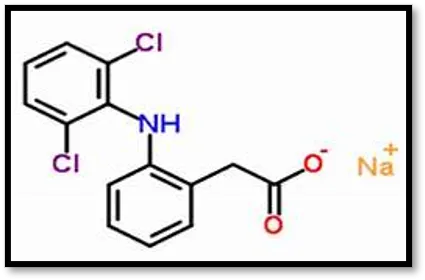
Fig. No. 1 Structure of Diclofenac Sodium
Table No. 1 Emulsion Formula Table
|
Ingredients |
F1 (gm) |
F2 (gm) |
F3 (gm) |
F4 (gm) |
F5 (gm) |
|
Diclofenac sodium |
0.3 |
0.3 |
0.3 |
0.3 |
0.3 |
|
Isopropyl Myristate |
3 |
3 |
3 |
3 |
3 |
|
Oleic acid |
1.5 |
1.5 |
1.5 |
1.5 |
1.5 |
|
Span 20 |
0.5 |
0.10 |
0.10 |
0.15 |
0.68 |
|
Tween 80 |
0.5 |
0.10 |
0.20 |
0.25 |
0.82 |
|
Methyl paraben |
0.018 |
0.018 |
0.018 |
0.018 |
0.018 |
|
Propyl Paraben |
0.002 |
0.002 |
0.002 |
0.002 |
0.002 |
|
Propylene glycol |
1 |
1 |
1 |
1 |
1 |
|
Distilled water |
q.s to 30 |
q.s to 30 |
q.s to30 |
q.s t o 30 |
q.s to 30 |
Table No. 2 Emulgel Formula Table
|
Ingredients |
F1 (gm) |
F2 (gm) |
F3 (gm) |
|
Diclofenac sodium |
0.3 |
0.3 |
0.3 |
|
Isopropyl Myristate |
3 |
3 |
3 |
|
Oleic Acid |
1.5 |
1.5 |
1.5 |
|
Span 20 |
0.68 |
0.68 |
0.68 |
|
Tween 80 |
0.82 |
0.82 |
0.82 |
|
Methyl paraben |
0.06 |
0.06 |
0.06 |
|
Propyl Paraben |
0.006 |
0.006 |
0.006 |
|
Propylene glycol |
1 |
1 |
1 |
|
Triethanolamine |
0.1 |
0.1 |
0.1 |
|
Xanthan Gum |
0.22 (0.75%) |
0.26 (0.87%) |
0.3 (1%) |
|
Distilled Water |
22.88 |
22.88 |
22.88 |
Preparation of Emulsion:
The oil phase of the emulsion was prepared by weighing required quantity of isopropyl myristate, oleic acid and add span 20. Mix using magnetic stirrer at for 2-3minutes. Aqueous Phase was prepared by weighing required quantity of water then dissolve the preservative in warm water and add Tween 80 and drug solution, stir for 3-5minutes. Drug solution is prepared by dissolving Diclofenac Sodium in propylene glycol to obtain clear solution. Heat both phases separately in water bath at 70-80 ºc. By maintaining temperature mix oil phase into Aqueous phase with continuous stirring to form o/w emulsion. Reduce the stirring speed and allow to cool at room temperature & Add camphor and stir to complete dissolve.
Preparation of Emulgel:
Preparation of Gel Base, take required quantity of distilled water. Start stirring using a mechanical stirrer. Sprinkle the xanthan gum in vortex to avoid the lump formation & stirrer for 15 to 20 min. Allow to hydrate for 24 hrs. to form uniform gel base. Add the gel base into the stable emulsion slowly. stir continuously at for 5minutes to obtain a uniform emulgel. Transfer into a clean Airtight container.
Propylene Glycol is added to the formulae as a humectant, to increase the spread ability; furthermore, it increases the aesthetic benefits regarding of skin feel of the product.
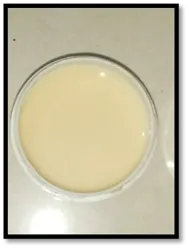
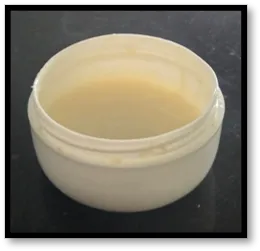
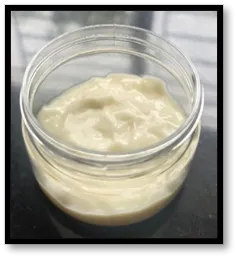
Fig. No. 2 Emulgel Batches
Characterization of Diclofenac Sodium Emulgel
Measurement of pH
Instrument Digital pH meter. Preparation of Sample, Weigh about 1 g of emulgel, disperse it in 10 mL of distilled water, stir properly to obtain a uniform dispersion. [9] Calibration of pH Meter, switch on the digital pH meter and allow it to stabilize. Calibrate using standard buffer solutions of pH 4.0, 7.0. measurement of pH, rinse the electrode with distilled water and blot dry. Immerse the electrode into the prepared emulgel dispersion. Allow the reading to stabilize. Note the pH value displayed on the meter. Repeat the measurement three times and calculate the average.
Rheology
Instrument Brook field viscometer. Take the sample in a clean, dry beaker and ensure it is homogeneous and free from air bubbles; maintain constant temperature (usually 25°C). Place the Brookfield viscometer on a stable, level surface and adjust using the levelling screw; switch on the instrument and allow it to stabilize. [8] Select a suitable spindle based on viscosity of the sample and attach it carefully to the instrument. Immerse the spindle into the sample up to the marked level without touching the bottom or sides of the container. Set the required rotational speed (RPM), commonly 10, 20, 50, or 100 RPM depending on the sample. Start the instrument and allow the reading to stabilize for about 30–60 seconds. Record the viscosity (in cp), torque (%), and speed (RPM) displayed on the screen. Repeat the measurement at least three times and calculate the average value for accuracy. After completion, remove the spindle, clean it properly with suitable solvent.
Spreading Coefficient
Instrument Wooden Block. Take two clean glass slides of equal size and place a fixed quantity (about 0.5–1 g) of the sample (gel/emulgel) at the centre of the lower slide. [9] Place the second slide gently over the sample to form a uniform film of the formulation between the slides. Apply a known weight (usually 500 g) on the upper slide for a specific time (about 5 minutes) to remove air and ensure uniform thickness. Remove the excess sample from the edges of the slides carefully. Attach a hook to the upper slide and tie a string passing over a pulley; fix a known weight (e.g., 20–50 g) to pull the upper slide horizontally. Allow the weight to pull the upper slide and note the time (in seconds) required for the upper slide to move a specified distance (usually 5–7.5 cm). Record the time taken for separation of slides under the applied weight. Calculate spread ability using the formula:
S=M×LT

Drug Content
Instrument UV visible Spectrophotometer. Weigh 1gm of formulation (Emulgel) And dissolve in 100 ml phosphate buffer (6.8). Sonicate for 20 minutes. Filter the solution by using Whatman filter paper to remove the unwanted particles. and collect the filtrate. [10] Pipette out 1ml solution from the filtrate and make up the volume up to 10ml by using volumetric flask of 10 ml. Take the Absorbance by using the UV visible spectroscopy at 275 nm and calculate the drug content & drug content %.
Formula: -
Drug content (%) =
Actual amount of drug present × 100
Theoretical amount of Drug
Determination of Drug release
Instrument Franz diffusion cell. Preparation of Cellophane Membrane, Cut required size of cellophane membrane. Soak in phosphate buffer pH 7.4 for 12–24 hours. Preparation of Receptor Phase. [8] Fill receptor compartment with phosphate buffer pH 7.4. Maintain temperature at 37 ± 0.5°C. Place magnetic bead and allow continuous stirring. Mounting of Membrane, place-soaked cellophane membrane between donor and receptor compartments. Application of Emulgel, weigh ~1 g diclofenac sodium emulgel Place in donor compartment and spread uniformly over membrane. Sampling, withdraw 1ml sample at specific time intervals at 15, 30,45,60,75,90 up to 4 hrs. Replace with equal volume of fresh buffer. Analysis, measure absorbance at λmax ≈ 276 nm. Use calibration curve to determine drug concentration.
RESULT AND DISCUSSION: -
Pre-formulation Study: -
Organoleptic Properties:
The colour and odour of active pharmaceutical ingredient Diclofenac Sodium is white to faint white and is odourless. The observed properties complied with standard specifications, indicating purity and suitability of the drug for formulation development.
Solubility:
Diclofenac Sodium is more Soluble in Propylene Glycol than other Solvents. This result supports the use of suitable co-solvent.
Maximum Absorbance by UV visible spectroscopy:
The λmax of Diclofenac sodium by UV spectrophotometric scan in the range 200–400 nm using phosphate buffer pH 6.8. The maximum absorbance was observed at 275.6 nm
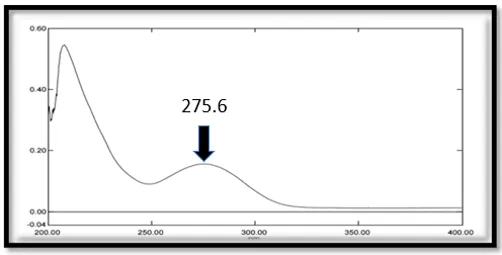
Fig. No. 2 Maximum Absorbance Graph
Calibration Curve:
The calibration curve of diclofenac sodium showed a good linear relationship between concentration and absorbance in the range of 5–30 µg/ml. The high R2 value indicates excellent linearity and accuracy of the analytical method. Hence, the calibration curve meets the required specification for diclofenac sodium estimation.
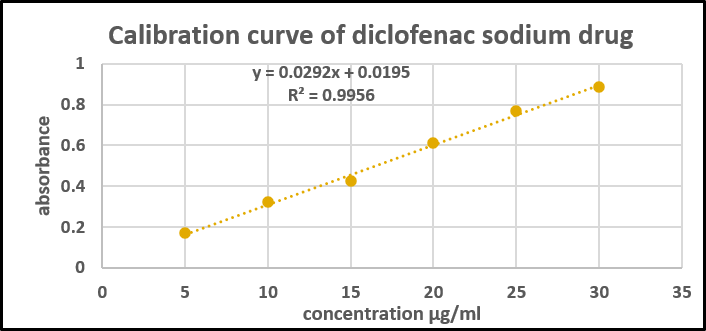
Fig. No. 3 Calibration Curve Graph
Drug-Excipient compatibility studies (FTIR)
The FTIR Spectrum of Diclofenac Sodium shows characteristics peaks corresponding to O-H/N-H, aromatic C-H, carboxylate (COO), C-N, C-O, and C-Cl groups, confirming its chemical structure and functional groups.
The FTIR Spectrum shows that all characteristics peaks of Diclofenac Sodium and Xanthan Gum are retained without significant shifts or new peaks, indicating no chemical interaction and confirming their compatibility. This Indicate that there is no chemical interaction between Diclofenac Sodium and Xanthan Gum. Therefore, Xanthan Gum is compatible with Diclofenac Sodium and can be used as a suitable excipient in the formulation.
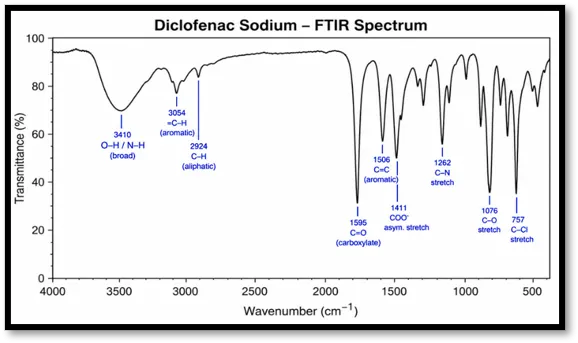
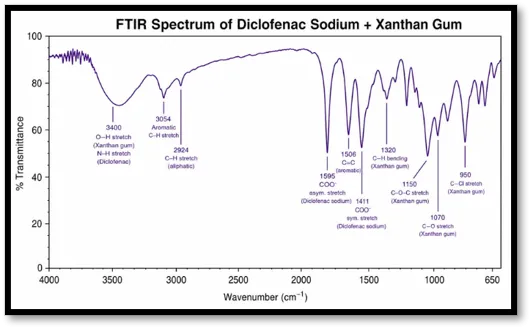
Fig. No. 4 Result of FTIR
Measurement of pH
The pH of the formulated diclofenac sodium emulgel was found to be within the range of 6.0–7.0, which is compatible with the normal pH of the skin. The formulation is therefore expected to be non-irritating and suitable for topical application.
Rheological Properties
The Formulation with a viscosity of 38000 cp was found to be satisfactory and within the acceptable range, indicating good consistency and suitable rheological behaviour for topical application. The viscosity of the formulations increased with increasing xanthan gum concentration, ranging from 33,000 to 38,000 cp. The optimized formulation (F3) exhibited the highest viscosity (38,000 cp), indicating good consistency and stability.
Spreading Coefficient
The spreading Coefficient values of the formulated emulgel were found within the acceptable range of 10–20 gm·cm/sec, indicating good spread ability and easy application on the skin. The highest spread ability was observed in sample 3 (18.7 gm·cm/sec). The spreading Coefficient of the optimized batch was found to be satisfactory, demonstrating easy application on the skin surface. Good spreading Coefficient ensures uniform distribution of the drug over the affected area, which may enhance patient compliance and therapeutic efficacy.
Drug content
The obtained value indicates satisfactory incorporation and uniform distribution of the drug within the formulation. The optimized batch showed satisfactory drug content, indicating uniform incorporation and distribution of diclofenac sodium in the emulgel. The results confirmed good content uniformity and formulation quality. The drug content analysis of the formulated batches (F1–F3) showed satisfactory drug incorporation, with values ranging from 90.92% to 93.66%. Among all formulations, F3 exhibited the highest drug content (93.66%), followed by F2 (92.63%) and F1 (90.92%). The results indicate uniform distribution of the drug within the formulations and demonstrate good drug-loading efficiency. Since all batches showed drug content above 90%, the formulations can be considered acceptable with respect to content uniformity. F3 may be considered the optimized batch based on its highest drug content.
Physicochemical properties of formulations
Table No. 3 Physicochemical properties of formulations
|
Formulation |
Measurement of pH |
Rheological Properties |
Spreading Coefficient |
Drug Content |
|
F1 |
6.66 |
33000 cp |
14.7 |
90.92 |
|
F2 |
6.76 |
36000 cp |
16.2 |
92.63 |
|
F3 |
6.83 |
38000 cp |
18.7 |
93.66 |
Determination of Drug Release
Table No. 4 Result of Franz Diffusion
|
Sr. No |
Time (Min.) |
Absorbance (nm) |
Concentration (µg/ml) |
Cumulative release (mg) |
% Cumulative release |
|
1 |
0 |
0 |
0 |
0 |
0 |
|
2 |
15 |
0.095 |
9.50 |
0.19 |
1.90 |
|
3 |
30 |
0.180 |
18 |
0.37 |
3.69 |
|
4 |
45 |
0.275 |
27.50 |
0.58 |
5.77 |
|
5 |
60 |
0.390 |
39 |
0.83 |
8.35 |
|
6 |
90 |
0.620 |
62 |
1.33 |
13.34 |
|
7 |
120 |
0.850 |
85 |
1.86 |
18.56 |
|
8 |
180 |
1.180 |
118 |
2.60 |
26.01 |
|
9 |
240 |
1.550 |
155 |
3.46 |
34.59 |
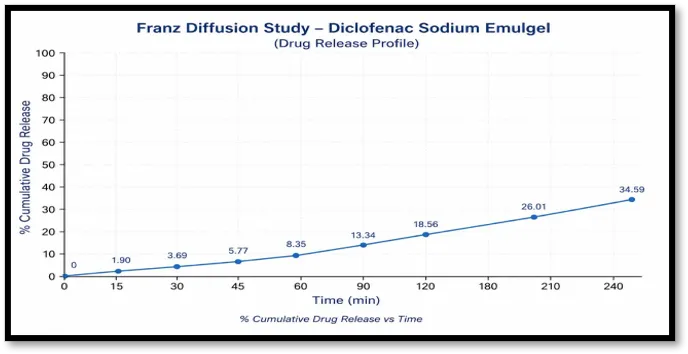
Fig. No. 5 Franz Diffusion Graph
The formulation showed a gradual and sustained release of the drug through the membrane and suggests that the emulgel can provide prolonged topical drug release. The formulation showed a gradual increase in drug release from 1.90% at 15 minutes to 34.59% at 240 minutes (4 hours). The cumulative amount of drug released reached 3.46 mg after 240 minutes. The continuous rise in absorbance values from 0.095 to 1.550 corresponds to an increase in drug concentration from 9.50 to 155 µg/mL, confirming progressive drug diffusion from the formulation.
RESULT
Three formulations (F1, F2, and F3) of Diclofenac Sodium emulgel containing xanthan gum as a natural gelling agent were successfully prepared and evaluated for their physicochemical properties. All formulations exhibited acceptable appearance, homogeneity, and pH suitable for topical application. The formulations were further evaluated for viscosity, spreading Coefficient, drug content, and in-vitro drug release. Among all batches, formulation F3 demonstrated optimum viscosity, better spreading Coefficient, satisfactory drug content uniformity, and enhanced drug release characteristics.
Stability studies revealed that F3 remained physically stable without any evidence of phase separation, creaming, or significant changes in appearance and pH throughout the study period. Based on the evaluation parameters results formulation F3 was identified as the optimized batch. The findings suggest that xanthan gum can be effectively utilized as a natural gelling agent in the formulation of Diclofenac Sodium emulgel, providing desirable stability and drug release properties for topical drug delivery.
CONCLUSION
From the present investigation, it can be concluded that Diclofenac Sodium emulgel formulated using xanthan gum was successfully prepared and evaluated. Xanthan gum provided good viscosity, and suitable rheological properties to the formulation. The emulgel exhibited satisfactory physicochemical characteristics along with effective drug release, making it a promising topical drug delivery system for the management of pain and inflammation. Thus, xanthan gum can be considered an effective and economical gelling agent for the formulation of Diclofenac Sodium emulgel.
REFERENCES


Janhavi Narkhede, Trunali Ghude, Manasi Navle, Tanshri Nifade, Pratap Nimbalkar, Pallavi Nichite, Formulate and Evaluate Diclofenac Sodium Emulgel using Xanthan Gum, Int. J. of Pharm. Sci., 2026, Vol 4, Issue 6, 6594-6605. https://doi.org/10.5281/zenodo.20912394
 10.5281/zenodo.20912394