

We use cookies to ensure our website works properly and to personalise your experience. Cookies policy
Department of Pharmaceutics, KLE’S College of Pharmacy, Gadag.
The main objective of present work was to formulate and evaluate the Anti-microbial herbal cream using Tulsi and aloe vera. The herbal cream was prepared by the oil-in-water (O/W) emulsion method using Tulsi extract and Aloe vera gel with suitable excipients. The oil and aqueous phases were heated to 70–75°C, mixed with continuous stirring, and allowed to cool to form a uniform cream. Four formulations (V1–V4) were developed and evaluated for physicochemical properties and stability. pH of the prepared formulations were found in the range of 5.0 to 5.96. viscosity of prepared formulations was found in the range of 13200 c.ps to 39400 c.ps V5 has showed a better result for viscosity. All prepared formulations showed good spreadability in the range of 25 gm.cm/sec to 41.6 gm.cm/sec. The formulated herbal cream containing Tulsi and Aloe vera was found to be stable, non-irritant, and effective for topical use. Among all formulations, V3 showed the best results in terms of viscosity, spreadability, and stability. The study concludes that the developed herbal cream is a safe and natural alternative for antimicrobial skin care applications.
Over the last decades the treatment of illness has been accomplished by administrating drugs to human body via various roots namely oral, sublingual, rectal, parental, topical, inhalation etc. Topical delivery can be defined as the application of a drug containing formulation to the skin to directly treat cutaneous disorder or the cutaneous manifestations of a general disease (e.g. psoriasis) with the intent of containing the pharmacological or the effect of drug to the surface of the skin or within the skin semisolid formulations in all their diversity dominate the system for topical delivery, but foams, spray, medicated powders, solutions and even medicated adhesive systems are in use1.
Creams are the topical preparations which can be applied on the skin. Creams are defined as “viscous liquid or semi-solid emulsions of either the oil-in-water or water-in-oil type” dosage forms which consistency varies by oil and water. Creams are used for cosmetic purposes such as cleansing, beautifying, improving appearances, protective or for therapeutic function. These topical formulations are used for the localized effect for the delivery of the drug into the underlying layer of the skin or the mucous membrane. These products are designed to be used topically for the better site-specific delivery of the drug into the skin for skin disorders. Creams are considered as a pharmaceutical product as they are prepared based on techniques developed in the pharmaceutical industry; unmedicated and medicated creams are highly used for the treatment of various skin conditions or dermatoses. Creams can be ayurvedic, herbal or allopathic which are used by people according to their needs for their skin conditions. They contain one or more drugs substances dissolved or dispersed in a suitable base.
Creams may be classified as o/w or w/o type of emulsion on the basis of phases. The term
„cream‟ has been traditionally applied to semisolid formulated as either water-in-oil (e.g.: cold cream) or oil-in-water (e.g.: vanishing cream).2,3,4
The skin is the largest organ of the human body that serves a vital role in many dynamic processes that maintain homeostasis. Composed of multiple cell types, our skin forms an effective barrier against environmental insults from sun exposure to direct contact with chemical agents, microbes, and physical trauma. The skin also confers the first-line of innate immune defense––a process that can go awry in disorders such as cutaneous T-cell lymphoma (CTCL) and immune-related adverse events. Melanocytes located in the basal cell layer of the epidermis produces the pigment melanin that absorbs ultraviolet (UV) light and reduces the risk of developing skin cancer. In many societies, the appearance and perception of one’s skin and hair also touch deeply upon issues of health, wellness, and identity. In this issue, we present 22 articles that deeply examine the mechanisms, pathologies, and therapeutics of the skin and dermatology5
Ocimum sanctum is a significant sign of the Brahminic spiritual ritual. While the term “Tulsi” tells the suggestion of the unparalleled one. Additional name, “Vishnupriya” expresses the one that delight Lord Vishnu. Cultivated in maximum of Indian houses and temples, its marvel has saturated our native society down the ages. In English it is called as Holy Basil and its botanical name is Ocimum sanctum and its family is Lamiaceae. Tulsi classified into two types- forestland and cultivated land. While having selfsame usage, it has dark colored leaves. Tulsi is widely used in home remedy for for treatment of injury, respiratory disorders, hepatic disorders, viral infection, earache, spinal pain, hiccup, inflammation of the conjunctiva in newborns. It also has ambrosial, appetizer, helps to relieving flatulence, helps to cure mucus irritation, inducing perspiration, diuretic, expectorator, alexiteric, anthelmintic and antipyretic properties. Tulsi is maybe one of the most specimens of Ayurveda universal method to live the life come up to health. Its taste is bitter.6
The use of aloe vera is being promoted for a large variety of conditions. Often general practitioners (GPs) seem to know less than their patients about its alleged benefits. The Department of Complementary Medicine at the University of Exeter receives more enquiries from colleagues related to aloe vera than for any other herbal remedy. Considering this high level of interest, it is relevant to review systematically the evidence for or against its clinical effectiveness. Aloe vera (synonym: Aloe barbadense Miller) belongs to the Liliaceae family, of which there are about 360 species. Aloe capensis (Cape aloes) belongs to a different species. Aloe vera is a cactus-like plant that grows readily in hot, dry climates and currently, because of demand, is cultivated in large quantities. Cosmetic and some medicinal products are made from the mucilaginous tissue in the center of the aloe vera leaf and called aloe vera gel. The peripheral bundle sheath cells of aloe vera produce an intensely bitter, yellow latex, commonly termed aloe juice, or sap, or aloes. Aloe vera sap and aloe vera gel are often confused. Unlike aloes, aloe vera gel contains no anthraquinones, which are responsible for the strong laxative effects of aloes.7
MATERIALS AND METHODS:
MATERIALS
Aloe vera gel was obtained from Ganga Mehandi Udyog Sojat City, Rajasthan. Tulsi Drops were obtained from Himalaya Drug Company. Karnataka (Bengaluru), White soft Paraffin were obtained from Unicorn Petroleum Industries Pvt. Ltd. Mumbai, Maharashtra, Bees Wax was obtained from Asha Enterprises. Bangalore, Karnataka, Borax were procured from Shivam Borax Industries. Ahmedabad, Gujarat. Every other chemical that was used was analytical grade.
METHOD
Preparation of anti-microbial herbal cream:
Various anti-microbial herbal creams were prepared using the Oil-in-Water (O/W) type emulsion base. The ingredients were divided into two separate phases, namely the oil phase and the aqueous phase. The oil phase consisted of white soft paraffin, bees wax, and stearic acid, while the aqueous phase contained borax, glycerin, aloe vera gel, methyl paraben, distilled water, and Tulsi extract or drops. Perfume or rose oil was added in the final stage to impart fragrance. In the first step, the oil phase was prepared by accurately weighing white soft paraffin, bees wax, and stearic acid. These ingredients were melted together in a beaker using a water bath maintained at 70-75°C until a uniform mixture was obtained. The mixture was kept warm to prevent solidification. In the second step, the aqueous phase was prepared by dissolving borax, methyl paraben, and glycerin in distilled water. Aloe vera gel and Tulsi extract or drops were then added to this mixture with gentle stirring. The aqueous phase was also heated to 70-75°C to ensure that both phases were at the same temperature during emulsification. The third step involved emulsification, where the hot aqueous phase was slowly added to the oil phase with continuous stirring. The mixture was stirred until a smooth, uniform, and consistent cream base was formed. In the fourth step, the cream was allowed to cool gradually, and perfume or rose oil was added at around 40°C with gentle stirring to obtain a pleasantly scented formulation. In This We Prepared the four Anti-microbial Herbal Creams and Named as V1.V2.V3.V4.
Table 1: Formulation Composition of Anti-microbial Herbal Cream
| INGREDIENTS | Batch code | |||
|---|---|---|---|---|
| V1 | V2 | V3 | V4 | |
| Tulsi Drops | 1.5g | 2g | 2g | 3g |
| Aloe vera gel | 35g | 30g | 25g | 20g |
| White soft Paraffin | 5g | 10g | 12g | 15g |
| Stearic acid | 6g | 8g | 9g | 10g |
|---|---|---|---|---|
| Bees wax | 2g | 4g | 5g | 6g |
| Borax | 0.8g | 1g | 1.2g | 1.5g |
| Glycerin | 6g | 5g | 4g | 3g |
| Methyl paraben | 0.5g | 0.5g | 0.5g | 0.5g |
| Rose oil | 0.5g | 0.5g | 0.5g | 0.5g |
| Distilled water | q.s to 100g | q.s to 100g | q.s to 100g | q.s to 100g |
| Total | 100g | 100g | 100g | 100g |
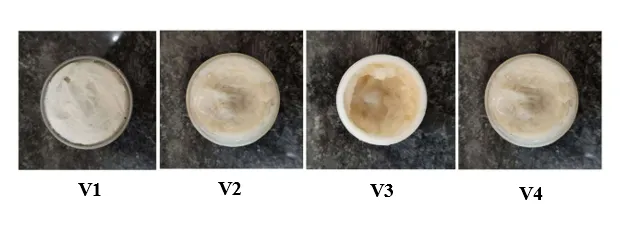
Figure 1: Formulations of Anti-microbial Herbal Cream
Evaluation of anti-microbial herbal cream:
Physical evaluation:
In this test, the cream was observed for color, odor, texture8.
Irritancy:
This test evaluates whether the cream's ingredients are harmful to the skin or mucosa. To conduct this test, mark an area on the left hand's dorsal surface, apply the cream to this area, and note the time. After a few minutes, check the area for any signs of irritancy.
Washability:
This test assesses the quality of the cream by applying a small amount to the hand and then washing it off with tap water to observe how easily it can be removed.
pH Test:
This measures the acidity levels of the cream, which should fall within the normal range of pH 4-7. The pH can be measured using a digital pH meter or pH paper.
Phase Separation:
This test checks for separation of the cream's components over 24 to 30 hours. Place the cream in a closed container at a temperature of 30-80°C, keeping it away from light.
Viscosity:
This test predicts how the cream's materials will behave in practical use, primarily checking the cream's efficacy.
Greasiness:
This test determines whether the cream is oily or greasy. According to the results, formulations can be classified as non-greasy9.
Stability:
Stability studies were carried out for one month at room temperature and pH, appearance and phase separation were recorded after one month. All the herbal creams were found to be stable at the end of the storage period.
Dye Test:
Small amount of cream was taken and diluted with Amaranth was mixed and placed on the glass slide and it was observed under the microscope. It was found that the scattered globules appear red and continuous phase colorless and it was indicated that the cream is water in oil type of emulsion10.
Spread ability:
The spread ability was measured by measuring the number of seconds it took for two slides separated by a cream layer under a specific load to separate from the cream. The ability to spread is improved by a shorter separation time between the two slides. Standardized glass slides were taken in two sets. Next, a slide with the appropriate dimensions was taken, and the cream formulation was put on it. After that, another slide was positioned above the formulation. Next, a weight was applied to the upper slide to evenly compress the cream between the two slides into a thin layer. After that, the weight was taken off, and any extra formulation that had stuck to the slides was scraped off. The force of the weight attached to the upper slide allowed it to slide off freely. It was noted how long it took for the upper slide to slip off.
Spread ability is equal to m × L/T Where,
m: standard weight (50g) that is attached to or positioned over the upper slide. L: glass slide's length (5 cm)
T: time in seconds11.
RESULTS & DISCUSSION:
Evaluation tests for antimicrobial herbal cream:
Physical evaluation:
In this test color, odor, texture of the four formulations were checked.
Table 2: In This Test Color, Odor, Texture of the Formulations Was Checked
| SL.NO | PARAMETERS | V1 | V2 | V3 | V4 |
|---|---|---|---|---|---|
| 01 | Color | White | White | White | White |
| 02 | Odor | Fragrant | Pungent | Disagreeable | Aromatic |
| 03 | Texture | Smooth | Smooth | Smooth | Smooth |
Irritancy test:
According to the results all the four formulations V1, V2, V3, and V4 showed no sign of irritancy, erythema and edema.
Table 3: Irritancy Test Observations
| SL.NO | FORMULATION | IRRITANCY | ERYTHEMA | EDEMA |
|---|---|---|---|---|
| 01 | V1 | Nil | Nil | Nil |
| 02 | V2 | Nil | Nil | Nil |
| 03 | V3 | Nil | Nil | Nil |
| 04 | V4 | Nil | Nil | Nil |
Washability:
Washability test was carried out by applying a small amount of cream on the hand and then washing it with tap water. All four formulations were easily washable.
Table 4: Washability Test Observations
| SL.NO | FORMULATION | WASHABILITY |
|---|---|---|
| 01 | V1 | Easily washable |
| 02 | V2 | Easily washable |
| 03 | V3 | Easily washable |
| 04 | V4 | Easily washable |
pH Test:
According to the results, the pH of all the four formulations that is V1, V2, V3, and V4 were found to be nearer to skin PH so it can be safely used on the skin.
Table 5: pH Test Observations
| SL.NO | FORMULATION | TRIALS | AVERAGE pH | ||
|---|---|---|---|---|---|
| 01 | V1 | 5.0 | 5.5 | 5.8 | 5.43 |
| 02 | V2 | 4.8 | 5.0 | 5.2 | 5.0 |
| 03 | V3 | 6.0 | 5.2 | 5.5 | 5.56 |
| 04 | V4 | 6.1 | 6.0 | 5.8 | 5.96 |
Phase Separation:
Prepared cream was kept in a closed container at a temperature of 30 - 80 ℃ away from light. Then phase separation was checked for 24 h for 30 d. Any change in the phase separation was observed/checked. According to the results no phase separation was observed in all the formulations.
Table 6: Phase Separation Test Observations
| SL.NO | FORMULATION CODE | PHASE SEPARATION |
|---|---|---|
| 01 | V1 | No phase separation |
| 02 | V2 | No phase separation |
| 03 | V3 | No phase separation |
| 04 | V4 | No phase separation |
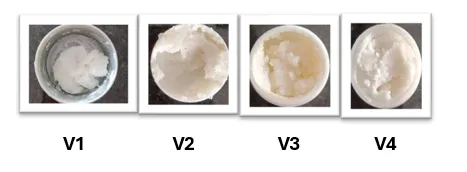
Figure 2: Phase Separation Test Results
Viscosity:
Viscosity of cream was done by using Brooke field viscometer at a temperature of 25℃ using spindle No. 63 at 2.5 RPM. According to the results all the four formulations V1, V2, V3, & V4 showed adequate viscosity.
Table 7: Viscosity Test by Brooke Field Viscometer
| SL.NO | FORMULATION CODE | VISCOSITY(Cps) |
|---|
| 01 | V1 | 13200 |
|---|---|---|
| 02 | V2 | 18720 |
| 03 | V3 | 29270 |
| 04 | V4 | 39400 |
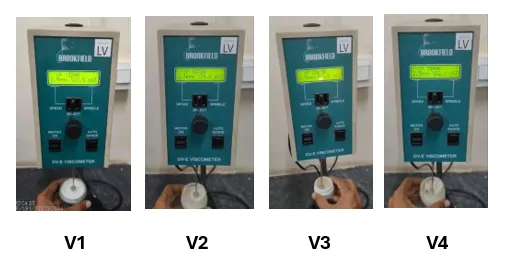
Figure 3: Viscosity Results
Greasiness:
Here the cream was applied on the skin surface in the form of smear and checked if the smear was oily or grease-like. According to the results, we can say that all four formulations were non-greasy.
Table 8: Greasiness Observation
| SL.NO | FORMULATION CODE | GREASINESS |
|---|---|---|
| 01 | V1 | Non – greasy |
| 02 | V2 | Non – greasy |
| 03 | V3 | Non – greasy |
| 04 | V4 | Non – greasy |
Stability:
Stability studies were carried out for one month at room temperature and pH, appearance and phase separation were recorded after one month. All the herbal creams were found to be stable at the end of the storage period.
Table 9: Stability Studies
| PARAMETERS | 0 DAYS | 30 DAYS | ||||||
|---|---|---|---|---|---|---|---|---|
| V1 | V2 | V3 | V4 | V1 | V2 | V3 | V4 | |
| pH | 5.43 | 5.0 | 5.56 | 5.96 | 5.4 | 5.0 | 5.3 | 5.5 |
| Phase separation | No phase separation | No phase separation | ||||||
Dye Test:
Table 10: Dye Test
| SL.NO | FORMULATION CODE | DYE TEST |
|---|---|---|
| 01 | V1 | Oil in water (o\w) |
| 02 | V2 | Oil in water (o\w) |
| 03 | V3 | Oil in water (o\w) |
| 04 | V4 | Oil in water (o\w) |
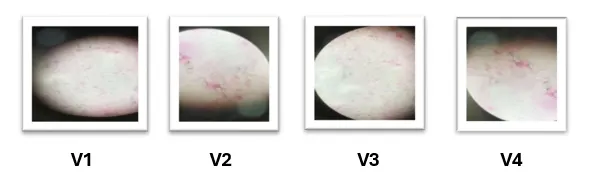
Figure 4: Dye Test Results
Spread ability:
The spreadability of the all formulations that is V1, V2, V3, and V4 was carried out and out of that for V3 the time taken by the 2 slides to separate is less so as said in the description of evaluation test lesser the time taken for separation of the two slides better the spreadability so according to this, V3 showed better spreadability.
Table 11: Spreadability Test Observations
| SL.NO | FORMULATION | TIME(SEC) | SPREADABILITY(Gmcm/sec) |
|---|---|---|---|
| 01 | V1 | 10 | 25.0 |
| 02 | V2 | 8 | 31.2 |
| 03 | V3 | 6 | 41.6 |
| 04 | V4 | 7 | 35.7 |
CONCLUSION:
An anti-microbial herbal cream was successfully prepared using aloe vera gel and Tulsi drops, According to irritancy test results, all the formulations showed no signs of irritancy, erythema and edema, The pH of the cream formulations ranged from of 5.0 to 5.9, which falls within the normal pH range of human skin, The dye test performed for all formulations confirmed that they were of the oil-in-water type emulsions, Phase separation tests indicated that no phase separation occurred in any of the formulations, All the cream formulations exhibited good viscosity and were able to remain on the application site for prolonged period. Stability studies revealed that there was no significant change in the formulations after the stability testing period, The spreadability values indicated that the cream could be easily spread with the application of a small amount of shear. On comparing all the formulations, formulation V3 showed the best results for all evaluated parameters.
ACKNOWLEDGMENTS:
The authors are thankful to Dr. Ramesh.V. Kinhal, Professor and Principal, K.L.E Society’s College of Pharmacy, Gadag, for showing care and tenderness towards our during hard times and for providing necessary facilities to carry out the work.
REFERENCES




Shivalingappa Hasabi, Pradeep Mirje, Ramesh Kinhal, Kiran Sutar, Preeti Meti Veeresh G. Hanagal, Formulation and Evaluation of Anti-Microbial Herbal Cream, Int. J. of Pharm. Sci., 2026, Vol 4, Issue 11, 3495-3502. https://doi.org/10.5281/zenodo.24387599
 10.5281/zenodo.24387599