

We use cookies to ensure our website works properly and to personalise your experience. Cookies policy
Shri Gurudev Institute of Pharmaceutical Education & Research, Temni Road Chulod, Gondia Maharashtra-441601 India.
Background & Operating Principle: Osmotic pump technology represents a sophisticated approach in oral controlled drug delivery, engineered to deliver active pharmaceutical ingredients (APIs) at predetermined, prolonged, and highly predictable rates governed by osmosis and osmotic pressure. The dosage form consists of an inner drug core enclosed by a rigid, biocompatible, and selectively semipermeable membrane (most commonly cellulose acetate). When exposed to gastrointestinal fluids, water enters through the semipermeable barrier driven by the thermodynamic activity gradient between the external environment and the internal core.Mechanism & Key Components: Incorporated osmotic agents (osmogens)—such as sodium chloride, potassium chloride, mannitol, and hydrophilic polymers—draw water across the membrane to generate internal hydrostatic and osmotic pressure. This generated pressure steadily expels dissolved drug or drug suspension through a microscopic delivery orifice (formed via mechanical or laser drilling) or via in situ micropores created by leaching water-soluble pore-forming agents. The release rate is governed by membrane thickness, water permeability, osmogen concentration, drug solubility, and orifice dimensions, remaining largely independent of gastrointestinal pH, fed or fasted states, and hydrodynamic agitation.Therapeutic Applications & Recent Advances: The technology is commercially validated through marketed products such as Procardia XL (Nifedipine), Glucotrol XL (Glipizide), Ditropan XL (Oxybutynin), and Concardia XL (Methylphenidate). Recent innovations have expanded its scope beyond conventional elementary systems to include controlled porosity osmotic pumps (CPOPs), push-pull osmotic pumps (PPOPs) for poorly soluble drugs, multiparticulate designs, gastro-retentive and colon-targeted formulations, nanotechnology integration, and 3D printing for personalized release profiles
Osmotic pump technology is an advanced drug delivery system used to control the release of drugs into the body for a prolonged period. It is based on the principle of osmosis, in which water moves through a semi permeable membrane from a region of lower solute concentration to a region of higher solute concentration.
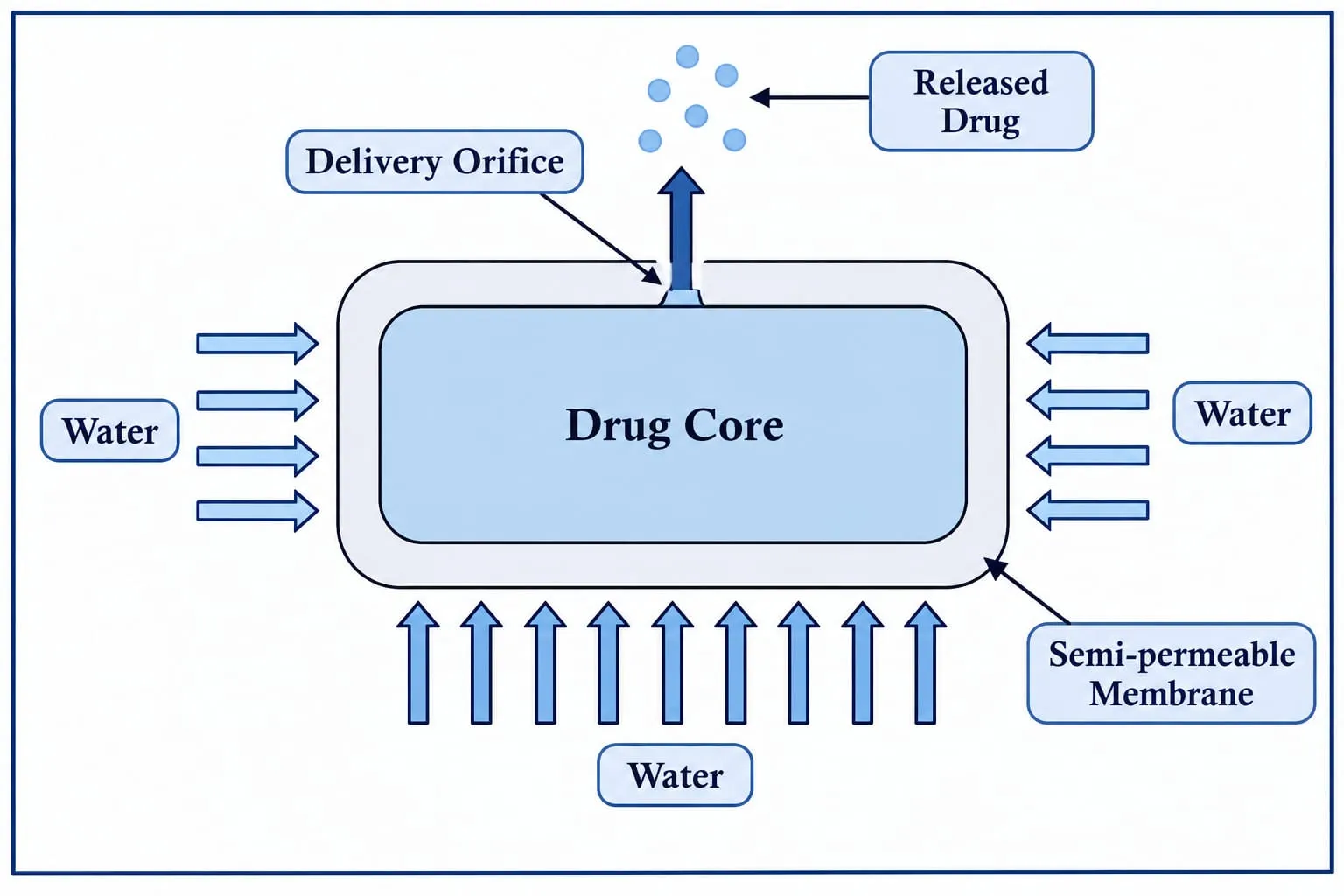
In this system, the drug is enclosed within a tablet or capsule surrounded by a semi permeable membrane. When the dosage form comes into contact with body fluids, water enters through the membrane and dissolves the drug. The dissolved drug is then released through a small delivery orifice at a controlled rate.
Osmotic pump technology is an important approach in modern pharmaceutical formulations because it helps maintain a more consistent drug concentration in the body. It can reduce fluctuations in drug levels and may decrease the frequency of drug administration.
This technology is used in the development of oral controlled-release formulations and is suitable for many drugs that require prolonged and predictable drug delivery.
Osmotic pump controlled release preparation is one of the most promising and effective dosage form as it is independent of all the physiochemical factors. This system also optimize the process and formulation parameter.
Example: solubility, concentration and osmotic pressure of core component , size of delivery orifice, and nature of rate-controlling membrane, and thus modulates the rate and pattern of drug release.
A significant development made in the osmotic delivery devices is their capability to deliver drugs as liquids to enhance permeability and to deliver insoluble drugs that can dispense sub-saturated solution of drug deliver high drug doses meeting high drug loading requirement
2. DEFINATION
Osmotic pump technology is a controlled drug delivery technique in which a drug is released at a predetermined rate by using osmotic pressure generated by the movement of water through a semi permeable membrane.
3. BASIC PRINCIPLE
Abbenollet submitted the first report of osmotic effect in 1748. However, Pfeffer obtained the first quantitative measurement in 1877 in his experiment, in which he separated a sugar solution from pure water using a membrane (permeable to water but impermeable to sugar). A flow of water occurs into the sugar solution that cannot be halted until a pressure (π) is applied to the sugar solution. Pfeffer showed that this pressure is the osmotic pressure (π) of the sugar solution and is directly proportional to the solution concentration and absolute temperature. After a few years, Van't Hoff showed the analogy between these results and ideal gas laws by the following expression:
π = Φcrt
Where,
Φ = Osmotic coefficient of the solution.
c = Molar concentration of sugar in the solution.
r = Gas constant.
t = Absolute temperature.
Concentrated solution of soluble solutes (used in controlled release formulation) has an extremely high osmotic pressure that ranges from 30 atm for sodium phosphate to 500 atm for a lactose-fructose mixture. This is because their osmotic pressure can produce high water flow across a semi-permeable membrane. The osmotic water flow through a membrane is given by the following equation:
dv/dt = AQΔπ/L
Where,
dv/dt = Water flow across the membrane of area A, thickness L, and permeability Q (cm²).
Δπ = Osmotic pressure difference between the two solutions on either side of the membrane.
This equation is used for a completely permeable selective membrane, which is permeable to water but completely impermeable to osmotic agent.
OSMOSIS:
Osmosis can be defined as spontaneous movement of a solvent from a solution of lower solute concentration to a solution of higher solute concentration through an ideal semipermeable membrane, which is driven by a difference in osmotic pressure across the membrane that permeable only to the solvent and impermeable to solute molecules or ions. The pressure applied to the higher-concentration side to inhibit solvent flow is
called osmotic pressure. Osmotic pressure is the pressure which, if applied to the more concentrated solution, would prevent transport of water across the semipermeable membrane. [Martin et al.1993][1]
Principle of Osmosis:
In 1877, Pfeffer performed an experimentusing semi-permeable membrane to separate sugar solution from pure water. He showed that the osmotic pressure of the sugar solution is directly proportional to the solution concentration and the absolute temperature. In 1886, Vant Hoff identified an underlying proportionality between osmotic pressure, concentration and temperature. He revealed that osmotic pressure is proportional to concentration and temperature and the relationship can be described by following equation.
Π = p c RT ...................................... (2)
Where, Π = osmotic coefficient of the solution
p = Osmotic pressure of concentration of solution
c = molar concentration of sugar in the solution
R = gas constant and
T = Absolute temperature
Osmotic pressure is a colligative property, which depends on concentration of solute that contributes to osmotic pressure. Solutions of different concentrations having the same solute and solvent system exhibit an osmotic pressure proportional to their concentrations. Thus a constant osmotic pressure, and thereby a constant influx of water can be achieved by an osmotic delivery system that results in a constant zero order release rate of drug
[Li & Jasti 2006].
The Van’t Hoff equation presents a good means for calculating the osmotic pressures of solutes across perfect semipermeable membranes and is accurate for low solute concentrations. But if the membrane is not completely semipermeable and
permits passage for solute along with solvent, the osmotic pressure calculated by utilizing vapour pressure measurements and by using the expression.[1]
Π = RT/V In (P0/P) ........................... (2)
Where, P0 = vapour pressure of pure solvent, P =
vapour pressure of the solution,
V = the molar volume of the solvent.
SEMI- PERMEABLE MEMBRANE:-
This plays an important role in the modulation of drug release from the osmotic drug delivery system. The membrane should be stable to the outer and the inner environment of the device. It should be rigid, inert, and should maintain its dimensional integrity so that a constant osmotic driving force can be provided during drug delivery. This membrane should be selectively permeable to avoid the loss of osmogen by diffusion across the membrane during the passage of drugs and other ingredients present in the compartment.
This membrane should be biocompatible and should have sufficient water permeability to retain the desired water flux rate. The transmission rates of water vapour can be used for estimating water flux rates. Polymers that are permeable to water but impermeable to solute can be used as coating material in osmotic devices, e.g., cellulose esters like cellulose acetate, cellulose acetate butyrate, cellulose triacetate, and ethyl cellulose.
Semi-permeable membranes should exhibit sufficient wet strength (-10S) and wet modulus to retain their dimensional integrity during drug delivery.
FUNCTION OF A SEMI-PERMEABLE MEMBRANE:-
1. It allows water to enter the osmotic system.
2. It prevents or restricts the passage of drug molecules through the membrane.
3. It helps maintain osmotic pressure inside the system.
4. It controls the rate of water entry.
5. It helps achieve controlled and sustained drug release
Examples: Cellulose acetate and cellulose acetate derivatives.
DRUG RELEASE MECHANISM:-
The drug release mechanism of an osmotic pump is based on the principle of osmosis and osmotic pressure.
The process occurs in the following steps:
1. Water Entry: Water from the surrounding body fluids enters the tablet through the semi-permeable membrane.
2. Osmotic Pressure Development: The drug formulation inside the tablet absorbs water, creating osmotic pressure.
3. Drug Dissolution: The drug dissolves in the water entering the tablet. If the formulation contains an osmotic agent, it helps generate osmotic pressure.
4. Drug Release: The osmotic pressure pushes the drug solution or suspension out through a small delivery orifice present in the tablet.
5. Controlled Release: The drug is released at a controlled rate over a prolonged period
6. Continuous Process: As long as sufficient osmotic pressure is maintained and the formulation is available, drug release continues.
DRUG RELEASE MECHANISM OF OSMATIC PUMP
Definition:
The drug release mechanism of an osmotic pump is based on the principle of osmosis and osmotic pressure, in which water enters the system through a semipermeable membrane and pushes the drug out through a small delivery orifice.
Mechanism of Drug Release
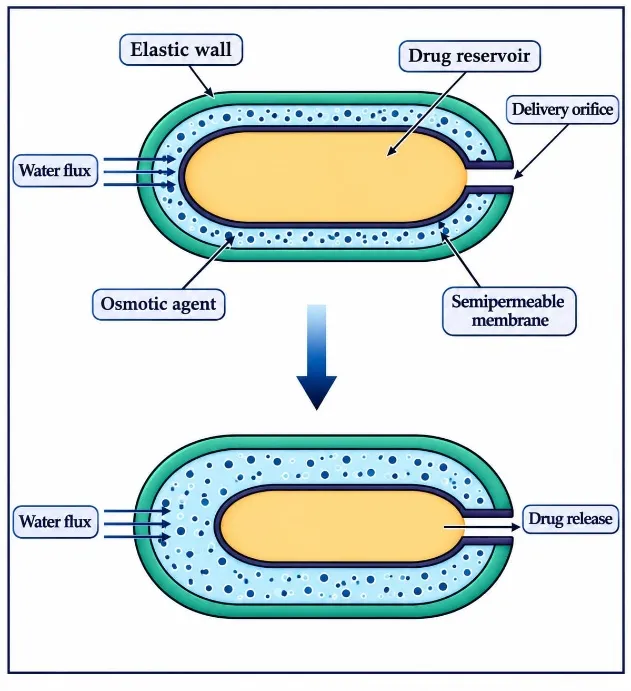
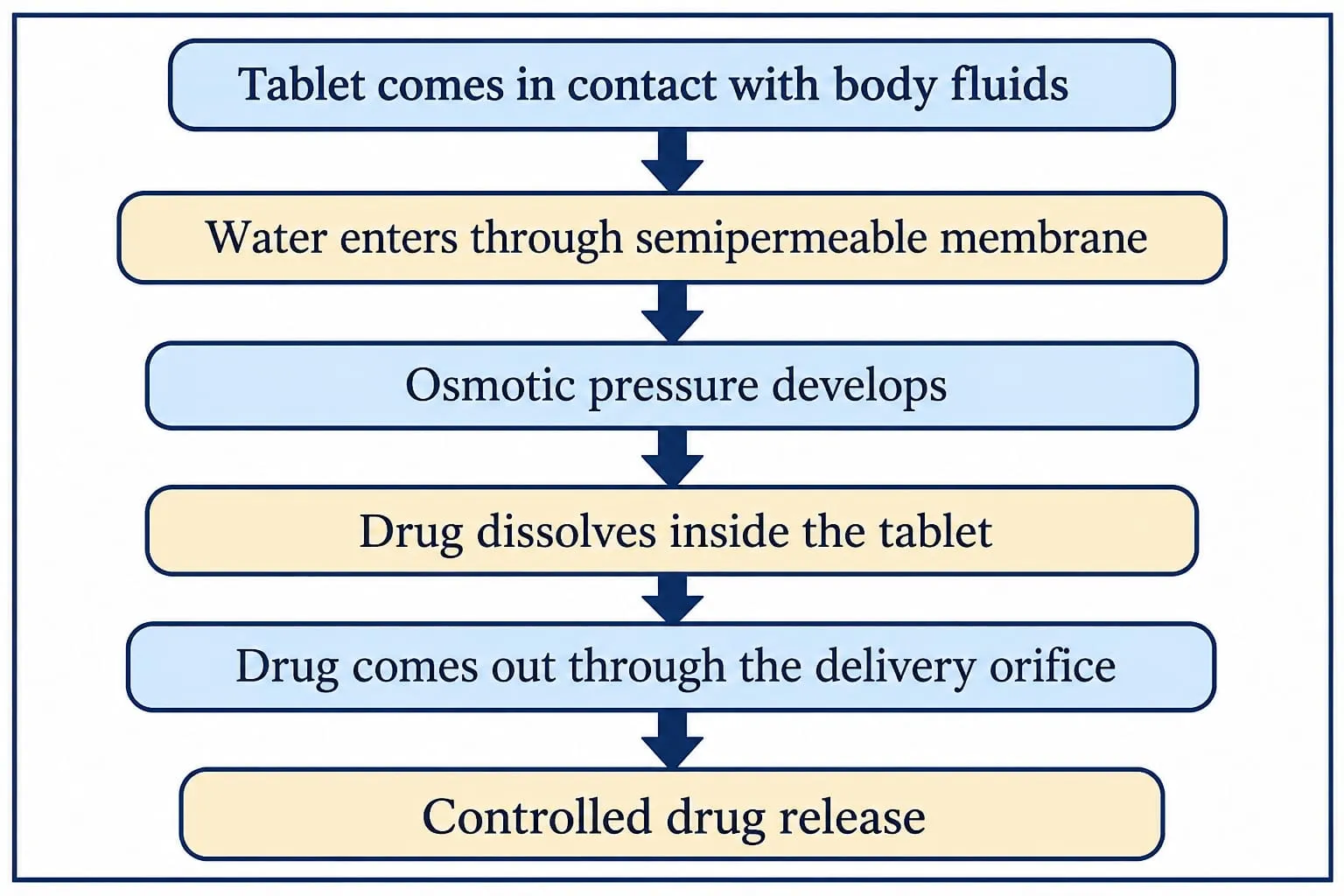
1. Water enters the system: When the osmotic pump tablet comes in contact with body fluids, water enters through the semipermeable membrane.
2. Osmotic pressure develops: The osmotic agent inside the tablet attracts water and creates osmotic pressure.
3. Drug dissolves: The drug present inside the tablet dissolves in the water and forms a drug solution or suspension.
4. Pressure increases: As more water enters the tablet, the internal pressure increases.
5. Drug release: The pressure pushes the dissolved drug through a small hole called the delivery orifice.
6.Controlled release: The drug is released at a controlled and predictable rate for a specific period.
FLOW CHART
ROLE OF WATER INFLUX:-
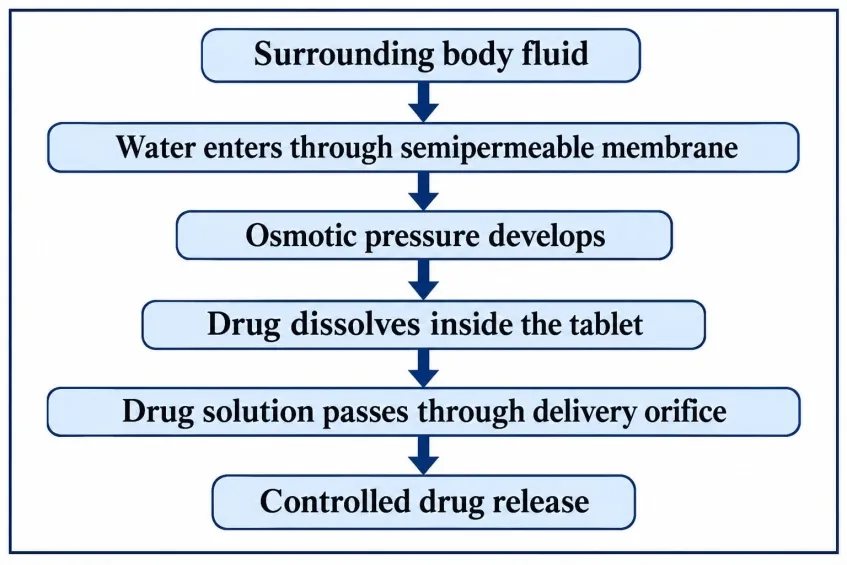
Water influx is an important process in osmotic pump technology. It refers to the movement of water from the surrounding body fluid into the osmotic pump through a semipermeable membrane.
Water enters the system due to the difference in osmotic pressure. This water helps dissolve the drug and creates pressure inside the tablet, which pushes the drug out through the delivery orifice.
Role of Water Influx
1.Water Entry: Water enters the osmotic pump through the semipermeable membrane
2. Development of Osmotic Pressure: Water entry creates osmotic pressure inside the tablet due to the presence of osmotic agents.
3. Drug Dissolution: Water helps dissolve the drug inside the tablet and forms a drug solution.
4. Drug Release: The pressure generated inside the tablet pushes the drug solution out through the delivery orifice.
5. Controlled Drug Delivery: Water influx helps maintain a controlled and gradual release of the drug.
6. Maintains Drug Release Rate: In a properly designed osmotic pump, water enters at a predictable rate, helping provide a relatively uniform drug release.
7. Improves Drug Delivery: It helps deliver the drug over an extended period of time.
Mechanism of Water Influx
Factors Affecting Water Influx
1. Nature of semipermeable membrane.
2. Thickness of the membrane.
3. Osmotic pressure difference.
4. Concentration of osmotic agents.
5. Temperature of the surrounding medium.
Advantages of Water Influx
COMPONETS OF OSMATIC PUMP DRUG DELIVERY SYSTEM:-
INTRODUCTION
An osmotic pump drug delivery system is a controlled drug delivery system that uses osmotic pressure to release the drug at a predetermined rate over an extended period of time.
It consists of different components that help in water entry, pressure development and controlled drug release.
Main Components
1. Drug
Examples: Metformin, nifedipine and theophylline.
2. Semipermeable Membrane
Examples: Cellulose acetate and cellulose-based polymers.
3. Osmotic Agent
Examples: Sodium chloride, potassium chloride and mannitol.
4. Pore-Forming Agents
Examples: Sorbitol, PEG and sodium chloride.
5. Plasticizer
Examples: Glycerol, triethyl citrate and propylene glycol.
6. Delivery Orifice
7. Other Excipients
These are added to improve the formulation and manufacturing process.
Examples:
DRUG CORE IN OSMATIC PUMP DRUG DELIVERY SYSREM :-
Definition :- Drug core is the inner part of an osmotic pump tablet that contains the active pharmaceutical ingredient (drug) along with different excipients. It is responsible for producing the therapeutic effect and helps in controlled drug release.
Composition of Drug Core
The drug core contains the following ingredients:
1. Active Drug: It is the main ingredient that produces the therapeutic effect.
2. Osmotic Agents: These attract water into the tablet and generate osmotic pressure.
Examples: Sodium chloride, potassium chloride and mannitol.
3. Binders: They hold the ingredients together and provide strength to the tablet.
Examples: Povidone (PVP), HPMC.
4. Diluents: They increase the bulk of the tablet.
Examples: Lactose and microcrystalline cellulose.
5. Lubricants: They reduce friction during tablet manufacturing.
Examples: Magnesium stearate and stearic acid.
1. It contains the active pharmaceutical ingredient.
2. It helps in drug dissolution.
3. It contains osmotic agents that generate osmotic pressure.
4. It helps in controlled drug release.
5. It provides the required therapeutic effect.
1. Water enters the drug core through the semipermeable membrane.
2. The osmotic agent attracts water.
3. The drug dissolves or forms a suspension.
4. Osmotic pressure develops inside the system.
5. The drug comes out through the delivery orifice.
Plasticizers:
Plasticizers used in coating membrane also have a significant importance in the formulation of osmotic systems. It lowers the temperature of the second order phase transition of the wall or the elastic modules of the wall and also increases the workability. They can change visco-elastic behavior of polymers and these changes may affect the permeability of the polymeric films [Pandey et al 2010].
Some of the plasticizers used are as below:
[Gadwal et al.2010]
1. Polyethylene glycols
2. Ethylene glycol monoacetate; and diacetate- for low permeability
3. Tri ethyl citrate
4. Diethyl tartarate or Diacetin- for more permeable films
5. dialkylphthalate, Trioctylphosphate,
6. Alkyl adipates, Acetate, Propionate, Glycolate.
Functions of Plasticizers
1. Increase flexibility: Make the membrane flexible.
2. Reduce brittleness: Prevent the membrane from becoming hard and brittle.
3. Improve film formation: Help form a smooth and uniform membrane.
4. Improve mechanical strength: Help the membrane withstand handling.
5. Control drug release: Some plasticizers can change membrane permeability and influence the drug release rate
OTHER EXCIPINTS USED IN OSMATIC PUMP TECHNOLOGY
Other excipients are substances used along with the drug to improve the performance of an osmotic pump and control drug release.
Examples and Functions
1. Osmotic agents: These increase osmotic pressure and help draw water into the system.
Examples: Sodium chloride, potassium chloride, mannitol.
2. Polymers: These form the membrane or help control drug release.
Examples: Cellulose acetate, HPMC, polyethylene oxide (PEO).
3. Binders: These hold the tablet ingredients together.
Examples: Povidone (PVP), HPMC.
4. Lubricants: These reduce friction during tablet manufacturing.
Examples: Magnesium stearate, stearic acid.
5. Diluents: These increase the bulk of the tablet.
Examples: Lactose, microcrystalline cellulose.
6. Surfactants: These improve the wetting and dissolution of poorly soluble drugs.
Examples: Sodium lauryl sulfate, polysorbate 80.
7. Pore-forming agents: These create pores in the membrane to help drug release.
Examples: Sorbitol, sodium chloride.
8. Plasticizers: These make the membrane soft and flexible.
Examples: Triethyl citrate, PEG.
Coating Solvent
For making polymeric membrane, suitable solvent should be used. There are various organic and inorganic solvent are available. Solvents should not be toxic, should not be alter the chemical nature of
polymer, should be solubilise to polymer completely. Some examples of solvents are acetone, isopropyl alcohol, ethanol, methanol, carbon tetrachloride, water, ethyl acetate, cyclohexane, butyl alcohol. The mixture of solvent like, acetoneethanol, methylene chloride-methanol, acetoneisopropyl alcohol, acetone-water, methylene choloride-methanol-water. [Pandey et al.2010]
PORE – FORMING AGRNT IN OSMATIC PUMP TECHNOLOGY
Definition:
Pore-forming agents are substances added to the semipermeable membrane of an osmotic pump to create small pores when they dissolve in body fluids. These pores help the drug release from the dosage form in a controlled manner.
Examples of Pore-Forming Agents
1. methylcellulose Sodium chloride
2. Potassium chloride
3. Sorbitol
4. Polyethylene glycol (PEG)
5. Hydroxypropyl (HPMC)
Mechanism of Action
1. The osmotic pump comes in contact with body fluid.
2. The pore-forming agent dissolves in the fluid.
3. Small pores or channels develop in the membrane.
4. Water enters the system through the membrane.
5. The drug is released through the pores in a controlled manner.
Advantages
DELIVERY ORIFICE
The drug is delivered through an orifice via the process of diffusion to achieve an optimal, zero-order drug delivery rate [56]. The cross-sectional area of the orifice must be small, but it should not be too small in order to create hydrostatic pressure in the osmotic system. This means that the orifice must be larger than the minimum size requirement. The optimum size range for a delivery orifice is 600 μm to 1 mm [57–59]. The delivery orifice can be created via a simple mechanical drilling method [60]. Another technique used to create orifices in the sub-millimeter range is laser drilling technology. The laser beam generally used for this purpose is CO2, and it has proved to be beneficial and economical . Leaching materials can also be employed for creating in situ orifices or pores in the membrane . There is a process known as indentation in core tablets that utilizes updated compression punches. The upper punch contains needles for the creation of orifices . [2]
WATER PENETRATION
Water penetration is the process by which water enters the osmotic pump through a semipermeable membrane when it comes in contact with body fluid. The water creates osmotic pressure inside the tablet, helps dissolve the drug and pushes it out through the delivery orifice. This process helps in controlled and prolonged drug release
Water enters due to the difference in osmotic pressure between the inside and outside of the tablet. This process helps in drug dissolution and controlled drug release.
Mechanism of Water Penetration
1. Contact with Body Fluid: When the osmotic tablet enters the body, it comes in contact with gastrointestinal fluid.
2. Water Entry: Water enters the tablet through the semipermeable membrane.
3. Osmotic Pressure: The osmotic agent attracts water and develops pressure inside the tablet.
4. Drug Dissolution: The drug dissolves in the water and forms a drug solution.
5. Drug Release: The pressure pushes the drug solution out through the delivery orifice.
6. Controlled Release: The drug is released slowly and continuously over a specific period.
1. Semipermeable membrane thickness.
2. Membrane permeability.
3. Osmotic pressure difference.
4. Concentration of osmotic agents.
5. Temperature of the surrounding fluid.
Importance of Water Penetration
GENERATION OF OSMATIC PRESSURE
Generation of osmotic pressure is an important step in osmotic pump technology used in controlled drug delivery systems. When the osmotic pump comes in contact with gastrointestinal fluid, water enters into the system through the semipermeable membrane due to the difference in osmotic pressure between the inside and outside of the tablet. The osmotic agents present in the drug core, such as sodium chloride, potassium chloride and mannitol, attract water and help develop osmotic pressure inside the system. As more water enters, the internal pressure increases and helps dissolve the drug or form a drug suspension. This pressure pushes the drug solution or suspension out through the delivery orifice at a controlled and predetermined rate. Thus, the generation of osmotic pressure plays an important role in maintaining prolonged, controlled and relatively uniform drug release.[CHATGPT]
DRUG DISSOLUTION /DISPERSION
Drug dissolution or dispersion is an important step in osmotic pump technology used in controlled drug delivery systems. When water enters the drug core through the semipermeable membrane, it helps dissolve the drug and form a drug solution. In the case of poorly water-soluble drugs, the drug may form a suspension or dispersion instead of a complete solution. The osmotic pressure developed inside the tablet helps push the dissolved drug or drug suspension out through the delivery orifice. This process ensures the continuous and controlled release of the drug over an extended period of time.[CHATGPT]
DRUG SOLUTION MOVEMENT THROUGH DELIVERY ORIFICE
Drug solution movement through the delivery orifice is an important step in osmotic pump technology used in controlled drug delivery systems. When water enters the osmotic pump through the semipermeable membrane, it dissolves the drug present in the drug core and forms a drug solution. Due to the continuous entry of water, osmotic pressure develops inside the tablet. This pressure pushes the drug solution or suspension towards the delivery orifice, which is a small opening present in the outer membrane of the osmotic pump. The drug solution then passes through this orifice and enters the surrounding gastrointestinal fluid. The rate of drug movement depends on factors such as membrane properties, osmotic pressure and formulation characteristics. This process helps in the controlled, continuous and prolonged release of the drug and maintains a relatively uniform drug release rate over an extended period of time.
CONTROLLED DRUG RELEASE
Controlled drug release is the final and most important step in osmotic pump technology used in controlled drug delivery systems. In this process, the drug is released from the osmotic pump at a predetermined and controlled rate over an extended period of time. When water enters through the semipermeable membrane, osmotic pressure develops inside the tablet and pushes the dissolved drug or drug suspension out through the delivery orifice. The release of the drug mainly depends on the water penetration rate, osmotic pressure, membrane properties and size of the delivery orifice. This system helps maintain a relatively uniform drug concentration in the body for a longer duration. It also reduces frequent dosing and improves patient convenience. Thus, controlled drug release provides prolonged and effective drug delivery.
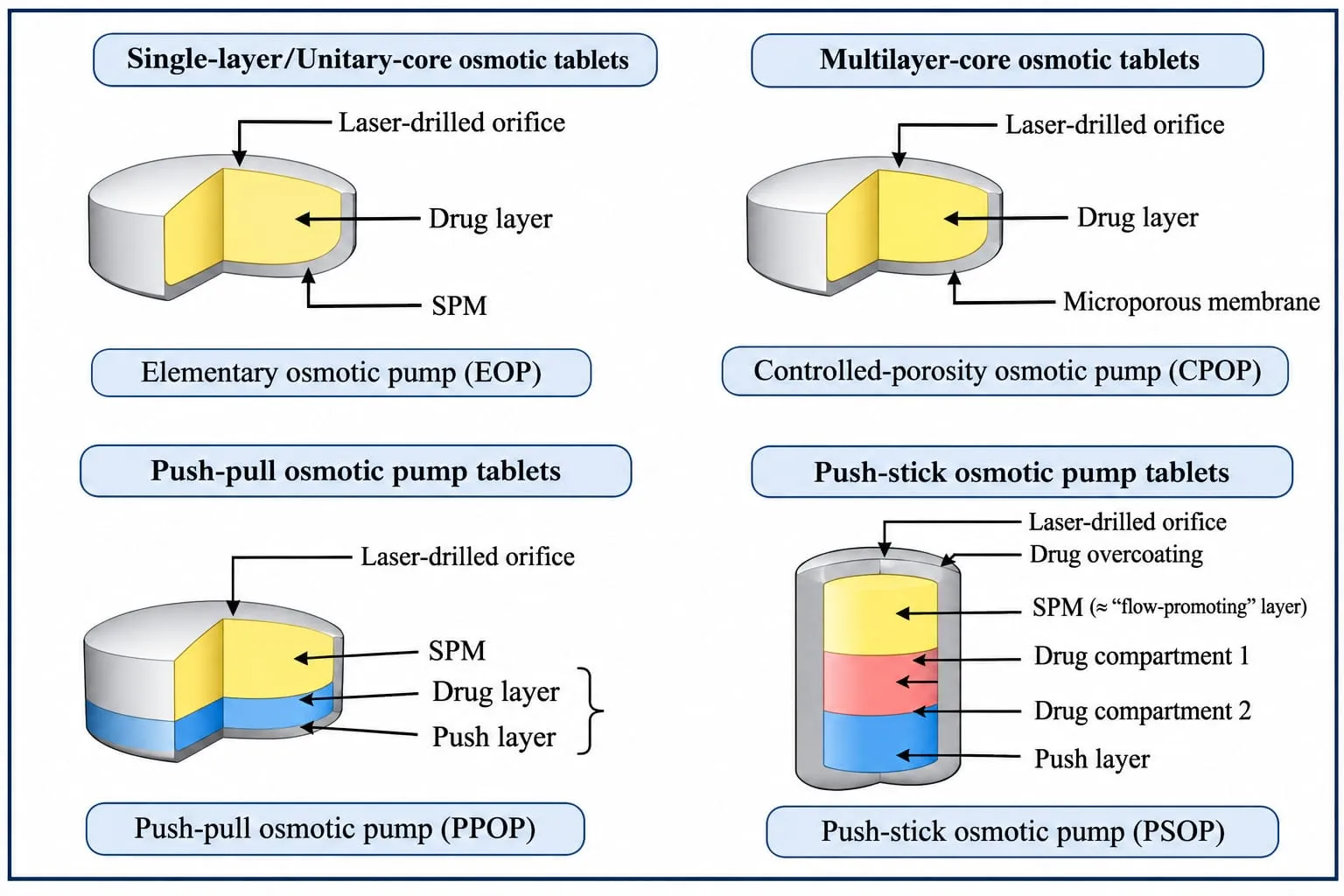
TYPES OF OSMATIC PUMP SYSTEM
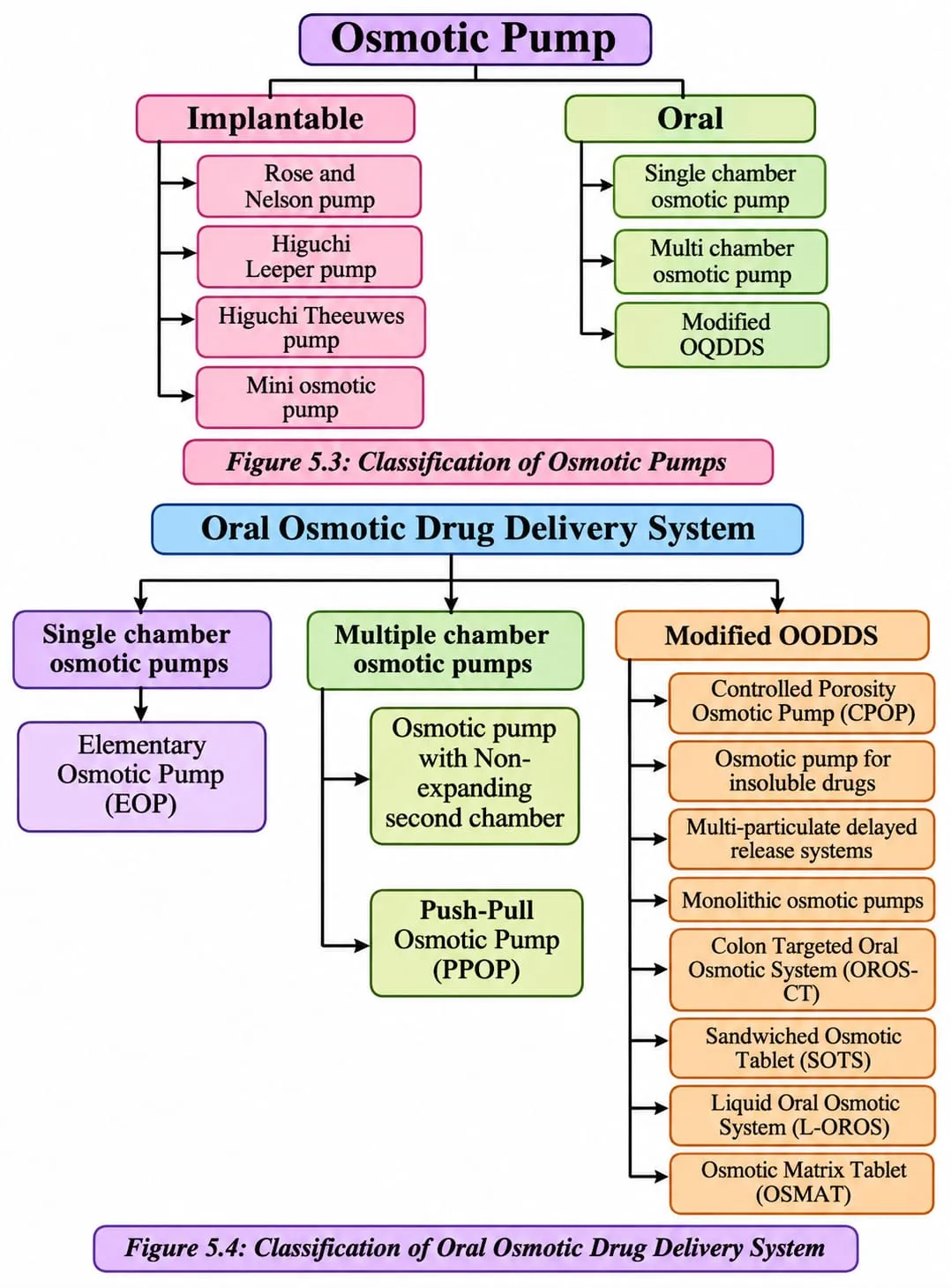
Depending on the active ingredient ,design,and purpose of use ,osmatic system are principally classified as shown in figure.
FORMULATION AND MANUFACTURING APPROCHES
1.Formulation Approches
Formulation of an osmotic pump drug delivery system involves the selection of suitable drugs, polymers and excipients to achieve controlled and prolonged drug release. The formulation is designed to allow water to enter through a semipermeable membrane and generate osmotic pressure inside the system.
Formulation and manufacturing approaches play an important role in the development of osmotic pump drug delivery systems. Proper selection of drug, osmotic agents, polymers and other excipients helps produce a stable formulation with controlled, predictable and prolonged drug release.
The main formulation approaches include:
1. Drug Selection: The drug should have suitable physicochemical properties, stability and therapeutic activity for controlled drug delivery.
2. Osmotic Agent Selection: Osmotic agents are added to generate osmotic pressure by attracting water into the system. Examples include sodium chloride, potassium chloride and mannitol.
3. Polymer Selection: Polymers are used to prepare the semipermeable membrane, which controls water penetration. Examples include cellulose acetate and other cellulose derivatives.
4. Plasticizer Selection: Plasticizers improve the flexibility and strength of the membrane. Examples include glycerol, polyethylene glycol and triethyl citrate.
5. Pore-Forming Agent Selection: These agents help create pores in the membrane and modify its permeability. Examples include sorbitol and polyethylene glycol.
6. Delivery Orifice Design: A small opening is provided in the membrane to allow the drug solution or suspension to come out at a controlled rate.
2. Manufacturing Approches
Manufacturing of osmotic pump tablets involves different steps to prepare the drug core and apply the semipermeable membrane.
1. Preparation of Drug Core: The drug is mixed with suitable excipients such as osmotic agents, binders, diluents and lubricants to prepare the tablet core.
2. Granulation: The ingredients are processed by wet or dry granulation to improve powder flow and compressibility, when required.
3. Tablet Compression: The prepared powder or granules are compressed into tablets using a tablet compression machine.
4. Coating Process: The tablet core is coated with a semipermeable membrane using a suitable coating technique.
5. Drying: The coated tablets are dried to remove the remaining solvent and obtain a uniform coating.
6. Orifice Formation: A small delivery hole is created in the membrane, commonly by laser drilling, to allow drug release.
7. Evaluation and Quality Control: The prepared osmotic pump tablets are evaluated for hardness, thickness, drug content, dissolution, membrane integrity and drug release rate.
3. Important Manufacturing Techniques
CORE PREPARATION:-
Core preparation is a fundamental step in the formulation of osmotic pump-based controlled drug delivery systems. The drug core is generally prepared by incorporating the active pharmaceutical ingredient (API) with suitable pharmaceutical excipients, including osmotic agents, polymers, binders, diluents and lubricants. Osmotic agents such as sodium chloride, potassium chloride and mannitol are added to generate the required osmotic pressure upon contact with the aqueous environment. Initially, the drug and other excipients are accurately weighed, sieved and mixed to obtain a uniform powder blend. Depending on the physicochemical properties of the drug and formulation requirements, different manufacturing techniques such as direct compression, wet granulation or dry granulation are employed. In the wet granulation method, a suitable binder solution is used to form granules, whereas dry granulation involves the formation of granules without the use of liquid. The prepared granules or powder blend are then compressed into tablet cores using a suitable tablet compression machine. The prepared cores are evaluated for hardness, friability, weight variation and drug content uniformity to ensure adequate quality. Finally, the drug cores are coated with a suitable semipermeable membrane to develop the osmotic pump delivery system. Proper core preparation is essential for maintaining formulation uniformity, osmotic pressure generation and predictable drug release over an extended period.
TABLET C0MPRESSION:-
Tablet compression is an important step in the manufacturing of osmotic pump drug delivery systems. In this process, the prepared powder blend or granules containing the active pharmaceutical ingredient (API) and suitable excipients are compressed into tablets using a tablet compression machine. The compression process helps convert the powder mixture into a compact and uniform tablet core with suitable hardness, thickness and mechanical strength. The compression force is carefully controlled to obtain tablets with proper weight, shape and uniformity. The prepared tablet cores should have sufficient strength to withstand handling and subsequent coating operations. After compression, the tablets are evaluated for different quality control parameters, such as hardness, friability, weight variation, thickness and drug content uniformity. Proper tablet compression is essential for obtaining a uniform drug core and ensuring the successful development of an osmotic pump drug delivery syst
COATING
Coating is an important step in the manufacturing of osmotic pump-based controlled drug delivery systems. In this process, the prepared tablet core is covered with a suitable semipermeable polymer membrane to control the entry of water into the system and regulate drug release. Cellulose acetate is one of the most commonly used polymers for preparing semipermeable membranes. Suitable plasticizers, such as polyethylene glycol (PEG), triethyl citrate and glycerol, may be added to improve the flexibility, strength and permeability of the coating membrane. The coating is generally applied using techniques such as film coating in a coating pan or fluidized-bed coating equipment. During the coating process, a uniform membrane is formed around the tablet core. The thickness and composition of the membrane play an important role in controlling water penetration and drug release rate. After coating, the tablets are properly dried to remove residual solvent and improve membrane stability. The coated tablets are further evaluated for coating uniformity, membrane integrity and drug release characteristics. Thus, the coating process plays a vital role in achieving controlled, predictable and prolonged drug release in osmotic pump drug delivery systems.
Important Functions of Coating in Osmotic Pump Technology:
1. Water Permeability: Allows water to enter the tablet through the semipermeable membrane.
2. Controlled Drug Release: Regulates the rate at which the drug is released from the tablet.
3. Osmotic Pressure Maintenance: Helps maintain the pressure required for drug release.
4. Membrane Protection: Protects the drug core from direct contact with the external environment.
5. Drug Release Regulation: Controls the movement of water into the tablet and helps provide predictable drug release.
6. Mechanical Strength: Provides strength and flexibility to the tablet membrane.
7. Prolonged Drug Delivery: Helps release the drug over an extended period of time.
DRILLING OF DELIVERY ORIFICE
Drilling of the delivery orifice is an important step in the manufacturing of osmotic pump drug delivery systems. In this process, a small opening or hole is created in the semipermeable membrane of the coated tablet to allow the drug solution or suspension to come out in a controlled manner. The delivery orifice is generally prepared using a laser drilling technique, which helps produce a small and uniform opening in the membrane. The size and position of the orifice are important because they influence proper drug discharge from the osmotic pump. After drilling, the tablets are checked to ensure that the orifice is properly formed and the membrane is not damaged. When the tablet comes in contact with gastrointestinal fluid, water enters through the semipermeable membrane and generates osmotic pressure inside the system. This pressure pushes the dissolved drug or suspension out through the delivery orifice. Thus, drilling of the delivery orifice plays an important role in achieving controlled, continuous and prolonged drug release.
Functions and Importance of Drilling of Delivery Orifice
1. Drug Release: Provides an opening through which the drug solution or suspension comes out of the osmotic pump.
2. Controlled Drug Delivery: Helps in releasing the drug at a predetermined and controlled rate.
3. Proper Drug Discharge: Allows the dissolved drug or drug suspension to move outside the tablet.
4. Maintains Drug Release: Helps in continuous and prolonged drug release.
5. Prevents Membrane Damage: Proper orifice formation helps maintain the integrity of the surrounding semipermeable membrane.
6. Improves Drug Delivery: Helps in efficient delivery of the drug into the gastrointestinal fluid.
Advantages
MEMBRANE MODIFICATION EVALUATION OF PREPARED SYSTEM:-
1. MEMBRANE MODIFICATION
Membrane modification is an important approach in osmotic pump drug delivery systems. It involves changing the composition, thickness, permeability and physical properties of the semipermeable membrane to achieve the desired drug release rate. The membrane controls the entry of water into the osmotic system and plays an important role in maintaining controlled drug delivery.
Different polymers, plasticizers and pore-forming agents are used to modify the membrane properties. Cellulose acetate is commonly used as a semipermeable membrane-forming polymer. Plasticizers such as polyethylene glycol (PEG), triethyl citrate and glycerol are added to improve membrane flexibility and mechanical strength. Pore-forming agents such as sorbitol and other water-soluble substances may be incorporated to increase membrane permeability by forming pores after contact with water.
The membrane can also be modified by changing its thickness, polymer concentration and composition. These modifications influence water penetration, osmotic pressure development and drug release behaviour. Proper membrane modification helps achieve a predictable, uniform and prolonged drug release profile. Therefore, membrane modification is essential for improving the performance and efficiency of osmotic pump drug delivery systems.
Important Methods of Membrane Modification
1. Polymer Modification: Different polymers are selected to improve membrane strength and permeability.
2. Plasticizer Addition: Plasticizers are added to increase flexibility and reduce membrane brittleness.
3. Pore-Former Addition: Pore-forming agents are used to create pores and modify water permeability.
4. Membrane Thickness Modification: Membrane thickness is adjusted to regulate water penetration and drug release.
5. Coating Composition Modification: The concentration and ratio of coating ingredients are changed to obtain the desired membrane properties.
2)Evaluation of Prepared Osmotic Pump System
Evaluation of the prepared osmotic pump system is an essential step to determine its quality, stability, safety and drug release characteristics. Different pharmaceutical evaluation tests are performed to ensure that the prepared formulation provides controlled and reproducible drug release.
Important Evaluation Parameters
1. General Appearance: The prepared tablets are visually examined for colour, shape, size, surface smoothness, cracks and coating defects.
2. Weight Variation Test: This test is performed to check the uniformity of tablet weight. Individual tablet weights are compared with the average tablet weight.
3. Hardness Test: It measures the mechanical strength of the tablet and determines its ability to withstand handling and transportation.
4. Friability Test: This test determines the ability of tablets to resist abrasion and mechanical damage during handling.
5. Thickness and Diameter: The thickness and diameter of tablets are measured to ensure uniformity in tablet size and shape.
6. Drug Content Uniformity: This test determines whether the active pharmaceutical ingredient is uniformly distributed in the prepared tablets.
7. Moisture Content: It measures the amount of moisture present in the formulation. Excessive moisture may affect tablet stability and drug release properties.
8. In-vitro Drug Release Study: This test is performed using a suitable dissolution apparatus to determine the amount of drug released from the osmotic pump over a specific period of time.
9. Membrane Integrity Test: This test evaluates the strength and uniformity of the semipermeable membrane. It helps identify cracks, defects or damage in the coating.
10. Osmotic Pressure Study: This study evaluates the effect of osmotic pressure on water entry and drug release from the formulation.
11. Stability Studies: Stability studies are performed under controlled temperature and humidity conditions to determine the physical and chemical stability of the prepared formulation over time.
12. Release Kinetics: Drug release data are analysed using different mathematical models, such as zero-order, first-order, Higuchi and Korsmeyer–Peppas models, to understand the drug release mechanism.
Importance of Evaluation
FACTORS AFFECTING DRUG RELEASR:-
Osmotic pump drug delivery systems are advanced controlled drug delivery systems that release drugs at a predetermined and controlled rate over an extended period of time. The drug release mechanism mainly depends on the movement of water through a semipermeable membrane, generation of osmotic pressure and movement of the drug solution or suspension through the delivery orifice. However, the rate and efficiency of drug release are influenced by several formulation, physicochemical and environmental factors. These factors include osmotic pressure, membrane thickness, membrane permeability, concentration of osmotic agents, delivery orifice size, drug solubility, polymer type, plasticizer concentration and pore-forming agents. The properties of the drug core and the composition of the surrounding dissolution medium also play an important role in determining drug release behaviour. Any change in these factors may affect water penetration, drug dissolution and the overall release rate. Therefore, proper selection and optimization of formulation ingredients and manufacturing parameters are essential for achieving uniform, predictable and prolonged drug release. Understanding these factors helps in designing an effective osmotic pump system, improving therapeutic performance, maintaining drug concentration within the desired range and enhancing patient compliance.
Important Factors Affecting Drug Release
1. Osmotic Pressure: Osmotic pressure is one of the major factors affecting drug release. A higher osmotic pressure difference between the inside and outside of the system generally increases water influx and may increase the drug release rate.
2. Semipermeable Membrane Thickness: The thickness of the membrane affects the movement of water into the osmotic pump. A thicker membrane generally reduces water penetration, whereas a thinner membrane may allow faster water entry.
3. Membrane Permeability: The permeability of the semipermeable membrane determines the amount of water entering the system. Higher water permeability may increase the drug release rate.
4. Osmotic Agent Concentration: The concentration of osmotic agents such as sodium chloride, potassium chloride and mannitol affects osmotic pressure generation and water absorption.
5. Delivery Orifice Size: The size of the delivery orifice influences the movement of drug solution or suspension out of the tablet. An appropriately designed orifice helps maintain controlled drug release.
6. Drug Solubility: Drug solubility plays an important role in the release mechanism. Highly water-soluble drugs can form solutions easily, whereas poorly soluble drugs may require suitable formulation approaches to ensure effective release.
7. Polymer Type: The type of polymer used in the semipermeable membrane affects its strength, flexibility and water permeability, thereby influencing drug release.
8. Plasticizer Concentration: Plasticizers such as polyethylene glycol and triethyl citrate improve membrane flexibility. Their concentration may also influence membrane permeability and drug release.
9. Pore-Forming Agents: Pore-forming agents create pores in the membrane after dissolving in the surrounding fluid. This changes membrane permeability and affects the drug release rate.
10. Temperature: Temperature can influence water movement, drug solubility and membrane properties, which may affect the overall drug release behaviour.
11. Drug Core Composition: The composition of the drug core, including the drug, osmotic agents and other excipients, influences water absorption and drug release.
12. Nature of External Environment: The surrounding fluid and its composition may influence water penetration and the performance of the osmotic pump.
MEMBRANE THICKNESS
Membrane thickness is one of the most important formulation parameters affecting drug release from osmotic pump-based controlled drug delivery systems. The semipermeable membrane acts as a barrier between the drug core and the surrounding gastrointestinal fluid. It allows water to enter the system while controlling the movement of dissolved substances. The thickness of the membrane plays an important role in determining the rate of water penetration and drug release. Generally, an increase in membrane thickness reduces water permeability and slows down the entry of water into the tablet, resulting in a slower drug release rate. On the other hand, a thinner membrane allows faster water penetration, which may increase the rate of drug release. Membrane thickness also influences the mechanical strength, flexibility and stability of the osmotic pump system. Excessive thickness may delay drug release, whereas insufficient thickness may affect membrane integrity and formulation performance. Therefore, proper optimization of membrane thickness is essential to maintain the desired osmotic pressure, achieve predictable drug release and provide prolonged therapeutic action.
MEMBRANE PERMEABILITY:-
Membrane permeability is an important factor affecting drug release in osmotic pump-based controlled drug delivery systems. It refers to the ability of the semipermeable membrane to allow water to pass through it into the drug core. The permeability of the membrane plays a major role in controlling water penetration and maintaining osmotic pressure inside the system. When the membrane has higher water permeability, more water enters the tablet, which may increase drug dissolution and the rate of drug release. On the other hand, lower membrane permeability reduces water penetration and slows down the drug release rate. Membrane permeability mainly depends on the type of polymer used, membrane composition, plasticizer concentration, pore-forming agents and coating characteristics. Proper selection and optimization of membrane permeability are essential for achieving uniform, predictable and prolonged drug release. Thus, membrane permeability plays a significant role in improving the performance and efficiency of osmotic pump drug delivery systems.
ORIFICE SIZE:-
Orifice size is a critical formulation and design parameter in osmotic pump-based controlled drug delivery systems. The delivery orifice is a small opening in the semipermeable membrane that provides a passage for the drug solution or suspension to move from the drug core into the surrounding gastrointestinal fluid. Its size plays an important role in regulating drug discharge and maintaining the desired release characteristics. An appropriately designed orifice facilitates the smooth and continuous delivery of the drug under the influence of osmotic pressure. If the orifice is too small, it may cause resistance to drug flow and increase the possibility of blockage, particularly in formulations containing poorly soluble drugs. On the other hand, an excessively large orifice may affect the release-controlling mechanism and increase the possibility of drug diffusion. The optimum orifice size depends on drug solubility, formulation characteristics, viscosity of the drug solution and the design of the osmotic pump. Therefore, proper selection of orifice size is essential for achieving predictable, reproducible and controlled drug release over an extended period.
DRUG SOLUBILITY:-
Drug solubility is an important physicochemical factor affecting drug release from osmotic pump-based controlled drug delivery systems. It refers to the ability of a drug to dissolve in an aqueous medium after water enters the system through the semipermeable membrane. The solubility of the drug plays a significant role in determining its dissolution, concentration and release behaviour. Highly water-soluble drugs readily dissolve in the incoming water and form a drug solution, which is expelled through the delivery orifice under the influence of osmotic pressure. In contrast, poorly water-soluble drugs may not dissolve completely and can form a suspension or dispersion inside the drug core. Such drugs may require suitable formulation approaches, including the use of solubilizing agents, suspending agents or other excipients, to improve their release characteristics. Drug solubility also influences the selection of osmotic agents and the overall formulation design. Therefore, proper consideration of drug solubility is essential for achieving efficient, predictable and controlled drug release from osmotic pump delivery systems.
Importance of Drug Solubility in Osmotic Pump Drug Delivery System
1. Drug Dissolution: Proper solubility helps the drug dissolve in water entering the osmotic pump.
2. Drug Release Rate: Solubility influences the amount of drug released through the delivery orifice.
3. Formulation Selection: It helps in selecting suitable polymers, osmotic agents and other excipients.
4. Drug Delivery Efficiency: Adequate solubility supports efficient drug release from the system.
5. Controlled Release: Proper drug solubility helps achieve predictable and controlled drug release.
6. Formulation Stability: Drug solubility is considered during formulation development to maintain consistent performance.
7. Selection of Excipients: Poorly soluble drugs may require suitable solubilizing or suspending agents to improve drug release.
Advantages and Disadvantages of Osmotic Pump Drug Delivery System
Advantages:-
1. Controlled Drug Release: It releases the drug at a controlled and predetermined rate for a specific period.
2. Prolonged Drug Action: It provides sustained drug release and helps maintain the drug effect for a longer time.
3. Reduced Dosing Frequency: It reduces the need for frequent administration of medicines.
4. Improved Patient Compliance: Less frequent dosing makes it easier for patients to follow their medication schedule.
5. Less Effect of Food: Drug release is generally less affected by food intake compared with some conventional dosage forms.
6. Reduced Side Effects: Controlled drug release may help reduce sudden fluctuations in drug concentration and minimize dose-related side effects.
7. Predictable Drug Release: Drug release is mainly controlled by osmotic pressure and membrane properties, making the release rate more predictable.
predictable.
8. Suitable for Different Drugs: It can be designed for drugs with different solubility characteristics, using suitable formulation approaches.
9. Improved Therapeutic Effect: It helps maintain a more consistent drug concentration in the body.
Disadvantages:-
1. Complex Manufacturing Process: Preparation requires special techniques, equipment and careful formulation.
2. High Manufacturing Cost: Special coating and drilling techniques may increase production costs.
3. Risk of Dose Dumping: Damage to the semipermeable membrane may disturb controlled drug release.
4. Limited Drug Loading: The amount of drug that can be incorporated into the system may be limited by tablet size and formulation requirements.
5. Not Suitable for Every Drug: Some drugs may not be suitable because of their solubility, stability or dose requirements.
6. Requirement of Special Coating: A semipermeable membrane is essential for proper functioning of the system.
7. Orifice Size Problem: If the delivery orifice is too small, it may become blocked; if too large, it may affect controlled release.
8. Effect of Membrane Properties: Changes in membrane thickness and permeability can alter the drug release rate.
9. Swallowing Difficulty: Some osmotic pump tablets may be relatively large and difficult for certain patients to swallow.
OSMOGEN CONCENTRATION
INTRODUCTION
Osmogen concentration is one of the most important formulation factors affecting drug release from an osmotic pump drug delivery system. An osmogen is a water-soluble substance that produces osmotic pressure when it dissolves in water. It helps attract water into the tablet through the semipermeable membrane.
The concentration of osmogen plays an important role in controlling water penetration, generation of osmotic pressure and the rate of drug release. Therefore, the proper selection and concentration of osmogen are essential for developing an effective osmotic pump formulation.
Role of Osmogen Concentration:-
When the osmotic pump tablet comes in contact with body fluids, water enters through the semipermeable membrane. The osmogen present in the tablet core dissolves in the incoming water and increases the osmotic pressure inside the tablet. This pressure helps push the dissolved or dispersed drug out through the delivery orifice.
The concentration of osmogen determines the osmotic pressure generated inside the system. A suitable concentration helps maintain controlled and predictable drug release.
Effect of Osmogen Concentration on Drug Release from Osmotic Pump Drug Delivery System
Osmogen concentration is one of the important formulation factors affecting the performance of an osmotic pump drug delivery system. An osmogen (osmotic agent) is a water-soluble substance that produces osmotic pressure when it dissolves in water. It helps attract water into the tablet through the semipermeable membrane.
The concentration of osmogen plays an important role in controlling water penetration, generation of osmotic pressure and the rate of drug release. Therefore, the proper selection and concentration of osmogen are essential for developing an effective osmotic pump formulation.
Mechanism of Action of Osmogen
When an osmotic pump tablet comes in contact with body fluids, water enters through the semipermeable membrane. The osmogen present in the tablet core dissolves in the incoming water and increases the osmotic pressure inside the tablet.
This pressure helps push the dissolved or dispersed drug out through the delivery orifice. In this way, osmogen concentration influences the amount of water entering the system and the movement of drug from the tablet.
Effect of Different Osmogen Concentrations
A. Low Osmogen Concentration
B. Optimum Osmogen Concentration
C. High Osmogen Concentration
Factors Influencing the Effect of Osmogen Concentration
1. Osmotic Pressure: Higher osmogen concentration generally produces greater osmotic pressure.
2. Water Uptake: Osmogen concentration influences the movement of water into the tablet core.
3. Drug Solubility: The solubility of the drug affects whether it forms a solution or suspension inside the tablet.
4. Membrane Permeability: The semipermeable membrane controls the rate at which water enters the system.
5. Drug Release Rate: Changes in osmogen concentration can change the rate of drug release.
6. Formulation Composition: The amount of drug, polymer and other excipients also influences the performance of the osmotic pump.
Commonly Used Osmogens
The following substances are commonly used as osmotic agents:
The selection depends on water solubility, osmotic activity, compatibility and the desired drug release profile.
Importance of Osmogen Concentration
1. It helps generate the required osmotic pressure.
2. It controls water penetration into the tablet.
3. It influences drug dissolution and dispersion.
4. It helps regulate the drug release rate.
5. It supports sustained and controlled drug delivery.
6. It helps in designing an effective osmotic pump formulation.
7. It improves the predictability of drug release when properly optimized.
COATING CHARACTERISTIC:-
Coating characteristics are important formulation parameters in an osmotic pump drug delivery system. The tablet core is covered with a special semipermeable membrane, which allows water to enter the tablet but controls the movement of drug and other substances through the membrane.
The coating membrane plays an important role in controlling water penetration, maintaining osmotic pressure and regulating drug release. The quality and properties of the coating directly influence the performance, efficiency and stability of the osmotic pump system.
Important Characteristics of Coating
1. Semipermeability
The coating membrane should be semipermeable in nature. It should allow water to enter the tablet while restricting the free passage of dissolved drug and osmotic agents. This property helps maintain the osmotic gradient required for controlled drug release.
2. Membrane Thickness
The coating should have an appropriate and uniform thickness. Membrane thickness affects the rate of water penetration into the tablet. A thicker membrane generally reduces water movement, whereas a thinner membrane may allow faster water penetration.
3. Membrane Permeability
The coating should have suitable water permeability. It determines how quickly water enters the tablet core. Proper permeability helps generate the required osmotic pressure and maintain a controlled drug release rate.
4. Mechanical Strength
The coating membrane should possess sufficient mechanical strength to withstand handling, packaging, transportation and pressure developed inside the tablet. It should not break or crack during storage or drug release.
5. Flexibility and Elasticity
The coating should be flexible and elastic enough to tolerate changes in internal pressure during water uptake. Plasticizers such as polyethylene glycol, triethyl citrate and glycerol may be used to improve membrane flexibility.
6. Uniformity of Coating
The membrane should cover the entire tablet surface uniformly. Uneven coating thickness may cause variations in water penetration and drug release, resulting in an inconsistent release profile.
7. Chemical Stability
The coating material should remain chemically stable during manufacturing, storage and administration. It should not react with the drug, osmotic agents or other formulation ingredients.
8. Compatibility
The coating polymer should be compatible with the drug and other excipients present in the tablet core. It should not cause degradation or affect the quality of the formulation.
9. Resistance to Dissolution
The coating should remain intact in gastrointestinal fluids during the drug release period. It should not dissolve rapidly, because this may disturb the controlled-release mechanism.
10. Biocompatibility
The coating material should be safe and suitable for pharmaceutical use. It should not produce harmful effects when administered to the patient.
ENVIRONMENTAL CONDITION:-
Environmental conditions are important factors that can influence the performance, stability and drug release characteristics of an osmotic pump drug delivery system. These conditions include temperature, humidity, pH, storage conditions and the surrounding fluid environment.
An osmotic pump works by allowing water to enter through a semipermeable membrane. Therefore, changes in environmental conditions may affect water penetration, osmotic pressure, membrane properties and drug release. Proper control of these conditions is necessary to maintain the quality and effectiveness of the formulation.
Different Environmental Conditions Affecting Drug Release
1. Temperature
Temperature is an important environmental factor affecting osmotic pump performance.
2. Humidity
Humidity refers to the amount of moisture present in the surrounding air.
3. pH of the Surrounding Medium
The pH of the surrounding medium may influence drug release from certain osmotic pump formulations.
4.Storage condition
Proper storage conditions are necessary to maintain the quality of osmotic pump tablets.
5. Composition of the Surrounding Fluid
The composition of the surrounding fluid can influence osmotic pressure and water movement.
Importance of Environmental Conditions
1. Helps maintain the stability of the drug.
2. Influences water penetration through the semipermeable membrane.
3. Helps maintain the required osmotic pressure.
4. Affects drug solubility and dissolution.
5. Helps maintain the physical properties of the coating membrane.
6. Supports predictable and controlled drug release.
7. Improves the shelf life and quality of the formulation
DRUG CONTENT:-
Drug content determination is an important evaluation parameter used to determine the actual amount of active pharmaceutical ingredient (API) present in the prepared osmotic pump drug delivery system. It helps to ensure that each tablet contains the required quantity of drug according to the formulation design. For this study, a suitable number of tablets are selected, accurately weighed and crushed into a fine powder. An appropriate quantity of powdered material equivalent to the required amount of drug is dissolved in a suitable solvent. The solution is mixed properly to ensure complete drug extraction and then filtered to remove insoluble particles. The filtered solution is diluted suitably and analysed using an appropriate analytical method, such as UV-visible spectrophotometry or High-Performance Liquid Chromatography (HPLC). The absorbance or drug concentration is determined using a suitable standard calibration curve or validated analytical method. The actual drug content is then calculated and expressed as a percentage of the theoretical drug content.
Drug content determination helps to evaluate the uniformity of drug distribution, accuracy of drug loading and consistency of the formulation. It also ensures that the prepared osmotic pump tablets contain the appropriate amount of active drug. Proper drug content is essential for achieving the desired therapeutic effect and maintaining the quality, safety and reliability of the drug delivery system.
IN- VITRO DISSOLUTION \ RELEASE STUDY:-
In-vitro dissolution or drug release study is one of the most important evaluation parameters of an osmotic pump drug delivery system. It is performed to determine the amount and rate of drug released from the prepared tablet under controlled laboratory conditions. The study helps to evaluate the controlled-release behaviour and performance of the formulation. In this method, the prepared osmotic pump tablets are placed in a suitable dissolution apparatus containing a specified dissolution medium. The temperature and rotation speed are maintained according to the selected study conditions. Samples of the dissolution medium are withdrawn at predetermined time intervals and replaced with an equal volume of fresh medium to maintain a constant volume. The collected samples are filtered and analysed using UV-visible spectrophotometry or HPLC to determine the drug concentration. The percentage of drug released at each time interval is then calculated and plotted against time to obtain the drug release profile.
This study helps to understand the rate, extent and pattern of drug release from the osmotic pump system. It also determines whether the formulation provides sustained, controlled and predictable drug release over the desired period. The results are useful for comparing different formulations and optimizing important formulation factors such as osmogen concentration, membrane thickness, membrane permeability and delivery orifice size. Therefore, in-vitro dissolution testing plays an essential role in evaluating the quality, efficiency and performance of osmotic pump drug delivery systems.
Importance:
MEMBRANE CHARACTERIZATION STABILITY STUDIES:-
1. Membrane Characteristics
Membrane characteristics are important evaluation parameters of an osmotic pump drug delivery system because the semipermeable membrane controls water penetration and influences the drug release rate. The membrane is evaluated for its thickness, permeability, mechanical strength, flexibility, uniformity and integrity. The coating should be uniformly distributed over the tablet surface and should not contain cracks, holes or other defects except for the designed delivery orifice. Membrane thickness and permeability are determined to understand their effect on water uptake and osmotic pressure. Mechanical strength and flexibility are also examined to ensure that the membrane remains intact during handling and drug release. Cellulose acetate is commonly used as a semipermeable membrane-forming polymer. Proper membrane characteristics help maintain controlled, uniform and predictable drug release from the osmotic pump system.
Importance:
2. Stability Studies
Stability studies are performed to evaluate the physical, chemical and pharmaceutical stability of the prepared osmotic pump drug delivery system during storage. These studies help determine whether the formulation maintains its quality, safety and performance over a specified period. The prepared tablets are stored under selected temperature and humidity conditions according to suitable stability study guidelines. Samples are withdrawn at predetermined time intervals and evaluated for physical appearance, colour, hardness, drug content, moisture content, membrane integrity and in-vitro drug release. Any changes in these parameters are recorded and analysed. Special attention is given to the stability of the drug and semipermeable membrane because changes in membrane properties may affect water penetration and drug release behaviour. The results of stability studies help determine the shelf life, suitable packaging and recommended storage conditions of the formulation.
Importance:
RELEASE KINETICS:-
Release kinetics is an important evaluation parameter used to understand the mechanism and pattern of drug release from an osmotic pump drug delivery system. In this study, the drug release data obtained from the in-vitro dissolution study are fitted into different mathematical models. These models help determine whether the drug is released at a constant rate, through diffusion or by other release mechanisms. The commonly used models include zero-order, first-order, Higuchi and Korsmeyer–Peppas models. The results are compared using suitable statistical parameters, such as the correlation coefficient (R²), to identify the model that best describes the release behaviour. Release kinetic studies help explain the drug release behaviour of osmotic pump systems and are useful in developing an effective formulation with predictable and controlled drug release.
Different Models of Drug Release Kinetics:-
1. Zero-Order Model: This model describes drug release at a constant rate over time. It is desirable for controlled drug delivery systems because it helps maintain a consistent drug release pattern.
2. First-Order Model: This model describes drug release according to the amount of drug remaining in the dosage form. The release rate generally decreases as the amount of drug remaining decreases.
3. Higuchi Model: This model explains drug release mainly through diffusion. It describes the relationship between the amount of drug released and the square root of time.
4. Korsmeyer–Peppas Model: This model is used to understand the mechanism of drug release from polymeric systems. It helps identify whether drug release occurs through diffusion, polymer relaxation or a combination of mechanisms.
Importance of Release Kinetics
ADVANTAGES OF OSMATIC PUMP DRUG DELIVERY SYSTEM:-
Osmotic drug delivery system for oral use offer distinct and practical advantage over other means
delivery. The following advantages contributed to the popularity of osmotic drug delivery system.
1. They typically give a zero order release profile after an initial lag.
2. The release mechanisms are independent on drug concentration.
3. Sustained and consistent blood levels within the therapeutic window [Gohel et al.2009].
4. Reduced side effects.
5. Deliveries may be delayed or pulsed if desired.
6. Drug release is independent of gastric pH and hydrodynamic condition.
7. They are well characterized and understood.
8. Delivery rate is independent of agitation outside, including GI motility.
9. Enhanced bioavailability of drug.
10.Reduced interpatient variability [Bhatt etal.2004].
11.Release rate of drug is highly predictable and programmable [Ajay et al.2010].
12.Decrease dosing frequency.
13.Improved patient compliance [Ajay et al.2010].
14.Increased safety margin of high potency drugs [Rajitha & Mathew 2009].
15.Drug release from the OCODDSs exhibits significant in vitro-in vivo correlation [IVIVC] within specific limits.
16.It is possible to attain better release rates than those obtained with conventional diffusion based drug delivery systems. [Sharma S. 2008][1]
Disadvantage of osmatic pump drug delivery system
1. High Cost.
2. If the coating process is not well controlled there is a risk of film defects, which results in dose dumping.
3. Hole Size is critical in case of elemetry osmotic system.
4. Drug release from the osmotic systems is affected to some extent by the presence of food.
5. Retrieval of therapy is not possible in the case of unexpected adverse event
6. Rapid development of tolerance.[1]
APPLICATION
1. Controlled Drug Delivery: Provides drug release at a controlled and predetermined rate.
2. Oral Drug Delivery: Used in oral tablets for prolonged drug release.
3. Treatment of Chronic Diseases: Useful in the treatment of hypertension and certain neurological disorders.
4. Poorly Soluble Drugs: Modified osmotic systems can deliver poorly water-soluble drugs using suitable formulation techniques.
5. Improved Patient Compliance: Reduces the frequency of drug administration.
6. Prolonged Therapeutic Effect: Maintains drug release over an extended period.
7. Site-Specific Drug Delivery: Specially designed systems can deliver drugs to selected regions of the gastrointestinal tract.
8. Peptide and Protein Delivery: Modified osmotic systems can be developed for certain peptide and protein drugs.
9. Veterinary Drug Delivery: Used in selected veterinary drug delivery applications.
10. Reduced Drug Concentration Fluctuation: Helps provide a more consistent drug release pattern.
11. Sustained Drug Release: Maintains drug delivery for a longer duration.
12. Improved Therapeutic Effectiveness: Helps achieve the desired therapeutic action through controlled drug delivery.
MARKETED OSMATIC DRUG DELIVERY PRODUCT:-
Marketed osmotic drug delivery products represent an important advancement in pharmaceutical technology. Different osmotic systems, including elementary osmotic pumps, push-pull osmotic pumps and controlled-porosity osmotic pumps, have been developed to achieve controlled and prolonged drug release. Commercial products using these technologies demonstrate their potential in the treatment of different diseases. However, the selection of an osmotic system depends on drug solubility, stability, dose requirements and desired release characteristics.
You can include these general categories
1. Elementary Osmotic Pump (EOP): Uses a semipermeable membrane to control water entry and drug release.
2. Push-Pull Osmotic Pump (PPOP): Uses a drug layer and a swelling push layer for drug delivery.
3. Controlled Porosity Osmotic Pump (CPOP): Uses pore-forming agents to create pores in the coating membrane.
4. Osmotic Pump with Liquid Drug Formulation: Designed to deliver drugs in liquid form.
5. Delayed-Release Osmotic System: Designed to release the drug after a predetermined lag time.
Importance of Marketed Osmotic Drug Delivery Products
1. They demonstrate the practical application of osmotic drug delivery technology.
2. They provide controlled and prolonged drug release.
3. They may reduce the frequency of drug administration.
4. They help maintain relatively consistent drug concentrations.
5. They improve convenience and patient compliance.
6. They demonstrate the use of different osmotic pump technologies.
7. They provide a basis for further development of advanced controlled-release formulations.
EXAMPLE OF MARKETED PRODUCT
The following are examples of pharmaceutical products developed using osmotic or related controlled-release technologies:
| Sr.No. | Marketed product | Active drug | Therapeutic use |
|---|---|---|---|
| 1 | Concardia XL | Methylphenidate | ADHD |
| 2 | Procardia XL | Nifedipine | Hypertension and angina |
| 3 | Glucotrol XL | Glipizide | Type 2 diabetes |
| 4 | Ditropan XL | Oxybutynin | Overactive bladder |
| 5 | Covera-HS | Verapamil | Hypertension |
| 6 | Volmax | Albuterol | Bronchospasm |
RECENT ADVANCE IN OSMATIC PUMP TECHNOLOGY
Osmotic pump drug delivery technology has undergone significant development in recent years to improve controlled drug release, formulation efficiency and therapeutic performance. Modern research focuses on developing advanced osmotic systems with improved membrane properties, better drug delivery, reduced formulation limitations and more predictable release profiles.
Recent advances include the development of controlled-porosity osmotic pumps, push-pull systems, asymmetric membrane technology, biodegradable materials, and advanced multiparticulate delivery systems. These developments have expanded the potential applications of osmotic drug delivery technology in pharmaceutical research.
Recent Advances in Osmotic Pump Technology
1. Development of Controlled Porosity Osmotic Pumps
Controlled porosity osmotic pumps are an advanced form of osmotic drug delivery systems. In this technology, water-soluble pore-forming agents are incorporated into the semipermeable membrane. When the system comes in contact with body fluids, these agents dissolve and create small pores in the membrane. These pores allow controlled drug release without requiring a separately drilled delivery orifice. This technology helps simplify the manufacturing process and provides controlled drug delivery.
2. Advancement in Push-Pull Osmotic Pump Systems
Push-pull osmotic pumps have been developed to improve the delivery of drugs with poor water solubility. These systems contain two layers: a drug layer and a push layer. The push layer absorbs water and expands, forcing the drug out through the delivery orifice. This technology helps improve the delivery of drugs that cannot be easily released using conventional elementary osmotic pumps
3. Use of Advanced Semipermeable Membranes
Modern research focuses on improving semipermeable membranes using modified polymers and advanced coating materials. These membranes are designed to provide suitable water permeability, mechanical strength, flexibility and stability. Improved membrane properties help maintain osmotic pressure and achieve a more predictable drug release profile.
4.Development of Multiparticulate Osmotic Systems
Multiparticulate osmotic systems consist of several small drug-containing units instead of a single large tablet. Each unit can release the drug through an osmotic mechanism. These systems are being explored to improve drug distribution in the gastrointestinal tract and provide more flexible drug release characteristics.
5. Application of Nanotechnology
Nanotechnology is being investigated in osmotic drug delivery to improve the formulation and delivery of certain drugs. Nanomaterials and nanoscale drug formulations may help improve drug solubility, dispersion and formulation performance. Their use requires careful evaluation of safety, stability and compatibility.
6. Development of Gastroretentive Osmotic Systems
Gastroretentive osmotic systems are designed to remain in the stomach for a longer period and provide prolonged drug release. These systems may use swelling or floating properties to increase gastric residence time. They are being investigated for drugs that are better absorbed in the stomach or upper gastrointestinal tract.
7. Colon-Targeted Osmotic Drug Delivery
Colon-targeted osmotic systems are designed to deliver drugs to the large intestine. They use specially designed coatings and formulation components to control the location and timing of drug release. This technology is being explored for medicines intended to act in the colon.
8.Application of 3D Printing Technology
Three-dimensional printing is an emerging manufacturing approach for developing advanced osmotic dosage forms. It may allow better control over tablet shape, internal structure, drug distribution and release characteristics. It also offers possibilities for developing personalized dosage forms with different drug-release profiles.
9. Development of Implantable Osmotic Pumps
Implantable osmotic pumps are designed to deliver drugs continuously over an extended period. These systems use osmotic pressure to move a drug formulation from an implanted device into the body. Research is focused on improving device materials, drug stability, delivery accuracy and long-term performance.
10. Smart and Responsive Osmotic Systems
Modern research is exploring the combination of osmotic drug delivery with responsive materials. These materials may respond to environmental changes such as pH or other physiological conditions. The aim is to develop more precise drug delivery systems with improved control over the timing and location of drug release.
11. Artificial Intelligence in Formulation Development
Artificial intelligence and computer-based modelling are emerging tools in pharmaceutical formulation research. They may help researchers study the effects of membrane thickness, osmogen concentration, polymer composition and other formulation variables. These approaches may reduce trial-and-error experiments and support formulation optimization.
12. Personalized Drug Delivery Systems
Recent research is exploring the possibility of designing osmotic formulations according to individual therapeutic requirements. Advanced manufacturing techniques may help adjust drug loading, tablet structure and release characteristics. This approach has potential applications in personalized medicine, although further research and validation are required.
Future Prospects
Future development of osmotic pump technology is expected to focus on:
1. Improved semipermeable membrane materials.
2. Development of biodegradable osmotic systems.
3. Better delivery of poorly water-soluble drugs.
4. Advanced 3D-printed dosage forms.
5. Improved targeted and site-specific drug delivery.
6. Development of smart and responsive formulations.
7. Improved manufacturing techniques.
8. Personalized controlled-release formulations.
FUTURE PERSPECTIVE
Osmotic pump technology has significant potential for future pharmaceutical development. The combination of nanotechnology, smart materials, biodegradable polymers, and targeted drug delivery approaches may improve the performance of these systems. Further research, safety evaluation, clinical studies, and advanced manufacturing techniques are required to make osmotic pump technology more effective and widely available in controlled drug delivery systems.
PERSONALISED DRUG DELIVERY
Personalized drug delivery is an emerging approach in osmotic pump technology that focuses on designing drug delivery systems according to the individual needs and treatment requirements of patients. It aims to provide the appropriate drug dose, release rate, and duration of therapy for better treatment outcomes. In osmotic pump drug delivery systems, personalized formulations can be developed by adjusting drug concentration, osmogen content, membrane thickness, membrane permeability, and delivery orifice size. These factors help to control the rate and duration of drug release according to the patient's therapeutic requirements. Advanced technologies such as 3D printing, smart polymers, and programmable drug delivery systems may further support the development of customized osmotic pumps. Personalized osmotic drug delivery systems may be useful in patients suffering from chronic diseases such as diabetes, hypertension, and neurological disorders, where long-term medication is required. These systems have the potential to improve patient compliance, maintain drug concentration within the therapeutic range, reduce dosing frequency, and minimize unwanted side effects. However, further research is required to improve formulation accuracy, patient-specific dose adjustment, safety, stability, and large-scale manufacturing. Thus, personalized drug delivery represents a promising future direction for osmotic pump technology in controlled drug delivery systems.
Improved Membrane Technologies
Improved membrane technology is an important area of development in osmotic pump technology for controlled drug delivery systems. The semipermeable membrane plays a major role in controlling the entry of water into the osmotic pump and regulating the rate of drug release. Recent pharmaceutical research focuses on developing advanced membrane materials with better permeability, mechanical strength, flexibility, biocompatibility, and stability. Different polymers, polymer blends, biodegradable materials, and nanocomposite membranes are being investigated to improve the performance of osmotic drug delivery systems. These improved membranes help to maintain a constant water influx and provide predictable and controlled drug release over an extended period. Modification of membrane thickness, pore structure, and permeability can also help to adjust the drug release rate according to therapeutic requirements. Novel membrane technologies may further improve drug delivery for poorly water-soluble drugs and drugs requiring prolonged release. These membranes can also reduce unwanted variations in drug release and improve the efficiency and reliability of osmotic pumps. However, further research is required to evaluate membrane safety, compatibility, stability, manufacturing cost, and large-scale production. Thus, improved membrane technology has significant potential for the future development of efficient and reliable osmotic pump drug delivery systems.
Combinations with Novel Drug Delivery Platforms
The combination of osmotic pump technology with novel drug delivery platforms is an emerging approach in controlled drug delivery systems. It aims to improve drug release, therapeutic effectiveness, drug absorption, and patient compliance. Osmotic pump technology can be combined with different advanced drug delivery approaches, such as nanotechnology, liposomes, nanoparticles, hydrogels, microspheres, and targeted drug delivery systems. These combinations help to overcome the limitations of conventional drug delivery systems, particularly in the delivery of poorly water-soluble drugs and drugs requiring prolonged therapeutic action. For example, nanoparticles can improve drug solubility and bioavailability, while osmotic pressure helps to control the rate of drug release. Similarly, hydrogels and biodegradable polymers can be incorporated to modify drug release according to specific therapeutic requirements. The combination of osmotic pumps with gastro-retentive and colon-targeted delivery systems may also improve site-specific drug delivery. These advanced platforms have the potential to provide better drug stability, controlled release, reduced dosing frequency, and fewer unwanted side effects. However, further research is required to improve formulation compatibility, manufacturing techniques, safety, stability, and clinical performance. Thus, the integration of osmotic pump technology with novel drug delivery platforms represents a promising direction for the future development of controlled drug delivery systems.
Patient-Specific Release Profiles
Patient-specific release profiles are an advanced approach in osmotic pump technology that focuses on designing drug release patterns according to the individual needs and therapeutic requirements of patients. In conventional osmotic pump systems, the drug is generally released at a predetermined rate, whereas patient-specific systems aim to provide customized drug release according to factors such as age, body condition, disease severity, drug absorption, and treatment requirements. The drug release profile can be modified by adjusting different formulation parameters, such as osmogen concentration, semipermeable membrane thickness, membrane permeability, drug loading, and delivery orifice size. Advanced technologies such as 3D printing, smart polymers, and programmable drug delivery systems may help in developing personalized osmotic pump formulations. These systems have the potential to maintain the required drug concentration within the therapeutic range, reduce frequent dosing, improve patient compliance, and minimize unwanted side effects. Patient-specific release profiles may be particularly useful in the treatment of chronic diseases such as diabetes, hypertension, and neurological disorders, where different patients may require different drug release patterns. However, further research is needed to improve dose accuracy, formulation flexibility, safety, and clinical effectiveness. Thus, patient-specific release profiles represent a promising future development in osmotic pump technology for controlled drug delivery systems.
CONCLUSION
Osmotic drug delivery systems have established themselves as an exceptionally reliable platform for oral controlled-release therapeutics. By providing zero-order release kinetics independent of physiological variables within the GI tract, they maintain steady therapeutic plasma concentrations, reduce fluctuations in drug levels, decrease dosing frequency, and enhance patient adherence.
Although these systems face challenges—such as complex multi-step manufacturing, higher production costs, and the risk of dose dumping if the membrane integrity is compromised—ongoing developments in novel membrane materials (nanocomposite, biodegradable, and stimuli-responsive polymers), nanotechnology integration, and 3D printing continue to broaden their utility. Consequently, osmotic pumps remain a cornerstone and an evolving frontier for delivering both water-soluble and poorly soluble drugs across chronic and targeted therapeutic indications
REFERENCES

Trisha Thakur, Pallavi Nagpure, Ragini Warhade, Aman Yadav, Osmotic Drug Delivery Systems: Recent Innovations, Applications and Future Perspectives, Int. J. of Pharm. Sci., 2026, Vol 4, Issue 11, 3381-3411. https://doi.org/10.5281/zenodo.24387198
 10.5281/zenodo.24387198
Severity: 8192
Message: substr(): Passing null to parameter #1 ($string) of type string is deprecated
Filename: frontend/article.php
Line Number: 890